184 824 résultats
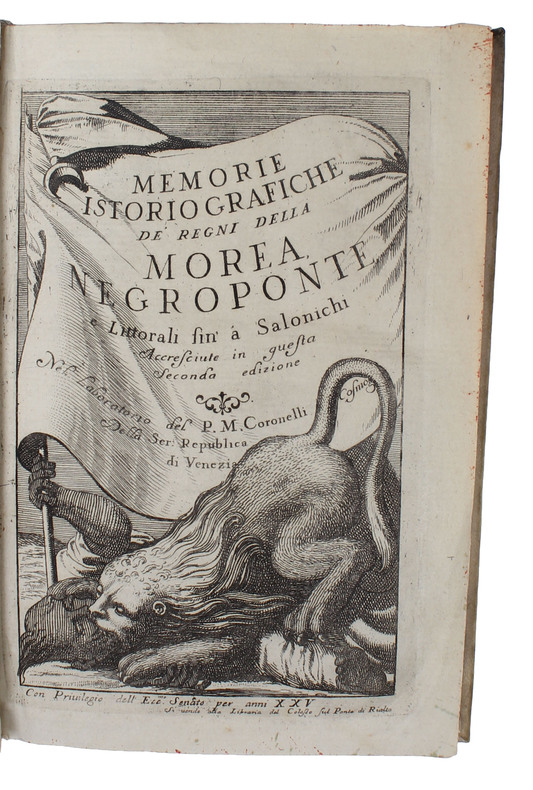
168649367Venezia, (1686). 8vo. (16,5x11 cm.). Contemp. full vellum. Halftitle-page. Engraved Title-page (the Lion of St. Mark). (8),237,1 blank,(2- Indice) pp. and 41 (of 42 ?) double-page folded engraved maps and plans (bird's-eye views or plans of fortified towns and places etc.). Internally fine and clean. Printed on good paper. A fine copy.
193846475(Princeton, NJ.), Annals of Mathematics, 1938 a. 1940. Both papers in orig. printed wrappers. Offprints from ""Annals of Mathematics"", Vol. 39, No. 1, january, 1938 and Vol. 41, No. 2, April, 1940. Pp. 65-100 and pp. 455-464. Both clean and fine. This copy has belonged to Abraham Pais (1918-2000) - the famous Einstein scholar, theoretical physicist and Einsteins collegue at Princeton - and having his name on top of both frontwrappers ""A Pais"".
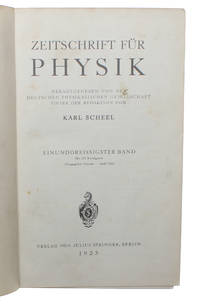
192547224Berlin, Julius Springer, 1925. 8vo. Contemp. full cloth. Spine lacks and covers detached (in need of a new spine). A stamp to front free endpaper (chinese). In: 'Zeitschrift für Physik', Volume 31. VIII,952 pp., textillustr. (Entire volume offered). Pauli's paper: pp.765-783.
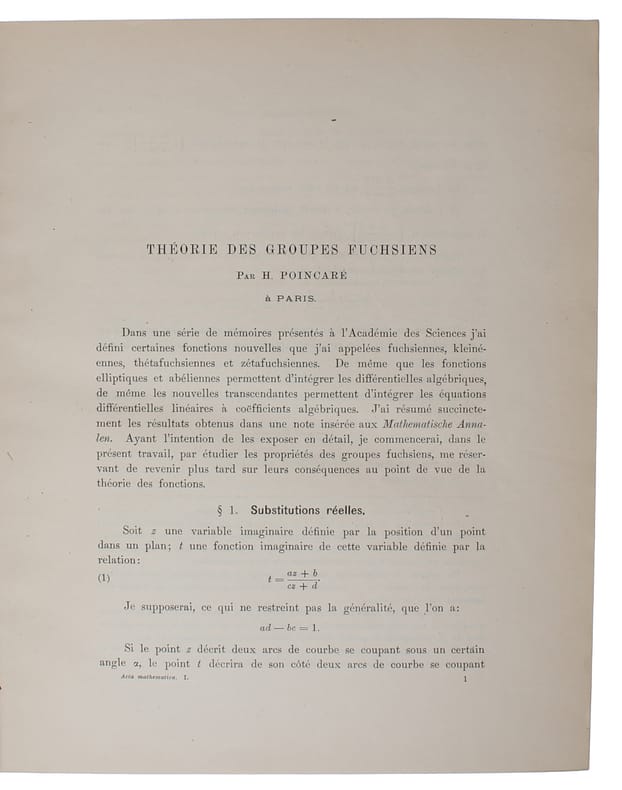
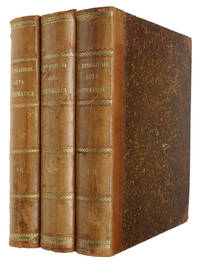
188460243Berlin, Stockholm, Paris, F. & G. Beijer, 1882-84. Large4to (272 x 230 mm). Three volumes uniformly bound in contemporary half calf with gilt lettering to spine. In ""Acta Mathematica"", volume 1-5. Light wear to extremities, boards and spines with scratches. Stamp to verso of front board in all volumes. First three leaves in first volume detached, otherwise internally fine and clean. Vol. I, pp. 1-62" Pp. 193-294 Vol. II, pp. 97-113 Vol. III. pp. 49-92 Vol. IV pp. 201-312" Vol. V pp. 209-278.
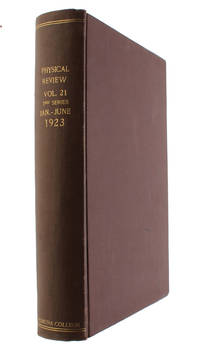
192347061Lancaster The Physical Review 1923. Royal8vo. Contemp. full buckram. In:"The Physical Review" Series II vol. 21. 4736 pp. Plates and textillustr. Entire volume offered. A perforated stamp in upper margin on a few leaves. Compton's paper: pp. 483- 501. <br/><br/><em>First printing of this milestone paper in quantum physics in which Compton verifies Planck's quantum postulate and found that some of the X-rays had in scattering lenghtened their wavelenght. This phenomena was called the "Compton Effect" in his honour. For this discovery Compton received the Nobel prize in physics in 1927."Compton was able to account for this lenghtening of wavelenght by presuming that a photon of light struch an electron which recoiled subtracting some energy from the photon and therefore increasing its wavelenght. This made it seem that a photon acted as a particle: thus after more than a century the particulate natuer of light as evolved by Newton was revived. What itamounted to was that Compton brought to fruition the view that electromagnetic radiation had both a wave aspect and a particle aspect and that the aspect which was most evident depended on how the radiation was tested. De Broglie was at the same time showing that this held true also for ordinary particles such as electrons." AsimovParkinson "Breakthroughs" 1923 P. - Sigmund Brandt "The Harvest of as Century" Episode 31. </em> hardcover
168649367Venezia 1686. 8vo. 165x11 cm. Contemp. full vellum. Halftitle-page. Engraved Title-page the Lion of St. Mark. 82371 blank2- Indice pp. and 41 of 42 double-page folded engraved maps and plans bird's-eye views or plans of fortified towns and places etc. Internally fine and clean. Printed on good paper. A fine copy. <br/><br/><em>Second edition the first 8vo-edition issued the same year as the first in folio describing the Venetian campaign for the reconquest of the Peloponnese or Morea from which Venice had been almost completely excluded since the Turkish conquest of the Greek island in 1458."As is often the case with Coronelli's work the contents may vary with each example as plates were added subtracted or changed as the editor saw fit" Rodney Shirley "Maps in the Atlases of the british Library" T.Coro-1a - listing only 39 maps and views for this copy.Coronelli Vincenzo Maria an Italian geographer and draughtsman was born at Venice about 1650. From 1681-1683 he worked in Paris on a pair of 3.85 meter diameter globes for Louis XIV which are now in the National Library in Paris. On his return to Venice he was made cosmographer of the Republic and founded the Academy of Argonauts the first Geographical Society. In 1702 he became general of his order. </em> hardcover
193846475Princeton NJ. Annals of Mathematics 1938 a. 1940. Both papers in orig. printed wrappers. Offprints from "Annals of Mathematics" Vol. 39 No. 1 january 1938 and Vol. 41 No. 2 April 1940. Pp. 65-100 and pp. 455-464. Both clean and fine. This copy has belonged to Abraham Pais 1918-2000 - the famous Einstein scholar theoretical physicist and Einsteins collegue at Princeton - and having his name on top of both frontwrappers "A Pais". <br/><br/><em>First editions in the scarce offprint versions of Einstein's last and highly important contributions to General relativity and in which is shown that the equation of motion follows directly from the field equation that defined the geometry."Einstein's last importent contribution to general relativity deals again with the problem of motion. It is the work done with Leopold Infeld and Banash Hoffmann on the N-body problem of motion. In these papers the gravitational field is no longer treated as external. Instead it and the motion of its singular sources are treated simultaneously. Anew approximationscheme is introduced in which the fields are no longer necessarily weak but in which the source velocities are small compared with the light velocity . The equations obtained have found use in situations where Newtonian interaction must be included. 'These equations are widely used in analyses of planetary orbits in the solarsystem. For example the Cal Tech Jet Propulsion Laboratory uses them in modified form to calculate ephmerides for high-precision tracking of planets and spacecraft."Pais "Subtle is the Lord" p. 290-91."The problem of the equation of motion of bodies is the following. The 1916 theory had a classical structure in the sense that there were both field equations the curvature of space-time is determined by the mass and motion of bodies in space-time and equations of motion of bodies the world line of small mass is a geodesic. Are these two statements really separate If the field equations were linear they indeed would be. They are not linear however and Einstein showed in the papers offered that if matter is represented by a point singularity of the metric field these singularities are located on world lines that are geodesics of space-time provided its metric satisfies the equation of general relativity."DSB.Weil: 202 a. 295 both with an asterix denoting a major paper. - Boni: 236 a. 236.1. </em> unknown
192547224Berlin Julius Springer 1925. 8vo. Contemp. full cloth. Spine lacks and covers detached in need of a new spine. A stamp to front free endpaper chinese. In: 'Zeitschrift für Physik' Volume 31. VIII952 pp. textillustr. Entire volume offered. Pauli's paper: pp.765-783. <br/><br/><em>First edition of the first announcement of Pauli's Exclusion Principle which gives a criterion for the electronic structure of atoms and explains the periodic table and the combining properties of the elements.Pauli first formulated his exclusion principle in this article in an attempt to explain the structure of the periodic table. By introducing an additional quantum number namely the spin of an electron to the already known three quantum numbers in Bohr's atom model and by postulating that no two electrons can have the same four quantum numbers Pauli could explain the number of electrons allowed in the outermost shell e.g. explaining the varying lengths of successive periods in the table. The exclusion principle turned out to be applicable to all fermions and thus plays a role in a variety of physical phenomena. For example it explains the formation of degenerate matter in white dwarfs and neutron stars. In 1945 Pauli received the Nobel Prize in physics "for the discovery of the Exclusion Principle also called the Pauli Principle".This volume also contains a paper by Heisenberg: 'Über eine Anwendung des Korrespondenzprinzips auf die Frage der Polarisation des Floureszenzlichtes' A. Einstein: "Bemerkung zu P. Jordans Abhandlung "Zur Theorie der Quantenstrahlung"and another paper by Pauli: 'Über den Einfluss der Geschwindigkeitsabhängigkeit der Elektronenmasse auf den Zeemaneffekt' Zeeman-Effect and the Dependence of Electron-Mass on the Velocity. </em> hardcover
188460243Berlin Stockholm Paris F. & G. Beijer 1882-84. Large4to 272 x 230 mm. Three volumes uniformly bound in contemporary half calf with gilt lettering to spine. In "Acta Mathematica" volume 1-5. Light wear to extremities boards and spines with scratches. Stamp to verso of front board in all volumes. First three leaves in first volume detached otherwise internally fine and clean. Vol. I pp. 1-62; Pp. 193-294; Vol. II pp. 97-113; Vol. III. pp. 49-92; Vol. IV pp. 201-312; Vol. V pp. 209-278. <br/><br/><em>First publication of these groundbreaking papers which together constitute the discovery of Automorphic Functions. "Before he was thirty years of age Poincaré became world famous with his epoch-making discovery of the "automorphic functions" of one complex variable or as he called them the "fuchsian" and "kleinean" functions." DSB.These manuscripts written between 28 June and 20 December 1880 show in detail how Poincaré exploited a series of insights to arrive at his first major contribution to mathematics: the discovery of the automorphic functions. In particular the manuscripts corroborate Poincaré's introspective account of this discovery 1908 in which the real key to his discovery is given to be the recognition that the transformations he had used to define Fuchsian functions are identical with those of non-Euclidean geometry. See Walter Poincaré Jules Henri French mathematician and scientist.The idea was to come in an indirect way from the work of his doctoral thesis on differential equations. His results applied only to restricted classes of functions and Poincaré wanted to generalize these results but as a route towards this he looked for a class functions where solutions did not exist. This led him to functions he named Fuchsian functions after Lazarus Fuchs but were later named automorphic functions. First editions and first publications of these epochmaking papers representing the discovery of "automorphic functions" or as Poincaré himself called them the "Fuchsian" and "Kleinian" functions."By 1884 Poincaré published five major papers on automorphic functions in the first five volumes of the new Acta Mathematica. When the first of these was published in the first volume of the new Acta Mathematica Kronecker warned the editor Mittag-Leffler that this immature and obscure article would kill the journal. Guided by the theory of elliptic functions Poincarë invented a new class of automorphic functions. This class was obtained by considering the inverse function of the ratio of two linear independent solutions of an equation. Thus this entire class of linear diffrential equations is solved by the use of these new transcendental functions of Poincaré." Morris Kline.Poincaré explains how he discovered the Automorphic Functions: "For fifteen days I strove to prove that there could not be any functions like those I have since called Fuchsian functions I was then very ignorant; every day I seated myself at my work table stayed an hour or two tried a great number of combinations and reached no results. One evening contrary to my custom I drank black coffee and could not sleep. Ideas rose in crowds; I felt them collide until pairs interlocked so to speak making a stable combination. By the next morning I had established the existence of a Class of Fuchsian functions those which come from hypergeometric series; i had only to write out the results which took but a few hours.the transformations that I had used to define the Fuchsian functions were identical with those of Non-Euclidean geometry." </em> hardcover
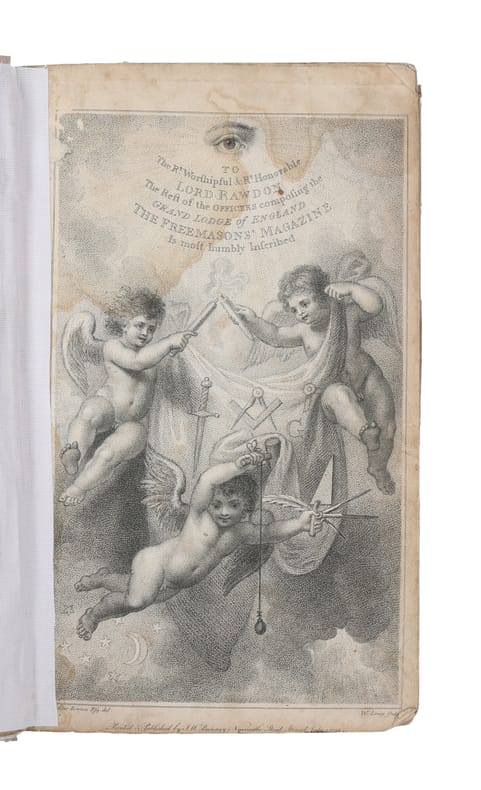
179863098London Scatcherd & Whitaker; Parsons; Cawthorn 1793 - 1798. 8vo. Bound in 11 volumes. Volume 2 - 11 uniformly bound in contemporary half calfs. Volume 1 in half calf with later marbled paper covered boards. Bindings with wear and stains. Leather on spines cracked. Volume 1 with reinforced hinges a dampstain to first leaves. A few volumes with dampstain to first leaves but internally generally a nice and clean set. 616 4 pp. 2 frontispiece and 7 engraved plates; 4 480 pp. 7 plates Wolstieg only calling for 5; 4 450 4 pp. 7 engraved plates; 4 426 6 8 pp. 7 engraved plates Wolstieg only calling for 3; 2 436 pp. 6 engraved plates Wolstieg only calling for 2; 2 452 4 pp. 6 engraved plates Wolstieg only calling for 4; 6 438 4 pp. 8 engraved plates Wolstieg only calling for 6; 4 464 4 pp. 8 engraved plates Wolstieg only calling for 4; 6 506 pp. 9 engraved plates Wolstieg only calling for 4; 2 430 pp. 6 engraved plates Wolstieg only calling for 1; 2 IV 338 8 pp. 9 engraved plates Wolstieg only calling for 2. This set has a total of 79 engraved plates Wolfstieg only calls for 47 plates. <br/><br/><em>Rare complete run of the first English periodical dedicated to freemasonry “the archetype of later Masonic periodicals†Önnerfors The Freemasons’ Magazine 1793–1798 published at a crucial time in the history of European Freemasonry in the immediate aftermath of the French Revolution. It represents one of the first efforts by the fraternity to define consolidate and disseminate its intellectual and moral identity in public. Its contents - lodge proceedings philosophical essays antiquarian inquiries biographical notices poetry and finely executed symbolic engravings - reflect the full breadth of late Enlightenment Masonry. The importance of the work lies in its function as a precursor since it anticipates the Masonic journals in the 19th century and marks the transition of Freemasonry into a self-conscious print-based intellectual culture. â€The Freemasons’ Magazine represent a forceful statement of British Freemasonry concerning its vigour loyalty and societal engagement. During 1794 the journal for the first time served as a platform to refute anti-Masonic writings that circulated in the public. Important apologies such as Defence of masonry 1730 or Cousto’s spiced account of his treatment by the Portuguese inquisition were republished. Parts of Ramsay’s ‘Oration’ were republished not just once but twice. We can also witness how the Knights Templar called the ‘sublime degree of masonry’ entered the world of British Masonic imagination long after the continental development. Nevertheless at the very same time Freemasonry in Britain was also celebrating technological progress in industry agriculture and science which makes its relationship to modernity complex. The Freemasons’ Magazine managed to attract correspondents in different parts of the empire and even the USA. A particularly strong link throughout the first seven volumes was Edinburgh. In the last four volumes we find more material inserted from Ireland at exactly the time when political tensions there erupted into a full-scale rebellion. The political tense years of 1797 and 1798 offer an intriguing insight into the British psyche at the time. Under constant real and imagined threat of French invasion internally shaken by the Irish rebellion uprisings and repeated mutinies public opinion was fuelled with anti-Masonic ideas not at least by Robison’s book Proofs of a conspiracy. The Freemasons’ Magazine unfortunately did not survive 1798. Most importantly perhaps it can be regarded as the archetype of later Masonic periodicals developing into a archtype Masonic press by the middle of the nineteenth century with titles such as he Freemasons’ Quarterly Magazine and Review 1834–53 The Masonic observer 1856–9 he Freemason’s Magazine and Masonic mirror 1856–71 the Freemason 1869–1951 some of them surviving well into the twentieth century. Whereas Masonic periodicals during the first century of their existence tied into the ongoing debates and controversies surrounding Freemasonry in culture and society they developed more and more into purely internal membership magazines with little connection to the outside world.†Önnerfors The Freemasons’ Magazine 1793–1798. Wolfsteig 516 </em> hardcover
179863098London, Scatcherd & Whitaker Parsons Cawthorn, 1793 - 1798. 8vo. Bound in 11 volumes. Volume 2 - 11 uniformly bound in contemporary half calfs. Volume 1 in half calf with later marbled paper covered boards. Bindings with wear and stains. Leather on spines cracked. Volume 1 with reinforced hinges a dampstain to first leaves. A few volumes with dampstain to first leaves but, internally, generally a nice and clean set. 616, (4) pp. + 2 frontispiece and 7 engraved plates (4), 480 pp. + 7 plates (Wolstieg only calling for 5) (4), 450, (4) pp. + 7 engraved plates (4), 426, (6), 8 pp. + 7 engraved plates (Wolstieg only calling for 3) (2), 436 pp. + 6 engraved plates (Wolstieg only calling for 2) (2), 452, (4) pp. + 6 engraved plates (Wolstieg only calling for 4) (6), 438, (4) pp. + 8 engraved plates (Wolstieg only calling for 6) (4), 464, (4) pp. + 8 engraved plates (Wolstieg only calling for 4) (6), 506 pp. + 9 engraved plates (Wolstieg only calling for 4) (2), 430 pp. + 6 engraved plates (Wolstieg only calling for 1) (2), IV, 338, (8) pp. + 9 engraved plates (Wolstieg only calling for 2). This set has a total of 79 engraved plates, Wolfstieg only calls for 47 plates.
177760749Uppsala, Magnus Swederus, 1777. 8vo. In a nice contemporary half calf binding with richly gilt spine. Light occassional marginal miscolouring. Plates closely trimmed but generally a very nice copy. (2), (24), 376, (4) pp. + 12 plates and 2 folded maps.
1980KOS00600075TBD 1980. Soft Cover. Fine. KOS00600075 TBD paperback
1980KOS01600159TBD 1980. Soft Cover. Fine. KOS01600159 TBD paperback
19882091202133211687Yagi shoten 1988. Soft Cover. Fine. Number of books: 17 Yagi shoten paperback
19672091502135702011Nihonhyoronsha 1967. Soft Cover. Fine. The book is in fine condition. Nihonhyoronsha paperback
20032082402113600881Urasoe City Okinawa Prefecture 2003. Soft Cover. Fine. Number of pages: 291 pages Number of books: 20 volumes Urasoe City, Okinawa Prefecture paperback
19722091502135400760Bunka Education Publishing Company 1972. Soft Cover. Fine. Number of books: 5 Bunka Education Publishing Company paperback
19912091502135309589Not Available 1991. Soft Cover. Fine. Number of books: 30 Not Available paperback
18782092902138300984Kihei Maeda version 1878. Soft Cover. Fine. Size: 35.5x49cm Kihei Maeda version paperback
200452684AW Fine Arts. New. 2004. Hardcover. 1556603169 . FREE UPGRADE to Courier/Priority Shipping Upon Request IN STOCK AND IMMEDIATELY AVAILABLE FOR SHIPMENT - FLAWLESS COPY BRAND NEW PRISTINE NEVER OPENED - A revision of the 1979 French language edition with titles and descriptions in English reproductions of multiple states a chronology and concordances to Baer Geiser Mourlot and Cramer. 270 works illustrated and described. 240 pp. Catalogue Raisonné Catalogue Raisonne Catalog Raisonnee Complete Works -- with a bonus offer; 1 x 12.4 x 9.4 Inches; 201 pages . AW Fine Arts hardcover
1677ZB666713Moguntiae: Sumpt. Ludovici Bourgeat Academiae Bibliopolae 1677. Rariores proprietates historias et sententias memorabiles non paucas breviter exponit. Ultima editio leaves slightly taller than 13.5 cm. 4 parts in one as issued 8 201 3 204 204 201 1 pp. each part has a special half title and each contains 100 circular engravings by Hans Sibmacher; contemporary vellum very worn with only a fragment of the spine covering remaining and the front cover bowed and almost detached armorial book plate of Wm. Strong and his name written in block letters on the now detached front free endpaper general light age toning with occasional age spotting the first twenty emblems hand colored good; edited by the author's son Ludwig Camerarius. - If you are reading this this item is actually physically in our stock and ready for shipment once ordered. We are not bookjackers. Buyer is responsible for any additional duties taxes or fees required by recipient's country. Photos available upon request. Moguntiae: Sumpt. Ludovici Bourgeat, Academiae Bibliopolae, hardcover
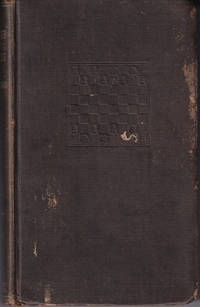
1937C2839<p>xxix281 pages with diagrams. Octavo 8 3/4" x 5 1/2" bound in original publisher's brown cloth with gilt lettering to spine with blind-stamped chess boards to covers. Inscribed by Capablanca on front end paper. from the library of David DeLucia with a typed manuscript referencing the first edition of this work with Capablanca's hand written correction. Betts: 10-136 Second American edition.</p><p>This work is in two parts. In part one the author gives basic instruction first very briefly the covering the same points in more detail. In part two he deals with endings the middle-game openings in that order. This was published in London by Bell in the same year. Jose Raul Capablanca y Graupera 19 November 1888-8 March 1942 was a Cuban chess player who was world chess champion from 1921 to 1927. A chess prodigy he is considered by many as one of the greatest players of all time widely renowned for his exceptional endgame skill and speed of play. Born in Havana he beat Cuban champion Juan Corzo in a match two days before his thirteenth birthday on 17 November 1901. His victory over Frank Marshall in a match in 1909 earned him an invitation to the 1911 San Sebastian tournament which he won ahead of players such as Akiba Rubinstein Aron Nimzowitsch and Siegbert Tarrasch. During the next several years Capablanca had a strong series of tournament results. After several unsuccessful attempts to arrange a match with the then world champion Emanuel Lasker Capablanca finally won the title from Lasker in 1921. Capablanca was undefeated for eight years from 10 February 1916 to 21 March 1924 a period which included the world championship match with Lasker. Capablanca lost the title in 1927 to Alexander Alekhine who had never beaten Capablanca before the match. Following unsuccessful attempts to arrange a return match over many years relations between them became bitter. Capablanca continued his excellent tournament results in this period but withdrew from serious chess in 1931. He made a comeback in 1934 with some good results but also showed symptoms of high blood pressure. He died in 1942 of "a cerebral hemorrhage provoked by hypertension". Wikipieda</p><p>David DeLucia's chess library contains 7000 to 8000 chess books a similar number of autographs letters score sheets manuscripts and about 1000 items of "ephemera". DeLucia's library contains such items as "a 15th-century Lucena manuscript score-sheets ranging from Fischer's Game of the Century against Donald Byrne to all the games of the 1927 New York tournament eight letters by Morphy over a hundred Lasker manuscripts Capablanca's gold pocket watch and the contract of the 1886 Steinitz-Zukertort world championship match".</p><p>Typed manuscript sent by an unknown author to Capablanca regarding errors in the first edition of <em>A Primer of Chess</em> with corrections in Capablanca's hand.</p><p><strong>Condition: </strong>Inscribed by Capablanca on front end paper. Binding with visible wear and scratches. Corners bumped. Some shelf lean. Paper toned with some foxing and soiling. some light worming to front board all edges and spine ends rubbed else good.</p> Harcourt, Brace and Company hardcover
196793638Harry N Abrams Inc. New. 1967. Hardcover. FREE UPGRADE to Courier/Priority Shipping Upon Request - IN STOCK AND IMMEDIATELY AVAILABLE FOR SHIPMENT - Flawless copy brand new pristine never opened -- Corresponds to ASIN: B000F6Q51C. 231 pages; nearly 500 illustrations. Catalogue Raisonne Catalog Raisonné Complete Works Life and Work Raisonnee Harry N Abrams Inc hardcover
27377Paris 1912 grand in folio (62,5x45) 1 chemise toilée à rabats de l'éditeur (légèrement défraichie, petites traces d'humidité et petites usures), dos de percaline lie de vin, plat supérieur titré, renfermant: un faux-titre, une page de titre imprimée en rouge et noir, 4 pages de notice et index des planches, et 48 planches hors-texte tirée en héliotypie par Berthaud frères, 35 planches sont très finement rehaussées par J. Saudé, petite trace brun clair au centre du verso des planches 46 et 47, rousseurs sur le faux-titre, et quelques rousseurs éparses. Tirage limité à 500 exemplaires numérotés. Envoi autographe signé de l'auteur à Monsieur Léon Bérard, S. Secrétaire d'Etat aux Beaux-Arts, daté 1912. Bon exemplaire ( Photographies sur demande / We can send pictures of this book on simple request )