Paine, ThomasBiblio.com
48 390 résultats
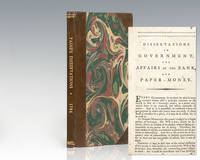
1786104062Philadelphia: Printed by Charles Cist 1786. First edition of Paine's defense of the Bank of North America. Small octavo bound in three quarters leather over marbled boards with gilt titles and tooling to the spine. Rare. "Another time that tried men's souls occurred in 1780 when the American troops were at the end of their patience because of lack of pay and scarcity of supplies. Serious features of mutiny and sedition had already appeared. A tone of discouragement swept through the Pennsylvania Assembly for the treasury was empty. One member said 'We might as well give up first as last.' But Paine did not agree and when he drew his meager salary he took $500 and started a subscription for the relief of soldiers. Robert Morris and many others followed and by June 18 1780 had raised 300000 pounds and started a bank which supplied the army through the campaign.When the bank came under attack by those who favored inflation after the war Paine rushed to its defense with this pamphlet."Gimbel 45. In very good condition with the title page backed with some restoration period ownership signature stamp to the verso of page 53 notations throughout. Printed by Charles Cist hardcover
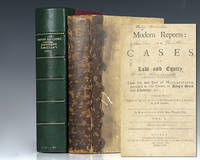
1769125709London: Printed by His Majesty's Law Printers 1769. Alexander Hamilton's copy of the tenth volume of Lucas's Modern Reports. Folio bound in one quarter contemporary calf over paper-covered boards. Signed by Alexander Hamilton and his son Philip Hamilton on the title page. In very good condition. Housed in a custom cloth chemise and half morocco slipcase. Rare and desirable books from Hamilton's library seldom appear on the market. The first treasury secretary of the United States and one of America's founding fathers Alexander Hamilton founded the nation's financial system the Federalist Party the United States Coast Guard and the New York Post newspaper. He was the main author of the economic policies of George Washington's administration and as Secretary of the Treasury established a national bank system of tariffs and trade relations with Great Britain. After the American Revolutionary War Hamilton resigned his seat in the Congress of the Confederation to practice law which he returned to in 1795 and was active in ending the legality of the international slave trade. Printed by His Majesty's Law Printers hardcover books
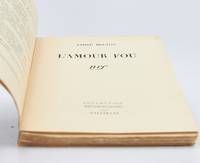
193787781Paris: Gallimard 1937. Fine. ""Convulsive beauty will be veiled-erotic fixed-explosive magic-circumstantial or it will not be"" Gallimard Paris 1937 14.50 x 19.50 cm Relié First edition one of 9 numbered copies on japon only deluxe issue aside from 35 copies on pur fil and a few on coloured paper. Full black morocco binding flat spine authors name palladium-stamped title stamped lengthwise in palladium and blind grey long-grain shagreen inlays to boards with author and title stamped lengthwise in palladium and in blind turn-ins framed in morocco light plum suede pastedowns and flyleaves three palladium decorated deckled edges outstanding custom binding by Thomas Boichot. Illustrated with 20 photographs including 7 photographs by Man Ray 4 by Brassaï one each by Dora Maar Henri Cartier-Bresson and Rogi André as well as artworks by Max Ernst and the statue of a female character by Giacometti in which the writer saw the very emanation of the desire to love and to be loved in search of its real human object in its painful ignorance. André Breton offers a meditation on love at first sight and passion drawn from his fateful first encounter in 1934 with his future wife Jacqueline Lamba this woman was scandalously beautiful. Recalling the beginnings of their romantic relationship he reflects on chance and embarks on a rereading of their love story detecting all sorts of phantasmagoric signs analysing his experiences and feelings. He concludes with an open letter to their daughter Aube born in December 1935 which ends with these words: I want you to be madly loved. A masterpiece of Surrealist literature both an extension and opposite of Nadja which was published nine years earlier also considered an objectbook in the classic surrealist style interleaved with photographs by Cartier-Bresson Brassaï and Man Ray . It proves its own startling kind of existence in the real world being not just a book not just the record of an extraordinary love that between André Breton and the artist with whom he shared his life but an object inserted madly and really now in our world Mary Ann Caws Translators note Mad Love University of Nebraska Press 1987. Gallimard hardcover
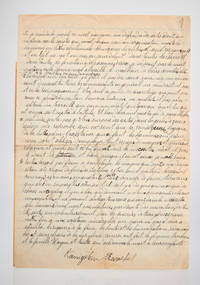
1892734381892. Fine. 1892 20 x 29.50 cm 4 pages sur un double feuillet Exceptional complete autograph manuscript of Ravachols true last testament largely unpublished unknown in this form preceding its rewriting by a third party for publication in the press. A unique testimony to the genuine thought of the anarchist icon. Four-page lined quarto manuscript entirely written in black ink and signed twice Konigstein Ravachol at the foot of each sheet. Pencil corrections within the text possibly in the hand of his lawyer. Some horizontal folds and very minor marginal tears without loss. Written in his prison cell during the second Montbrison trial that led to his death sentence this text hastily penned without punctuation or capital letters and in naïve spelling was meant to be delivered orally by Ravachol during the hearing. Ravachol was dead set on putting in his two cents for the defence not to defend himself but to explain. No luck dammit! Four words in and the judge cut him off. His statement isnt lost by Jove! Émile Pouget in Père Peinard July 310 1892. This self-styled Rocambole of anarchism was not allowed to read his statement aloud but he handed it to his lawyer Maître Lagasse and by June 23 the forbidden text appeared in the conservative newspaper Le Temps. This first publication was so faithful to the original that it preserved the author's eccentric spelling a fidelity that Émile Pouget would ironically criticise in the Père Peinard issue of July 3 1892 one week before Ravachols execution: Le Temps that opportunist bedsheet printed it as is. Like a true Jesuit it even printed it too true. Ravachol had written the thing for himself; he knew how to read it but there wasnt a word of correct spelling seeing as he knew about spelling as much as he knew about cabbage farming. Le Temps printed the thing without changing a line so its practically unreadable . Thats exactly what the bastards wanted dammit! . Im reprinting it below without changing a word just fixing the spelling. That same July 3 issue of Père Peinard included a corrected version orthographically of the statement initially published in Le Temps. This dual publication combined with Ravachols defiant bearing before the guillotine had a powerful effect on public opinion. Until then even anarchist publications had kept a certain distance from this provocative criminal suspected of using the anarchist cause for personal gain. But following his execution the testament was quickly reproduced in other newspapers and Ravachols final cry of revolt soon became a genuine anarchist anthem among libertarians worldwide. However the version circulated in the press the only known version until now the original manuscript having disappeared differs markedly from the manuscript in our possession. Indeed the style was lightly polished several turns of phrase refined and most significantly entire passages were excised including the conclusion paragraph which was fully replaced. Our manuscript with its crossings-out and revisions is likely the original version of this political testament. Written in a single burst in dense handwriting without punctuation or paragraph breaks it includes two lengthy sections expressing concerns for public health that are entirely absent from the published version. The first is a third of a page-long passage about the dangerous ingredients added to bread: no longer needing money to live thered be no fear of bakers adding dangerous ingredients to bread to make it look better or heavier since it wouldnt profit them and theyd have like everyone else and by the same means access to what they needed for their work and existence. Thered be no need to check whether the bread weighs right if the money is counterfeit or if the bill is correct. The second nearly a full page long concerns the silk-dyeing industry in which Ravachol had worked: If one reflects atten unknown
195884321Paris: Gallimard 1958. Fine. Gallimard Paris 1958-1972 14.50 x 21.50 cm 4 volumes brochés sous coffrets Mémoires d'une jeune fille rangée Memoirs of a Dutiful Daughter - La force de l'âge The Prime of Life - La force des choses Force of Circumstance - Tout compte fait All Said and Done Gallimard Paris 1958-1972 145x215cm 4 bound volumes. First edition one of 25 30 35 and 40 numbered copies on vergé de hollande most limited deluxe issue for each of the 4 volumes. A very rare and handsome set of this autobiographical and feminist tetralogy. Each volume is presented in a custom box signed by Julie Nadot reproducing the cover plates and the spine of the work. Gallimard unknown
188060981Paris: Calmann Lévy 1880. Fine. Juliette Drouet's copy Calmann Lévy Paris 1880 15.50 x 24 cm relié First edition. Black half morocco binding spine with four raised bands adorned with gilt dotted fillets and double gilt compartments decorated at the corners gilt date and the inscription ""Ex. de J. Drouet"" at the tail marbled paper boards and endpapers preserved covers and spine top edge gilt binding signed by René Aussourd. Some minor foxing mainly at the beginning and end of the volume. Precious signed and inscribed copy by Victor Hugo to Juliette Drouet the great love of his life: To you my lady. Humble homage. V.' This copy comes from the library of Pierre Duché who acquired Juliette Drouet's entire library and commissioned René Aussourd to bind the volumes uniformly marking each with an identifying inscription at the foot of the spine. Bookplates pasted on a pastedown and a flyleaf. In late 1878 after more than forty years together Victor Hugo and Juliette Drouet finally moved in together at Avenue d'Eylau in the small town house where the poet would spend his final years. ""From that moment on Juliette's life became little more than an unbroken sorrow a servitude of every hour. She herself suffered from stomach cancer knowing she was condemnedto die of hunger!"" Louis Guimbaud Victor Hugo et Juliette Drouet Paris 1927. Despite her illness and severe physical weakness she remained devotedly at Hugo's side as his caregiver. It was during this time that Bastien Lepage painted a strikingly realistic portrait of her: ""From her goddess-like face once serene and noble the relentless illness had made a frail human visage drawn and hollowed furrowed with wrinkleseach one telling a story of pain."" ibid. Religions et religions was published two years before Juliette's death; is was one of the last books Hugo dedicated to the unwavering love of his life. In a final tribute to her lifelong devotion he later offered her a photograph inscribed: ""Fifty yearsthat is the most beautiful marriage."" Copy from the most intimate source. Calmann Lévy hardcover
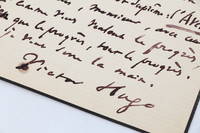
1871833181871. Fine. « So that justice finally be done for women » Mardi 7 novembre 1871 13.30 x 20.80 cm 2 pages sur un feuillet double Autograph letter signed by Victor Hugo to Léon Richer two pages in black ink on a double sheet framed in black. Crosswise folds inherent to envelope inserting. A central tear at the junction of the two sheets. Published in uvres complètes de Victor Hugo Ollendorff 1905. Manuscript housed in a blue half morocco chemise and slipcase marbled paper boards marbled paper slipcase signed Boichot. A magnificent and important letter to Léon Richer one of the first male feminist activists considered by Hubertine Auclert as the ""father of feminism"" and later regarded by Simone de Beauvoir as its ""true founder"". This deeply humanist text is a compendium of Victor Hugo's campaign for the abolition of capital punishment and the female attainment of social equality and civil rights. « Mardi 7 novembre 1871 Monsieur on m'a demandé d'urgence mon intervention pour les condamnés à mort. L'accomplissement de ce devoir a retardé ma réponse à votre excellente lettre. Vous avez raison de compter sur moi pour affirmer l'avenir de la femme. Dès 1849 dans l'Assemblée nationale je faisais éclater de rire la majorité réactionnaire en déclarant que le droit de l'homme avait pour corollaires le droit de la femme et le droit de l'enfant. En 1853 à Jersey dans l'exil j'ai fait la même déclaration sur la tombe d'une proscrite Louise Julien mais cette fois on n'a pas ri on a pleuré. Cet effort pour qu'enfin justice soit rendue à la femme je l'ai renouvelé dans les Misérables je l'ai renouvelé dans le Congrès de Lausanne et je viens de le renouveler encore dans ma lettre au Rappel que vous voulez bien me citer. J'ajoute que tout mon théâtre tend à la dignification de la femme. Mon plaidoyer pour la femme est vous le voyez ancien et persévérant et n'a pas eu de solution de continuité. L'équilibre entre le droit de l'homme et le droit de la femme est une des conditions de la stabilité sociale. Cet équilibre se fera. Vous avez donc bien fait de vous mettre sous la protection de ce mot suprême : l'Avenir. Je suis Monsieur avec ceux qui comme vous veulent le progrès rien que le progrès tout le progrès. Je vous serre la main. Victor Hugo » ""Tuesday november 7 1871 Sir I have been urgently asked to intervene on behalf of those sentenced to death. The fulfillment of this duty has delayed my reply to your excellent letter. You are right to count on me to defend the future of women. As early as 1849 in the National Assembly I made the reactionary majority burst into laughter by declaring the rights of man as natural counterparts to the rights of woman and the rights of children. In 1853 in my Jersey exile I made the same declaration on the grave of an outlaw Louise Julien but this time people didn't laugh they wept. I renewed this effort to finally do justice to women in Les Misérables I renewed it in the Congrès de Lausanne and I've just renewed it again in my letter to Le Rappel which you are kind enough to publish. I would add that every single one of my theatrical works aims to dignify women. As you can see my plea for women is long-standing and persevering and no other has ventured to continue with this endeavor. Balance between men's rights and women's rights is one of the conditions of social stability. This balance will be achieved. I commend you for placing yourself under the protection of this supreme word: the Future. I am Sir with those who like you want progress nothing but progress the whole of progress. I shake your hand. Victor H Although this letter focuses primarily on advocating for women's rights it begins with the death penalty: I have been urgently asked to intervene on behalf of those sentenced to death. The fulfillment of this duty has delayed my reply to your excellent letter. Shortly after the Paris Commune the October 1871 pages of Hugo's diary la hardcover
19080001468ARGENTINA SOUTH AMERICA. Good. 1908. On offer is an exceptional massive historically significant archive of original handwritten manuscripts documents photographs and related ephemera including maps passports and research materials of noted geographer geologist explorer and expert on South America Anselmo Windhausen. Of particular interest to historians and researchers and collectors of the natural history of the continent are 10 original manuscripts: 1. Geologica Argentina; 2. Paleonto Logia I; 3. Geologia Historica Y Sudamericana II; 4. Geologia De Los Combustibles; 5. Nociones de Hidrogeologia; 6. Mineralogia Y Geologia; 7. Geologia General III III IV; 8. Geografia Fisica I; 9. Accion Coustructiva Y Destructiva Aqua Carrienta; 10. Sierra De Cordoba Hidrogeolica Y Pampeano Cordoba with hundreds of photographs in albums full of exploration photographs and a trip from Argentina to California; across the US in 1915; the Panama Pacific Exposition plus the archive boast hundreds of documents maps passports and other ephemera. BIO NOTES: Dr. Anselm Windhausen 1882-1932 Anselm Windhausen was born in Lingen Germany on April 20th 1882. He studied at the Gymnasium Josephinum in Hildesheim and successively at the universities of Berlin Munich and Göttingen where he had among his teachers such renowned scientists as Ferdinand von Richthofen Wilhelm Roentgen Karl von Zittel Wilhelm von Branca and Adolf von Koenen. He began his scientific work at the Unicorn Cave in the Harz mountains of Germany under a scholarship from the Virchow Foundation conducting geological and paleontological studies whose basic conclusions were confirmed many years later. In those early years he worked for Göttingen's Geological-Paleontological Institute and the Roemers Museum in Hildesheim. In 1907 he obtained his Ph. D. in Geology at the University of Göttingen and that same year he was appointed to take care of the geological and paleontological collections at the Provincial Museum in Hanover. On April 20th 1909 when he was turning 27 he was hired by the Mines and Geology Division of Argentina's Ministry of Agriculture as a staff geologist. He moved to Argentina shortly thereafter. His first geological surveys in Argentina where conducted in the southern area of the province of Mendoza between 1909 and 1910. In 1910 he was in charge of organizing the mineralogical collection at the Centennial Exposition in Buenos Aires. Commissioned by the Argentine government he organized the Mines and Geology Division exhibition at the Industries and Labor Exposition in Turin and Roubaix in 1911 in which he obtained a "Grand prix." Between 1912 and 1913 he began his first explorations in northern Patagonia to investigate the oil outcrops that had been reported in the late 19th century in the Cerro Lotena area of the province of Neuquén. In September of 1913 he recommended the exploitation of oil in what is today the Plaza Huincul field during a lecture he gave at the Sociedad Científica Argentina in Buenos Aires. However the merit of having discovered that oil field was wrongly attributed to one of his superiors Dr. Hans Keidel and it wasn't until 1972 some 60 years later that Windhausen's achievement was finally recognized. In 1916 he resumed his explorations in the areas of Río Negro and Neuquén to define the limits between the Cretaceous and the Jurassic. His conclusions were first published in 1918 in the American Journal of Science. In that study he established the concept and nomenclature of the so-called 'Jagüel layers'. Subsequently he extended his expeditions to the area south of Lake Nahuel Huapí the Chubut River Puerto Camarones Puerto Madryn and other parts of Patagonia. He published his research on the Neocomian fauna at the National Academy of Sciences in Córdoba Argentina of which he became a member a few years later in 1922. He maintained important scientific correspondence on the controversy surrounding the theories of Florentino Ameghino with such renowned colleagues as Herman von Ihering director of the Museo Paulista and W. D. Matthew of the American Museum of Natural History. In 1919 he was transferred to the newly-created Dirección General de los Yacimientos Petrolíferos Fiscales which later became the state-owned oil company YPF. Windhausen was commissioned to conduct a complete geological survey of the oil areas of Chubut and Santa Cruz whose partial conclusions he published in Argentina and Germany. In 1920 Windhausen took the Argentine citizenship. After a strong argument with the Director of YPF Col. Enrique Mosconi about the prospects for the exploitation of Patagonian oil which he defended against other opinions he returned to Mines and Geology in 1923. In 1924 he published a landmark geological study of the Bay of San Jorge which for decades was the basis for the exploration and exploitation of oil in that zone of Patagonia. Besides he brought back to public attention the importance of the Jaramillo Petrified Forest now known as the Cerro Cuadrado Petrified Forest in the southern province of Santa Cruz. He sent samples of area fossils like the " Araucaria mirabilis " to his German colleague Walter Gothan a celebrated paleontologist with a recommendation for further studies in Germany. Windhausen also recommended the exploitation of what was later known as the lignite fields of Río Turbio and extensively explored the Lake Argentino area of Santa Cruz. In 1923 he cooperated with renowned South African scientist A. du Toit during his visit to Argentina closely working with him on the geological correlations of Patagonia and Southern Africa. He then published a milestone article titled "El nacimiento de la Patagonia" The birth of Patagonia in 1924. In it he pioneered the idea of using Alfred Wegener's theory of continental drift for the study of South American geology. His ideas about the tectonic plates of South America were confirmed some 30 years later with the use of satellite photography. In 1925 as a member of the Argentine Geographical Society GAEA he actively cooperated with the expedition of the German oceanographic ship " Meteor " which mapped the South Atlantic floor with the use of sonar. Along with his brother-in-law the German topographer Fritz Graef he co-edited GAEA's scholarly journals. In 1926 he was appointed Geology and Paleontology professor of Graduate Studies at the School of Natural Sciences of the National University of Córdoba. In 1928 the Berlin Geographical Society in its centennial granted him the Gustav Nachtigal medal ex aequo with the noted German geographer Fritz Kühn for his contributions to Earth Sciences. In 1929 he published the first volume of his landmark work 'Geología Argentina' Ed. Peuser Buenos Aires. Dr. Windhausen working circa 1926. At that time he also worked as a private consultant for the U.S. company Electric Bond and Share Co. for building a dam in Anisacate Córdoba. He was one of the founders of the Mining and Geology Society of Argentina. He traveled to Germany in late 1929 invited by the famous German geographer Albrecht Penck to finally receive the Nachtigal medal. In January of 1930 he lectured on " Bau und Bild Patagoniens " at the Society in Berlin presented by Penck himself.In 1931 he published the second volume of his " Geología Argentina " devoted to regional and historical geology. For decades the two volumes of this work were an obligatory source for scholars and a textbook on the subject. The book incorporated his visionary application of Wegener's theory of continental drift to the geological interpretation of South America. In April of 1931 through the University of Córdoba he proposed to YPF the establishment of a scholarship program for students of natural sciences which benefited several generations of Argentine geologists as of 1932. After making a trip to Southern Patagonia in the summer of 1931-32 he suffered a stroke. Anselm Windhausen died at the German Hospital in Buenos Aires on April 2 1932 just eighteen days before turning 50. In 1935 a jury of which later Nobel Prize winner Bernardo Houssay was a member gave him a posthumous National Science Prize for his "Geología Argentina." There are also some early German papers when Dr. Anselmo Windhausen leading up to his taking on the position in Argentina. Overall G.; Spanish German English; KEYWORDS: HISTORY OF LATIN AMERICA SOUTH AMERICA GEOLOGY GEOGRAPHY GERMANY GOTTINGEN ARGENTINA ANSELMO WINDHAUSE NATURAL HISTORY PALEONTOLGY VOLCANO MINERALS MINERALOGY PANAMA EXPOSITION HANDWRITTEN MANUSCRIPT DOCUMENT LETTER AUTOGRAPH KEEPSAKE WRITER HAND WRITTEN DOCUMENTS SIGNED LETTERS MANUSCRIPTS HISTORICAL HOLOGRAPH WRITERS AUTOGRAPHS PERSONAL MEMOIR MEMORIAL PERSONAL HISTORY ARCHIVE DIARY DIARIES GEOLOGIA DE LOS COMBUSTIBLES GEOLOGIA HISTORICA Y SUDAMERICANA MINERALOGIA CARRIENTA SIERRA DE CORDOBA HIDROGEOLICA Y PAMPEANO CORDOBA SOCIEDAD CIENTÍFICA CERRO LOTENA PATAGONIA CÓRDOBA ARGENTINA JARAMILLO PETRIFIED FOREST . unknown
185965117Honfleur 1859. Fine. Honfleur 28 février 1859 13.10 x 20.50 cm 3 pages sur un feuillet remplié Remarkable autograph letter signed by Charles Baudelaire to Auguste Poulet-Malassis publisher of Les Fleurs du Mal dated 28 February 1859 and written in Honfleur. 64 lines in black ink some passages underlined housed in a modern black half-morocco folder. Baudelaire appears preoccupied with the Sainte-Beuve/Babou affair one of the many controversies following the Fleurs du Mal trial in which the writer Hippolyte Babou accused Sainte-Beuve of failing to defend Baudelaire during the proceedings. Excerpts from this letter were quoted by Marcel Proust in his celebrated Contre Sainte-Beuve where he lamented Sainte-Beuves cowardice during the trial of Les Fleurs du Mal and the undue esteem Baudelaire continued to show him. The poet writes from Honfleur where he had retired in January to live with his mother a revered figure who haunts her sons heart and mind. This letter was written eight days after a new development in the aftermath of the Fleurs du Mal trial. Torn by conflicting emotions Baudelaire confides in Malassis after his friend Hippolyte Babou had on 20 January published an article in La Revue française attacking Sainte-Beuve for failing to defend Baudelaire during the trial: He will glorify Fanny by Ernest Feydeau the honest man and remain silent about Les Fleurs du Mal he wrote. Despite Baudelaires pleas Sainte-Beuve had never published anything in support of the collection. In response to Babous attack Baudelaire received a horrible letter from Sainte-Beuve: It seems the blow . struck Sainte-Beuve deeply. I must do him the justice of saying he did not believe I had prompted Babou in any way. Although outraged by the accusations Sainte-Beuve did not hold Baudelaire personally responsible. Baudelaire is surprised by the critics vehemence writing to Poulet-Malassis: Truly here is a passionate old man with whom it is dangerous to fall out . You cannot imagine what that letter from Sainte-Beuve is like. It appears that for twelve years he had been noting every sign of malice from Babou. Baudelaire stands helpless amid the quarrel between two respected men while expressing a clear attachment to Sainte-Beuve now jeopardised by Babous article: Either Babou wanted to help me which would imply a certain degree of stupidity or he wanted to play a trick on me; or he simply pursued a mysterious grudge without any concern for my interests. Baudelaire indeed held Sainte-BeuveUncle Beuvein the highest regard. A senator an academician and the undisputed master of literary criticism Sainte-Beuves opinions carried great weight in Parisian literary circles. For years Baudelaire had awaited a formal sign of approval from Sainte-Beuve which might have bolstered his fragile career still tarnished by the scandal of Les Fleurs du Mal. The poet thus finds himself torn between his admiration for Sainte-Beuve and his long-standing friendship with Hippolyte Babouwho according to legend suggested the title Les Fleurs du Mal. To Poulet-Malassis he confides: What made this situation dangerous for me was that Babou appeared to be defending me against someone who had done me a great many favours. It remains unclear what Baudelaire meant by favours given that Sainte-Beuve had done relatively little to advance his career. This letter was later quoted in Marcel Prousts posthumously published Contre Sainte-Beuve 1954 a fierce and famous indictment in which Proust reproaches Sainte-Beuve for failing to recognise Baudelaires poetic genius and highlights his cowardice during the Fleurs du Mal trial. To preserve his position in the Senate Sainte-Beuve refrained from public support and provided only a defence strategy which the lawyer was authorised to use provided Sainte-Beuves name was not mentioned. Nearly two years after the verdict the disastrous trial of Les Fleurs du Mal still haunted B unknown
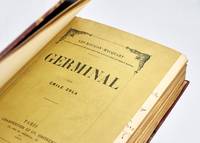
188582388Paris: Charpentier 1885. Fine. Charpentier Paris 1885 11.50 x 18.50 cm relié Charpentier Paris 1885 115x185cm bound. First edition. One of 150 numbered copies on hollande the only deluxe issue after 10 on papier japon. Half red morocco binding gilt date on spine marbled paper covers and endpapers. Original wrappers including the spine preserved. Set in an early 20th century binding signed by Alfred Farez. Our copy includes a two-page autograph letter dated and signed by Émile Zola to Octave Mirbeau. The author thanks him for the benevolent article he recently wrote about Germinal while defending himself from being considered as the leader of Naturalism: But why do you say that I lead naturalism I don't lead anything at all. I work in my own corner letting the world go where it pleases. A beautiful and rare copy perfectly established with a superb autograph letter signed about Germinal and Émile Zola's position within the École Naturaliste. Charpentier unknown
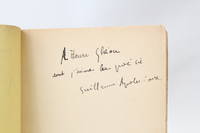
191371213Paris: Mercure de France 1913. Fine. “To Henri Ghéon whose poetry I love Guillaume Apollinaire” Mercure de France Paris 1913 11.50 x 18.50 cm broché First edition one of the first-issue copies press-numbered from a total limitation of just 23 deluxe copies on Holland paper. Illustrated with a frontispiece portrait of Guillaume Apollinaire by Pablo Picasso. Spine sunned with discreet restorations.Our copy is preserved in a red half morocco chemise spine with five raised bands date lettered at the foot paper-covered boards matching paper slipcase edged in red morocco the whole signed by Boichot. Rare signed autograph inscription by Guillaume Apollinaire: « à Henri Ghéon dont j'aime la poésie Guillaume Apollinaire ». Our copy further contains five manuscript corrections in ink by Apollinaire on pages 71 77 92 110 and 189. Also included is an autograph satirical quatrain by Apollinaire composed two years earlier offering a caustic critique of René Fauchois's mediocre play 'Rivoli' devoted to Napoleon. Apollinaire presented this copy to Henri Ghéon literary critic for La Nouvelle Revue Française. The poet took care to correct himself the typographical errors still present in this very first edition corrections likewise found in other presentation and review copies distributed by the author. Upon receiving his copy Ghéon devoted an article to Alcools «Alcools par Guillaume Apollinaire» Nouvelle Revue Française no. LVI 1 July 1913 describing the collection as a «démarche aventureuse». Presentation copies of this work inscribed by Apollinaire are rare and highly sought after. The small autograph satirical quatrain by Apollinaire composed two years earlier offers a caustic critique of René Fauchois's mediocre play 'Rivoli' devoted to Napoleon. Although it makes no claim to the poetic ambition of Alcools the poem nevertheless shares with that celebrated collection several features that illuminate the genesis of Apollinaire's masterpiece. Published under the pseudonym « Montade » in the Mercure de France of April 1911 with five commas the manuscript of the poem is written entirely without punctuation just like the avant-garde poems of Alcools. The very form of this brief poem reveals Apollinaire's curiosity and his constant search for the renewal of poetic expression as evidenced by the introductory note accompanying its publication in the Mercure: « Chantecler a été l'occasion pour les poètes français de reprendre un genre délaissé l'épigramme. . Le Rivoli de M. Fauchois a aussi inspiré des épigrammes. En voici deux qui sont bien tournés. L'une a été insérée dans l'Intransigeant :Après Beethoven Amen ! Après Rivoli au lit !La seconde parce qu'il y a plus de ruelles court les brasseries :Le grand Napoléon au jour de Rivoli Avait fait par ma foi une belle trouvaille Inutile vraiment puisque partout on lit Qu'à l'Odéon Fauchois a perdu la bataille » One also notes the poet's own assessment of his work and his desire for a poetry that wanders freely through the streets and cafés liberated from the constraints of print punctuation and formal rigidity much like the cascading calligraphy of these handwritten verses composed nine years before Calligrammes. Mercure de France hardcover
155165642Lyon: Guillaume Rouillé 1551. Fine. Guillaume Rouillé Lyon 1551 10.50 x 17.50 cm relié Juda ABRAVANEL or Leo the Hebrew Philosophie d'amour de M. Léon Hébreu The Dialogues of LoveGuillaume Rouillé Lyon 1551 small 8vo 10.5 x 17.5 cm 675 pp. 44 p. contemporary full calf First edition of the French translation of Dialoghi d'Amore by Denis Sauvage Sieur du Parc. The title page is decorated with a handsome border wood-engraved based on a composition by Pierre Vase. A very beautiful Lyon print in italic characters with ornamental initial letters and decorations. Copy entirely red ruled 28 lines per page. Contemporary binding from the city of Lyon spine repaired richly decorated with arabesques and gilt stippling the centre of the boards decorated with a large typographic gilt motif against a background of gilt stippling large arabesques and interlacing in the corner pieces all edges gilt and gauffered with vegetal arabesques. James Toovey's library ex-libris glued on the inside of the first board that of Samuel Putnam Avery produced by the English painter and engraver Charles William Sherborn glued on the first endpaper Gianni de Marco library's dry stamp on the following endpaper. Two old handwritten ex-libris on the title page. Librarian and publisher James Toovey 1813-1893 was also an influential bibliophile. He acquired the Gosford Castle library in Northern Ireland in 1878. After his death his books were sold in part at auction in 1894 while his son kept the other part which was then sold in 1899 to Mr J. Pierpont Morgan founder of the Morgan Library in New York. Samuel Putnam Avery 1822-1904 art dealer and expert was named commissioner in charge of the American art department at the Exposition Universelle in Paris. Founder and long-standing director of the Metropolitan Museum of Art in New York he was also a great collector of prints and rare books with superb bindings. This high-quality work one of the most beautiful productions from the Lyon printing works then at its peak is emblematic of a transitional period in the history of the re-emerging French language two years after the publication of the Défense et illustration de la langue française by Joachim du Bellay. Denis Sauvage's translation dedicated to Catherine de' Medici is an historical milestone in the history of the French language. Sauvage for a time proofreader for the publisher Guillaume Rouillé converted to La Réforme and was like Froissart and Commines historiographer to King Henri II. Particularly sensitive to the reform of the French language he did not hesitate in this work to invent numerous neologisms. In total there are more than one hundred words that are indexed in the glossary which he writes for the attention of the reader at the end of the volume. Many of these terms have today been adopted through use: astuce bénévole dimension immédiatement contrary to médiatement moteur etc. The publisher Guillaume Rouillé trained at the Venice print works was one of the first in France to conform to the modernised spelling rules that Ronsard had just advised some months earlier. Juda Abravanel or Leo the Hebrew 1460-1521 a Cabalist Jew refusing to convert to Christianity was forced in 1492 to leave Castille for Genoa where he practised medicine. His dialogues contributed along with those of Marsilio Ficino to the diffusion of a Neoplatonism closely linked to the humanist movement in France. The poets in the Lyon art circle then those from La Pléiade welcomed the Philosophie d'amour with enthusiasm. Furthermore we find a copy amongst the 105 volumes listed in Montaigne's library that will be amused by the text's great success: My valet made love read Leo the Hebrew and Ficino. His influence will however carry through time a century later Spinoza will borrow his concept of God's intellectual love. Beautiful and rare copy in a luxurious Lyon Renaissance binding and notably having belonged to Samuel Putnam A Guillaume Rouillé hardcover
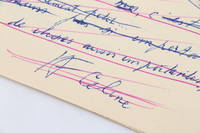
195483743s. l. Meudon 1954. Fine. Céline's Ars Poetica: ""I capture all the emotion on the surface! I cram it into my metro! s. l. Meudon s. d. 1954 10 x 21 cm 34 feuillets Manuscript pages from Conversations with Professor Y' n.p. Meudon n.d. 1954 various sizes from 10x21 cm to 27x21 cm 34 sheets. Autograph manuscript by Louis-Ferdinand Céline 34 sheets of various sizes written in blue and sometimes pink ballpoint pen. Some of the pages are numbered by Céline at top left. The last folio numbered 159 is signed by the writer at the bottom. Two leaves contain previously unpublished passages: the first a few lines long refers to the Professeur. The second leaf numbered 136 features another full-page text on the verso which we did not find in the Professeur Y' or in any of the published works of Céline. Céline refers in this unpublished passage to article 75 of the penal code condemning to the death penalty any French citizen found guilty of intelligence with the enemy. It also mentions a certain ""Me Johann Niels Borggensen"" no doubt a pseudonym for his lawyer Thorvald Mikkelsen: "".supposedly to protect me from police curiosity! holy cow! he was having a ball.when you've got the warrant up your arse crossed out: article 75 anyone can do what they like with you! what a joke! we can do what we like with you.it wouldn't have been Borggensen perhaps someone else would have been worse.give me article 75 and I'll put the whole of France in a Mouse hole for you! and Germany with it! and England such a nag and Europe with it! no bomb needed! H ! Y ! Z ! I'll make you fit the atom into a."" Important set of working manuscripts bearing witness to the writing of Conversations with Professor Y' Céline's true Ars poetica. Since the first part of Féerie pour une autre fois' Fable for Another Time was not as successful as expected Céline wanted to give the release of the second part - Normance - as much publicity as possible and restore his reputation after his years of exile in Germany and Denmark. Instead of writing the usual promotional note prière d'insérer he suggested to publisher Gaston Gallimard this eulogy written in the style of an imaginary interview between himself and Professor Y alias Colonel Réséda a prostatic old man. This zany ""interviouwe"" was published in several parts in the Nouvelle Revue française in 1954 and the finished work through Éditions Gallimard the following year. Céline speaks fervently of his style and his conception of literature and vehemently criticizes the world of letters and public taste. Unlike Céline's other works the genesis of this text crucial to the understanding of his oeuvre is poorly documented and its manuscripts are rare. The Pléiade edition of Celinian novels contains only a few pages of an earlier version very close to the published text. This set of pages covering every passage of the text contains both heavily crossed-out sheets and neatly rewritten notes. It bears witness to the different stages of the writer's work: drafting an initial sheet crossing out and rewriting on the same page then transcribing short passages on separate notes. The last page of the text is extensively crossed out and rewritten resulting in a slightly different version of the published version. The manuscript also contains the famous metaphor of the metro typical of the writer's emotive style compared here to the ""dry language"" of his peers: ""Did you see Have you noticed All caught up in my metro!. what do I leave on the surface. the worst rubbish in cinema!. foreign languages then!. translations!. retranslations of our worst rubbish that they use for their ""parlants"" talking pictures superb foreign languages!. in addition to the psychology! the psychological mumbo jumbo!. all the crap. . Me it's something else! me I'm much more brutal! me I capture all the emotion!. all the emotion on the surface! all at once! I decide! I stick it in the metro! my metro! all t unknown
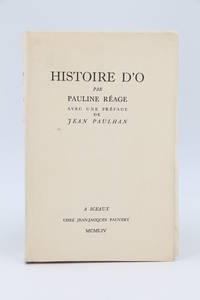
195484226Sceaux: Jean-Jacques Pauvert 1954. Fine. Masterpiece of Eroticism with a Capital O Jean-Jacques Pauvert Sceaux 1954 12 x 19 cm en feuilles sous chemise et étui First edition one of 20 copies on Arches paper most limited deluxe issue tirage de tête. Like all copies on Arches it is wrapped in a double dust jacket in yellow and white and bears the rare sanguine vignette drawn and engraved by Hans Bellmer. Preface by Jean Paulhan. Our copy is housed in a custom clamshell box featuring an original design signed by Julie Nadot. Beautiful first edition copy of this masterpiece of erotic literature in its most limited deluxe issue. Jean-Jacques Pauvert unknown
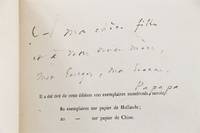
187583705Paris: Michel Lévy frères 1875. Fine. First edition copy of Hugo's political manifesto offered to his grandchildren Jeanne and Georges signed Papapa' Michel Lévy frères Paris 1875 19.50 x 25 cm relié Actes et paroles - Avant l'exil 1841-1851 Words and Deeds - Before the Exile 1841-1851 Michel Lévy frères Paris 1875 195x25cm bound. First edition one of 20 numbered copies on chine most limited deluxe edition of this important collection of speeches public declarations and political texts intended for French parliament Chamber of Peers Constituent Assembly and Legislative Assembly all written - as stated in the title - prior to his exile. These important texts address freedom of the press theater and education as well as the abolition of the death penalty. Half red shagreen binding smooth spine decorated in gilt lengthwise marbled paper boards caillouté pastedowns and endpapers original covers preserved top edge gilt over untrimmed edges. Exceptional and loving signed inscription by Victor Hugo to his daughter-in-law Alice Lehaene - widow of Charles Hugo - and his beloved grandchildren: ""To my dear daughter and your sweet mother my Georges my Jeanne signed: Papapa"" A ma chère fille et à votre douce mère mon Georges ma Jeanne Papapa. ""We called him Papapa. Legend has it - he surrounded us with legends! - that one morning at Hauteville House while he was working in that glass cage perched at the top of the house little Georges came in and said: - Hello Papapa! . To hear the son of his son Charles who had just died pronounce this unknown word the grandfather was overjoyed for he knew the secret language of children: Georges' stammer made him twice a father much more than a grandfather. . My name is Papapa now' he said softly. And until he died my sister and I called him by this dearest name which he always cherished"" Georges-Victor Hugo My Grandfather Mon grand-père Paris: Calmann-Lévy In 1871 after the tragic and unexpected death of his son Charles Victor Hugo became guardian of his two grandchildren Georges and Jeanne. From then on he played a large part in their upbringing and spent some of the happiest moments of his life with them reflected in the countless endearing notes about the two children in Choses vues Things Seen. Upon the death of his last son François-Victor he moved in with Georges and Jeanne's mother Alice at 21 rue de Clichy; on the floor below he lodged Juliette Drouet. This gave him plenty of time to spend with his ""little ones"" for whom he organized children's dinners and made plenty of toys. The children are the subject of his immensely popular poetry collection L'Art d'être grand-père 1877 The Art of Being a Grandfather. ""Its popularity was immediate and its success resounding so dazzling was his way of celebrating childhood by telling the story of Georges Jeanne and himself. By putting children's words into verse so naturally and freshly Georges et Jeanne's ""Papapa"" has succeeded like no other in exalting ""grandparental"" feelings. At home these feelings are not limited to allowing children to leave their toys lying around on manuscripts: when Alice remarried journalist and politician Édouard Lockroy' Simon contributor to Le Rappel Hugo opposed him sharing guardianship"" Sandrine Fillipetti Victor Hugo This inaugural volume of Actes et paroles Deeds and Words containing Victor Hugo's first major political texts is a poignant testimony to his humanist commitments. The ""little"" owners of this precious copy received their grandfather's intellectual and militant legacy: from his ""Discours de réception"" at the Académie française 1841 to his famous stance against Napoleon III ""Révision de la Constitution"" ""No! after Napoleon the Great I don't want Napoleon 'le Petit'!"" which led to his exile. At the heart of this compilation is a highly significant text ""For Charles Hugo. The death penalty"" delivered by Hugo before the Seine Assize Court in 1851 in de Michel Lévy frères hardcover
1920NNMV718NPERSIA IRAN. Very Good. 1920. Hardcover. On offer is an absolutely sensational original set of three 3 historic photo albums circa 1920 with one album identified specifically as 'October 11-29 1920'. This is an outstanding irreplaceable one of a kind collection of approximately 158 period photographs each about 2-1/2 x 1-1/2 inches wherein the photos include: Uman summit of Latakuh Pass the Gilan jungle Lahijan a super photo of a sailing barge on the Chamkhaleh scenes around the Caspian gypsies a Ford vehicle stuck in a pond a mosque in Kasvin the Shah's Palace in Tehran scenes of Baghdad the bringing in of Bolshevik prisoners a shikarchi a muzzle loading rifle the Tomb of Esther and Mordechai a caravan of camels the Persian Army a display of corpses and heads on posts an oil refinery at Abadan Nodeh Shah Suvar and Muskrat plus many many more which makes for one part diary-like experience following this officer and his group and another part an historic photgraphic evidence of the ancient world meeting the modern world and the difficult collision. Careful reading suggests while unidentified the photographer and original owner of the albums was a British officer assuredly future famed author on the Middle East Cecil James Edmonds whose initials are present on most of the pictures and there is a picture of the man himself who has a portrait of his 'batman' and provides many more clues that will assuredly assist researchers in confirming his ownership. Historians collectors and researchers of old Persia and the roots of contemporary Iran will understand that these albums are of no small historic value: in 1920 Persia was at the crossroads of history being the end of one era in their history and the beginnings of another. 1920 saw the new raw Communist regime now the Soviet Union marking the end of old imperial Russia invade northern Persia and establish Soviet satellite states in Gilan the northernmost province of Persia where an independent Soviet Republic was established there under Kuchik Khan with Soviet recognition and military assistance Kurdistan Azerbaijan and Khorasan. With great cynicism a march on Teheran was initiated though supposedly repudiated by the Soviet Government. This was also the start of the Persian Revolution in 1921 wherein Reza Khan Pahlavi overthrew the corrupt Shah Ahmad Mirza and crushed the separatist regimes in Gilan Kurdistan Azerbaijan and Khorasan. Following the coup of Persian General Reza Khan Pahlavi in February of 1921 a peace treaty with the Soviets was ratified and Soviet forces withdrew. This collection of photographs offers an unusual and unique perspective for historians as it is in these photos we see the old world's demise and the modern era conceived. Most of the photos are in excellent condition being sharp and clear. The photo albums are approx. 6 x 4/5 inches ; Photo Album; 6.5 X 4.5 IN.; KEYWORDS: PERSIA PERSIAN HISTORY OF PERSIA IRAN IRANIAN QAJAR SHAH TEHERAN FARSI RHA R.H.A. ROYAL HORSE ARTILLERY THE CHESTNUT TROOP MIDDLE EAST SOVIET INVASION OF PERSIA BEHEADINGS TRAVEL HANDWRITTEN MANUSCRIPT DOCUMENT LETTER AUTOGRAPH DIARY JOURNAL LOG KEEPSAKE WRITER HAND WRITTEN DOCUMENTS SIGNED LETTERS MANUSCRIPTS HISTORICAL HOLOGRAPH WRITERS DIARIES JOURNALS LOGS AUTOGRAPHS PERSONAL MEMOIRPHOTO ALBUM PHOTOGRAPHIC ALBUM MEMORIAL PERSONAL HISTORY antiquité contrat vélin document manuscrit papier Antike Brief Pergament Dokument Manuskript Papier oggetto d'antiquariato atto velina documento manoscritto carta antigüedad hecho vitela documento manuscrito Papel Arabs of Khuzistan Azeris Baluchis Uman Latakuh Pass Gilan jungle Lahijan Chamkhaleh Caspian gypsies mosque Kasvin Shah's Palace Tehran Baghdad Bolshevik Abadan . hardcover
19050009182ABOARD THE HMS PEGASUS AUSTRALIA STATION. Good. 1905. On offer is a sensational historically significant manuscript relic of British naval history being the handwritten journal of F. G. Hedingham a sailor on the British Royal Navy cruiser the HMS Pegasus working in the Australian Station. The back of the front cover reads: Rough notes on the Commission of H.M.S. Pegasus. On the Australian Station. F. G. Hedingham. January 31st 1905. The journal begins Commissioned in Sheerness dockyard on 31st January. 1905. Left the dockyard on the 24th of Feb after repairs to boilers were finished.proceeded straight up to Chatham and into Dry dock the same day.Took in 250 tons of coal in the morning of the 9th and went down the River to Saltpan reach in the afternoon. Raised steam on the morning of the 10th and left Sheerness at 2.20pm and proceeded down Channel. The ship faces rocky weather almost immediately: .had a rough passage all the way out at times in the Bay of Biscay we were only doing about 2 knots an hours. The ship arrives in Gibraltar takes on more coal and see the Duke and Duchess of Connaught. On the way down to Australia the ship stops in Malta Aden Suez Colombo and Batavia. Hedingham gives pretty quick and to-the-point accounts of each day stating larger and more straightforward observations such as weather events ships seen ports left from or sailed to rate of the ship's progress etc. In Batavia a man on the Pegasus dies: Weds: May 10th. We were going to sea at Daybreak this morning but the stoker in the steam-boat got sun-stroke and was carried inboard about 6pm last night he died at 9am this morning. I went to his funeral on shore this afternoon he was buried about 3pm about 1/4 mile from the harbor. The next day it is back to normal going on towards Albany Australia described as a large harbor but not very deep water. With hills all around. The ship moves on to Sydney where the Pegasus gets a number of repairs done on it a process that takes about six weeks. In the meantime Hedingham spends his days in town going to see sports walking around the city going to the National Gallery taking day trips to places like Manley. His days are easy and enjoyable. On September 26 Admiral Arthur Fanshaw hoised his flag as full admiral on the flagship for the first time this morning and the ships in harbour fired the salute. The ship leaves Sydney and goes to Jervis Bay for military exercises then back to Sydney. The ship leaves again a couple weeks later for Noumea the capital of New Caledonia which Hedingham reports: Noumea it has a population of 6000 of which 2000 are blacks. The majority of the houses have only one story can hardly call the town pretty but the country about is very nice. The cemetery is large and well kept with a lot of expensive wreaths. A fire starts on the dock shortly after the Pegasus arrives in Noumea and there are a number of days of a court of inquiry into the cause of the fire. The ship moves on to Port Sandwich at one of the Islands in the New Hebrides. Hedingham continues We have 5 nrs on board as prisoners since we were at Noumea we are taking them down to the Islands for exile as they have committed a murder. The ship leaves Port Sandwich and arrives at the Island of Mallicolo. The Pegasus joins a French ship on the island. What happens next is a sad legacy of European colonialism. Hedingham and a party of about 80 men and officers land on the island and proceed to massacre the local population as revenge for alleged recent murders of French members of the schooner Lily by the natives of this small island. The event is harrowing but is written with the same cool and calm demeanor as all the other entries: .we carried two Maxim guns and the men armed with rifles and bayonets and some with cutlass and revolvers each man carried 120 rounds a small party landed at the same time from the French ship we all line up on the beach and the whole marched off together into the bush the party passed through a friendly village about a mile from the beach and about two miles further on they came to another village a halt was made and about 100 rounds fired from the Maxim and when they came into the village it was deserted.again to another village with the same result the natives firing one or two shots. The village which was called Billias was then set on fire cokeonut trees and fruit trees were cut down and all the wooden idols blown up after.the party marched back again to the other village which was also burned down.steep hills all the while. The ship then moves on to another part of the island landing another armed force on the village and threatening that we would blow the village up if they do not fetch off two others that escaped this afternoon. The natives deliver the men the next day. The ship leaves and goes back to Noumea where Hedingham reports: one of the last two nr prisoners that we took on board jumped overboard in the night and tried to escape but they lowered a boat and brought him back. About a month later another raid and massacre on the natives occurs: As soon as the natives saw that they had got to go with us they started resisting one of the broke away and they shot him down as soon as they heard the shot all the lot made a rush in all directions down the hill they fired at them as quick as they could and several of them fell they ceased firing and all we had was four men and two women. We left those that were shot where they fell and marched back about 2pm. On the way down 2 of the men broke away at different places and were shot. So when we got to the beach we only had two men and two women. The French take the prisoners off with them. Another landing happens a few days later at the town of Atchin in Malekula island. They demand the natives give up their pigs and rifles and the natives give in bringing all together about 24 pigs and about 60 Snider Rifles. This is the last landing as the ship soon goes back to Sydney harbor. There is shore leave in Sydney where Hedingham takes the train to Menangle Australia to shoot rabbits. 1906 begins with more of the same patrolling the Australian station doing military exercises with other ships and remarking on the occasional shore leave regatta or holiday. In April Hedingham gets appendicitis and is holed up in the sick bay for a couple days. There is more patrolling and the occasional landing in New Hebrides or Vanuatu to capture alleged criminals. For example: Wed. June 5th. Landed an armed Party this afternoon and brought off two chiefs to be punished for stealing canoes. Gave them a dozen strokes each in their own village. Beginning in November 1906 the ship begins to head back to England arriving at the end of January 1907. The book is approximately 260 pages in length of which close to 200 pages have writing in them. The covers are marbled paper over board and are faded and speckled especially at the corners. The spine is in fair condition showing wear and tear at the top and bottom. No pages are fully detached from the book but many are detached from the spine. The book still holds together but should be handled with care. The paper especially in the beginning and end shows some foxing and age-toning but not enough to affect the legibility of the content. The handwriting is crisp and clean throughout and the ink is still quite dense fading only at a few points throughout. Background: The HMS Pegasus was one of 11 Pelorus-class protected cruisers ordered for the Royal Navy in 1893 under the Spencer Program and based on the earlier Pearl class. The ship was sunk at the Battle of Zanzibar in 1914. OVERALL: G; Manuscript; 8vo - over 7¾" - 9¾" tall; KEYWORDS: HISTORY OF F. G. HEDINGHAM H.M.S. PEGASUS AUSTRALIA STATION BRITISH ROYAL NAVY PRE WORLD WAR 1 BRITISH NAVY COLONIALISM IN OCEANIA VANUATU NEW HEBRIDES NOUMEA ENGLISH COLONIAL EMPIRE DOWN UNDER OZ AUSSIE SOUTH PACIFIC ANGLO-FRENCH JOINT NAVAL COMMISSION ENGLISH SUBJUGATION OF NATIVE PEOPLES PELORUS-CLASS PROTECTED CRUISER ENGLAND UNITED KINGDOM BRITISH NAVAL DOMINANCE PRE-WW1 OCEANIA BRITANNICA HANDWRITTEN MANUSCRIPT DOCUMENT LETTER AUTOGRAPH WRITER HAND WRITTEN DOCUMENTS SIGNED LETTERS MANUSCRIPTS HISTORICAL HOLOGRAPH KEEPSAKE WRITERS AUTOGRAPHS PERSONAL MEMOIR MEMORIAL ARCHIVE DIARY DIARIES JOURNAL LOG ANTIQUITÉ CONTRAT VÉLIN DOCUMENT MANUSCRIT PAPIER ANTIKE BRIEF PERGAMENT DOKUMENT MANUSKRIPT PAPIER OGGETTO D'ANTIQUARIATO ATTO VELINA DOCUMENTO MANUSCRITTO CARTA ANTIGÜEDAD HECHO VITELA DOCUMENTO MANUSCRITO PAPEL . unknown
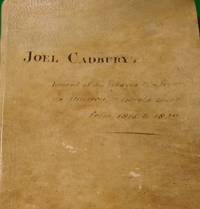
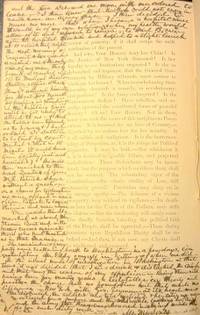
18150002581Good. 1815. On offer is a fascinating historically significant journal handwriten by Joel Cadbury on his journey to post War of 1812 America. The journal sees Cadbury travel from England to the United States travel south to Washington D.C. discussing many of the prescient questions of the early 1800s in America including seeing the U.S. Senate debate the 'Missouri Question'. He travels to Virginia where he sees and is disgusted with the state of slavery and African-Americans on plantations. He visits Mount Vernon and George Washington's tomb and meets by chance the Vice President of the United States Daniel D. Tompkins. While the cover of the journal says "Joel Cadbury's Account of his Voyages to and From American and from its shore from 1815 to 1820" the years of 1815 appear to have been cut out of the book. 4 pages are missing from the very beginning and the journal's first entry is in 1816. The journal begins with Cadbury's journey on the "Ship Mexico" that sailed from England to the United States. "2nd day 8 Mo. 1816. Being the second time we come on board there was a fair freeze but very little of it we got down as far as the Rock this day but the wind dying entirely away we were obliged to drop anchor to keep us from being run on the sands." Cadbury keeps details on what happened on the ship and the many other ships and people interacted with on the journey across the Atlantic. These ships include one heading from Liverpool to Savannah called "the Recovery from New Orleans Captain Barnard bound to Bordeaux she had on board the crew of a Spanish ship bound to Holland which they had taken off a wreck in distress." The ship lands in Sandy Hook New Jersey 'certainly well named for there is nothing but sand on which there are a few evergreens grown." Cadbury heads on horseback to Philadelphia where he meets with family. ' reached my uncle about 2 oclock found my cousins at dinner was exceeding kindly received by them.' The first long entry in the book ends with Cadbury speaking reflexively on his life and journey so far. The next entry 18 pages in length is entitled by Cadbury "A short account of an agreeable excursion taken to Muncy for 3 weeks from 15th of 7th Mo. to of the 8th Mo. 1817 to our Dear Fr'd Mercy Ellis's.' The longest section of the journal is next entitled 'An account of an excursion to the South from 1. Mo. 10 1820 to 2 Mo.' First he goes to Washington D.C. and requests his driver to take him "immediately to where congress was sitting in the finished wings of the Capitol." He then remarks that "the center building tis supposed will be finished and will be one of the most splendid buildings in America." He is referring to the Capitol building which was burned down in the War of 1812 and for which was being reconstructed had started in 1815 and which was continuing when Cadbury sees it in 1820. He writes "you will find us in the Gallery of the Senate been very desirous to hear everything we can on the Missouri Questions not only of great importance but also on account of the results which may issue from any decision on the subject." The Missouri Question he speaks of is the furious debate going on the congress as to whether the state of Missouri should be admitted to the United States as a slave owning state or one in which slavery was abolished. The "Missouri Compromise" ratified in early May 1820 provided for the admission of the District of Maine as a 'free state' and Missouri as a 'slave state' so as not to disturb the power balance between free and slave states. He writes "The Missouri demand on admission into the Union is justified in doing it by the laws of the US the question this is shall she be admitted while her state laws admit for slavery." Though England still had slavery by the time Cadbury was writing he is obviously a virulent abolitionist writing "The inhuman traffic in negroes one party contended tis not constitutions to cripple her in any point while the other say admit her not to join a free congress with slavery in her bosom. She herself demands a curse a yoke which will one day grind her to the dust how blind then are men to their own real interested Strange infatuation murdering their own feelings and intending to murder those of generations unborn for ages to com." Cadbury predicts the a U.S. Civil War writing "Some day if she is not admitted it may cause a division of the States woe to this happy land when this does not take place." He spends much of the time in his journey to the South commenting on the sugar rice and cotton plantations that he sees and the misery that he witnesses in the slaves who work the plantations. "Permit me to copy the following advertisement which was the first thing that struck my eye in turning over a paper in the tavern we are now in: Negroes for Sale The Subscriber offers for sale a bargain 1 Colored Women 28 years 1 colored girl 8 years 1 Colored boy child 7." After this page 3 pages from this section have been cut out. Cadbury "accompanied by James on horse or rather on ponyback and J on horseback" travels to Mount Vernon "Once the residence and now the resting place of the Bones of the General Washington" near Alexandria Virginia. He describes the home and gardens in great detail and visits Washington's tomb. From there Cadbury travels back to Washington D.C. visits the Patent Office "which is really a great curiosity." He visits the House of Representatives and "there with wonder I surveyed the objects which surrounded me with an astonishment called forth by the grandeur which appeared in the inside decorations." The section ends with Cadbury meeting the Vice President of the United States "at the first place I stopped." At the time in 1820 the V.P. was Daniel D. Tompkins who was serving under James Monroe. In the next section Cadbury heads back to England on the Ship Bourier. The section is 20 pages long and accounts the trip back to Cadbury's home in Liverpool. Cadbury spends much of the section reminiscing about the United States and England and its people as well as speaking often about the weather and the speed of the ship. He returns home to a Liverpool that 'looks dark dirty and gloomy every thing appeared very different to what I had anticipated - the houses looked high the Bricks very dark coloured.' The final section a short 11 pages is the 'Journal of my second voyage to the United States in the Ship Lancaster Burkhart for Philadelphia - Sailed the 4th day of Second Month 1821. On this journey he is 'accompanied by my kind & affectionate brother Bevy. This section is written in much less detail than the others. It recounts Cadbury and his brother's trip back to Philadelphia to see their uncle and cousins. 3 pages have been cut off the middle. the section ends abruptly with the brothers still on the ship to America. Many blank pages follow the section suggesting that Cadbury had the intention of finishing the section but never actually did. ; Manuscript; 8vo - over 7¾" - 9¾" tall; KEYWORDS: HISTORY OF JOEL CADBURY BEVERLY CADBURY ENGLAND WASHINGTON D.C. DISTRICT OF COLUMBIA CONGRESS SENATE HOUSE OF REPRESENTATIVES 1815 1820 EARLY 1800s SHIP MEXICO SHIP RECOVERY SHIP BOURIER SHIP LANCASTER BURKHARDT CAPITOL BUILDING MISSOURI QUESTION MISSOURI COMPROMISE SLAVERY FREE STATE SLAVE STATE SLAVES PLANTATION MOUNT VERNON GEORGE WASHINGTON NORTHUMBERLAND PHILADELPHIA ALEXANDRIA VIRGINIA VICE PRESIDENT DANIEL D. TOMPKINS POST WAR OF 1812 ENGLISHMAN TRAVELING IN AMERICA HANDWRITTEN MANUSCRIPT DOCUMENT LETTER AUTOGRAPH WRITER HAND WRITTEN DOCUMENTS SIGNED LETTERS MANUSCRIPTS HISTORICAL HOLOGRAPH WRITERS AUTOGRAPHS PERSONAL MEMOIR MEMORIAL AMERICANA ANTIQUITÉ CONTRAT VÉLIN DOCUMENT MANUSCRIT PAPIER ANTIKE BRIEF PERGAMENT DOKUMENT MANUSKRIPT PAPIER OGGETTO D'ANTIQUARIATO ATTO VELINA DOCUMENTO MANOSCRITTO CARTA ANTIGÜEDAD HECHO VITELA DOCUMENTO MANUSCRITO PAPEL . unknown
18790002377UTICA NEW YORK WASHINGTON DC OLD CAPITOL PRISON 1879. On offer is a sensational original manuscript Civil War relic of no little significant historical content. The author Morven M. Jones 1815-1886; Utica New York was a key player in one of the Civil War's most notorious scandals: allegations of election fraud vote tampering conspiracy leading to the brutal arrest and incarceration of three men; a Union Colonel a Major and the author a middle aged Lieutenant cashiered out as an officer due to the ill effects of his time as a POW working under the auspices of the Governor of New York whilst trying to follow unclear regulations. The case details were published in a pamphlet and researchers and historians will treasure the fact that Mr. Jones wrote his 50 page or so memoir in the broad margins of an early printed edition of this booklet about him and his co-defendants case and the trial: The United States of America vs. Samuel North Levi Cohn and Morven M. Jones the published work names him as Marvin which he corrected in pencil. Writing retrospectively we note his signature at the close of an entry near the end dated 1879 he writes a commentary following the published parts of the trial and at great length about his arrest incarceration and his time and terrible treatment at the Old Capitol Prison especially by the warden William Wood. He also writes about his time during the war conversations he had with President Abraham Lincoln and much much more offering page after page of historical narrative. Here are some snippets: North Jones and Cohn were arrested by Military Police Oct 27 1864 and at once placed in separate close confinement in Old Capitol Prison The cells were close and sultry during the day but the nights were cold and chilly One day I burned a broom handle slowly nearly from end to end for fear of entirely losing fire to kindle with While in the cells we were not allowed to look out of the small windows not even to place our faces to the lower part of the window .Several times when I had my face close to the lower end of the window trying to inhale a little fresh air did I see a musket pointed at my head with the order from the sentinel to get away from that wind several of our soldiers being shot for looking out of the windows of the prison. The windows were the death line and if a prisoner could be seen looking out the order or the practice was to shoot him My wife was one of the most fearless women I had ever known she could assist in an amputation of a soldiers limb with as much coolness as any surgeon in the army while all the tender sympathies of the mother wife and sister combined .soon after our imprisonment Col Foster told my wife she might as well go home that she could do her husband no good by staying in Washington and he would be convicted and sent to state prison whenever she went in the street was under the surveillance of male and female spies and detectives. Her private baggage and clothing was searched several times once by men with shoulder straps she told these that her husband had been an officer He suspected someone was preparing to attempt to escape that evening and if he saw anyone trying to get out there his orders were to shoot him. The attempt was made and the prisoner was shot dead and then Wood after telling the story would laugh at it as a good joke Bill Wood superintendent of Old Capitol Atheist and generally a brute as he was sometimes had good streaks in him at one of the times when North Jones and Cohn had been taken from their cells and put in the large favored room with some 20 to 30 other gentlemen he said to us you damned New York ballot box stuffers have no business here didn't do half as bad things as I did at Baltimore on Election day for I and the other fellows I took with me voted early and often One prisoner by a bold reckless effort escaped in broad daylight although the prisoner was surrounded by 3 lines of sentinels One day an old man and his daughter a good and respectable looking young woman were brought to the prison from West Virginia as hostages for a son and brother who was accused of a crime and with being in the rebel service. The girl was placed in one end of the block alone and there were seldom any but very few females prisoners in that part of the building. Wood used to visit her room ostensibly to obtain some state secrets but it was well known that he was a beast in his passions soon it was known that the girls was very ill of brain fever and was a raving maniac about a week after the body of the poor girl was carried from the prison in a rough box the father was weeping in the prison yard he had not been allowed to visit her during her illness nor was he allowed to see her remains and all of this within almost a stones throw of the Capitol of the United States At one time a colored soldier was brought to the prison under sentence of death by court martial for shooting his wife. He was to be hanged in two days this was the first he had heard of his sentence. He was placed in a cell close by where I was and a colored preacher was sent to prepare him for his doom. Bill Wood said it looked too damned bad that if his death could be put off for a week he would find whiskey and beef steak and the nigger preacher could pray the poor devil right straight into Father Abraham's bosom. Early next morning the day of execution Wood sent the colored preacher in his carriage to ask President Lincoln to defer the execution for a week but the preacher returned saying he could not see the President. wood said no one could keep him out of the White House and he and the preacher started putting the horse to his speed saying the President would very likely interfere and compel them to come again that it would be just as well to hang the man that morning. Wood came back jubilant over his success in seeing the President Lincoln and told the preacher to do his best and pray the nigger in Abraham's bosom When arrested October 27 I was put in a cell with a man charged with passing Confederate money here I was buried out of sight Nov 1 a prison official opened my cell door and ordered to proceed to the prison office as I did with a guard of a soldier with a fixed bayonet On our trial we called for the order for our arrest and it was then By Order of Abraham Lincoln President by HA Stanton Secretary of War a forged or substituted order died the next day after we were in prison May 17 my wife and self with Dr Coventry and Merit Peckham started for Washington on a telegram from JF Seymour this was soon after the slaughter of the Wilderness My wife and myself devoted our time and strength to the 50000 wounded and sick soldiers in the hospitals at Washington. They died there by thousands many recovered or were removed to distant hospitals or were sent home discharged but the places were filled from the battlefield the 50000 cots were full. This was true while Republican soldiers in the hospitals in Washington had no difficulty in having their voting papers certified by officers detailed of the purpose every obstacle was thrown in the way of Democratic soldiers An Oswego Captain whose arm was shattered so that he could but barely write his name and that with much pain and difficulty being a Democrat came from his hospital to the NY agency and for a day or two and took a few votes. For this he was at once dismissed from the service without any ceremony only for helping some wounded democratic soldiers to send home their votes for the old Gen Little Mac and Gov Seymour The next Monday Jones and his traps were taken to cell No 8 where he was put in with a Cincinnati engraver arrested on a charge of counterfeiting in a few days Jones was taken from No 8 and put in cell No 6 where he found Col North alone and Sick The next day Wood called for Cohn and invited him to take a ride took him to the Treasury where they stopped fora few minutes and then drove on to the White House with as much freedom as tho he had owned the White House Bill Wood invited Cohn upstairs to see Old Abe they were shown into a small room and there Cohn found the President Col Foster the Judge Advocate and Clephane the recorder of the military court the two men who had imposed themselves upon Jones in the Prison Office 25 days before. The whole trick and conspiracy were apparent at a glance After an Introduction President Lincoln with Foster Clephane and Wood present says President Lincoln you Mr Cohn are one of these New York prisoners arrested for fraud as to soldiers votes now if you will make a full statement of all you know about those matters you need not go back to prison but shall be discharged from this moment. Cohn replied that he knew nothing in regard to those matters but what he was willing to tell there or anywhere. Pres Lincoln then repeated what he had said that if Mr Cohn would then state what he knew he should then and there be discharged Mr Cohn then gave a history of all he had known or see with regard to voting at the NY Agency and elsewhere When Mr Cohn had completed his statement President Lincoln said Mr Cohn I don't see as you have hurt anybody nor could I if I told the truth was Mr Cohn's reply. The President then dismissed Cohn and Wood and Cohn started downstairs supposing that he was free according to Pres Lincoln's promise Oh No says Wood you will have to go back to prison until your statement is written out for you to sign and then you will be discharged The McClellan meetings seemed to be the largest and most enthusiastic a large portion of the soldiers were for little Mac on one evening the Republicans had a very large torch procession helped greatly by niggers and as it passed up Pennsylvania Avenue one of the helpers at Old Capitol Prison set fire to and burned the large National Flag hanging across the avenue in front of the Democratic Headquarters Toward the latter part of Oct President Lincoln became quite confident of carrying New York. in cases of outrage in cases calling for sympathy or investigation President Lincoln heard and ears were more open than any member of his cabinet and yet no one democrat nor republican was allowed to approach him in regard to North President Lincoln was made to see and feel how much he was indebted to the Sewards Fenton and the few other arch conspirators and to be made a tool of as in Cohn's case bringing down the dignity of the Presidency to the dirty work of a detective The President and those below him made such efforts to find or invent something which might be used in getting out of the dilemma The prosecution had sent its spies all over the state of New York to find if possible some weak point in the characters or records of the Defts it would be policy not to produce before a court of decent Army officers had stakes its reputation upon being able to prove monstrous frauds as to soldiers votes.one the day the trial was concluded Maj General Doubleday President of the court pronounced the whole thing a farce Half of Grant's army would have been transferred from Petersburg to Albany the plans were formed to capture Gov Seymour and only failed in execution the object was to carry the state for Lincoln and Fenton. Suspicion and doubts were thrown around the democratic soldiers votes sent home I then took passage for Fortress Monroe with one assistant feeling disposed to fight out the question of a NY agency on that line if it took all summer arriving in James River. We were all stopped by Gen Butler's orders. After being arrested by a lot of drakes as a Virginia rebel because I wore a light gray suit I made my way back to Washington with six physicians and four assistants and over six hundred dollars in hospital stores I started for City Point intending to establish an agency where New York soldiers would be looked after and cared for some as soldiers of other states on arriving at City Point obstacles were immediately thrown in the way of landing my good s and storing them. We arrived at City Point in PM of 22nd and were directed back a mile or two to the main camp where are found lodgings in tents. The next morning all of the physicians were ordered to duty as common nurses in various corps hospitals and our six physicians were assigned to duty as such Our guards kindly marched us aboard the steamboat and with many curses against those who had treated us in that manner at that time it was decided that I was drunk and sutured the camp and that was the reason for my expulsion " Overall G. BIO NOTES: Morven M. Jones fought in the Civil War for the Union in the 2 New York Heavy Artillery Regiment. He entered the war with the rank of 1 Lieut. and left with the rank of 1 Lieut. Company M mustered in December 12 1861. Jones was the former Chief Clerk Office Secty of State NY; one of the founders and organizers of the Oneida Historical Society; "attorney autograph collector and victim of one of the most scandalous political trials of the Civil War." HISTORICAL NOTES: Wiki: Old Capitol Prison 1861-1867 With the start of the Civil War in 1861 the Union repurchased the building to use as a prison for captured Confederates as well as political prisoners Union officers convicted of insubordination and local prostitutes. Many people arrested following the assassination of President Abraham Lincoln were also held here. These included Dr. Samuel Mudd Mary Surratt Louis Weichmann and John T. Ford owner of Ford's Theater where Lincoln was shot. The adjoining row of houses Duff Green's Row was also used as part of the prison. Famous inmates of the prison included Rose Greenhow Belle Boyd John Mosby and Henry Wirz who was hanged in the yard of the prison. Good. 4to - over 9¾" - 12" tall. Manuscript. hardcover
19470008116Jerusalem Israel British Mandated Palestine. Good. 1947. On offer is a unique historically significant journal handwritten during the final days of British Mandated Palestine most entries made immediately prior to the Declaration of Independence. This is a one-year page a day journal for the Jewish year of 5708 September 1947 to October 1948 has about 50 entries with most entries made between September 1947 and December 1947 and few brief records scattered over the next few months - the last one is dated June 7. It measures 7' by 5' the hardcover is slightly soiled but otherwise the journal is in very good condition. The text is in Hebrew the handwriting is mostly legible. Author's name is not identified but there is a note on the front page: "Vaad Hakehilla. Hanala Klalit" Local Community Council. General Management. It is clear from this note and from the context that the journal was kept by a member of the Hebrew Community Council in Jerusalem the body that was established in 1917 and coordinated and represented different groups of Jerusalem Jews during the British Mandate. Vaad Hakehila was responsible for different aspects of Jewish life in the city including economic and social assistance to the residents. It had a social services department and a society of assistance to kindergartens issues related to them are mentioned in the journal several times. Most entries are the minutes of the Council meetings. Some entries deal with organizational and financial matters taxes elections complaints dispute settlement work of social services purchase of fire engines but most meetings reflect increasingly tense situation in the city and concern food and fuel supply food rationing security and organizing Mishmar ha'am National Guard - unit of volunteers established in September 1947 in Jerusalem for maintenance of public order. The Council was constantly in contact with the state authorities political and religious leaders various Jewish organizations trying to solve various problems facing Jewish community in the city. Among the names mentioned in the journal are Yitzhak Ben-Zvi David-Zvi Pinkas a Zionist activist politician a signatory of the Declaration of independence and a future minister Mordechai Shatner a signatory of the Declaration activist and politician one of the founders of Yad Va-Shem who then was a member of the Jewish National Council Ben-Zion Meir Hai Uziel the Sephardi chief rabbi of Mandatory Palestine who appeared before the Mandatory government as representatives of the Jewish community and on missions on its behalf Itzhak HaLevi Herzog the first Chief Rabbi of Ireland and then the Ashkenazi Chief Rabbi of Mandatory Palestine and of Israel Menashe Elassar a noted Jerusalem businessman and many other. The first entry is dated September 15 and mentions a meeting with Mr. Ben-Zvi who had been the President and a member of the Vaad Haleumi the National Council a post in which he served as the chief representative of the Jewish community vis-a-vis the mandatory authorities. His name is mentioned several times throughout the journal in relation to various matters. A council meeting on September 17 dealt with several issues including social work and house confiscation order of the Babayoff family: "Military Commander refused a request to postpone confiscation order for the Babayoff's House till after the holidays . Chief Rabbi Uziel was asked to speak with the commissioner about postponement of the confiscation order. Rabbi Herzog was also asked to speak with the Military Commander regarding the same matter". Many entries mention searches conducted by the British Army in Jewish neighbourhoods one of such searches on Yom Kippur Eve finished with desecration of a synagogue: "Search in Nachlat Zvi Jerusalem neighbourhood. After we received information regarding the desecration of the synagogue by the army during their search R' Nattan and I went to check if the information was correct. We reached the location after the search had finished and the army left the place. All the synagogue benches the tables chairs and pillows were upside down. All of the study books Mishnayot Zohar Gemaras were scattered on the floor. The holy ark was open and the Torah scrolls were open ." Some of the entries refer to property damage caused by bombings that the council members were assessing: "After the two nights that passed in Jerusalem Shabbat night and Motzei Shabbat when tens of thousands of bullets were shot towards the all the Jewish areas of the city I got up early . to visit the places that were the primary targets of the bullets of the police and soldiers. The primary target was again the homes near the police dormitory in the hospital of the English Mission. The view of the horrifying sight of the destruction caused to these homes and the miracle that nobody's life was taken . testimonies were collected from dozens of people."Nov. 16. One of the constant subjects was ensuring food and fuel supply in the city: "Meeting of the supply committee with bakery owners to ensure sufficient flour supply in case of emergency" ".To bring all wholesalers and demand from them to increase supplies in Jerusalem." they meet with members of the Jewish National Council JNC and devote many meetings to this matter. As part of their activity they meet with mukhtars heads of Arabic neighbourhoods. Va'ad had limited means to cope with the worsening situation and in December the Jerusalem Emergency Committee was set up that took upon itself civil administration of Jewish Jerusalem which explains why there are almost no entries after November. Though it includes only about 50 entries of varying length the journal provides a lot of details from the months preceding the Declaration of Independence and contains names of many people who played an important role in creation of the Israeli State. Overall it's a fascinating document of the life of Jewish community in Jerusalem during the last months of the British Mandate and activity of the Jewish Community Council in Jerusalem.; Manuscript; 12mo - over 6¾" - 7¾" tall; KEYWORDS: HISTORY OF 20TH CENTURY 1940s POST-WW2 ERA MIDDLE EAST ISRAEL JERUSALEM JEWISH QUARTER CREATION OF ISRAEL JEWS OF JERUSALEM BRITISH MANDATE DECLARATION OF INDEPENDENCE MANDATORY PALESTINE BATTLE OF JERUSALEM 1947 BOMBINGS IN JERUSALEM JEWISH SELF-GOVERNING BODIES IN MANDATORY PALESTINE MISHMAR HA'AM NATIONAL GUARD IN JERUSALEM LOCAL COMMUNITY COUNCIL IN JERUSALEM VA'AD HAKEHILA VAAD HAKEHILA JERUSALEM LOCAL AUTHORITIES LEADERS OF JEWISH COMMUNITY OLD CITY PARTITION BRITISH ARMY IN MANDATORY PALESTINE SOCIAL SERVICES DURING THE BRITISH MANDATE ISRAEL BEFORE INDEPENDENCE SELF-GOVERNMENT OF JEWS IN JERUSALEM JEWISH COOPERATION WITH BRITISH ADMINISTRATION IN PALESTINE YITZHAK BEN-ZVI DAVID-ZVI PINKAS MORDECHAI SHATNER END OF THE BRITISH MANDATE FOOD RATIONING IN JERUSALEM FOOD SUPPLY TO JERUSALEM ZIONISM ZIONIST ACTIVISTS JEWISH NATIONAL COUNCIL JNC VAAD HALEUMI 1947 JERUSALEM RIOTS JERUSALEM RELIGIOUS LEADERS HEBRAICA JEWISH HISTORY HANDWRITTEN MANUSCRIPT DOCUMENT LETTER AUTOGRAPH WRITER HAND WRITTEN DOCUMENTS SIGNED LETTERS MANUSCRIPTS DIARY DIARIES JOURNALS PERSONAL HISTORY SOCIAL HISTORY HISTORICAL HOLOGRAPH WRITERS AUTOGRAPHS PERSONAL MEMOIR MEMORIAL ANTIQUITÉ CONTRAT VÉLIN DOCUMENT MANUSCRIT PAPIER ANTIKE BRIEF PERGAMENT DOKUMENT MANUSKRIPT PAPIER OGGETTO D'ANTIQUARIATO ATTO VELINA DOCUMENTO MANOSCRITTO CARTA ANTIGÜEDAD HECHO VITELA DOCUMENTO MANUSCRITO PAPEL . hardcover
102885Original bronze bust of Ulysses S. Grant by Henry Shrady the famed sculptor of the Ulysses S. Grant Memorial on the west front of the United States Capitol in Washington D.C. Mounted on socle and base the entire piece measures 18.5 inches in height. In fine condition. An exceptional piece of Americana. Henry Merwin Shrady was an American sculptor known for the Ulysses S. Grant Memorial on the west front of the United States Capitol in Washington D.C. Shrady and architect Edward Pearce Casey won the competition to build the Ulysses S. Grant Memorial in 1902. In the twenty years Shrady spent executing its sculpture program he studied biology at the American Museum of Natural History and dissected horses to gain a better understanding of animal anatomy. The memorial was dedicated on April 27 1922 two weeks after Shrady's death. The Grant Memorial is described as "one of the most important sculptures in Washington" by James M. Goode in The Outdoor Sculpture of Washington D.C. It consists of a colossal equestrian statue of Grant atop a marble pedestal with bas relief plaques guarded by four lions. unknown books
102885Original bronze bust of Ulysses S. Grant by Henry Shrady the famed sculptor of the Ulysses S. Grant Memorial on the west front of the United States Capitol in Washington D.C. Mounted on socle and base the entire piece measures 18.5 inches in height the base measures 9.5 inches square. In fine condition. An exceptional piece of Americana. Henry Merwin Shrady was an American sculptor known for the Ulysses S. Grant Memorial on the west front of the United States Capitol in Washington D.C. Shrady and architect Edward Pearce Casey won the competition to build the Ulysses S. Grant Memorial in 1902. In the twenty years Shrady spent executing its sculpture program he studied biology at the American Museum of Natural History and dissected horses to gain a better understanding of animal anatomy. The memorial was dedicated on April 27 1922 two weeks after Shrady's death. The Grant Memorial is described as "one of the most important sculptures in Washington" by James M. Goode in The Outdoor Sculpture of Washington D.C. It consists of a colossal equestrian statue of Grant atop a marble pedestal with bas relief plaques guarded by four lions. unknown
1784101412Philadelphia May 5th 1784. Rare autograph document signed by George Washington as President of the Society of the Cincinnati during the first general meeting of the Society and 5 years prior to his election and inauguration as the first President of the United States of America. One page partially printed on vellum with engraved vignettes by Auguste L. Belle after Jean-Jacques <span class="match">And</span>re LeVeau depicting America in knight's armor trampling upon the British st<span class="match">and</span>ard <span class="match">and</span> the American eagle casting the British lion <span class="match">and</span> Britannia out to sea with thunderbolts engraved seal of the Order of the Cincinnati. The document reads: Be it known that Lieutenant William Andrews is a member of the society of the Cincinnati instituted by the Officers of the American Army at the Period of Dissolution as well to commemorate the great Event which gave Independence to North American as for the laudable Purpose of inculcating the Duty of laying down in Peace Arms assumed for public Defence and of uniting in Acts of brotherly Affection and Bonds of perpetual Friendship the Members constituting the same. In Testimony whereof I the President of the said Society have hereunto set my hand at Philadelphia in Pennsylvania this fifth day of may in the Year of our Lord One Thousand Seven Hundred and Eighty Four and in the Eighth Year of the Independence of the United States. By Order " "H.<span class="match">Knox</span>" Secretary "G. Wahsington" President. William <span class="match">And</span>rews was commissioned a lieutenant on 1 January 1777 with the Third Continental Artillery. His regiment wintered at Valley Forge <span class="match">and</span>the following June <span class="match">And</span>rews was captured <span class="match">and</span> held by the British in New York until he was exchanged in September 1781. In fine condition. Double matted and framed with an engraved portrait of Washington. The entire piece measures 36 inches by 23 inches. An exceptional example. Conceived of by Henry Knox in an effort to establish a fraternal organization for all officers who had served in the American War for Independence The Society of the Cincinnati was founded in early May 1783 at the headquarters of General Friedrich Wilhelm von Steuben at Verplanck House in Fishkill New York. The three guiding principles of the organization were: First "An incessant attention to preserve inviolate those exalted rights and liberties of human nature for which they have fought and bled. ." Second "An unalterable determination to promote and cherish between the respective States that union and national honor so essentially necessary to their happiness and the future dignity of the American empire." And third "To render permanent the cordial affection subsisting among the officers. This spirit will dictate brotherly kindness in all things and particularly extend to the most substantial acts of beneficence according to the ability of the Society towards those officers and their families who unfortunately may be under the necessity of receiving it." The concept of using Cincinnatus as an emblem of the Order was particularly resonant with Americans since the life of this mid-fifth century Roman nobleman and farmer closely paralleled that of many who had served with George Washington in the vanguard. Lucius Quinctius Cincinnatus was called upon to repel two hostile tribes that threatened Rome. He issued his orders which were efficiently carried out and vanquished the enemy. Although elected a dictator for six months and voted a triumph by the Senate Cincinnatus stepped down just after fifteen days and returned to private life on his farm. Similarly at the conclusion of hostilities Washington returned to his plantation at Mount Vernon. hardcover books
187174060Philadelphia: W.S. Turner 1871. Rare first <span class="glossaryQtip qTip">edition</span> of the first Jewish cookbook published in America with extensive instructions on keeping a kosher household in addition to recipes.<i> </i>Octavo original cloth. In very good condition rebacked. Housed in a custom half morocco clamshell box. First editions are exceptionally scarce of this milestone in American Jewish history. The introductory sections provide an overview of kosher dining household economy and table-setting. Later sections include household tips "to cement broken china" "to revive the color of black silk" lists of seasonable foods by month and a two-page summary of the Jewish calendar. A longer section titled "Hints for Housekeepers" suggests a weekly routine in detail. For Sunday dinner Levy points out that "this is the day the husbands are at home then something good must be prepared in honor of the lords of the household." Most of the book consists of recipes as expected including some classics from Jewish cuisine. Macaroons matzo cleis soup German kouglauff kugel grimslechs chremslachs and "potato souffle for Passover." Some recipes have apparently been adapted from American neighbors such as macaroni hominy fritters and "ochre soup or gumbo" which is reported to be "much used in the South." Throughout Levy's recipes are more impressionistic than scientific pepper pot soup: "in a pint and a half of water put such vegetables as you wish . . . cut them very small and stew them with a couple of pounds of mutton and a piece of nice beef" and the requirements of kashrut are strongly emphasized. "This book offers us a vivid look into the daily lives of the American Jewish community just before the period of its most rapid growth. In the recipes you can see the dynamic between the requirements of keeping kosher the cultural traditions brought over from Europe and the American ingredients at hand but it's also rich in detail on the day-to-day management of a 19th-century Jewish household. It's an interesting and important cultural document" Rick Stattler The New York Jewish Week. Only one copy listed in OCLC. W.S. Turner hardcover books
19070001420PURNODE BELGIUM THE HAGUE NETHERLANDS GENEVA. Very Good. 1907. On offer is a sensational archive of historically significant original manuscript diaries of Stanley Thomas Cross an well placed employee of the BBC British Broadcasting Company acting as a 'switch-censor' at the League of Nations Permanent Court of International Justice and United Nations International Court of Justice at The Hague under Edvard Isak Hambro b.1911 - d.1977; was a Norwegian politician; the 25th President of the United Nations General Assembly 1970 - 1971 and also served on the UN's International Law Commission from 1972 to 1977. The historical significance of the diaries is inestimable as they provide primary information on the day-to-day inner workings of the Court of Justice over a period of 25 years spanning the Second World War as well as of the activities of a wartime BBC 'switch censor'. Cross does a super job of describing his employment at the League of Nations 'jet-setting' for the BBC between London England; Geneva Switzerland; The Hague Holland and Purnode Belgium plus other exotic locales. By diarizing his own life he also captures much of the work he does for Edvard Hambro providing an almost parallel `biography` of Hambro`s work. Over 35 volumes from 1907 - 1950 lacking 1914-1919 1940 1945 1946 Cross over writes most days misses some but collector's researchers and historians of the era International law and post-World War I Europe will find a treasure trove of insider details. The diaries are written by a cultured educated individual in international affairs though he is not afraid to let his prejudices` show: on November 15th Cross is present at the first session of the General Assembly at its new headquarters in Geneva 'I wore the old tail coat got for H T Cs wedding for the third time in my life'. On 12 May 1936: 'Council met 1700-1800 re Ethiopian affair. Ital delegation left Geneva!!' On 3 September 1924: 'Exciting day at Court. Election of President for 1925-7. Loder to be reelected & was exceedingly upset with result & in my opinion behaved in a contemptible & undignified manner. Moore was the best candidate but there were always 4 votes stoutly opposed to him I suspect coming from the Jap & the 2 S. American Dagos. . To day Thursday morning Loder who had been talked to by Finlay announced that he withdrew his candidature; Moore did the same that being the bargain between them. After several more ballots & another adjournment Huber was elected President much against his wishes.' He describes the effects on London of German bombing. On 11 May 1941: 'Left Blackheath 1630 had to take several trams & buses to get to town because of results of Blitz. Crossed Lambeth Bridge on foot. Most of London Bridges closed. Ho of Commons Westmr Abbey Deanery & other buildings have been hit. Also Big Ben but it still functions.' 13 May 1941: 'Had to do a Belgian transmission 9am Then for a walk to see results of blitz. Ludgate hill lower part S. Side K. William Street Gt Tower St Gresham St & Newgate especially. Old Bailey & "Divisions" blitzed. Also Bartlett's Buildings.' BIO NOTES: Stanley Thomas Cross c.1884 - 1950 was educated at Christ's Hospital London and Pembroke College Oxford. After a period as a schoolmaster and service in the Great War he worked as a translator at the League of Nations Permanent Court of International Justice at The Hague. On the outbreak of the Second World War he was employed at the BBC in London as a 'switch censor'; at the end of 1944. By 1947 he was back translating at The Hague where he worked closely with Edvard Isak Hambro later President of the U.N. by whom he was held in high regard. Thereafter he returned to the Hague where he worked at the Registry of the United Nations International Court of Justice until his retirement in 1949. In August 1949 Cross retired to Purnode where beset with money worries he died six months later. Loosely inserted in the last volume is a manuscript account 4to 1 p by Cross's wife Alice of his last day and death after an attack of angina. Mostly 12mo the first six are uniform by W. Straker Ltd of Ludgate Hill; the rest 'Boot's Home Diary' in various colours and slightly larger format from 1939. All in good condition: lightly-aged and with a few preliminary leaves not containing diary entries torn out by Cross from the volumes for 1920 and 1921. Later volumes with accounts at end. Overall VG.; 12mo - over 6¾" - 7¾" tall; KEYWORDS: HISTORY OF STANLEY CROSS LEAGUE OF NATIONS THE UNITED NATIONS BBC BRITISH BROADCASTING COMPANY EDVARD ISAK HAMBRO UNITED NATIONS GENERAL ASSEMBLY NORWEGIAN NORWAY CINEY-PURNODE BELGIUM THE HAGUE INTERNATIONAL COURTS GENEVA SWITZERLAND INTERNATIONAL LAW UN WORLD COURTS HOLLAND THE NETHERLANDS POST WORLD WAR I WORLD WAR ONE WWI WW1 WWII WORLD WAR II WORLD WAR TWO WW2 VADE MECUM HANDWRITTEN MANUSCRIPT DOCUMENT LETTER AUTOGRAPH DIARY JOURNAL LOG KEEPSAKE WRITER HAND WRITTEN DOCUMENTS SIGNED LETTERS MANUSCRIPTS HISTORICAL HOLOGRAPH WRITERS DIARIES JOURNALS LOGS AUTOGRAPHS PERSONAL MEMOIR MEMORIAL PERSONAL HISTORY TRAVEL 20TH CENTURY antiquité contrat vélin document manuscrit papier Antike Brief Pergament Dokument Manuskript Papier oggetto d'antiquariato atto velina documento manoscritto carta antigüedad hecho vitela documento manuscrito Papel . unknown