48 402 résultats
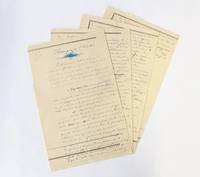
18960002337FEZ MOROCCO CASABLANCA SAHARA DESERT NORTH AFRICA. Very Good. 1896. On offer is a simply sensational riveting original very intriguing significant manuscript autobiography dated Dec. 27 '96 1896 of a young Muslim boy who recounts over 69 or so pages his birth on the sands of the desert near Fez and his enslavement and eventual repatriation. The details of his life a nothing short of remarkable for readers in the 21st Century: his parents; a father of immense piety his mother an outcast of her tribe and himself a young boy who would eventually watch his father and his mother be murdered separately. Historians and researchers will find a fascinating and arguably an unparalleled first-hand account of this boy's life under Islamic Code and his utterances provide a full understanding of his beliefs and the guidance they provide his humanity. Even a casual read reveals an eyebrow raising narrative: after the murder of his father by the Sultan's soldiers and his mother by robbers he was taken captive as a slave and apprenticed to a gunsmith who finished guns for the Sultan's army. The unidentified author and some other slaves were apprenticed to the Sultan's gunsmith and were at one time sent to America where they were to work in what appears to be the Winchester Gun Factory in order to learn the art of gun making - to provide better guns for Sultan's army. The details of travels suffering and cruelty are all related but in a quick paced to the point manner. After returning from his training he was returned to his master at Casablanca. It appears that the author escaped slavery around this time and eventually returned to his homeland in the Sahara Desert where he had a deep religious experience and felt the call of Allah on his life to become a hadji like his father. With this call he sought out the place where his father had lived to claim that dwelling as his own. The manuscript begins: "I was born on the sands of the Sahara where the caravans come up from Timbuctoo. The white sands that stretch away from the mountains on the West toward the end of the world behind these mountains there is nothing and no one has been there but towards the East one may go as far as Mecca and become a Hadji as was my father. All this is the land of the true believer where he may hear and obey the call of the Prophet and live in the true faith. The sun shines there always and there are no rains as in other lands to torment the faithful. If clouds come it is but to chase their shadows on the sunlit sand. My father was a saint and lived in a white tomb overlooking the plain and near the ___ of the great caravan . . . . He was a holy man who made the journey to Mecca many times. Sickness and death did not molest him so that he knew he was accepted of Allah and waited only the call of the Prophet. . . . . It was caravans from the south that were the most interesting for thy brought the slaves that should serve the faithful at Fez and Wazan. As true believers we could rejoice at their captivity for they would be converted. They were mostly in chains each with a heavy ring about his neck from which a chain extended to a ring upon the neck of his neighbour and there were always some rings without necks by counting which you might know how many had died in coming through the desert. My father thought that all should be killed as infidels hateful to Allah intolerable to the faithful but the people of the caravans thought not so claiming the example of Mohamad who spread the faith by conquest." We learn that his father's piety was also his downfall as he was enraged by an infidel Englishman travelling under the Sultan's protection and after he raised a knife to attack the infidel he was summarily destroyed by the Sultan's troops. His mother died within days at the hand of robbers who stole the camel she was given as a blood libel payment. The boy's description of the Englishman's attitude of the blood libel payment is near comedic if it was not so insensitive to the local custom. Toward the conclusion of the 69 page manuscript is the following interesting statement regarding the author's account of his experiences. After describing his having found a place of safety in the mosque of Edris he writes "Not far away is the house of the books of a thousand years near which dwells the scribe who has written this for me to send to the head man a Lida Winster Winchester gun house. A gun maker in the old street goes shortly to see Caid Cobb at Cassablanca. I know not why he has promised to give the Caid this writing to be sent to the head man also to say to the Caid that the man who made it was dead." The work closes with the following: "Soon the rains will be over and then I will walk southward to the place where my father dwelt and seize the tomb in which he lived for it is my right. There only is the land of the true believer where he may hear and obey the call of the prophet. There he needs neither mosque nor Caid for he has the protection of the white sand of the desert and its rainless sky." We note there is what we believe is a later ownership inscription with the name J.G. Bennett 258 Church Street. Research suggests this was likely the noted Islamist John Godolphin Bennett who may have received the book after as the book relates it was sent to the head man at Winchester. The manuscript is written in a ledger style book with black boards and red morocco spine cover and corners. The spine cover is missing. Wear to extremities and fading in one area on the upper front panel corner. The early pages are alphabetized followed by 245 pages of very thin paper. The biographical account is written on the first 69 pages are upon this thin stock. With a few exceptions the back of each page is blank. The work is entirely in pencil with corrections made here and there as will be noted in the accompanying scans. The pages are all intact with only the first page showing a small separation from the inner hinge. The last page blank is mostly missing---no writing evident on this page. The covers are loose and there is weakness in the spine but nothing that affects the text. Occasional light brown age spots otherwise the pages are quite clean. Overall G.; Manuscript; 4to - over 9¾" - 12" tall; KEYWORDS: HISTORY OF J.G. BENNETT 258 CHURCH STREET JOHN GODOLPHIN BENNETT MUSLIM SLAVE BOY RABAT FES MEKNES SLAVERY WINCHESTER FIREARMS 19TH CENTURY SLAVERY TRUE TALES OF BONDAGE SLAVING SLAVE MASTER LIFE IN BONDAGE GUNS GUN MAKING WINCHESTER GUN FACTORY SAHARA NORTH AFRICA MOROCCO WINCHESTER REPEATING ARMS COMPANY NEW HAVEN CONNECTICUT FEZ ISLAM ISLAMIC ISLAMISTS SHARIANOMADS NOMADIC PEOPLES NOMADIC TRIBES BEDOUIN HANDWRITTEN MANUSCRIPT AUTOGRAPHED AUTHORS DOCUMENT LETTER AUTOGRAPH KEEPSAKE WRITER HAND WRITTEN DOCUMENTS SIGNED LETTERS MANUSCRIPTS HISTORICAL HOLOGRAPH WRITERS AUTOGRAPHS PERSONAL MEMOIR MEMORIAL PERSONAL HISTORY ARCHIVE DIARY DIARIES JOURNAL LOG PRIMARY SOURCE FIRST HAND ACCOUNT SOCIAL HISTORY PERSONAL STORIES LIVING HISTORY ANTIQUITÉ CONTRAT VÉLIN DOCUMENT MANUSCRIT PAPIER ANTIKE BRIEF PERGAMENT DOKUMENT MANUSKRIPT PAPIER OGGETTO D'ANTIQUARIATO ATTO VELINA DOCUMENTO MANOSCRITTO CARTA ANTIGÜEDAD HECHO VITELA DOCUMENTO MANUSCRITO PAPELBIOGRAPHY BIOGRAPHICAL AUTOBIOGRAPHICAL AUTOBIOGRAPHY PERSONAL NARRATIVES . hardcover
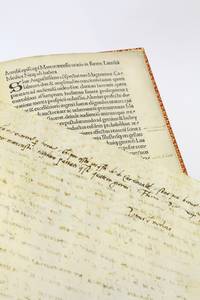
149262206Milan: Philippus de Mantegatiis 1492. Fine. Philippus de Mantegatiis Milan s. d. après le 8 avril 1492 et s. d. 1493 20.80 x 13.80 cm relié Oratio in funere Laurentii de Medicis habita. With an autograph letter signed by Piero II de' Medici to Dionigi PucciPhilippus de Mantegatiis Milan n. d. after April 8 1492 208 x 138 cm 8 f. Sig: a8 later morocco & for the letter n. d. 1493 22 x 30 cm 1 page and a few lines on a folded leave First edition of the eulogy of Lorenzo de' Medici said by Aurelio Bienato bishop of Martorano Catanzaro Calabria on 16 April 1492 in the church of Santa Maria la Nuova in Florence eight days after the prince died. This eulogy is followed by a short eight-verse poem. This is the only printed eulogy of Lorenzo the Magnificent John McManamon Funeral Oratory and the Cultural Ideals of Italian Humanism 1989. 19th century binding full red morocco. Several brackets and handwritten notes from then. Ex-libris of Prince Piero Ginori Conti 1865-1939 an Italian businessman and politician on the first pastedown. Ex-libris of Gianni de Marco's Library. Opposing a complete different approach from the usual laudatory praises Aurelio Bienato introduces Lorenzo the Magnificent as a modern prince a European model a patron of arts and literature but also a guarantor for peace in Italy. The purpose of his text is above all political: he underlines and praises the recent diplomatic ties between Florence and Naples enabling Lorenzo the Magnificent to establish his power over the Florentine city. This volume comes with an autograph letter signed by Piero de' Medici son of Lorenzo the Magnificent addressed to Dionigi Pucci himself a diplomat and friend of the sender. 28 lines written in a fine and slim writing. Address of the recipient at the back of the second leaf. Wax seal marks. Light brown spotting. In this letter Piero the Unfortunate claims his allegiance to Ferdinand II of Aragon king of Naples. Actually as he was writing this letter he had already reached a neutrality agreement with Charles VIII King of France who was about to capture by force the realm of Naples he considered his. Despite this agreement Piero II de' Medici was nonetheless compelled to surrender unconditionally and seek exile in Venice: this is the beginning of the first Italian war. In two years on the throne he destroyed everything the Medici dynasty had built during the former century. Rare collection of documents evoking the climax and the dawn of decay of the mighty Medici dynasty the most influential family of the Italian Renaissance. Philippus de Mantegatiis unknown
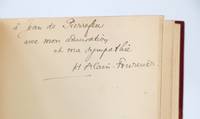
191386453Paris: Emile-Paul frères 1913. Fine. Surprising inscription to the editor-in-chief of L'Opinion Emile-Paul frères Paris 1913 12 x 19 cm relié First edition with all the features of first issue copies one of 300 first issue copies on alfa satiné paper numbered at the press and reserved for the author. 3/4 half red morocco binding spine with five raised bands framed in black gilt date at foot marbled paper boards marbled paper endpapers and pastedowns original wrappers and spine preserved top edge gilt elegant binding signed by Devauchelle. Rare inscribed copy by Alain-Fournier to writer and journalist Jean de Pierrefeu: À Jean de Pierrefeu avec mon admiration et ma sympathie. H. Alain-Fournier To Jean de Pierrefeu with my admiration and sympathy. H. Alain-Fournier. A very surprising inscription to the editor-in-chief of LOpinion who first offered to publish this novel in February 1913 through Henri Massis. The offer was ultimately redacted after being rejected by the magazines other editors. Thanks to his longtime friend Jacques Rivière young Alain-Fournier managed to get a pre-first edition serialized version of this novel published in the Revue de la Nrf. In the end the small publishing house Emile-Paul agreed to issue the finished work in volume in September. The immediate success of this masterpiece of 20th-century French literature must have somewhat ruffled the feathers of Jean de Pierrefeu who wrote a bitter and ambivalent review: I would have liked Alain Fournier to stop his story at the moment of his departure for Paris. we would have been quite happy to accept that this slightly mad and fanciful tale should remain unexplained. . but he wanted to weigh down his novel which from then on turns out to be absurd the characters become puppets. the dried-up skeleton of a love story to which one is not allowed to become seriously attached. No doubt Pierrefeu wished to justify LOpinions failed offer of publication. Although in so doing he was reflecting a general lack of understanding by literary critics confused by the innovative double narrative structure of the novel. Rare inscription penned a year before the authors death in action in the first weeks of the First World War. Exceptional copy of one of the greatest French novels of the 20th-century. Emile-Paul frères hardcover
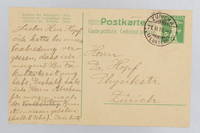
191083637Zurich Zurich 1910. Fine. Einstein writes to a friend who introduced him to Carl Jung Zurich Zurich 21 juin 1910 9 x 14 cm une carte postale Autograph postcard signed by Albert Einstein to Ludwig Hopf. 18 lines written verso and recto address also in Einstein's handwriting. Postmarked June 21 1910. Published in The Collected Papers of Albert Einstein Volume 5: The Swiss Years: Correspondence 1902-1914 Princeton University Press 1993 n°218 p. 242. An exceptional and highly aesthetic card from Albert Einstein to ""the friend of the greatest geniuses of his time"" - according to Schrödinger - mathematician and physicist Ludwig Hopf who introduced Einstein to another 20th-century genius: Carl Jung. The master invites his pupil Hopf to a dinner party whose guests include scientist Max Abraham future great rival during Einstein's Zurich years and a fervent opponent of his theory of relativity. The recipient Ludwig Hopf joined Einstein in 1910 as an assistant and student at his physics and kinetic theory seminars at the University of Zürich. They signed two fundamental papers on the statistical aspects of radiation and gave their names to the ""Einstein-Hopf"" velocity-dependent drag force. Their letter exchanges retrace the complex path of Einstein's work on relativity and gravitation bearing witness to their great complicity and Hopf's invaluable contribution to the Master's research. A few months after writing the postcard Hopf even found an error in Einstein's calculations of the derivatives of certain velocity components which Einstein corrected in a paper the following year. They also formed a musical duo Hopf accompanied on the piano the Master's violin performing pieces by great musical geniuses like Bach and Mozart. With this card Einstein invited his pupil and friend Hopf to dinner with Max Abraham at the dawn of a major scientific controversy that would pit them against each other from 1911 onwards. Abraham's theory of special relativity failed to convince Einstein who criticized its lack of observational verification and its failure to predict the gravitational curvature of light. In 1912 their dispute became public through scientific articles. Abraham never acknowledged the validity of Einstein's theory. During their brilliant artistic and intellectual exchanges Hopf undoubtedly succeeded where Freud had failed as he declared to him in a letter: ""I shall break with you if you boast of having converted Einstein to psychoanalysis. A long conversation I had with him a few years ago showed me that analysis was as hermetic to him as the theory of relativity can be to me"" Vienna September 27 1931. As a fervent supporter of psychoanalysis Hopf is known to have introduced the famous psychoanalyst Carl Jung to Einstein. Hopf and his teacher both left for Prague's Karl-Ferdinand University in 1911 where they met writer Franz Kafka and his friend Max Brod in Madame Fanta's salon. With the rise of the Nazi regime the fates of the two theoreticians were plagued by persecution and exile. Einstein first took refuge in Belgium Hopf in Great Britain after his dismissal in 1934 from the University of Aachen because of his Jewish origins. They continued their prolific correspondence in the midst of the turmoil Einstein suggesting to Hopf the opening of a university abroad for exiled German students. Hopf died shortly after his appointment as chair of Mathematics studies at Trinity College Dublin in July 1939. A precious invitation from the great physicist to one of the final dinner gatherings of the ""old school"" of science embodied by Max Abraham on the eve of the publication of the theory of general relativity which would overturn classical conceptions of space and time and propel Science into the 20th century. unknown
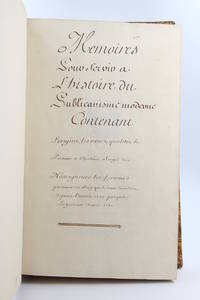
175078168s. l. 1750. Fine. s. l. 1750 23 x 38 cm 2 manuscrits reliés en un volume Manuscript entitled Mémoires pour servir à l'histoire du publicanisme moderne contenant l'origine les noms qualités le portrait et l'histoire abrégée de nosseigneurs les fermiers généraux du Roy qui se sont succédés depuis l'année 1720 jusqu'à la présente année 1750 with Mémoires pour servir à l'histoire du publicanisme ou l'Origine des receveurs généraux des finances du royaume 1750 folio 23 x 38 cm 330 pp 4 p. bl. 8 p. 4 p. bl. 83 pp. contemporary full calf Important and long manuscript composed of two parts written by two different hands retracing in total 160 biographies of the Fermiers Généraux active between 1720 and 1750 lavish and unpopular collectors of indirect taxes in the Ancien Régime. Each of the parts also contains a very useful index. The entries with the exception of 19 of them are all decorated with a coat of arms drawn in pencil painted by hand in colour and sometimes enhanced with gold or silver. Some modern notes some juicy in pencil in the margin of certain leaves. These memoirs have never been the object of a publication and we know of only a few handwritten copies with varying texts. The other examples that we have been able to find including the one digitised by the French National Library contain fewer biographies that ours and are not illustrated. Contemporary binding in full blond marbled calf title pieces in black and red morocco. Joints top of the first board and spine head repaired joints of the first board split but solid scratches on the boards corners damaged. A very beautiful manuscript richly painted retracing the history of the most despised institution of the Ancien Régime. Provenance: library of Count Chandon de Briailles descendent of the founders of the famous house of Champagne then of the Michel de Bry library with its motto Pro captu lectoris with their ex-libris glued to the first endpapers. hardcover
193948285Paris: Gallimard 1939. Fine. Gallimard Paris 1939 13.50 x 19.50 cm relié sous étui First edition one of 23 numbered copies on Hollande paper tirage de tête after one copy on Whatman and 9 on China paper. Light brown Oasis goatskin by Morina Mongin covers and spine with dreamlike decoration of humanized mountains after a drawing by Peter Sis printed in brown colored film and heightened in ochre sky-blue suede pastedowns brown suede endpapers the first endpaper with a lunette of modified sky-blue leather printed in colored film covers and spine preserved. Half light brown Oasis goatskin slipcase wood-effect paper boards lined with brown suede; a spectacular set. A fine copy with all margins in a handsome binding reaching back to the pilot's spirit for whom every mountain every valley every house is a landscape which could be friend or foe. Gallimard hardcover
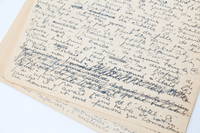
194585163s. l.: S. n.chez l'auteur 1945. Fine. I prefer the soldiers; the officers are even more obnoxious than the French sub-lieutenants and that is saying something - those fellows send the stink-meter off the charts with their little sticks for buggering horses. S. n. chez l'auteur s. l. 10 octobre 1945 22 x 17 cm 17 pages sur 9 feuillets Original autograph manuscript of a short story by Boris Vian written in 1945 and published posthumously in the collection Le Loup-Garou in 1970. Highly dense manuscript of 17 pages on 9 sheets written in black ink with deletions and corrections on perforated graph paper dated 25.10.45 at the end of the text. One of the very rare manuscripts dated by the author. Exceptional manuscript of Boris Vians first short story written at the age of 25 just a few months after the Liberation. Bison Ravis initial literary experiments date to the winter of 1941-42. At Michelle Vians request he produced a fairy tale an exercise that prompted the young engineer to undertake another fantastical and deliberately incoherent piece for his friends amusement: Troubles dans les Andains. Two years later he began work on what in 1947 would become his first published novel -Vercoquin et le plancton - thanks to the encouragement and support of Raymond Queneau. Before the decisive encounter with the mentor and spiritual father who would open to him the doors of Gallimards prestigious Blanche series writing for Vian was merely a pastime - a light-hearted diversion with no consequence or ambition meant to stave off the gloom of the Occupation years. The true passion of the mediocre young engineer was jazz and his gradual professionalisation within Claude Abadies ensemble. When on 18 July 1945 he signed his contract for the collection La plume au vent created and directed by Queneau Boris Vian most likely felt he had written nothing of real substance. His little oeuvrette Vercoquin ecaetera timidly sent to Queneau the previous month would appear with a world-weary preface and a dedication shaped almost as an apology. Completed in October 1945 Martin stands as his first attempt at authorship and his very first short story - a form in which he would demonstrate remarkable mastery. As M. Lapprand C. Gonzalo and F. Roulmann observe in the Pléiade edition:Vians sharp cutting prose lends itself marvellously to short texts. It first manifested itself in his early practice of the nouvelle understood in the Anglo-Saxon sense of the short story a form he greatly admired. From 1945 to 1958 his lively pen produced forty-five short narratives . He delighted so much in the genre that between 1945 and 1948 he composed no fewer than some thirty only five of which remained unpublished during his lifetime.Martin would be published only eleven years after his death in the volume Le Loup-Garou with no acknowledgement of its crucial role in the formation of Vians oeuvre and artistic identity. And yet this first tale by Vian possesses a set of singular traits that make it something of a turning point. Entirely built around his two great passions jazz and American automobiles the piece distinguishes itself from his earlier efforts chiefly through its stylistic daring. At the threshold of what he imagined would be a writers career - one ultimately far more turbulent than he anticipated - Boris adopts not a Vian style but a Sullivan style. Martin is a short story cast squarely in the tradition of American noir even though Vian provides neither a proper plot nor any real narrative structure. Martin relates nothing more than the rather disappointing evening of a ""rank amateur"" trumpeter that is a semi-professional musician enlisted to play in an impromptu band at a party organised for the G.I.s. Lacking introduction climax or denouement the piece reads as a pure exercise in style yet in a style entirely new to the budding writer: the very idiom that would later shape I Shall Spit on Your Graves E S. n.[chez l'auteur] unknown
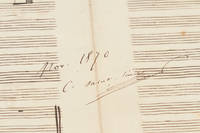
1870877761870. Fine. An exceedingly rare Saint-Saëns unpublished score novembre 1870 33.20 x 24.50 cm un bifeuillet Unpublished and signed autograph score by Camille Saint-Saëns. Two pages of handwritten music for solo voice and piano on an oblong bifolium with twenty staves. Autograph inscription on the first page signed by Saint-Saëns with his signature and date ""Nov. 1870"" appearing again on the second page. Trace of vertical fold with a tiny tear along the fold a small marginal tear on 1 cm of the first page without damage to the manuscript. An exceptional unpublished autograph manuscript of a Persian melody for voice and piano composed by Camille Saint-Saëns during the Siege of Paris in November 1870 enriched with a autograph inscription: 'A Geneviève Bréton / Hommage de respectueux dévouement' To Geneviève Bréton / In homage with respectful devotion signed and dated on the second page 'Nov 1870 C. Saint Saëns'. The lyrics of the piece were directly inspired by its dedicatee the fiancée of the painter and tenor Henri Regnault 'the most musical of all the painters' Saint-Saëns École buissonnière translation by Edwin Gile Rich who was the first performer of several other Mélodies persanes. Geneviève Bréton a cultured and passionate woman was a fixture in the literary and artistic salons of her time surrounded by composers painters and the young Parnassian poets of her generation. Saint-Saëns likely met her through his friend the orientalist painter Henri Regnault a Prix de Rome laureate with whom she fell madly in love in Italy in 1867. A handsome young man already celebrated for his art Regnault also fascinated Saint-Saëns with his 'exquisite tenor; voice . alluring in its timbre and irresistible in its attractiveness just as he was himself' as the composer would later recall in 1913. Regnault premiered several of his compositions: 'In 1868 Regnault was the first to embody the role of Samson in the second act of the celebrated opera Samson et Dalila created during a private evening performance. Saint-Saëns renewed their collaboration by entrusting the artist with two of the Mélodies persanes composed for tenor voice.' Manon Bertaux. The Mélodies persanes op. 26 based on verses by the Parnassian poet Armand Renaud consist in their published version of three works for tenor Sabre en main Au Cimetière Tournoiement and three for contralto La Brise La Splendeur vide La Solitaire. They form one of Saint-Saëns's most famous cycles and belong to the golden age of French mélodie. This manuscript for voice and piano with its ardent colourful tone can unquestionably be linked to this set of melodies begun in June 1870 and sold by Saint-Saëns to his publisher Hartmann shortly afterwards. However Manon Bertaux's research has shown that 'the composer sold Hartmann an incomplete cycle having composed his final melodies at the beginning of the Siege of Paris from September onward"". Dated November 1870 our melody - as far as we know unknown to biographers and musicologists - is one of those composed in the midst of the Franco-Prussian war: 'Serving as a National Guard during the Siege of Paris Saint-Saëns continued his activities as a musician and composer alongside his duties guarding the ramparts'. It appears that both the text and music of this composition remained entirely unpublished and were never sent to Hartmann. For his part the painter Henri Regnault enlisted as a maverick also risked his life in an attempt to break the siege much to the dismay of Geneviève who confided her worries in her now famous diary Ramsay 1985. The young lovers had finally become engaged after years of opposition from the young woman's mother. Saint-Saëns likely offered this exquisite melody to Geneviève as a betrothal gifta radiant piece of warmth for the anxious young woman and here is the first of its two verses: « Ka-douja la chanteu-se Au manteau noir Qu'on trouve sous l'y-eu-se Quand unknown
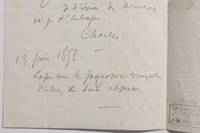
185862164Paris 1858. Fine. ""My dear little mother you are mad"" Paris 13 juillet 1858 mal datée « juin » 13.30 x 20.60 cm 2 pages sur un feuillet remplié sous chemise et étui Autograph letter signed by Charles Baudelaire written in pencil and addressed to his mother. Dry-stamped stationery of the Grand Hôtel Voltaire Faubourg Saint-Germain. Address to Madame Aupick in Honfleur Calvados in the author's hand together with several postal markings dated 13 and 14 July 1858. Several underlinings deletions and corrections by Baudelaire. Trace of a wax seal bearing Charles Baudelaire's initials in pencil probably in the author's hand. A small portion of the second leaf has been excised with no loss of text. This letter was first published in the Revue de Paris on 15 September 1917. From the former collection of Armand Godoy no. 102.The letter is preserved in a half black morocco chemise with abstract-patterned paper boards housed in a matching slipcase edged in the same black morocco and covered with abstract-patterned paper boards. A precious document bearing witness to a decisive moment in the poet's life: his reconciliation with the now widowed Madame Aupick that revered mother «who haunts her son's heart and mind». Victorious Baudelaire had overcome the obstacle represented by his burdensome stepfather whose death he had at times wished for; he was now ready to reclaim his place beside the mother by whom he had so often felt neglected. Following the death of her husband in April 1857 she invited her son to come and live with her in her « toy-house » at Honfleur. This letter reveals a Baudelaire torn by complex emotions: divided between his longing for an ideal union with his mother and his irresistible attraction to spleen. For the « low bohemian » as the Goncourts called him hounded by creditors Honfleur and the exclusive attention of his mother held out the promise of fulfilling his poetic destiny. The poet expressed this hope to his friends notably Antoine Jaquotot mentioned at the end of the present letter: « Je veux décidément mener cette vie de retraite que mène un de mes amis . qui par la vie commune qu'il entretient avec sa mère a trouvé un repos d'esprit suffisant pour accomplir récemment une fort belle uvre et devenir célèbre d'un seul coup. » 20 February 1858 «Tu vas dans peu de jours recevoir le commencement de mon déménagement . Ce seront d'abord des livres tu les rangeras proprement dans la chambre que tu me destines.» By entrusting his books to her he asks his mother to create for him an ideal world in which to write and create. Yet alongside these promises and hopes of a life finally serene and peaceful Baudelaire also reveals his attachment to the existence of the cursed poet: «Tu sais cependant bien que ma destinée est mauvaise.» Beyond his «nouveaux embarras d'argent» it is above all his work that keeps him in Paris: «Si mon premier morceau à la Revue contemporaine a été retardé c'est uniquement parce que je l'ai voulu ; j'ai voulu revoir relire recommencer et corriger.» The «premier morceau» referred to here is none other than « De l'Idéal artificiel le Haschisch » the first text of the future Paradis artificiels 1860 which would not appear until the issue of 30 September 1858. This passage illustrating Baudelaire's relentless perfectionism recalls the extraordinary complexity of the poet's drafts and proofs which he continued to revise meticulously until the very last moment even on the first copies of Les Fleurs du Mal; see the copy we offer. Despite his financial difficulties Baudelaire revised and altered his texts incessantly limiting the number of articles he could produce. Yet he remained convinced that writing would bring him prosperity and confidently declared: «Cette fois-ci je m'en tirerai à moi tout seul sans emprunter un sol.» Baudelaire ultimately left Paris for Honfleur only in January 1859 and did not remain there long. After only a few weeks he hardcover
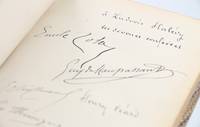
188087614Paris: Charpentier 1880. Fine. The Manifesto of Naturalism Charpentier Paris 1880 12 x 19 cm relié First edition. Half blue morocco shagreen smooth spine gilt date at foot of spine marbled paper boards contemporary binding. Exceptionally inscribed by Emile Zola to the playwright and opera librettist Ludovic Halévy with the autograph signatures of Guy de Maupassant Joris-Karl Huysmans Léon Hennique Paul Alexis and Henri Céard on the first flyleaf. Provenances: from the libraries of Ludovic Halévy and Marcel Lecomte with their bookplates on front pastedown. Our copy also includes on a flyleaf an autograph note by Ludovic Halévy: ""See a letter by Guy de Maupassant at the end of the volume. L.H. Inscribed by the six authors of the volume. Ludovic Halévy."" Voir une lettre de Guy de Maupassant à la fin du volume. L.H. Envoi autographe des six auteurs du volume. Ludovic Halévy. The reproduction of the famous letter sent by Guy de Maupassant to Halévy in 1880 is pasted onto six additional leaves at the end of the volume. It bears Halévy's penned note at the beginning and end of the letter: ""Cette lettre est de 1880 / 1880."" Cette lettre est de 1880 / 1880. A fine and rare uncut copy of this manifesto of Naturalism signed and inscribed by Emile Zola with the signatures of the other five authors to their librettist colleague. Halévy notably co-wrote the libretto of Georges Bizet's Carmen. Charpentier hardcover
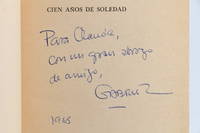
196780853Buenos Aires: Editorial Sudamericana 1967. Fine. Editorial Sudamericana Buenos Aires 1967 13.50 x 20 cm broché Second edition only one month after the first edition. Spine lightly wrinkled small signs of folding in the margins of the boards a light mark on the second board. Rare and precious autograph inscription signed by Gabriel García Márquez on his masterpiece to his friend and translator Claude Couffon: Para Claude con un gran abrazo de amigo Gabriel 1968. For Claude with a big hug from your friend Gabriel 1968. Claude Couffon a French specialist and translator of the major Spanish-speaking writers of the second half of the 20th century translated Chronicle of a Death Foretold a few years later. On the last page below the colophon Gabriel García Márquez specified an address in Barcelona that of his famous literary agent for Spain: c/o Agencia Carmen Ballcells Urgel 241 Barcelona 11. Rightly considered as one of the most important works op the Spanish language the novel by García Márquez however had difficult beginnings after a first refusal by the avant-garde Barcelona publisher Seix Barral: This novel will not be successful . this novel is useless. García Márquez sent it from Mexico to the Argentinian publisher Francisco Porrúa who immediately perceived the power of this unknown Colombian writer: It wasn't a question of getting to the end to find out if the novel could be published. The publication was already decided from the first line in the first paragraph. I simply understood what any sensible publisher would have understood: that it was an exceptional work. Finished printing in May 1967 Cien Años de Soledad appeared in bookshops in June with 8000 copies selling out in a few days. The second print on 30 June will have the same success as will the editions that follow week after week. More than half a million copies were sold in three years. Several copies were later inscribed by Gabriel García Márquez who over the years has become one of the most famous South American writers translated into 25 languages. However contemporary autograph inscriptions on the first prints are extremely rare even more so to one of his French translators who will contribute largely to his international renown. Editorial Sudamericana hardcover
186349387Paris: Michel Lévy frères 1863. Fine. Michel Lévy frères Paris 1863 14 x 22 cm relié First edition. Contemporary half navy blue shagreen over marbled paper boards spine with triple gilt fillets slightly discolored but not seriously speckled edges. Inscribed by Gustave Flaubert to the jurist and politician from Rouen Frédéric Deschamps: hommage de la plus haute considération souvenirs d'amitié with my deepest respect and memories of our friendship. Frédéric Deschamps was one of the leading lights of the Rouen bar and one of the most upstanding citizens in Normandy Biographie nationale des contemporains Glaeser 1878. A Republican serving alongside Jules Sénard he was also a writer and a poet; and acted in defence of Flaubet's proposition of erecting a statue to Louis Bouilhet against the municipality of Rouen. Part of the correspondence between Flaubert and Deschamps is preserved in the Institut de France. A handsome copy in its contemporary binding with a friendly autograph inscription from the author to a member of the literary world in Rouen. Michel Lévy frères hardcover
186340674Paris: Michel Lévy 1863. Fine. Michel Lévy Paris 1863 15 x 23 cm relié First edition on ordinary paper. Half-forest green shagreen contemporary binding spine with five raised bands marbled paper board and endpapers bookplate pasted on one guard. Some slight minor foxing. Rare signed and inscribed copy by Gustave Flaubert to Louis de Carné journalist and historian several of whose works were listed in the inventory of Flaubert's personal library. Flaubert's interest in de Carné's work was not always benevolent however. Critical notes on his articles can be found in the Bouvard and Pécuchet files. Moreover the publication of Salammbô coincided with the controversial election of Louis de Carné to the Académie Française which some critics deemed a clerical coup d'état. His election resulted from a campaign orchestrated by Bishop Dupanloup against the opposing candidate Émile Littré whose materialist definition of man had provoked the ire of religious and Orléanist factions. Flaubert refers to the scandal of this election in a letter to the Goncourt brothers dated 6 May 1863: ""Have you sufficiently railed against Sainte-Beuve and cursed the Académie over Carné's appointment"" While this inscription likely predates the election it remains a curious tribute from an author once accused of offense against public morality and religion to a future representative of religious power within the prestigious Académie. A precious copy featuring a rare autograph inscription handsomely bound in a contemporary binding. Michel Lévy hardcover
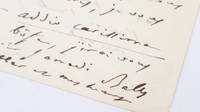
184286807Paris 1842. Fine. Balzac's Soon to be Lost Illusion Paris 12 mars 1842 13.50 x 26 cm 4 pages sur un feuillet Autograph letter signed by Honoré de Balzac to Sophie Koslowska. 4 pages in black ink on a bifolium. Usual folds. Very small lacks of paper along the horizontal fold of the first leaf. Published in his Correspondance 1819-1850 II. Paris Calmann-Lévy 1875 pp. 31-33. A long feverish letter by Balzac a few days before the premiere of Les Ressources de Quinola at the Odéon theater. The writer writes to his close friend Sophie Kozlowska daughter of Prince Kozlowski about the chaotic final preparations and urges her to fill the theater with all of Paris's Russian high society. Balzac wrote this important letter just as he was about to take one of the biggest gambles of his career. The writer wanted to convene a real audience for the premiere of Les Ressources de Quinola and have the play performed in front of a full house of paying spectators instead of using the famous claqueurs clappers traditionally seated in the parterre to encourage audience reactions which is described at length in Lost Illusions. His failed attempt was so publicized by all the newspapers that this performance proved the very necessity of claqueurs: The author preferred peril. Such is the reason for this first performance in which so many people were displeased to have been elevated to the dignity of independent judges Editor's notes in Balzac's OEuvres complètes A. Houssiaux 1855. La Mina wrote me that you were ill and it struck me as a blow as if someone had told Napoleon that his aide-de-camp had died: disregarding Kozlowska's fragile health Balzac set about filling the twelve hundred seats of the Théâtre-Français with all the high-ranking and wealthy spectators Paris had to offer. He relied on the relations of his carissima Sofia to pay for the priciest seats an inclination that earned him accusations of speculation. He indeed takes particular care going over prices in the letter: We'll play next Wednesday barring any misfortune. The first seatings with four places are one hundred francs a box and everyone wants to be there. But the fashionable place where the Aguados the Rothschilds the Doudeauvilles the Castries etc. are is the loge des premières fermées because one feels at home. . Lamartine has asked me for a box: I'll put him between the Russians. Princess Troubetskoï is not the same one whose husband I know. See to it that you write to the prince And don't forget your Makanof . So: balconies twenty-five francs; stalls twenty francs; premières découvertes twenty-five francs a seat; secondes découvertes twenty francs; secondes fermées twenty-five francs; baignoires twenty francs a seat. . Ah! if you only knew what wealth of beautiful women! There will be no clappers in the parterre which is priced at five francs . Write a note to Princess Constantine Razumovska. I don't dare do it myself. For you and for your mother you will go to the premières découvertes; I will place you well. These hurried lines reveal Balzac's great expectations. He deeply believed in the merits of his comedy play about a man of industrial genius in 16th century Spain although the play's reception certainly suffered from Balzac's poor choices during its premiere. The writer expected to solve his financial difficulties and travel with his beloved Madame Hanska following the play's success. Having finished writing the final acts in a hurry he describes the terrible days leading up to the premiere: I'm overwhelmed on edge! I have the actors rehearse in the morning the entire cast during the day and the actresses in the evening. There are twenty thousand francs worth of costumes in the play. The sets are brand new. I'm told that the work is a masterpiece and that makes me shudder! It will always be frighteningly solemn. Some lines even border on the paranoid abundantly underlined with unknown
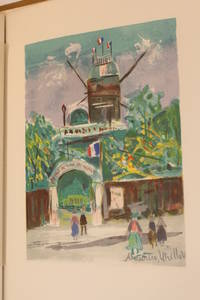
194774125Paris: Editions Pétridès 1947. Fine. Editions Pétridès Paris 1947 28 x 38 cm relié First edition one of 240 numbered copies on vélin d'Arches with 22 color lithographs after gouaches including 12 full-page plates by Maurice Utrillo printed in the ateliers of Fernand Mourlot and Lucien Détruit. White aniline calf with gilt titanium joints ink-painted boards in green and grey decoration continuing edge-to-edge on the liners loose endpapers on papier japon dyed with Kakishibu by the binder title lengthwise on the spine decorated chemise titled on the spine and matching custom slipcase. Original wrappers and spine preserved. Binding signed by Julie Auzillon gilt title by Geneviève Quarré de Boiry and gilt top edge by Jean-Luc Bongrain 2022. This book presenting every style of the famed artist from Montmartre was published on the occasion of his exhibition in 1947 at the Paul Pétridès gallery. This book presenting every aesthetic period of Montmartre artist Maurice Utrillo was published for his 1947 exhibition at the Paul Pétridès gallery. Mounted at the front of the book an autograph sonnet entitled ""L'Art pictural"" signed by Maurice Utrillo and addressed to Francisque Poulbot; two quatrains and two tercets written in black ink on lined paper. Before the poem Utrillo specified: ""Sonnet par Maurice Utrillo V < dédié à son ami et confrère < Georges Kars."" Sonnet by Maurice Utrillo V < dedicated to his friend and colleague < Georges Kars Signed and inscribed by Utrillo a second time at the top of the sheet: ""Amicalement à Francisque Poulbot"". A few stains to the margins not affecting reading. The sonnet was published in ART vol. 2 October 1934-July 1935 p. 9. This beautiful poem a true poetic manifest of pictorial independence twice signed by Utrillo is dedicated to cartoonist Francisque Poulbot a key figure in Montmartre society. It brings together iconic figures of the Butte famous for their bohemian life and eternal drunkenness: Utrillo Poulbot and Georges Kars a Cubist artist of Czech origin living in Montmartre whose paintings are celebrated by Utrillo in the sonnet. Utrillo wrote this manuscript in 1928 to Francisque Poulbot former classmate of the Lycée Rollin who had become a renowned draughtsman goguettier and founder of the République de Montmartre. Poulbot sketched the painter many times in his beloved Montmartre streets brush in one hand and bottle in the other the silhouette of the Sacré-Coeur church looming in the distance. Utrillo and Poulbot both stayed at some point in their lives at 12 rue Cortot where the Musée de Montmartre is now located. The year he wrote this poem Utrillo painted a superb gouache of Poulbot's house on avenue Junot. Although known for his paintings Utrillo also found in poetry a form of redemption for his bouts of alcohol-induced hysteria. Considered by his friends as a ""builder of sonnets or dithyrambic quatrains"" his verses were praised by famed critic Félix Fénéon. Utrillo also used poetry to celebrate his Montmartre artist neighbors. He wrote this poem in honor of Czech painter Georges Kars thanking him for a striking portrait of him exhibited at the Berthe Weill gallery: « Qu'il me soit donc ici permis en compagnon Sincère et noble et pur en non troubleur en rond Sur cet Art pictural d'émettre un trait austère Georges Kars en ce lieu de digne réunion Rue Laffitte chez Weill de l'art porte-fanion S'affirme en ses tableaux inventif et sincère. » Kars had settled in Montmartre in 1908 and spent many summers in Cadaquès with his wife Utrillo and his mother Suzanne Valadon. In these verses dedicated to the lines of ""his friend and colleague"" Kars Utrillo celebrates the independence and aesthetic personality emancipated from any artistic movement which also characterized Utrillo's own style. Utrillo being a self-taught painter he states his difference from academism and even the avant-gardes of yesteryear citing the Impressionist revolution embodied by the Cormon s Editions Pétridès hardcover
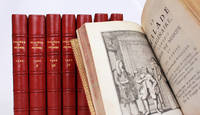
168254099à Paris: Chez Denys ThierryClaude BarbinPierre Trabouillet 1682. Fine. First and most acclaimed collected edition of Molière's works bound by M. Lortic Chez Denys Thierry Claude Barbin Pierre Trabouillet à Paris 1682 9 x 16.50 cm 8 volumes reliés First complete collected edition and first illustrated edition. The first edition of Dom Garcie de Navarre L’Impromptu de Versailles Dom Juan ou le Festin de Pierre Les Amans magnifiques and La Comtesse d’Escarbagnas. With thirty copper engraved illustrations by Jean Sauvé after Pierre Brassart 9 of them included in the pagination.19th-century red full morocco binding spines with five raised bands date gilt at foot double gilt fillets to edges of covers and spine-ends large inner gilt dentelle marbled endpapers all edges gilt. Bindings signed M. Lortic. An exceptional copy of the famous 1682 edition housed in a very elegant binding by Marcelin Lortic who succeeded his father Pierre-Marcellin Lortic - Baudelaire's binder. The first complete edition of the works of Molière edited by two of his close friends Vinot and the actor Charles Varlet de la Grange who was also his troupe’s secretary: “For this edition publishers used Molière’s manuscript texts more or less corrected by him either according to the needs of performances or publication. This means that the text of 1682 often differs slightly from the separate first editions and the collected edition of 1674.Despite this it is the text that has most often served as a source for the numerous later editions published right up to the present time” J. Le Petit Bibliographie des principales éditions originales.  According to Anaïs Bazin “It is in the Préface by Lagrange and Vinot placed at the beginning of the first edition of the Œuvres complètes de Molière 1682; there and nowhere else we still find today the only reliable and acceptable information — perhaps the only information and this conjecture is a serious one — that Molière wished to leave to the public concerning his fifty-one-year career!” Notes historiques sur la vie de Molière Techener 1851. This slightly excessive sentence nevertheless highlights the unique importance of these first biographical notes written by close friends of the greatest French dramatist. It also reveals numerous faults within the known versions of Molière’s final play and masterpiece Le Malade imaginaire printed after the author’s death. “This comedy is corrected from the author’s original manuscript and free of all the false additions and presumed scenes inserted in previous editions. And to highlight this declaration even further they take care to write at the beginning of two scenes in the first act that the text — actually the entire act — was not Molière’s in the previous editions and that they publish here the author’s original scenes.” In his bibliography Albert-Jean Guibert would conclude: “This edition must be regarded quite rightly as the most complete of the seventeenth-century editions. Stage directions are included and for the first time each comedy is preceded by an engraving particularly valuable for the attitudes and costumes of the characters.”  Chez Denys ThierryClaude BarbinPierre Trabouillet hardcover
1797761731797. Fine. An exceedingly rare letter from Restif: « Les événemens du 18 fructidor' m'ont rendu la vie . en affligeant mon cur » 30 fructidor 1797 An V 16 septembre 1897 18.50 x 21.30 cm 3 pages sur un double feuillet Extremely rare autograph letter signed « Restif Labretone » addressed to Citoyenne Fontaine. Three pages written in black ink on a double sheet of laid paper. Remains of a wax seal folds inherent to mailing. This letter was published with some inaccuracies in Lettres inédites de Restif de Labretone by V. Forest and É. Grimaud 1883. The Fontaine couple are merchants from Grenoble and Restif de la Bretonne began corresponding with them on March 15 1797. Important letter testifying to the completion of the publication of Restif's great autobiographical work: Monsieur Nicolas ou les Ressorts du Cur Humain dévoilé. « I will have completed the Cur humain Dévoilé within 15 days I will prepare your package immediately to have it ready. » The first eight volumes of this great autobiographical work printed by Restif himself a typesetter by trade in his residence at 11 rue de la Bûcherie were entrusted to the « dishonest » bookseller Nicolas Bonneville who did not honor his debts to the writer. Besides health issues « I exchange my illnesses and do not cure them » Restif also shares with his correspondent his literary setbacks: « The Author of Nature will preserve a sincere friend for me to compensate for the scoundrels of the Institute and the perfidious Mercier ». Indeed the previous year the author learned with bitterness that he was not admitted to the National Institute and Louis-Sébastien Mercier who had praised him in his Tableau de Paris and supported his candidacy then turned away from him. To this sum of misfortunes financial difficulties are added. Penniless and living on meager state pensions he maintains all his support for the Republic: « By what fatality do I never see the views of the rulers who welcome me; or how do they not see at once that I am attached to the Revolution to the point that I still love it even when it beats me. » Restif profoundly anti-royalist wrote several pamphlets to this effect and had just added to the end of Monsieur Nicolas an apology for the coup d'état of 18 Fructidor Year V. However this date marks the end of the allowance granted to him by Lazare Carnot after his failure at the Institute: « You know the events of 18 Fructidor; I will not speak to you about them. They have given me back my life; but by afflicting both my heart and my gratitude. » But Restif's great sorrow is the loss of his daughter Filette born from his adventure with Louise Allan whose paternity was revealed to him only late: « I am writing to you from bed weeping over my Filette who died 11 months and ten days ago . Filette was my daughter and Louise's whose soul and beauty she had. » Autograph letters signed by Restif de La Bretonne that have survived to this day are extremely rare. unknown
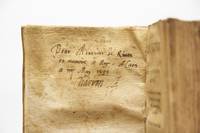
159571963à Bourdeaus Bordeaux: Par S. Millanges 1595. Fine. Par S. Millanges à Bourdeaus Bordeaux 1595 10.50 x 16 cm relié Third edition after the original published in Bordeaux in 1593 and a second Parisian edition in 1594. The copy mentions the second edition because it is the second to be published in Bordeaux. Extremely rare handwritten presentation signed by the author on the page of the endpaper: Pour Monsieur de Rives en memoire de moy. A Caors ce iiij 4 may 1595. Charron. For Monseiur de Rives in memory of me. In Caors this iiij 4 May 1595. Charron. It is without doubt about Jean III de Rieu Lord of Rives who belonged to the family of Antoine Hébrard de Saint-Sulpice bishop of Cahors. Pierre Charron had been called theological by this same bishop of Cahors and became his curate for six years. Bound in calf vellum with contemporary yapp edges blank spine. Extensive yellowing of the endpaper page until page 30 then lessening in the middle of the page throughout the first part and until page 120 of the second part. This yellowing resumes from page 760 until the end. Pierre Charron's first writing who in this controversial work regarding Protestantism develops three great vérités truths: religion is necessary Christianity is revealed and only the Roman Church is the true Church. It is this last point in particular that the author tries to demonstrate. This third part is so important that it has its own title page and takes up two-thirds of the book. In Bordeaux Pierre Charron met Montaigne whose ideas spread through his works and his thoughts. They bonded with such a deep friendship that Montaigne designated Charron as heir to his house coat of arms. The handwritten ex-donos or presentations of the great humanists of the 16th century are an exceptional rarity. Par S. Millanges hardcover
1808689671808. Fine. 26 mars 1808 20 x 24.80 cm 3 pages 1/2 sur un double feuillet Long autograph letter by Stendhal addressed to his sister Pauline written in fine handwriting with black ink. Address of Stendhal's father where his sister resides in Grenoble with the stamp ""n°51 Grande Armée."" Red wax seal bearing Stendhal's coat of arms. Several original folds inherent to postal delivery. A paper loss due to the unsealing of the letter has been skillfully restored. Published in his Correspondance ed. Henri Martineau Paris Le Divan 1933 vol. 3 no. 262 A pp. 26-29. A very beautiful letter filled with romantic passion blending childhood nostalgia with sentimental tales and foreshadowing The Red and the Black. This letter is part of the correspondence between twenty-five years old Henri Beyle and his sister Pauline three years his junior. This epistolary relationship which quickly took the form of a ""journal"" as Pauline's responses were rare. It is deemed a crucial milestone in the intellectual development of the future Stendhal: ""Here are my dreams my dear friend; I am almost ashamed of them; but after all you are the only person in the world to whom I dare confess them."" In this letter which attests to the strong bond between brother and sister Stendhal then in Germany expresses his deep nostalgia: ""I revisited in my memory all the time we spent together: how I did not love you in our childhood; how I once hit you at Claix in the kitchen. I hid in the little book cabinet; my father came back a moment later furious and said to me: 'Wicked child! I would eat you!' Then all the woes inflicted upon us by poor Aunt Séraphie; our walks along those paths surrounded by stagnant water towards Saint-Joseph."" These regrets about the past are accompanied by a typically Stendhalian melancholy: ""Alas! That delightful happiness I once imagined I glimpsed it once at Frascati and a few other times in Milan. Since then it has not returned; I marvel at my inability to feel it. The mere memory of it is more powerful than all the present joys I can procure."" This evocation of the Italy he longs for is intertwined with memories of the women he loved: ""I told you that while in Frascati at a charming fireworks display at the moment of the explosion Adèle leaned on my shoulder for an instant; I cannot express how happy I was. For two years whenever I was overwhelmed with sorrow this image gave me courage and made me forget all my troubles. I had long forgotten it; I tried to recall it today. Against my will I see Adèle as she is; but as I am now there is no longer the slightest joy in this memory."" This lengthy account of Adèle Rebuffet his cousin with whom he had a profound romantic relationship before forming a closer bond with her mother reflects Stendhal's sentimentality. He also mentions another of his great passions Angelina Pietragrua the ideal Italian woman and embodiment of his Milanese memories: ""Madame Pietragrua is different: her memory is linked to that of the Italian language; whenever something pleases me in a role for a woman in a work I involuntarily put it into her mouth."" This ""role for a woman"" that Stendhal refers to echoes the central theme of this letter the work Il Matrimonio segreto by composer Cimarosa: ""Do you sometimes play the Matrimonio Its the passage Cara sposa at the beginning between Carolina and Paolino. . But play the Matrimonio for my sake especially Signor deh permettette and the finale Io rival de mia sorella."" This opera by Cimarosa remained a constant throughout the writer's life and work. In his Memoirs of an Egotist 1832 he explains: ""In Milan in 1820 I wanted to have this written on my tomb . I wanted a marble tablet in the shape of a playing card: ""Errico Beyle - Milanese - Visse scrisse amò - Quest'anima adorava Cimarosa Mozart e Shakspeare - Morì di anni. il . 18."" ""Henri Beyle - Milanese - He lived wrote loved - This soul adored Cimarosa Mozar unknown
185153579Paris: La librairie nouvelle 1851. Fine. Precious inscribed copy signed by Victor Hugo to Juliette Drouet: «à mon pauvre doux ange aimé. V.» La librairie nouvelle Paris 1851 16.50 x 25 cm broché Partly first edition gathering the most famous speeches by Victor Hugo including some of his most memorable addresses delivered at the tribune of the Legislative Assemblymost notably the speech on constitutional revision and the powerful plea he gave at the trial of his son on 11 June 1851 before the Cour d'assises of the Seine in defense of the inviolability of human life. Spurious mention of eighth edition. Complete with the rare portrait of the author by Masson printed on China paper as frontispiece. Scattered occasional foxing. Precious inscribed copy signed by Victor Hugo to Juliette Drouet: «à mon pauvre doux ange aimé. V.» A treasured copy belonging to Victor Hugos muse and mistress. This moving and remorseful dedication is Hugos response to the tragedy Juliette endured that same year having just discovered he had been unfaithful for seven years with Léonie Biard. In June 1851 Biard sent Juliette the letters Victor had written to her. In July Hugo swore eternal fidelity to Juliette and in August inscribed this plea for a more compassionate justice to her. In the autumn Juliette demanded that Hugo meet Madame Biard to formally end the affaira meeting she choreographed in every detail and to which Hugo complied. Provenance: libraries of Pierre Duché 1972 no. 75 and Philippe Zoummeroff 2001 no. 71. La librairie nouvelle unknown
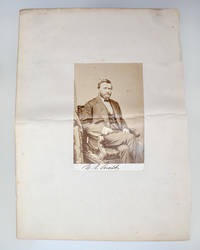
143272Rare collection of documents related to the 1871 Treaty of Washington including signatures of all of the key figures involved in its signing including President Ulysses S. Grant his Secretary of State Hamilton Fish and the British delegation led by George Robinson Earl de Grey and Ripon. The collection was assembled by Frederic Daustini Cremer who acted as secretary to de Grey and travelled with him and his son Viscount Goderich to Washington for the proceedings where he also obtained letters by William Sherman amongst others for his collection and contains: Two lined folio pages containing the signatures of the British and American signatories of the Treaty of Washington including: the British High Commissioners George Robinson the Earl de Grey and Ripon chairman Stafford Northcote Edward Thornton John Macdonald and Montague Bernard and the American delegation U.S. Secretary of State Hamilton Fish chairman Robert Schenck Samuel Nelson Ebenezer Hoar and George Williams with seven other protagonists. 2 pages folio written on recto only on lined paper watermark 'Department of State/ US' creased page one affixed to an album leaf page two loose dated at head "May 8 1871 11am." A portrait photograph of President Ulysses S. Grant seated in an armchair signed in ink on lower margin "U.S. Grant." Affixed to the reverse of the above album leaf. An autograph note in the third person from General W. T. Sherman to Earl de Grey accepting an invitation to dine on US Army Headquarters notepaper. One page on a bifolium lined paper affixed to an album leaf dated "28 February 1871." Two autograph letters signed "U.S. Grant" the first to Hamilton Fish making arrangements to meet the Italian Minister on Executive Mansion notepaper one page on a bifolium creased dated 13 May 1870; the second to an unknown recipient arranging to meet at Harrisburg 3 pages on a bifolium lined paper torn along fold creased sent from Long Branch N.J. 6 August 1870 both affixed to an album leaf with an accompanying letter to Frederic Daustini Cremer on Executive Mansion notepaper sending him ".an autograph letter of Gen Grant's as a memento. it is one selected for the reason that it is entirely unofficial." Three pages on a bifolium sent from Washington 5 May 1871. An autograph letter signed "Hamilton Fish" to Hon Ogden Hoffman of San Francisco a letter of introduction for ".Lord Goderich and his friend Mr Cremer. The former is the son of the Earl de Grey & the latter is his Lordships Secretary." 2pp. on a bifolium sent from Washington 6 May 1871. With an accompanying autograph envelope; and two autograph letters from Charles Sumner one to Mrs Fish regarding a book of Froissart illustrations and another in the third person to Earl de Grey accepting an invitation 4 pages 7 May 1866 and 13 March no date; with autograph letter signed "Schulyer Colfax" to Hamilton Fish reporting he has not yet received his copies of the Lincoln Memorial on Vice President's Chamber notepaper one page on a bifolium Washington 9 July 1870; with signature of J. G. Blaine Speaker dated 19 April 1871 one page three items affixed to an album leaf the others loose. An autograph letter signed "de Grey" to Cremer written on the voyage back to England after the signing of the Treaty sorry to leave Washington and regretting that the Senate would not ratify the Treaty before he left talking of the Free Trade movement in the US and asking him to report back on the reaction to the treaty in Canada 8pp. creased remains of guard 31 May 1871; with a manuscript fragment outlining two points of the treaty with regards to inshore fisheries one page torn from a larger sheet. In very good to near fine condition. Provenance: The Rev. Frederic Daustini Cremer 1848-1927; thence by descent to the present owner. The 1871 Treaty of Washington augmented permanent peaceful relations between the United States and Canada and the United States and Britain by settling various disputes lingering from the civil war navigation and fishing rights and defining the rules for neutral governments during times of war thereby establishing a precedent for future international arbitration. unknown
177691322Philadelphia: Robert Bell 1776. Exceptionally rare edition of the first surgical work by an American and printed in North America. Octavo bound in nineteenth century three quarters morocco over marbled boards gilt titles and tooling to the spine frontispiece. Jones' work was the accepted guide to surgical practice during the American Revolutionary War" G&M 2155; Austin 1843; Evans 15100 and 14814; Sabin 94063 and 36524. In near fine condition. Although Jones was born in America and brought up in a family of medical doctors he was trained as a surgeon in France by some of the leading physicians in the world including Percivall Pott one of the founders of the study of orthopedics. His doctoral thesis On the Observation of Wounds would later develop into this seminal surgical text and the very first treatise on surgery to be printed in North America. Jones was also integral in establishing the medical school that would later become Columbia University's College of Physicians and Surgeons where he was appointed as the very first professor of surgery in the Americas. Robert Bell hardcover books
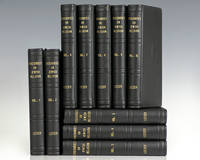
1866107732Philadelphia: Sherman & Co 1866-68. First editions of one of the 'major builders of American Judaism' Isaac Leeser's Discourses on the Jewish Religion. Octavo 10 volumes bound in full leather gilt titles to the spine raised bands. In near fine condition. Complete sets are of the utmost rarity. American Jewish lay minister author translator and publisher Issac Leeser's "contributions to every area of Jewish culture and religion made him a major builder of American Judaism." In addition to his influence on the Jewish pulpit in the United States Leeser became the first American Jewish publisher and produced the first Jewish translation of the bible into English. "The translation of the Bible was Leeser's great literary achievement and represented many years of patient labor and devotion to a task which he considered sacred.until the new Jewish Publication Society version was issued in 1917 it was the only source from which many Jews not conversant with Hebrew derived their knowledge of the Bible in accordance with Jewish tradition" Waxman 1090. Sherman & Co hardcover books
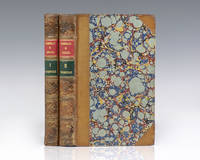
1835132164London: Saunders and Otley 1835. First edition in English of Tocqueville’s magnum opus. Octavo 2 volumes bound in three quarters period calf over marbled boards with gilt titles and tooling to the spine marbled endpapers all edges marbled half-titles folding engraved map. In very good condition. An attractive contemporary binding. “One of the most important texts in political literature†PMM. “This is by far the best book ever written about America and the most penetrating book ever written about democracy. It won instant acclaim not only in the writer’s native France where Royer-Collard declared: “Nothing equal to it had appeared since Montesquieu’ but in England where John Stuart Mill hailed it as ‘among the most remarkable productions of our time.’ Its central theme is that democracy has become inevitable; that it is with certain qualifications desirable; but that it has great potentialities for evil as well as good depending upon how well it is understood and guided. In the view of de Tocqueville the greatest danger that threatens democracy is its tendency toward the centralization and concentration of power… There is revived interest in Tocqueville today because of what seems like the uncanny clairvoyance of his prophecies. For example this by a Frenchman in 1835: ‘There are at the present time two great nations in the world which started from different points but seem to tend towards the same end. I allude to the Russians and the Americans… The principal instrument of America is liberty; of Russia servitude. Their starting point is different and their courses are not the same; yet each of them seems marked by the will of Heaven to sway the destinies of half the globe†Hazlitt 163. Saunders and Otley hardcover
189060481Paris 1890. Fine. Paris s. d. 1890 21.30 x 14 cm 3 pages in-8 au verso de 4 feuillets de l'Assistance publique de Paris VERLAINE Paul Complete autograph manuscript signed by Paul Verlaine of one of his Hospital Chronicles: We poets as well as they the workers our companions in misery Paris n. d. 1890 213 x 140 mm 8 3/8 x 5 1/2 3 pages in-8 at the back of 4 leaves of the Assistance publique de Paris Complete autograph manuscript signed by Paul Verlaine of one of his Hospital Chronicles 90 close lines in black ink on the verso of paper from the Assistance publique de Paris. The chronicle of one of Verlaines stays in hospital between September 1889 and February 1890. The note III has been crossed out in blue printers pencil. In the definitive collection this text is in fact second. In the version published by Le Chat noir on 5 July 1890 there appear to be no variations with the text of this manuscript. This is thus the final state of the text the one sent to the printer. Jacques Borel dates the writing of this chronicle to a hospital stay in Cochin in June 1890. Verlaine spent many days in hospital during his life especially in this period. During these stays he wrote Hospital Chronicles prose poems in eight parts. Here he mixed anecdotes observations of the lives of the patients and a delicate poetical analysis of the world of the hospital. Verlaine starts off with a troubling and tired observation: But certainly all the same the Hospital darkens despite the fine June weather.Yes the Hospital is dark despite philosophy insouciance and pride. Despite the fine weather the inflexibility of the system the misery and the sickness give the poet a gloomy take on things: let us punish all objections under pain of expulsion still severe even in this month of flowers and hay of warming days and clement nights if you have the devil at your back and debt and hunger at home. Discharge whether by way of being thrown out or getting cured and life outside did not offer more comfort than the stay itself: Clearly well all get out sooner or later more or less well more or less happy more or less sure of the future at any rate more or less alive. So we will think sadly.of our suffering emotional and otherwise of the doctors good or inhuman. This was a feeling he had already experienced during what he called my intervals the times when he was out of hospital. Life outside hospital was a miserable prospect despite his established fame. Verlaine compares his misery to that of the working classes who share his stays in various hospitals. The poet calls for resignation from his brothers artisans of one sort or another workers without a lifes-work and poets.and publishers too let us accept our fate let us drink up the cup of tea with barely any sugar or this little hot chocolate and let us be brave whether it be with our medicine or an enema or chewing tobacco. Let us follow their prescriptions closely let us obey all injunctions so that injections and colonics will seem sweet to us and let us reprimand all objections.. And along with them the poet wanted to take advantage of the beauties of June in quoting two verses from the Chanson sentimentale of Xavier Privas: We are pleased with ourselves in the strong sun. And under the green branches of the oaks we poets as well as they the workers our companions in misery.. Equal in the face of misfortune whether active or passive they might feel nostalgia once they were out: And perhaps some day we will miss these good times where you workers you could rest and where we we poets worked and where you artists earned your wine and your cups . Despite this reverie Verlaine was: tired of so much poverty provisionally believe me because I have been so used to it these last five years! and concludes bitterly with the observation of the lack of humanity in modern medicine: Hospital with a capital H an awful idea unknown