48 402 résultats
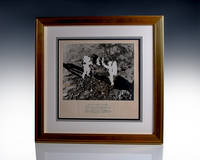
19691484731969. Rare original photograph of Neil Armstrong and Buzz Aldrin raising the United States flag at the Apollo 11 lunar landing site. Vintage matte-finish photograph of Neil Armstrong and Buzz Aldrin at Tranquility Base. Boldly signed by Neil Armstrong "Neil Armstrong Tranquility Base Moon Landing of Apollo 11 20 July 1969" and signed by Michael Collins. Armstrong added a proxy signature of Buzz Aldrin. Very few photos of Neil Armstrong on the moon exist as he was the chief photographer during the Apollo 11 EVAs. This remarkable image was taken by the 16mm Data Acquisition Camera that was mounted inside the Lunar Module. It is one of the most iconic photographs of the 20th century captured at the mission's triumphant climax when the stars and stripes were first unfurled on another celestial body. Mounted on cardstock with an affixed caption below. Triple matted and framed. In very good condition. From the collection of Norris McWhirter 1925-2004 by family descent. Norris McWhirter was a British writer political activist and television presenter known most famously for founding with his brother Ross the Guinness World Records which they wrote and annually updated together between 1955 and 1975. A remarkable example with Armstrong's uncommon inclusion of the lunar time and place. The entire piece measures 17 inches by 16.75 inches. On July 20th 1969 American astronauts Neil Armstrong and Buzz Aldrin landed the Apollo Lunar Module Eagle on the lunar surface. Six hours after landing Neil Armstrong became the first person to step onto the lunar surface; Aldrin joined him 19 minutes later and the two spent over two hours collecting lunar materials. Armstrong's first step onto the lunar surface was broadcast on live TV to a worldwide audience during which he uttered the historic phrase "That's one small step for man one giant leap for mankind." Apollo 11 effectively ended the Space Race and fulfilled a national goal proposed in 1961 by President John F. Kennedy: "before this decade is out of landing a man on the Moon and returning him safely to the Earth." unknown
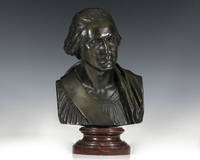
123102Fine bronze bust of George Washington after the famed Houdon bust of 1785 which is considered the most accurate depiction of Washington. Bronze mounted on a marble pedestal. French sculptor Jean-Antoine Houdon was revered for his life-like portrayals of numerous notable eighteenth-century philosophers inventors and political figures including Jean-Jacques Rousseau Voltaire Benjamin Franklin Thomas Jefferson Napoléon Bonaparte and George Washington. In 1784 the Virginia General Assembly commissioned a statue of George Washington "to be of the finest marble and the best workmanship" necessitating a European craftsman. The Governor of Virginia gave the responsibility of selecting the artist to Thomas Jefferson then ambassador to France who together with Benjamin Franklin recommended that Jean-Antoine Houdon the most famous sculptor of the day execute the work. Unsatisfied to work from a drawing of Washington by Charles Willson Peale sent for the project and lured by a potential commission for an equestrian monument by the Congress of the Confederation Houdon agreed to travel to the United States to work directly from Washington. In early October 1785 Houdon and three assistants arrived at Washington's plantation Mount Vernon where they spent two weeks taking detailed measurements of Washington's arms legs hands and chest and made a plaster cast of his face. Before returning to France to perfect his work Houdon presented his first draft of the bust sculpted in terra cotta to Washington which he is known to have placed in his study. The final statue was carved from Carrara marble depicting a standing life-sized Washington with a cane in his right hand and cape in his left. Chief Justice John Marshall a contemporary of Washington's said of the work "Nothing in bronze or stone could be a more perfect image than this statue of the living Washington." In fine condition. The bronze casting measures 14.25 inches in height. The entire piece measures 17.25 inches in height. American statesman and soldier George Washington served as the first President of the United States from 1789 to 1797 and was one of the Founding Fathers of the United States. He served as Commander-in-Chief of the Continental Army during the American Revolutionary War and later presided over the 1787 convention that drafted the United States Constitution. He is popularly considered the driving force behind the nation's establishment and came to be known as the "father of the country" both during his lifetime and to this day. unknown
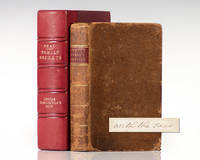
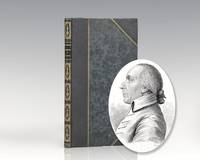
1798139518London: Printed for T.N. Longman Paternoster-Row 1798. Octavo bound in full contemporary calf with a burgundy morocco spine label lettered in gilt gilt ruling to the spine. Vol. III of the original five volumes. Tipped in to the pastedown is a small clipped note in the hand of George Washington which reads "with the said" and the bookplate of Benjamin Lincoln Lear. The set in which this volume originated was listed in a manuscript by Washington's private secretary Tobias Lear titled 'Catalogue of Books received from Washington' and bears the bookplate of Lear's son Benjamin Lincoln Lear. Tobias Lear served as Washington's personal secretary from 1784 until the former-President's death in 1799. Washington unexpectedly died while Lear was visiting him at Mount Vernon on December 14 1799 leading to Lear's famous diary entry: "About ten o'clk Saturday December 14 1799 Washington made several attempts to speak to me before he could effect it at length he said—'I am just going. Have me decently buried; and do not let my body be put into the Vault in less than two days after I am dead.' I bowed assent. He then looked at me again and said 'Do you understand me' I replied 'Yes.' "Tis well' said he. Lear oversaw the funeral arrangements even to the detail of measuring the corpse at 6 feet 3.5 inches long and 1 foot 9 inches from shoulder to shoulder. Lear's only biographer Ray Brighton was convinced that Lear destroyed many of Washington's letters and diary entries which he had possession of for about a year after Washington's death. In very good condition. Housed in a custom half morocco and folding chemise slipcase. An exceptional piece of Americana. American statesman and soldier George Washington served as the first President of the United States from 1789 to 1797 and was one of the Founding Fathers of the United States. He served as Commander-in-Chief of the Continental Army during the American Revolutionary War and later presided over the 1787 convention that drafted the United States Constitution. He is popularly considered the driving force behind the nation's establishment and came to be known as the "father of the country" both during his lifetime and to this day. Printed for T.N. Longman, Paternoster-Row unknown
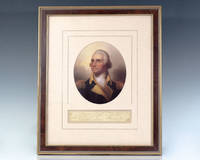
1799142623January 21 1799. Rare partial document signed by George Washington on January 21 1799 eleven months before his death on December 14 1799. Octavo the partial manuscript document reads "I do acknowledge that this is the Platt referred to in the Deeds made for the Lands of George Mercer." Signed by Washington "Go. Washington" and countersigned by three witnesses. Accompanied by a typed letter signed by Dorothy Twohig editor-in-chief of the The Papers of George Washington which reads in part "The note on Mercer explains Washington's involvement in the whole affair which started before the Revolution. After the war Washington tried to extricate himself from the problems resulting from the power of attorney given him by George Mercer who had died in 1784 and indeed a decree of the Virginia Court of Chancery had removed Mercer's affairs from his control but ramifications from land sales followed him even into his years of retirement after his presidency. I am also inclosing transcriptions of three letters between Washington and Raleigh Colston involving Mercer's land. We think that your document was issued by Washington to reassure Colston in regards to his purchase of Mercer land. It was all an extremely complicated affair that plagued Washington for much of his public life." George Mercer served as a captain under George Washington during the French and Indian War moving to Europe in 1765. Washington became entangled in his American business affairs in the early 1770s after Mercer had inherited properties in Virginia from his father. The present document seems to pertain to the sale of Mercer's lands to Raleigh Colston with Washington offering reassurances of a clean title. It is a particularly noteworthy document in that Washington began his adult life as a surveyor—in July 1749 at the age of 17 Washington was appointed official surveyor for the newly created Culpeper County in northern Virginia. Here a mere eleven months before his death on December 14 1799 he is still attending to matters of plats and surveys. In very good condition. Handsomely matted and framed with a portrait of Washington after Rembrandt Peale’s famed painted portrait “George Washington Patriae Pater" considered by many second only to Gilbert Stuart’s iconic Athenaeum portrait of the first president and variations of which hang in the Oval Office and Old Senate Chamber. The entire piece measures 16 inches by 19.25 inches. American statesman and soldier George Washington served as the first President of the United States from 1789 to 1797 and was one of the Founding Fathers of the United States. He served as Commander-in-Chief of the Continental Army during the American Revolutionary War and later presided over the 1787 convention that drafted the United States Constitution. He is popularly considered the driving force behind the nation's establishment and came to be known as the "father of the country" both during his lifetime and to this day. Washington retired to Mount Vernon in March 1797 and devoted time to his plantations and other business interests including his distillery. His plantation operations were only minimally profitable48 and his lands in the west Piedmont were under Indian attacks and yielded little income with the squatters there refusing to pay rent. He attempted to sell these but without success. Washington was known to be rich because of the well-known "glorified façade of wealth and grandeur" at Mount Vernonbut nearly all of his wealth was in the form of land and slaves rather than ready cash. To supplement his income he erected a distillery for substantial whiskey production. Historians estimate that the estate was worth about $1 million in 1799 dollars equivalent to $17.59 million in 2022. Washington bought land parcels to spur development around the new Federal City named in his honor and he sold individual lots to middle-income investors rather than multiple lots to large investors believing they would more likely commit to making improvements. unknown
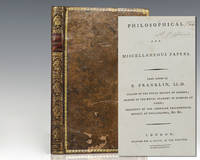
1787125345London: Printed for C. Dilly in the Poultry 1787. First edition of the last collection of Franklin's writings to appear during his lifetime; a major collection of his political philosophical and scientific writings a second volume of which was planned but never published. First issue with page 25 <span class="glossaryQtip qTip">mispaginated</span> "52." Octavo bound in full contemporary tree calf with elaborate gilt tooling to the spine red morocco spine label lettered in gilt gilt Greek key ruling to the front and rear panels. With four copper-engraved folding plates including diagrams of the Franklin stove and the earliest published map of the Gulf Stream. In very good condition. Armorial bookplate and early ownership inscriptions. Text and plates very clean. Rare. Intended by the publisher as a companion volume to the Experiments and Observations on Electricity 1769 and his Political Miscellaneous and Philosophical Pieces 1779 Franklin's Philosophical and Miscellaneous Papers contains a selection of important political essays including his Remarks concerning the Savages in North America 1784 The letter from Dr. B. Franklin to Benjamin Vaughan. of Privateering 1785 and Information to those who would remove to America 1784 which is "one of the clearest expressions of his belief that American society should be based on the virtues of the middle. classes" Isaacson 423. Also highly notable is Internal State of America his sharply optimistic postwar reply to "complaints of hard times in the American press. with an equally sharp consciousness of British propaganda" Crane William and Mary Quarterly XV:2 218. This volume additionally contains three major scientific writings: Description of a New Stove for the burning of Pitcoal 1785 Letter from Dr. B. Franklin to Dr. Ingenhausz On the Causes and Cure of Smoky Chimneys 1785 and Letter from Dr. Benjamin Franklin. containing sundry Maritime Observations 1785. Merging his political and scientific interests Franklin used Maritime's study of the sea and Gulf Stream to "proclaim the virtues of his nation and its people." This inspired others to also "think of the Gulf Stream in political terms. In 1790 Thomas Paine declared the French Revolution 'as fixed as the Gulf Stream' and Jonathan Williams claimed the current's waters were as distinct as 'the colors of red white and blue'" Chaplin 320-25. Printed for C. Dilly, in the Poultry unknown books
1787125345London: Printed for C. Dilly in the Poultry 1787. First edition of the last collection of Franklin's writings to appear during his lifetime; a major collection of his political philosophical and scientific writings a second volume of which was planned but never published. First issue with page 25 mispaginated "52." Octavo bound in full contemporary tree calf with elaborate gilt tooling to the spine red morocco spine label lettered in gilt gilt Greek key ruling to the front and rear panels. With four copper-engraved folding plates including diagrams of the Franklin stove and the earliest published map of the Gulf Stream. In very good condition. Armorial bookplate and early ownership inscriptions. Text and plates very clean. Rare. Intended by the publisher as a companion volume to the Experiments and Observations on Electricity 1769 and his Political Miscellaneous and Philosophical Pieces 1779 Franklin's Philosophical and Miscellaneous Papers contains a selection of important political essays including his Remarks concerning the Savages in North America 1784 The letter from Dr. B. Franklin to Benjamin Vaughan… of Privateering 1785 and Information to those who would remove to America 1784 which is "one of the clearest expressions of his belief that American society should be based on the virtues of the middle… classes" Isaacson 423. Also highly notable is Internal State of America his sharply optimistic postwar reply to "complaints of hard times in the American press… with an equally sharp consciousness of British propaganda" Crane William and Mary Quarterly XV:2 218. This volume additionally contains three major scientific writings: Description of a New Stove for the burning of Pitcoal 1785 Letter from Dr. B. Franklin to Dr. Ingenhausz On the Causes and Cure of Smoky Chimneys 1785 and Letter from Dr. Benjamin Franklin… containing sundry Maritime Observations 1785. Merging his political and scientific interests Franklin used Maritime's study of the sea and Gulf Stream to "proclaim the virtues of his nation and its people." This inspired others to also "think of the Gulf Stream in political terms. In 1790 Thomas Paine declared the French Revolution 'as fixed as the Gulf Stream' and Jonathan Williams claimed the current's waters were as distinct as 'the colors of red white and blue'" Chaplin 320-25. Printed for C. Dilly, in the Poultry unknown
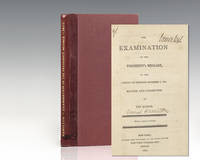
1802131843Printed and Published at the Office of the New York Evening Post: New York 1802. First separate edition of Hamilton's analysis of Jefferson's first Annual Message to Congress which first appeared in the Evening Post under the signature of Lucius Crassus. Howes H112. Octavo bound in quarter morocco. Association copy from the library of American jurist James Kent with his ownership signature to the title page. American jurist New York legislator and legal scholar James Kent was part of the same legal elite in New York as Hamilton and an ardent Federalist and admirer of both Hamilton and Jay. At the time of the present publication he sat on the bench of the New York Supreme Court where he was shortly to become chief judge. He wrote admiringly of Hamilton "He was blessed with a very amiable generous tender and charitable disposition and he had the most artless simplicity of any man I ever knew. It was impossible not to love as well as respect and admire him. He was perfectly disinterested. The selfish principle that infirmity too often of great as well as of little minds seemed never to have reached him. He was a most faithful friend to the cause of civil liberty throughout the world but he was a still greater friend to truth and justice" James Kent 1832. In near fine condition. A significant association copy. Thomas Jefferson presented his first Annual Message to Congress in writing by way of a clerk on December 8 1801. He did not speak it to the 7th United States Congress because he thought that would make him seem like a king remarking "Whilst we devoutly return thanks to the beneficent Being who has been pleased to breathe into them the spirit of conciliation and forgiveness we are bound with peculiar gratitude to be thankful to Him that our own peace has been preserved through so perilous a season and ourselves permitted quietly to cultivate the earth and to practice and improve those arts which tend to increase our comforts. New York unknown
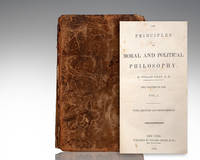
1839145971New York: Collins Keese & Co 1839. Later edition of this classic book on moral and political philosophy; used by William Tecumseh Sherman while a cadet at the United States Military Academy at West Point. Octavo original calf. General Sherman and his son's bookplates to the front pastedown. Intentionally scratched with "S" multiple times on the front panel by General Sherman. Inscribed by Sherman as a cadet on the front flyleaf "Sherman Nov. 1st/39." The date indicates that Sherman was in his third year at the academy upon signing this book. While at West Point Sherman excelled academically described by fellow cadet William Rosecrans as "one of the brightest and most popular fellows" at the academy. Hirshson The White Tecumseh 1997 p. 13. This book on one of the subjects Sherman described as excelling at would have been used by him in his studies. In good condition with front panel detached splitting to the hinges some loss to the spine and some toning throughout. No other examples of books used by Sherman at West Point are known. Sherman writes about his time at West Point only briefly in his memoirs: "At the Academy I was not considered a good soldier for at no time was I selected for any office but remained a private throughout the whole four years. Then as now neatness in dress and form with a strict conformity to the rules were the qualifications required for office and I suppose I found not to excel in any of these. In studies I always held a respectable reputation with the professors and generally ranked among the best especially in drawing chemistry mathematics and natural philosophy. My average demerits per annum were about one hundred and fifty which reduced my final class standing from number four to six." Collins, Keese, & Co unknown
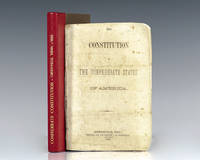
1861125394Greenneville sic Tenn.: Printed And For Sale by J. M. Robertson 1861. Scarce 1861 Tennessee printing of The Constitution of The Confederate States of America adopted on March 11 1861. Octavo original wrappers. In very good condition wrappers laminated in glassine. Housed in a custom cloth chemise and half morocco slipcase. Exceedingly rare being the only example printed in Tennessee in the year of the Constitution's adoption to appear in auction records. Adopted on March 11 1861 the Constitution of the Confederate States was the supreme law of the Confederate States of America. It was in effect from 22 February 1862 to the conclusion of the American Civil War in May 1865. The majority of its provisions follow the United States Constitution verbatim; however there are critical differences between the two documents regarding slavery. Whereas the original U.S. Constitution did not use the word "slavery" or the term "Negro Slaves" but instead used "Persons held to Service or Labour" which included whites and Native Americans in indentured servitude the Confederate Constitution addresses the legality of slavery directly and by name. Though Article I Section 9 1 of both constitutions are quite similar in banning the importation of slaves from foreign nations the Confederate Constitution permitted the Confederate States to import slaves from the United States and specified the "African race" as the subject. The importation of slaves into the United States including the South had been illegal since 1808. Printed And For Sale by J. M. Robertson hardcover books
1828102755New York: Published by S. Converse. Printed by Hezekiah Howe 1828. Rare first edition of Webster's monumental American Dictionary one of only 2500 copies with <span class="glossaryQtip qTip">frontispiece</span> portrait of the pioneering lexicographer in full contemporary calf. Quarto two volumes bound in full contemporary calf marbled endpapers illustrated frontispiece tissue guard present. In near fine condition light toning to the text. Most rare and desirable bound in contemporary calf. An exceptional example most rare without any restoration. In 1807 Webster began compiling a fully comprehensive dictionary An American Dictionary of the English Language; it took twenty-eight years to complete. To evaluate the etymology of words Webster learned twenty-six languages including Old English Anglo-Saxon Greek Hebrew and Latin. Webster completed his dictionary during his year abroad in 1825 in Paris France and at the University of Cambridge. His book contained seventy thousand words of which twelve thousand had never appeared in a published dictionary before. As a spelling reformer Webster believed that English spelling rules were unnecessarily complex so his dictionary introduced American English spellings replacing colour with color substituting wagon for waggon and printing center instead of center. He also added American words like skunk and squash that did not appear in British dictionaries. At the age of seventy Webster published his dictionary in 1828 registering the copyright on April 14. Webster did all this in an effort to standardize the American language. "This dictionary which almost at once became and has remained the standard English dictionary in the United States was the end-product of a stream of spelling books grammars readers and dcitionaries which flowed from the pen of the industrious Noah Webster.Webster's great dictionary all the 70000 entries of which he wrote with his own hand has been reprinted and brought up to date innumerable times.the book marked a definite advance in modern lexicography as it included many non-literary terms and paid great attention to the language actually spoken. Moreover his definitions of the meaning of words were accurate and concise.and have for the greater part stood the test of time superbly well" Printing and the Mind of Man. "As a whole Webster's American Dictionary was a scholarly achievement of the first order richly deserving of its great reputation at home and abroad" DAB. With definitions for "some 70000 words--15000 more than any previous English lexicon. Although only 2500 copies of the first edition were printed the work established Webster as a lexicographer of international repute" Lathem 76 United Statesiana 9. Published by S. Converse. Printed by Hezekiah Howe unknown books
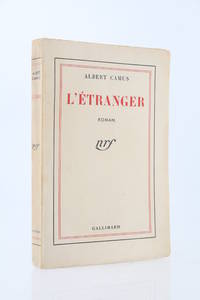
194280260Paris: Gallimard 1942. Fine. Precious Advance Copy as Issued Gallimard Paris 1942 12 x 19 cm broché sous chemise et étui First edition first issue for which no grand papier deluxe copies were printed one of the rare service de presse advance copies. Some very discreet restorations to spine paper browned some discreet traces folds at the bottom of some leaves. A handsome copy as issued. The book is housed in a slipcase signed by Julie Nadot reproducing the original design of the cover and spine. This first edition of L'Étranger was printed on 21 April 1942 with a run of 4400 copies: 400 advance copies service de presse 500 copies without statement and 3500 copies with false statements from the second to eighth edition. The advance copies not intended for sale do not include the indication of price 25 francs on the back of the cover. Paper was rare in 1942 and Albert Camus being then an unknown author Gallimard did not print any deluxe grands papiers copies as was often the case. The advance copies or copies without false statements are particularly sought after. Precious and rare unsophisticated copy under an elegant slipcase by Julie Nadot. Gallimard unknown
153266816Norimbergae Nürimberg Nuremberg: In aedib. viduae Durerianae Hieronymus Andreae 1532. Fine. In aedib. viduae Durerianae Hieronymus Andreae Norimbergae Nürimberg Nuremberg 1532 20.50 x 32 cm relié Alberti Dureri clarissimi pictoris et geometræ. De symmetria partium in rectis formis humanorum corporum In aedibviduae Durerianae Hieronymus Andreae Norimbergae Nuremberg 1532 folio 20.5 x 32 cm 80 f. A-E6 F4 G-N6 O4 full parchment First edition of the Latin translation created by Joachim Camerarius the work appeared in German in 1528 under the title Vier Bücher von menschlicher Proportion. Our edition contains the first two books the following two will be published in 1534 under the title De varietate figurarum et flexuris partium ac gestibus imaginum. We will have to wait until 1557 for Louis Meigret's French translation to be published. Our edition is illustrated with 85 large wooden insert illustrations and many other smaller in-text illustrations the same as those used in the original German edition. The title page shows Dürer's well-known monogram. Gothic text. The last white leaf missing in most copies is present here. Large greatly fresh margined copy. Full parchment with preserved laces. Very beautiful copy of the most sought-after of Albrecht Dürer's technical works. The illustrations required the examination of several hundred male and female models and something rarer for the time children. These extremely precise analyses resulted in anthropometrical impressionist drawings showing the human body as a whole and also in detail hands feet heads etc. Each drawing squared or scaled in the margin allows the models to be easily reproduced the book being intended to avoid errors of proportion for young artists. Joachim Camerarius' Latin translation humanist and close friend of the author had at the time an essential role: it gave Dürer's work until then written in archaic German a significant audience; without Camerarius Michelangelo would never for example have known of Dürer's theory of proportions. Dürer whose godfather Anton Koberger published La Chronique de Nuremberg in 1493 frequented the world of printing and engraving very early on and unlike his contemporary Florentine Leonardo da Vinci who published nothing he produced several theoretical treatises. It was during a trip to Italy in 1494 that he met Jacopo de' Barbri 1445-1516 who introduced him to the role of mathematics in perspective and the study of the proportions of the human body. On returning to Germany he opened a workshop became the painter of Maximillian I of Habsbourg and joined the Great Council of the City of Nuremberg. Recognition is complete and Dürer becomes an internationally known artist with the knowledge and ability for well-received thought. In the last years of his life not abandoning the pictorial arts Dürer encouraged by his humanist friends spends most of his time writing. Determined to leave the results of his long theoretical thoughts for posterity he publishes several treatises: Instruction sur la manière de mesurer 1525 Instruction relative aux fortifications des bourgs villes et châteaux 1527 and finally Traité des proportions du corps humain 1528. In keeping with the artistic considerations of the Renaissance the intention of this last treaty is to establish a scientific basis geometrical and arithmetical applied to aesthetics and thus to provide practical guidelines aimed at achieving anatomical perfection. A true artistic testament this emblematic work will have a considerable influence on the history of Western art. In aedib. viduae Durerianae[ Hieronymus Andreae] unknown
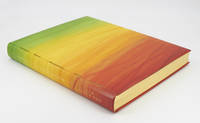
192979718Paris: Nrf 1929. Fine. Nrf Paris 1929 25.50 x 33.50 cm relié Voyage au Congo suivi de Retour du Tchad Nrf Paris 1929 255 x 335 cm full calf & custom chemise and slipcase First collective edition of two journeys in Africa by André Gide published successively in 1927 and 1928. First edition grand papier deluxe copy with 64 photographs by Marc Allégret printed in sepia and four maps. One of 28 numbered copies on japon impérial the tirage de tête. Our copy includes the 1928 colophon of first issue copies on japon impérial. Copies printed on Arches bear the date 1929 Bibliographie des écrits d'André Gide Arnold Naville. The high ink absorption quality of papier japon and its affinity with color make it the ideal medium for Marc Allégret's famous sepia heliographed photographs. White aniline calf with gilt titanium joints ink-painted boards and spine in green yellow and red colors of the Republic of the Congo-Brazzaville flag decoration continuing edge-to-edge on the liners loose endpapers on papier japon dyed with Kakishibu by the binder title lengthwise on the spine decorated chemise titled on the spine and matching custom slipcase. Wrappers and spine preserved. Binding signed by Julie Auzillon gilt title by Geneviève Quarré de Boiry and gilt top edge by Jean-Luc Bongrain 2022. Very scarce tirage de tête on papier japon of this masterpiece book of photographs and the first account of travel to these very remote territories of central Africa by an intellectual and outspoken critic of colonialism. Unique copy set in a stunning art binding in the colors of the Republic of Congo-Brazzaville. Nrf hardcover
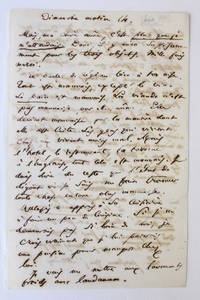
186459356Biponti Deux-Ponts 1864. Fine. Biponti Deux-Ponts Dimanche matin 14 août 1864 13.40 x 20.60 cm 3 pages sur un feuillet remplié N. p. Bruxelles Sunday morning 14 August 1864 134 x 206 cm 3 pages on a folded leave Autograph letter signed in black ink addressed to his mother and dated Sunday morning the 14th. A few underlinings deletions and corrections by the author. Formerly in the collection of Armand Godoy n°188. A fading Baudelaire: The state of disgust in which I find myself makes everything seem even worse. Drawn by the promise of epic fame Baudelaire went to Belgium in April 1864 for a few conferences and in the hope of a fruitful meeting with the publishers of Les Misérables Lacroix and Verboeckhoven. The meeting didn't happen the conferences were a failure and Baudelaire felt boundless resentment for Poor Belgium. Nonetheless despite numerous calls to return to France the poet would spend the rest of his days in this much-castigated country living the life of a melancholic bohemian. Aside from a few short stays in Paris Baudelaire floored by a stroke that left him paralyzed on one side would only return to France on 29 June 1866 for a final year of silent agony in a sanatorium. Written barely a few months after his arrival in Brussels and his initial disappointments this letter shows us all the principal elements of the mysterious and passionate hatred that would keep the poet definitively in Belgium. In his final years in France exhausted by the trial of The Flowers of Evil humiliated by the failure of his candidacy to the Académie Française a literary orphan after the bankruptcy of Poulet-Malassis and disinherited as an author by the sale of his translation rights to Michel Lévy Baudelaire was above all deeply moved by the inevitable decline of Jeanne Duval his enduring love while his passion for la Présidente had dried up her poetic perfection not having withstood the prosaic experience of physical possession. Thus on 24 April 1864 he decided to flee these decomposing loves of which he could keep only the form and the divine essence. Belgium so young as a country and seemingly born out of a Francophone Romantic revolution against the Dutch financial yoke presented itself to the poet phantasmagorically as a place where his own modernity might be acknowledged. A blank page on which he wanted to stamp the power of his language while affirming his economic independence Belgium was a mirror onto which Baudelaire projected his powerful ideal but one that would send him tumbling even more violently into the spleen of his final disillusionment. Published in the Revue de Paris in November 1917 without the sensitive passage about his cold enemas this emblematic letter evokes all of Baudelaire's work as poet writer artist and pamphleteer. The first such reference is via the reassuring mentor-like figure of the publisher of The Flowers of Evil Poulet-Malassis: If I was not so far from him I really think I'd end up paying so I could take my meals at his. This is followed by a specific reference to the venal value of his Aesthetic Curiosities: all these articles that I so sadly wrote on painting and poetry . Baudelaire then confides in his mother his hopes for his latest translations of Poe which to his great frustration are not getting published by L'Opinion La Vie Parisienne or in Le Monde illustré. He concludes with his Belgian Letters which Jules Hetzel had just told him had been after negotiations with Le Figaro received with great pleasure. Nonetheless as Baudelaire literally underlined they were only to be published when I come back to France. His perennially imminent return to France is a leitmotiv of his Belgian correspondence: Certainly I think I'll go to Paris on Thursday. It is nonetheless always put off I'm putting off going to Paris until the end of the month he corrects himself eight days later and it seems to stoke up the poet's ferocity towards his new unknown
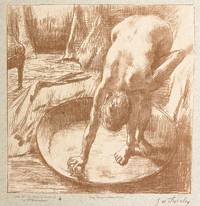
188966900Paris: Boussod Valadon & Cie 1889. Fine. Boussod Valadon & Cie Paris s. d. 1889 41 x 59 cm en feuilles sous portefeuille de l'éditeur First and only edition published of this remarkable set of 15 original lithographs from the post-impressionist painter George William Thornley only 100 copies printed. Publisher's portfolio bound in boards very skilfully restored. 14 of the 15 lithographs are printed in colour black blue green mauve and different browns on broadside China paper laid on pale blue thick paper one is directly printed on thick paper. All except the last bear the stamp of Thornley's signature with the words Chez Mrs Boussod & Valadon 19 Bd Montmartre and Imp. Becquet frères à Paris. In 1888 George William Thornley was commissioned to produce a series of lithographs based on the works of Degas. These lithographs go well beyond the reproduction quality of the renowned publisher. They also demonstrate the high level of collaboration between Degas and Thornley. Thornley first selected the works to publish made the necessary changes in the preparatory drawings and even interrupted the printing at times so that improvements could be made. The importance of Thornley's engravings in Degas' work is particularly highlighted by the book dedicated to Degas by JS Boggs and published by the Metropolitan Museum of New York; a publication in which we find several of the engravings presented in the collection. Chantal and Guy Heytens We have only identified two copies in libraries: one in the Bibliothèque nationale de France and the other in the Institut national d'histoire de l'art. Boussod, Valadon & Cie hardcover
184259614Paris: Charpentier 1842. Fine. Charpentier Paris 1842 12 x 19 cm relié First definitive editions partly original.Bound in red half-shagreen with corners spine with four raised bands decorated with blind-stamped panels and fillets the entwined monogram of Jules Hetzel at the foot uncut copy contemporary binding.A few occasional spots of foxing.Inscribed by the author to Jules Hetzel as a token of the authors friendship. In the 1840s Balzac contributed to a collective volume illustrated with Grandvilles vignettes Scènes de la vie privée et publique des animaux issued in parts by a new publisher Pierre-Jules Hetzel 18141886 who was to become a friend and play a crucial role in the consortium of publishers of La Comédie humaine. Balzac also assisted Hetzel in drafting texts signed P.-J. Stahl the publishers pseudonym. Roger Pierrot Honoré de Balzac Paris Fayard 1994 An outstanding copy inscribed by Balzac in a charming contemporary binding. Charpentier hardcover
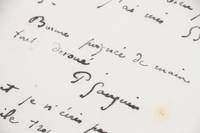
189684738s. l. Tahiti 1896. Fine. ""I'm gifted he says to the point of making others jealous."" s. l. Tahiti août 1896 20.50 x 27 cm quatre pages sur deux feuillets Yes I have sarcasm in my words yes I do not know how to flatter and bend my back how to beg in official salons I am nothing but a braying schemer but if I had submitted - yes I would be comfortable."" Long autograph letter dated August 1896 and signed by Paul Gauguin to painter Daniel de Monfreid. Four pages in black ink on two lined sheets. Small tears to margins not affecting the text traces of folds inherent to sending. In the midst of his descent into hell abandoned in his Tahitian artificial paradise Gauguin feels cursed : Definitely I was born under a bad star. he laments. His quest for primitive freedom leaves him in destitution and misery. Suffering agony the painter sends paintings to one of his few supporters his faithful friend Daniel de Monfreid - but writes the wrong address. Published in Lettres de Paul Gauguin à Georges-Daniel de Monfreid 1918 p. 146 n° XXIII; our letter reveals the name of Émile Schuffenecker his friend and associate on the Paris stock exchange and then Pont-Aven - anonymized in the published version - whom Gauguin vilifies on numerous occasions in these pages. This exceptional missive was written in Tahiti where the painter had returned the previous year bidding a final farewell to the old Europe. Gauguin had just come out from a stay in hospital in Papeete to treat his bruised legs following the beating he had received in Concarneau two years earlier for defending his muse Annah the Javanese. The painter could not escape the aftermath of this altercation and suffered from a terrible purulent eczema on his leg as well as syphilis drowning his torments in alcohol. The letter is a perfect example of Gauguin's correspondence from the summer of 1896 which ""smells of the fever that has seized a mind overheated by pain and lack of sleep"" David Haziot. In his confusion the painter misspelt the address of Monfreid's studio at the Cité Fleurie a famous chalet-like artists' residence where Gauguin had stayed : I sent you a bunch of paintings last month. I'm afraid for them because it seems to me that I put 55 Bd Arago instead of 65 This mailing included his composition Eihaha Ohipa painted in his studio in Punaauia and now kept at the Pushkin Museum in Moscow. Shipped via a naval officer - fees to be paid by Monfreid - the paintings did not arrive until November. Beyond his feverish fears Gauguin delivers in these lines a true manifesto of his integrity as an artist - the perfect counterpart to his famous Christlike self-portrait Near Golgotha painted around the same period. To him his destiny and generosity are nothing short of Christ-like: in the most difficult moments of my life I more than shared with unfortunate people and never had any reward other than complete abandonment. He had in fact helped display Schuffenecker's paintings in Impressionist exhibitions saved his friend Laval from suicide and opened his purse to so many others. Instead of returning the favor Schuffenecker prefers to feel sorry for himself: Schuff really wrote me a crazy and unfair letter and I don't know what to answer because he is a sick mind . he would be more unhappy than me who has glory strength and health. Let's talk about it! I'm good at making others jealous he says. Gauguin who had always refused to make concessions and compromise is finally betrayed by one of his closest relations Schuffenecker who becomes in the letter a true Judas Iscariot: Schuff has just made a useless petition I believe for the State to come to my aid. This is the thing that can offend me the most. I'm asking friends to help me out for the time it takes to get back the money I'm owed and their efforts to recover it but begging the State was never my intention. The painter reaches a point of no return not only bruised in his flesh but also unknown
194984229Paris: Gallimard 1949. Fine. The most important feminist essay in a limited first edition deluxe issue Gallimard Paris 1949 15 x 21 cm 2 volumes brochés en coffret First edition one of 55 numbered copies on pur fil paper most limited deluxe issue. Endleaves and half-title slightly and partially shaded. Exceedingly rare and handsome copy of this seminal text of modern feminism. Our copy is housed in a custom gray clamshell box square spine titled in red author's name and subtitles in black first panel hollowed revealing a black and white photograph of Simone de Beauvoir as a young woman under a plexiglass title in red author's name first volume number and subtitle in black second panel hollowed revealing a color photograph of the author in her prime under plexiglass titled in red author's name second volume number and subtitle in black box lined with burgundy paper superb work by artist Julie Nadot. Gallimard unknown
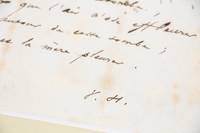
1840878291840. Fine. ""Spare still the mother vainly weepingO'er baby lost not long a-sleeping."" s.d. 21 janvier 1840 21.20 x 26.70 cm un feuillet sous cadre Autograph poem by Victor Hugo signed V. H. four stanzas written black ink on a leaf. Blind stamp of the city of Bath in the lower left-hand corner. Some folds small traces of foxing along the folds a few pale stains to the lower right margin not affecting the text. A few very small dark spots in the lower right margin one affecting a single letter of the word retombe. Original manuscript and earlier version of Victor Hugo's poem published as Écrit sur le tombeau d'un petit enfant au bord de la mer Baby's seaside grave in Les Rayons et les Ombres XXXVIII Paris Delloye 1840. Hugo wrote this magnificent eulogy in memory of his great friend Auguste Vacquerie's young nephew who died at the age of four years and ten months. The poet had promised a poetic epitaph and personally addressed this manuscript to Vacquerie: Take these verses if you still want them for the tomb of this dear little one Letter to Vacquerie January 21 1840. As Joseph Petrus Christiaan de Boer pointed out There is no sorrow Hugo understood and expressed more delicately than the immense grief that fills the hearts of parents upon the death of a child Victor Hugo et l'enfant 1933 p. 48-49. This poem is the first of a sublime macabre series composed on the occasion of the numerous tragedies suffered by the families of both Victor Hugo and his friend Auguste Vacquerie. The most famous will be Demain dès l'aube. written after the untimely death of Hugo's beloved daughter Léopoldine who drowned alongside Auguste Vacquerie's brother Charles on September 4 1843 shortly after their marriage. Hugo wrote these verses for Charles-Emile Lefèvre the young child of Vacquerie's sister who had succumbed to sudden illness on November 6 1839. On January 21 1840 Hugo sent this manuscript to Vacquerie which includes a variation from the final version published by Delloye on May 16 of the same year: « Vieux lierre frais gazon herbe roseaux corolles ; Église où l'esprit voit le Dieu qu'il rêve ailleurs ; mouches qui murmurez d'ineffables paroles A l'oreille du pâtre assoupi dans les fleurs ; Vents flots hymne orageux chur sans fin voix sans nombre ; Bois qui faites songer le passant sérieux ; fruits qui tombez de l'arbre impénétrable et sombre ; Étoiles qui tombez du ciel mystérieux ; oiseaux aux cris joyeux vague aux rumeurs ' plaintes' in the published version profondes ; froid lézard des vieux murs dans les pierres tapi ; plaines qui répandez vos souffles sur les ondes ; Mer où la perle éclot terre où germe l'épi ; Nature d'où tout sort nature où tout retombe feuilles nids doux rameaux que l'air n'ose effleurer Ne faites pas de bruit autour de cette tombe ; Laissez l'enfant dormir et la mère pleurer. » ' Brown ivy old green herbage new; Soft seaweed stealing up the shingle; An ancient chapel where a crew Ere sailing in the prayer commingle. A far-off forest's darkling frown Which makes the prudent start and tremble Whilst rotten nuts are rattling down And clouds in demon hordes assemble. Land birds which twit the mews that scream Round walls where lolls the languid lizard; Brine-bubbling brooks where fishes stream Past caves fit for an ocean wizard. Alow aloft no lullall life But far aside its whirls are keeping As wishfully to let its strife Spare still the mother vainly weeping O'er baby lost not long a-sleeping.' tr. Nelson Rich Tyerman Hugo sent the manuscript with a touching letter: Here at last my poet is what I have kept you waiting for so stupidly long. . Take these verses if you still want them for the tomb of this dear little one . For my part I do not feel that I have repaid my debt to this angel with so little. I have begun something longer for him that I will one day lay at the feet of his poor mo unknown
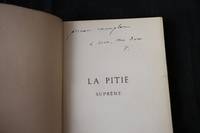
187945162Paris: Calmann Lévy 1879. Fine. ""for you my lady"" - Juliette Drouet's personal copy Calmann Lévy Paris 1879 15 x 24 cm relié HUGO Victor La Pitié suprême The Supreme Compassion Calmann Lévy Paris 1879 150 x 240 mm 5 15/16 x 9 7/16 half shagreen First edition. Elegant half dark blue shagreen over marbled paper boards by René Aussourd spine in four compartments with gilt dots and double gilt compartments containing horizontal arabesques and gilt stars date and ex. de J. Drouet in gilt at foot marbled endpapers and pastedowns covers and spine preserved marginal repairs to covers top edge gilt ex-libris of Pierre Duché on one endpaper. An exceptional presentation copy inscribed by Victor Hugo to Juliette Drouet the love of his life: The first copy for you my lady. V. Premier exemplaire à vous ma dame. V. Written in 1857 this long philosophical poem on the Revolution was originally meant to conclude the ""Légende des Siècles"". Victor Hugo eventually published it in 1879 when he took a stand on behalf of the Communards. Pleading for the abolition of the death penalty La Pitié suprême highlights one of the first and most heartfelt of Hugo's political struggles which he carried on till the very end of his eighties: if my name stands for anything in these deadly times in which we live it stands for Amnesty ""Letter to the citizens of Lyon"" 1873. Comparing Hugo and Machiavelli J. C. Fizaine underlines the intellectual rigor of the poet who put himself at the service of a humanism elevated into a universal principle: Machiavelli writes for those who wanted to become princes. Hugo writes first and foremost for the people who have known tyranny. It is ""La Pitié suprême"" that defines what will remain immutably sacrosanct human life without hate resentment and the memory of past suffering being justifications for the transgression of its sanctity; and the danger of such transgression is the impossibility of establishing any kind of political system and falling back into a pre-civilized state. Victor Hugo penseur de la laïcité Le clerc le prêtre et le citoyen He waged this final struggle alonside Juliette Drouet. Published in February 1879 not long after they had settled in the avenue d'Eylau La Pitié suprême seems to be a political echo of the newfound legitimacy of the two old lovers after fifty years of clandestine relations. Hugo's last fight for amnesty and pardon reverberated in his emotional life like with the poem he wrote on the death of Juliette in 1883: On my grave they'll write as a great victory The cherished deep embattled memory of a love that was not sanctioned but grew virtuous. A fine copy in a handsome binding and with an extraordinary provenance the most desirable one could wish for. Calmann Lévy hardcover
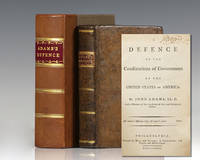
1787125308Philadelphia: Printed for Hall and Sellers; J. Cruikshank; and Young and McCulloch 1787. First edition of John Adams's greatest contribution to American political theory; from the library of one of the 39 signers of the United States Constitution Founding Father Gunning Bedford Jr. Octavo bound in full contemporary tree calf with gilt ruling to the spine red morocco spine label lettered in gilt gilt turn-ins. Signed by Gunning Bedford Jr. on the title page. Born in Philadelphia in 1747 Gunning Bedford attended the College of New Jersey where he was a classmate of James Madison and later served in the Continental Army as an aide to General George Washington. After the Revolutionary war he became a prominent political figure sitting in the legislature on the state council and in the Continental Congress 1783-85. One of the more active members of the Constitutional Convention on May 14 1787 he was one of the 39 delegates that signed the Constitution of the United States. Gunning Bedford also served as Attorney General of Delaware from 1784 until he was designated by George Washington as a federal district judge for his state in 1789 a position he held for the rest of his life. In near fine condition. Housed in a custom half morocco and chemise case. An exceptional example with fine provenance. Adams wrote this work on constitutional theory while serving as Minister to the Court of St. James as a response to liberal French statesman Turgot who had criticized the new American state constitutions for their conservative economic framework. Adams's Defence was often cited in the debates of the Constitutional Convention. "A work marked by insight breadth of views conviction courage and--we may venture to add--much wisdom" Larned Literature of American History 2287. At the start of 1787 while minister to Great Britain and a year before he returned to America John Adams "felt an urgency like that of 1776. Great events were taking place at home. Support for a stronger central government was gaining ground. A constitutional convention was in the offing and as he had been impelled in 1776 to write his Thoughts on Government so Adams plunged ahead. books piled about him his pen scratching away until all hours. By early January 1787 Adams had rushed the first installment of his effort to a London printer. Titled A Defence of the Constitutions of Government of the United States of America. copies were sent off at once to the United States and to Jefferson in Paris" McCullough John Adams 374. Of the Defence Thomas Jefferson wrote to Adams "I have read your book with infinite satisfaction and improvement. It will do great good in America. Its learning and its good sense will I hope make it an institute for our politicians old as well as young" Sowerby 3004. "From Philadelphia where the Constitutional Convention had assembled Benjamin Rush a member of the Convention wrote that the Defence had 'diffused such excellent principles among us that there is little doubt of our adopting a vigorous and compound federal legislature. To a considerable extent Adams' Defence was an expanded more erudite rendition of the case for checks and balances in government that he had championed in his Thoughts on Government 1776 and later put into operation in his draft of the Massachusetts constitution" McCullough 375. "The work did much to familiarize the European mind to the novel state of things then taking place in America" Sabin 236. This volume was issued as a stand-alone work and was followed by two supplemental volumes the following year Sabin 234. Printed for Hall and Sellers; J. Cruikshank; and Young and McCulloch unknown books
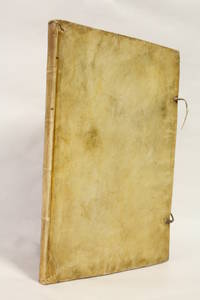
177691322Philadelphia: Robert Bell 1776. Exceptionally rare edition of the first surgical work by an American and printed in North America. Octavo bound in nineteenth century three quarters morocco over marbled boards gilt titles and tooling to the spine frontispiece. Jones' work was the accepted guide to surgical practice during the American Revolutionary War" G&M 2155; Austin 1843; Evans 15100 and 14814; Sabin 94063 and 36524. In near fine condition. Although Jones was born in America and brought up in a family of medical doctors he was trained as a surgeon in France by some of the leading physicians in the world including Percivall Pott one of the founders of the study of orthopedics. His doctoral thesis On the Observation of Wounds would later develop into this seminal surgical text and the very first treatise on surgery to be printed in North America. Jones was also integral in establishing the medical school that would later become Columbia University’s College of Physicians and Surgeons where he was appointed as the very first professor of surgery in the Americas. Robert Bell hardcover
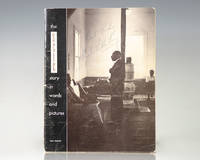
1964141073Atlanta Georgia: Southern Christian Leadership Conference 1964. First edition first printing of The SCLC Story containing one of the first appearances in print of Martin Luther King Jr.'s I Have a Dream Speech. Quarto original illustrated wrappers as issued illustrated with photographs including a full-page photograph of King photographs of the officers executive board regional and secretarial staffs of the SCLC. Signed by Martin Luther King Jr. on the front panel "Best Wishes Martin Luther King." With a letter of provenance that relays that the magazine was signed at an event where King spoke in Atlanta in 1964 and that it may have been first obtained when the Coliseum in Los Angeles hosted the Religious Witness for Human Dignity on May 31 1964. Dr. King gave a forty-minute speech at this event of which Pepperdine University Archives has a recording that can be hear online. In near fine condition. Very rare and desirable containing one of the earliest appearances of King's powerful and iconic I Have a Dream Speech. Baptist minister and activist Martin Luther King Jr. became the most visible spokesperson and leader in the civil rights movement from 1954 through 1968. He is best known for his role in the advancement of civil rights using the tactics of nonviolence and civil disobedience based on his Christian beliefs and inspired by the nonviolent activism of Mahatma Gandhi. King led the 1955 Montgomery bus boycott and in 1957 became the first president of the Southern Christian Leadership Conference SCLC. With the SCLC he led an unsuccessful 1962 struggle against segregation in Albany Georgia and helped organize the nonviolent 1963 protests in Birmingham Alabama. He also helped organize the 1963 March on Washington where he delivered his famous "I Have a Dream" speech. On October 14 1964 King received the Nobel Peace Prize for combating racial inequality through nonviolent resistance. In 1965 he helped to organize the Selma to Montgomery marches and the following year he and the SCLC took the movement north to Chicago to work on segregated housing. In his final years he expanded his focus to include opposition towards poverty and the Vietnam War alienating many of his liberal allies with a 1967 speech titled "Beyond Vietnam". In 1968 King was planning a national occupation of Washington D.C. to be called the Poor People's Campaign when he was assassinated on April 4 in Memphis Tennessee. He was posthumously awarded the Presidential Medal of Freedom and the Congressional Gold Medal. Martin Luther King Jr. Day was established as a holiday in numerous cities and states beginning in 1971 and as a U.S. federal holiday in 1986. The Martin Luther King Jr. Memorial on the National Mall in Washington D.C. was dedicated in 2011. Southern Christian Leadership Conference unknown
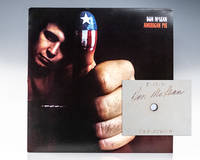
1971149880New York: United Artists 1971. Don McLean's personal test pressing of American Pie before mass production gifted in 1971 to his former sister-in-law. A 12-inch vinyl test pressing with paper labels on both sides and the album itself etched with the word "Peace" and codes "UAS-5535A" and "UAS - 5535B". Signed by Don McLean on both paper labels and dated "8-17-71" with the code "UAS - 5535A" on the verso and "UAS - 5535B" on the recto. The album is housed in its original plain brown sleeve with McLean's handwritten tracklisting of each song title. In fine condition with the sleeve in very good condition. Accompanied by two letters of provenance one from McLean's former sister-in-law and one from session bassist Rob Stoner who has offered his recollections of the session and the test pressing. Together with a new copy of the album featuring the famous cover art. A unique piece of musical history. The album was recorded in the summer of 1971 with test pressings going to McLean and United Artists in August before its October release. Recorded at the Record Plant in Manhattan McLean surrounded himself with a crack band of session musicians including Paul Griffin Rob Stoner and David Spinozza. Rob Stoner credited on American Pie as Bob Rothstein describes meeting McLean at his house to listen to this test pressing of American Pie. In that room at that moment the two men must have known they'd struck gold. Around this time the copy of the test pressing given to McLean for review was gifted to his then sister-in-law. This was before the fame that came with the album transitioning a song into a national treasure. Just one example among many: the song "American Pie" hit the Billboard 100 chart in 1972 and set a record for the longest song to hold the top position for nearly 50 years. Said McLean "There is something to be said for a great song that has staying power." Critics and fans alike raved about the album's title track which documents a uniquely American form of innocence lost. American Pie is a triple-platinum album and has gone down as a cultural touchstone covered parodied analyzed and referenced for decades. United Artists unknown
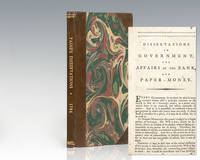
1786104062Philadelphia: Printed by Charles Cist 1786. First edition of Paine's defense of the Bank of North America. Small octavo bound in three quarters leather over marbled boards with gilt titles and tooling to the spine. Rare. "Another time that tried men's souls occurred in 1780 when the American troops were at the end of their patience because of lack of pay and scarcity of supplies. Serious features of mutiny and sedition had already appeared. A tone of discouragement swept through the Pennsylvania Assembly for the treasury was empty. One member said 'We might as well give up first as last.' But Paine did not agree and when he drew his meager salary he took $500 and started a subscription for the relief of soldiers. Robert Morris and many others followed and by June 18 1780 had raised 300000 pounds and started a bank which supplied the army through the campaign.When the bank came under attack by those who favored inflation after the war Paine rushed to its defense with this pamphlet."Gimbel 45. In very good condition with the title page backed with some restoration period ownership signature stamp to the verso of page 53 notations throughout. Printed by Charles Cist hardcover books