Roosevelt, Franklin DelanoBiblio.com

48 390 résultats
1926125163Boston and New York: Houghton Mifflin Company 1926. First edition of Franklin Delano Roosevelt's first book being the text of a lecture delivered by him at Milton Academy on the Alumni War Memorial Foundation on May 18 1926. Octavo original cloth. One of one thousand copies printed. Association copy inscribed by the author on the title page on the occasion of publication and within a month of the delivery of the lecture to his son "For my son Elliott Roosevelt This copy of his Dad's first book Franklin D. Roosevelt June 1926." Additionally signed by Roosevelt on the title page "Franklin Roosevelt." Elliott was the fourth of Roosevelt's six children and Eleanor's acknowledged favorite. His future career included military service involvement in aircraft procurement and roles as author rancher radio station owner and Mayor of Miami Beach. Near fine in the rare original dust jacket which is in good condition. Housed in a custom cloth chemise and half morocco slipcase. Small bookplate to the pastedown. An exceptional association. American statesman and political leader Franklin Delano Roosevelt served as the President of the United States from 1933 to 1945. A Democrat he won a record four presidential elections and dominated his party after 1932 as a central figure in world events during the mid-20th century leading the United States during a time of worldwide economic depression and war. Houghton Mifflin Company hardcover
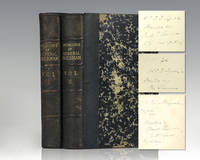
1875103400New York: D. Appleton and Company 1875. First edition of this memoir from one of the most well regarded generals “oft-consulted and much-quoted reminiscences . Sherman wrote as he fought; dynamically and bluntly†Nevins II 89. Octavo bound in publishers three quarters morocco over marbled boards gilt titles to the spine illustrated. Presentation copy inscribed by General Sherman three times: on the front free endpaper of Vol. I "Mrs. E.J. Lynch Presented by Gen. W.T. Sherman 1876 New York City"; on the front free endpaper of Vol. II "Mrs. E.J. Lynch Presented by Gen. W.T. Sherman 18"; and the second free endpaper of Vol. II “Mrs. Eleanor D. Lynch New York 1876 Presented by General Sherman to Mrs Lynch By order.†The recipient Eleanor D. Lynch of New York City was the mother-in-law of Brigadier General J. Worden Pope and “had many friends in the Army.†With Eleanor Lynch's ownership signature to the second free endpaper of Vol I. In very good condition small loss to the folding map. Signed examples of Sherman's memoirs are rare with only a handful of examples appearing at auction of the trade edition with no publishers morocco ever appearing desirable signed and inscribed three times. "Penned with intelligence and passion Sherman's Memoirs cover the periods of birth to the Meridian Expedition early in 1864 Volume I and the remainder of the war to the commander's first decade following the war Volume II… The memoirs frankly describe the rights and wrongs of the Civil War campaigns Sherman experienced without regard to stepping on the feelings of others. The work is not unduly harsh but is unwaveringly honest as the author viewed these events… The writing in this work is enjoyable more so than the average soldier's memoirs and the enlightened opinions of the second-ranking Federal officer on a multitude of operations make the work invaluable" Eicher 576. D. Appleton and Company hardcover
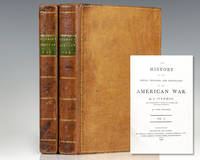
179499225London: Printed for the Author and Sold by J. Murray et al 1794. First edition wide-margined copy of Stedman's massive contemporary two-volume History of the American Revolution-- "the standard work on the subject" --containing 15 military maps and plans 11 folding the largest nearly 20 by 30 inches. Two volumes handsomely bound in contemporary calf green morocco labels half-titles to both volumes. In very good condition rebacked laying down the original backstrips. Rare and desirable with the half-title pages. Philadelphia-born military historian Charles Stedman was a Loyalist who served "with the British at Lexington and Bunker Hill later became commissary to the army of Sir William Howe and was with Cornwallis in the South" New International Encyclopedia 21:485. Taken prisoner by American forces he was sentenced to be hanged as a rebel but escaped. At war's end Stedman moved to England where he authored this authoritative two-volume History--"considered the best contemporary account of the Revolution from the British side" Sabin 91057. As "the standard work on the subject" Stedman's History especially benefits from eyewitness accounts of many campaigns DNB. In addition "the military maps and surveys in the History are of great interest and value" Allibone 2231. Here Stedman argues that Britain's defeat was largely due to the failure of its politicians and ministers and "the military genius of Britain was unimpaired; she rose with elastic force under every blow." Ultimately he concludes that the American Revolution "came as a surprise to the world. no invading army in the present enlightened period can be successful in a country where the people are tolerably united" 449. These two volumes feature folding strategic plans of the Battle of Bunker Hill attacks on Forts Clinton and Montgomery and the Sieges of Charleston Savannah and Yorktown along with maps of Long Island and the Catawba River. Printed for the Author and Sold by J. Murray, et al unknown books
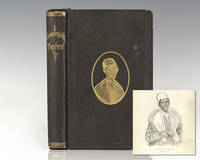
1875133297Boston: Published By The Author 1875. Rare first revised edition of the book that brought Truth's remarkable story to the world and the first edition of The Book of Life. Octavo original cloth gilt titles to the spine illustrated frontispiece portrait of Truth. In very good condition contemporary ownership inscription on front free endpaper. Rare and desirable. “A legend in her own time Truth’s indomitable will has won her a permanent place in American History. Her evangelic fervor and plain wit helped to advance the causes of emancipation and women’s rights†Blockson 29. Evangelist abolitionist reformer and women’s rights advocate Sojourner Truth was born to James and Elizabeth Baumfree both slaves of a Dutch family in Ulster County New York. Named “Isabelle†by her parents she developed deep religious feelings from her mother from whom she was separated at age nine. After a number of new masters and four children later she escaped her last servitude shortly before the mandated New York State emancipation took effect on July 4 1827. “I did not run off for I thought that wicked but I walked off believing that to be all right.†In 1843 she renamed herself “Truth†for God and “Sojourner†because she intended to “travel up and down the land†preaching and testifying. She became associated with such renowned abolitionists as William Lloyd Garrison Frederick Douglass and David Ruggles and toured the country speaking out against slavery. Her Narrative dictated to her friend Olive Gilbert and subsidized by Garrison gave Sojourner an income and increased her speaking engagements where she sold copies of the book. In 1854 at the Ohio Woman’s Rights Convention in Akron Ohio she gave her most famous speech— with the legendary refrain “Ain’t I a Womanâ€: “That man over there says that women need to be helped into carriages and lifted over ditches and to have the best place everywhere. Nobody ever helps me into carriages or over mud puddles or gives me any best place and ain’t I a woman… I have borne thirteen children and seen most all sold off to slavery and when I cried out with my mother’s grief none but Jesus heard me— and ain’t I woman†Blockson 3434; Schomburg 326. Published By The Author hardcover
19670002590ISRAEL THE HOLY LAND ERETZ YISRAEL. Good. 1967. On offer is a superb significant original manuscript diary of a visit to Israel mere weeks after the Six-Day War in 1967 when the State of Israel was compelled to attack her threatening Arab neighbours and thusly destroying their armies and repatriating her ancient homelands of Judea and Samaria and most importantly the Old City of Jerusalem. For a historian this is an exceptional primary-source document. Not only does it deal with the immediate aftermath of the war it opens the door to examining the role of Christian groups in the United States vis-a-vis Israel and the rise of the religious right in American politics. In her trip she confronts circumstances that underlie the critical issues that beset the region to this today. Mary Beth Foland is a 55 year old American tourist who travels to Israel 7 weeks after the conclusion of this war. Born in 1912 she was 55 years old when she made this trip Foland passed away in 1988 at age 76. She was part of a church group that organized this tour - the Eggleston Missionary Tour. For many Christians in the United States Israel has a special draw and the Six-Day war made many more biblical sites accessible. Her trip encompasses visits to Tel Aviv Haifa Akko a Kibbutz Jerusalem Rome Athens Create Rhodes Istanbul Belos Mykonos Lucerne Dublin and Cork Ireland. Foland's travel journal is packed with details. She is a keen eyed erudite observer and prolific note taker. She is free with her opinions and observations - even if they are at times less than accurate and coloured by her religious views Her comments fully reflect the social circumstances of the late 1960s in affluent merica/California. She writes about war torn sections of cities the ever-present military and refugee camps. She also writes about the historic aspects of each area with emphasis on religious sites and practices. In addition to her own observations she notes conversations with local people who experienced the conflict first-hand. She begins her trip account after flying from Los Angeles to Washington DC: Enroute to Intern'al airport of Wash DC. Talk with chauffeur negro of limousine are serving God avoiding nervous breakdown by going to church his idea He's Baptist. . Barbara told she was Schiziod - used Thorazine to come out of voices & Shock - still "sees" people they were "inside" now are "outside" Aug 1 Her day ends with a prayer group meeting. . In Boeing 707 with 129 others aboard. We rec'd a menu printed for Eggleston Missionary Tour and a red rose on tray of our grp . A grp of orientals from Hawaii with us enroute . Aug 2They stay in London for 2 days before heading off to Paris. Her notes are replete with descriptions of what she saw mentioning Hogarth's House Baden Powell statue Buckingham Palace a description of her visit to St. Pauls Cathedral Parliament St. James Palace and Westminster Abbey among many others. She comments that the Tower of London was "The Bastille of England" . She certainly packed a great deal into those 2 days. There is a longer passage summarizing a talk on the history the Jewish people including a reference to Thoedor Hertzl recognized as the "spiritual father of the Jewish State" Israeli Declaration of Independence. She spends a day and a half in Paris and is as much the active tourist as she was in London. Then on to Tel Aviv. 'Our carrier at Tel Aviv was rather disorganized and we were the last through the customs. We followed a thin ascetic Jew we had seem in Paris at 11:00 am with his Phylacteries- on head & wrist & wrapped in black & white prayer shawl. At customs he was declaring several wigs etc some of his bags broke under the load. 2 taxis took 10 of us to Dan Hotel - rather shabby and county looks poor drab & brown. We stopped in route to see where some of Gen. Patton's tanks were sold to Jordan & King Hussein had been stopped by Israel. Saw 6 or 8 there Cabby couldn't understand why L.B.J. sold them to Jordan in the first place. Aug 7 Her descriptions over the next few days are detailed noting meals eaten the geography of various locations archaeology history and conversations. Learn of pilgrimages of Israelis to places where their men reversed the tide of those coming during the 6 day war. They go to touch places saved. Tell of tanks in desert in sand of the naval base in Syria deserted by troops when Isr came in. Of the Kibbutz fired on by tanks & Israel building a road around them in the rear. Of fact that Isr. literate whereas Arabs can't read to fix machines when break down. I see buses filled with younger people in uniforms or partial uniform - very few oldsters out and about. On Old Joppa Street men play backgammon . Aug 8 Haifa - Megiddo - Nablus Jerus Road block of soldiers customs to enter Jordan & former Samaria. Bedouin black tents 1 pix in distance. See refugee camp with block houses out in rocky area. US pays 70 % of their bill via UN. They said 1 1/2 mill but counted dead and brot Egyptians to swell no 15 mill dollars. US to build Jordan airport now in Israel hands. Guide asked Arab why Jordan didn't help refugees more & he said if we did it would solve your problem Israel probl Propaganda better this way. . Aug 11 Jerusalem - Jerico Aug 12 1967 Meet at 8:20 to go to Collegiate Church of St. Geo the Martyrs Episc for welcome service Read psalm 122 & I weep. At oh pray for the peace of Jerusalem they shall prosper that love thee. This church been thru wars 1914 - 1948 etc. In 1899 it founded - William II visited recently Prince Phillip. school hit as it on Israel side. Shelled hard 48 hrs. got phosphorous bomb thru roof 6" in floor windows out. Had chapel services every day during war & still very uneasy. Both Jew & Arab Chris ask why Christians did not help them. Used to pray for King Hussein now they pray " Oh Lord save this land" sch will open in Sept - ot all out safety. Most Jordanians not hostile to Jews. Only thing notice Israelis say "those dirty Arabs" . Aug 12 Men at hotel shop say they well off as Christians & can work for either Jordanians or Israelis. But Holy places defiled Muslims not allowed in Holy places but Christians & Jews intermingle. In Church of Sepulchre a young Isr. girl in with only shorts & priest asked her to cover up - She talked back priest upset hit her - police called to take her to jail. They smoke loud talk go uncovered into holy places. The US must settle this - make an international city out of Jerusalem - this Arab Christian would like that "We depend on you & Pres Johnson to help us out "To save the city". I said we must depend on God & work out forgiveness for our brother. He said "You in U.S. more forgiving & don't know our problems here." . Aug 14 She leaves Jerusalem for Rome on Aug 15th. As in her other entries she makes detailed notes of what she observes. This is an outstanding first-hand account of the early days following the Six-Day War. The conversations she records such as the ones quoted above are eerily similar to comments made today over a half century later. The journal measures 6.5 inches by 4 inches. It contains 160 pages and is 60% complete. The cover binding and pages are all in good condition. The handwriting is dense but legible. HISTORICAL NOTES: The Six-Day War was the third military conflict between Israel and her surrounding Arab neighbours. Faced with their stated objective of destroying the Israeli state and the immediate circumstance of Egypt closing the Straits of Tiran to Israeli shipping Israel struck back and in 6 days smashed the combined armies of Egypt Syria and Jordan. The ramifications continue to this day. ; Manuscript; 16mo - over 5¾" - 6¾" tall; KEYWORDS: HISTORY OF MARY BETH FOLAND; SIX-DAY WAR; ISRAEL; BRITISH MANDATED PALESTINE; JERUSALEM; STRAITS OF TIRAN; KIBBUTZ; THEODORE HERTZL; CITY OF GOLD THE WAILING WALL JUDEA SAMARIA WEST BANK EGGLESTON MISSIONARY TOUR CHRISTIANS IN ISRAEL THE HOLY LAND JUDAISM JUDAICA JEWISH HOMELAND HANDWRITTEN MANUSCRIPT DOCUMENT LETTER AUTOGRAPH WRITER HAND WRITTEN DOCUMENTS SIGNED LETTERS MANUSCRIPTS DIARY DIARIES JOURNALS PERSONAL HISTORY SOCIAL HISTORY HISTORICAL HOLOGRAPH WRITERS AUTOGRAPHS PERSONAL MEMOIR MEMORIAL ANTIQUITÉ CONTRAT VÉLIN DOCUMENT MANUSCRIT PAPIER ANTIKE BRIEF PERGAMENT DOKUMENT MANUSKRIPT PAPIER OGGETTO D'ANTIQUARIATO ATTO VELINA DOCUMENTO MANOSCRITTO CARTA ANTIGÜEDAD HECHO VITELA DOCUMENTO MANUSCRITO PAPEL . unknown
18650012130Havana Cuba Macao China. Good with no dust jacket. 1865. Non-Book. On offer is a rare and tightly focused five-day administrative archive created between March 2024 1865 documenting the Cuban colonial states full processing of the Spanish barque Encarnación and the 283 Chinese indentured labourers she carried from Macao. The archive contains thirteen manuscript documents all docketed to File No. 539 tracing every step of the arrival-to-assignment cycle: arrival notice medical inspection mortality reporting judicial review of contractual status police authorization sanitary clearance internal administrative circulation and the early phase of labour distribution. The Encarnación is well documented in scholarship. As John Asome notes in Coolie Ships and the Chinese Diaspora 18461874 the vessel made eight coolie voyages between 1853 and 1871 transporting 2547 migrants with an average mortality rate of 4.91%. Her 186465 voyage departed Macao on November 23 1864 and reached Havana on March 16 1865 landing 274 survivors from the 283 who embarked. The Mariel medical reports describe a voyage marked by ophthalmia dysentery ulcers anasarca pulmonary fevers and a single death from tuberculosis. This archive records with unusual precision how Cuban authorities evaluated certified and redistributed this human cargo upon arrival. Despite being unified under one file number the documents originate from at least six separate offices: Junta Local de Sanidad de MarielJunta de Sanidad de La HabanaGobierno PolíticoGobierno Superior CivilDirección de AdministraciónMerino Gilledo y Cía. And Gelledos y Cía. consignees and brokers What survives is not a stray fragment but a working colonial dossier showing in real time how the Encarnación moved from newly arrived vessel to a documented source of indentured labour within Cubas plantation economy. The Chinese coolie trade 18471874 brought over 125000 Chinese labourers to Cuba under contracts that although legally framed as free often masked coercion restricted movement and conditions approaching slavery. By the mid-1860s under intense diplomatic criticism Spain developed an elaborate regulatory apparatus intended to prove that these workers were free contractual migrants. That apparatus medical inspection judicial evaluation mortality accounting manifest verification and authorization for disembarkation is captured here with exceptional completeness. Within this archive the two Mariel medical actas the mortality note the judicial referral the police authorization and the four-folio passenger manifest together reveal the lived administrative reality of the trade: illnesses documented in precise categories; the single death noted; consignees defending their conduct; and Chinese names transliterated paired with imposed Christian names and absorbed into Cubas indentured labour regime. For institutions or collectors building holdings in Chinese diaspora history Cuban colonial history transpacific migration Caribbean labour systems or the slavery-to-post-slavery transition this archive offers an unusually rich and granular look at how the coolie system was operationalized. For collectors it is a rare survival: a concentrated administrative file created over just five days showing the entire process from arrival to assignment. March 20 1865 is the most active date in the archive when both Mariel and Havana offices processed the Encarnación simultaneously. On that single day were produced: the Havana arrival notice; the Guanajay telegram; the internal forwarding memorandum; the formal Merino Gilledo petition; the four-page certified Mariel medical report; the separate one-page Mariel acta; the mortality declaration; and the fully signed four-folio passenger manifest. The subsequent days continue the administrative cycle: judicial review on the 21st police authorization and final Mariel clearance on the 22nd departmental forwarding on the 23rd and labour assignment orders on the 24th. Together these documents form a sharply coherent internally consistent file tracing the Encarnación from first notices of arrival through medical and legal examination and onward to the issuance of cédulas for the first group of 36 labourers. Document Overview by DateMarch 20 1865Arrival notice from the Havana Junta de Sanidad reporting the Encarnación from Macao. Telegram from Guanajay declaring the ship del todo perdida condemned/unseaworthy. Internal administrative note circulating the telegram within Havana. Formal petition of Merino Gilledo y Cía. reporting 283 embarked / 274 arrived nine lightly ill requesting exemption from Article 15 deposit. Four-page certified Mariel medical report summarizing voyage conditions provisioning ventilation one death and 39 medical cases ophthalmia ulcers dysentery anasarca pulmonary fever. Signed by Dr. Luis José Márquez. Separate one-page Mariel acta Acta No. 110 confirming observation-period findings and listing 38 sick colonos. Mortality note from Merino Gilledo y Cía. Summarizing deaths and illness patterns. Four-folio fully signed passenger manifest listing all 283 colonos by Chinese and assigned Christian names with ages. 21 March 1865Judicial referral ordering determination of whether the colonos qualify as libre contratación. 22 March 1865Authorization from the Political Governor instructing police not to obstruct disembarkation or residence. Final Mariel sanitary clearance affirming no contagious disease and permitting the ship to proceed. 23 March 1865Forwarding note transmitting the Mariel papers to the Section of Agriculture Industry & Commerce. 24 March 1865Labour-distribution order from the Superior Civil Government assigning 36 colonos through Gelledos y Cía. And ordering the issuance of cédulas. Condition: Very good for active nineteenth-century administrative material. Expected folds docketing and edge wear; ink consistently strong and legible. The four-folio manifest is complete and structurally sound; both Mariel actas clear and fully legible; no text loss. ; Manuscripts; 15 pages; Signed by Author . unknown
19100002591COLORADO TO BROOKLYN BY RAIL. Good. 1910. On offer is a most unusual and utterly unique original 1910 manuscript diary detailing the adventures escapades and lifestyle of Fred Alexander and Roy Pinegar two young American men likely in their 20s who live as hobos travelling across the United States. Researchers and historians will find a trove of many first-hand accounts of unique experiences of a group of people unarguably a cultural phenomenon who existed on the fringes and in the shadows of normal life. To the Romantic this is a classic example of the 'quest theme' in literature referencing the cities and towns they wander too and through. And it is a thoroughly American experience part of the fabric of American life. Today it is a way of life that has for all intents and purposes vanished. Contrary to common opinion hobos were not simply aimless drifters. There was a hierarchy - hobos were men who travelled to find work essentially migrant workers; tramps worked if they were forced to and at the bottom of the scale were 'bums' who simply refused to work. The term originated in the western United States around 1890. The origins of the term itself are uncertain. By 1911 it was estimated that there were more than 700000 hobos travelling the railways and roads of America. The United States was experiencing a depression in 1910-11 which forced many men to travel seeking work. The life of a hobo was far from the romantic image presented in early silent movies or books. Hobos were exposed to serious risks of injury and ill-health often hungry poorly clothed and exposed to the elements. They faced violence from railway workers and distrust and hostility in many towns. This is the world that these two young men entered as they leave Denver CO heading to New York City. It is a trip full of adventures and escapades. Fred seems to be the recorder of their experiences. The ledger style journal is inscribed as found this book in Lamar Hotel Quincy IL the book had some pages both at the front and back torn out the remaining ledger pages repurposed as a journal. The pages are numbered and entry dates are noted: Left Denver on 9/19 - 10 On Cushions passenger train. Had a good time on train and arrived at Kansas City Missouri. Got a room at McGee St. ate in World Restaurant & went to Kansas City Kansas on 9/21. Staid all morning. Went to show at Empress Theatre and left K.C. on 9/22 arrived in Moberly Illinois at 1:30 P.M. Played pool and hung around the park all afternoon. Left Moberly at 8:30 P.M. on cushions . Arrived at Quincy at 12:30 P.M.on the morning of 9/23. p 21 In Quincy they seek out and find work. Fred is not happy with his 10 hour daily shifts in the steel foundry where he is working so he quits. However he can't find another job. Roy has changed jobs and as luck would have it is working in the freight yards. In nearby Fowler they have friends and family Spare time is spent hanging around with other people especially girls in local parks or downtown. They are back and forth between Fowler and Quincy where they work odd jobs. Eventually they decide to keep on moving towards family in Schenectady NY. They send their bags ahead to St. Louis and on Oct 3rd they are on their way again: Hate to leave Fowler had a good time there; the girls. Visited Uncle Fred's store in Fowler. Arrived in Quincy and it is raining like H.Got a room at 3rd and Vermont 2nd floor and took it for a week. Left our grips in the room and walked to the Post Office. Only 1 letter from the folks and from Dutch . pp 27-8 St. Louis is not as promising as it seemed and work is scarce. The work they do find is hard physical labour. In short order they are looking to move on: . came up to room. Played mouth harp and sang & talked then retired. Think we will ship our suit cases to Brooklyn Sat. afternoon unless we hear from Schenectady NY and then we will ship them to Albany. We intend to leave Saturday night. . Pin quit his job but he can't get his money til 5:00 tomorrow aft. Will keep us going some to get money and make 6:00 train .I walked over to & Palm sts to get my overalls and someone stole them. We walked back to the depot and went into yards to see how we would make the 24 hour New Yorker out of here. Think it will be easy to make but hard to get up to Engine as they don't watch it but there are so many ark lights it is awful bright. . Then took suit cases to Express Co and shipped them to Brooklyn . pp 37-9 He also notes: This book along with them his suitcases Can't write any more until we reach Brooklyn & get our suit cases out. p 39 Page 40 opens with them in Brooklyn. What Fred does is he then records his experiences from memory of the trip. And what a trip!. They hopped an east-bound train and hid in the space between the engine and baggage car - called a 'blind'. Out of town they climbed to the roof of the car and rode for 100 miles to a town called Effingham. In the yards they were caught by railroad police or 'bulls': . a railroad bull saw us and told us to come down off of there and as we would rather walk or climb down than be shot down we climbed down . p40 Over the next few hours they played a cat and mouse game with the bull including a chase through town. Eventually they eluded him and caught a night train leaving town: Ran quite a risk as it was going pretty good. . p 41 Eventually they reached Indianapolis and the train stopped with them right in front of the depot building. Eventually they were discovered: Just then a car inspector came up with a torch & saw us. I frowned at him and shook my head in a plea to not give us away. And he sure was a good fellow as he not only didn't give us away but closed the trap door and told us to close the top door. We did & were then pretty safe as the only way anyone could get in was thru the coach end. And it wasn't very likely that anyone would come thru there. Well we rode all night and ½ the next day and rode that same train a distance of 400 miles making a total of 500 miles in one night. Not so bad eh!. p 44 On another occasion he was nearly yanked off a moving train by a pursuing 'bull' but managed to hang on and escape. Coming in to Altoona his luck changed: as the train stopped we jumped right into the arms of a Rail Road Bull. He had an awful big pistol that he stuck in our faces and said "don't you run - halt." And as we didn't want the top of our heads blew off we didn't run. Guess we could have knocked the Devil out of him if he would only put away that big smoke-wagon gun but he didn't put it away until he had us handcuffed. He took us up 2 or 3 blocks to the City jail & there he locked us up. There was a bunch of fellows in there for the same thing as we were and we sure raised the dickens. We sang & hollered all night & almost all of the next day. Until the Detective came and got us and took us up to the Alderman for a hearing. The Alderman he wanted to know where we came from and then said being as we were a long way from home he would be lenient and give us 20 days apiece in the Hollidaysberg jail or a fine of $10.00 & costs. Wasn't he kind. Well we paid the fine and the handcuffs were taken off and we were free . pp48-9 And so it goes - one adventure after another until they arrive in Brooklyn. In November of 1910 Fred and Roy both started working at General Electric. Measuring 7.5 inches by 4.5 inches this journal has 146 pages and is approximately 90% complete. The cover is intact. The first 20 pages have been torn out as well as 43 pages at the back. The remaining 146 are complete. A few of these pages have separated from the binding and are loose. All however are in good condition. The handwriting is legible.; Manuscript; 12mo - over 6¾" - 7¾" tall; KEYWORDS: HISTORY OF HOBO; HOBO'S IN AMERICA; AMERICAN RAILROADS; FRED ALEXANDER ROY PINEGAR VAGRANTS VAGRANCY RIDING THE RAILS HOPPING TRAINS BULLS MIGRANT WORKERS TRAMPS ECONOMIC TRAVELERS BUMS HOMELESS DRIFTERS DEPRESSION OF 1910 DENVER COLORADO AMERICANA HANDWRITTEN MANUSCRIPT DOCUMENT LETTER AUTOGRAPH WRITER HAND WRITTEN DOCUMENTS SIGNED LETTERS MANUSCRIPTS DIARY DIARIES JOURNALS PERSONAL HISTORY SOCIAL HISTORY HISTORICAL HOLOGRAPH WRITERS AUTOGRAPHS PERSONAL MEMOIR MEMORIAL ANTIQUITÉ CONTRAT VÉLIN DOCUMENT MANUSCRIT PAPIER ANTIKE BRIEF PERGAMENT DOKUMENT MANUSKRIPT PAPIER OGGETTO D'ANTIQUARIATO ATTO VELINA DOCUMENTO MANOSCRITTO CARTA ANTIGÜEDAD HECHO VITELA DOCUMENTO MANUSCRITO PAPEL . hardcover
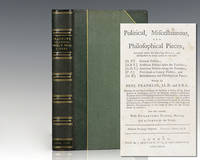
1779125950London: Printed for J. Johnson 1779. First edition of "the only edition of Franklin's writings other than his scientific printed during his lifetime" Ford. Octavo bound in three quarters leather gilt titles to the spine raised bands. With the engraved frontispiece portrait of Franklin three engraved plates one folding and folding table of the reformed alphabet. In near fine condition. Complete with index addenda and corrigenda. A very nice example. "The only edition of Franklin's writings other than his scientific which was printed during his lifetime; was done with Franklin's knowledge and consent and contains an 'errata' made by him for it" Ford 342. Edited by his close friend Benjamin Vaughan and published in London while Franklin was serving as America's ambassador this seminal collection contains many of his writings on the rebellious American colonies and incendiary British measures such as the Stamp Act. Of particular interest is The Examination of Dr. Benjamin Franklin 255-301 a record of his 1766 appearance before Parliament. In Franklin's answers to the over 150 questions posed him in an afternoon of "highly charged testimony he would turn himself into the foremost spokesman for the American cause" Isaacson. Printed for J. Johnson hardcover books
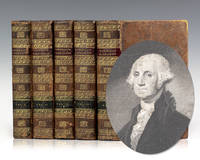
1804131234Philadelphia: C.P. Wayne 1804-1807. First edition first issue of the first biography of George Washington with the scarce atlas volume and list of subscribers. Octavo six volumes bound in full contemporary tree calf with elaborate gilt tooling to the spine morocco spine labels lettered in gilt tissue-guarded engraved frontispiece portrait of Washington to volume I. With the scarce atlas volume which is bound in three quarter calf over marbled boards and contains 10 engraved maps 9 folding and the 22-page list of subscribers. In very good condition. A rare and complete set in an attractive contemporary binding. John Marshall's description of the life character and achievements of the "Father of America" is unparalleled by any other author. As a contemporary and peer of Washington he has a unique and intimate perspective on the man that no other historian can claim. If you want a first hand description of this history changing figure John Marshall's work is essential. The work “is political history as well as biography… the only comprehensive account by a great statesman of the full founding of the United States— of the founding of an independent people as well as of its government… There is no other concentrated history of the essentials by such an authority on American institutions†Robert K. Faulkner. C.P. Wayne hardcover
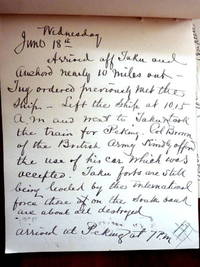
19020002347ABOARD THE USS NEW YORK. Good. 1902. On offer is a superb fascinating original soft bound 1902 China Station diary and personal log handwritten by Admiral Frederick W. Rodgers 1842 - 1917. Rodgers was a Rear Admiral in the United States Navy. He fought in the American Civil War and ascended to be the last commander of the Asiatic Fleet. He was a grandson of U.S. Navy Commodore Matthew Perry. In May 1901 Rodgers became Senior Squadron Commander within the Asiatic Squadron. On March 1st 1902 he became the commander of the entire Asiatic Squadron which was engaged in combat during the Philippine-American War at the time. He was the Squadron's last commander. At the end of his tour on 29 October 1902 the Asiatic Squadron was abolished and its responsibilities were assumed by the new United States Asiatic Fleet. This logbook documents his ship the U.S.S. New York while stationed in Amoy China and Nagasaki Japan during a critical time in the area's history. The log begins March 27th with a final entry on - July 26th 1902. The log recounts the daily workings of the ship and personnel deployments lists of repairs to various ships within the Asiatic Fleet. What is of real importance is Rodgers encounters with the Emperor of China and Prime Minister of Japan. He also mentions other naval vessels from Britain Germany and Japan listing the ship's numbers and armaments. This log contains important information about the fleet in this very historical period when the United States emerges as a world naval power. The 60 pages of handwritten narrative and notes make for some revealing entries regarding American efforts at diplomacy in the area; Rodgers' diplomatic contacts with the Emperor and Dowager of China are well noted as are intelligence reports on fortifications in China. He mentions brief reports from missionaries concerning conditions in the interior of China contact with British troops who are guarding parts of Peking. While in Peking Rodgers meets the British Foreign Minister and writes about the looting that took place at the summer palace blaming it on Russian and Italian troops during the Boxer Rebellion. Furthermore he discusses positioning gunboats along the rivers near Peking due to further disturbances. Rodgers also mentions meeting the Prime Minster of Japan encounters with the Japanese navy and various dignitaries princes and barons. Here are some snippets: U.S.S. New York -March 27th 1902 Cable arrived from Hong Kong French Cruiser Arriau called on the American Consul no information from him - he informed me that there was nothing new to report here. A missionary who had just returned from an extensive trip into the interior had informed the consul that he had been treated with much consideration. U.S.S . New York - March 31st 1902 Woosung China - Visited Chinese Cruiser Hai Chai cable from Widdes asking change of officers from G.C.M. not practicable - one case of Cholera in Cavite - condition in Manila improving. Glaicer arrived Cavite - Drake commanding Muntrey officially visited ship brought in 3 cases for G.C.M. U.S.S. New York April 2nd 1902 Left ship at 3 pm for Shaug Hai 30 min from ship to station Woosung road is bad anchorage . The tides were up to more than four knots - ships at single anchor are liable to drag. Went to French hotel De Collmines - it is fairly good but the rooms are most uncomfortable - Captain Tah of the Chinese navy accompanies us. Friday April 1902 Intelligence reports from Monterey Fortifications of the Yangsee River - Forts on Silver Island Black Dragoon forts -Forts at Chu San Knan Forts at Kiaung Yri Required examination of the county between Woosung and Shanghi copy of railroad maps mark chart examination of Woonsung river regards fortifications. U.S.S. New York- April 22nd 1902 New York sailed for Yokahma at 9am Weather raining: A German steamer came in last night with Prince Imperial on board - made preparations for a national salute address ship but found steamer had carried no distinctive flag boarding officer at 4am countermanded order for salute and dressing ship. U.S.S. New York Yokahama Japan Monday April 28th 1902 Rear Admiral Evens hoisted his flag exchanged salutes Went to Tokio Made official visits to US. Minister To Prime Minister of Japan To Minister of War Called on Baron Kaneko. Wednesday June 18th 1902 Arrived off Tokio and anchored nearly 10 miles out - Tug ordered previously met ship - left the ship at 10:15 am and went to Tokio took the train to Peking. Col Brown of the British Army Kindly offered the use of his car which was accepted. Taku forts are still being leveled by the international force those on the south side are all destroyed. Arrived at Peking at 7pm.was meet by a gentleman from the legation and a guard of honor from the 9th infantry. Went to the U.S. legation with my personal staff as a guest of Hon E.S.Conger. Thursday June 19th Visited the temple of Heaven discussed affairs with minister he informed me that the principal questions now between the Chinese Government and the internationals are: First as regards the transfer back to civil administration of the Tuiu Suen and Peking rail road and 2 the return of the city of Tien Sien to civil administration. The rail road is now under English military management. Called on the various foreign ligations - only met two personally the German and the Japanese. Friday June 20th 1902 Visited the Summer Palace of the Emperor. A special permission from the Foreign office was required to visit the Palace it is the most interesting place about Peking but the effects of the results of the trouble in 1900 is very apparent and the destruction was very great - Repairs have been made to a very limited extent this place was occupied by the Italians and Russians who must have looted it to the fullest extent. Peking Sunday 22nd 1902 Diplomatic dinner at the legation - meet the English Minister than the Austrian Charge of Affairs also the Russian Minister. Peking Tuesday June 24th 1902 By Previous arrangements was given was audience by the Empress Dowager and the Emperor at the Winter Palace. The logbook has one torn page one page detached from the binding and four blank pages and is overall G.; Manuscript; 8vo - over 7¾" - 9¾" tall; KEYWORDS: HISTORY OF ADMIRAL FREDRICK W. RODGERS ASIATIC SQUADRON LOGBOOK CHINA STATION JAPAN. TURN OF THE CENTURY EARLY TWENTIETH CENTURY NAVAL MARINE MARINERS WARSHIPS SOUTH CHINA SEA UNITED STATES NAVY USN FLAGSHIPS DIPLOMACY NAUTICAL PHILIPPINE-AMERICAN WAR POST SPANISH AMERICAN WAR COMMODORE MATTHEW PERRY U.S.S. NEW YORK EMPEROR OF JAPAN EMPEROR OF CHINA DOWAGER EMPRESS OF CHINA TOKIO TOKYO AMERICANA HANDWRITTEN MANUSCRIPT AUTOGRAPHED AUTHORS DOCUMENT LETTER AUTOGRAPH KEEPSAKE WRITER HAND WRITTEN DOCUMENTS SIGNED LETTERS MANUSCRIPTS HISTORICAL HOLOGRAPH WRITERS AUTOGRAPHS PERSONAL MEMOIR MEMORIAL PERSONAL HISTORY ARCHIVE DIARY DIARIES JOURNAL LOG PRIMARY SOURCE FIRST HAND ACCOUNT SOCIAL HISTORY PERSONAL STORIES LIVING HISTORY ANTIQUITÉ CONTRAT VÉLIN DOCUMENT MANUSCRIT PAPIER ANTIKE BRIEF PERGAMENT DOKUMENT MANUSKRIPT PAPIER OGGETTO D'ANTIQUARIATO ATTO VELINA DOCUMENTO MANOSCRITTO CARTA ANTIGÜEDAD HECHO VITELA DOCUMENTO MANUSCRITO PAPELBIOGRAPHY BIOGRAPHICAL AUTOBIOGRAPHICAL AUTOBIOGRAPHY PERSONAL NARRATIVES . paperback
18990002596BOLIVIA PERU SOUTH AMERICA. Very Good with no dust jacket. 1899. On offer is a superb pair 2 of original manuscript diaries handwritten by an unidentified American adventurer and gold prospector in Bolivia and Peru circa 1899 - 1901. The diaries inscribed #4 and #5 with the others lost to history tell the incredible story of the author's adventures and encounters with Indigenous Bolivians thieves highwayman soldiers and expatriates. In many ways the times and places nted evoke Butch Cassidy and the Sundance Kid. Historians and researchers will be delighted given the long detailed and keen-eyed observations of the author. While this is non-fiction and a personal account it reads like an old-fashioned novel full of intrigue and adventure. For example our author actually pulls his revolver on a group over a mining claim. In another entry he believes he is being followed and writes his location for friends in case he is murdered and his body is found. In another entry he finds an Indigenous man who fell off a treacherous mountain trail into a box canyon and helps in his recovery. Almost every entry mentions his interactions with the Indigenous people of the area and he is often asked to administer help or supply medicine to those he encounters. He also mentions the Federal Revolution of 1899 in Bolivia and battles in the mountains towns etc. There is so much more. In addition to those events he writes about his mining explorations in the Andes on foot with mules and his battle with the elements and fellow miners. There is lots of cheating and double crossing taking place from those he encounters which makes for intense drama. In most cases the author hires Indigenous guides and travels with Anglo companions. They are frequently on the lookout for gold and attempt to make contacts with the local population. Our author had some connection with and worked directly for The Inca Mining Co and Santo Domingo gold mine in Peru. He mentions both several times the diaries also a mill. RESEARCH INFO: "The Santo Domingo mine is located in that zone of the great rivers known in Peru under the name of 'Montana' and situated on the east of the great Andes Cordillera. During the bonanza Mr. W. L. Hardison from California a well-known American engaged in the oil industry happened to pass Santo Domingo on his way to other mines further in the interior and seeing the great output of the mine he made a contract with the owners to buy it. Six months afterward the Inca Mining company a corporation organized under the laws of the state of West Virginia with a capital of $1000000 acquired the property and began workings on a larger scale. Nearly 18 months were devoted to the proper development of the mine and in July 1898 the old mill was completely modified and started continuous running giving good profits and insuring the success of the enterprise." The diaries contain approximately 140 very well-filled pages each. The 1900 diary begins April 7 1900 with a final entry May 14 1901. The 1899 diary begins March 5 1899 with a final entry April 5 1900. Both diaries are bound in hardbound covered boards with red marbled paper and measure 5 x 3 inches. The handwriting is immaculate and easy to decipher. Here are some snippets: "March 5 1899 Borrow twenty four Bolivianos of Recardo. He can give me mule but no Indian. Want to sell him farm to Adams or don't think he would be as accommodating as he is. Also urges me again to employ his daughters husband and he offers me his sisters son of 9 years to cook & do chores for board or an adopted boy. Water reported high on Juliaco- road and likely impassable. Hire Indian to go with me and Bonito to finish drying peaches and prepare garden." "March 7 1899 I can get neither breakfast or mule and in noon before I get started stop with pleasant gentleman in Charzani- He informs me the revolution is not over and Alonzo is still supported by the army showed me good gold ore and offers me half to prospect it for him. Takes no pay." "March 11 1899 Wait long but finally start without breakfast. Bring bread at Jrancame- Pay Indian to let mule feed on her grass. Cross river in boat called balsa- and swim the mule. Road under water and return for guide. Again swim mule much difficulty in reaching Taracos Accommodation with Governor Sugar for two cups of coca. Early start swim two more rivers and hire guide where road is under water. Egbert has not been here. Mr. Carmichel gives me interesting details of the war and present doings of our glorious country." "March 15 1899 Mr. Carmukel arrives from Arizona to take charge of the Santo Domingo Mill. We help him find Mr. Pool ask for the Santo Domingo mine. Attend business. Go to Depot to help Mr. Carmichel get off. Also see an officer and wife off. See Dr. Hunter who advises us to be vaccinated. Pool boys draft with draft on Jose Sanchez. Much interested in information I give him and invite us back tomorrow." "March 191899 Rise early and take train for Juliaca- Gentleman reports battle at Charizami and all killed by the Indians. It startles me but when I learn date I know its a false report for it is since I passed Charizami later on other reports the battle near La Paz. Call on Mr. G. Cannon who expresses interest in out prospecting and wants us to allow him a second chance of good." "March 27 1899 Egbert tried and wants to sleep late. Sanchez brothers start for Puno for school. They especially Philipi very friendly to me. Indian woman sells us burros and I take them from the purchaser. See Governor to get Indian who tries to and called on another price. Calls in a friend and ridicules me because I cant speak good Castillano. I soon lose control of myself and want to fight them both and two Indians that enter but Indians turn tail. Firm all over and the curs want to make amends but I move them aside and walk out." "March 29 1899 Indian steals my old poncho sheep skin and rope from back saddles. Jose warms me to have no business transactions of importance with Frederico Franch. Mule and burro escaped from the corral. Indian started in pursuit but returns with them late for which I compensate him. However it causes a late start. Hire Indian on the road who knows the river crossing. Put clothes on top of cargoes and cross river. Cold as the snow mountains it come from. Find some of our bread was stolen at Cojata. Stop at Indian house and well smoked." "April 9 1899 Many little things to be done today but interruptions result in my accomplishing nothing. Bonito comes with potatoes send medicine to a sick woman hunt the mule Indian comes to sell cheese and guinea pig and wants treatment for what appears to be a light paralytic stroke. Bonito comes again and wants medicine for a burro and so the day passes and all I get done is the washing of my clothes. Bonito tells me a man fell of the bridge just below here and was swept away by the current." "April 16 1899 Egbert sleeps late while I wash clothes Bonito helps get mule across river. Hire him to show me good timber tomorrow Bonito describes trouble between Recardo & Flores most empathically Saze Florio was whipping his wife and would have shot Recardo had the latter shown his heels." "May 1 1899 Blast blown out in crevice and Recardo cries because it did no good. Send Indian for dynamite and pull Recardo back in time to keep stone from hitting him. Go to work without breakfast and by noon can eat two dinners. Blast does little good and Recardo cries again disappears and finally returns and tells me next blast will do better for he went into bush and prayed but the next one also blows out in a crevice. Run a line for him. He wants me to help him sell his finca to Winslow or Glass. Sent mutton down to camp for which I paid well." "June 6 1899 Glass sees one deer. Glass delays travel by leading way himself instead of letting Benito who knows the country lead. Leads us over a dangerous mountain peak. G shoots Piscacho- for supper." "June 241899 Glass leaves us in evident depressed spirits. Pass Recardo and almost have to strike him to make him settle fairly. Thinking he has called on his Indians for help draw my revolver to make them stand aloof in which I committed a grave and foolish error for my temper should not be trusted with the control of my revolver. Egbert and I discuss pro and con the advisability of seeking work and decide to go to Santo Domingo mine but first prospect the Nuicor- so we will know if it will pay us to return to it when we have saved up some cash." "June 301899 Continue washing Egbert returns and reports being well entertained. Girl puts her arm around his neck to induce him to remain for breakfast. Glass has reported us as taking out lots of gold and the whole town is excited. A jug full of gold is credited to us. Numbers of papers and letter from uncle Scott and very friendly one from Mr. Laughlin in which he relates winning the title sent of Easton grant over T. B. Canton." "Sept 29 1899 A letter from Al Lee written last June in answer to my letter and hinting for interest in my claim as he hears I have a good claim on Camata. Want a companion but on experience is enough. Leave Savage rifle with Marcos. Marco's child dies at noon. Indian music and dances going on since sundown yesterday. Three bands of Indian masqueraders appearing on the plaza in turns and at intervals all together when child is entered. All bands in different forms of dress and having brand of music and clowns. Want to describe dress as too varied for short description. This lasts till Monday morning without cessation night and day." "Oct 3 1899 Cold and get late start stop on good grass some time. Mazordoma- of Accacunco pay $5.00 for Indian to linbani- I won't pay it and he wont give me directions so I go it alone and as former directions were take right had trail at Acconco and trail six leagues to Linbani I take trail right. Travel till night and am told in yet another 15 leagues to Limbani- trade for Indian guide for $ 2.00 and instructed to wait 400 yards further on till Cholorizomi near there. Wait till long after dark have been warned repeatedly and am afraid something is up so travel on half a mile and seek camping place. Arrange call with care so it is difficult for anyone to get near without making noise or fuss and am not afraid of any of them when awake. Don't think trouble is intended but no harm to prepare for it . Will write up diary every day at evening and if I do fall a victim to foul play this may perhaps fall into the hands of another or countryman if so tell where I last camped am now below the trail and above the little settlement the first on the East side for mountain track." VG. ; Manuscript; 32mo - over 4" - 5" tall; KEYWORDS: HISTORY OF; AMERICAN GOLD MINER PROSPECTOR BOLIVIA INDIANS BOLIVIAN ARMY REVOLUTION PERU INCA MINING CO & SANTO DOMINGO GOLD MINE ADVENTURERS BUTCH CASSIDY AND THE SUNDANCE KID LATIN AMERICA SOUTH AMERICA CENTRAL AMERICA ANDES BANDITS BANDITO INCA INCAN MAYAN AZTEC ANCIENT PEOPLES OF THE ANDES AMERICANA HANDWRITTEN MANUSCRIPT DOCUMENT LETTER AUTOGRAPH WRITER HAND WRITTEN DOCUMENTS SIGNED LETTERS MANUSCRIPTS DIARY DIARIES JOURNALS PERSONAL HISTORY SOCIAL HISTORY HISTORICAL HOLOGRAPH WRITERS AUTOGRAPHS PERSONAL MEMOIR MEMORIAL ANTIQUITÉ CONTRAT VÉLIN DOCUMENT MANUSCRIT PAPIER ANTIKE BRIEF PERGAMENT DOKUMENT MANUSKRIPT PAPIER OGGETTO D'ANTIQUARIATO ATTO VELINA DOCUMENTO MANOSCRITTO CARTA ANTIGÜEDAD HECHO VITELA DOCUMENTO MANUSCRITO PAPEL . hardcover
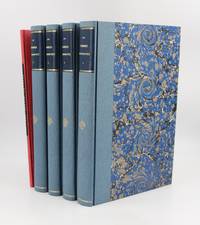
187883249Paris: Léon Vanier 1878. Fine. Léon Vanier Paris s. d. 1878-1899 & 1886-1892 19.50 x 28.50 cm 5 volumes reliés First edition of Les Hommes d'aujourd'hui 33 issues lacking out of 469. Five volumes bound in light blue half-cloth smooth spines blue morocco title labels decorated with double filets marbled paper boards 4 volumes. The color title pages have been preserved and bound in. Marginal tears without damage to the text no. 163; no. 165; no. 184 p. 2. Marginal restorations without damage to text on 8 leaves between nos. 214 and 223. Two leaves of no. 224 backed. Marginal tear with some paper missing no. 345 p.1. Format of quires in the first volume varies; some are trimmed more than others. First edition of Les Femmes du jour very rare complete collection in 11 issues published between 1886 and 1892 the last very rare Réjane issue appeared in 1892 six years after the other 10. Bound in half red cloth smooth spine midnight-blue morocco title labels framed in gilt gilt title lengthwise marbled paper boards. An impressive gallery of prominent 19th century women and men caricatured and described by the foremost avant-garde artists and writers of the time. Created by writer Félicien Champsaur and illustrator André Gill in 1878 this exceptional literary and satirical review was later directed by Léon Vanier the publisher of the Parnassiens poets from 1885 to 1899. Each issue is a portrait of a contemporary figure in the world of arts and letters politics science or technology. The full set includes 469 monographs written by some of the most provocative voices of the time: Jules Laforgue Gustave Kahn Joris-Karl Huysmans Jean Moréas Félix Fénéon. The only contributor Vanier ever paid for those written portraits was Paul Verlaine famously always short of money. Each issue includes on the front page a large and fine color lithographed caricature by artists such as Manuel Luque André Gill and Félix Régamey but also world-renowned painters: Toulouse-Lautrec Steinlen Pissarro Seurat Signac to name a few. The actress Sarah Bernhardt was so famous she appeared both in the men-issue Hommes d'aujourd'hui as well as one of the very rare women-issues Femmes du jour! The literary issues cover every school and movement of the second half of the 19th century including Buveurs d'eau Vilains bonshommes Hydropathes Parnassiens Naturalists Decadents Symbolists and Incohérents. There is also a number of avant-garde painters belonging to the Pont Aven school Schuffenecker Pissarro Emile Bernard Maximilien Luce the circle of the Montmartre Affichistes Chéret Willette Caran d'Ache Georges Auriol Job Steinlen as well as Post-Impressionnists Cézanne Toulouse-Lautrec Anquetin Pointillists Signac Seurat and Symbolists Redon. Musicians are also featured with fine portraits of Gounot Massenet Verdi Camille Saint-Saëns Rubinstein and Reyer. An exceptional and rare set bearing witness to the free spirit of 19th century French intellectuals and artists. Léon Vanier hardcover
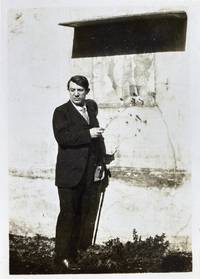
191778126Paris 1917. Fine. Paris 1917 6.30 x 8.60 cm une photographie Original photograph likely unique and unpublished of Pablo Picasso at the Casa di Marco Lucrezio Pompeii spring 1917 Paris 1917 63 x 86 cm one photograph Original photograph depicting Pablo Picasso in the spring of 1917 at the Casa di Marco Lucrezio in Pompeii holding a twig in front of a wall on which there is a Pompeian fresco. Contemporary silver print perhaps unique from Jean Cocteau's personal archives then the Maurice Sachs collection. Exceptional almost undiscovered and probably unpublished photograph taken by Jean Cocteau during the stay. On 16 April 1917 Picasso visits Pompeii accompanied by Jean Cocteau and Léonide Massine to prepare the ballet Parade the first work described as surrealist by Guillaume Apollinaire for the new season of Serge de Diaghilev's Ballets Russes. On his return this initiatory journey inspired his monumental painting: the Parade stage curtain a real visual signature of the ballet marking the beginnings of Picasso's neo-classical period and today preserved at the Musée national d'Art Moderne Georges Pompidou. Pierre Daix in his bibliography dedicated to the painter recounts the aesthetic shock caused by the discovery of the Pompeian frescoes: Giovanni Carandente to whom we owe the best studies on this trip highlights that Picasso was strongly struck by the animation and the sensuality that the cataclysm of the year 79 AD had brutally destroyed. If it is true as he wrote to Gertrude Stein that he immediately drew many Pompeian fantasies which are a little daring attracted as he was by the erotic elation that emerges from these licentious paintings . these memories settled in him to emerge with force thereafter. . Everything that had made up the Pompeian universe was preserved on the site as well as in the National Archaeological Museum of Naples . In its singularity this universe contributed to enriching Picasso's cultural heritage with something more alive more trembling than he had gained from his museum visits until then. He particularly loved the conciseness of the paintings: two or three years later the impressions felt in Pompeii were to translate into a real creative explosion a series of paintings which all bore traces of these never buried memories. This source was to remain alive until La Danse of 1925. Pierre Daix Picasso. Unique and early original photograph of Picasso taken and printed by his friend Jean Cocteau in a mythical place that will influence his aesthetic for the long-term. Provenance: Jean Cocteau's personal archives then the Maurice Sachs collection and Max-Philippe Delatte. unknown
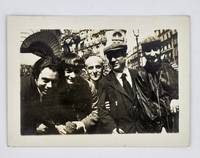
191678127Paris 1916. Fine. Paris 12 août 1916 6.30 x 8.60 cm une feuille Original photograph likely unique taken by Jean Cocteau showing Pablo Picasso and Co in Montparnasse in front of the café La Rotonde the 12 August 1916 Paris 12 august 1916 63 x 86 cm one photograph Original photograph by Jean Cocteau taken on 12 August 1916 showing Manuel Ortiz de Zárate Moïse Kisling Max Jacob Pablo Picasso and the model Pâquerette his girlfriend at the time posing in front of the famous café La Rotonde on Boulevard du Montparnasse in Paris. Contemporary silver print probably unique from Jean Cocteau's personal archives then the Maurice Sachs collection. This image was published in Billy Klüver's book entitled A day with Picasso: twenty-four photographs by Jean Cocteau 1997. However Klüver states that he didn't know the original photograph and used a modern reprint from the negative in the Cocteau archives for his work. We have not found any other copy of our original photograph in international public collections. Billy Klüver has assembled and commented on the twenty-one photographs taken by Jean Cocteau on 12 August 1916 in Montparnasse close to this intersection of the Boulevard Raspail and the Boulevard du Montparnasse which was named Place Pablo-Picasso in 1994. They take us to the café La Rotonde before which a beaming Picasso in a cap speaks with Max Jacob whose baldness shines in the sun behind them Henri-Pierre Roché in uniform and Manuel Ortiz de Zarate sit at a table on the terrace of the same café where Pablo is next to the glowing Pâquerette and the young Polish painter Moïse Kisling. Pâquerette with her hair in a headband a chic dress is the queen of the encounter. . It's the relaxed life at the back. Pâquerette or rather Émilienne Pâquerette Geslot was then a star model of the fashion designer Poiret who was all the rage at the time. A real one-day film of Picasso outside of his studio. Pierre Daix Picasso In his book Klüver questions the presence of all these artistic authorities in the making in a Paris that is deserted by war. The answer is according to him to search in the direction of the Salon d'Antin an exhibition organized by André Salmon in July 1916 in which all the protagonists of our photograph took part with the exception of Pâquerette. It is also on this occasion that Picasso reveals his Demoiselles d'Avignon to the public. This extremely rare image taken by Jean Cocteau with his mother's Kodak camera immortalizes a moment of joy that depicts the artistic all-Montparnasse of the early 20th century. Provenance: Jean Cocteau's personal archives then the Maurice Sachs collection and Max-Philippe Delatte. unknown
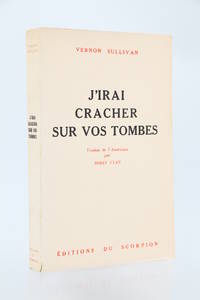
194687213Paris: Les Editions du Scorpion 1946. Fine. Les Editions du Scorpion Paris 1946 12 x 19 cm broché First edition one of 120 numbered copies on Lafuma pure wove paper the only large-paper issue. Endpapers very slightly and marginally toned two small tears at foot of spine. A rare and much sought-after copy in original state. Les Editions du Scorpion unknown
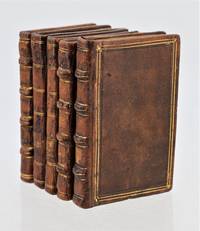
154682797Paris: Robert Estienne 1546. Fine. Robert Estienne Paris 1546 7 x 11.50 cm 5 volumes reliés TORAH Quinque libri legis BIBLE IN HEBREW ESTIENNE Robert Estienne Paris 1546 16mo 7x115cm 5 bound volumes. First 16mo edition of the Torah in Hebrew by Robert Estienne. Printer's woodcut device on each title page with book titles set within woodcut cartouche head-pieces. Only the title page is in Latin-Hebrew. Slightly later brown morocco bindings 1590-1615 two of the volumes with a smooth spine the three others with gilt raised bands gilt tooled boards all edges gilt. Some wormholes on the fifth volume not affecting the text. Numerous contemporary Latin marginalia mainly in the first two volumes. This five-volume Torah includes Genesis Exodus Leviticus Numbers and Deuteronomy. ""This little edition said to be very accurate is a true typographical jewel and perhaps the most beautiful one ever printed in the Hebrew language. Cette petite édition que l'on dit fort exacte est vraiment un bijou typographique et peut-être ce qui a jamais été imprimé de plus beau en langue hébraïque"" A. A. Renouard Annales de l'imprimerie des Estienne Brown morocco later binding 1590-1615 smooth spine with gilt fillets double gilt borders on covers all edges gilt. Some wormholes to the fifth volume not affecting the text. Joints corners and spine-ends expertly restored. Numerous contemporary marginal annotations in Latin manly in the first two volumes. This little edition said to be very accurate is a true typographical jewel and perhaps the most beautiful one ever printed in the Hebrew language.A. A. Renouard Annales de l'imprimerie des Estienne Exceptional copies of the Books of the Bible in Hebrew in first 16mo edition published by Robert Estienne. This pocket edition was printed in 17 volumes between 1544 and 1546 after the success of the four-volume quarto edition printed from 1539 to 1544. Based on the Hebrew Soncino princeps published in 1488 it was established by Humanist François Vatable. The text in Hebrew follows the Masoretic tradition and presents diacritics that facilitate its vocalization. Talented exegete François Vatable 1495-1547 early scholar of Hebrew studies during the French Renaissance was a member of the 'Cénacle de Meaux' founded by Jacques Lefèvre d'Étaples and translated for him in 1509 the Hebraicum one of the five psalters of the Quincuplex Psalterium published by Henri Estienne. After founding the Collège de France in 1530 King Francis I appointed him chair of Hebrew studies. As a Royal lecturer he actively participated ten years later in a Hebrew edition of the Bible with Robert Estienne 1503-1559 printer to the King in Latin and Hebrew. This edition is undoubtedly a real typographical feat for a small format text in Hebrew lettering. It was certainly intended for scholarly use by Sorbonne and Collège Royal students given its pocket size sold in separate individual volumes. The presence of numerous contemporary marginal notes further indicates its educational purpose as is the numbering of lines of several pages in some of our volumes. A very beautiful and scarce collaborative work by two of the greatest figures of Parisian humanist scholarship a fine example of the renewed interest in classical texts and their study in the original language. Provenance: library of Charles John Dimsdale 1801-1872 fifth baron of the Russian Empire with his bookplate on each pastedown endpaper. Robert Estienne hardcover
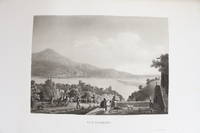
182385268Paris: Panckoucke 1823. Fine. Panckoucke Paris 1823-1832 36 x 54 cm relié First and only edition. This copy is one of the rare examples complete with the 64 full-page plates. The work is also illustrated with a title vignette depicting the artist Ambroise-Louis Garneray in a small boat sketching the entrance to the port of Brest. Contemporary binding of half tan sheep with corners smooth spine richly decorated in gilt and blind with multiple large typographic tools discreet restorations to the joints marbled-paper boards marbled endpapers and pastedowns. A magnificent work on the ports of France and one of the finest collections ever produced on the subject. The author of these highly precise engravings joined the navy at the age of thirteen and thereby witnessed numerous naval battles. From 1806 he was imprisoned for eight years in Portsmouth using his captivity to study drawing and painting and to record the scenes he had observed during his voyages. Upon his return from the United Kingdom Garneray became painter to the Duke of Angoulême then Grand Admiral of France later serving as director of the Rouen museum and entering the Sèvres manufactory where he executed numerous maritime subjects. His work of remarkable delicacy and realism was praised by Melville in Moby-Dick: ""Who Garneray the painter is or was I know not. But my life for it he was either practically conversant with his subject or else marvellously tutored by some experienced whaleman. The French are the lads for painting action."" Panckoucke hardcover
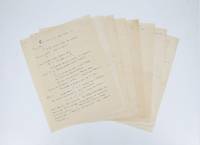
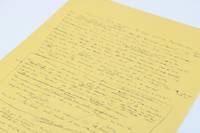
1930822781930. Fine. s. d. 21.40 x 27.20 cm 9 pages sur 8 feuillets ""In the end 5 hours of work for example to produce - per man - all that is necessary to man."" Complete unpublished autograph manuscript in French by Antoine de Saint-Exupéry. 9 pages on 8 leaves in black ink. Traces of horizontal and vertical folds. A small piece of paper missing in the center of two leaves. Exceptional unpublished manuscript by Saint-Exupéry to be compared with his political and economic reflections in Carnets 1989 p. 43. Personally affected by the 1929 crisis Saint-Exupéry the self-taught writer writes passionately about the economy and puts forward reform strategies. The manuscript features a lot of mathematical formulas and equations along with remarks To make the ideas clear about what is happening today p. 1 on the national economic system and the labor market. These unpublished pages testify to Saint-Exupéry's great intellectual curiosity his insatiable need for innovation in all fields of knowledge: mechanics technology politics economics. Saint-Exupéry writes on capitalist reform as he was an outspoken critic of the system which he later personified in The Little Prince businessman character. He develops theories where the State becomes the only employer banker and overall production manager: If the State pays all the salaries including those of the administrations and considers itself as owner of all the products nothing to be changed within the capitalist system in the sense that it can pay to the administrations special bonuses returning in their salaries and according to the quality as well as the quantity. He pays an amount X. He sells having taxed his stocks so that they express Y. His reflection is directly related to the stock market crash that bankrupted the Aéropostale the pioneering airline company where Saint-Exupéry had displayed his talents as an aviator-writer. One also remembers the splendid lines from Terre des Hommes on the value of work: The greatness of a profession is perhaps above all to unite men: there is only one true luxury and that is human relations. Concerned about a better distribution of wealth he develops throughout the pages several labor market and pension system theories halfway between Keynes and Marx. The writer was well aware of the value of labor having himself spent long hours on his aircrafts' mechanics. He details his views on the duration of a working day In the end 5 hours of work for example to produce per man all that is necessary to man. With little work and it is possible to supply men with everything that is and can with the increase of luxury become necessary to them and makes calculations on savings pensions purchasing power. His novels and personal writings contain numerous references to labor and hopes for a more equal human community: Saint-Exupéry was also a man of his time passionate about modernity especially technical innovation who constantly tried to reflect on all the problems that arose from it. Hence the countless notebooks notes and scattered sheets of paper that he constantly filled in and carried in his pockets and trunks with which he might one day have written a book. Jean-Claude Perrier Rare manuscript from a true Humanist a talented artist aviator novelist political and economic thinker. Saint-Exupéry tries to build a harmonious social order and lay the theoretical groundwork for an ideal society. unknown
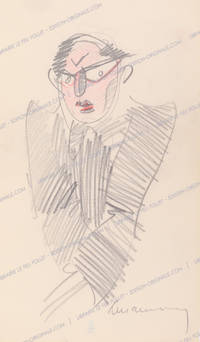
194286828s. l. 1942. Fine. s. l. s. d. 13.40 x 20.90 cm une feuille Original drawing with graphite blue and pink colored pencils signed by Antoine de Saint-Exupéry on a sheet of watermarked paper “Navarre”. HorÂizontal fold pencil annotation in the upper left margin very small loss of paper in the lower right margin. A remarkable caricature signed by Saint-Exupéry akin to a cartoon character. The writer-aviator-artist very rarely signed his graphic works.  « Je ne sais pas ce qui m'a pris je dessine toute la journée et de ce fait les heures me paraissent moins brèves. J'ai découvert ce pourquoi j'étais fait : le crayon Conté mine de charbon. »  ‘I don't know what came over me; I draw all day and the hours seem less fleeting as a result. I've discovered my true calling: the charcoal Conté pencil.' From sketches of barrack mates made in Casablanca during his military service to the watercolours in The Little Prince Saint-Exupéry's life also included an important side-activity: drawing. On letters to his friends in the margins of his manuscripts in books he gave away telegrams invoices tablecloths leaflets - everything he could get his hands on that could serve as a canvas for his imagination - Saint-Exupéry drew sketched caricatured illustrated invented and doodled living and imaginary people friends and girlfriends. He would often casually discard these ephemeral works extensions of his moods and daydreams.  Among these sketches of inspired by circumstance which seem to foreshadow in one way or another his immortal masterpiece very few are fully claimed by the artist-dilettante as his own. Although all of Saint-ExupéryÂ’s graphic work is highly sought-after today fullpage drawings signed by the author of The Little Prince are extremely rare and bear witness to his passion for Man in all his expressions.  Among his drawings which exhibit an astonishing variety of styles this mustachioed head stands out as one of the most accomplished examples of what his sister Simone called his “dreadful caricatures” — she herself along with many of the writer's friends was a frequent victim of his graphÂic parodies. The drawing showcases Saint-Exupéry's fondness for shades of blue and pink which often enliven his colored drawings. Far from being sketched in the margins the drawing is distinguished by its intentionality: the writer took the trouble to sign it which is a rare occurrence. The colored highÂlights and contrasting graphite give it a delightful cartoonish look with its eyes bulging out. Precisely dating Saint-Exupéry's drawings remains challenging. As The Little Prince began to take shape he started from his time in New York to systematically preserve his sketches. Before his American exile most of his earlier drawings—apart from those made in the margins of letters and manuscripts or given as gifts to friends—were discarded by the author.  Precious graphic creation by the faÂther of The Little Prince an importÂant example of his drawings' extraorÂdinary vibrancy and keen sense of contrast.  hardcover
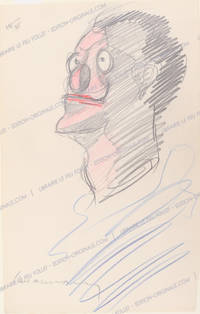
194286799s. l. 1942. Fine. s. l. s. d. 22 x 28 cm une feuille Original signed drawing in pencil and pink crayon by Antoine de Saint-Exupéry on Navarre watermarked paper. Horizontal fold annotation in pencil in upper left-hand corner minute tears in lower margin. Precious drawing signed by Saint-Exupéry the writer-artist very rarely signed his graphic works of a caricature character sharing some of the writer's own features. ""I don't know what came over me he says I draw all day so the hours don't seem so short. I discovered what I was made for: the Conté pencil. From the sketches of barrack mates that Saint-Exupéry then a young conscript made in Casablanca during his military service to the watercolors of 'The Little Prince' the writer's life was marked by the marginal but omnipresent activity of drawing. On letters to friends in the margins of manuscripts in donated books on incoming telegrams invoices tablecloths leaflets - on everything he could get his hands on to support his imagination - Saint-Exupéry drew sketched caricatured illustrated invented doodled living or imaginary beings friends and girlfriends. Then absent-mindedly he threw away these ephemeral works an extension of his moods and reverie of the moment. Among these sketches of inspired by circumstance which seem to foreshadow in one way or another his immortal masterpiece very few are fully claimed by the artist-dilettante as his own. Although all of Saint-Exupérys graphic work is highly sought-after today full-page drawings signed by the author of The Little Prince are extremely rare and bear witness to his passion for Man in all his expressions. Among all these incredibly varied drawings of Saint-Exupéry a recurring character emerges a humorous self-portrait he transforms into an infinite number of silhouettes and characters. Sometimes as it is the case here he transforms himself into a ferocious caricature or into the childlike benevolent figure of the Little Prince. Executed broadly and quickly this drawing shares a great deal with a comical full-length self-portrait also in the same shades with furious striated lines Bibliothèque R. Et B.L. auction sale October 7 2014 lot 196. Several of its attributes can be compared to the writer's own face: the shadow of hair on either side of a round skull or the famous V-shaped arched eyebrows that would later become characteristic of the Little Prince's face. It is difficult to date the writer's drawings precisely. Saint-Exupéry only began to keep his sketches more systematically in New York when The Little Prince was coming of age. Apart from doodles made in the margins of letters and manuscripts or given to friends he destroyed most of his drawings prior to his American exile. This precious portrait fortunately escaped Saint-Exupéry's merciless liquidation. The comical silhouette exudes a familiar air of self-mockery often hovering over the drawings of a writer-aviator who never quite believed in his talent as a draughtsman. hardcover
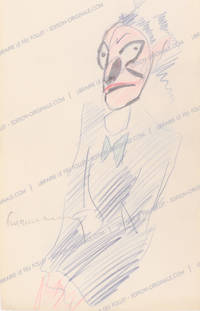
194286829s. l. 1942. Fine. 'I don't know what came over me; I draw all day and the hours seem less fleeting as a result. I've discovered my true calling: the charcoal Conté pencil.' s. l. s. d. 13.40 x 20.90 cm une feuille Original drawing in graphite and blue and pink colored pencils signed by Antoine de Saint-Exupéry on a sheet of watermarked paper ""Navarre"". Horizontal fold. One of Saint-Exupéry's quirky characters in a suit and bow tie spawn from the baroque and overflowing imagination of the Little Prince's author. The writer-aviator-artist very rarely signed his graphic works. From sketches of barrack mates made in Casablanca during his military service to the watercolours of The Little Prince Saint-Exupéry's life also included an important side-activity: drawing. On letters to his friends in the margins of his manuscripts in books he gave away telegrams invoices tablecloths leaflets - everything he could get his hands on that could serve as a canvas for his imagination - Saint-Exupéry drew sketched caricatured illustrated invented and doodled living and imaginary people friends and girlfriends. He would often casually discard these ephemeral works extensions of his moods and daydreams. Among these sketches of inspired by circumstance which seem to foreshadow in one way or another his immortal masterpiece very few are fully claimed by the artist-dilettante as his own. Although all of Saint-Exupérys graphic work is highly sought-after today fullpage drawings signed by the author of The Little Prince are extremely rare and bear witness to his passion for Man in all his expressions. This mysterious eccentric character is one of Saint-Exupéry's creatures whom Delphine Lacroix calls ""sacred monsters with undefined roles"" Antoine de Saint-Exupéry. Dessins aquarelles pastels et crayons. Surrounded by a halo of blue hair his large frightening and almost Cubist-like eyes seem to stem from a single original line. He added figurative elements and then a bow tie - a common feature of Saint-Exupéry's fantastic characters of strange proportions often wearing bow ties or cravats. Precisely dating Saint-Exupéry's drawings remains challenging. As The Little Prince began to take shape he started from his time in New York to systematically preserve his sketches. Before his American exile most of his earlier drawings were discarded by the author apart from those made in the margins of letters and manuscripts or given as gifts to friends. Saint-Exupéry's precious signed and colorful graphic work which fortunately escaped the fate of many of his drawings. hardcover
1938839081938. Fine. ""We fed on the magic of the sands others perhaps will dig their oil wells there"" 1938 21 x 27 cm 1 page sur un feuillet Original autograph manuscript by Antoine de Saint-Exupéry one page in black ink on a yellow paper sheet numerous corrections and rewritings. Exceptional working manuscript of a passage from the original French version of Wind Sand and Stars Terre des Hommes from chapter VI ""Dans le désert"" a magnificent ode to the barren wilderness of deserts doomed to disappear due to the inevitable development of the industrial age. This section from the original French novel was removed for the English version translated by Galantière and remains unpublished in English. Moreover the final two paragraphs of the manuscript are unpublished in the original French version. Saint-Exupéry recalls magnificent memories of liberating adversity and cherished ""dissidence"" he experienced in the heart of Mauritanian and Libyan deserts. This heavily corrected state of the text is the true genesis of Saint-Exupéry's Pulitzer Prize winning masterpiece: he reworked and rearranged here his memories published as articles reportages in Paris-Soir magazine in 1938. Some sentences ""What does it matter what you find at the pole if you walk in a state of enchantment"" remaining in the published version are variants of one of his reportages present in the manuscript among redacted and unpublished sentences obscured by pen strokes. This manuscript indicates an early writing stage not mentioned in the Notes et variantes of the comprehensive Pléiade edition. The passage is originally from his fifth article for Paris-Soir entitled ""La magie du désert c'est ça"" ""This is the magic of the desert "" from November 14 1938 published with some of the changes made in this manuscript and other later corrections at the end of the sixth chapter of Terre des Hommes. The central theme of the text dissidence is mentioned in the very first sentence of the manuscript and would later become the title of the passage indicated on the typed proofs. This leitmotiv is steeped in nostalgia with vivid descriptions of fleeting moments of freedom during the writer's escapades in the desert: ""The horizons crossed out : places towards which we ran one after the other faded away 'died out one after the other' in the published text like those insects once trapped by lukewarm hands 'which lose their color once trapped in lukewarm hands ' idem. But there was no illusion 'he who pursued them was not the victim of illusion' idem. We were not mistaken when we walked like this from miracle to miracle 'we were after these discoveries' idem. Nor was the Sultan of the Thousand and One Nights who ran one morning 'pursued a matter so subtle' idem sentence deleted that his beautiful captives one by one died at dawn in his arms having lost scarcely touched the gold of their wings"" It conveys an acute awareness of the end of an era marked by the bankruptcy of Aéropostale and his grave plane accident in Guatemala. Saint-Exupéry takes refuge in the memory of the rebel-filled deserts of Mauritania whose charm wore off with the passing of time: ""But there is no more dissidence. Cap Juby Cisneros Puerto Cansado Dora Smarra there is no longer any word struck out mystery."" It is followed by descriptions of the lands he and his fellow aviators flew over: ""For the pure shell powder sand and the forbidden palm groves gave us their most precious gift: they offered only an hour of fervor and we were the ones who dwelled in it"" The story is told in plural honoring the memory of Guillaumet and Mermoz his friends and famous aviators who fell from the sky. The manuscript also contains a prophetic remark on the deserts soon to be exploited for their resources: ""We fed on the magic of the sands others perhaps will dig their oil wells there and benefit from their deleted: this goods."" We can already see the businessman character in The Little Pr unknown
193480016Paris: Denoël & Steele 1934. Fine. Deluxe copy exceptional inscription and historic manuscript: The Crown the Ermine and the Sceptre of the Anarchist Heliogabalus Denoël & Steele Paris 1934 14.50 x 19.50 cm relié First edition one of 100 numbered copies on alfa the only grands papiers deluxe copies after 5 pur-fil paper. Bound in half green morocco paste paper boards marbled paper endpapers wrappers and spine preserved top edge gilt contemporary binding signed Lucie Weill. Skilful and discreet repair to the top of a joint. Illustrated with 6 vignettes by André Derain. Handsome inscription signed by Antonin Artaud: à Alice & à Carlo Rim que j'aime beaucoup parce que j'aime dans la vie tout ce qui est nature franc et sans fard et la vie d'Héliogabale aussi est franche et sans fard et dans la ligne de la grande Nature. Antonin Artaud leur ami. To Alice & Carlo Rim whom I love very much because I love in life all that is nature frank and unvarnished and the life of Elagabalus is also frank and unvarnished and in line with the great Nature. Antonin Artaud their friend. Carlo Rim one of Antonin Artaud's oldest friends was a companion of poetic beginnings and a brother of Marseille blood the French Chicago that nourished their works and their imaginations. Although we do not know exactly how the complicity between Antonin and Pagnol's young protégé Jean Marius Richard alias Carlo Rim was born we do know the melting pot in which their unbreakable friendship was formed: Marseille. Even more precisely between five avenues and the Vieux-Port in the heart of what was the city of Artaud's childhood and literary beginnings. It was in the magazine Fortunio founded by two young baccalaureate graduates Marcel Pagnol and Marcel Palnas Antonin's cousin that Artaud published some of his first poems alongside the very young cartoonist Carlo Rim. Shortly afterwards he titled his own magazine of which only two issues were published after the bilboquet that presided in the Fortunio offices and which had already sealed Rim and Pagnol's friendship during an epic baccalaureate review. When published the same day and with the same publisher Denoël Héliogabale and Carlo Rim's first work Ma belle Marseille the two accomplices went out to celebrate this simultaneous release together with the Literary Tout-Marseille: Kisling Lhote Raimu Dabit Dyssord. In Le Grenier d'Arlequin Carlo Rim will talk of this memorable evening at Titin's during which Artaud overexcited by four mominettes little glass of absinthe enthuses to his neighbouring table about the cult of the phallus and the Sperm Festival introduced by Elagabalus the Sodomite the empaffed Caesar. It was probably during this evening that the two friends respectively offered each other one of the rare luxury copies of their latrine volumes in the literary pool. The two works share more than their contingent publication. The Baudelairian ode to debauchery without thirst and love without soul of Ma belle Marseille agrees as a sister with the background of our wild literature which is according to Le Clézio Héliogabale. Rim's work will have a considerable impact on Artaud who in a famous letter to Jean Paulhan will make it one of the three books to consecrate the legend of his double mystic Saint-Artaud. It is especially at the reading of this unvarnished portrait of the aristocracy and the Phocaean underworld that Artaud will decide the future of Carlo Rim by persuading him to make his first film Justin de Marseille as the filmmaker will recount in his Mémoires d'une vieille vague: I want to play a crackpot ""fada"" in your film a crackpot who would be like a real madman a puzzle solver a proxy of fate an Elagabalus in a hat and sandals! Do you know Etienne the crackpot of the Vieux-Port He is my double and I will show this resemblance again by imitating his voice and his gestures. And Antonin Artaud suddenly dismantled his skinny car Denoël & Steele hardcover
19508512498 rue du Faubourg Poissonnière Xe Paris: S. n.chez l'auteur 1950. Fine. We have not yet attempted to endow the machine with general knowledge S. n. chez l'auteur 98 rue du Faubourg Poissonnière Xe Paris s. d. 1950 21 x 27 cm 18 feuillets numérotés Important original autograph manuscript signed of Boris Vians short story written in 1950 first published in Bizarre no. 3233 in 1964 and later included in the posthumous collection Le Loup-Garou in 1970.With Vians autograph name and address at the head of the manuscript. Extensively revised manuscript written in blue and violet ink on the versos of each leaf with a pasted slip of corrections mounted to page 13. A striking work of speculative fiction in which Boris Vian prophesies artificial intelligence as a conversational module drawing on the integration of encyclopedic data: The model you see here is designed to acquire the complete knowledge contained in the sixteen volumes of the Larousse Grand Encyclopedic Memo of 1978 . It is an administrative machine Florence. It is meant to serve as an adviser . For every request for information it will provide the typical answer of an extensive French culture. In all circumstances it will indicate the course of action to follow explain what it is about and how to behave . It must absorb everything. It only has a chance of balanced behaviour if it knows everything. Only on this condition can it remain objective and impartial. Unlike the utopias of his time Vians narrator does not imagine an A.I. with its own thought and sensibility but rather a true aggregator of knowledge equipped with an autonomous and efficient search engine. Paradoxically its sensibility becomes the cause of its downfall: after absorbing Toi et moi Paul Géraldys sentimental romance the machine falls in love and ultimately assaults its creator. Anticipating Google and ChatGPT more than fifty years before their emergence Vians little futuristic tale above all stages the dynamics of human relationships the real subject of the story in which he joyfully inverts the conventions of seduction. A very rare signed literary manuscript by Boris Vian. Provenance: Boris Vian Foundation. S. n.[chez l'auteur] unknown
1887873521887. Fine. An Impressionnist Token of Friendship s. d. 1887 20.50 x 30.50 cm une feuille Original etching signed and inscribed by Pissarro to Maximilien Luce 1887 leaf: 205 x 305 cm; plate: 11 x 161 cm one leaf Rare original etching by Camille Pissarro titled ""La Sarcleuse"" one of 12 prints in 2nd state after the artist's first state print and three or four proofs in 2nd state. Like several other copies it is marked in pencil ""2e État imprimé par F. Jacques"". Uniformly browned scattered foxing outer margins sunned with small marginal tears. Exceptionally inscribed by the artist to his great friend the painter Maximilien Luce: ""Pour l'ami M. Luce"". Another print provides context for this beautiful portrait which is said to have been inspired by the silhouette of a peasant woman in the fields at Eragny in the Oise region. This rare and superb etching can be compared with the painting of the same name Les Sarcleuses Pontoise 1882 exhibited at the VIIth Impressionist exhibition. This print is the only one bearing an inscription by the artist listed in his catalogue raisonné Delteil no. 72 with only four listed Musée du Luxembourg - now BnF - New York Public Libary Campbell Dodgson Alfred Beurdeley. The etching also dates from the year of their meeting in 1887 when Pissarro along with George Seurat and Paul Signac met Luce at the Salon de la Société des artistes indépendants. They immediately bonded over their ideas and artistic pursuits: ""Luce's revolutionary convictions were confirmed when he met Camille Pissarro . Both men had a taste for the working environment industrial labor for the first agriculture for the latter"" Xavier Mauduit. Through contact with Pissarro Luce adopted the tonal division dear to the Neo-Impressionist movement Pissarro belonged to. unknown