Charles BAUDELAIREBiblio.com
48 390 résultats
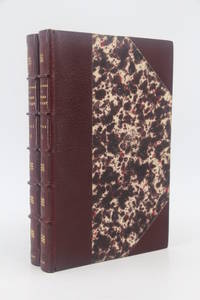
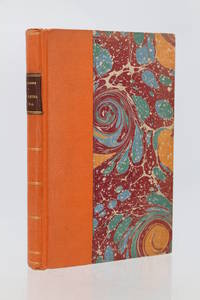
186183274Paris: Poulet Malassis & De Broise 1861. Fine. Poulet Malassis & De Broise Paris 1861 12.50 x 19 cm relié The second édition originale on ordinary paper. Fifteen hundred copies had been printed plus 4 on chine paper a few copies on hollande and on vélin. Complete with the portrait of the author by Félix Bracquemond often missing here in first state on papier chine pasted on the page before letters i.e. L'Artiste on top of the portrait. Orange half cloth Bradel binding smooth spine double ruled in gilt gilt date at foot slightly scratched brown shagreen title-label marbled paper boards slightly later 19th-century binding. Mistakenly considered as partly original this edition was entirely revised by the author with 35 newly composed poems and 55 deeply rewritten poems profondément remaniés among the 129 poems. This true new first edition of Les Fleurs du Mal is the culmination of Baudelaire's grand uvre and the only text of reference for foreign language translations. AN EDITION WORTHY OF FURTHER RESEARCH Long considered a simple expanded edition this important publication has received little scholarly interest although it offers a valuable and instructive research area: namely the different states of Bracquemond's engraving but also the misprints of the very first copies partly corrected during printing including two missing initials in our copy p. 20 and 49 added in ink at the time. It strangely resonates with a remark made by Charles Baudelaire to his editor in January 1861: Without a doubt the book has good general appearance; but until the last good leaf I found gross negligences. In this house it is the proofreaders who are lacking. For example they don't understand punctuation from a logical point of view; and many other things. There are also broken letters fallen letters Roman numerals of unequal size and length etc. . His editor Poulet-Malassis had indeed separated from his printer De Broise and the new Fleurs du Mal edition was printed by Simon Raçon in Paris. This change of printer could also be linked with the foxing present in numerous second edition copies which could be explained by a paper of lesser quality making copies without foxing especially rare. POSTERITY'S CHOICE Les Fleurs du Mal have two faces. To the third one it is allowed to dream. When Claude Pichois collected Baudelaire's works for the Pléiade edition he had to choose between three: the first of 1857 the 1861 edition revised by the author and the last published shortly after Baudelaire's death in 1868. Although the 1868 third edition is the most complete with 25 added poems its architecture and perhaps even the choice of unpublished poems may not have accurately reflected the poet's initial wishes. This is certainly the more comprehensive however it can only be qualified as partly original. Along with an introduction by Théophile Gautier the poet Théodore de Banville established the order of the edition and included numerous unpublished poems among the already existing ones. The mythical historically influential 1857 first edition obviously cannot be stripped from its princeps status. With its famous misprints carefully hand corrected on the first copies given out by the author its censored poems missing from the second edition but above all its thoughtful and corrected editing right up to the very last proofs and to the point of driving his editor crazy nicknamed Coco mal perché that Baudelaire exhausted with remarks and criticisms the so-called 1857 edition is unquestionably a landmark in literary and poetic history. The few copies containing the condemned pieces are among the most desirable bibliophilic treasures. However the first edition could not be considered the sole form of Baudelaire's masterpiece as the poet thoroughly revisited it in the following years. Far from a simple collection of poems Les Fleurs du Mal is built from a unique narrative logic in the history of poetry. As his editor Pou Poulet Malassis & De Broise hardcover
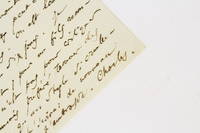
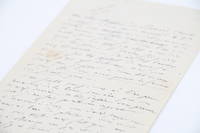
186562589Biponti Deux-Ponts 1865. Fine. Biponti Deux-Ponts Vendredi 12 mai 1865 13.20 x 20.80 cm 1 page sur un feuillet remplié Autograph letter signed by Charles Baudelaire written in ink and addressed to his mother. A few underlinings deletions and authorial corrections. This letter was first published in Charles Baudelaire Dernières lettres inédites à sa mère in 1926. Former collection of Armand Godoy no. 197. A precious letter from Baudelaire's Brussels period during the poet's voluntary exile at the end of his life. « Il est douteux que j'habite quelque part à Paris. Je crois que j'habiterai surtout une voiture dans laquelle je ferai si je peux toutes mes courses en un ou deux jours. » Haunted by Paris the city of vice and creditors he dreads this brief return. His exile in Brussels is in his eyes a sign of failure and ever since arriving in Belgium he has delayed his return to France. Yet weary of the flat country he despises he mocks its inhabitants: « On est lent ici. » The poet like the seventeen-year-old student who once promised his mother he would get back on track now vows: « Me voici en mesure d'accomplir tous mes plans. Je ne sais comment t'exprimer ma reconnaissance ; et je crois que la meilleure manière sera d'exécuter mes promesses. » Literally obsessed with this sacred mother « who haunts his heart and his mind » the « grateful son » sees himself as incapable of fulfilling his poetic destiny without her undivided attention. unknown
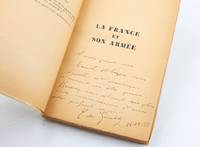
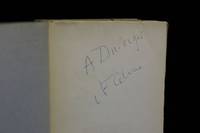
193886447Paris: Plon 1938. Fine. An important presentation inscription to his strategic mentor Plon Paris 1938 13 x 19.50 cm broché First edition on ordinary paper with the printed dedication to Marshal Pétain. Discreet restorations to the spine. Our copy is housed in a chemise and slipcase of navy blue half morocco smooth spine lettered with author title and date in palladium decorated paper boards grey paper pastedowns slipcase trimmed with matching navy morocco and decorated paper sides; binding signed by Boichot. An exceptional copy inscribed by General de Gaulle to Colonel Émile Mayer his great friend . without whom this book could not have been conceived as stated in the authors own inscription which continues: Receive my Colonel my deepest gratitude and my profound respect. A visionary soldier and theorist whom de Gaulle would later acknowledge as his strategic mentor Émile Mayer corrected the very proofs of this work which is here presented to him in these warm lines. Fifteen years before the First World War Mayer had predicted the trench warfare to come. From the 1920s de Gaulle frequented the salon of this great thinker of military art whose Jewish origins and Dreyfusard sympathies had subjected him to calumnious antisemitic attacks and suspension from the army between 1899 and 1907. Both Mayer and de Gaulle opposed the immobile dogma of the French General Staff. Their military prophecies proved extraordinarily accurate concerning the mechanisation of the modern army: For fifteen years they confronted the same themes not without disagreements and each evolved while enriching the other Milo Lévy-Bruhl. At their weekly lunches they exchanged perspectives on the future of corps and tactics both convinced of the futility of the Maginot Line. Mayer favoured a strategy of aerial and chemical warfare while de Gaulle advocated the use of armoured divisions. Despite their differences Mayer actively promoted the ideas of his protégé and assisted in revising France and Her Armyhaving been won over after the shock of the reoccupation of the Rhineland to de Gaulles ambition of creating a professional armoured army. De Gaulle addressed these remarkable words of gratitude to his mentor just two weeks before Mayers death on November 28 1938 which grieved him deeply. An exceptional presentation copy from General de Gaulle of his essential and visionary work on military strategya significant testimonial linking two independent spirits who revolutionised the theoretical understanding of national defence. Plon hardcover
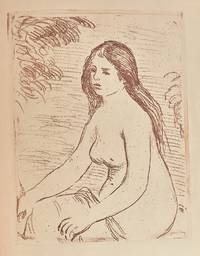
190687491Paris: H. Floury 1906. Fine. H. Floury Paris 1906 20.50 x 27 cm relié First edition one of 100 copies on Japon the only deluxe issue. Navy blue half shagreen with slight color restoration spine with five raised bands abundantly framed in gilt blue watered silk flyleaves marbled endpapers and pastedowns original wrappers and spine preserved gilt top edge binding signed J. Querelle. A superb copy on japon of the first authoritative publications on the history of Impressionism and the first bibliophile edition centered around this movement. Illustrated edition with 6 original etchings by Pissarro Les Faneuses; Renoir Femme nue assise and Femme nue couchée; one of only three etchings ever made by Cézanne Portrait of Guillaumin; Armand Guillaumin Vue près de Saardam - the copy is complete with the additional etching by Renoir on bistre Seated Nude Woman' reserved for copies on japon. The work also features a frontispiece rotogravure of Fantin-Latour's Atelier aux Batignolles. In addition to the six original etchings the book features 21 full-page plates including a colour rotogravure of Monet's famous Impression sunrise and no fewer than 105 reproductions of works and portraits of artists in the text. Théodore Duret paints here the great history of the movement he championed collected and theorized from its very beginnings. As early as 1878 he had published a small study that made him the first historian of these artists if not of the group itself just four years after their first exhibition at Nadar's studio. Twenty years after the last Impressionist exhibition Duret establishes the comprehensive story of this artistic revolution: ""For the early twentieth century and the decades to follow the history of Impressionism is Duret's 'The history of the Impressionist painters'."" Laura Iamurri. Renowned for its chronological accuracy - although in many cases Duret recalls events from his own memories - this work became a reference and was widely reprinted and translated London: Grant Richards 1910; Berlin: B. Cassirer 1909. Duret dedicates a monograph to each painter he mentions with the exception of Caillebotte and places Berthe Morisot in what he refers to as ""the core group of Impressionists."" Absent from his 1878 study Paul Cézanne now considered a post-Impressionist and Armand Guillaumin make their appearance here. A true art gallery on papier japon this text of reference for generations of readers' Laura Iamurri was the first to find a legitimate place for Impressionism in French art history. Not in Carteret. Etchings by Renoir Delteil 12 14 15; Camille Pissarro Delteil 94/XII Cézanne Venturi 1159; Armand Guillaumin Armand Guillaumin 1841-1927 gravures et lithographies 1995 p. 41. H. Floury hardcover
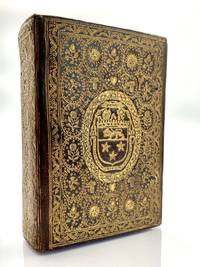
160275949Anvers Antwerp: Jean MoretusEx officina plantiniana apud Ioannem Moretum 1602. Fine. Jean Moretus Ex officina plantiniana apud Ioannem Moretum Anvers Antwerp 1602 8.20 x 12.60 cm relié New Plantin press editions in portable format of these three works. Ruled throughout in red ink. Copy with the arms of Nicolas de Villars clerical councillor at the Parlement of Paris and treasurer of the Sainte-Chapelle later bishop of Agen. Contemporary full soft brown morocco a fanfare binding with the rare Duodo-type decoration: smooth spine gilt with six medallions each containing a flower gilt foliage border covers fully gilt with 24 medallions some emblematic sun heart acorn bouquet sheaf of wheat arms stamped in the centre edges gilt. Discreet restorations to joints corners and headcaps; upper and lower borders with minor wear to leather 0.5 cm; lacking ties; pinhole at head of spine. From the first title-leaf a wormhole in the lower margin extending through to the final leaves of the Fables of Aesop gradually diminishing. A magnificent copy of the utmost rarity. The singular decoration of this style of binding representing one of the pinnacles of the art of French bookbinding is today identified as Duodo after Pierre Duodo Venetian ambassador to Paris from 1594 to 1597. About 150 small volumes were uniformly bound for a portable library only part now known probably towards the end of his stay. It is unlikely he ever enjoyed these treasures which fell into oblivion for nearly two centuries. When they reappeared on the English market at the end of the eighteenth century they were mistakenly attributed to Marguerite de Valois an error that persisted until the 1920s. Although the name Duodo remains attached to this style of decoration another great collector commissioned similar bindings: Nicolas de Villars bishop of Agen. Duodos bindings are now well identified while those of Nicolas de Villars are considerably rarer on the market. While the spine here is very close to the Duodo examples with flowers and foliage borders though in a finer and denser design the covers show 24 medallions compared to only 14 on Duodo bindings and the tools employed are not limited to floral motifs but include a variety of emblems such as the sun and the heart. Jean MoretusEx officina plantiniana, apud Ioannem Moretum hardcover
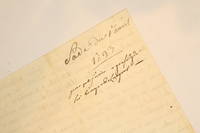
1793733941793. Fine. 1er avril 1793 15.60 x 20 cm une page sur un feuillet Unpublished autograph letter signed and dated written in black ink and addressed to a notary. On the verso probably in the hand of a secretary the inscription ""Sade du 1er avril 1793""; below this inscription a short sentence in the Marquis's hand: ""so that I may write to Gaufridy to send him money"". Some transverse folds from the original folding for posting. Lengthy letter addressed to a notary while the Marquis freed on April 2 1790 by the abolition of royal warrants is at liberty and attempting to put his affairs in order. After the Revolution his sons emigrated and he did not follow them. His name nevertheless appears on the list of persons who left France due to the revolutionary troubles: ""I hope that with all this I will manage to have my name erased from that fatal list of émigrés."" Anxious not to be considered a ci-devant Marquis in this period preceding the Terror he insists on the persecution of which he claims to be a victim despite his good will: ""It is an unparalleled atrocity that such a trick should have been played on me who have not left Paris since the revolution and who since that time have not ceased to give the most unequivocal proofs of my patriotism"". In this letter Sade also denounces the complexity of the workings of the French administration after the Revolution: ""I have just sent M. Lions the appropriate certificate of residence and I have attached a petition to the district which he tells me is . essential."" Impecunious he begs his lawyer ""to excite the zeal of those who owe him and to urge them to pay as much money as they collect immediately to M. Gauffridi sic"" and does not hesitate to show himself obliging in order to achieve his ends: ""spare no effort then I beseech you . always preserve for me your care and your friendship . I embrace and greet you with all my heart."" Sade's efforts would prove futile; in December 1793 he was imprisoned at the Madelonnettes before being admitted through the good offices of his friend Mme Quenet to the Coignard de Picpus establishment a nursing home sheltering wealthy suspects. Interesting unpublished letter showing the unfortunate Marquis at bay during one of his rare moments of freedom. unknown
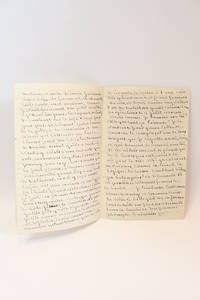
191564417La Maison-Forestière 1915. Fine. La Maison-Forestière 28 mai 1915 13.40 x 21.30 cm 4 pp. sur un feuillet double One of the most magnificent letters by Fernand Léger La Maison-Forestière Argonne 28 mai 1915 134 x 213 cm loose leaves A fabulous handwritten letter by the painter Fernand Léger written on the front line during the Battle of Argonne addressed to the Parisian art trader Adolphe Basler. 92 lines in black ink four pages on a double leaf dated 28 May 1915 by Léger. The handwritten letter is presented with a half forest green morocco chemise green paper boards with a stylised motif endpapers lined with green lamb slip case lined with the same morocco the piece is signed by Goy & Vilaine. The letter was chosen for Cécile Guilbert's anthology Les Plus Belles Lettres manuscrites de Voltaire à Édith Piaf Robert Laffont 2014. A true masterpiece of correspondence this exceptional missive by Fernand Léger shows that the experience of the trenches is of fundamental importance to his future work. Sent to the Engineering troops in 1914 Léger spent two years on the front at Argonne in the Maison-Forestière section from where he writes this letter on 28 May 1915 pendant que les obus lui passent au-dessus de la tête while shells were passing over his head. In complete freedom of tone and form the Célinian charm of this style is a surprise and is a sign of the mécanique mechanical period of his post-war painting. Through his letter we witness his political conscience awakening to contact with the men he has met on the front line whose merit and bravery made their mark on the painter. His particularly clear analysis of the inhumanity of the war gives this missive a place amongst the most beautiful combat letters of the first World War. Fernand Léger is replying to Adolphe Basler a Polish art critic who was Guillaume Apollinaire's secretary and a trader of paintings. Basler probably met Léger around 1910 since he was a member of the bande à Picasso Picasso's gang and was strongly influenced by Cubism alongside Derain Maurice de Vlaminck and Max Jacob. Trying his hand at monochrome and then at abstraction Léger applies the principles of form decomposition and perspective distortion. His work with Cubists becomes premonitory of the pending apocalypse. Some years later this Cubist vocabulary in fact becomes for Léger the perfect illustration of the war which he describes to Basler: It is linear and abrupt like a geometry problem. So many shells for such a long time on such a surface so many men every metre ready to go at any given time. More than ever the Cubist innovation allowed the contemporary world to be translated swaying between rationalism and chaos. Contact with the trenches causes a real upheaval both intellectual and artistic for the painter. As Blaise Cendrars comments It was at war that Fernand Léger had a sudden revelation of the depth of today.. Léger tell Basler of his vision of an industrial inhumane and depersonalised war: The wavering is over. It is a war without waste.' Everything goes. Everything is organised for maximum return. This war is the perfect orchestration of the all methods of killing old and new. It is intelligent through and through. It is even annoying there is nothing left that is unexpected. Léger's pertinent analysis was reflected in his post-war canvases by very calculated and balanced aesthetics a rendement pictural painting output of the image of the modern war in which he took part. For Léger the Cubist lesson is accompanied by a deep reflection of modernity and the modern men that he wishes to represent in his painting. The letter shows the gestation of his post-war painting style keeping the Cubist elements while making his canvases more vibrant with color and patterns taken from his time in the trenches. In fact Léger gives Adolphe Basler a glimpse of his famous période mécanique mechanical period in the 1920s of which the propheti hardcover
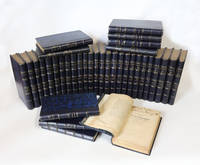
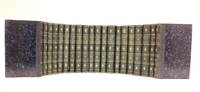
182669321Paris: Ladvocat 1826. Fine. Ladvocat Paris 1826-1831 & 1824 & 1838 13 x 21.50 cm 36 volumes reliés First collected edition partly original by far the most important and most sought-after cf. Clouzot with Chateaubriand having revised and reworked a large part of his writings.This set also contains in first edition several texts including Les Natchez Le Dernier Abencérage Le Voyage en Amérique and Moïse placed at the end of vol. XXII and often lacking. Each volume illustrated with a frontispiece by Charles Thompson. Bound in contemporary navy blue half shagreen spines with five raised bands marbled paper boards marbled endpapers and pastedowns. A few spots of foxing. Together with these collected works uniformly bound: a volume entitled uvres diverses collecting several political pamphlets in first edition; Le Congrès de Vérone 2 vols. Delloye 1838; Essai sur la littérature anglaise and Miltons Paradise Lost both Gosselin 1839. In the volume uvres diverses important presentation inscription signed by François-René de Chateaubriand to Monsieur Henri Bayart on the half-title of La nouvelle proposition relative au bannissement de Charles X et de sa famille. This inscription dating from the writers final years is addressed to Henri Bayart 18251892 godson of the Duchesse de Berry and brother of Sophie-Josèphe Bayart a close friend of François-René and his wife. The Chateaubriands and the Bayart family formed bonds of friendship and business during the Hundred Days and remained close until the end of their lives. As staunch legitimists devoted to the Bourbon cause they even attempted the impossible in seeking to have the writer appointed governor to the young Comte de Chambord claimant to the French throne. When writing this inscription probably around 1843 Chateaubriand was at the twilight of his political and literary life; close to the Comte de Chambord then exiled in England the Bayarts once again tried to intercede on his behalf sending Henri Bayart without success to persuade the last Bourbon heir to invite the ageing writer into his circle. A rare and fine set in uniform bindings containing numerous first editions and enriched with an important presentation inscription. Ladvocat hardcover
186771232Nohant Nohant-Vic 1867. Fine. Nohant Nohant-Vic 21 décembre 1867 13.40 x 20.70 cm deux feuillets sous chemise et étui Autograph letter from George Sand to Gustave Flaubert dated December 21 1867 8 pages on two lined leaves. Published in Sand's Correspondance XX pp. 642-645. From one of the finest literary correspondences of the century this letter written on Christmas Eve 1867 is a sublime testament to the frank friendship between George Sand the old troubadour and Gustave Flaubert christened cul de plomb leaden ass after declining his invitation to Nohant to complete L'Éducation sentimentale. Despite their seventeen year-age gap opposing temperaments and divergent outlooks on life the reader is gripped by the tenderness and astonishing verve of George Sand's long confession to Flaubert. At the height of her literary fame and enjoying her theater in Nohant Sand talks at length about politics their separation their conception of the writer's work and life itself. In this stream-of-consciousness letter Sand naturally and freely sets down on paper eight pages of conversations with Flaubert who made only too rare and brief appearances in Nohant: But how I chat with you! Do you find all this amusing I'd like a letter to replace one of our suppers which I too miss and which would be so good here with you if you weren't a cul de plomb leaden ass who won't let yourself be dragged along to life for life's sake whereas Flaubert's motto then busy writing L'Éducation sentimentale was rather art for art's sake. In the end of 1867 Sand grieved the death of an almost brother François Rollinat which Sand appeased with letters to Flaubert and lively evenings at Nohant: This is how I've been living for the last 15 days since I stopped working . Ah'! . Ah! when you're on vacation work logic and reason seem like strange swings. Sand was quick to criticize him for working tirelessly in his robe the enemy of freedom while she was running up and down mountains and valleys from Cannes to Normandy even to Flaubert's own home which she had visited in September. On this occasion Sand had happily reread Salammbô where she picked up a few lines for her latest novel Mademoiselle Merquem. Their literary and virile friendship similar to Rollinat's defied the old guard of literati who declared the existence of a sincere affair between man and woman utterly impossible. Sand who has been described in turn as a lesbian a nymphomaniac and made famous for her resounding and varied love affairs began a long and intense correspondence with Flaubert for whom she was a mother and an old friend. She called herself in their letters old troubadour or old horse and no longer even considered herself a woman but a quasi-man recalling her youthful cross-dressing and formidable contempt for gender norms. To Flaubert had compared the female writers as Amazons denying their femininity: To better shoot with the bow they crushed their nipples Sand replied in this letter: I don't share your idea that you have to do away with the breast to shoot with the bow. I have a completely opposite belief for my own use which I think is good for many others probably for the majority. A warrior yes but a peaceful warrior Sand willingly adopted the customs of a world of misogynistic intellectuals while remaining true to herself: I believe that the artist should live in one's nature as much as possible. To the man who loves struggle war; to the man who loves women love; to the old man who like me loves nature travel and flowers rocks great landscapes children too family everything that moves everything that fights moral anemia she then adds. A fine evocation of her green period this passage marks the time of Sand's country novels when mellowed by the years she gave herself over entirely to contemplation to write François le Champi La Mare au diable and La Petite Fadette. But her love of nature didn't stop unknown
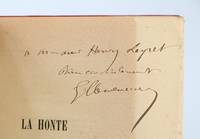
190386548Paris: P.V. Stock 1903. Fine. Rare inscription to a fervent Dreyfusard and chronicler at L'Aurore P.V. Stock Paris 1903 16 x 18.50 cm relié First edition one of 12 numbered copies on hollande paper the only large paper copies. Full red shagreen binding spine with three raised bands decorated with gilt fillets and gilt cartouche enriched with black typographic motifs marbled paper endpapers and pastedowns bookplate affixed to pastedown original wrappers and spine preserved top edge gilt other edges uncut. Foxing to some uncut edges. Autograph inscription signed by Georges Clemenceau to Monsieur Henry Leyret political and judicial chronicler and editor at L'Aurore. The Tiger here presents his monumental work on the Dreyfus Affair to one of his collaborators at L'Aurore where ""J'accuse!"" was published. Both Leyret and Clemenceau shared a profound sensitivity to social injustice. Leyret himself led a successful campaign in the pages of the same newspaper against the unjust sentences to hard labour imposed on anarchists. He was directly involved in L'Aurore's pro-Dreyfus commitment by writing a major article on the founding principles of the newly created League for the Rights of Man three months after ""J'accuse!"". In 1898 he compiled Esterhazy's correspondence for posterity: ""Let them now read the Letters of a Guilty Man let them read them to their wives to their sons. Ah! I defy them not to be indignant not to catch in the eyes of their listeners a flash of anger an expression of disgust and not to cry out: 'No! This acquitted man is not innocent!'"" An exceptional inscription to a committed chronicler who waged the fierce struggle for law and justice alongside Clemenceau in the columns of L'Aurore. P.V. Stock hardcover
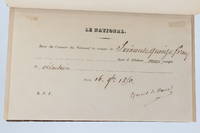
184880363Paris: Ferdinand Sartorius 1848. Fine. Ferdinand Sartorius Paris 1848 13.50 x 22 cm relié Ferdinand Sartorius Paris 1848 135 x 22 cm one volume bound in shagreen & one note First edition rare and very sought after according to Clouzot. Precious copy with the title page having the correct date of 1848. This work is the first to be published recounting Nerval's stay in Egypt and will be followed the same year by Femmes du Liban. These two main texts will form the famous Voyage en Orient in 1851. Copy free from foxing some leaves have angular fold marks. Binding in half green shagreen spine in four compartments enhanced with gilt stipples decorated with double gilt spine panels and fleurons black fillets some signs of rubbing marbled paper boards two corners restored sprinkled paper endpapers charming contemporary binding. Our copy is enriched with a receipt for the amount of seventy-five francs signed by Gérard de Nerval and mounted on the guards. Extremely rare in good condition according to Clouzot. Ferdinand Sartorius hardcover
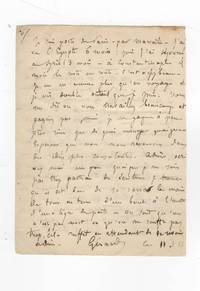
184475148Paris 1844. Fine. Paris 11 février 1844 10.40 x 13.60 cm quatre pages sur deux feuillets Three autograph letters signed by Gérard de Nerval 2 pages signed «Gérard» Théophile Gautier 1 page and a third unsigned letter 1 page penned by a certain «Robert» cf. Nerval's letter Louis Desessart Théophile Gautier's appointed publisher co-published Nervals play Léo Burckart with Barba in 1839. Following financial difficulties he was forced to take refuge «in that sad and charming city of Brussels». The three friends wrote this letter from Paris where they had reunited following Nervals long journey to the East: «I spent six months in Egypt; then three months in Syria four months in Constantinople and the rest en route. Its quite beautiful. I only enjoy myself while traveling and try to live twice as much as I can.» This journey deeply impressed Théophile Gautier who would only travel to Turkey and Egypt years later: «I am in Paris and wish I were in Cairo from where Gérard is returning.» The exoticism of distant lands starkly contrasts with the melancholy and severity of Europe: «How sad Paris is when one returns from sunlit countries.» Nerval And in Paris far from dreams of escape life means toil and melancholy: «We are like sick people who are never comfortable anywhere. I think the good times are gone and the golden hours of the past when we spoke such wise follies will never return. Whats the point of living if we must work and cannot see our friends or write to them or do anything we would like» Gautier The two writers express great compassion for their friends Belgian exile with Brussels appearing as the capital of spleen: «What! Youre still in that sad and charming city of Brussels! . Brussels is even darker poor fellow!» Nerval This joint letter was in fact initiated by «Robert»: «Isnt it true my dear friend that Im quite skilled at making you forget my faults . as a way of making it up to you Im sending you the autographs of two of your . comrades your fondest memories two men of fame who despite all their affection and friendship for you would never have written a word had I not trimmed their quills and handed them paper like sulky children and told them: write at once at once to the exile you love most.» unknown
188152259Paris: Alphonse Lemerre 1881. Fine. ""Bouvard et Pécuchet where Flaubert sought to enclose and subdue the whole world the whole of human striving and human failing"" Julian Barnes Flaubert's Parrot Alphonse Lemerre Paris 1881 12 x 18.50 cm relié First edition one of 50 copies on vergé de Hollande only deluxe issue with 10 copies on papier Chine. Contemporary dark red shagreen probably a publisher's binding spine in six compartments with gilt fleurons covers with double gilt fillet frame and gilt fleurons to corners marbled endpapers and pastedowns edge of covers ruled in gilt gilt roulette to head-pieces top edge gilt slipcase edged in dark red shagreen. A very rare and handsome copy perfectly set in a contemporary binding. Alphonse Lemerre unknown
185788314Paris: Michel Lévy frères 1857. Fine. Michel Lévy frères Paris 1857 12 x 18.50 cm 2 volumes reliés First edition with all the features of first issue copies including the misprint Sénart on the dedication leaf. Contemporary plum-coloured 3/4 morocco binding signed by Georges Huser spines with five raised bands numerously ruled in blind with a gilt floral tool at centres dates in gilt at foot marbled paper boards marbled endpapers and pastedowns original wrappers preserved top edges gilt bookplates on each front pastedown. Complete with the publishers catalogue at the end of the first volume. A very handsome copy elegantly bound by Georges Huser with the rare original wrappers preserved. Michel Lévy frères hardcover
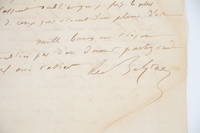
183077791Tours 1830. Fine. Tours 23 juin 1830 13.20 x 19.90 cm une feuille Unpublished autograph letter: As soon as I had arrived in Tours I was thrown on the coasts of Brittany by the best conditioned desire that had ever seized a man to shut off the atmosphere of Paris and its ideas by going to run on the beautiful rocks that border the sea in Brittany Tours 23 June 1830 13.2 x 19.9cm one leaf Unpublished handwritten letter signed by Honoré de Balzac one and a half pages written in black ink on a leaf of white paper. Transversal folds and ink a little faded at the bottom of the first page without making it difficult to read. The man from Tours poetically recounts his wanderings on the Breton coast during a trip he took in the company of Madame de Berny. Together they sailed up the Loire in a boat all the way to Le Croisic: As soon as I had arrived in Tours I was thrown on the coasts of Brittany by the best conditioned desire that had ever seized a man to shut off the atmosphere of Paris and its ideas by going to run on the beautiful rocks that border the sea in Brittany and there once arrived I stayed a fortnight the most delicious in the world running on the bays on the kelp collecting the pucelages that are in large numbers on the sea sand in reverse of the rue Vivienne. The pucelages here are shellfish so named because of their vulvoid shape allowing Balzac an allusion to the prostitution very popular at the time that occupied the Galerie Vivienne. This amusing letter is addressed to one of the editors of La Silhouette magazine as evidenced in particular by the sign off at the end of the letter mentioning the founder of the periodical: A thousand good friendships do not forget to give a large part to our friend Victor Ratier. Balzac also mentions several articles: I am writing to give you a sign of life proof of interest and of friendship but I write to you briefly because I have twenty letters to answer and I promise you a letter for.1st July which will contain the end of the charlatan issue 2 la bella dona and finally the articles that will have passed through my head and with which you will be furnished so as to not ask anything of me for a month or two and so that around August you will be my publisher. We have not found any trace of said letter in the writer's correspondence no more besides than the continuation of the Charlatan the first part of which was published in the second issue of La Silhouette. No article under the title of Bella Dona appears in the following issues either although Balzac emphasizes in his letter the desire to provide other texts given that the charms of the Loire must not make him forget that he is the poorest of those who live on a quill pen. A beautiful and spicy unpublished letter. unknown
183386496s. l. Neuchâtel 1833. Fine. Eve's first kiss: 'The gods grant no favours untainted.' s. l. Neuchâtel 29 septembre 1833 13.40 x 21.10 cm une page sur un double feuillet Autograph letter signed by Honoré de Balzac addressed to his friend the writer Charles de Bernard. One page written in black ink on a bifolium. On the verso of the second leaf appears the address of the recipient Charles de Bernard du Grail written in Balzacs hand along with postal stamps and the seal bearing the arms of the Balzac dEntraigues family which the author had appropriated. A few minor holes not affecting the text; fold marks as usual from mailing. Published in his correspondence Paris Calmann Lévy 1876 CXIV pp. 252253. Balzac wrote this letter four days after his very first meeting and first kiss with Madame Hanska in Neuchâtel following many months of epistolary correspondence. « Jai été très heureux ici. Je suis très content de ce que jai vu le pays est délicieux ; mais vous savez que Jupiter a deux tonneaux et que les dieux nont point de faveurs qui soient pures. » ""I have been very happy here. I am most pleased with what I have seen; the country is delightful. But you know that Jupiter has two jars and the gods grant no favours that are untainted."" Two years after receiving the first letter from the Stranger Éveline Rzewuska a lovestruck Balzac left Paris to join her in Switzerland. His brief stop in Besançon ostensibly a convenient detour served as a polite pretext for his departure from the capitalwhere he took the opportunity to visit his correspondent Charles de Bernard. « Il me semble que je vous ai bien peu remercié de la bonne journée que vous mavez donnée ; mais jespère vous prouver que je ne suis point un ingrat. À mercredi donc ; vous devez penser que jaurai bien du plaisir à vous revoir vous qui avez fait que mon voyage à Besançon na pas été inutile et que jy ai trouvé du plaisir ». I fear I thanked you all too little for the delightful day you gave me; but I hope to prove that I am not ungrateful. Until Wednesday then you must know how much I look forward to seeing you again you who ensured that my journey to Besançon was not in vain and even brought me joy. After a day in Besançon and a chaotic journey by mail coach Balzac finally met his beloved though regrettably in the company of her husband Count Hanski. Seizing upon the Counts absence the writer stole a long-awaited kiss with Madame Hanska on an ancient stone bench upon the hill of Crêt. In the rapture of their first encounter he could not help but invoke La Fontaines ominous fable in his letter: « mais vous savez que Jupiter a deux tonneaux et que les dieux nont point de faveurs qui soient pures ». but you know that Jupiter has two jars and the gods offer no favours untainted. His love affair with Madame Hanska would prove far from serene as Gonzague Saint Bris aptly summed it up: eighteen years of love sixteen of waiting two of happiness and six months of marriage. Neuchâtel would remain a powerful emblem of their union recurring in some sixty of their letters. Neuchâtel is like the white lily he wrote to her pure with a penetrating fragrance youth freshness brilliance hope happiness glimpsed. De Bernard who had previously arranged his journey to Switzerland was once again tasked with organising Balzacs return: « Jaurai le plaisir de vous revoir mercredi 2 octobre. Voulez-vous avoir lobligeance de me retenir une place à la malle pour Paris ». I shall have the pleasure of seeing you again on Wednesday 2 October. Would you be so kind as to reserve me a place in the mail coach to Paris The journey separating him once again from his beloved proved wretched: The mail coach was fully booked for six days so my friend from Besançon Charles de Bernard was unable to secure me a place. I was thus obliged to travel on the roof of a diligence in the company of five Swiss from the canton of Vaud unknown
184273008Paris: FurneDubochetHetzel & Paulinpuis Alexandre Houssiaux 1842. Fine. Furne Dubochet Hetzel & Paulin puis Alexandre Houssiaux Paris 1842-1855 14.50 x 22 cm 20 volumes reliés Honoré de BALZAC & Honoré DAUMIER & Charles Constant Albert Nicolas d'Arnoux de Limoges Saint-Saëns dit BERTALL & Paul GAVARNI & Tony JOHANNOT & Célestin NANTEUIL uvres complètes de H. de Balzac Complete Works Furne Dubochet Hetzel Paulin puis Alexandre Houssiaux Paris 1842-1855 14.5 x 22 cm 20 volumes in contemporary half shagreen First collective edition sold as the Works comprising as well as numerous texts published for the first time a new version of the Human Comedy reviewed and revised by Balzac. This is also the first illustrated edition. Contemporary half blue shagreen over marbled paper boards spines slightly sunned in five compartments with thin raised bands decorated with gilt dots and compartments with triple blind-ruled frames gilt fleurons to centre marbled endpapers and pastedowns. A little foxing in some volumes a very small stain to page 119 of volume 4 another to page 321 of volume 8 a tear to half-title of volume 9 a small damp stain to corner of pages 449 and following of volume 10 stain to pp. 173-74 of volume 14 stains to pages 303 to 307 of vol. 16. The full set of 152 hors-texte plates by the best artists of the age including Bertall Daumier Gavarni Johannot Nanteuil as well as illustrations to text. Four rejected plates have been added bringing the number of plates in this copy to 156. There are so many reasons for emphasising the interest of this edition one of the most important in French literature. Having had a turbulent existence and confused and having been several times republished in a great number of copies it is very rare in its first form and in this first version even rarer in a contemporary uniform binding than with a modern binding and the wrappers preserved cf Clouzot. A very good and rare copy in a contemporary uniform binding ca 1855 with all the plates called for by Clouzot and four additional ones. FurneDubochetHetzel & Paulinpuis Alexandre Houssiaux hardcover
195445261Paris: Gallimard 1954. Fine. Gallimard Paris 1954 14 x 21 cm relié sous chemise et étui First edition one of 45 numbered copies on Hollande paper the tirage de tête Autograph inscription from Louis-Ferdinand Céline to his friend Pierre Duverger the only photographer to have taken color photographs of Céline Quality blueish paper covers sunned as is often the case Ex libris pasted onto foot of half-title This copy has a half black morocco chemise spine in six compartments date to foot and a slipcase edged in black morocco both by Goy & Vilaine. Gallimard unknown
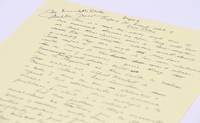
1983822701983. Fine. There is a long-standing myth that if two economists discuss any topic they will have at least three opinions about it. s. d. septembre 1983 21.50 x 28 cm une page sur un feuillet Autograph manuscript signed one a page written in black ink on a sheet of yellow lined paper and titled by the author: Draft 8 Preface for French edition 8 Price Theory; numerous erasures and corrections. At the top left of the sheet in ballpoint pen autograph signed: For Bernadette Platte Milton Friedman. Extremely rare autograph manuscript signed by the 1976 Nobel Prize winner one of the most influential economists of the 20th century whose entire archives are now kept at the Hoover Institution Library & Archives Stanford University. The few Friedman manuscripts still in private hands are particularly desirable and sought-after. Important theoretical text of the first two paragraphs of the preface to Price and Economic Theory first French translation of Price Theory published in 1983 by Economica editions. Completed on September 7 1983 at Stanford University this original version in English is completely new. Price Theory Friedman's major work Chicago Aldine Press 1962 whose definitive version was published in 1976 the year Friedman won the Nobel is a fundamental essay directly inspired by his lectures at Chicago University. For his first publication in France seven years later Friedman therefore undertook to compose a completely new preface intended for this public less naturally won over to monetarist ideas than the Americans. Our manuscript the final version of a text that required eight rewrites as evidenced by the exergue still bears multiple modifications underlining the attention paid by Friedman to the reception of his work by the French readership. Spearhead of Ronald Reagan's economic policy Friedman's theory of prices comes from a long tradition of French and Anglo-Saxon thinkers whom the economist takes care to quote in this manuscript: From the French physiocrats and Adam Smith to Léon Walras and Alfred Marshall to Maurice Allais and Paul Samuelson a body of theory has been elaborated and refined that essentially all economists accept and use in their analysis of the problems for which it is relevant. As a connoisseur of the French spirit Friedman thus insists on the connection between the economic liberalism of his famous school of Chicago and the philosophy of the Enlightenment dear to the intelligentsia of the old continent. It is moreover in homage to this French critical spirit that he opens his preface with an ironic anecdote on the relativity of economic theories: There is a long-standing myth that if two economists discuss any topic they will have at least three opinions about it. We note however that he replaces the real author of this trait who is none other than Churchill with an anonymous long-standing myth. The repetitions and redactions on our manuscript show Friedman's temptation to analyze the origin of this myth: This myth rests like most myths is crossed out and replaced by an irrevocable Whatever small element of validity this myth may have with respect to some topics it has none whatsoever with respect to the core of economics. price theory. The second paragraph of our manuscript is a promotion of his monetarist theories which at the beginning of the 1980s had just borne fruit: their application by the American Federal Reserve led to a sharp decline in inflation and a historic rise of the dollar. At the height of his influence Friedman then saw his works including Price Theory republished taught around the world and translated into several languages. He emphasizes here the central importance of his theory for understanding the world market: For price theory seeks to understand how the actions of hundreds of millions of people spread around the surface of the globe interact through a market to determine the price of one good or service relates to unknown
184077055Paris: Léon Curmer 1840. Fine. Léon Curmer Paris 1840-1842 18 x 26.50 cm 11 volumes reliés Les Français peints par eux-mêmes. Encyclopédie morale du dix-neuvième siècle Le Prisme with Les Anglais peints par eux-mêmes The French painted by themselves The English painted by themselves Léon Curmer Paris 1840-1842 18 x 265 cm 11 volumes in half morocco First edition one of the grand papier deluxe copies with two states of the illustrations for the 8 volumes of Les Français peints par eux-mêmes: one in black on tinted paper and one enhanced by hand using the so-called coloris gommé technique with watercolour and varnish on white paper. Les Anglais peints par eux-mêmes includes the engravings in black. No deluxe copies in colour have been made for this rare set of Les Français. Bound in half brown morocco spine in five compartments enhanced with stipple engraving and double gilt panels richly decorated with gilt floral motifs framing a mosaic medallion of green morocco with a gilt rose stamped in the center cartouches at the top decorated with a gilt garland framing the place and publication date some light minor rubbing on some compartments gilt fillets on the marbled paper boards comb-patterned endpapers top edges gilt. Elegant late nineteenth century bindings signed Durvand-Thiret. Complete with all engravings along with added engravings i.e. 930 engravings including 415 in colour. Title pages dated 1841 for all volumes of Les Français except for volume 5 of Les Parisiens and volume 3 of La Province dated 1842. Les Français peints par eux-mêmes has 415 engravings in black including that of Napoleon on horseback instead of the 405 announced and 415 in colour including a double page map of France in volume III of the Province. The English volume illustrated by Kenny Meadous is complete with 100 plates in black. This unique set contains in total almost a thousand black and coloured engravings and more than 1500 in-text illustrations. Famous gallery of woodcut portraits depicting the social classes of the 19th century by the greatest artists of the time: Gavarni Daumier Delacroix Grandville Johannot Bellangé Charlet Daubigny etc. The portraits are all accompanied by original texts from the most famous Romantic authors including: Balzac Nodier Gautier Nerval Gozlan Janin Karr etc. Scarce foxing affecting mainly the Prism and the Anglais. The texts and illustrations of the book paint a lively picture of inhabitants and their trade in metropolitan France and its colonies. It sets the tone for panoramic literature a new genre coined by Walter Benjamin in Charles Baudelaire. A lyric poet at the height of capitalism. In addition to these portraits of the Français the contribution of a whole areopagus of great and small authors and illustrators S. Le Men La 'littérature panoramique' dans la genèse de la Comédie Humaine: Balzac et Les Français peints par eux-mêmes L'Année balzacienne 2002/1 No. 3 CAIRN includes some of the most renowned authors and cartoonists of the time each of whom made an original creation for the project. This protean fresco was directed by editor Léon Curmer already known for the publishing success of Paul et Virginie between 1836 and 1838. Curmer is represented here by an article L'éditeur in volume IV written by Elias Regnault. The latter takes example in Louis-Sebastien Mercier's Tableau de Paris published in 1781 whose vision is even further extended by the representation of French provinces in Les Français. Thanks to Curmer the work finds an even deeper meaning: the editor has widened his frame and instead of letting a few fleeting portraits get lost in the immense daily whirlwind that engulfs all things he has sought to bring together the most salient physiognomies of that time. S. Le Men Ibid. Curmer selected the authors and illustrators closest to the ones they depict: It is therefore a question of calling upon authors and illustrators who are wel Léon Curmer hardcover
189072241et ne se vend nulle part Fictional Place Bruxelles Brussels: Imprimé sous le manteau Henri Kistemaekers 1890. Fine. Imprimé sous le manteau Henri Kistemaekers et ne se vend nulle part Fictional Place Bruxelles Brussels 1890 13.50 x 22 cm relié First edition clandestinely printed in 175 numbered copies ours being one of the 25 lettered copies from the head of the print run. Bradel binding in half bordeaux morocco smooth spine gilt date at foot marbled paper boards marbled paper endpapers and pastedowns original wrappers preserved. A very rare and handsome copy. Provenance: from the library of Dr. Lucien-Graux with his ex-libris mounted on a pastedown. Imprimé sous le manteau[ Henri Kistemaekers] hardcover
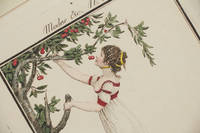
179887502A Paris: Au Bureau du Journal des Dames Rue Montmartre N° 183 au coin du Boulevart 1798. Fine. Au Bureau du Journal des Dames Rue Montmartre N° 183 au coin du Boulevart A Paris s.d. 1798-1808 10.80 x 17.60 cm 52 planches en feuilles montées sous marie-louise en étui Set of 52 original plates etched and enhanced with watercolours at the time numbered 1 to 52 mounted in pairs under mats. Leaves in red half calf slipcase early 20th century red shagreen boards. The plates vary in size 10.8 x 17.6 cm to 28.1 x 18.8 cm and paper stock as was often the case with La Mésangère's publications. Unbound engraved title on a bifolium printed separately absent from most copies. It is replaced here by its identical reprint by Gosselin 1893-1903 on antique watermarked paper and bears the publisher's 'G' mark characteristic of this reprint a century later. All the plates however are in their first edition without the G mark added by Gosselin to the lower corners of the engravings in the figure or the bowl occasionally accompanied by a date. Some foxing a few rare engravings showing traces of pasted tabs on the reverse. Plate 42 restored without missing. A green stain in plate 11 probably due to the watercolour of the landscape. Twelve plates are trimmed to the plate mark: pl. 12 12.7 x 19.2 cm pl. 15 12.4 x 18.7 cm pl. 19 11.9 x 19.8 cm pl. 29 11.9 x 19 cm pl. 30 12.5 x 19 cm pl. 39 12.1 x 18.4 cm pl. 41 12.5 x 19.1 cm pl. 42 12.5 x 19.1 cm pl. 48 11.9 x 18.3 cm pl. 49 12.9 x 19.9 cm pl. 51 12.5 x 18.4 cm and pl. 52 12 x 18.1 cm. Plate 37 is trimmed around the black border 10.8 x 17.6 cm. More pronounced foxing in the margins of plates 4 28 30 31 35 44 45 and 47. A rare and precious complete suite of 52 original costume prints from the Directoire and First Empire periods. Deemed ""unfindable"" by Gaudriault in his study of women's fashion engravings in France this is the only complete set of first editions currently available. This series of elegant silhouettes was published on the initiative of the bookseller Sellèque and Pierre La Mésangère a clergyman who returned to the press after the turmoil of the Revolution. In 1800 La Mésangère took over the management of the renowned Journal des Dames et des Modes a pioneering publication in the history of the women's press and produced a few standalone series such as this one aimed at 'a category of connoisseurs with an interest in a more refined and luxurious interpretation of fashion than that offered by the plates in the newspapers' Philippe Séguy Histoire des modes sous l'Empire. The plates are the work of Philippe-Louis Debucourt a painter of French elegance since 1787 and a regular contributor to the Journal des Modes. The first 38 date from Year VIII the next 12 from Year IX and the last two from 1808. Through these 52 costumes unfolds a veritable grammar of dress a precious alphabet of the gown and hat - a language in which Parisian women were particularly well versed. Shepherdesses sultanas Etruscan princesses. the trend leaned towards exoticism even eroticism with the occasional bare breast. We find the fashions brought to the fore by the Merveilleuses following the Revolution inspired by Antiquity and mythology - gowns of iridescent muslin light and form-fitting alongside coats bandeau hairstyles and Grecian tunics. The captions accompanying the etchings often provide detailed descriptions of the attire hairstyles and headwear meticulously enhanced with watercolour. Some figures even double as biting social commentary verging on caricature featuring characters such as the ludicrously pretentious Turcaret a recurring theatrical figure since the early 18th century or genre scenes teeming with amorous intrigues. The significance of this series in the history of colour engraving is noteworthy albeit underappreciated by bibliographers. Some plates bear tiny black dots in the margins indicating the process of colour engraving by superimposing intaglio plates. These mark Au Bureau du Journal des Dames, Rue Montmartre, N° 183, au coin du Boulevart hardcover
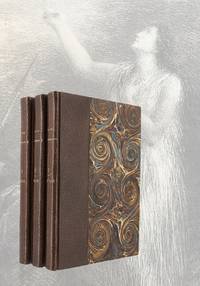
188584667Paris: Imprimeries MorelletBoyer & Cie 1885. Fine. Wagner's influence on literary and artistic avant-garde Imprimeries Morellet Boyer & Cie Paris 1885-1888 16.80 x 24.60 cm 3 volumes reliés Complete collection in 36 issues including three double issues bound in three volumes - First year: 12 issues from 8 February 1885 to 6 January 1886 - Second year: 12 issues from 8 February 1886 to 15 January 1887 - Third year: 12 issues from February 1887 to January 1888. Illustrated with 4 full-page lithographs by Fantin-Latour: L'Évocation d'Erda - Odilon Redon : Brünnhilde - Jacques-Emile Blanche : Tristan et Isolde and Le pur-simple. Three quarter brown morocco binding smooth spine titled in gilt marbled paper boards marbled paper endpapers and pastedowns orignal wrappers preserved binding signed by Dupré. Numerous contributions from some of the most prominent writers critics poets and musicians of the late 19th-century including Wagner himself: Charles and Pierre Bonnier Jules de Brayer Alfred Ernst Joris-Karl Huysmans Fourcaud René Ghil Stuart Merrill Stéphane Mallarmé Catulle Mendès Éphraïm Mikhael Pierre Quillard Jean Richepin Émile Hennequin Charles Vignier Charles Morice Paul Verlaine Villiers de l'Ilse Adam Teodor de Wyzewa Stewart Chamberlain Gerard de Nerval Souvenirs sur Lohengrin Jean Ajalbert Gabriel Mourey Adolphe Jullien Tola Dorian Swinburne Evenepoel Franz Liszt. A very valuable complete collection of this avant-garde journal both literary and aimed at presenting Wagner's works through a new aesthetic. Imprimeries MorelletBoyer & Cie hardcover
196084581Paris: Gallimard 1960. Fine. Gallimard Paris 1960 15 x 21 cm relié First edition one of 30 numbered copies on Holland paper the deluxe issue.Bound in full ebony morocco smooth spine decorated with small inlays of garnet morocco and pearl-grey box calf the latter framing the authors initials and the title; the first numeral of the date given in Roman numerals appears within a square of pearl-grey box calf. Morocco boards framed with wide panels of chocolate suede the upper cover with a large granulated paper panel lettered with the title and date of the edition set in garnet morocco the initials framed by a rectangle of paper taken from a map of Haute-Savoie; bluish paper endpapers and pastedowns original wrappers and spine preserved top edge gilt; housed in a chemise with a rhodoid-backed spine and slipcase trimmed with ebony morocco. Binding signed by Pierre-Lucien Martin and dated 1964. These memoirs-autobiography by Simone de Beauvoir trace her life from her success at the agrégation prepared with Jean-Paul Sartre to the Liberation of Paris in August 1944. A superb and celebrated binding produced in a few copies each differing slightly by Pierre-Lucien Martin one of the masters of twentieth-century French bookbinding. Gallimard hardcover
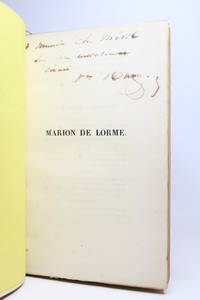
183173562Paris: Eugène Renduel 1831. Fine. Eugène Renduel Paris 1831 14 x 22.50 cm relié First edition rare copy with no statement of print. Full blue morocco binding spine with raised bands in the Jansenist style endpapers and pastedowns of combed marbled paper gilt dentelle framing the pastedowns double gilt fillets and gilt tooling to headcaps and board edges top edge gilt with untrimmed margins preserved original front wrapper bound in binding signed by Marius Michel. Monogrammed bookplate mounted on the verso of the first endpaper. This copy is enriched with four hors-texte plates by Louis Boulanger and Alfred Johannot. Signed autograph inscription by Victor Hugo on the half-title: « À Monsieur Charles Mévil son bien cordialement dévoué Victor Hugo. » Valuable and intriguing presentation inscription to the administrator and principal shareholder of the highly influential Revue de Paris publisher of Balzac whom the young Hugo was likely hoping to win over. It was only in 1834 two years after the success of Notre-Dame de Paris that Hugo would publish a text in the Revue Claude Gueux alongside his prolific rivals Le Père Goriot. Presentation copies of this title by Victor Hugo are exceedingly rare. In his Chronologie des livres imprimés de Victor Hugo published in 2013 Éric Bertin records only nine such inscriptions in this edition: to Sainte-Beuve Taylor Paul Lacroix Charles Mévil this copy Charles Nodier Loève-Veimars Armand Bertin H. Romand and the faithful Paul Meurice. The work also notes that this copy appeared in the Latour sale 1885 and more significantly the Noilly sale 1886. Magnificent copy bound by Marius Michel enriched with engravings and a signed autograph inscription by the author. Eugène Renduel hardcover