Rainer Maria RILKE - (Elya Maria NEVAR)Biblio.com
48 390 résultats
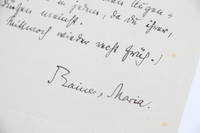
191886607Munich 1918. Fine. Letter to a Young Artist Munich Sonntag dimanche 3 novembre 1918 14.40 x 18.50 cm 2 pages et demi sur un bifeuillet enveloppe jointe Autograph letter in German signed by Rainer Maria Rilke to actress Else Hotop to whom he writes under her stage name Elya Maria Nevar. 2 1/2 pages written on a bifolium watermarked Sackleinen. Autograph envelope enclosed addressed to Else Hotop bearing postmarks dated November 3 1918.Published in Freundschaft mit Rainer Maria Rilke 1946 p. 35. A precious piece of Rilkes correspondence reflecting the delights of an enchanted afternoon spent during WW1 with the actress Elya Nevar one of his most fervent admirers. The truly active and creative period of young Elyas and Rainer-Marias attachment to each other is the beginning of their friendship with the discovery of the unknown the surprise of affinities that are revealed and finally what is so important in friendship as in love this intimacy that begins during a Bavarian autumn while the tumult of war rumbles in the distance Marcel Brion. This letter belongs to the beginnings of his relationship with the young Elya Nevar guardian of his solitude during Rilkes troubled Munich period where he experienced an inspiration crisis between The Notebooks of Malte Laurids Brigge and the Duino Elegies. We are just a few days away from the end of WW1. After brief encounters the previous year Rilke had rediscovered Elya Else Hotop during the summer of 1918 on the theater stage. Every evening he came to admire the actress nineteen years his junior who played the role of a medieval princess in a piece inspired by a 15th-century epic poem. She borrowed her characters stage name Elya by which Rilke addresses her. Their correspondence began a few weeks earlier after an intensely poetic note by Elya who greatly admired his Book of Hours 1905: she regards him as THE poet indestructible admirable and accepts everything from him including his indifference Rilke Catherine Sauvat. Romantic and cerebral the poet makes up for his absences with a beautiful declaration of affection in this letter: even if I was put off by many things from the intention of writing to you immediately at your first letter my attention has been close to you at many moments and it is so whenever you think you need it dear child. In spite of this they would spend moments together which soothed Rilke afflicted by a deep creative crisis and affected by the war years.I would have asked you to send me the book with your notes but look: when I got home late at night it was on my table. And since youre already familiar with the language of seals in our exchanges: you who are sincerely attentive. His mention of seal language alludes to one of their ritual Wednesday afternoon meetings at Rilkes house; the poet had gifted Elya a removable seal which could alternatively house a set of ten double-sided sigils engraved with symbols and written captions: We spent an afternoon playing like children drafting the twenty seals on a sheet of drawing paper and Rainer Maria wrote the text underneath in his delicate handwriting. The book with my notes mentioned by Rilke above was sealed with a sigil depicting an ancient mask with the inscription Lift it up! she later recalled. True to her art the actress had chosen the actors mask as her symbol. Rilke himself had a fascination for seals; he used the greyhound coat of arms inherited from his Czechoslovakian grandfather to seal his correspondence; and toward the end of his life living in Muzot he wished for these same arms to appear on his tombstone and accompany him into eternity. The poet was grateful for this delightfully quaint activity alongside his medieval princess fond of his eminently medieval Book of Hours: What you have written about the previous Wednesday this Wednesday so richly ours has gladdened my heart. As Marcel Brion observes it was in he unknown
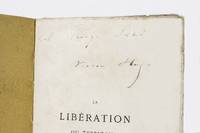
187369841Paris: Michel Lévy frères 1873. Fine. Michel Lévy frères Paris 1873 15.50 x 24 cm broché sous chemise et étui First edition mention of second edition. Our copy is presented in a case and shirt with a green canvas back and marbled paper boards. We enclose the cover of the catalog of the sale of the library of George and Maurice Sand in 1890 on which was pasted the descriptive sheet of our copy with its hammer price in pencil. Exceptional autograph shipment signed by Victor Hugo to Georges Sand. ""But what did they think of each other these two outstanding personalities of literary life in the 19th century Because they never met these two yet they were perfectly contemporary: Victor Hugo 1802-1885 George Sand 1804-1876. Certainly there were the ups and downs of life: George Sand did not really publish until 1832 at a time when Victor Hugo was already aware of his glory; and then there was the exile of Victor Hugo from 1851 to 1870 but that does not explain everything! At the beginning they are not really part of the same coterie: Victor Hugo Pair of France support of Louis-Philippe on one side George Sand socialist on the other. They do not really appreciate each other even if George Sand has a certain annoyed admiration for Victor Hugo called grandiloquent: ""the most talkative of sublime poets"" while Hugo him finds bluntly that ""Sand does not know how to write""! Then with the coup d'etat of Napoleon III Victor Hugo evolves politically; he quickly overflows George Sand on his left goes into exile while George Sand accommodates internal exile. Their relationship heats up only very very weakly: ""George Sand has talent that's all"". In exile Victor Hugo publishes ""Les Châtiments"" a very critical work which is obviously prohibited in France. George Sand would like Victor Hugo to be less intransigent in his writings so as to be published. The publication of ""Contemplations"" in 1856 much less controversial is welcomed by George Sand and marks a new phase in their relations. In fact their first letter contact does not concern literary life. Nini the little girl of George Sand dies in 1855 Victor Hugo still very marked by the death of his daughter Léopoldine sympathizes; the loss of a loved one brings them together. Here they are friends George Sand becomes a ""genius"" she will often be invited to Guernsey . without further action their relationship will never be familiar. Victor Hugo supports him during the publication of the Beaux Messieurs de Bois Doré 1858 but George Sand gets angry when he refuses the amnesty of 1859 while on her side she seeks to soften the situation of the proscribed. When Les Misérables was published 1862 Victor Hugo sought the support of George Sand but this support was lacking. Victor Hugo is saddened George Sand will say that he prefers the poetry of Victor Hugo to his prose work. On the return from exile with the Commune here is a new misunderstanding; Victor Hugo argues George Sand is horrified: legalist and shocked by the violence she condemns in extremely harsh terms this Paris Commune. Nevertheless from there these two support and defend themselves as soon as one or the other is attacked. In 1876 it was Victor Hugo who delivered the famous funeral praise of George Sand: ""I mourn a dead woman I salute an immortal ."" The relationships of George Sand and Victor Hugo have therefore evolved a great deal during their lives. It is undoubtedly a reflection of their personal development but perhaps their entourage political ideas or the opinion that the other had of his own work also interfered with literary criticism; even our great personalities are under influence! ""Victor Hugo and George Sand what if they had met"" »This is a fictional play by Danièle Gasiglia. But maybe as Danièle Bahiaoui suggests: Both of them in the same room it's one too many! »» Blog ""We in Boischaut Sud"" conference by Danielle Bahiaoui Arnaud Laster and Danielle Gasaglia Provenance: Maurice Sand Venet Ferrou Michel Lévy frères hardcover
183556714Paris: Eugène Renduel 1835. Fine. Eugène Renduel Paris 1835 14 x 21.50 cm relié First edition.Bound in red half Russia with corners spine with four raised bands gilt-ruled and decorated with double gilt panels date in gilt at foot within a compartment marbled endpapers and pastedowns rare wrappers and spine preserved top edge gilt uncut binding signed by Bernasconi.The catalogue leaf of Victor Hugos works is present. A few folding creases to some leaves. Mounted opposite the definitive version printed on p. 223 is a precious autograph poem by Victor Hugo entitled La pauvre fleur disait au papillon céleste on two folded leaves mounted on a stub. This is a first version consisting of four quatrains. These verses were reworked by Hugo with some variants in the definitive version augmented with four additional quatrains. The poem was composed by Hugo for his mistress Juliette Drouet whom he had met two years earlier. It symbolizes the nature of their relationshipthe poet bound by his marital and literary life the young woman condemned to wait for himand played a central role in their shared imagination: Juliette Drouet frequently quoted the line Et moi je reste seule à voir tourner mon ombre / À mes pieds ! in her love letters to Victor Hugo. The double motif of the flower and the butterfly alongside their entwined initials also appears in the painted decoration of the Chinese salon from Hauteville Fairy Juliette Drouets residence in Guernsey a décor conceived by Hugo himself and now preserved at the Maison Victor Hugo in Paris. A fine uncut copy in a charming signed binding enriched with a very rare autograph poem by Victor Hugo written for Juliette Drouet. Eugène Renduel hardcover
188047658Paris: Michel Lévy 1880. Fine. Michel Lévy Paris 1880 15.50 x 23.50 cm relié First edition. Contemporary half red shagreen over marbled paper boards a few discreet repairs spine in six compartments date to foot marbled paper-lined endpapers and pastedowns covers preserved top edge red. A very handsome autograph inscription signed by Victor Hugo to Alphonse Daudet. Mrs. Daudet's collection stamp to first endpaper. Victor Hugo represented for Alphonse Daudet as for the other writers of his generation the incontestable master of the Pantheon of the arts. His benevolent attention runs through Daudet's work often listed side by side with Rousseau Byron Sand and Delacroix. If during Daudet's childhood and youth Hugo an exile of enormous stature in Guernsey remained a distant ideal ""almost above humanity"" his return to France allowed him finally to meet the master. Around 1875 just after his first works appeared Alphonse and Julia Daudet were thus invited to Hugo's house; Hugo was living with Juliette Drouet at the time. From then on they become frequent visitors to the house right up to the poet's death. Hugo helped with the young Léon Daudet's education his grandson Georges' best friend and later for a short while Jeanne's husband. In her Souvenirs d'un cercle littéraire Memories of a Literary Circle Julia Daudet talks of their friendship of ten years with ""the idol of lyric France"": ""I can see Victor Hugo at the end of his great table: the aged master a little cut off a little deaf presiding with god-like silence the little absences of a genius on the verge of immortality. His hair all white his face colorful and his eyes like an old lion's that would occasionally flash with ferocious bursts of force. He is listening to my husband and Catulle Mendès between whom there is a very animated discussion on the subject of the youth and celebrity of famous men and their charm for women.During the debate we moved through to the salon with Hugo musing beside the fire famous omni-present and a demi-god but perhaps still missing his youth a little as Mme Drouet sleeps softly."" The friendship between this great Romantic writer and one of the masters of the nascent naturalist school is testimony to Hugo's sharpness who even during his glory days preserved a special and benevolent attention for modern literature no matter how far removed it was from his own lyricism. This inscription from Hugo to Daudet on a work considered - along with Le Pape The Pope and La Pitié suprême The Supreme Compassion - a ""philosophical testament"" by Henri Guillemin resonates strongly the passing of the writer's political and moral responsibilities to a devoted disciple. Provenance: Alphonse Daudet his sale at Sicklès 1990 IV n°1200 then Philippe Zoummeroff's sale 2 Avril 2001. An extract from Memories of a Literary Circle by Julia Daudet : ""How could I forget that first visit to his in the rue de Clichy in a modest apartment so out of proportion to his glory to the image of his glory that we had which would have filled entire palaces. He got up out of his chair beside the fire opposite Madame Drouet his old friend.I was shocked by how small he was but soon after he had greeted me and begun talking to me I felt him very big indeed very intimidating. And this timidity that I felt then I would always feel towards him the result of my great admiration and respect something akin to that for an absent god that my parents had inculcated within me for inspired poets. I could never overcome that wobble in my voice whenever I would reply to his kind words and I was shocked to hear women over the course of almost ten years when admitted to his presence regale him with their personal matters and their everyday chatter. That evening when he had introduced me all in a flutter to Madame Drouet she said to me with her most charming grace: 'This is the old people's bit you know and you're far too young for us. But Mon Michel Lévy hardcover
178159108s. l. Vincennes 1781. Fine. s. l. Vincennes s. d. circa 1781 15.70 x 20.10 cm une feuille SADE Donatien Alphonse François Marquis de Autograph letter to his wife. Hommages à la Présidente: Faire noyer vive l'exécrable coquine qui depuis neuf ans . suce mon sang. N. p. Vincennes Castle n. d. circa 1781 157 x 201 mm 6 3/16 x 7 15/16 single leaf The more I think about it however the more I think you have to have quite a nerve to dare write to a poor suffering unfortunate. Autograph letter unsigned from the Marquis de Sade to his wife. One page closely written in ink on 31 lines. This letter was written during Sade's imprisonment at Vincennes probably in April 1781 if one is to believe the occasional indicators of date referenced by the writer. Sade mentions the end of his exile from Marseilles referring to the decision of the court in Aix-en-Provence to overturn his conviction for debauchery and libertinage on the 14 July 1778 but which nonetheless banned him from living in or visiting Marseilles for three years. Sade also mentions one of the defining episodes of his life his flight to Italy between January and November 1776: they may as well have killed me straight off as left me in that foreign country where I was. Sade also mentions the amazing favor that befell him of moving house which is to say his potential transfer to the fort at Montélimar. In April 1781 Madame de Sade through the good offices of her friend Madame de Sorans got authorization from the King for her husband to be transferred to the prison there. Sade explains in the letter: I think you have to have quite a nerve to dare write to a poor suffering unfortunate who has been beset these nine years.telling him to thank ever so humbly the woman who obtained for him the amazing favor of moving house. Sade is here no doubt referring to the famous Madame de Sorans a lady of Louis XVI's sister's bedchamber and a friend of his wife's who out of a spirit of adventure accepted the task of petitioning the King in his favor. It was to Commissioner Le Noir referenced in this letter that Renée-Pélagie left the task of breaking the news to the prisoner: Ah I see now what this nice little visit by M. Lenoir means I'm used to seeing him in the middle of my incarcerations. Despite the fact that as Pauvert points out in Sade vivant this change of house occupied the Marquis' thoughts to a large extent he was never actually moved preferring to stay in the gaols of the keep at Vincennes. At this point Sade had been imprisoned for several years and this letter full of movement reveals his thirst for freedom. This letter was written when Madame de Sade withdrew to the convent at Sainte-Aure. If she saw this act as a liberation from the yoke of her marriage the Marquis for his part was obsessed by the idea of his own liberation and mentions a potential date: October 1783. His long incarceration which began in 1777 would last till April 1790 when lettres de cachet were abolished. Madame de Sade's visits were not reauthorized by the prison authorities until 13 July 1781 after four years and five months of separation. Several important themes in Sade's correspondence already appear in this letter from his first years in prison. First of all his hatred for his mother-in-law the Présidente de Montreuil an execrable wretch who drinks my blood.disgraces her children who has not yet done scattering her horrific deeds and platitudes and whom he would like to drown alive. The Marquis also complains of his poor physical health: my head spins and in my condition I hardly need any more misery using very Sadean epithets to express his despair. A poor suffering unfortunate who has been beset these nine years; what have I done what have I done dear Lord to suffer for twelve years. Provenance: family archives. unknown
178059110s. l.: S. n. 1780. Fine. S. n. s. l. 17 août 1780 10 x 16 cm 2 pages sur un feuillet Handwritten letter to his wife. Sufferance and philosophy: Punish as much as you like but do not kill me: I did not deserve it . Ah! If you could read to the bottom of my heart see everything that happens there I think you would give up using it!August 17 1780 10 x 16 cm loose leaves Handwritten letter from the Marquis de Sade addressed to his wife. One recto-verso leaf written in fine tight writing. It has the partial date at the top ce jeudi 17 this Thursday 17th. Two slight signs of folding. The end of the letter was mutilated at the time probably by the prison administration which destroyed the Marquis' licentious correspondence. So several months later in March 1781 his wife wrote to him: My dear you really must change your style so that your letters can reach me whole. If you give the truth it offends turns against you. If you give any untruths they say: this is an incorrigible man always with the same head that ferments ungrateful false etc. In any case your style can only harm you. So change it. The letter was found as it was when in 1948 the Marquis' trunk that had been sealed by the family since 1814 was open and it was published in this reduced form in the correspondence of the Marquis de Sade. Provenance: family archives. This letter was written on 17 August 1780 during the Marquis' incarceration in Vincennes Prison. Following the umpteenth altercation with the prison guard the right to go for a walk was taken away from him on 27 June and was not reinstated until 9 March the following year. The Marquis' physical and mental health is strongly affected by not being able to go out and he constantly begs Renée-Pélagie for the right to be quickly reinstated: I urge you to let me get some fresh air: I absolutely cannot take it any longer. The suffering caused by these deprivations is a pretext for setting up a mechanism of guilt and blackmail with his wife: There three days that I have felt an awful dizziness with blood rushing to my head so much so that I do not know how I have not fainted. One of these days they will find me dead and you will be responsible after having warned you as I do and having asked you for the help which I need to avoid it. Here the Marquis is intentionally pulling on Renée-Pélagie's heartstrings really putting her Christian values to the test and giving her the role of grand inquisitor: You can grant me what I ask for whilst keeping on your signal the same strength. We note as in Tancrède's letter a new appearance of signal which masks completely different semantics. An essential component of the Marquis' prison mindset this encoded language like the fantasised interpretations of his correspondents' letters feeds the theories of researchers philosophers mathematicians. and poet biographers. As such Gilbert Lely estimates that far from being symptomatic of psychosis the return to signals is his psyche's defence reaction a subconscious struggle against despair where without the help of such a distraction his motivation could have declined. Missing from his correspondence during his eleven years of freedom these enigmatic semantic depths a real challenge to semiological judgement Lever p.637 reappear in his Charenton diary. This letter is also an opportunity for the Marquis to deploy his rhetorical panel confronting the sadistic antonyms in the same sentence. Pleasure is synonymous with abominable revolting cemeteryand garden are superimposed I suffer is conjugated as I enjoy and softness stands alongside darkness. The mastered practice of this eloquence exercise is united with the depths of Sadian thought: sufferance and pleasure are closely mixed simultaneously endured inflicted and desired. Through these associations we glimpse the sensitive Manicheism of the Marquis's philosophical thought which reaches its climax at the S. n. unknown
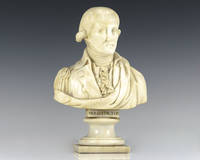
126004Rare marble bust of George Washington depicted as general. The entire piece measures 12.5 inches by 10.5 inches. George Washington was an American statesman and soldier who served as the first President of the United States from 1789 to 1797 and was one of the Founding Fathers of the United States. He served as Commander-in-Chief of the Continental Army during the American Revolutionary War and later presided over the 1787 convention that drafted the United States Constitution. He is popularly considered the driving force behind the nation's establishment and came to be known as the "father of the country" both during his lifetime and to this day. unknown
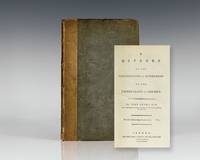
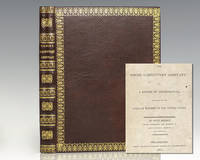
178750010London: Printed for C. Dilly 1787. First edition of John Adams' landmark work. Octavo original boards minor wear. In very good condition. Housed in a custom half calf clamshell box. Rare especially in the original boards. Adams wrote this work on constitutional theory while serving as Minister to the Court of St. James. It was a response to the liberal French statesman Turgot who had criticized the new American state constitutions for their conservative economic framework. Adams's Defence was often cited in the debates of the Constitutional Convention. "A work marked by insight breadth of views conviction courage and--we may venture to add--much wisdom"--Larned Literature of American History 2287. This volume was issued as a stand-alone work and was followed by two supplemental volumes the next year. Howes A60 "aa" Sabin 234 Printed for C. Dilly hardcover books
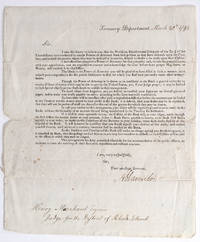
1793135218March 30 1793. Partially printed United States Treasury Department circular signed by Alexander Hamilton as the first secretary of the treasury. Folio partially printed the document is dated March 30th 1793 addressed to Henry Marchant Judge of the Rhode Island District Court. The document reads in full: Sir I take the liberty to inform you that the President Directors and Company of the Bank of the United States have consented to accept Powers of Attorney from such persons as may have demands upon the Treasury and to hold the monies which they may be authorised to receive subject to drafts to be made upon their Cashier. I have therefore prepared a Power of Attorney for that purpose; and in case the proposal meets with your approbation you are requested to execute and acknowledge the same before some proper Magistrate or Notary and transmit it to this Office. … To avoid risque from forgeries you are desired to transmit your signature on several pieces of paper and to make your drafts payable to order according to the form herewith transmitted. As some time will be necessary after your compensation falls due before the accounts can be settled at the Treasury and the money placed to your credit in the Bank it is desired that your drafts may be so regulated that they will not be presented until ten days after the end of the quarter for which they may be drawn. In case you consent to this arrangement your salary will be regularly placed to your credit in the Bank without the formality of an account thereof being transmitted to the Treasury for settlement. … As the President and Directors of the Bank will make no charge against you for their agency it is expected by them that the postage on such letters as you may have occasion to address to their Cashier will be paid at the offices in which they may be lodged. This arrangement has been concerted essentially for the accommodation of the public officers to facilitate to them the receiving of their dues with expedition and without expence. I am very respectfully Sir Your obedient Servant "A. Hamilton." In very good condition. Housed in a custom half morocco clamshell box made by the Harcourt Bindery. The document measures 9.5 inches by 8.75 inches. As the first secretary of the treasury Alexander Hamilton was the main author of the economic policies of the administration of President George Washington. He took the lead in the federal government's funding of the states' American Revolutionary War debts as well as establishing the nation's first two de facto central banks i.e. the Bank of North America and the First Bank of the United States a system of tariffs and the resumption of friendly trade relations with Britain. His vision included a strong central government led by a vigorous executive branch a strong commercial economy support for manufacturing and a strong national defense. unknown
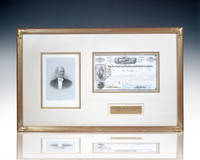
1864146773New York: American Bank Note Co 1864. Rare New York and Harlem Rail Road Company stock certificate signed by one of the wealthiest Americans in history Cornelius Vanderbilt. Oblong octavo one page partially printed and accomplished in manuscript the certificate is dated April 12 1864 and grants John M. Dobin 500 shares in the New York and Harlem Railroad Company. Signed by Cornelius Vanderbilt on the verso. In near fine condition. Matted and framed with a portrait of Vanderbilt and an informational placard. The piece measures 17.6 inches by 28 inches. "Contemporaries too often hated or feared Vanderbilt or at least considered him an unmannered brute. While Vanderbilt could be a rascal combative and cunning he was much more a builder than a wrecker . being honorable shrewd and hard-working" H. Roger Grant. From adolescence Cornelius Vanderbilt showed signs of entrepreneurial spirit starting his own ferry service at just 16. In those starting years Vanderbilt's voraciousness earned him the nickname "The Commodore" telegraphing what the future might bring for such an industrious young man. With enough time "The Commodore" succeeded in organizing a steamboat freight empire and began expanding into the railroad industry with his purchase of stock in the New York and Harlem Rail Road Company line one of the first railroads in the United States. His goal was to take the railroad which was generally considered worthless and make it valuable. Five years later after much work he consolidated it with the Hudson River RR to form the New York Central and Hudson River Railroad one of the first giant corporations in United States history. "Vanderbilt vastly improved and expanded the nation's transportation infrastructure contributing to a transformation of the very geography of the United States. He embraced new technologies and new forms of business organization and used them to compete.He helped to create the corporate economy that would define the United States into the 21st century" T. J. Stiles 'The First Tycoon'. American Bank Note Co unknown
18900002593SOUTH AMERICA PERU BOLIVIA VENEZUELA CHILE. Good. 1890. On offer is an original historically significant 1890 to 1891 manuscript diary handwritten by prominent New York businessman and author E.C. White E.C. White was the son of Dr. Emerson White who was president of Purdue University. His brother was Albert Blakeslee ''A. B.'' White he was West Virginia's 11th governor serving from 1901-05 who traveled and lived in South America. The keen eyed and erudite diarist Mr. White does a superb job detailing his adventures by steamship horseback Alpaca and train. But his experiences and downright good fortune to be in the right place at the right time to witness and participate in some extraordinary events in South America most particularly the civil war in Chile. White was in Venezuela Peru Chile Bolivia and points in between and among his experiences are the finding an Incan "ruined city" on top of a mountain in Peru spies hiding on board a steamship remains of a torpedoed ship and travel by train through the Andes. As noted on the cover of the diary is "South American Notes - E C White. Kal- Blanco" casual research finds E.C. White was a wealthy businessman he owned E.C. White Co in New York City. White traveled the world and spent most of his time in South America. In fact he spent so much time there that he was offered the appointment as Minster to Chile by President Harrison. He declined the offer due to business considerations. He had a close association with McKinley who at the time was his main supporter for the position. McKinley wrote of White to President Harrison "Mr. White has spent several years in Spanish- America. He is a gentleman of high character education and refinement". The book contains about 150-165 typed and handwritten pages sketches mimeographed bulletins business contacts in South America. He may have been in the pharmaceutical business there are lists of doctors pharmacists herbal medicines and cures are noted. We note some pages are onion skin and faded but all can be read with patience. As an expert on South America he periodically wrote articles in a number of publications. He wrote under his pen name "Kal- Blanco" and some of his original articles are on the web. There are several typed stories in this diary that appear to be rough drafts he later published. These stories are about his observations and travels and are nonfiction and include original corrections. There is even an original story he did for the Home Maker Magazine titled "Among the Venezuelans" with some hand written notations in the margins. This story includes photos. Entries begin in New York Oct 8 1890 as White boards the Steamship Muriel in route the ship stops at St George St. Kitts Dominca Martinique Granada and Trinidad. He would eventually reach Columbia Venezuela Peru Chile and Bolivia. Included are three mimeographed bulletins 2 titled" Manavi's Bulletins" and one titled "The Esk's Daily Bulletin". Historians and researchers will find a treasure trove of material. White writes about the socio political aspects of each country and examines cultural traits with a keen eye for observation. His diary entries as well as his articles are extensive and in many cases fill the entire sheet. Other items found between the sheets are advertising flyers one photo negative and travel notes. Here are snippets: Note: interestingly White writes in the third person throughout the diary. Peru - March 8 1891 We had our first earthquake this morning. The servants thought that it was quite severe to M. It seemed quite a respectable shake. M.was tired and did not feel like going to church and Mr. W. Allowed his wife's indisposition to impose him so both stayed at home and Mr. W. bad man printed blue prints. In the afternoon we studied a little Spanish and took a walk. Retired early as usual. Peru - March 10 1891 Mr. W. Worked all day on the type- writer and M. extremely busy cleaning up everything after the journey to Huaca Puno In the evening we went to the circus by Mr. Pacigalupi's invitation and found it very good and that the theatre was very pretty. Peru -March 26 1891 Mr. W. Went to Callao in the morning to arrange to go on Saturday but found that there was no steamer left until the next week. In the afternoon there was a procession of 250 of the militia the army numbers 15000 all Indians & these Indians control the country. In the evening everybody promenading the streets: the ladies dressed their best. Children men woman all Going to church. Peru -March 27 1891 Great feast day. The militia surrounded the plaza and expect a grand procession. The people devote themselves to fasting and prayer what time they are not on the street and Mr. Basigalupi is very much put out about it as it is a check to all business. Bolivia - April 14 1891 Arrived at Chililaya - in Bolivia last night but on account of the Cana could not enter the port until daylight The town has about 40 houses and the chief export is potatoes silver and tin ore. The Grand Hotel where we stopped for the night is kept by a lady in high heeled shoes short dress and log earrings. The Amiras wear lose under drawers from the knee down and pants with a slit in the back of each leg. They bundle up their heads and necks with knitted goods and go barefoot. The women wear skirt a little below the knee and never change their clothes from one years end to the other. They very rarely wash. All dress in bright colors. Bolivia - April 23 1891 Left Puno for Arequipa early in the morning and arrived in the pm Mr. McCord has everything arranged for us to stay there. The ride was rather tedious as the scenery was the same as before except when we reached Arequipa- The moon rising between Mista- & Potosi was a beautiful sight. Bolivia April 24 1891 Took the train for Mollendo- after bidding Mr. McCord goodbye. Had a crowded car and rather unpleasant journey as it was very dusty. Arrived at 3 pm and found Mr. Turner waiting for us at the station to tell is that the" Bolivia " would sail that night and that they could not tell when there would be another steamer. We went up the company house and rested for an hour and than went to the steamer. The Purser gave is his room as the S. Was full but it was small and uncomfortable when we got to the S. We found Mr. Allen A. Swimmingly awaiting us. Chile- May 11891 Stopped at Autofogasta- and went ashore with Mr.S. and Mr.W. and appointed agents for all parties.Had a good time.At all of these ports there have been officers of the Revolution on board to search the ship for Government officials and we carry spies with us. It is supposed that there is one man hidden in the ship who is an officer of Balmaceda's. His wife is very cool collected even sleeping in the same cabin with the woman spy.There have been several parties arrested on suspicion and brought back but one was arrested and kept because he was known to have 50000 dollars concealed in his cabin. We are now past the Congressionalist's District. Discovery of the Ruins of a Pygmy city in the Andes. On the 26th day of April 1885 I arranged with a friend of mine who lived in Callao Peru to ascend Huaca Puno Dead Point and explore a ruined city said to be at its summit. The descendants of the Children of the Sun warned me against such an undertaking. Their superstitious ideas of Huaca Puno were not pleasant I must admit. They informed me that this was the home of bad spirits and that wild beasts only were allowed to exist there prowling around the streets day and night. They told me that no white man or Indian had ever been in this city since it was depopulated during the pre - Inca times by the cannibalistic tribes who leagued themselves with Satan against these wicked people who had rebelled from Satan and exterminated them. As we ascended our guide seemed to gain courage and decided to accompany us to the city. We found it walled egg shaped about one mile in length and one eighth of a mile in width and admirably fortified. Huaca Puno is in the Pacific range of the Andes and about 15000 ft. In elevation the tropical ocean breeze melting white frost that comes in July. I heard my friend hallooing for me to come up the Citadel Then it dawned upon us that it was a pygmy city. Columbia- Dec 1 & 2nd 1890 I contracted with the following papers viz. El FonografoLas Noticias El Zulia Illustrarado M Los Escos del Zulla. All of which I send to C.H.Gould. On the evening of the 2nd I left for Curacoa by the steamer Maracaibo. The cost of a passage is $ 15.00. Dec 3rd& 4th - I arrived in Curaacoa on the 4th and went to the hotel De Leon. Paid $ 1.60 per day and the food was so poisoned could hardly stand it. The maggots crawled out of the warmed over beef when brought on the table. I watched to see how many partook of the same and saw them all eat it the same as if it had not been alive. I went on the Philadelphia as soon as the steamer arrived. Mrs. Chambers and Miss Randolph were with the Caption Chambers. I met a druggist from Cucuta Gonzales Bona Hermanos who gave me the following doctors: List of doctors in Cucuta Columba. Among the Curacoans & The Maracaiboans excerpts from a 3 page story written in Venezuela The poor of Curacoa live entirely by their commerce as the Island produces only limited products. The island produces only a limited amount of agricultural products. The houses are constructed as in Holland roofed with red tile and very quaint in appearance. The people of this country believe that all North Americans are wealthy they know that our people tip them freely and from this they draw the rather erroneous conclusion that we are all millionaires. To them a little money means great luxury. For the lower classes are very destitute. Traveling is expensive in these countries on account of the excessive rates on steamers and the continual robbing of the boatmen and custom house officials. The later we might dispense without the former we must have the steamers being compelled to anchor one to five miles from shore. What a contrast: This evening I am writing on a table in the hotel parlor which has an old brick floor and naked whitewashed walls but lighted with an excellent Edison Electric light the only mark of advanced civilization around me. In one corner are crickets singing joyful songs under the new Star in Maracaibo- In another corner the lovers of evening light the lizards are blinking and twisting their heads to see if any person is intruding upon their possessions. Frequently these little innocent cold blooded vertebrates amuse themselves by running over your shoulders or the table where you are writing. However they are perfectly harmless and the larger species the Iguanas are eaten by the natives. In the early morning the market and the streets are full of Iguana vendors who are very persistent in their endeavors to sell you a string of live Iguana for the small sum of one real. There are 6 sketches. Two small sketches are executed in pencil: One mimeographed sketch titled "This Great Sea- Monster discovered by the Captain of the Muriel Oct 10 1890 off St Kitt's Island". The diary is bound in a leather folio sized journal 10.5 x 8.5 inches and overall G.; Typed Manuscript; 4to - over 9¾" - 12" tall; KEYWORDS: HISTORY OF E.C. WHITE CHILE LOST INCA CITY PERU BOLIVIA COLOMBIA ESPIONAGE STEALTH DIPLOMACY LATIN AMERICA SOUTH AMERICA VENEZUELA PYGMY CITY IN THE ANDES INCA INCAN CHILEAN CIVIL WAR PHARMACEUTICALS MEDICINE IN SOUTH AMERICA PURDUE DR. EMERSON WHITE ALBERT BLAKESLEE ARCHAEOLOGY PALEONTOLOGY EXPLORATION KAL BLANCO HANDWRITTEN MANUSCRIPT DOCUMENT LETTER AUTOGRAPH WRITER HAND WRITTEN DOCUMENTS SIGNED LETTERS MANUSCRIPTS DIARY DIARIES JOURNALS PERSONAL HISTORY SOCIAL HISTORY HISTORICAL HOLOGRAPH WRITERS AUTOGRAPHS PERSONAL MEMOIR MEMORIAL ANTIQUITÉ CONTRAT VÉLIN DOCUMENT MANUSCRIT PAPIER ANTIKE BRIEF PERGAMENT DOKUMENT MANUSKRIPT PAPIER OGGETTO D'ANTIQUARIATO ATTO VELINA DOCUMENTO MANOSCRITTO CARTA ANTIGÜEDAD HECHO VITELA DOCUMENTO MANUSCRITO PAPEL . hardcover
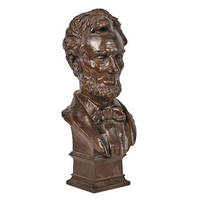
133797Patinated bronze portrait bust of Abraham Lincoln marked "GEO. E. BISSELL Sc GORHAM CO. FOUNDERS copyrighted" and stamped "G 47." This is one of a series of popular desktop busts of Lincoln produced by the Gorham foundry in the early part of the 20th century. In fine condition. The piece measures 18 inches in height. An exceptional piece of American history. unknown
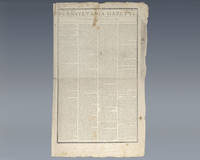
1518126803Philadelphia: Hall & Sellers January 15 1800. Exceedingly rare first appearance in print of Washington's Funeral Oration featured on the front page of the Wednesday January 15 1800 issue of the Pennsylvania Gazette. Folio four pages the headline reads "A Funeral Oration in Honor of the Memory of George Washington. Late General of the Armies of the United States. Prepared and Delivered at the Request of Congress at the German Lutheran Church on Thursday the 26th of December By Major-General Henry Lee One of the Representatives from the State of Virginia." Washington's eulogy was delivered by Major-General Henry Lee to both Houses of Congress and a crowd of 4000 at the first President's funeral on December 26 1799. This printing of the eulogy in the Pennsylvania Gazette precedes the first official Congressional printing Evans 37797 Sabin 39744. In very good condition. Exceedingly rare being one of two copies to have appeared in existing auction records the other in 1889. The father of his country" and the first president of the United States General George Washington died on December 14th 1799 and was buried at Mount Vernon in Virginia. In his Last Will and Testament written only months before his death Washington left explicit directions for the emancipation of each of his 123 slaves to be carried out after the death of his wife Martha. Legislature was passed in Virginia toward the end of the American Revolution in 1782 making it legal for slave holders to emancipate their slaves without an special action by the government. In his will Washington left a detailed slave census as well as stipulations regarding the treatment of the emancipated slaves who were sick and elderly orphaned children and the binding of children to masters and mistresses who would provide them with an education. Upon his death memorial processions were held in every major city and thousands wore mourning clothes for months; Martha Washington was known to have worn a mourning cloak for over a year. Hall & Sellers hardcover
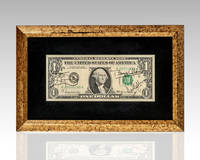
19691506101969. Series 1969 dollar bill from the United States of America the year Armstrong and Aldrin touched the moon. Boldly signed by Apollo 11 crew members Neil Armstrong Buzz Aldrin and Michael Collins on the portrait side in black felt tip. Mounted and framed. In fine condition. The entire piece measures 9.5 inches by 6 inches. Rare and desirable signed especially as this "Series 1969" Federal Reserve Note was issued in the year of their historic mission. On July 20th 1969 American astronauts Neil Armstrong and Buzz Aldrin landed the Apollo Lunar Module Eagle on the lunar surface. Six hours after landing Neil Armstrong became the first person to step onto the lunar surface; Aldrin joined him 19 minutes later and the two spent over two hours collecting lunar materials. Armstrong's first step onto the lunar surface was broadcast on live TV to a worldwide audience during which he uttered the historic phrase "That's one small step for man one giant leap for mankind." Apollo 11 effectively ended the Space Race and fulfilled a national goal proposed in 1961 by President John F. Kennedy: "before this decade is out of landing a man on the Moon and returning him safely to the Earth." unknown
1805117672Philadelphia: Benjamin Johnson 1805. First edition of the second book on architecture published in America second only to Asher Benjamin's Country Builder's Assistant' published in 1797 Shaw & Shoemaker 8018. Quarto bound in full calf gilt titles and tooling to the spine gilt ruled to the front and rear panels illustrated with 44 engraved plates 2 folding. In very good condition. Scarce with only 2 copies having appeared at auction in the past 50 years. "A native born American like Asher Benjamin who wrote the first original American architectural book in 1797 Biddle emphasizes in his title that his book is especially suited for American use and that there is by this time 'a style of building in the United States' distinguishable from that of England. Benjamin imitated this title the next year in that of the first edition of The American builders' companion." American Architectural Books 176. Benjamin Johnson unknown books
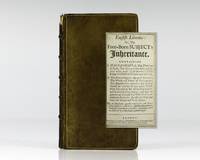
168024087London: Printed by G. Larkin for Benjamin Harris at the Stationers Arms and Anchoy in the Piazza under the Royal Exchange 1680. First edition of one of the very first law books printed in colonial America contains the first American printing of Magna Carta and other fundamental documents of individual liberty in Anglo-American law. Small octavo contemporary calf. In excellent condition with light wear to the crown of the spine. Auction records show that there has not been a first edition offered in the twentieth century. A rare landmark work which significantly influenced the American colonies. "Care intended his English Liberties to provide uneducated and inexperienced English persons with documents and information about the law and their rights. praising England's 'fundamental laws as coeval with government' and describing the Magna Charta as 'Declaratory of the principal grounds of the Fundamental Laws and Liberties of England.' Celebrating law in another piece as second only to the gospel he described it in English Liberties as 'the Best Birthright the Subject hath. Care regarded the essence of this birthright as the 'privilege not to be exempt from the law of the land but to be freed in Person and Estate from Arbitrary Violence and Oppression" Morrison & Zook Revolutionary Currents 46-7. First issued in England in 1680 English Liberties had a "longer and more significant reach in the American colonies. It played an important role in spreading concepts about English law history government liberties and especially juries. Colonists found in Care's English Liberties support of their views about the Saxons Magna Charta as a reaffirmation of old laws guaranteeing the rights of all freemen and ways to protect themselves against oppression. Printed by G. Larkin, for Benjamin Harris at the Stationers Arms and Anchoy in the Piazza under the Royal Exchange unknown books
168024087London: Printed by G. Larkin for Benjamin Harris at the Stationers Arms and Anchoy in the Piazza under the Royal Exchange 1680. First edition of one of the very first law books printed in colonial America contains the first American printing of Magna Carta and other fundamental documents of individual liberty in Anglo-American law. Small octavo contemporary calf. In excellent condition with light wear to the crown of the spine. Auction records show that there has not been a first edition offered in the twentieth century. A rare landmark work which significantly influenced the American colonies. Care intended his English Liberties to provide uneducated and inexperienced English persons with documents and information about the law and their rights… praising England’s ‘fundamental laws as coeval with government’ and describing the Magna Charta as ‘Declaratory of the principal grounds of the Fundamental Laws and Liberties of England.’ Celebrating law in another piece as second only to the gospel he described it in English Liberties as ‘the Best Birthright the Subject hath… Care regarded the essence of this birthright as the ‘privilege not to be exempt from the law of the land but to be freed in Person and Estate from Arbitrary Violence and Oppression†Morrison & Zook Revolutionary Currents 46-7. First issued in England in 1680 English Liberties had a “longer and more significant reach in the American colonies… It played an important role in spreading concepts about English law history government liberties and especially juries… Colonists found in Care’s English Liberties support of their views about the Saxons Magna Charta as a reaffirmation of old laws guaranteeing the rights of all freemen and ways to protect themselves against oppression. Printed by G. Larkin, for Benjamin Harris at the Stationers Arms and Anchoy in the Piazza under the Royal Exchange unknown
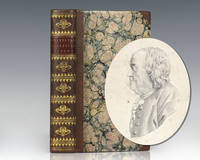
1779125035London: Printed for J. Johnson 1779. First edition of "the only edition of Franklin's writings other than his scientific printed during his lifetime" Ford. Octavo bound half diced calf over marbled boards with elaborate gilt tooling to the spine red morocco spine label lettered in gilt. With the engraved frontispiece portrait of Franklin three engraved plates one folding and folding table of the reformed alphabet. In near fine condition. Complete with index addenda and corrigenda. An exceptional example. "The only edition of Franklin's writings other than his scientific which was printed during his lifetime; was done with Franklin's knowledge and consent and contains an 'errata' made by him for it" Ford 342. Edited by his close friend Benjamin Vaughan and published in London while Franklin was serving as America's ambassador this seminal collection contains many of his writings on the rebellious American colonies and incendiary British measures such as the Stamp Act. Of particular interest is The Examination of Dr. Benjamin Franklin 255-301 a record of his 1766 appearance before Parliament. In Franklin's answers to the over 150 questions posed him in an afternoon of "highly charged testimony he would turn himself into the foremost spokesman for the American cause" Isaacson. Printed for J. Johnson hardcover books
1779125035London: Printed for J. Johnson 1779. First edition of "the only edition of Franklin's writings other than his scientific printed during his lifetime" Ford. Octavo bound half diced calf over marbled boards with elaborate gilt tooling to the spine red morocco spine label lettered in gilt. With the engraved frontispiece portrait of Franklin three engraved plates one folding and folding table of the reformed alphabet. In near fine condition. Complete with index addenda and corrigenda. An exceptional example. "The only edition of Franklin's writings other than his scientific which was printed during his lifetime; was done with Franklin's knowledge and consent and contains an 'errata' made by him for it" Ford 342. Edited by his close friend Benjamin Vaughan and published in London while Franklin was serving as America's ambassador this seminal collection contains many of his writings on the rebellious American colonies and incendiary British measures such as the Stamp Act. Of particular interest is The Examination of Dr. Benjamin Franklin 255-301 a record of his 1766 appearance before Parliament. In Franklin's answers to the over 150 questions posed him in an afternoon of "highly charged testimony he would turn himself into the foremost spokesman for the American cause" Isaacson. Printed for J. Johnson hardcover
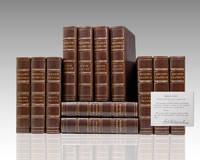
1887151459New York: G.P. Putnam's Sons 1887. The Federal edition number one of 1000 numbered copies signed by the publisher of the works of Benjamin Franklin. Octavo 12 volumes bound in full morocco with gilt titles to the spine blue morocco doublures framed by elaborate gilt tooling complemented by matching blue moiré silk free endpapers raised bands top edge gilt illustrated with engraved frontispiece portraits protective tissue guards. In near fine condition bookplate. Compiled and edited by John Bigelow. A stunning set rare and desirable. Benjamin Franklin earned the title of "The First American" for his early and indefatigable campaigning for colonial unity initially as an author and spokesman in London for several colonies. As the first United States Ambassador to France he exemplified the emerging American nation. Franklin was foundational in defining the American ethos as a marriage of the practical values of thrift hard work education community spirit self-governing institutions and opposition to authoritarianism both political and religious with the scientific and tolerant values of the Enlightenment. In the words of historian Henry Steele Commager "In a Franklin could be merged the virtues of Puritanism without its defects the illumination of the Enlightenment without its heat." To Walter Isaacson this makes Franklin "the most accomplished American of his age and the most influential in inventing the type of society America would become." G.P. Putnam's Sons hardcover
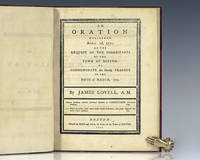
1771125360Boston: Printed by Edes and Gill by the Order of the Town of Boston 1771. First edition of the first <span class="match">Boston</span> <span class="match">Massacre</span> oration; a classic of the Revolutionary period. Octavo bound in three quarter morocco morocco spine label lettered in gilt. In near fine condition. American Antiquarian Society stamp to the half-title page. Rare. On March 5 1770 British Captain Preston and eight British soldiers brought to trial on the charge of murdering five Bostonians that evening were defended by young lawyer John Adams later Vice-President and President of the United States assisted by Josiah Quincy Jr. This unpopular defense Adams rightly regarded as "one of the most gallant generous manly and disinterested actions of his whole life." In observance of the first anniversary of the tragedy though not until April 2 1771 was delivered the first of a series of annual patriotic speeches known as "the Boston Massacre Orations." These speeches were contemporaneously printed. John Adams later wrote: "These orations were read I had almost said by everybody that could read and scarcely ever with dry eyes. They have now been continued for forty-five years. Adams counted in the annual Fourth of July Orations which began in Boston in 1783. Will you read them all They were not long continued in their original design; but other gentlemen with other views had influence enough to obtain a change from 'standing armies' to 'feelings which produced the Revolution'. Of these forty-five orations I have read as many as I have seen. They have varied with all the changes of our politics. They have been made the engine of bringing forward to public notice young gentlemen of promising genius whose connections and sentiments were tolerable to the prevailing opinions of the moment." Lovell a Boston schoolmaster was one of the staunchest of the local patriots. After the Battle of Bunker Hill he was arrested by the British for spying and was sent a prisoner to Halifax. Following his exchange he became a member of the Continental Congress 1777 where he was a supporter of Gates and one of the harshest critics of Washington. How active a part he played in the Conway Cabal against Washington is not known but he certainly approved it. Printed by Edes and Gill, by the Order of the Town of Boston unknown books
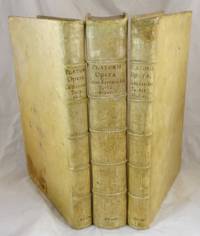
1578620Geneva: Henr. Stephani 1578. First Edition. vellum. Very good. The STEPHANUS Plato <br />The Book That Established the UNIVERSAL REFERENCE System for Platos Writings <br /><br />PLATO. Platonis opera quae extant omnia. The Complete Works of Plato Title also in Greek Henr. Stephani Geneva 1578. First Greek/Latin Edition. <br />Volume 1: TP 16 unnumbered leaves handwritten replacement preliminaries circa 18th c = Dedication to Queen Elizabeth Studioso Lectori Platone Epigrammata Catalogus Dialogorum half title with first page of text - unnumbered - on the verso 1 469 471 471 542. <br /><br />Volume 2: Half-title blank leaf lettered AA.i. 3 unnumbered leaves printed replacement preliminaries circa 18th c. = Dedication to King James the Sixth of Scotland later James the First of England Two Poems 3-701 672 673 704 992. <br /><br />Volume 3: Half-title 3 unnumbered leaves handwritten replacement preliminaries circa 18th c. = Dedication to the Republic of Bern Poem AAAA.i. = Contents Page 3-374 375 368 377-416 1-139; Folio. <br /><br />Three vols. 10.25 x 15.5 in. text block sheets are 10 x 15 in. Folio. <br /><br />"A great Renaissance author and scholar as well as a member of one of Europe's most illustrious families of printers Henri Estienne II himself edited his grand Plato for which he commissioned a new Latin translation by Jean de Serres. Together with his monumental 1572 Thesaurus graecae linguae the lavish Plato was responsible according to Schreiber for securing both Estienne's scholarly reputation and his financial ruin" Garden Ltd. #40. <br />First Greek/Latin edition printed in parallel text with translation and commentary by Jean de Serres noted French historian and advisor to King Henry IV during the reformation. The famous Stephanus edition which has served as the universal reference system for all other editions of Plato's writing since its publication. In every translation of Plato there are small numbers in the margin which refer to the pagination in this edition affording scholars the opportunity to cross-reference each other's work in any language - they are called the "Stephanus numbers." For example Socrates major speech in the Symposium completes at 212c. <br /><br />Some preliminary pages dedication poems etc. are not original but rather were printed and inserted sometime in the 18th century. Because the preliminary pages included dedications to Queen Elizabeth copies of the Stephanus Plato circulating in countries hostile to the throne at the time of publication 1578 often had these pages removed. Some copies of the Stephanus Plato have appeared at auction lacking preliminaries altogether. In 2008 Sokol Books Ltd. catalogued the missing prelims: their absence is the works most common defect. Others like this copy had the preliminaries replacedsometimes by hand other times by a local printeronce relations with England had improved. This is one of those rare copies with replacements. Thus not only is this an important and rare antiquarian book The Stephanus Plato! but also an important historical artifact given its unique history and provenance. <br /><br />CONDITION: Very Good in uniformly bound contemporary possibly early 17th c. vellum with manuscript lettering to spines. Minor repairs to vellum on head and heel of spine mostly on volume 3. Expert old paper repairs to title page of volume I and half-titles of vols. II & III with bookplates on all three pastedowns: Inter Libros Josephi Mariae Parascandolo Antecessoris Regii A.L.N. of Naples. Woodcut-engraved printers vignette on title woodcut-engraved decorated initials head-pieces & tail-pieces. Large paper 15 x 10. Handwritten and printed preliminaries replaced sometime in the 18th c. A tightly bound historically important copy of one of the most important books in the history of philosophy. Henr. Stephani hardcover
1926125163Boston and New York: Houghton Mifflin Company 1926. First edition of Franklin Delano Roosevelt's first book being the text of a lecture delivered by him at Milton Academy on the Alumni War Memorial Foundation on May 18 1926. Octavo original cloth. One of one thousand copies printed. Association copy inscribed by the author on the title page on the occasion of publication and within a month of the delivery of the lecture to his son "For my son Elliott Roosevelt This copy of his Dad's first book Franklin D. Roosevelt June 1926." Additionally signed by Roosevelt on the title page "Franklin Roosevelt." Elliott was the fourth of Roosevelt's six children and Eleanor's acknowledged favorite. His future career included military service involvement in aircraft procurement and roles as author rancher radio station owner and Mayor of Miami Beach. Near fine in the rare original dust jacket which is in good condition. Housed in a custom cloth chemise and half morocco slipcase. Small bookplate to the pastedown. An exceptional association. American statesman and political leader Franklin Delano Roosevelt served as the President of the United States from 1933 to 1945. A Democrat he won a record four presidential elections and dominated his party after 1932 as a central figure in world events during the mid-20th century leading the United States during a time of worldwide economic depression and war. Houghton Mifflin Company hardcover books
1903116342c. 1903. Olga Roosevelt's autograph book lengthily inscribed and signed by Theodore Roosevelt as President of the United States William Howard Taft as Vice President of the United States and several other famous figures of the era including naturalists John Muir and John Burroughs and financier Bernard Baruch. Octavo bound in full vellum with hand painted decorations to the spine and panels patterned endpapers. Inscribed and signed by Theodore Roosevelt with a lengthy quotation "No one quality by itself makes a good man or woman; many are essential; but three especially - courage straightforward honesty and common sense. Theodore Roosevelt July 23rd 1903." Inscribed by William Howard Taft "For Miss Olga Roosevelt with best wishes of William H. Taft May 23 1910." Inscribed by American naturalist John Burroughs "The most precious things of life are without money & without price John Burroughs Sept 8 1903." Inscribed by the President of Cornell University and United States Ambassador to Germany Jacob Gould Schurman "Beauty graceful manners good temper common sense and a kind heart: these are the qualities that make a woman to be beloved and powerful. J.G. Schurman East Hampton September 14th 1903." Additionally inscribed by Alfred W.S. Garden American diplomat Robert Underwood Johnson American screenwriter Daniel Carson Goodman and American naval officer Leigh Carlyle Palmer. Signed by John Muir and signed and dated by Bernard Baruch "B. Baruch Jan 20th 1920." From the collection of Theodore Roosevelt's niece Olga Roosevelt. Roosevelt was the heiress to a fortune of several million dollars left her by her mother. She made her debut in Washington in 1908 and married Dr. Breckenridge Bayne in 1911. In very good condition. An exceptional collection of signatures with noted provenance. Theodore Roosevelt was an American statesman author explorer soldier naturalist and reformer who served as the 26th President of the United States from 1901 to 1909. As a leader of the Republican Party during this time he became a driving force for the Progressive Era in the United States in the early 20th century. hardcover books
1903116342c. 1903. Olga Roosevelt's autograph book lengthily inscribed and signed by Theodore Roosevelt as President of the United States William Howard Taft as Vice President of the United States and several other famous figures of the era including naturalists John Muir and John Burroughs and financier Bernard Baruch. Octavo bound in full vellum with hand painted decorations to the spine and panels patterned endpapers. Inscribed and signed by Theodore Roosevelt with a lengthy quotation "No one quality by itself makes a good man or woman; many are essential; but three especially - courage straightforward honesty and common sense. Theodore Roosevelt July 23rd 1903." Inscribed by William Howard Taft "For Miss Olga Roosevelt with best wishes of William H. Taft May 23 1910." Inscribed by American naturalist John Burroughs "The most precious things of life are without money & without price John Burroughs Sept 8 1903." Inscribed by the President of Cornell University and United States Ambassador to Germany Jacob Gould Schurman "Beauty graceful manners good temper common sense and a kind heart: these are the qualities that make a woman to be beloved and powerful. J.G. Schurman East Hampton September 14th 1903." Additionally inscribed by Alfred W.S. Garden American diplomat Robert Underwood Johnson American screenwriter Daniel Carson Goodman and American naval officer Leigh Carlyle Palmer. Signed by John Muir and signed and dated by Bernard Baruch "B. Baruch Jan 20th 1920." From the collection of Theodore Roosevelt's niece Olga Roosevelt. Roosevelt was the heiress to a fortune of several million dollars left her by her mother. She made her debut in Washington in 1908 and married Dr. Breckenridge Bayne in 1911. In very good condition. An exceptional collection of signatures with noted provenance. Theodore Roosevelt was an American statesman author explorer soldier naturalist and reformer who served as the 26th President of the United States from 1901 to 1909. As a leader of the Republican Party during this time he became a driving force for the Progressive Era in the United States in the early 20th century. hardcover