ANONYMEBiblio.com
48 402 résultats
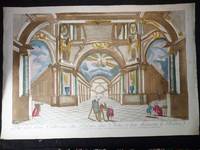
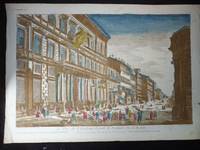
179040682Paris: Chez Lachaussée 1790. Fine. Chez Lachaussée Paris circa 1790 46 x 33.50 cm une feuille Original engraving. Optical view heightened in watercolor depicting a view of the Royal Academy of Painting in Rome. Blue paper. Optical views also called views perspectives or ""mondo nuovo"" are engravings very fashionable between the end of the 18th and the beginning of the 19th century. They were intended to be observed through a set of several mirrors or by means of a Zygrascope an instrument consisting of a mirror and a lens. Optical views can be considered as the precursors of three-dimensional images and stereoscopes which enjoyed great success from the 19th century onwards. Optical views seem to appear in the 1740s and were drawing room entertainments. The process was first developed in Paris then London and finally in Germany and was dedicated to representing - in an idealized manner - the most famous panoramas and landscapes of the Orient and the West. Some very light marginal foxing. Fine impression with very fresh colors. Chez Lachaussée unknown
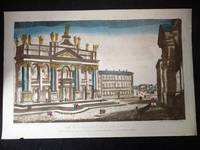
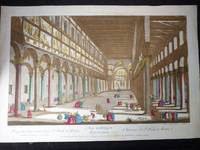
179040686Paris: Chez Daumont et Lachaussée 1790. Fine. Chez Daumont et Lachaussée Paris circa 1790 46 x 33.50 cm une feuille Original engraving. Optical view heightened in watercolors depicting a view of the Church of St. John Lateran in Rome. Optical views also called vues perspectives or ""mondo nuovo"" are engravings that were very fashionable between the late 18th and early 19th centuries. They were intended to be observed through a series of mirrors or by means of a Zograscope an instrument consisting of a mirror and a lens. Optical views can be considered the precursors of three-dimensional images and stereoscopes which enjoyed great success from the 19th century onwards. Optical views seem to appear in the 1740s and were drawing room entertainments. The process was first developed in Paris then London and finally in Germany and focused on representing - in an idealized manner - the most famous panoramas and landscapes of East and West. Fine impression with very fresh colors. Chez Daumont et Lachaussée unknown
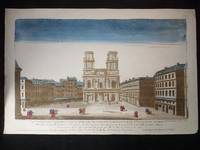
179040665Paris: Chés Lachaussée 1790. Fine. Chés Lachaussée Paris circa 1790 46 x 33.50 cm une feuille Original engraving. Optical view heightened with watercolors depicting Saint Eustache Church. Optical views also known as views perspectives or ""mondo nuovo"" are engravings that were very fashionable between the late 18th and early 19th centuries. They were intended to be observed through a set of multiple mirrors or by means of a Zograscope an instrument consisting of a mirror and a lens. Optical views can be considered as the precursors of three-dimensional images and stereoscopes which enjoyed great success from the 19th century onwards. Optical views seem to appear in the 1740s and were parlor entertainments. The process was first developed in Paris then London and finally in Germany and focused on representing - in an idealized manner - the most famous panoramas and landscapes of East and West. Fine impression with very fresh colors. Chés Lachaussée unknown
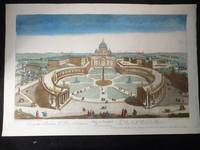
179040681Paris: Chez Daumont et Lachaussée 1790. Fine. Chez Daumont et Lachaussée Paris circa 1790 46 x 33.50 cm une feuille Original engraving. Optical view heightened in watercolor depicting a view of Saint Peter's in Rome. Optical views also called views perspectives or ""mondo nuovo"" are engravings very fashionable between the end of the 18th and the beginning of the 19th century. They were intended to be observed through a set of several mirrors or by means of a Zygrascope an instrument consisting of a mirror and a lens. Optical views can be considered as the precursors of three-dimensional images and stereoscopes which enjoyed great success from the 19th century onwards. Optical views seem to appear in the 1740s and were drawing room entertainments. The process was first developed in Paris then London and finally in Germany and was dedicated to representing - in an idealized manner - the most famous panoramas and landscapes of the Orient and the West. Fine impression with very fresh colors. Chez Daumont et Lachaussée unknown
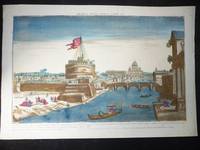
179040680Paris: Chez Daumont 1790. Fine. Chez Daumont Paris circa 1790 46 x 33.50 cm une feuille Original engraving. Optical view heightened in watercolor depicting a view of the Ponte Sant'Angelo in Rome. Optical views also called vues perspectives or ""mondo nuovo"" are engravings that were very fashionable between the late 18th and early 19th centuries. They were intended to be viewed through a set of mirrors or by means of a Zograscope an instrument consisting of a mirror and a lens. Optical views can be considered as the forerunners of three-dimensional images and stereoscopes which enjoyed great success from the 19th century onwards. Optical views seem to appear in the 1740s and were parlor entertainments. The process was first developed in Paris then London and finally in Germany and was devoted to representing - in an idealized manner - the most famous panoramas and landscapes of East and West. A fine impression with very fresh colors. Chez Daumont unknown
179040689Paris: Chez Daumont et Lachaussée 1790. Fine. Chez Daumont et Lachaussée Paris circa 1790 46 x 33.50 cm une feuille Original engraving. Optical view heightened in watercolor depicting a view of the three galleries of the Palace of Arts and Sciences in Rome. Optical views also called vues perspectives or ""mondo nuovo"" are engravings that were very fashionable between the late 18th and early 19th centuries. They were intended to be viewed through a set of several mirrors or by means of a Zograscope an instrument consisting of a mirror and a lens. Optical views can be considered the predecessors of three-dimensional images and stereoscopes which enjoyed great success from the 19th century onwards. Optical views seem to appear in the 1740s and were salon entertainments. The process was first developed in Paris then London and finally in Germany and sought to represent - in an idealized manner - the most famous panoramas and landscapes of East and West. Fine impression with very fresh colors. Chez Daumont et Lachaussée unknown
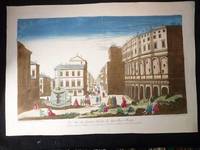
179040691Paris: Chez Daumont et Lachaussée 1790. Fine. Chez Daumont et Lachaussée Paris circa 1790 46 x 33.50 cm une feuille Original engraving. Hand-colored optical view in watercolor depicting a view of the Theatre of Marcellus in Rome. Optical views also called vues perspectives or ""mondo nuovo"" are engravings that were very popular between the late 18th and early 19th centuries. They were intended to be viewed through a set of several mirrors or by means of a Zygrascope an instrument consisting of a mirror and a lens. Optical views can be considered the forerunners of three-dimensional images and stereoscopes which enjoyed great success from the 19th century onwards. Optical views seem to appear in the 1740s and were salon entertainments. The process was first developed in Paris then London and finally in Germany and focused on representing - in an idealized manner - the most famous panoramas and landscapes of East and West. A central fold mark. Fine impression with very fresh colors. Chez Daumont et Lachaussée unknown
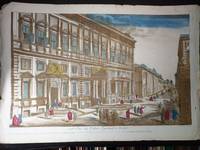
179040684Paris: Chez Lachaussée 1790. Fine. Chez Lachaussée Paris circa 1790 46 x 33.50 cm une feuille Original engraving. Optical view heightened in watercolors depicting a view of the Quirinal Palace in Rome. Blue paper. Optical views also called vues perspectives or ""mondo nuovo"" are engravings that were very fashionable between the late 18th and early 19th centuries. They were intended to be observed through a series of mirrors or by means of a Zograscope an instrument consisting of a mirror and a lens. Optical views can be considered the precursors of three-dimensional images and stereoscopes which enjoyed great success from the 19th century onwards. Optical views seem to appear in the 1740s and were drawing room entertainments. The process was first developed in Paris then London and finally in Germany and focused on representing - in an idealized manner - the most famous panoramas and landscapes of East and West. Some very light marginal foxing. Fine impression with very fresh colors. Chez Lachaussée unknown
179040695Paris: Chez Daumont et Lachaussée 1790. Fine. Chez Daumont et Lachaussée Paris circa 1790 46 x 33.50 cm une feuille Original engraving. Hand-colored optical view in watercolor depicting an interior view of St. Paul's in Rome. Optical views also called vues perspectives or ""mondo nuovo"" were engravings very fashionable between the late 18th and early 19th centuries. They were intended to be observed through a set of several mirrors or by means of a Zograscope an instrument consisting of a mirror and a lens. Optical views can be considered as the precursors of three-dimensional images and stereoscopes which enjoyed great success from the 19th century onwards. Optical views seem to appear in the 1740s and were parlor entertainments. The process was first developed in Paris then London and finally in Germany and aimed to represent - in an idealized manner - the most famous panoramas and landscapes of East and West. Fine impression with very fresh colors. Chez Daumont et Lachaussée unknown
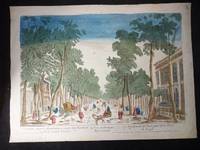
179040688Paris: Chez Daumont et Lachaussée 1790. Fine. Chez Daumont et Lachaussée Paris circa 1790 46 x 33.50 cm une feuille Original engraving. Optical view heightened in watercolor depicting a view of the Boulevards of Paris taken from the Porte du Temple. Optical views also called views perspectives or ""mondo nuovo"" are engravings that were very fashionable between the late 18th and early 19th centuries. They were intended to be viewed through a set of several mirrors or by means of a Zograscope an instrument consisting of a mirror and a lens. Optical views can be considered as the precursors of three-dimensional images and stereoscopes which enjoyed great success from the 19th century onwards. Optical views seem to appear in the 1740s and were parlor entertainments. The process was first developed in Paris then London and finally in Germany and sought to represent - in an idealized manner - the most famous panoramas and landscapes of East and West. Two pale corner dampstains not affecting the engraving. Fine impression with very fresh colors. Chez Daumont et Lachaussée unknown
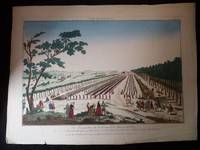
179040694Paris: Chez Daumont et Lachaussée 1790. Fine. Chez Daumont et Lachaussée Paris circa 1790 46 x 33.50 cm une feuille Original engraving. Hand-colored optical view in watercolor depicting a view of the review of the King's Household ""infantry which takes place every year in the plain of Sablons one league from Paris"". Optical views also called vues perspectives or ""mondo nuovo"" were engravings very fashionable between the late 18th and early 19th centuries. They were intended to be observed through a set of several mirrors or by means of a Zograscope an instrument consisting of a mirror and a lens. Optical views can be considered as the precursors of three-dimensional images and stereoscopes which enjoyed great success from the 19th century onwards. Optical views seem to appear in the 1740s and were parlor entertainments. The process was first developed in Paris then London and finally in Germany and aimed to represent - in an idealized manner - the most famous panoramas and landscapes of East and West. A small angular crease mark. Fine impression with very fresh colors. Chez Daumont et Lachaussée unknown
1760015796Paris Circa 1760: Jacques Chereau 1760. First Edition . No Binding. Good. 15 1/2" x 10 1/4. Hand Colored Engraving. A Very Large 15 1/2" X 10 1/4" Engraved View Of The Ruins Of A Monastery In Rome. Many Figures In Foreground Walking And Exploring The Ruins. Title In Mirror Image Above " Les Ruines De Ste. Marie Des Anges A Rome" All In Capital Letters At Bottom Is The Full Title With The Publisher's Legend Beneath "A Paris Chez Jacques Chereau Rue St. Jacques Au Defous De La Fontaine St. Severin Aux A Colonnes No. 257". 3/4" Chip In Margin At Left Not Affecting The Engraving; 1/2" Tear At Right Margin Including 1/4" Barely Visible Tear Into Engraved Area. Colored As Usual In Red Blue Pink Green Yellow. <br/> <br/> Jacques Chereau unknown
177659469s. l.: S. n. 1776. Fine. S. n. s. l. circa 1776 32 x 40.50 cm une feuille encadrée Original drawing in ink and watercolor depicting an animated seaside view with a village perched on a cliff. Modern framing in blonde molding. Drawing executed during the journey made with the Marquis de Sade during the year 1776. Jean-Baptiste Tierce 1737-1794 student at the École des Beaux-arts in Rouen then at the Academy of Painting and Sculpture in Paris quickly distinguished himself as a landscape painter for his views of the South of France and Italy. His paintings are preserved at the Uffizi in Florence and in several French museums. When in December 1775 Sade left Rome for Naples he was welcomed by the son-in-law of his friend Doctor Mesny Jean-Baptiste Tierce who at that time was receiving commissions from Cardinal de Bernis. He found lodging for the Marquis ""who intended to see everything in the region learn about everything judge admire criticize love hate in short to give free rein to that insatiable and passionate curiosity which led him into museums galleries churches palaces and libraries as well as into grottos vaults catacombs and even into the bowels of volcanoes. He was not content to contemplate works of art ancient or modern monuments; he also observed customs politics religion administration social life. The beauty of women worldly customs the quality of entertainments ways of eating drinking dressing praying conducting oneself in society: nothing left him indifferent. He wanted to grasp all the present and all the past of this civilization to embrace it entirely in a single and universal vision. A gigantic program commensurate with his exceptional imagination but which he could no longer fulfill which was impossible for him to fulfill. Yet such was his first ambition as a writer: grandiose excessive. With this 'great work' in view Sade hastily took notes at roadsides or in inns which he supplemented with the notes of his correspondents Mesny and Iberti. Thus was built this monument which he intended for the public but which would not see the light of day until the 20thth century. Jean-Baptiste Tierce collaborated closely: he reread the notes and recorded his observations in small notebooks with numbers referring to the works described. Sade took the greatest account of them. Often the painter accompanied him on his excursions his sketchbook in hand drawing the buildings and landscapes before their eyes. About a hundred of these drawings and gouaches were recently found in the archives of the Sade family. They give the Journey to Italy the appearance of a true reportage."" Maurice Levert Sade pp. 283-284. Provenance: archives of the Sade family. S. n. unknown
177659528s. l.: S. n. 1776. Fine. S. n. s. l. Circa 1776 40 x 50 cm une feuille encadrée Italian scene: animated seaside with square tower Original pencil drawing showing an animated seaside scene. Modern black wooden frame. A drawing done during the journey the artist undertook with Sade in 1776. Jean-Baptiste Tierce 1737-1794 who studied at the School of Fine Arts in Rouen and subsequently at the Academy of Painting and Sculpture in Paris quickly built a reputation as a landscapist for his views of the South of France and Italy. His paintings are in the Uffizi in Florence and several French museums. When in December 1775 Sade left Rome for Naples he was welcomed by the son-in-law of his friend Dr. Mesny Jean-Baptiste Tierce who at the time was working on commissions for Cardinal de Bernis. He found lodgings for the Marquis who intends to see everything of the region learn everything judge admire critique love hate in short give himself over to the insatiable and passionate curiosity that takes him to museums galleries churches palaces and libraries as well as grottoes caves catacombs and right down to the very innards of volcanoes. He was not content merely to look at the various works of art and ancient and modern monuments; he also set out to observe the local mores politics religion administration and social life. The beauty of the women the local traditions the quality of plays table manners and the way people drank dressed prayed and made their way in the world all interested him. He wanted to take in both the present and the past of this culture to encompass it all in a unique and universal vision. A massive undertaking to match his extraordinary imagination which he was however unable to fulfil it being impossible for him to do so. This was however the nature of his central ambition as a writer: grandiose and outsized. With a view to this great work Sade took hurried notes at the side of the road or in hostelries which he then complemented with notes from his correspondents Mesny and Iberti. Thus he built up the monument he intended to put before the public but which did not end up seeing the light of day until the 20th century. Jean-Baptiste Tierce was a close collaborator: he re-read Sade's notes and gave his observations on the little notebooks with numbers referring to the works mentioned. Sade took the greatest notice of his views. Often the painter accompanied him on his rambles sketchbook in hand drawing the buildings and landscapes before them. A hundred or so of these drawings and watercolors were recently found in the Sade family archives. They give the Voyage en Italie the charm of a real travel diary. Maurice Levert Sade pp. 283-284. Provenance : Sade family archives. S. n. unknown
A clean, unmarked copy with a tight binding. Exhibition catalog. Cover worn around edges. Signed by Pavel Banka.
1994057869Pasadena: A. C. Vroman / Ward Ritchie 1994. 1st Edition 1st Printing. Hardcover. Fine. Photographs. 138 Pp. Brown Cloth Gilt Over Patterned Boards. One Of 2000 Copies Of The Trade Edition. Fine No Wear Or Damage. Inscribed By The Author "With Affectionate Best Wishes To Nancy From Her Friend Jane" And With Ownership Signature Of Nancy Parsons. <br/> <br/> A. C. Vroman / Ward Ritchie hardcover
1953059536Pasadena: A. C. Vroman / Anderson Ritchie & Simon / Doubleday & Co. 1953. 1st Edition 1st Printing. Soft cover. Near Fine. 15 Pp. Softcover. Issued On The Occasion Nof The Opening Of Their Flagship Store On Colorado Boulevard. Well Printed Designed By James Leach. Privately Printed 1953 This Issue In Red-Brown Doubleday & Company Printed Wrappers With An Introductory Note From Doubleday. Near Fine Fading Along Top And Spine Edges. <br/> <br/> A. C. Vroman / Anderson, Ritchie & Simon / Doubleday & Co. paperback
1897032984Zagreb: Matice Hrvatske 1897. Soft cover. Good. Engravings And Charts Throughout. 351 Pp. Original Blue Wrappers Printed In Brown And Black. This Has 1897 Date On Prelim Title And Full Title Pages And Preface Dated 1897; Sources Refer To An 1893 First Edition But I Can Find No Record Of Such An Edition This Being The Only Edition In Worldcat Which Shows Only Two Institutional Holdings Of This Edition. Wear A Few Minor Chips No Fading No Names Or Marks Or Chips. Very Scarce Major Work By The Foremost Science Educator In Croatia. Per Wikipedia Oton Kucera 1857 - 1931 Zagreb Was A Croatian Astronomer. He Played A Crucial Role By Popularizing Science And Technology In Croatia. He Was Also The President Of Matica Hrvatska And The Author Of Several Physics Handbooks For Primary School And A Series Of Popular Scientific Works From The Areas Of Physics Astronomy And Electrical Engineering. <br/> <br/> Matice Hrvatske paperback
1924032714Zagreb: Izdanje Nakladnog Zavoda "Neva" / Stampa "Tipografije 1924. 1st Edition 1st Printing. Hardcover. Good. 137 Pp. Olive Green Cloth Gilt Endpapers With Complex Blue And Yellow Design Title Page Printed In Red And Black. Wear Starting To Fray At Corners Gilt With Some Wear But Still Clear Some Pages With A Few Spots Of Very Light Foxing. Per Wikipedia Miroslav Krleza 1893 -1981 Was A Yugoslav And Croatian Writer Who Is Widely Considered To Be The Greatest Croatian Writer Of The 20Th Century. He Wrote Notable Works In All The Literary Genres Including Poetry Ballads Of Petrica Kerempuh 1936 Theater Messrs. Glembay 1929 Short Stories Croatian God Mars 1922 Novels The Return Of Philip Latinowicz 1932; On The Edge Of Reason 1938 And An Intimate Diary. His Works Often Include Themes Of Bourgeois Hypocrisy And Conformism In Austria-Hungary And The Kingdom Of Yugoslavia. Krleza Wrote Numerous Essays On Problems Of Art History Politics Literature Philosophy And Military Strategy And Was Known As One Of The Great Polemicists Of The Century. His Style Combines Visionary Poetic Language And Sarcasm. Krleza Dominated The Cultural Life Of Croatia And Yugoslavia For Half A Century. A "Communist Of His Own Making" He Was Severely Criticized In Communist Circles In The 1930S For His Refusal To Submit To The Tenets Of Socialist Realism. After The Second World War He Held Various Cultural Posts In Socialist Yugoslavia And Was Most Notably The Editor Of The Yugoslav Lexicographical Institute And A Constant Advisor On Cultural Affairs To President Tito. After The Break With Stalin It Was His Speech At The 1952 Congress Of Yugoslav Writers That Signaled A New Era Of Comparative Freedom In Yugoslav Literature. <br/> <br/> Izdanje Nakladnog Zavoda "Neva" / Stampa "Tipografije hardcover
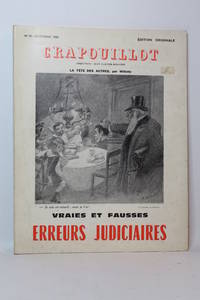
196072587Paris: Imprimerie spéciale du Crapouillot 1960. Fine. Imprimerie spéciale du Crapouillot Paris Octobre 1960 24.50 x 31.50 cm broché First edition one of 330 numbered copies on coated paper the only deluxe copies. Under the direction of Jean Galtier-Boissière. Light worming to covers. Imprimerie spéciale du Crapouillot unknown
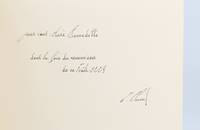
200988086Paris: Cerf 2009. Fine. Cerf Paris 2009 24 x 23 cm broché First edition illustrated with 8 lithographs by Kim en Joong. Light rubbing to margins of dust jacket boards. Autograph inscription dated and signed by François Cheng to a woman named Bernadette: "". dans la joie de ce renouveau de Noël 2009."" in the joy of this renewal of Christmas 2009. Cerf hardcover
1919032034Leiden: Eduard Ijdo 1919. 1st Edition . Soft cover. Good. 119 Pp. Gray-Brown Covers Printed In Black. 10 3/8" X 7 3/4". Hendrika Johanna Van Leeuwen 1887-1974 Was A Dutch Physicist Known For Her Early Contributions To The Theory Of Magnetism. She Studied At Leiden University Under The Guidance Of Hendrik Antoon Lorentz Receiving Her Doctorate In 1919. Her Thesis Explained Why Magnetism Is An Essentially Quantum Mechanical Effect A Result Now Referred To As The Bohr-Van Leeuwen Theorem Niels Bohr Had Arrived At The Same Conclusion A Few Years Earlier. She Continued To Investigate Magnetic Materials At The "Technische Hogeschool Delft" First As "Assistant" Until 1947 When She Was Promoted To Reader In Theoretical And Applied Physics. Hendrika Van Leeuwen Was The Sister-In-Law Of Gunnar Nordstrom Known As The "Einstein Of Finland" Who Studied In Leiden With Paul Ehrenfest The Successor Of Lorentz. She Was Present At The Celebration Of The Golden Anniversary Of The Doctorate Of Lorentz On 11 December 1925 And On That Occasion Reported On The Role Of Lorentz As Scientist And Teacher. Covers Worn Short Tears At Edges Very Small Losses At Corners Spine Chipped At Top And Bottom But Title Intact. <br/> <br/> Eduard Ijdo paperback
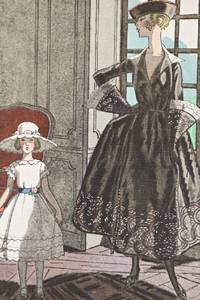
192054777Paris: Lucien Vogel éditeur 1920. Fine. Lucien Vogel éditeur Paris Juin 1920 18 x 24 cm une feuille Original color print printed on vergé paper signed in the plate. An original print used to illustrate the Gazette du bon ton one of the most attractive and influential 20th century fashion magazines featuring the talents of French artists and other contributors from the burgeoning Art Deco movement. A celebrated fashion magazine established in 1912 by Lucien Vogel La Gazette du bon ton appeared until 1925 with a hiatus from 1915 to 1920 due to the war the editor-in-chief having been called up for service. It consisted of 69 issues printed in only 2000 copies each and notably illustrated with 573 color plates and 148 sketches of the models of the great designers. Right from the start this sumptuous publication was aimed at bibliophiles and fashionable society Françoise Tétart-Vittu La Gazette du bon ton in Dictionnaire de la mode 2016 and was printed on fine vergé paper using a type cut specially for the magazine by Georges Peignot known as Cochin later used in 1946 by Christian Dior. The prints were made using stencils heightened in colors some highlighted in gold or palladium. The story began in 1912 when Lucien Vogel a man of the world involved in fashion he had already been part of the fashion magazine Femina decided with his wife Cosette de Brunhoff the sister of Jean creator of Babar to set up the Gazette du bon ton subtitled at the time: Art fashion frivolities. Georges Charensol noted the reasoning of the editor-in-chief: In 1910 he observed there was no really artistic fashion magazine nothing representative of the spirit of the time. My dream was therefore to make a luxury magazine with truly modern artists I was assured of success because when it comes to fashion no country on earth can compete with France. Un grand éditeur dart. Lucien Vogel in Les Nouvelles littéraires no. 133 May 1925. The magazine was immediately successful not only in France but also in the United States and Latin America. At first Vogel put together a team of seven artists: André-Édouard Marty and Pierre Brissaud followed by Georges Lepape and Dammicourt as well as eventually his friends from school and the School of Fine Arts like George Barbier Bernard Boutet de Monvel and Charles Martin. Other talented people soon came flocking to join the team: Guy Arnoux Léon Bakst Benito Boutet de Monvel Umberto Brunelleschi Chas Laborde Jean-Gabriel Domergue Raoul Dufy Édouard Halouze Alexandre Iacovleff Jean Émile Laboureur Charles Loupot Chalres Martin Maggie Salcedo. These artist mostly unknown when Lucien Vogel sought them out later became emblematic and sought-after artistic figures. It was also they who worked on the advertising drawings for the Gazette. The plates put the spotlight on and celebrate dresses by seven designers of the age: Lanvin Doeuillet Paquin Poiret Worth Vionnet and Doucet. The designers provided exclusive models for each issue. Nonetheless some of the illustrations are not based on real models but simply on the illustrators conception of the fashion of the day. The Gazette du bon ton was an important step in the history of fashion. Combining aesthetic demands with the physical whole it brought together for the first time the great talents of the artistic literary and fashion worlds; and imposed through this alchemy a completely new image of women: slender independent and daring which was shared by the new generation of designers including Coco Chanel Jean Patou Marcel Rochas and so on Taken over in 1920 by Condé Montrose Nast the Gazette du bon ton was an important influence on the new layout and aesthetics of that little dying paper that Nast had bought a few years earlier: Vogue. Lucien Vogel éditeur unknown
1924059773New York Ny: G. P. Putnam's Sons / Knickerbocker Press 1924. 1st Edition 1st Printing. Hardcover. Very Good/No Jacket. Plates And Illustrations In Text. Xv 184 Pp. #32 Of A Limited Edition Of 110 Copies Of Which 100 Were For Sale. Faux Vellum Spine Blue Boards Spine An Cover Labels Printed In Blue Blue And White Illustrated Endpapers The Trade Edition Had Map Endpapers. First Edition Signed By Kent On Limitation Page And Again In The Two Color Woodcut Bound Before The Half Title And With The Extra Illustration Not Present In The Trade Edition Placed After The Introduction. Light Wear Showing With Tinybumps/Splits/ Frays At Corners. Hinges Tight. Faint Damp Stain In Small Area At Top Of Spine Panel Affecting Upper 2/3 Of The Spine Label And 1/2" Across Bottom Edge Of Spine. <br/> <br/> G. P. Putnam's Sons / Knickerbocker Press hardcover
197967841Paris: Encre 1979. Fine. Encre Paris 1979 14 x 21 cm broché First edition for which it was not drawn from great papers. Nice copy. Autograph dedication dated and signed by Michel Butor to his friend Georges Raillard. Encre unknown