78 262 résultats
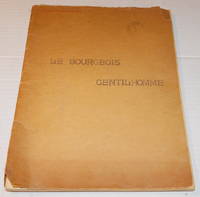
188097222Paris France circa 1880-1899. 1880-1899. Fair. - Quarto 14 inches high by 10-3/4 inches wide. Softcover bound in printed tan wraps titled in gilt on the front cover identified as "Partition Orchestre" in gilt along the top left and with the Comedie-Francaise's 1680 dated stamp on the front cover. "Partition Orchestre" is underlined in red graphite at the top of the front cover. The top and bottom edges to the soiled covers are chipped with tears to the top corner of the front cover and a piece out from the top corner of the rear. The front cover is nearly detached with tears along the spine and the rear cover is glued to the last blank leaf. Title plus 98 pages printed on lined music paper with most sheets stamped "Comedie Francaise 1680". The text is also printed in the appropriate parts of the score. The text block is shaken. There is occasional light soiling with signs of early worming to the top corner of the last 2 leaves. Good in a fair binding. <p>Titled: "Le Bourgeois Gentilhomme. Partition d'Orchestre. J.B. Lulli" on the title page.<p>This copy of the score was evidently prepared for a performance as there are numerous pencil notes throughout.<p>Laurent Leon 1835-1913 was the music director at the Comedie Francaise Paris from 1871 to 1913.<p>The parts of the score are as follows:<p>Overture. Pp. 1-8<p>Marche. Pp. 9-10. At the head of page 9 is printed "Reconstituee par L. Leon Chef d'orchestre de la comedie francaise conforme a la reprise de la Comedie Francaise 1880".<p>Act 1 No. 1: La Musicienne. Pp. 11-14; No. 2: Chanson de Jeanneton; P. 15. No. 3: Recits et Trio. Pp. 16-35; No. 4: Entre de Ballet. Le Maitre a danser. Pp.36-44.<p>Act 2. No. 5: Menuet du Maitre a danser. Pp. 45-48; No. 6: Air des garcons tailleurs. Pp. 49-50; No. 7: Gavotte. Pp. 51-53; No. 8: Final. Air des Cuisiniers. Rameau. Pp. 54-56. A note at the foot of page 55 states: "Ce morceau de Lulli etant introuvable on a introduit pour l'air des cuisiniers la musique de Rameau". The music of Rameau substituted for that of Lully is his popular work "Le Tambourin".<p>Act 3 No. 9: Air a Boire. Pp. 57-66. This is said to be Lully's favorite among his compositions.<p>Act 4: La Ceremonie: No. 10: Marche. Pp .66-67; No. 11: Invocation du Muphti. Pp. 68-69; No. 12: Choeur. P.70; No. 13. P. 70; No. 14: Le Muphti et le Choeur. Pp. 71-82; No. 15: Symphonie. Pp. 83-84; No. 16: Le Muphti et le Choeur. Pp. 85-92; No. 17: Marche. Unnumbered pages 95-96. For the most part this march is identical to No. 10.<p>A play intermingled with music dance and singing by Moliere Le Bourgeois Gentilhomme was first performed in 1670. The incidental music was composed by Jean-Baptiste Lully with choreography by Pierre Beauchamp.<p>RARE. [Paris, France], circa [1880-1899]. paperback
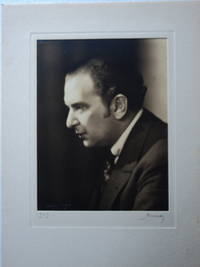
192925352New York 1929. 1929. Very good. - sc A 9-7/9 inch high by 8 inch wide softly hued sepia photograph depicting the great classical music conductor Fritz Reiner in profile from the chest up. Neatly attired in a three piece suit and tie over white shirt Fritz Reiner's gently softly smiling face appears illuminated by inspiration. The photographer's stamp is embossed on the bottom left of the image. The photograph is mounted by the photographer with glue from the verso into a 15-3/4 inch high by 11-1/2 inch wide creamy white mat. Signed in pencil on the mat at right immediately under the image "Muray" and dated "1929" by the photographer. There are a few spots of abrasion to the emulsion along the top with a couple of spots at the top right corner of the image. A beautiful portrait housed in the photographer's light gray cardboard folder with his pictorial device above his name on the folder's front cover. <p>The Hungarian-born conductor Frederick Martin "Fritz" Reiner 1888-1963 was highly regarded for his performances of Opera and symphonic music. Born in Budapest to a secular Jewish family he studied the piano and composition at the Franz Liszt Academy. Among his teachers was the young composer Bela Bartok. For a time he worked closely with Richard Strauss before moving to the USA in 1922 to take over as condutor of the Cincinnati Symphony Orchestra. Taking citizenship in his new country he taught at the Curtis Institute in Philadelphia. Both Leonard Bernstein and Lukas Foss where among his students. His appointment as music director of the Chicago Symphony Orchestra in 1953 marked the pinnacle of his career which included landmark recordings.<p>Like Fritz Reiner the photographer Nickolas Muray 1892-1965 was born in Hungary. He was a student of lithography photoengraving and photography. Having fled Europe at the advent of the first World War he settled in Brooklyn where he found work as a color printer. Opening a studio in Greenwich Village in 1920 he was soon commisioned by Harper's Bazaar to do a portrait of the Broadway actor Florence Reed. Harper's Bazaar were apparently happy with his work as they were soon publishing his photographs on a near monthly basis. As his reputation grew New York City's elite and celebrities sought him out to have the portraits taken and in 1926 Vanity Fair sent him to Europe to photograph celebrities in London Paris and Berlin and in 1929 hired him to photograph Hollywood movie stars. Moving away from his earlier work Muray turned to commercial photography becoming famous for his work in color advertising. New York, 1929. unknown
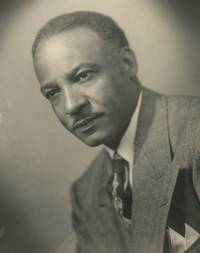
1949List1707Tuskegee 1949. Silver gelatin photograph measuring 8 x 10 inches with two typed letters signed one from Dawson and one from Rolla Foley. Identifying marks to verso of photograph generally fine condition. Fine. A portrait of William L. Dawson taken by P.H. Polk during Dawson’s tenure at the Tuskegee Institute where he served in several capacities from 1931-1956. A note on the photograph states that the photograph was sent to Rolla Foley the director of music at Wilmington College. In the correspondence Dawson writes to Foley explaining that a the spiritual “There is a Balm in Gilead†has been misidentified in their programming as White Spiritual: “This is a mistake†he writes “This number is one of our most beloved Negro Folksongs.†A response letter from Foley is included in which he apologizes for the error and notes the correction. A fine photograph and illuminating bit of correspondence from Dawson whose compositions and choral arrangements of spirituals are still performed widely. unknown
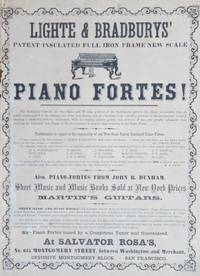
1864List2420San Francisco 1864. Broadside measuring 12 x 8.5. Some wear and archival tape repair to margin fine contrast excellent condition overall. Very Good. An interesting broadside advertising the Lighte and Bradbuiry piano as well as Martin Guitars printed for the Salvator Rosa music store at 615 Montgomery Street in San Francisco. Lighte and Bradbury was in its third iteration in the period from 1858-1864 when this broadside was printed having been started by the German immigrant Ferdinand C. Leuchte in 1847 who did business with a range of partners after anglicizing his name to Lighte. Among the testimonials listed on the broadside is praise from Lowell Mason the composer and music director. Salvator Rosa’s store was around from at least 1852 when a fire in the city destroyed the building on Clay St. making this location at 615 Montgomery Street at least the second for the firm. The firm published sheet music including “Fireman’s March†and “Garibaldi’s Hymn.†Martin Guitars had been based in Nazareth Pennsylvania since 1838 and were a relatively small company at this point before the growth of popularity of guitars and the shift to steel strings that happened in the early twentieth century. We find no other nineteenth century examples of broadside advertisements for Martin in trade records. unknown
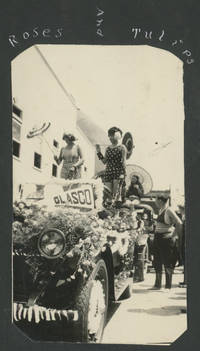
1920List1317Southern California 1920. Limp leatherette album oblong 4to measuring 10 x 7 inches with seventy photographs most measuring 4 x 2 ½ inches. Wear to binding photographs with excellent contrast very good to near fine overall. Near Fine. An energetic album of photographs belonging to one Eddie Jones a fun-loving banjo player from Santa Ana mostly composed of photographs of musicians performing at small parties and functions during the prohibition era. Jones was apparently quite active on the local scene and the album is mostly made up of candid photographs of musicians all captioned some humorously. Many of the photographs show small bands playing guitars many of them playing with slides likely due to the popularity of Hawaiian music at the time. Also included are many photographs of parades in and around Los Angeles as well as photographs of the 1925 Santa Barbara Earthquake showing damaged buildings. Two photographs feature a glass of rye others show agricultural scenes. Newspaper clippings in the back center on the Santa Ana and it’s possible that Jones - who was the common name mentioned in these clippings - was also a farmer from the Santa Ana area when he wasn’t playing music. One photograph shows San Diego a couple show a bullfight in Tijuana. Overall an evocative and well preserved piece of California Prohibition-era history. unknown
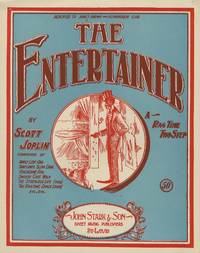
1902List3687St. Louis: John Stark & Son 1902. Folio sheet music illustrated color pictorial cover. 5 pp. including cover. Early issue dedicated to “James Brown and His Mandolin Club.†A notably bright and well-preserved example with strong color and only light edge wear; small chips to corners of second and third leaves with no loss to printed portion very good overall an unusually attractive copy of one of the most famous publications of the ragtime era. Very good. First edition of Scott Joplin’s celebrated ragtime composition issued during the composer’s most productive period with his principal publisher John Stark of St. Louis. The cover illustration depicts a sharply dressed performer stepping through a theatrical doorway while a curious onlooker peers from below. Joplin 1868–1917 often called the “King of Ragtime†was the most influential composer associated with the style and his partnership with Stark produced many of the era’s defining works including “Maple Leaf Rag†1899 “The Ragtime Dance†1902 and “The Entertainer.†Though enormously popular when published the piece would achieve even greater fame during the twentieth-century ragtime revival especially after its prominent use in The Sting 1973 where Marvin Hamlisch’s adaptation of Joplin’s music introduced the composition to a new international audience.<br /> <br /> Like many of Joplin’s works “The Entertainer†is structured as a ragtime two-step combining the syncopated rhythms of African American musical traditions with forms derived from the late nineteenth-century dance repertoire. The dedication to James Brown and His Mandolin Club reflects the widespread popularity of mandolin orchestras and amateur musical societies during the ragtime era which frequently performed arrangements of current dance compositions. Few pieces of American popular music have enjoyed the enduring recognition of “The Entertainer.†We find no other first edition copies on the market at the time of writing. John Stark & Son unknown
162576N.p.: N.p. 1974. Collection of eleven vintage borderless black-and-white photographs of rock pop and jazz musicians performing circa 1973 taken by noted French photographer Claude Gassian. With Gassian's stamp on the verso of every photograph.<br /> <br /> Collection includes two photographs of Alice Cooper one photograph of J.J. Cale one photograph of Chick Corea Stanley Clarke and Al Di Meola Return to Forever one photograph of Carla Bley at an electric keyboard two photographs of Bryan Ferry with Roxy Music one photograph of John McLaughlin and Jean-Luc Ponty Mahavishnu Orchestra one photograph of Alvin Lee with Ten Years After and one photograph of Tom Johnston Jeff "Skunk" Baxter and Patrick Simmons The Doobie Brothers. <br /> <br /> Born in Paris in 1949 Claude Gassian began his career in the 1970s capturing numerous iconic images of rock-and-roll musicians throughout that decade. His work has been the subject of several exhibitions and has been featured in several photography books including "Rock Images" 1990 and "Claude Gassian photographies 1970-2001" 2001.<br /> <br /> 9.5 x 7 inches. Very Good to Near Fine some with light edgewear and faint aging to the emulsion. N.p. unknown
2013815j1572New York: Harper. Very Good in Very Good dust jacket. 2013. First Edition. Hardcover. 0062206060 . Signed without inscription by Burt Bacharach upon title page. "The story of a man who has always expressed his deepest feelings through his music. Filled with the emotional power that defines Burt Bacharach's most unforgettable songs his memoir offers a candid backstage look at show business as well as the personal struggles of an artist whose incredible body of work has earned him a unique position in the American cultural landscape. He has written more than seventy Top 40 hits and received Grammy Oscar and Emmy awards for his work." - dust jacket. "Burt Bacharach 1928 - 2023 was an American composer songwriter record producer and pianist who is widely regarded as one of the most important and influential figures of 20th-century popular music" - Wikipedia. 291 pages. Index. Black and white photos. Book clean tight and unmarked with light wear. Light wear to complete dust jacket now in glossy new archival protection. A wonderful signed memento of Burt Bacharach whose music touched the hearts of a generation.; 8vo; Signed by Author . Harper hardcover
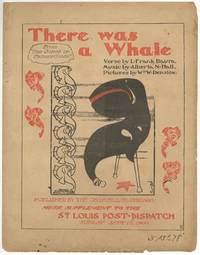
1900602083Chicago: Geo. M. Hill Co 1900. Softcover. Very Good. First edition thus. Pictures by Wm. W. Denslow. Folio. Single bifolium making four pages. Ink writing in the lower margin of the front and back covers edgewear including some tears one partially affecting the music though it remains perfectly legible and soiling at the exterior still a very good copy of this fragile publication. For voice and piano. A scarce piece. OCLC locates only a single holding. Geo. M. Hill Co unknown
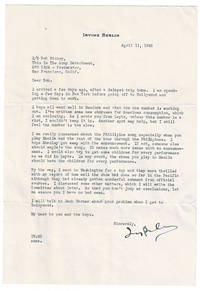
1945100362<p>April 11 1945. 1945. Very good. - Over 250 words typed on his personal 10-1/2 inch high by 7-1/4 inch wide embossed watermarked linen stationery. Irving Berlin writes to Bob Sidney the choreographer of his important World War II musical "This Is the Army" concerning new music he created for the show's tour of the Philippines. He writes that "I hope all went well in Mendora Mindora and that the new number is working out.As I wrote you from Leyte unless this number is a riot I wouldn't keep it in. Another spot may help but I still feel the number is too slow." Berlin had introduced his new song "Heaven Watch the Philippines" during a ceremony in Leyte in March of 1945 singing the song with a chorus of Filipino girls and the cast of the play "This Is the Army". He wrote the song as a tribute to the Filipino people and their resilience during World War II. In his letter to Bob Sidney he expresses his concern that the song will be misunderstood. "I am really concerned about the Philippine song especially when you play Manila and the rest of the tour through the Philippines. I hope Shanley Pvt. Robert Shanley got away with the announcement. If not someone else should explain the song. It makes much more sense with an announcement. I would also try to get some children for every performance as we did in Leyte. In any event the shows you play in Manila should have the children for every performance." Signed in full "Irving Berlin". Folded for mailing with some light creases. Near fine.</p><p>Originally composed as a Broadway Musical Irving Berlin's "This is the Army" was staged as a morale-boosting revue to raise money for the troops. The musical opened on Broadway on July 4 1942 during the Second World War with a cast consisting of 300 uniformed soldiers. The show was so successful that it was followed by a national and international tour playing in the European Far East and Pacific Theaters of War. Irving Berlin designed the show so that he could insert new songs depending on the location of the performances. "My British Buddy" was composed for the English performances and "Heaven Watch the Philippines" for Pacific Island shows. The song "Heaven Watch the Philippines" was written as a tribute to the Filipino people's resilience during the war and as a benefit to aid in the recovery following the war. Dedicated to General Douglas MacArthur Berlin sang the song with a chorus of Filipino girls and the cast of the musical in a presentation ceremony in Philippine city of Leyte in March 1945. He subsequently donated the song to the country with proceeds to go to the Boy & Girl Scouts of the Philippines.</p><p>The Russian-born American composer and songwriter Irving Berlin 1888-1989 wrote an estimated 1500 songs including scores for 20 Broadway musicals and 15 Hollywood movies. His music forms a large part of the Great American Songbook.</p><p>The American choreographer Robert Sidney 1909-2008 was self-taught as a dancer. He made his Broadway debut in "On Your Toes" in 1936 and appeared in George Balanchine's "Keep Off the Grass". Assigned to the Special Services Division during the Second World War he was the principal choreographer for Irving Berlin's musical "This Is The Army" and was later involved in the movie version starring Ronald Reagan. He choreographed many Broadway shows and worked with Bing Crosby Rita Hayworth Nancy Walker Jackie Gleason Cyd Charisse Debbie Reynolds and Mitzi Gaynor. He also went on to work in television choreographing for "The Dean Martin Show" television versions of musicals and 4 Academy Awards shows.</p> April 11, 1945.
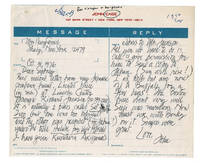
100977<p>New York October 14 1976. 1976. Very good. - Over 110 words penned in two columns on his personal 7 inch high by 8-1/2 inch wide ruled "Message/Reply" stationery. John Cage writes to Sydney Cowell Henry Cowell's widow about Henry Cowell's compositions "Recv enclosed letter from my Japanese composer friend. Located piece in Ms. at Lincoln Center. It is actually 2 pieces called Set of Two but one was too difficult and the other was recorded in Japan under the title Prelude for Vn & Hapschd. I have given Kuniharu Akiyama's address to Mr. Jackson." He goes on to indirectly refer to his own compositions "Renga" and "Apartment House 1776" which were performed in Boston: "The Boston piece went very well. Seiji was marvelous. Now must wk with Boulez on it. Singers were great." Signed "John". There are minor annotations along the top edge in an unidentified hand and staple holes at top left. Else near fine.</p><p>John Cage's compositions "Renga" and "Apartment House 1776" were performed simultaneously by the Boston Symphony Orchestra under Seiji Ozawa on September 29 1976. Boulez performed the works with the New York Philharmonic on November 5th of that year.</p><p>The Japanese avant-garde composer Kuniharu Akiyama 1929-1996 was also a music critic and a poet. He was a founding member of the Jikken Kobo group of avant-garde artists.</p><p>The American avant-garde composer John Cage 1912-1992 was a pioneer in electroacoustic music and the unconventional use of instruments. An artist and music theorist he was Merce Cunningham's lover and influential in the development of modern dance. Henry Cowell and Arnold Schoenberg were both his teachers.</p><p>Henry Cowell's wife Sidney Robertson Cowell 1903-1995 was a pianist and an American ethnomusicologist and collector of folk songs.</p> New York, October 14, 1976.
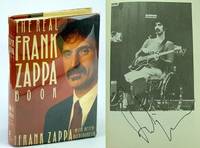
1989322H1377New York: Poseidon Press 1989. Book. Good. Hardcover. Signed by Authors. First Printing. 8vo - over 7¾" - 9¾" tall. Signed by Frank Zappa beneath his photo on page 116. 352 pages. Black and white illustrations and reproductions of photos. "The legendary Frank Zappa one of the most influential innovative and controversial musicians of the past twenty years takes us on a wild funny outrageous trip through his life and times. Here is how he became the state of the art in weirdness as only he can tell it." - from dust jacket. Unmarked. Average wear and soiling. Board tips rubbed open. Binding intact. Narrow 2.5" faded patch along dust jack spine corresponds to security strip on verso. A wonderful Zappa memento. Bonus: includes ticket stub for Zappa's May 10 1980 concert at the Tower Theater in Upper Darby PA. Poseidon Press Hardcover
1949139871Los Angeles: Twentieth Century-Fox 1949. Revised Final script for the 1950 film. Bound presentation belonging to producer Sol C. Siegel with his name in gilt on the front board. With 53 studio still photographs tipped in throughout four pages of retakes and added scenes tipped in at the rear as well as a number of holograph annotations primarily denoting the titles of various musical numbers. <br/><br/>Based on the short story "Stork Don't Bring Babies" by S.K. Lauren Grable and Dailey play a showbiz couple who discover in successive order that they cannot have children that they can adopt children and that they aren't really fit to raise children. But things get better with the help of several musical numbers scored by Harold Arlen. <br/><br/>Bound in green faux leather boards with gilt titles and rule and marbled endpapers. Title page present dated Dec. 1 1949 noted as Revised Final with credits for screenwriters Trotti and Binyon. 191 leaves with last page of text numbered 130. Mimeograph duplication with blue revision pages throughout dated variously between 12/21/19 and 1/5/50. Pages Very Good plus photographs Near Fine with some bruising or chipping to the verso of the preceding page on either the top or bottom edge. Boards Near Fine with a bump to the upper rear corner. <br/><br/>Hirschhorn The Hollywood Musical. Twentieth Century-Fox unknown books
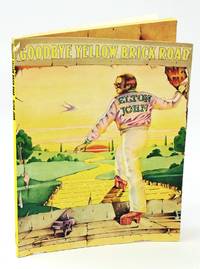
563h5913USA: Dick James Music Inc. Fair. 1973. First Edition. Paperback. One of the greatest songbooks of all time in our opinion. Ian Beck's iconic cover art of Elton John stepping onto the Yellow Brick Road is a perfect introduction to the incredible compositions contained inside which include: All The Girls Love Alice The Ballad of Danny Bailey 1909-34 Bennie and the Jets Candle in the Wind Dirty Little Girl Funeral For a Friend Goodbye Yellow Brick Road Grey Seal Harmony I've Seen That Movie Too Jamaica Jerk-Off Love Lies Bleeding Roy Rogers Saturday Night's Alright For Fighting Social Disease Sweet Painted Lady This Song Has No Title and Your Sister Can't Twist But She Can Rock 'N' Roll. Piano sheet music lyrics and chords are included for each song. Also includes a variety of colour illustrations. Upon the tragic 1997 passing of Diana Princess of Wales Elton John a friend of the Princess quickly reworked the lyrics of Candle in the Wind which he then performed at her state funeral "which was viewed by nearly 2.5 billion spectators. Subsequently the song originally written as a tribute to Marilyn Monroe became one of the best-selling singles in history." - Celeb Magazine News. Printed upon yellow paper in keeping with the Yellow Brick motif. Back cover features solo colour photos of Elton John Davey Johnstone Bernie Taupin Dee Murray and Nigel Olsson. Former price written on back cover otherwise unmarked with above-average wear. Binding intact. A worthy copy of this precious Elton John memento.; 4to . Dick James Music, Inc. paperback
1955149900Beverly Hills CA: Metro-Goldwyn-Mayer MGM 1955. Five vintage candid reference photographs from the 1955 film showing variously actors Marlon Brando Frank Sinatra composer Frank Loesser and director Joseph L. Mankiewicz on the set. <br/><br/>The first photo double weight shows Marlon Brando as Skye Masterson surreally <br/>socking one of his gangster companions in the nose. <br/><br/>The second photo shows Brando rehearsing "Luck Be a Lady" with sheet music in hand and with the song's composer Frank Loesser at the piano.<br/><br/>The third photo shows Sinatra and Brando in a candid moment.<br/><br/>The fourth photo single weight shows director Joseph L. Mankiewicz and dancer Carey Leverette relaxing contemplatively Mankiewicz sitting and smoking his pipe Leverette inside a large industrial exhaust pipe.<br/><br/>FIFTH PHOTO 149973 TBD KRJ<br/><br/>Based on the 1950 Broadway musical which was in turn based on Damon Runyon's short stories "The Idyll of Miss Sarah Brown" and "Blood Pressure." A serial gambler wins a bet that he can get a Christian missionary to travel with him to Havana where the pair begin to fall for each other. Nominated for four Academy Awards.<br/><br/>Set in New York and Havana.<br/><br/>All photos: 8 x 10 inches. Very Good to Near Fine overall variously with a few pinholes and very shallow creasing. Metro-Goldwyn-Mayer [MGM] unknown books
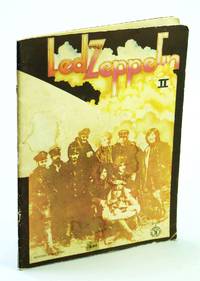
1969563H4528USA: Superhype Music Inc. Fair. 1969. First Edition. Paperback. Original 1969 Led Zeppelin songbook for what many consider to be their finest album. 48 pages including 19 pages of photos of the boys in band six of which are in color. One-page color headshot photo of each band member. Colour photos of the band inside each cover our favorite being the one inside the front cover which shows the shaggy boys staring down at the camera with Jimmy Page resplendent in yellow clothes trimmed in blue and the band's yellow phallic logo added above them. Includes piano sheet music lyrics and chords for these classic rock anthems: Whole Lotta Love; What Is And What Should Never Be; The Lemon Song; Thank-You; Moby Dick; Heartbreaker; Living Loving Maid; Ramble On; Bring It On Home. Includes brief write-ups about the band and each of its members. Store stamp atop title page otherwise contents clean and unmarked. Binding intact. Above-average external wear and soiling as perhaps befits this pre-eminent heavy metal band which definitely got down and dirty on this album. An awesome Led Zep collectible.; Folio - over 12" - 15" tall; Led Zeppelin; Page Jimmy; Plant Robert; Jones John Paul; Bonham John Whole Lotta Love; What Is And What Should Never Be; The Lemon Song; Thank-You; Moby Dick; Heartbreaker; Living Loving Maid; Ramble On; Bring It On Home . Superhype Music, Inc. paperback
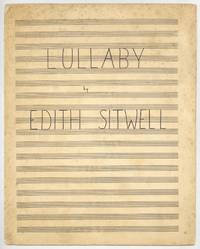
579085No place: no publisher no date. Softcover. Very Good. Original holograph score. Folio. Four nested bifolia making 16 pages. Foxing and light edgewear throughout and the two outermost bifoliums are separating a bit at the top and bottom of the folds still very good. Vocal score for solo soprano women's chorus and orchestra. Hand written by the composer and Signed by her above the score. Alice Hunt Sokoloff was the daughter of famed Columbia University neurologist Dr. James Ramsay Hunt and a scholar in her own right entering Radcliffe at just 16 and going on to publish three biographies. One of her biographies focuses on Ernest Hemmingway's first wife Hadley Mowrer with whom Sokoloff had formed a close friendship. She studied composition under Rubin Goldmark Constantin Shvedoff and Alexander Siloti composing a symphony and three string quartets along with various shorter pieces and solo pieces some of which were reportedly performed at Carnegie Hall. This piece set to words by the English poet Edith Sitwell appears to have never been published. Rare and possibly one of a kind. no publisher unknown
195081400New York: Music Theatre Inc 1950. Softcover. Fine. Mimeographed sheets bradbound in pink stiff paper wrappers. Fine. Script for the original performance of this important musical play which originally ran for 1200 performances with a splendid cast that included Robert Alda Isabel Bigley Vivian Blaine and Sam Levene. The show's success begat the 1955 Joseph L. Mankiewicz-directed film version featuring Marlon Brando Jean Simmons Frank Sinatra Vivian Blaine and Stubby Kaye the latter two reprising their inimitable Broadway performances. Co-author Swerling was one of Hollywood's best kept secrets; he contributed to the screenplays for many excellent films. Rare. Ex-Carter Burden. Music Theatre, Inc unknown
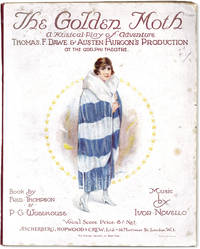
192155221London: Ascherberg Hopwood & Crew Limited 1921. First Edition. Quarto 31cm; original pictorial wrappers backed in maroon cloth; viii1124pp. Rubber-stamped signature of Ivor Novello on lower title page. Modest wear and creasing wrappers dust-soiled with a few tiny nicks and creases to same and a small ink notation and small stain to front cover; several creased corners in text with the holograph addition in pencil of a second verso in "Lonely Soldier" on pp.24-25 in an undetermined hand though not Wodehouse's; complete Very Good. A musical play co-written by Wodehouse and English author Frederick A. Thompson 1884-1949 with music by Welsh composer Ivor Novello. The Golden Moth premiered at the Adelphi Theatre in London on 5 October 1921 running for 281 performances. An elusive Wodehouse item in the original wrappers; OCLC notes 12 holdings. McIlvaine Ga.5. Ascherberg, Hopwood & Crew, Limited unknown
18942193Paris, Imprimerie Charles Verneau, 1894. Dimensions : 60,5 x 79,5 cm (65 x 85 cm avec toile). Superbe affiche entoilée, imprimée en lithographie et en couleurs, représentant la muse de l'Ecriture assise sur un chapiteau corinthien sur un fond de soleil couchant. Un enfant nu tient à ses pieds un portrait de Gutenberg placé à côté de symboles des arts : une palette de peintre, une toile enroulée, une lyre, un livre et une sculpture représentant un lion. Timbre fiscal de la République Française. Eugène Ogé (1861-1936) débute comme apprenti chez l'imprimeur parisien spécialisé dans les affiches, Charles Verneau. Il devient ouvrier lithographe. Durant cette période, il croise des artistes comme Willette, Forain et Steinlen. Au milieu des années 1890, il ouvre son propre atelier et commence à dessiner des affiches d'abord sous contrat avec Verneau, puis avec l'imprimeur Vercasson. Inspiré par le style de Chéret, il compose des images avec des femmes opulentes. Il connaît alors un certain succès, se consacre entièrement à cet art et devient un affichiste important de la Belle Époque. Par la suite, son style évoluera peu à peu vers les scènes de genre, l'humour et la caricature. En 1902, il collabore à La Lanterne, produisant des caricatures anticléricales, puis il travaille avec d’importantes marques séduites par son sens de l'humour : Bouillon Maggi, Gellé frères, Bicyclette La Guêpe, Bazar de l'Hôtel de Ville, Réglisse Zan, Bec Auer, Thé Lombart, Billards Brunswick, etc.
1 S. Gr.-4to. Hochkarätig besetztes Albumblatt mit den eh. U. von John Quincy Adams, Heinrich von Angeli, Raoul Auernheimer, Hermann Bahr, Anna Bahr-Mildenburg, Julius Bittner, Hugo Darnaut, Edmund Eysler, Selma Halban-Kurz, Hugo von Hofmannsthal, Maria Jeritza, Emmerich Kalman, Wilhelm Kienzl, Erich Wolfgang Korngold, Franz Lehár, Joseph Marx, Alfred Piccaver, Franz Schalk, Ferdinand Schmutzer, Arthur Schnitzler, Arnold Schönberg, Leo Slezak, Karl Hans Strobl, Felix Weingartner und Anton Wildgans. - Leicht gebräunt und verso stellenweise gering fleckig; von geringfügigen Randläsuren abgesehen gut erhalten.
Je 1 S. Qu.-8vo. Beide Bll. mit jeweils einem kleinen Portrait (Zeitungsausschnitt) und zusammen auf Untersatzkarton montiert. Ein durch die zwei Bilder äußerst humorvolles Ensemble, das den Komponisten einmal nachdenklich vor dem Klavier und dann überlegend in die Tasten greifend zeigt.
[Figurato Musica] (cm.14,4) buona piena pergamena dell' epoca. -- cc. 13 nn., pp. 479, cc. 6 nn. Bella antiporta figurata con angeli musicanti e veduta di Firenze in basso. A pag. 229 e al verso di p. 479, due xilografie di carattere sacro. Il testo è costituito per lo più da musica notata, in fine è l' elenco delle laudi e all' inizio la tavola delle materie contenute. Veramente rara edizione originale e sua prima opera stampata. Manca a Choix, Piantanida, Gasperini "Opere Musicali di Parma", Wood "Music in Harvard libraries" e a molti repertori musicali specializzati. L' autore, abate fiorentino e maestro di canto, pubblicò altre significative opere musicali, tutte rare e ricercate. Bell' esemplare fresco e ben completo. * Gaspari "Biblioteca Musicale Martini Di Bologna" vol. II p.405 (scompleto); Michel-Michel II 113 (senza collazione per non averlo visto); * Bm. Stc. Italian XVII Cent. I 242; * Eitner III 4; * Fetis II 330.[f68] Libro
(2+2½ =) 4½ SS. auf 2 Doppelbll. 8vo. Ein Begleitschreiben aus Dürrners letzten Lebensjahren in Edinburgh als Haus- und Kirchenkomponist des Herzogs William von Devonshire zur Übersendung von zwei "Gesängen für Männerstimmen", einer hs. Notiz zufolge an den Dirigenten des Gewandhausorchesters Julius Rietz: "Ich hoffe das dieselben Ihren Beifall haben mögen und bitte Sie, sie als ein Geschenk von mir anzunehmen. Im Falle Sie sie drucken lassen, ersuche ich Sie, mir ein Exemplar zukommen zu lassen. Zugleich benachrichtige ich Sie, daß ich nächstens an einen Verleger in Leipzig ein neues Heft von Gesängen für Männerstimmen zur Herausgabe senden werde [...]". - Der Brief vom 11. IV. 1858 einer Sammlernotiz zufolge an den Organisten und Universitätsmusikdirektor, Herrmann Langer (1819-89) in Leipzig, ebenfalls zur Publikation von Gesangswerken für Männerstimmen: "In dem Brief, der den Gesängen beigelegt war, hatte ich vergessen, zu erwähnen, daß Ihnen das Eigenthumsrecht der 2 Gesänge für den Continent überlassen ist, daß ich mir aber dasselbe für England vorbehalte [...]". - Johannes Dürrner gründete als langjähriger Ansbacher Stadt- und Stiftskantor den Männergesangsverein "Ansbacher Liederkreis", für den er zahlreiche Gesangswerke komponierte, die in der "Allgemeinen Musikalischen Zeitung" viel Lob erhielten. - Jeweils mit eh. Edinburgher Adresse Dürrners am Briefende und Sammlernotiz in Bleistift.
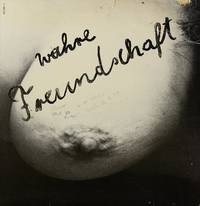
55196Berlin: Heimproduktion and Köln Electrola 1978. Vinyl record in original pictorial record sleeve measuring 31 × 31.4 cm. Cover with signed dedication: "heart symbollich Valie Export M. Wiener. Berlin 26.5.79" and record label also with signed dedication: "Mike Steiner von Monsti Wiener. Valie Export 26.5.79" the dedication signed by both probably in Wiener's hand. Sleeve creased; edges rubbed; small edge defect; the record with a few superficial scratches. The album "Wahre Freundschaft" is the first of two records that Valie Export and Monsti Wiener produced together. The recordings were made in 1978 in Wiener's apartment in Berlin-Kreuzberg and were released in an edition of 1000 copies. On the record the two Viennese performance artists sing old German and Austrian folk songs and popular classical songs such as "Das Wandern ist des Müllers Lust" Franz Schubert and avant-garde pieces by Gerhard Rühm and Konrad Bayer for example as well as numerous obscene banal and silly pop songs. The performances are repeatedly interrupted by fits of laughter from the two interpreters who barely hit a note correctly and fail in their attempt to sing the canon "Frère Jacques". Cf. Wolfgang Müller Subkultur Westberlin 1979-1989 Hamburg 2014 p. 69f.<br /> <br /> Ingrid Wiener and Valie Export had previously worked together with Dieter Roth on a longer project which at first glance seems atypical of the neo-avant-garde. On the initiative of Wiener who studied textile design in the first half of the 1960s the three artists created a series of tapestries although Valie Export withdrew from the project. The production of the tapestries was a tedious very time-consuming practice; it could sometimes take years to produce one carpet. However Dieter Roth maintained his spontaneous approach in this collaboration. For the first tapestry in which Export was involved Roth supplied a soiled linen napkin from a meal at the Italian restaurant chain "Bertorelli". He scribbled three chunky cats in red pencil on the grease-stained machine-made napkin. In the bottom right-hand corner of the tapestry Valie Export wove Roth's signature and the year the collaboration began 1974 as well as her own logo signet at the top right-hand edge next to the city name Berlin and the end year 1976. At the top left Wiener wove her signature in small letters. The record offered here was thus created in the context of this collaboration. Caroline Lillian Schopp: Feminist In-Action. Ingrid Wiener's Tapestry Collaborations in: FKW: Zeitschrift für Geschlechterforschung und visuelle Kultur. No. 68 October 31 2020 p 52ff.<br /> <br /> As of June 2025 no copies located in North American institutions. unknown