859 132 résultats
Folio. 4 pp. on 2 ff. Notes for a perhaps unfinished work on Charlemagne: "1. La législation selon les races a été remplacée par la législation selon les conditions sociales et les [illegible] le pouvoir législatif central et l'unité qui en résultait dans certains parties de la législation surtout dans la législation publique ont disparu. Il y a une charte [illegible] tous les articles des capit qui concernent la morale, la religion les affaires canoniques […]". - Stamped twice "Vente Flaubert" (Antibes, April 28-30, 1931); slight ruststains from old paper clip, and small damage to edges; mild toning.
4to. 2 pp. Addendum: TLS by the author's widow, Eleni Kazantzakis. Geneva, 25 May 1973. Folio. 1 p. Important, pessimistic letter to the Swedish Hellenist Börje Knös (1883-1970), whose visit he anticipates: "Cher monsieur et ami! Nous voilà dans le mois d'Août - le généreux dieu grec qui nous apporte là-bas les deux fruits pleins de mystère et de miel: les figues et les raisins. Pourrais-je espérer que ce dieu généreux va conduire Vos pas à Paris? J'en serais vraiment heureux [...] Ici, à Unesco, le travail commencé à être intense et trés intéressant. Mais il ne me reste plus un instant libre pour respirer et écrire; j'avais commencé une série d'oeuvres (des tragédies et des romans) et tout reste en suspens. Et il n'y a rien au monde qui me donne une plus grande douleur que l'oeuvre inachevée. Je ne voudrais pas mourir sans avoir pu sauver toute mon âme, en l'exprimant par des mots clairs, durs et enflammées. Comme l'Ulysse de mon Odyssée je ne voudrais laisser à la mort comme butin que quelques os et un peu de chair desséchée [...]." Undoubtedly under the impression of the Civil War in Greece, Kazantzakis continues: "Aura-t-on le temps de jouir encore un peu de cette vie unique et éphémère? La lumière de plus en plus s'assombrit; notre pauvre planète est entrée dans une ombre envahissante; l'esprit humain subit une éclipse - notre responsabilité est grande; chaque étincelle de lumière qui existe encore et vacille doit être sauvée: [Ho lógos ho spermatinós (gr.)], la Parole ensemençant! Chaque jour je deviens plus pessimiste et plus conscient de la responsabilité humaine. Garder cette etincelle, ne pas la laisser s'eteindre! Combattre la nuit horrible avec cette petite lumière. Rester debout, les yeux ouverts, l'esprit en sentinelle. - Cher monsieur et ami, j'espère Vous revoir bientôt et pouvoir parler avec Vous et nous promener aux bords de l'abîme sans trébucher [...]". - On stationery with printed UNESCO letterhead. Kazantzakis was then head of the Unesco's classics translation bureau. All the famous novels and tragedies on which his fame rests were written in exile in Paris. - Includes a TLS by the widow Eleni Kazantzakis, in which she sends he late husband's letter to a Mr. Dubois for a charity auction of the "Association Suisse en Faveur des Enfants Infirmes Moteurs Cérébraux".
8vo (160 x 227). 634 pp. Blue cloth titled in gilt on spine. First edition: one of only 1,160 illegally printed copies in Russian of the novel which won Boris Pasternak (1890-1960) the Nobel Prize. These were published by Mouton in the Netherlands - though they feature the Feltrinelli imprint - and are issued in their trademark, nondescript blue cloth. The publication in Russian was facilitated by the CIA as part of an effort to embarass and ultimately to undermine the USSR, and several hundred copies were distributed via the Vatican's stall at the 1958 Brussels World's Fair. - The journey to a rushed publication started two years previously in the USSR. After having been rejected by the literary monthly Novy Mir for not adhering to socialist realism, the manuscript for Doctor Zhivago was smuggled out of Soviet Russia by the Italian journalist Sergio d'Angelo and published by the Italian communist Giangiacomo Feltrinelli, an act for which Feltrinelli later claimed that the Italian communist party revoked his membership. Feltrinelli in fact published an Italian translation first, which became an international sensation and was subsequently followed by numerous other translations. However, to win a Nobel Prize, it was generally understood that an author must have been published in the original language of his manuscript. With Pasternak an acknowledged favourite for 1958, the pressure was on. Feltrinelli managed to get his imprint on most or all of the Mouton copies, as seen on this volume, thus cementing his name as the publisher of the work which was expected to win that year's Nobel Prize. - John Maury, chief of the CIA's Soviet Russia division, recognized the novel as "the most heretical literary work by a Soviet author since Stalin's death". Perhaps the novel's greatest champion in America was the critic Edmund Wilson, who in The New Yorker described it as "one of the very great books of our time [...] a great act of faith in art and in the human spirit". Pasternak was denounced in Russia as being "anti-Soviet", and the pressure only increased after he was named winner of the Nobel Prize for Literature in 1958, which he was forced to refuse in order to avoid deportation. - In exceptionally fine condition. Cf. Finn/Couvee, The Zhivago Affair (London, 2014).
8vo. 66 ff. of entries and 19 blank ff. Contemporary calf with corner fittings and clasp. The present guestbook with more than 230 entries of varying length constitutes a fine document of Rilke's sojourn on Capri, where he had been invited as guest of Mrs. Alice Faehndrich, née Baroness of Nordeck zur Rabenau, sister of Countess Luise Schwerin. The poet spent the winter and following spring of 1906/07 on the island, "from December 4 to May 15 [...] living the life of the House of Roses attentively and gratefully“, as he penned on the day before his departure. His wife Clara, too, was twice a guest at the glamorous villa: on Jan. 14, on her way to Egypt, she pays her thanks "for being honoured with two beautiful days at the Villa Discopoli as an unexpected present on my journey - between Berlin and Egypt", and after her return she spends the last few weeks there with her husband: "returned from Egypt the 20th of April, I was received and indulged until May 15 in the dear Villa Discopoli". Rilke's brief but grateful entry does not reveal that here he composed his "Improvisations from the Capri Winter“, a work that points beyond his "New Poems". Other guests at the Villa whom Rikle must have met during his stay there included Wolfgang von Tirpitz (the son of Alfred von Tirpitz), Ferdinand von Martitz, and Franz von Niebelschütz. The encounter with the with most far-reaching consequences, however, was that with the young Countess Manon zu Solms-Laubach, a niece of the Hereditary Count Friederich (1833-1900). After her departure, a correspondence ensued which by 1913 was to comprise on Rilke's side no less than 19 letters and a calligraphic transcription of what is possibly Rilke's most famous poem, "The Panther". - Rilke and his wife had known the sister of their hostess Alice (called "Alla" in the guestbook), Countess Luise von Schwerin, née Nordeck zu Rabenau, since 1905, when they had met in Dresden. At the beginning of his stay, Rilke had been the only guest, but with the arrival of Alice, Julie von Nordeck ("Nonna"), and Manon zu Solms-Laubach his solitary position ended. "The exploration of Anacapri, the ascent to Monte Solaro, the visit to the grotta of Migliera and to the little church of Sarita Maria a Cetrella unlocked a countryside similar to Greece [...] During the evenings, the ladies were an attentive audience, when they sat doing their needlework or peeling him an apple, ready to hear his day's work [...]“ (cf. Donald A. Prater, Ein klingendes Glas. Das Leben R. M. Rilkes, Hamburg 1989). - Apart from the entries of the Rilkes, the guestbook contains an autograph pencil portrait by Pauline von Kalckreuth, as well as the two-page poem, "Le tombeau du poete" ("d'apres Henry Heine") by Camille du Locle, who was soon to end his life on Capri. Other entries are by Vera Amerongen, Julia and Eugéne Bonnard, Réne and Gilbert Clavel, Emmy and Ernst Gumppenberg, Baroness and Baron Alice and Walther von Falkenhausen, Hanns and Margarethe Floerke, Leonie and Marie Fontaine, Eberhard Hardeck zur Rabenau (Count of Schwerin), Heinrich and Elise Lützow, Richard Mackensen, Ferdinand von Martitz, Julie Baroness Nordeck zu Rabenau (née von Wallenberg), Baron Friedrich von Oppeln-Bronikowski (fine, 1½-page dedication with a 14-line poem), Emmy von Radetzky, Prince Heinrich XXX. zu Reuss, A. von Röder, Auguste Schepp, Leopold von Schlözer (with a half-page, coloured pencil drawing), Luise Schwerin (wife of Count Karl v. Schwerin), Count Friedrich von Schwerin, Countess Manon zu Solms-Laubach, Baroness and Baron Mathilde and Arthur von Stackelberg, Wolfgang von Tirpitz, Baron Jakob and Gabrielle von Uexküll (twice), Hermann Vierordt, Anna von Wallenberg, Wanda von Wallenberg, Elisabeth Wegeli, Baroness Adele Wolff, Count and Countess von Zieten Schwerin, and Ernst Zitelmann (with a fine quote from his "Radierungen und Momentaufnahmen", published the same year). - Wants spine; covers rubbed and with signs of splitting; binding loosened. Interior well-preserved throughout, with occasional penciled notes regarding individual contributors.
8vo. VIII, 117 pp. Original half calf with title to spine. First edition; no. 13 of 50 copies of the numbered luxury edition on wove paper: still without p. IX of the preface and the statement "1.-6. Tausend". Includes eight-line autograph poem on flyleaf, signed "Th. Tiger" and dated 1920: "Ich gucke freundlich um die Oecke und greife voller Seelenruh der Muse unter ihre Röcke ... Und dabei, Leser, siehst du zu - ? Sie quitscht. Ich grinse. Sie verstehen: Nicht immer gilt der Klassik Maß. Denn was wir im Verborgnen drehen macht uns am allermeisten Spaß - ! 1920. Th. Tiger". - "This edition was printed in 50 copies, numbered, and provided by the author with an unpublished poem, signed". The book is so scarce that it is questionable whether fifty copies were indeed printed. The poem was first published by the Tucholsky Archive in 1978 (Bonitz/W. D 2790). - Slight staining to edges; spine and corners somewhat scuffed, otherwise well-preserved. Bonitz/W. C 4. Wilpert/G. 3.
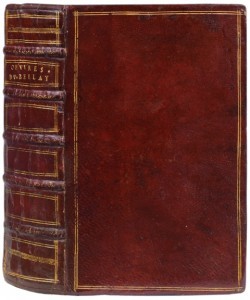
LCS-13322Première édition à pagination continue des Œuvres de Du Bellay, de toute rareté dans son beau maroquin de l’époque. Paris, Federic Morel, 1574.In-8 de (12) ff., 559 ff., 1 f. de privilège. Plein maroquin rouge, double filet doré encadrant les plats, dos à nerfs orné de double-filets dorés dans les caissons, tranches mouchetées. Reliure de l’époque. 162 x 100 mm.
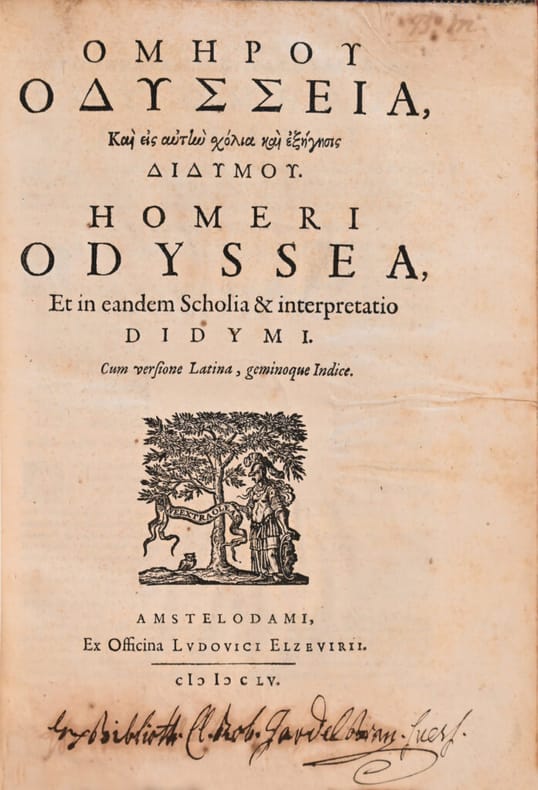
LCS-186461Le somptueux exemplaire du baron de Longepierre (1659-1721) relié à l’époque par Boyet en maroquin bleu doublé de maroquin rouge. Amstelodami, ex Officina Elzeviriana, Anno 1656. 2 volumes in-4. T.I: (8) ff. y compr. le titre gravé, 716 pp., T. II(daté 1655): 536 pp., (22) ff. d’index. Maroquin bleu, emblème de la Toison d’or aux angles, au centre et quatre fois répétée aux dos, doublures de maroquin rouge, dentelle intérieure dorée, toison dorée au centre, tranches dorées sur marbrures. Reliure de Boyet, actif sous le règne de Louis XIV. 235 x 167 mm.
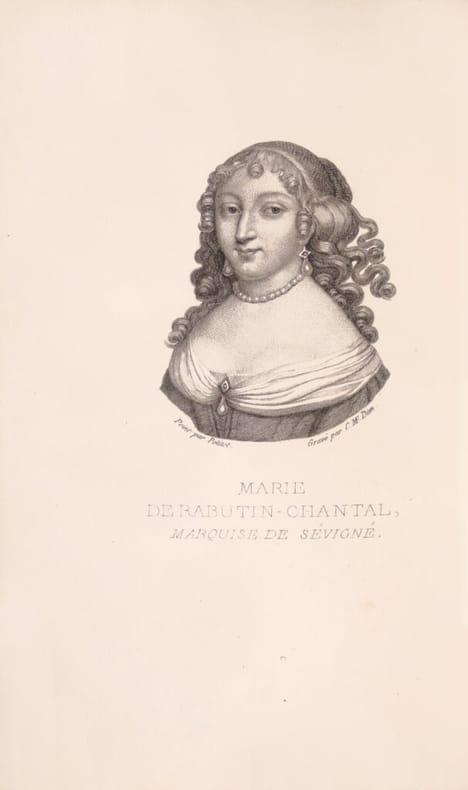
LCS-17743Magnifique exemplaire, assurément l’un des plus beaux connus, revêtu d’éblouissantes reliures en maroquin de l’époque signées de Lefebvre, bien complet des Mémoires de Coulanges. Paris, J.J. Blaise, Libraire de S.A.S. Madame la Duchesse d’Orléans, 1818. 12 volumes. - Mémoires de M. de Coulanges, suivis de Lettres inédites de Madame de Sévigné, de son fils, de l’abbé de Coulanges, d’Arnauld-d’Andilly, d’Arnauld de Pomponne, de Jean de La Fontaine… Paris, J.J. Blaise, Libraire de S.A.S. Madame la Duchesse d’Orléans, 1820. 1 volume. Soit 13 volumes in-12, maroquin bleu nuit à grain long, roulette à fond perlé sertie de filets droits autour des plats, dos lisses ornés d’un décor doré à fond criblé, damiers dorés en pied, chaînette intérieure dorée, doublures et gardes de tabis parme, tranches dorées. Riche reliure de l’époque signée Lefebvre. 162 x 98 mm.
- Michel Lévy frères, Paris 1863, 14x22cm, relié. - First edition. Contemporary half navy blue shagreen over marbled paper boards, spine with triple gilt fillets (slightly discolored, but not seriously), speckled edges. Inscribed by Gustave Flaubert to the jurist and politician from Rouen, F[rédéric] Deschamps: "hommage de la plus haute considération, souvenirs d'amitié [with my deepest respect and memories of our friendship]". Frédéric Deschamps was "one of the leading lights of the Rouen bar and one of the most upstanding citizens in Normandy," (Biographie nationale des contemporains, Glaeser, 1878). A Republican serving alongside Jules Sénard, he was also a writer and a poet; and acted in defence of Flaubet's proposition of erecting a statue to Louis Bouilhet against the municipality of Rouen. Part of the correspondence between Flaubert and Deschamps is preserved in the Institut de France. A handsome copy in its contemporary binding with a friendly autograph inscription from the author to a member of the literary world in Rouen. [FRENCH VERSION FOLLOWS] Édition originale. Reliure en demi chagrin bleu marine, dos lisse légèrement foncé sans gravité orné de triples filets dorés, plats de papier marbré, tranches mouchetées, reliure de l'époque. Envoi autographe signé de Gustave Flaubert au jurisconsulte et homme politique rouennais F[rédéric] Deschamps : « hommage de la plus haute considération, souvenirs d'amitié ». Frédéric Deschamps est « une des lumières du barreau rouennais et l'un des citoyens les plus estimés de la Normandie » (Biographie nationale des contemporains, Glaeser, 1878). Egalement républicain engagé aux côtés de Jules Sénard, mais aussi écrivain et poète, il défendra contre la mairie de Rouen la proposition de Flaubert d'édifier une statue en hommage à Louis Bouilhet. Une partie de la correspondance entre Gustave Flaubert et Frédéric Deschamps est conservée à l'Institut de France. Précieux exemplaire en reliure d'époque enrichi d'un amical envoi autographe signé de l'auteur à l'un des membres du cénacle rouennais.
- Charpentier, Paris 1880, 12x19cm, relié. - First edition, an ordinary paper copy. Contemporary half bottle-green shagreen over marbled paper boards, spine in compartments with gilt flowers, speckled edges. With the autograph signatures of Guy de Maupassant, Emile Zola, Joris-Karl Huysmans, Léon Hennique, Paul Alexis and Henri Céard on the first endpaper. A very good and rare copy in a strictly contemporary binding. [FRENCH VERSION FOLLOWS] Édition originale sur papier courant. Reliure en demi chagrin vert bouteille, dos à cinq nerfs orné de motifs floraux dorés, plats de papier marbré, tranches mouchetées, reliure de l'époque. Notre exemplaire est enrichi des signatures manuscrites de Guy de Maupassant, Emile Zola, Joris-Karl Huysmans, Léon Hennique, Paul Alexis et Henri Céard sur la première garde. Bel et rare exemplaire établi dans une reliure strictement de l'époque.
4 SS. auf Doppelblatt. 4to. Geschrieben von Goethes Sekretärin Caroline Ulrich und fortgesetzt von seinem wissenschaftlichen Helfer und Mitarbeiter Friedrich Wilhelm Riemer, dem ehemaligen Hauslehrer in der Familie von Wilhelm von Humboldts und dann von Goethes Sohn August. Der Adressat des Briefes ist Friedrich von Schlichtegroll, seit 1807 Generalsekretär der Bayerischen Akademie der Wissenschaften, der sich mit einer Empfehlung für die Schauspielerin und Sängerin Anna Altmutter an ihn gewandt hatte: "Wie gern möchte ich das Gute, was sich auf unserm Theater nach und nach hervorgetan [...] weiter ausbreiten", aber "bey uns kann nur eine kleine Anzahl Talente neben einander bestehen, denn da wir nur dreymal in der Woche spielen, so ist für mehrere nicht Raum, und selbst die schon gegenwärtigen haben sich öfter zu beklagen, daß sie nicht genug beschäftigt sind. Besonders aber ist das Verhältniß, in welchem Ihre Künstlerin zu stehen wünscht, nicht wohl einzuleiten, indem, wenn man ihr auch Rollen zutheilen wollte, man bey Ihrem Abgange sich in der doppelt unangenehmen Lage sähe, dieselben wieder erledigt, und die Schauspielerinnen, die darauf Anspruch machen könnten, übel disponirt zu finden. Von schon besetzten Rollen könnte ohnedies bey dem längeren Aufenthalte eines so werthen Gastes die Rede nicht seyn […]". - Auf S. 4 eine eh. Nachschrift von F. W. Riemer, der im November des Jahres mit Caroline den Bund der Ehe schließen sollte: "Die Absendung des Vorstehenden ist leider sehr lange verzögert worden. Ich werde an meine Pflicht erinnert in dem Augenblick, da ich von Weimar scheide, um nach Frankfurt und Wiesbaden zu gehen". - Stellenweise etwas fleckig; Falteinrisse fachmännisch restauriert.
DJ has 2" closed tear to front ; INSCRIBED with ball point pen by King to Wanda Horowitz, the daughter of the conductor Toscanini. ; 8vo - 8" to 9" tall; 209 pages
- Urbain Canel, Paris 1829, 10x17,5cm, 4 volumes reliés. - Édition originale très rare et très recherchée du premier roman de Balzac signé de son nom. Publié à petit nombre d'exemplaire, ce premier roman dont le titre original est inspiré du dernier des Mohicans de James Cooper, reparaîtra, remanié, en 1834 sous un nouveau titre : Les Chouans. Cette première oeuvre d'importance de Balzac marque également le début de La comédie Humaine dont elle constitura dès 1845 une Scène de la vie Militaire. Reliures en demi cuir de Russie rouge, dos lisses ornés de filets dorés et noirs, frises dorées en têtes et en queues, plats de papier marbré, reliure de l'époque. Un mors restauré et un feuillet de contreplat du premier volume changé, quelques petites rousseurs. Exceptionnel exemplaire établi dans une charmante reliure de l'époque. [ENGLISH DESCRIPTION ON DEMAND]
- Fasquelle pour chacun des volumes, Paris 1931 - 1932 - 1937, 13x19,5cm pour chacun des volumes, 3 volumes brochés sous étui et un billet autographe monté sur onglet. - Fasquelle | Paris 1931-1932-1937 13 x 19,5 cm | 3 volumes in original wrappers and custom slipcase & one note First edition, one of 50 numbered copies on Imperial Japan for "Marius" and "Fanny", one of 25 numbered copies on Imperial Japan for César, the tirage de tête for each volume. Spine and boards lightly and marginally discoloured as always, a full-margined pleasant copy. These three volumes are presented in a box with a flap in half olive green morocco, paper boards with a decorative motif, slipcase lined in olive green morocco, set signed Thomas Boichot. Extremely rare set complete and as published, the tirage de tête of this famous trilogy. We attach an extraordinary handwritten note signed by Pagnol on the subject of the unforgettable Marius; five lines signed in blue ink and the date and place by machine at the bottom right ("Cassis 1st July 1941"): "Jamais Mr Raimu ne tournera dans un film de moi ni ne mettra les pieds dans mes studios." ("Mr Raimu will never shoot in a film of mine or set foot in my studios.") Marcel Pagnol naturally never argued with Raimu, his favourite actor, whose eulogy he delivered: "One cannot make a speech at the grave of a father, a brother or a son, and you were all three at once." This note comes from the library of the Provençal caricaturist, filmmaker and writer Carlo Rim who was a very close friend of Marcel Pagnol, Raimu, Fernandel, Antonin Artaud and Max Jacob. [FRENCH VERSION FOLLOWS] Édition originale, un des 50 exemplaires numérotés sur japon impérial pour Marius et Fanny, un des 25 exemplaires numérotés sur japon impérial pour César, tirage de tête pour chacun des volumes. Dos et plats légèrement et marginalement décolorés comme toujours, agréables exemplaires à toutes marges. Les trois volumes sont présentés dans une boîte à rabat en demi maroquin vert olive, dos lisse, plats de papier à motif décoratif, étui bordé de maro quin vert olive, ensemble signé Thomas Boichot. Rarissime ensemble complet et tel que paru, en tirage de tête, de cette célèbre trilogie. On joint un extraordinaire billet autographe signé de Pagnol au sujet de l'inoubliable Marius ; cinq lignes signées à l'encre bleue et date et lieu à la machine en bas à droite («?Cassis 1er juillet 1941?»)?: «?Jamais Mr Raimu ne tournera dans un film de moi ni ne mettra les pieds dans mes studios.?» Marcel Pagnol ne se disputa bien entendu jamais réellement avec Raimu, son acteur fétiche, dont il prononça l'éloge funèbre?: «?On ne peut faire un discours sur la tombe d'un père, d'un frère ou d'un fils, et tu étais les trois à la fois.?» Ce billet provient de la bibliothèque du caricaturiste provençal, cinéaste et écrivain Carlo Rim qui fut un très proche ami de Marcel Pagnol, Raimu, Fernandel, Antonin Artaud et Max Jacob.
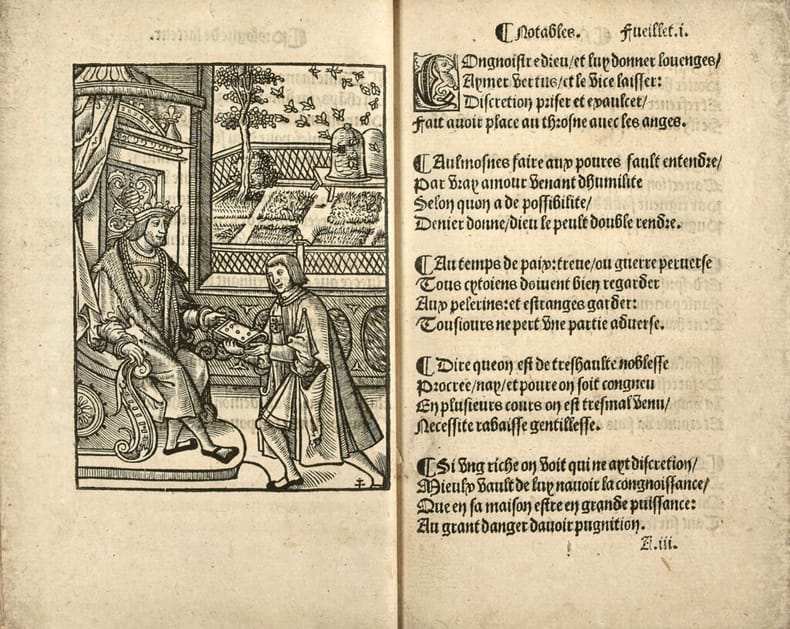
LCS-18428La moitié des pièces paraissent ici pour la première fois. Elle est si rare que Tchemerzine ne cite qu’un exemplaire incomplet. On les vend a Paris en la rue Saint-Jaques a lenseigne de Lelephat devant les Mathurins. A la fin:… Imprimez a Paris p Nicolas Couteau imprimeur demourant audit lieu et furent achevez dimprimer le xxvie iour du moys de Janvier / Lan de grace mil cinq cens vingt et huyt. 1528. In-8 de (2) ff. y compris un bois gravé à pleine page, cxxiii ff., (1) f. avec la marque à l’éléphant de François Regnault au verso. Pte. restauration au titre imprimé en rouge et noir. Maroquin rouge janséniste, dos à nerfs, double filet or sur les coupes, roulette intérieure dorée, tranches dorées sur marbrures. Reliure signée de Chambolle-Duru. 156 x 102 mm.
Une page petit in-4. Suscription. À "mon cher Hérold": "[...] Dites si ce n'est pas bien exigeant de vous demander de reprendre demain soir Mardi le chemin de la rue de Rome, parce que je voudrais prendre votre avis sur un rien tout en causant [...]". - En 1888, le tout jeune poète (Hérold est né en 1865) fait parvenir spontanément au Maître son premier recueil de poésie "L'Exil de Harini" que Dalou venait de publier. L'accueil de Mallarmé lui fut d'emblée favorable et Hérold allait devenir un des plus fervents affidés des célèbres Mardis de la rue de Rome, où se croisèrent entre 1880 et 1898, Verlaine, Gide, Louÿs, Régnier, Whistler, etc. autant de visiteurs illustres ou poètes inconnus qui participèrent à la légende mallarméenne des Mardis, ces réunions hebdomadaires où le Maître improvisait, debout, fumant la pipe, face à des disciples dévots de la génération post-symboliste. - A.-J. Ferdinand Hérold est le petit fils du compositeur Ferdinand Hérold (l'auteur du Pré-aux-Clercs). Entré à l'École des Chartes en 1885, il en sort trois ans plus tard pour se consacrer entièrement à la littérature qu'il servit au cours de sa vie avec beaucoup d'intelligence et de sensibilité poétique. Il s'immisce parmi les auteurs symbolistes, fréquente assidument les Mardis de Mallarmé, et noue une vive amitié avec son coreligionnaire le poète Pierre Louÿs dont il se séparera au moment de l'Affaire Dreyfus. Très lié au cercle des Heredia (les sœurs Heredia), Régnier, Gautier (par Judith Gautier, la fille de Théophile), Louÿs et Valéry, ami des musiciens Fauré et Ravel, il fut un contributeur avisé au Mercure de France d'Alfred Vallette. Poète, mais aussi auteur dramatique, traducteur d'Eschyle et d'Euripide, plusieurs de ses pièces furent représentées sur la scène du théâtre d'avant-garde de Lugné-Poë (L'Anneau de Çacuntala en 1895, ainsi que La Cloche engloutie, tirée du conte de G. Hauptmann, deux ans plus tard).
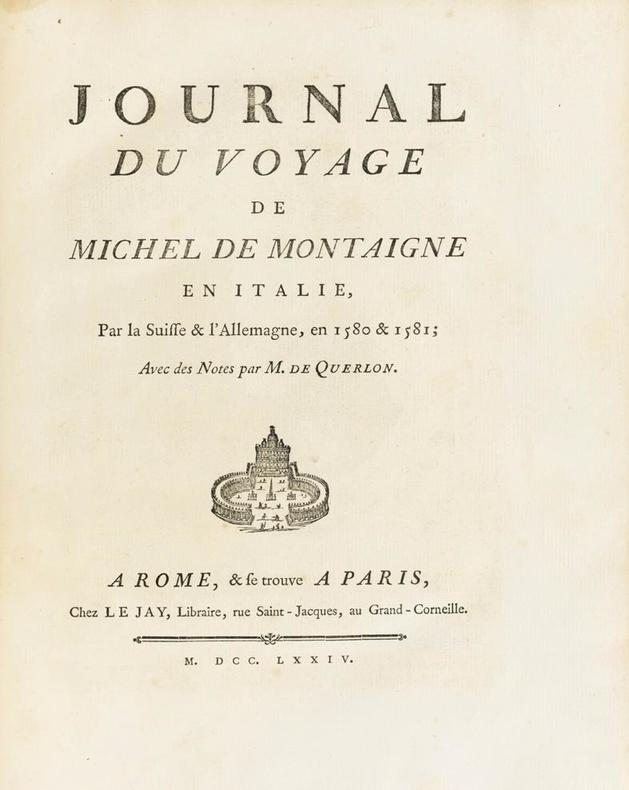
1774YTB-5Le Jay - J. Tonson & J. Watts (1774) 2 ouvrages en 4 volumes in-4 de : I/ (1) f. pour le portrait, (2) ff., XV pp., (4) ff., 363 pp., (6) ff., XVIII pp., (1) f. bl., (1) f., 95 pp. ; II/ 538 pp., (8) ff. de table.; III/ (1) f.,411 pp., (12) pp. de table ; IV/ (1) f. pour le portrait, (4) ff., LIV et 416 pp. Maroquin bleu nuit, triple filet or encadrant les plats, dos lisses richement ornés, pièces de titre et de tomaison en maroquin rouge, double filet or sur les coupes, roulette intérieure dorée, tranches dorées. Reliure de l’époque. 289 X 230 mm. EXCEPTIONNELLE REUNION, EN TRES BELLE RELIURE HOMOGENE EN MAROQUIN DU TEMPS, DE L’EDITION ORIGINALE IN-4 DU VOYAGE DE MONTAIGNE ET DE LA PREMIERE EDITION COMPLETE DES ESSAIS. LES EDITIONS ANCIENNES DES « Essais » DE MONTAIGNE EN MAROQUIN DE L’EPOQUE ONT DE TOUT TEMPS ETE RECHERCHEES. SUPERBE ET PRECIEUX EXEMPLAIRE, GRAND DE MARGES (hauteur : 289 mm), SUR GRAND PAPIER, CONSERVE DANS SON MAROQUIN BLEU NUIT DE L’EPOQUE. L’exemplaire répertorié par Philippe Desan mesurait 283 mm de haut et l’exemplaire répertorié par André Pottiée-Sperry : 285 mm. Tchemerzine ne cite que 3 exemplaires, tous reliés en veau ancien : « Bénard, 4000 frs ; Roussel, 1300 frs ; De Backer, 3650 fr. ». EXCEPTIONNELLE REUNION DES ESSAIS ET DU JOURNAL DE MONTAIGNE CONSERVES DANS LEUR RELIURE HOMOGENE EN SUPERBE MAROQUIN BLEU NUIT DU TEMPS.
1450258541450. <blockquote><p>The sole known surviving piece of a once vast and grand 15th century ""Faits des Romans"" doubtless for a noble patron of enormous wealth.</p><p> </p><p>The artist is a follower of the Coëtivy Master</p></blockquote><p><strong>The twin nostalgias of Europe— one for the powerful all-encompassing Roman Empire the other for connecting with the mysterious pre-Roman peoples— combine in this 15th century French illumination of Caesar’s final and questionably successful encounter with the Britons led by Cassivellaunus. While Caesar won this battle his dream of a conquered and Roman Britain would not be realized within his lifetime. His legacy however was studied admired and immortalized far after his fatal betrayal by Brutus. This illustration captures this historic moment of Caesar’s triumph the beginning of the end for the Britons and the cultural legacy as viewed during the waning of the Middle Ages.</strong></p><p><a href=""https://cdn.raabcollection.com/wp-content/uploads/20231204135204/A-2.jpg""><img class=""alignnone size-post-window wp-image-25868"" src=""https://cdn.raabcollection.com/wp-content/uploads/20231204135204/A-2-1600x632.jpg"" alt="""" width=""1600"" height=""632"" /></a></p><p>In the nineteenth century European medievalists began shoring up their nations’ relationships with medieval literature to try to create firm claims of their peoples’ innate heroic attributes their noble histories their glorious pasts. This led for example to the French identifying themselves with the Chanson de Roland and the English lionizing King Arthur. But the desire to have these medieval roots overshadowed the more complicated histories: the Chanson de Roland though composed in French is about an emperor best known by his French name Charlemagne but who was born in Aachen Germany and is buried there. The first legends of King Arthur from the 9th century reflecting a much earlier time came from Wales a nation suppressed by the English and the major inventions in the narrative like the love story of Guinevere and Lancelot and the Round Table were invented in France. Though English storytellers engaged with Arthur and his knights it wasn’t until Thomas Malory in the 15th century that Arthur became English.</p><p>During the Middle Ages Rome was the empire to draw connections to for auctoritas. This is why the empire established by Charlemagne became known as the Holy Roman Empire. Though the term was not in use until the 13th century the Emperors were instilled with translation imperii-- a transfer of rule directly inherited from the historic emperors of Rome.</p><p>One aspect of Rome that was particularly admired in the Middle Ages was the conquering and bringing into Civilization of the barbarians north of the Alps and west of the Rhine that includes Caesar's foray into England and his confrontation with Cassivellanus. Cassivellaunus was likely the chief of the Catuvellauni of Hertfordshire whose tribal name translates to ‘war-chiefs’. In British accounts he appears in Welsh literature ranging from Geoffrey of Monmouth’s chronicle about the history of the Kings of Britain in both Latin Historia regum Britanniae and Welsh Brut y Brenhinedd to the more folkloric-based Trioedd Ynys Prydein The Triads the second branch of the Mabinogi and Cyfranc Lludd a Llefelys The Adventure of Lludd and Llefelys. The British chieftain even appears briefly in the Greek Stratagemata by Polyaenus. The Latin literature of course written by the winners includes Julius Caesar’s own Commentary de Bello Gallico Commentary on the Gallic War.</p><p>During the account of his second campaign in Britain from Gaul in 54 BCE after a failed first a year earlier Caesar writes that Cassivellaunus was a rabble-rouser conquering the Trinovantes the most powerful British tribe perhaps how the tribe received their appellation of ‘war-chiefs’. Though his location was betrayed by the Cenimagni Segontiaci Ancalites Bibroci and Cassi who had surrendered to Caesar Cassivellaunus gathered the forces of the Kentish kings Cinetorix Varvilius Taximagulus and Segovax. The tribes retreated to higher ground when they saw the sheer masses of Romans that Caesar had brought to avert the same failure of preparedness he suffered the year before. The legions established their military camp on the beaches and sought out the Britons. As they searched their party was harassed by Britons on chariots; it was chariots which had given the edge to the British during Caesar’s first invasion. About 12 miles away he encountered Cassivellaunus’ forces at a hillfort at the River Stour. A storm destroyed Caesar’s fleet of ships and the repair gave the Britons time to regroup and rally behind Cassivellaunus.</p><p>Previously the Britons operated as independent tribes; under Cassivellaunus these tribes became an army growing with more tribes coming to support Cassivellaunus. Their knowledge of the land and their use of chariots created a powerful enemy against Caesar’s army which was not used to fighting such a chaotic force. Had the Britons continued this strategy history might have played out differently; however they appeared to try to meet the Romans head-on in large-scale battle a tactic at which the Romans were well-practiced and deadly.</p><p>Cassivellaunus’s attempt to attack a foraging party as had been done to the Briton’s success in 55 BCE was the beginning of the end for the Britons now. Though he had unified some of the tribes the Trinovantes remained staunchly against Cassivellaunus since he murdered their king. The murdered king’s son bargained with Caesar— his tribe would support Rome and Rome would defend the tribe from any retribution. This gave the Romans a newfound understanding of the land and the warfare tactics of the Britons. Once again the tribes were divided which inclined them to making alliances with Rome. The final two-fronted battle between the Romans and Britons saw British defeat. It is this routing of the British charioteers that the French illuminator included in this illustration of the Faits de Romains some 1500 years later.</p><p>The Britons essentially defeated Caesar sent Commius the King of the conquered Atrebates to negotiate peace. Cassivellaunus agreed to paying tribute. In writing up the terms Caesar used specific legal terms which would eventually make Britain a province of Rome. But this would not come to pass before Caesar’s untimely death on the Roman Senate floor nearly a decade later. It would be another century before Britain came truly under Roman rule.</p><p>In 13th century medieval writers began to compile works by Caesar Lucan Suetonius and Sallust retelling Caesar’s life in the format of a chanson des geste a song of deeds— the same genre as the Chanson de Roland. The text which is listed under many names but most commonly Faits des Romans grew very popular from 14th century onwards with over 50 manuscripts now recorded – these usually grand commissions for noble reading with many miniatures set into the text columns opening significant chapters of which this extract serves as an example.</p><p>This miniature depicts the great scene introduced above: Caesar's confrontation with the Cassivellanus during the former's great invasion of Britain.</p><p><strong>Caesar routing the chariot-mounted forces of the British cheiftain Cassivellanus miniature on a cutting from an illuminated manuscript of the Faits des Romains</strong></p><p>France most probably Paris mid-15th century. The illuminator represented the two armies in armor contemporary with his own time— the armor of chivalric knights— rather than the Roman legion outfits of Caesar’s time and blue-painted leather-clad attire of the Britons. Differentiation between the Britons and the Romans is made by the Britons wearing blue and white tunics over their armor and using bows while the Romans have pikes and silver armor without tunics with the exception of a figure who may be Commius a Celt-turned-Roman-ally.</p><p>An historic cutting of an illumination on verso and 16 lines of one of two original columns of text on recto. 128x98mm in total. Text column of 102mm on verso. Written in Middle French in a Gothic bâtarde script with minimal abbreviations for legibility. Some oxidation from the silver-gilt on the illustration have bled through to the text side but still legible. Illumination is flanked on both sides by blue and gold acanthus leaves and green-leaved penwork-foliage. Illuminator applied silver to highlight the armour of the armies and gold touches to illuminate Caesar himself.</p><p>The artist is a follower of the Coëtivy Master worked in Paris c. 1450-85 and shares that artist’s simple but delicate facial modelling as well as his love of finely depicted drapery.</p><p>What remains of the text here allows us to see that this miniature came from a very grand manuscript almost certainly produced at vast expense for an important noble patron. Its text was clearly in two columns like many grand copies of the text with column-wide miniatures set at the head of crucial chapters. Examination of other copies of the text shows that about 3700 characters of text are missing between the foot of the miniature on the recto and the first partial line of text on the verso here. With an approximate average line length of 41 characters here this allows us to predict that the miniature here most probably sat in the inner column of the recto and thus some 90 lines of text are missing between its foot and the first line of text on the other side. Allowing for two columns this indicates that each column had 45 lines plus the 12 lines on the verso of this fragment allowing us to predict that the text on each page of the parent manuscript was approximately 57 lines in height. This is more than the 50 lines in some of the grandest surviving manuscripts such as BnF Fr. 64 made in the fifteenth century for an unknown noble patron. In addition as the cutting here gives us measurements for the column width 95mm. and the line height 5mm. we can further calculate that the parent codex of this cutting had a text block of approximately 285 by 220mm. the last 9595mm. plus 30mm. for an approximate gutter measurement. BnF Fr. 64 has a text block that measures 278 by 200mm. and a complete size including borders of 430 by 315mm - comparable to the copy from the library of the Comte d'Angouleme Fr. 250: 420 by 317mm. but far smaller than that made for a member of the De Fou family and later taken into the fine library of Cardinal Richelieu Fr. 23084: 345 by 245mm. and with only one miniature. The parent codex of the present miniature must have been on the same scale as Fr. 64 and 250 if not slightly larger. It was a vast codex produced on a scale to impress through its sheer opulence doubtless for a noble patron of enormous wealth.</p><p><img class=""alignnone wp-image-25018 size-post-window"" src=""https://cdn.raabcollection.com/wp-content/uploads/20231204144051/Folder-site-11-1600x1327.jpg"" alt="""" width=""1600"" height=""1327"" /></p> hardcover
- Emile-Paul frères, Paris 1913, 16x20,5cm, broché sous étui et chemise. - Edition originale, un des très rares exemplaires imprimés sur papier vert pour l'auteur dont il n'a été tiré que 6 ou 10 exemplaires (d'après la correspondance d'Emile-Paul), tirage en grand papier le plus restreint avant les 10 Japon et les 20 Hollande. Notre exemplaire possède une couverture verte comme tous les autres grands papiers, avec au centre du dos la mention imprimée « Exemplaire sur Hollande », d'autres exemplaires sur papier vert portant, selon les bibliographes, un simple fleuron central. Notons cependant que l'inventaire exhaustif des différentes couvertures vertes reste à établir et que les bibliographes n'ont notamment pas encore relevé cette particularité ni l'existence de deux type d'inscriptions : « Exemplaire sur / Hollande » en deux lignes (comme sur cet exemplaire) et « Exemplaire sur Hollande » sur une ligne (comme sur l'exemplaire de Madame Simone). L'insigne rareté des exemplaires d'auteur sur papier vert ne permet malheureusement pas de statuer en ce domaine et le seul exemplaire passé en vente ces dernières années (chez Christie's en avril 2014) ne comportait pas le dos de la couverture. Dos légèrement éclairci comme souvent et témoins passés. Notre exemplaire est présenté sous chemise en demi maroquin bleu marine, dos à cinq nerfs sertis de filets vert, date et mention « Exemplaire sur papier vert » dorées en queue, plats de papier marbré, étui bordé de maroquin bleu marine, plats de papier marbré, intérieur de feutrine grise, élégant ensemble signé de Lavaux. Précieux et rarissime exemplaire à toutes marges du tirage le plus court en grand papier. [ENGLISH DESCRIPTION ON DEMAND]
- Librairie moderne & Maison Quantin, Paris 1889, 13x19cm, relié. - Edition originale, un des12 exemplaires numérotés sur papier de Hollande, seul tirage en grand papier. Exemplaire complet de son plan dépliant in-fine. Reliure en plein maroquin fauve, dos à cinq nerfs, date en queue, contreplats de papier peigné bordés d'une riche roulette dorée, gardes de papier peigné, filet doré sur les coupes, roulette dorée sur les coiffes, couvertures et dos conservés, toutes tranches dorées sur témoins, étui bordé de maroquin fauve, ensemble signé Semet et Plumelle. Provenance : des bibliothèques du Docteur André Chauveau, Lucius Wilmerding et RBL avec leurs ex-libris encollés. Magnifique exemplaire d'une insigne rareté en grand papier. [ENGLISH DESCRIPTION ON DEMAND]
Large 4to and (oblong 8vo). Altogether (2+2+1 =) 5 pp. on 3 ff. With one autogr. envelope. To the German publisher Joseph Melzer, on being distressed by Melzer's fate, which he had to go through during these days. He had spoken to Margarete Susman in Zurich on that case, and recommends the German writer Paul Schallück to whom Melzer should turn to as the only one "who has a hand to help and an ear to listen [...] You see: I have just a word of helplessness to say ... and only a little hope searching for a space in what we have in common [...]" (7. VI. 1963; transl. from the German original). - Each with punched holes (not touching text).
Large 4to. German manuscript in brown ink on paper. 1½ pp. on 1 f. An early version of Celan's poem "Chanson einer Dame im Schatten" that was first published in the 1952 poetry collection "Mohn und Gedächtnis": "Wenn die Schweigsame kommt, die die Tulpen köpft: | Wer gewinnt? | Wer verliert? | Wer tritt an das Fenster? | Wer nennt ihren Namen zuerst? | Es ist einer, der trägt mein Haar. | Er trägts wie man Tote trägt auf den Händen. | Er trägts wie der Himmel mein Haar trug im Jahr da ich liebte. | Er trägt es aus Eitelkeit so. | Der gewinnt. | Der verliert nicht. | Der tritt nicht ans Fenster. | Der nennt ihren Namen nicht [...]". - The only discrepancy between this manuscript and the published version concerns the first line where Celan changed "die die Tulpen köpft" to "und die Tulpen köpft". - Celan presented this manuscript as a gift to Diet Kloos-Barendregt in August 1949. Kloos-Barendregt (1924-2015) was a Dutch singer and resistance fighter whose husband had been executed by the Nazis in 1945. During a brief stay in Paris she met Paul Celan by chance at the Café Dupont in August 1949. They immediately formed a connection over their traumatic experiences and losses and started a romantic relationship. - Traces of folds. Minimally creased and minor browning. With punch holes, a paper clip stain to the upper margin, and insignificant tears. Provenance: from the estate of Diet Kloos-Barendregt, Bubb Kuyper auctions, November 2021. P. Celan, Mohn und Gedächtnis (Stuttgart, DVA, 1952). Cf. Paul Celan, Du mußt versuchen, auch den Schweigenden zu hören. Briefe an Diet Kloos-Barendregt. Handschrift - Edition - Kommentar (ed. by P. Sars, Frankfurt a. M., 2002).
LCS-1864085
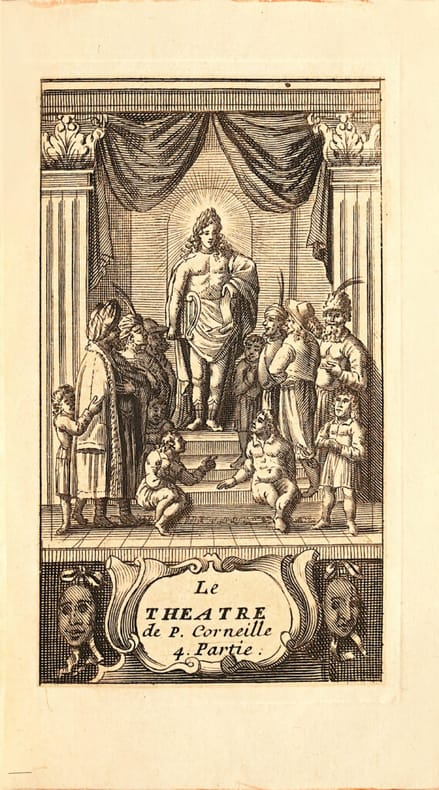
LCS-18596Rarissime exemplaire de premier tirage complet des 4 frontispices de l’édition originale définitive du Théâtre de Pierre Corneille. A Paris, chez Guillaume de Luyne, Libraire Juré, au Palais, en la Galerie des Merciers, 1682. Avec Privilège du Roy Partie 1 : frontispice gravé, portrait de Corneille, xcviij pp. (y compris le titre), (1) f. pour le titre de Mélite, 586 pp. et (1) f. pour le Privilége. Le portrait de Corneille ne porte pas de signature ; il représente le poëte dans le costume des premières années du règne de Louis XIV : perruque, calotte et rabat. Partie 2 : frontispice gravé, cx pp., (1) f. pour le titre du Cid, 597 pp., (1) p. pour le Privilège. Il y a deux sortes d'exemplaires de cette IIè Partie ; les uns comptent 597 pp. et contiennent un Extrait du Privilège au verso de la p. 597 ; les autres n'ont que 596 pp. et l'Extrait du Privilège y occupe le recto du feuillet suivant. Cette différence vient de ce que, pendant le tirage, Corneille a supprimé vingt vers dans la scène Vè du cinquième acte dé Théodore (p. 587). La feuille Bb, dernière du volume, s'est ainsi trouvée subir un remaniement complet. Partie 3 : frontispice gravé, lxxxiv pp., (1) f. pour le titre de Rodogune, 618 pp. et (1)f. pour le Privilège. Partie 4 : frontispice gravé, xxij pp., (1) f. pour le titre de Sertorius, 591 pp., (1) p. pour le Privilège. 4 in-12 reliés en veau fauve, dos à nerfs ornés, deux mors faibles, tranches rouges. Reliure de l’époque sortant de l’Atelier de Jean Le Vasseur, relieur du roi Louis XIV. Réf: Bibl. R. Esmérian, Paris, 8 décembre 1972, n° 63). 151 x 85 mm.
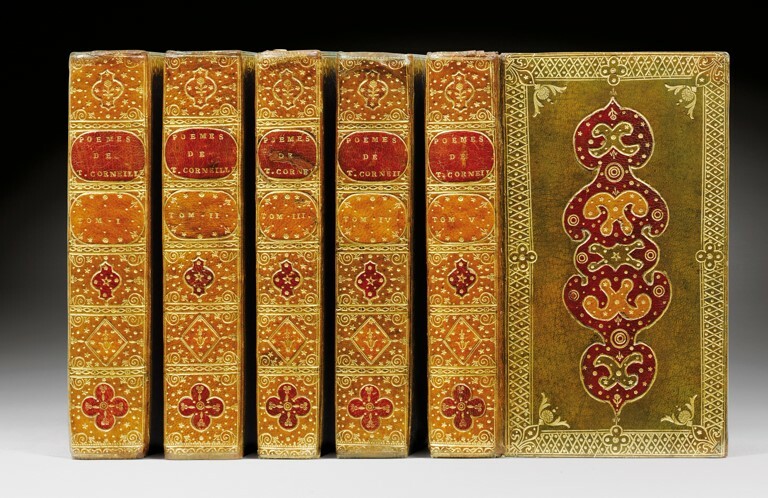
YTB-35Paris, 1738. 5 volumes in-12, maroquin olive, fine roulette en poignée de tiroir encadrant les plats des tomes I, III et IV ; roulette aux croisillons et semé de points dorés aux tomes II et V. fleurs de lys ou fleurons quadrilobés aux angles, vaste motif central chantonné avec mosaïque de maroquin rouge et citron différent sur chacun des cinq volumes, dos lisse richement orné et mosaïqué avec pièce de maroquin rouge et citron, coupes décorées, roulette intérieure, doublures et gardes de papier doré orné de motif en relief, tranches dorées. Étui de maroquin havane. Reliure mosaïquée de l’époque attribuée à l’Atelier des Petits Classiques. 167 x 100 mm EXCEPTIONNELLE REUNION DE CINQ VOLUMES ENTIEREMENT DECORES ET MOSAÏQUES PAR L’ATELIER DES PETITS CLASSIQUES, LA SEULE REPERTORIEE SUR LE MARCHE AU COURS DU SIECLE ECOULE. Cet Atelier fut ainsi dénommé par Michon dans « les Reliures Mosaïquées du XVIIè siècle » comme s'étant spécialisé dans la reliure des petites éditions d'écrivains classiques du type Elzevier. Michon ne connaît que 9 reliures sorties de cet atelier actif de 1720 à 1738. Outre la richesse des fers employés, — points et pointillés dorés, étoiles, fleurettes, volutes et cercles évidés, roulette, cordons, fleurs de lys, coquilles, tulipes — la diversité des décors mosaïqués et l'harmonie des dos, la réunion même de cinq volumes ainsi reliés constitue l'un des temps forts de l'histoire de la reliure mosaïquée de la première moitié du XVIIIè siècle. Magistrale œuvre de transition, elle allie l’emploi des petits fers utilisés au siècle précédent à la technique de la mosaïque dont le but est précisément de réduire l’importance accordée à ces petits fers dorés. L'emploi de couleurs autres que l'or permet en effet au relieur de se libérer des lignes droites ou des formes géométriques pour la première fois depuis 1550 et les premières tentatives de reliures mosaïquées s'agencent alors en de grandes courbes rococo. Prestigieux ensemble, du plus haut intérêt pour l’histoire de la reliure. RARISSIME EXEMPLE REUNISSANT CINQ VOLUMES EN MAROQUIN DECORE ET MOSAÏQUE SORTI VERS 1738 DE « l’Atelier des Petits Classiques », PRESENTANT LES CHEFS-D’ŒUVRE DE THOMAS CORNEILLE (1625-1709). Provenance : Mortimer L. Schiff ; Baronne de Faucigny-Lucinge ; Famille Rothschild ; Baron Alexis de Rédé.