859 132 résultats
LCS-186433
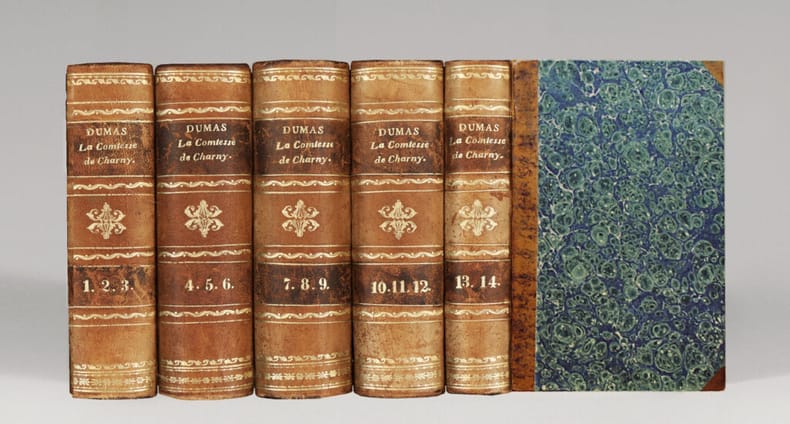
LCS-17792Edition originale rarissime - l’édition française se poursuivra jusqu’en 1855 - de l’un des remarquables romans historiques d’Alexandre Dumas dont un feuilleton télévisé vient d’être adapté. Bruxelles, Méline, 1852-1854. 14 tomes en 5 volumes in-12 de : I/ (2) ff., 273 pp., (2) ff., 268 pp., (2) ff., 270 pp. ; II/ (2) ff., 266 pp., (2) ff., 265 pp., (2) ff., 270 pp. ; III/ (2) ff., 275 pp., (2) ff., 261 pp., (2) ff., 258 pp.; IV/ (2) ff., 266 pp., (2) ff., 253 pp., (2) ff., 245 pp.; V/ (2) ff., 278 pp., (2) ff., 232 pp. Demi-veau havane marbré à coins, dos lisses ornés, tranches jaunes. Reliure de l’époque réalisée pour la duchesse de Berry avec l’étiquette de la bibliothèque de son château de Brunsee. 149 x 97 mm.
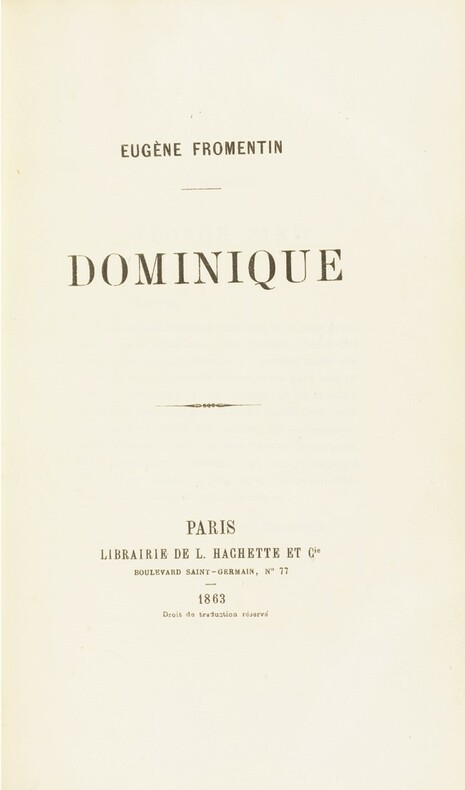
1863YTB-32Paris, Librairie de L. Hachette et Cie, 1863. Paris, Librairie de L. Hachette et Cie, 1863. In-8 de (1) f. bl., (3) ff. de faux-titre, titre et dédicace, 372 pp. Demi-chagrin rouge, plats de papier marbré, dos à nerfs orné de filets à froid, titre doré, tranches jaspées. Reliure de l’époque. 216 x 130 mm. EDITION ORIGINALE DU SEUL ROMAN D’EUGENE FROMENTIN, DEDIE A GEORGE SAND. Dominique a paru primitivement dans la Revue des Deux Mondes (15 avril 1862). Clouzot, 124 ; Carteret, I, pp.307-310 ; Vicaire, III, 840 ; Talvart, VI, pp.226-227, 4A; Rahir, Catalogue, VI, 1942. NOTRE EXEMPLAIRE PORTE CET ENVOI AUTOGRAPHE DE L’AUTEUR : « A monsieur J. Pelletier Hommage de gratitude très vive et de dévouement, Eug. Fromentin ». « Les grands papiers sur Hollande et de format in-8 sont fort rares. » (Clouzot). EXEMPLAIRE IMPRIME SUR GRAND PAPIER DE HOLLANDE, « tirage à très petit nombre et d’une très grande rareté » (Carteret). EXEMPLAIRE DE PREMIERE EMISSION avec la faute à la page 177, « en sueur » qui sera corrigé en « censeur » et la faute qui n’existe que dans les grands papiers p.191 « je reçus » au lieu de « je relus ». La parution de Dominique, s’inspirant des amours de Fromentin avec Madame Howland, suscita dès sa sortie l'admiration de toute la jeune école naturaliste. Flaubert qui était sur le point de se mettre à travailler à la version révisée de L’Education sentimentale, écrivit à Fromentin qu’il avait lu son roman d’un seul coup : « Je brûle de l’envie de vous voir pour en causer et pour vous en féliciter. » Le 20 janvier 1863, Ludovic Halévy déclarait à Fromentin que Dominique resterait « une des œuvres les plus touchantes et les plus complètes de la littérature de tous les temps. » « Eugène Fromentin (1820-1876) est un grand peintre qui fut, la plume à la main, un artiste aussi délicat que lorsqu’il maniait le pinceau. » (Carteret). L’UN DES TRES RARES EXEMPLAIRES SUR PAPIER DE HOLLANDE, DE PREMIERE EMISSION, CONSERVE DANS SA RELIURE DE L’EPOQUE ET ENRICHI DE CET ENVOI AUTOGRAPHE DE L’AUTEUR : « A monsieur J. Pelletier Hommage de gratitude très vive et de dévouement, Eug. Fromentin ». Jules Pelletier, conseiller d’Etat et secrétaire général au ministère des Finances en 1863 (ministère Fould), fut approché par Baudelaire entre 1858 et 1862 pour obtenir une subvention de la maison de l’Empereur.
Folio (321 x 200 mm). 3½ pp. on 4 ff. Autograph emendations and cancellations in black ink, editorial annotations in pencil and pink ink in another hand (each of the first three leaves in two pieces and repaired with thick tape). An intriguing autograph manuscript by Kipling for a satirical short story. Written to be published in the Pall Mall Gazette, "Things As They Are" never appeared there and is not published in any of the collected editions of Kipling's work. Kipling recounts the details of a conversation between "That very terrible deity The God of things as They are" and the British public, imagined here as a teething kitten, on the failure of most artists to truly grasp the beauty of the world around them. - The manuscript was written by Kipling for the Pall Mall Gazette under the condition that his name not be attached to it; the editor, Harry Cust, refused to grant this anonymity, so Kipling declined to have it published. Rudyard Kipling was just one of the literary luminaries enticed to join the ranks of contributors to William Waldorf Astor's Gazette under the editorship of Harry Cust, who transformed the publication into one of the best respected evening journals of the time after his appointment in 1892; alongside Kipling, it featured work from H. G. Wells, Algernon Swinburne, Jack London, and Joseph Conrad. The manuscript was probably written between 1892 and 1896: Kipling writes on the same theme in an article published by The Times on 20 August 1892 entitled "Half-a-Dozen Pictures", and by 1896 Cust had ceased to edit the Gazette.
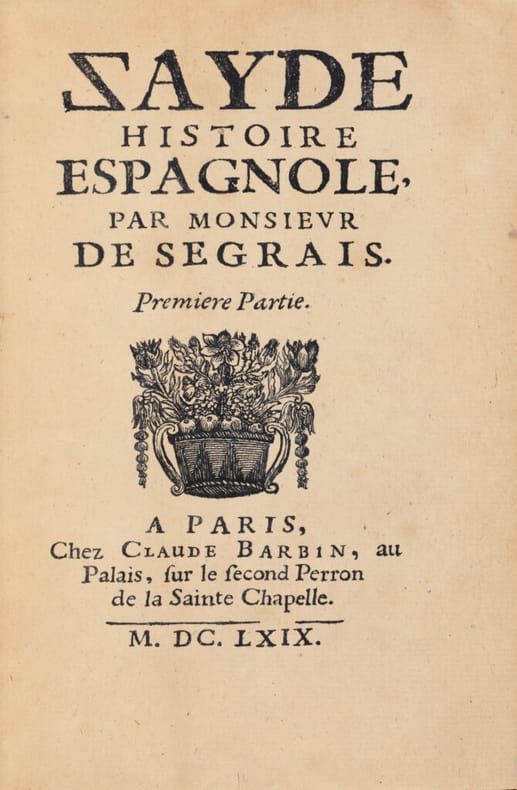
LCS-18287Edition originale de ce roman précieux de Madame de La Fayette publié sous le nom de Segrais. Paris, Claude Barbin, 1669-1671. 2 volumes petit in-8 de : I/ 99 pp. pour la Lettre de Huet, (1) p., 441 pp., (1) p. ; II/ (2) ff., 536 pp. Plein maroquin bleu nuit, double filet à froid encadrant les plats, dos à nerfs ornés de filets à froid, double filet or sur les coupes, large roulette dorée intérieure, tranches dorées sur marbrures. Niedrée. 160 x 100 mm.
LCS-1864022
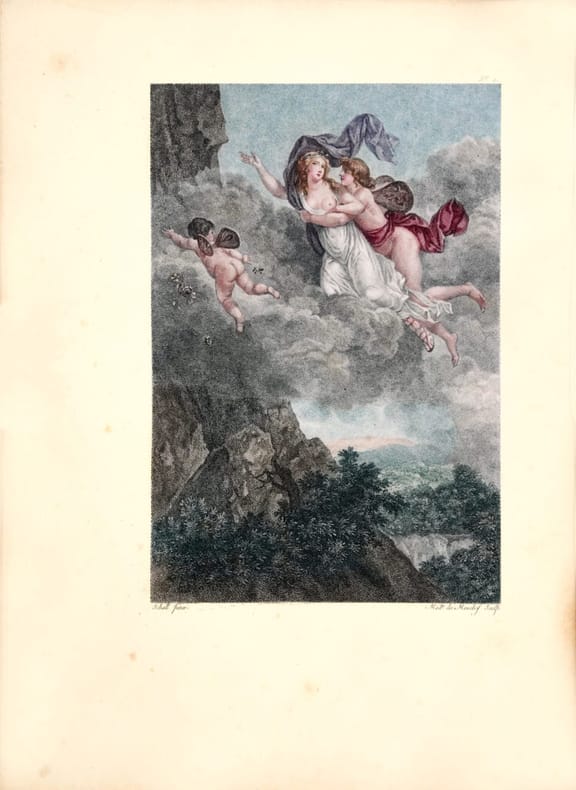
LCS-18574Superbe exemplaire relié en maroquin citron de l’époque. Paris, Didot Jeune, 1791. Grand in-4 de 163 pages et 4 planches hors-texte. Maroquin citron, filets, chainettes et roulettes dorés encadrant les plats, dos à nerfs orné de fleurons dorés et de roulettes à la grecque en tête et en pied, double filet doré sur les coupes, roulette intérieure dorée, doublures et gardes de tabis bleu, tranches dorées. Reliure de l’époque. 329 x 248 mm.
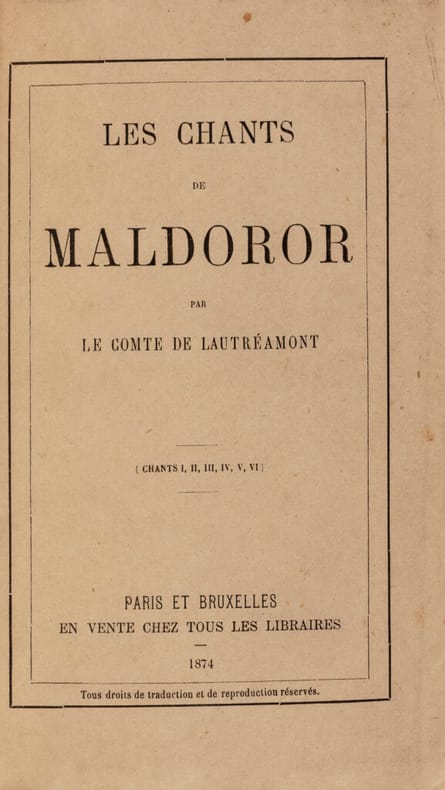
LCS-18399Précieux exemplaire à toutes marges, avec témoins, relié avec ses couvertures conservées, de ce livre majeur dans l’histoire de la littérature française. Paris et Bruxelles, 1874. In-12 de 332 pp., (1) f. Demi-maroquin brun à coins, dos à nerfs, tête dorée sur témoins, couvertures beiges imprimées et dos conservés. Reliure signée Blanchetière, vers 1915. 188 x 115 mm.
Zusammen ca. 75 SS. auf 17 Doppelbll. und 4 Einzelbll. Meist kl.-8vo und 8vo. An die Schriftstellerin Rosa von Gerold, u. a. über Alexander von Warsberg, den "Reisemarschall" von Kaiserin Elisabeth, der das geistige Konzept zu Elisabeths Achilleion auf Korfu geliefert und auch Grundstücke hierzu erworben hatte. Schwer lungenleidend hatte er, der regelmäßig in Gerolds Wiener Salon zu Gast gewesen war, Malwida von Meysenbug im Mai 1889 nach Venedig an sein Sterbebett gerufen: "Wünscht er daß ich komme, so werde ich mich beeilen hinzugehen und dann bitte ich sehr, daß Sie auch kommen. Der Palazzo ist so eingerichtet, daß er uns nur zu sehen braucht wenn er es wünscht u. daß wir nicht für ihn da sind, wenn er allein bleiben will. Vereint aber können wir es vielleicht zu Stande bringen ihm sein Haus so einzurichten, daß er endlich in Frieden leben kann wenn er uns erhalten bleibt [...]" (10. V. [1889]). - "Es bleibt ein seltsames Rätsel, dieses, gewiß in jeder Beziehung tugendhafte, untadelhafte Leben, das nicht an Excessen, sondern an falschen Ideen über Hygiene zu Grunde ging [...]" (19. VII. [o. J.]). - Malwida erläutert, wie lebensspendend ihr die Freundschaft mit Warsberg war, wie unangenehm das Klima im Norden sei und dass sie der Kaiserin Elisabeth die Schuld an Warsbergs Tod gebe: "Ehe er in mein Leben trat, war ich so völlig resignirt [...] Nun kam mir plötzlich, ganz ungesucht u. ungeahnt, diese Sympathie entgegen, die das Echo in mir weckte und zu einem Bund wurde wie ihn reine Geister, befreit von allem irdischen Beisatz, schließen mögen. Das Leben wurde mir wieder für mich selbst lieb und es schien als solle der Abend meines Lebens zu einem schönen Sonnenuntergang werden [...]" (24. VII. [o. J.]). "Ach ja, je mehr man sich losgelöst fühlt vom Leben und den unbekannten ewigen Sphären näher, je mehr bedarf man nach der Sonne und der Lieblichkeit des Südens um sich den Befreier als den schönen Genius mit der umgekehrten Fackel nahen zu sehen und ihn lächelnd zu grüßen. Im Norden nur, unter dem grauen Nebelhimmel und im Dunkel der Catakomben konnte das Bild des häßlichen Sensenmanns entstehen. Gesegnet sei mir der Süden, der die Seele mit milden Entsagungen füllt. Ich begreife die Kaiserin, mit Ihrem Corfuasyl, wenn ich sie gleich hasse[,] weil sie unseren Freund damit getödtet hat. Ihr persönlicher Zauber muß sehr groß sein[,] denn sie hat Gustav W[arsberg] jetzt auch ganz eingenommen, so daß er nicht zugeben will, daß die Corfu[-] und Wien-Reisen Schuld an dem jähen Tode Alexander's sind [...]" (23. XII. 1889). - Das Kennenlernen der beiden Damen wird von Paris wegen "Zahnweh" ("Ich bin noch so entstellt und geschwollen [...]") nach Versailles verlegt. Nachrichten über ihr Leben und Erinnerungen folgen in späteren Briefen: "Ich lebe wie immer still, nur auf den Umgang mit wenigen alten Freunden beschränkt, in den dann manchmal eine neue Erscheinung, mir von auswärts gesandt, herein schneit. Interessant war unter den Letzteren, übrigens dieser mir von lange her befreundet, nur Gregorovius und im nächsten Monat erwarte ich Lenbach. Das Übrige zieht vorüber wie in einer Lanterne magique und hinterläßt kaum eine Spur. Nein, Einen muß ich doch noch aufnehmen: Klaczko, den polnischen Patrioten [...]" (17. I. 1890). - Vereinzelt etwas gebräunt. Beiliegend einige Zeitungsausschnitte. Zu Malwida von Meysenbug und Alexander Warbserg vgl. Ruth Stummann-Bowert: Malwida von Meysenbug - Paul Rée. Briefe an einen Freund. Würzburg, Königshausen & Neumann, 1998, S. 34f.
Various formats. Altogether 22 pp. on 12 ff. Fine correspondence with the German writer Arthur Kahane (who, from 1905 to 1932, served as dramatic advisor to Max Reinhardt's Deutsches Theater) and Margaret on various topics, including private affairs, ongoing projects for Reinhardt and his work as a translator, and about reading Flaubert, whose "letters are splendid, especially those to Mme X and George Sand [...]" (14 Aug. 1907).
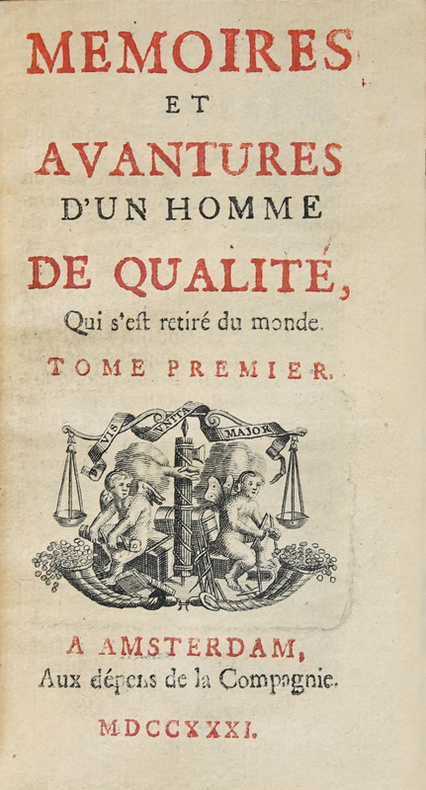
LCS-17958Le plus précieux exemplaire cité par Brunet. Amsterdam, Aux dépens de la Compagnie, 1731. 7 volumes petit in-12. « Sept vol. pet. in-12 de (2) ff., 218 pp et (1) f.bl., 173 pp. et (1) f.bl. ; (1) f. et 232 pp. ; (1) f., 221 pp. et (1) f.bl. ; (4) ff. dont 1 bl. et 288 pp. ; (2) ff. dont 1 bl. et 283 pp., (2) ff. dont 1 bl. et 344 pp. (Le relieur n’a pas conservé les ff. blancs). Le septième volume contient l’édition originale de Manon Lescaut. Les tomes I, III, V et VII sont ornés d’une vignette sur cuivre et les tomes II, IV et VI d’un fleuron sur bois. Seuls les trois derniers volumes possèdent un faux-titre, ici non conservé par le relieur. » (Tchemerzine). Plein maroquin bleu janséniste, dos à nerfs, filets or sur les coupes, roulette intérieure, tranches dorées sur marbrures. Reliure de Thibaron-Joly. 127 x 73 mm.
8vo. 4 pp. on bifolium. On stationery with black border. In French, to Gabriel Mourey on his translation of Ruskin's "Treasures of the Kings" and his love of flowers thwarted by asthma. The letter refers to the proofs of the last part of his translation of John Ruskin's "Treasures" published on 15 May 1905 in the magazine "Les Arts de la Vie", edited by Mourey. Proust thanks him for having "taken the trouble and found the time, in the midst of all your occupations, to return this manuscript to me. I immediately corrected the proofs, which were absurd because of the fault not of your protests but of my typist", and he sent them back to Mr. Davoust. "I did not confuse your handwriting with my own (unfortunately for me there is no confusion possible!) you restored a paragraph number that I had forgotten. So you correct this in the English text! That is wonderful! This way of conducting our poor little instruments, with an open book, on the orchestral score, amazes me." He recommends not to correct the word 'chanter': "It's not a mistake, I put 'chanter' once and 'château' the other time. There is 'cantel' and 'castel' in the text and I have thus preserved, even reinforced, the alliteration. I know that 'chantau' is not very popular, but neither is 'cantel'. It is the same word and the same derivation." Finally, he evokes Mourey's "Verger" (Orchard) "that undoubtedly the spring dews and Japanese of these flowers that I loved so much and that I can no longer approach since they give me terrible asthma attacks, punishment for having loved them too much, which in my case takes on something even more mythological than pathological, and from which I would easily extract, it seems to me, the legend of a Nemesis hidden in the starry heart of the apple trees, who forbids to overstep the normal limit of admiration and desire towards them and stops in front of their flowers the indiscreet lover in a ridiculous sternutation, which, if I had not suffered so much, would seem to me, in some metamorphosis, directly translated from Latin" (transl.). - Slight damage to edges and centerfold, otherwise in fine condition.
LCS-18582L’un des 20 exemplaires mythiques dits «des bonnes feuilles». Paris, Bernard Grasset, 1924. In-12 de (244) pp. Broché sous couverture vert d’eau imprimée spécialement, dos de la couverture passé, chemise, étui demi-chagrin brun. 187 x 119 mm.
Small 4to. 8 pp. on two bifolia. On stationery with illustrated letterhead. Long, early letter to the Danish writer and editor Poul Levin (1868-1929), announcing the Rilkes' approaching relocation to Paris and the poet's plans to attend the Russian University there. In full: "Verehrter Herr Doctor Levin, erinnern Sie sich wirklich noch meiner? Ich sende Ihnen mitfolgend einige Kleinigkeiten, welche dazu beitragen sollen, diese Erinnerung aufzufrischen. Und viele Grüße. - Dieser Brief bringt eine Neuigkeit: Wir haben vor, im Herbst nach Paris zu übersiedeln. Wir: Daß ich geheiratet habe, habe ich Ihnen wohl angezeigt. Meine Frau ist die junge Bildhauerin Clara Westhoff. Bleibt noch zu erwähnen, dass wir seit Dezember eine kleine Tochter haben Ruth, Ruth Rilke, eine liebe, gar nichtmehr ganz unverständige Freundin unserer Tage. - Dieses alles, einschließlich meiner Person kommt, nach Paris. - Meine Frau, die einige Zeit bei Rodin gearbeitet hat, will wieder in seiner Nähe arbeiten. Worpswede, das dem Maler unerschöpflich viel bietet, konnte ihr, dem Bildhauer, nur eine gewisse Zeit lang Anregung und Arbeit bieten - und diese Zeit ist, glaube ich, abgelaufen. - Wir haben nun ein Jahr in aller Stille gelebt. Und wir gedenken in Paris nicht weniger still zu leben. Nur mehr lernen wollen wir, mehr sehen und uns vielem aufthun; denn das Viele ist uns, da wir beide über einen gewissen Punkt in unserer Entwicklung hinaussind, keine Gefahr mehr. - Meine Frau hat in diesem Jahr manches ausgestellt und verkauft, und neben den ihren sind meine äußeren Erfolge nicht nennenswert. Das kleine Buch 'Die Letzten' ist den Meisten zu still, das Drama 'Das tägliche Leben ' ist in Berlin bei der Premiere totgelacht worden; es soll noch in Hamburg bei Baron Berger gegeben werden, aber ich erwarte mir nichts davon. - Das macht mir natürlich diese beiden Bücher, nicht weniger lieb. Ich habe ein treues Vertrauen zu Ihnen und ganz allein stehe ich nicht da mit diesem Gefühl. - Aber zur Sache: Meine Frau hat ganz bestimmte Absichten in Paris. Die Nähe des Meisters, der ihr Vertrauen besitzt, ist nun doppelt köstlich für sie, da ihre Kunst in der Einsamkeit ganz eigenständig und sicher sich entfaltet hat, so dass sie neben dem Willen des Großen, seinen Anregungen dankbar, ihren eigenen Willen mühelos wird behaupten können. - Und ich: ich habe in der Einsamkeit dieses Jahres, Durst bekommen, viel zu lernen. Ich gedenke die russische Universität in Paris zu besuchen; denn seit meinen großen Reisen in Russland verlässt mich der Gedanke nichtmehr, in diese wahlverwandte Sprache so tief einzudringen, dass ich sie einmal noch neben meiner ursprünglichen ebenbürtig gebrauchen kann. - Also lernen. Und ich glaube man lernt in Paris auf Schritt und Tritt. Natürlich auch verdienen. Erinnern Sie sich: einmal schrieb ich Ihnen von den traurigen Umständen, in denen ich lebe. Nun diese haben an Traurigkeit noch zugenommen. - Aber es muss mir gelingen, von Paris aus für ein oder zwei Kunstzeitschriften regelmäßige Korrespondenzen zu finden, - dazu Übersetzungen aus dem Russischen.... - Kurz: es muss gehen! Was hab ich in diesem Jahr nicht alles zu erlangen gesucht! Das Haupthindernis schien, dass ich so auf dem Lande, im Moor saß: von dort aus wollte Keiner was hören, obwohl eine ganze Menge da geschieht... Dieses Hindernis soll nun beseitigt werden. Und dann muss sich etwas finden. - Natürlich denke ich an Ihren Rath, womöglich sogar an Ihre Hülfe. Aber erschrecken Sie nicht: ich weiß wie kostbar Ihre Zeit ist und verlange nur gelegentlich einen Wink, einen Rath im Telegrammstyl, eine Anempfehlung, die ich mir selber zubereite, wenn Sie mir sie in rohem Zustand überlassen. - Zum Beispiel: Thema: Wohnen. Meine Frau schlägt vor: St. Cloud oder Meudon oder Joinville... Mit wem kann man sich wohl in Verbindung setzen, um von solchen Möglichkeiten zuverlässiges zu hören? - Meine Bitte meint nur, daß Sie, sehr werter Herr Dr. Levin, wenn Sie zufällig etwas hören, was dieses Thema oder ein anderes (etwa das meines täglichen Brotes) anlangt, es für mich notieren, um es mir bei Gelegenheit mitzutheilen. - Es ist ja noch eine Weile Zeit; denn wir kommen voraussichtlich erst Ende September, und Sie hören inzwischen gewiß manches, was wir uns zunutze machen können. - Sie waren gewiß in den letzten Jahren noch öfters in Italien. Für mich war es ferne seit Russland; ein Land wie im Traum. Und Russland ist voll tiefer unerwarteter Wirklichkeiten! Was für Menschen. Das war mein Ereignis! - Ich würde Ihnen gerne davon erzählen. Ich würde Sie überhaupt so gerne wiedersehen, aufrichtig: obwohl es den Anschein hat, dass ich Ihnen immer nur schreibe, wenn ich wieder was brauche. Aber können überhaupt nicht nur müssige Menschen auch zu anderen Zeiten aneinander denken? Kann man es nicht auch in freundlichem Sinne auslegen, dass ich, wenn ich was brauche, an Sie denke? Bitte, thun Sie das. - Noch Eines: ich habe in Bremen kürzlich Maeterlincks 'Schwester Beatrix ' inszeniert. Mit Dilettanten; es war eine schwere Sache, die schließlich gut gelang. Die Aufführung fand zur Eröffnung der umgebauten bremer Kunsthalle (und einer sehr schönen internationalen Kunstausstellung) statt und hernach wurde das Festspiel gesprochen, das ich Ihnen auch beilege, weil es mir lieb ist und mancher Vers darin, [der] über den vergangenen Zweck hinaus gilt! Ihr aufrichtig ergebener: Rainer Maria Rilke". - Slight duststaining to first bifolium.
Folio. 15 pages. Reading notes for the redaction of his own works. As usual, de Sade composes a list of names of historical characters that interest him, indicating the page or chapter number of the source so as to find them again more easily. The section on Pierre Bayle spans three pages; it is particularly interesting for proving that the marquis de Sade indeed had read Bayle. A French Huguenot exiled in Rotterdam, the author of the "Dictionnaire Historique et Critique" promoted the atheist and materialist doctrines of the Enlightenment. While Bayle scholar was widely appreciated in the 18th century, his Dictionary was banned in France, and he was accused of heresy, obscenity and pyrrhonism. - The next five pages are taken up by references to the Latin poet Martial; subsequent notes are more expansive and concern various districts of Rome, their history (the circus, the baths), Tivoli, antiquities, religion, wine etc. The final page forms a table of contents of the Life of Famous Men and Women of Italy. Here, we find the name of Laura, Petrarch's lover and de Sade's ancestor, but also that of Aretino, an ancestor in spirit if not in blood. Notwithstanding the title, the present pages contain no reference to Livy: "Douceur du séjour de Tivoli, l'ivoire y conserve sa blancheur, bibliothèques leur antiquité, à Rome: invention de l'imprimerie [...] Forum novum, ou marché neuf: on envoyait à Rome des roses d'Egipte pendant l'hiver, ensuite on en éleva toute l'année [...] Respect de Silius pour le jour de la naissance de Ciceron. Pour son sépulcre à Naples, le poète Sannazar en fait autant, ainsi que pour une maison de Ciceron; tombeau de Virgile [...] Église de St André à Rome était l'ancien cimetière des Gaulois. Espèce de culte que les anciens rendaient aux statues semblables au notre [...] Montagne d'Albe: bon vignoble, c'était celui des princes. Vin de Souriente [in the margin: ou de Surrente]. Vin de Letie et de Situation, vin de Foudi: dissertation de Pline pour tous les bons vins [...]".
1 p. (22 lignes). In-4. Peut être un brouillon pour sa "Citadelle" composée en partie aux Etats-Unis en 1941/1943, peu avant son retour en Europe et son dernier survol de la Méditerranée. Non corrigé. - "Oh, mon Dieu, moi je veux vous aider et reparer les mœurs du jour et redresser l'autel. Et retablir le sens du livre. On vous permettra, vous les hommes, sur une page blanche de l'ecrir. L'amour? Je ne crois plus à cet amour immediat. L'amour n'est point de s'attendrir sur cette [...] qui [...] mais sur ce dont elle est depositaire et qui seul rayonne. Il ne s'agit pas de ranger ceux qui ont dispersé leurs aromates mais de refaire ces vase sacrés capable de capter la conscience et de construire un livre avec les mots. Nous avons besoin que tous collaborent. La [...] n'est point l'œuvre repandue par quelque vers, alimentant les justes - mais la [...] de vreation - et ici je resoud cette contradiction interne qui nous fait sentir sans enthousiasme pour Descartes - La [...] pour nous - tantot pour les sauvages des iles qui dansent leurs danses et chantent leurs chants loin de nos [...] [...] ouvriers. Et nous balancons entre ces deux pôles sans idée claire pour saisir la réalité qui disperse nos aspirations. La même chose cependant. Createur - Je t'ai donc surpris là dans ton obscur travail fourmillier qui ruche qui fabrique ton miel sans le savoir. Et cette [...] qui souffre ne na sais pas pourquoi elle souffre sinon qu'elle souffre. C'est l'humble image d'une mauvaise aventure, d'une famille dispersée et d'un enfant malade - quand il s'agit de quelque chose [...] comee une crise religieuse et d'une ascension retardée. Je ne peux souffrir ces notions prises non à la base. Les polemiques. Un roi c'est un sang royal jusqu'au dernier".
Large 8vo. 1 p. To Maximilian Harden, sending corrections of an article by Ernst Horneffer about the Nietzsche Archive in Weimar. - The Nietzsche Archive had seen its first serious crisis in the winter of 1896/97 when Elisabeth Foerster-Nietzsche wanted to win over Rudolf Steiner as publisher and dismiss Fritz Koegel. The subsequent negotiations with Steiner failed, however, as he expressed sharp criticism of Foerster-Nietzsche, which culminated in the assertion that Mrs. Foerster-Nietzsche was completely unqualified to judge "in all matters concerning the teachings of her brother". - Slight damage to edges, partly repaired; very rare. Steiner, Briefe, vol. II (Dornach, 1987), p. 390, no. 548.
182 x 139 mm. Signed in Latin script on the image. With two enclosures. The well-known image by Vladimir Grigorievich Chertkov shows Tolstoy with his granddaughter Tatiana Sukhotina at Yasnaya Polyana. Together with a cabinet photograph signed by Tolstoy's eldest daughter Tatiana in 1897, and a portrait photograph signed by Tolstoy's youngest daughter Alexandra (undated, but after 1931). - Tatiana Mikhailovna Sukhotina was aged 5 in 1910: she later married Leonardo Albertini, son of the celebrated newspaper editor and historian, Luigi Albertini. Her mother, Tatiana Lvovna Tolstaya (1864-1950), was Tolstoy's eldest daughter: she married Mikhail Sergeevich Sukhotin in 1899, in the face of her father's fierce opposition; she was later guardian of the museum at Yasnaya Polyana, and director of the Tolstoy Museum in Moscow in 1923-25, before emigrating to France and then Italy. Alexandra Tolstaya (1884-1979) was Tolstoy's youngest daughter, secretary and later executor: she emigrated to the United States in 1931. The photographer, Vladimir Grigorievich Chertkov (1854-1936), was a prominent Tolstoyan, and later became the writer's literary executor. He was by some accounts responsible for the rapid deterioration in Tolstoy's relationship with his wife, which culminated in his extraordinary escape from home immediately before his death at Astopovo railway station on 7/20 November, only six months after his inscription of this appealing portrait.
193488436London: Nancy Cunard at Wishart & Co 1934. First Edition. One of 1000 copies. Large quarto 31.5cm; publisher's dark brown buckram with titles stamped in red on spine and front cover and a map of "The Black Belt of America" on rear cover; dark brown topstain; viii23-855pp; with numerous half-tone and other illustrations throughout including the color fold-out map of Africa tipped in between p.584-585. Modest external wear particularly to base of spine and upper and lower front joint gently spine-sunned light wear to topstain with a touch of dust-soil to covers and faint foxing to endpapers and text edges occasionally extending into the margins; small closed tear to lower edge of title page with a tiny puncture to one lower fold on the map; hinges sound; a solidly Very Good copy. <br /> <br /> A monumental work compiling some 250 contributions by more than 150 authors two-thirds of whom were Black privately published and financed by Cunard a direct descendant of Benjamin Franklin and heiress to the Cunard shipping fortune. Blockson notes Cunard's "bohemian spirit" and "unbending devotion to ending racial prejudice" and calls Negro "a landmark in African-American literature see BLOCKSON 71 p.53-5. Cunard stated her purpose in publishing Negro was to show "that there was no superior race merely cultural differences that racism has no basis whatsoever." Among the impressive list of contributors were Langston Hughes W.E.B. Du Bois Zora Neale Hurston Jomo Kenyatta Samuel Beckett Ezra Pound Theodore Dreiser Countee Cullen Sterling Brown Claude McKay and many other key figures in the Harlem Renaissance. Of the 1000 copies printed many hundreds were destroyed during the blitz of London -- an assertion that was long offered by dealers without documentation but which is indeed supported by an annotation in Cunard's own copy held by the Ransom Center dated October 1941: ".what remained of the whole edition has been destroyed by bombs and fire last years Sept. save 10 copies saved by E.E. Wishart as if in prevision." This fact along with the book's unwieldy size and fragile binding accounts for the scarcity of attractive copies in the marketplace; the present example being among the nicer copies we have handled. BLOCKSON 71; PERRY 761 The Harlem Renaissance: An Annotated Bibliography and Commentary. 88436. Nancy Cunard at Wishart & Co unknown
Small folio. 2 pp. Comprehensive transcript of remarks to the central character in Flaubert's "La Tentation de Saint-Antoine" which had appeared in 1874 after twenty years in which Flaubert had dealed with the subject. The detailed notes are relating to the dispute between Arius and Alexander, Bishop of Alexandria, the subsequent exile of Arius and finally his condemnation as a heretic by Emperor Constantine; for instance, Flaubert reflects on there a sons for Arius to beconsidered a heretic: "Hérésie d'Arius. […] Le point fondamental de la doctrine d'Arius etait que le fils etait l'ouvrage et la créature du père. […] Ce fut comme l'on croit vers ce même temps qu'Arius composa sa thalie [?]. C'etait un Cantique sur la même mesure et sur le même air des chansons infames que Sotade [?] avait autrefois composées pr. les festins et pr. les danses, ce qui suffisait pr. rendre ce cantique odieux outre les erreurs qu'il contenait car Arius y avait enfermé la substance de sa doctrine. […]".
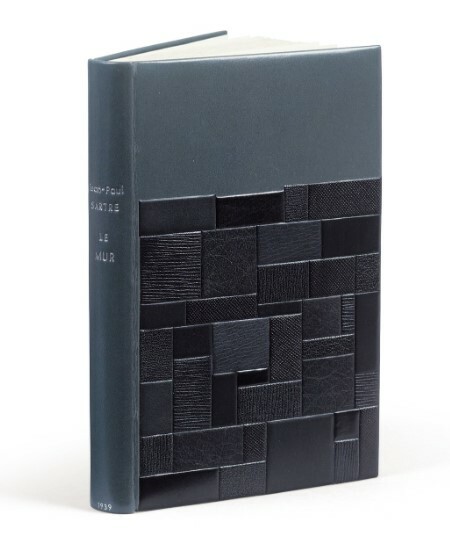
YTB-66Paris, Gallimard, (26 janvier) 1939. In-12 de 220 pp., (2) ff. Box anthracite doublé, dos lisse, titre à l’œser argent, date en pied, plats ornés d’un décor mosaïqué de petites pièces de veau noir et de maroquin à grains longs, gardes de velours noir, couvertures et dos conservés, emboîtage. Honegger, 2013. 187 x 116 mm. ÉDITION ORIGINALE. L’un des 40 premiers exemplaires sur vélin pur fil (n° 3). « Le Mur ouvre en 1939 l’unique recueil de nouvelles de Sartre. Elle lui donne son titre ; aussi bien, Gide la tenait pour un chef-d’œuvre. On pourrait résumer le sujet du « Mur » en parodiant Victor Hugo : il ne s’agit plus du Dernier jour d’un condamné, mais de la dernière nuit de trois condamnés, durant la guerre civile en Espagne. Trois hommes que les phalangistes de Franco veulent exécuter à l’aube : le jeune Juan, Tom, Irlandais engagé dans la Brigade internationale, et Pablo Ibbieta, le personnage principal. » (J. F. Louette). Ce recueil comprend cinq nouvelles : Le Mur, La Chambre, Erostrate, Intimité et L’Enfance d’un chef. La première a pour cadre la guerre d’Espagne. Un républicain a été fait prisonnier avec deux autres hommes. Tous trois, après un bref interrogatoire qui était aussi un jugement dont ils n’ont pas connu la sentence, attendent de connaître leur sort… Cette nouvelle exprime l’angoisse qui, devant le surgissement de la mort, éloigne le héros de tout ce qu’il avait aimé, de tout ce en quoi il avait cru. L’Enfance d’un chef constitue une parodie du roman d’apprentissage traditionnel… Cette nouvelle montre comment la recherche de soi d’un adolescent le conduit, influencé par le manque d’authenticité du milieu où il vit, à partager les convictions et les attitudes des « salauds », comme Sartre appelle ailleurs les bourgeois, qui s’attachent avant tout au maintien de l’ordre social. Le style volontairement gris et dépouillé, est d’une efficacité magistrale qui rend saisissante l’évolution du personnage. C’est d’ailleurs ce style, apparemment neutre et profondément original, qui fait la valeur de ce recueil, lequel demeure l’un des sommets de l’œuvre de Sartre. MAGNIFIQUE EXEMPLAIRE CONSERVE DANS SA RELIURE REALISEE PAR HONEGGER.
LCS-18481Bel exemplaire à grandes marges provenant des bibliothèques «Charlotte Hoive 1737» et André Cade avec ex-libris. Paris, Augustin Courbé, 1647. 5 volumes in-8 de I/ (16) pp. dont 1 frontispice gravé et 2 portraits, 855 pp. comprenant 12 gravures, (5); II/ (16) pp. dont 1 frontispice gravé, 2 portraits, 984 pp. y compris 12 gravures; III/ (23) pp. y compris 1 frontispice et 2 portraits, 1221 pp. y compris 12 gravures, (3) pp.; IV/ (16) pp. y compris 1 frontispice, 2 portraits, 1386 pp. y compris 12 gravures, (4) pp.; V/ (32) pp. y compris 1 frontispice gravé et 3 portraits, 953 pp. y compris 12 gravures, (3) pp. Maroquin rouge, triple filet doré encadrant les plats, dos à nerfs très ornés, roulette dorée intérieure, double filet or sur les coupes, tranches dorées sur marbrure. Chambolle-Duru. 180 x 113 mm.
8vo. 2 pp. To General Christensen, in Danish. Andersen states that it has been a "peculiar pleasure" to make his correspondent's acquaintance, remarking "There are men to whom we feel drawn at once at the first meetings, and who become dear to us, and you are such a man. It is wonderful to me to think of, that we will probably never meet again, for I don't think I will ever come to America, although I am certainly not wanting in the desire". The author further adds that he promised Christensen's wife a small bouquet, "but the flowers must be fresh; it is the colour grouping that has an effect, if the flowers are dried the effect is mostly gone. I must therefore choose such colours that will keep best, but the appearance at best is not promising; yet it is flowers and greens from Danish soil, and my cordial greeting, and remembrance of the land of your birth, you must take as an evidence of my sincere good will" and also writes "You will soon depart for the great land beyond the ocean, bring my friends, old and young, my heartfelt love, and if you meet Mr. Marcus Spring and his wife Rebecca, remember me to them [...] Remember me also to the publishers of the Riverside Magazine and my dear friend there, Mr. Horace C. Scudder [...]". - Accompanied by a contemporary English translation in the hand of Christensen and also including an A.L.S. by Christensen, two pages, 8vo, Copenhagen, 7th April 1903, to Miss. M. D. Holliday in Brooklyn, New York, in English. Christensen states that he is anxious to meet his correspondent's wishes, as a proof of his friendship, and sends her "a letter which I received [from] Hans Christian Andersen more than 32 years ago, on my first visit to my native city after 20 years absence", further commenting "It is a valuable memento indeed - the signatures of the roy[al?] persons are very difficult, almost impossible to obtain [...] But Andersen's letter is worth them all!" - Marcus Spring (1810-1874) American Cotton Merchant, creator of the Raritan Bay Union, a utopian community in New Jersey. Husband of Rebecca Buffum (1812-1911) from 1836. - Horace Scudder (1838-1902) American Man of Letters and Editor, best known for his children's books. - All three letters are slightly worn to the edges, evidently a result of them having been removed from an album, only very slightly affecting a few words of text, but not the signatures.
Large 4to. 2 pp. on bifolium. With autogr. address. To the German translator and poet Adolf Böttger (1815-1870), who had sent him his recently published poem "Düstere Sterne". Eichendorff acknowledges Böttger's "rich, poetic talent", but refuses to participate in a lyrical anthology, as he has no suitable poem at hand and is not in the mood to write a ballad. - Adolf Böttger was one of the most highly esteemed English-German translators of the 19th century; his major project was the translation of the complete works of Byron. - Edges slightly frayed, and small clipped section on fol. 2 (not touching text). Not mentioned in Koch; presumably unpublished.
6 pages in-8 sur papier de riz "à lettre", toutes les env. sont cons. Très intéressante correspondance de Leiris avec sa femme lors de son voyage dans le cadre des amitiés franco-chinoises en 1955, contrepoint au Journal de Chine, qui sera publié en 1994. I: "Ce papier à lettre - trouvé sur la table de la chambre que je partage avec Lurçat - te donnera une idée de la gentillesse de nos hôtes! A Moscou, nous avons vu Le Lac des Cygnes au Bolchoï, par une danseuse telle que je n'en ai jamais vue, devant Boulganine et Krouchtchev recevant le ménage Grotewohl. En Sibérie, l'avion s'arrêtait à des guest-houses genre isba, auberges de campagne qui faisaient penser au troisième tableau de Boris Godounov. [...] Dorénavant, il faudra que nous nous arrangions pour prendre nos habitudes dans l'Est : c'est sans commune mesure avec le reste [...]" (22 sept.). - II: "[...] Hier, dîner d'une trentaine de plats, à nous offert dans un restaurant réputé de Pékin par le vice-ministre aux Relations Culturelles! Le plus étonnant en Chine c'est, décidément, qu'on y est absolument pas dépaysé, en dépit de tout l'exotisme du décor. Cela tient au fait qu'avec les gens les rapports sont parfaitement normaux et non pas ce qu'ils sont dans les pays africains ou antillais. Cet après-midi nous allons visiter la Cité Interdite, qui est la plus belle partie de la ville, - le reste valant surtout pour le pittoresque [...]" (26 sept.). - III: "Me voilà depuis ce matin en Mandchourie et cela change beaucoup, car il fait assez froid! [...] A la différence de Pékin, cette région-ci fait un peu bout de monde et c'est assez étonnant de voir là-dedans des constructions industrielles. Sartre et le Castor, avec qui j'ai déjeuné ces jours derniers, partent demain pour Shanghaï : pour des raisons d'organisation et d'hébergement, on s'arrange toujours pour que les divers invités ne soient pas tous ensemble au même endroit de sorte que ce n'est pas très commode de se voir si l'on ne fait pas partie d'une même délégation [...]" (5 octobre). - IV: "[...] Ce matin , avec deux de mes collègues, nous sommes allés au local de travail de la Troupe n°3 de l'Opéra de Pékin et l'accueil a été bouleversant : acclamations par toute la troupe, plus les machinistes, etc. [...] formant une double haie d'honneur sur notre passage, démonstrations d'entraînement devant nous, splendide spectacle sur scène, remise de cadeaux et de bouquets de fleurs, etc. On nous a même fait revêtir des costumes d'acteurs chinois et affublés de grandes barbes pour nous photographier! Tout ce qu'on voit ici est suffoquant et la difficulté sera, au retour, de le faire saisir à ceux qui, ne l'ayant pas vu, nous regarderons comme des fous[...]" (21 octobre). - V: "[...] A mesure que la fête de demain approche, c'est de plus en plus magnifique : une foule énorme a dû passer dehors une bonne partie au moins de cette dernière nuit, à regarder les groupes de jeunesse s'entraîner à la danse. Nous avons eu hier soir un banquet d'environ 2.000 couverts présidé par Chou En-lai, avec toasts portés à de nombreuses reprises tandis que l'orchestre jouait alternativement des airs chinois et des airs européens (dont une valse viennoise et l'Ouverture de Carmen). J'ai pu déjeuner avec Sartre et le Castor et il est probable que nous serons en même temps à Shanghaï. Mais les programmes sont très minutés et le fait que, pour des raisons d'ailleurs strictement linguistiques, on est sous la dépendance des interprètes empêche quelque peu de se voir [...]".