859 132 résultats
8vo. 3 pp. on bifolium. In French. Important letter to Arsène Houssaye, desperately requesting an advance on articles or a loan, as he is facing eviction, and offering valuable hints at his current work, which mostly remained unpublished during Baudelaire's lifetime: "If you do not come to my rescue today, I will find myself today even without lodging, and in a situation in which I will no longer have the necessary rest to work a little. I always hoped that La Presse would begin [to print] my Variétés [a section of his diary] and would slowly continue week by week or fortnight by fortnight. It is, I assure you, with deep regret that I address myself to your purse but to whom do I address myself at this moment? No one is in Paris. It will be, if you wish, an advance, which you will repay, or a loan; for if I consider the work finished, I know someone who will advance me the whole amount. The sum I need is too great for me to have any right to ask you for it, but 250 fr., which probably represents two large Variétés-articles that you have, might allow me to put off my man for a few days. Permit me, I beg you, to insist vigorously, as on a serious matter, and not to speak of recognition. It is the fashion of those who forget" (transl.). In a long postscript, Baudelaire mentions his "Petits Poèmes en prose", better known under the later title "Le Spleen de Paris", his posthumously published diatribe "L'esprit et le style de M. Villemain", ideas for new titles that feature in his diaries and the autobiographical fragment "Mon cœur mis à nu" and he announces to visit Houssaye: "It is not surprising that I torment you to try [to have] a work of mine in La Presse. I have many other things in my mind than the Poèmes and Villemain. Everything could be broken up. I found two new titles: Fusées et Suggestions / Soixante Six Suggestions. I did not know until yesterday that I would be obliged to assail you in this way; do all you can, not to get me out of trouble but to help me lengthen the belt. I still have a little bit of copy with me but I would have liked to extend it. I will go and see you today". - Baudelaire's plea was successful, as Arsène Houssaye published some of the "Petits Poèmes" in La Presse on 26 August, 27 August, and 24 September 1862. - With several small tears and one larger tear due to ink corrosion affecting the text. Somewhat brittle.
8vo. 1 page on bifoium. In French, to his publisher Eugène de Broise, advertising the second edition of "Les Fleurs du Mal": "Note for Mr. De Broise, to be given to Mr. Arsène Houssaye, at the same time as the authorization to print the portrait of Bracquemond. 'The portrait of Charles Baudelaire that we offer to our subscribers, drawn and engraved by Mr. Bracquemond, decorates the second edition of the Flowers of Evil, which has just appeared in the bookshop Malassis and De Broise, increased by thirty five new poems'. Moreover, one must remember that the portrait is not accompanied by the name, and that if it is useless for the volume, it is indispensable for the newspaper". He adds: "Mr. Arsène Houssaye will arrange the advertisement as he sees fit" (transl.). - Somewhat browned and spotty; small tear to one corner (not touching text).
Small 4to. 1 page on bifolium. To the writer Noël Parfait, then editor Michel Lévy's, about his work on the translation of Edgar Allan Poe's "Tales of the Grotesque and Arabesque" and "The Mystery of Marie Rogêt", which Baudelaire considered "un chef-d'oeuvre, une merveille" (Letters): "Mille remerciements! vous me tirez d'angoisse. Toutes les fois que je croirai pouvoir me dispenser de lire une 2e épreuve, j'écrirai sur l'épreuve: M. Parfait relira et donnera le bon à tirer. J'ai reçu d'Honfleur ma grosse édition. J'ai un bon texte sous les yeux. Quand Marie Roget sera tirée, n'oubliez pas de transmettre les bonnes feuilles à Pauchet, secrétaire de l'Opinion nationale, qui m'a payé le manuscrit et à qui je l'ai repris. - Prière à lui de publier au plus vite. Ce sera une excellente annonce pour le livre. Hier soir pour me soulager du tintouin Marie Roget, je me suis livré à l'ale et au porto, et dans cet état, j'ai écrit à Michel une lettre un peu vive. S'il est offensé, demandez-lui pardon pour moi!" (transl.: "A thousand thanks! You've saved me from anguish. Whenever I think I can dispense with reading a second proof, I will write on the proof: Mr. Parfait will reread it and give me the right one to print. I received my big edition from Honfleur. I have a good text in front of me. When Marie Roget is printed, don't forget to send the right sheets to Pauchet, Secretary of National Opinion, who paid me for the manuscript and from whom I took it back. - Please ask him to publish as soon as possible. It will be an excellent announcement for the book. Last night, to relieve myself of the tintouin Marie Roget, I gave myself over to ale and port, and in this state, I wrote a rather lively letter to Michel [Lévy]. If he is offended, ask him to forgive me"). - Some paper flaws from ink corrosion.
Altogether approximately 14 pp. Various formats. With 10 autogr. envelopes. To the German actor Stefan Wigger, who had played the character of Vladimir in Beckett's Berlin production of "Waiting for Godot" in 1975. During the following years, Wigger had sent him congratulations, books or messages of various content, and Beckett answered him kindly. - "[...] Bien reçu hier les deux livres dont je me promets beaucoup de plaisir et votre gentille carte de voeux. Je suis très touché que vous ayez pensé à mon anniversaire et vous remercie de tout coeur. Je pense souvent aux amis du Schiller et leur dis à tous un grand Grüss Gott! [...]" (13 April 1972). - "[...] Retour de voyage je trouve avec le beau livre du cher vieux Fontane votre gentille carte de voeux [...]" (23 April 1974). - "[...] Als Stock absagte, wollte ich Sie. Mir wurde geantwortet, Sie seien nicht mehr frei. Jetzt ist es mit Fernau abgemacht. Ich bedaure sehr [...]" (18 Aug. 1975). - "[...] Un grand merci pour votre toi-toi-toi. Le travail ici s'est bien passé. Retour à Paris cette semaine [...]" (10 Oct. 1976). - "[...] Many thanks for your card from Dublin. Hope all went well & no casualties [...]" (25 April 1977). - "[...] J'ai peur que le théâtre ne m'ait fait ses adieux. Moi qui aimerais tant pouvoir jouer encore une fois avec la chère bande à Godot. Bolli, Klaus, Carl, embrasse-les bien fort à ma place [...]" (12 April 1980; Beckett refers to the Berlin "Godot" performers, Horst Bollmann, Klaus Herm and Carl Raddatz). - "[...] I feel my theatre days are over - as director at least. TV perhaps not yet quite. I often think of you all & of our times together - with fondness & nostalgia [...]" (6 April 1983).
Oblong folio. 35 pp. on 37 ff. Brown ink on drawing-paper with some additions and corrections in pencil. Original wrappers. Screw-bound. Illustrated with two original ink drawings, one signed (ca. 53 x 29,5 cm and 19 x 19,6 cm). - Together with an 11-page typed copy of the manuscript with notes and corrections in ink and pencil. Also, a typed description of the manuscript and receipt from the "Librairie Francaise" in London, as well as 3 autograph letters signed with 3 autograph envelopes by Cocteau. Beautiful draft for a lecture given by Cocteau during his four-month stay with his friend, the avant-garde composer Ivor Markevitch, in Vevey, Switzerland in 1938. The French text ranges from apparently incoherent cues to elaborate lines of thought, touching highly diverse subject matters such as surrealism, cubism, jazz, poetry, religion, Orphism, and some of Cocteau's favourite artists and historical figures including Picasso, Max Ernst, Marcel Proust, Baudelaire, and Napoleon. The "Causerie" revolves around an expansive definition of poetry and the idea that poetry is truth itself: "Epoch without sacred monsters. I am one of the last writers whose mythology gradually forms as he exists. Legends, follies, inaccuracies. Advantage of legends; one burns a straw man. Legends surrounding men living in a glass house and recounting everything [...] - We hate the truth. Here we come to the heart of our subject. Poetry is scandalous because it is truth itself. Poets, children (Let [them] come to me, he knew what he did). Quote the Swan in majuscules, very proud. Pure poetry. Nonsense from Minos and Pasiphae. Poetry everywhere. Vinci's time. Believed poet, painter, etc. Alas, we've gone too far. Any photographer is a poet [...] Beware of serious men, laughter rends a man in two, reaching the soul, following the tree, the bird. False grandeur, grandeur laughs. For Max Ernst's admirable photo collages, montages, etc. Poetry of posters, of window displays, of street shops. Music Hall, fun fair for a dime, before, after. Dangerous poetry, poet's room, police raid. Any suspect. Poets come from a country where the language is neither alive nor dead, not yet born, heard. The somnambulist poet exploited by forces, he cannot mingle too much, else he ends up with evil. I do not believe in precursors but loneliness is still loneliness. Even in real poetry [...]". - This beautiful manuscript, complete with two elegant original drawings, is highly illustrative of Jean Cocteau's thinking, influences, and lifelong themes. It was acquired by the literary scholar Bill Chapman in 1954, when he was writing his doctoral thesis on "The Aesthetics of Jean Cocteau". The transcript with extensive notes, explaining Cocteau's allusions and identifying his sources, was prepared by Chapman, who corresponded with Cocteau during his research, as the three enclosed letters show. Referring to the manuscript, Cocteau thanks Chapman for being "the Champollion of his hieroglyphs" and discourages speculative interpretations: "Merci d'essayer d'être le Champollion de mes hieroglyphes. Trop de gens prennent encore des vocables hieroglyphiques des poètes pour de simples figures qu'ils interprètent à leur usage personnel. Soyez l'ami des Nombres et de notre algèbre. Haïssez la Fantaisie et dites vous que nous ne voulons pas être admirés mais être crus. Marco Polo fut appelé le menteur de Venise, parce qu'il témoignait [...]" (Saint-Jean-Cap-Ferret, 22 Feb. 1953). - In a letter from 27 March 1953, Cocteau affirms his position that "artistic and religious audacity are not incompatible", naming the Catholic philosopher Jacques Maritain as an influence. In the final letter of the collection, Cocteau taunts the author Jean-Pierre Millecam as an "adorable egocentric" whose selfhood is the "star that governs his sky" (25 Feb. 1954). Apparently, Chapman had warned Cocteau of Millecam's character. - Deep tears to the spine and abrasions to the cardboard wrappers. The first two pages of the manuscript with the illustrations (on verso) are loose. Some pages show minor tears, two pages have further minor damage. Some browning. Two of the letters to Chapman show some tears and creasing.
8vo. 6 pp. Manuscript of poem from the great Surrealist poet to his long-time muse, the Belgian actress and singer Yvonne George. Written on six loose leaves of faded notebook paper, it is a moving testament to his obsession and unrequited love for a woman who inspired two collections of poetry and figured a major artistic inspiration in his life.
Large 8vo. 1 p. To Alfred Nion, Flaubert writes for news of his "fairy" play, Le Chateau Des Coeurs; desiring to demonstrate that this old form can be profitably revived, he is nevertheless pessimistic about the sucess of his play: "Eh bien, et la Feerie, cher ami? Je crois que contrairement au proverbe 'pas de nouvelles, bonnes nouvelles' la chose est completement flambée? Mon seuil en est tout fait. J'avais cependant été bien aise de gagner quelques portraits de l'empereur sur metal, avec cette folichonnerie […] on peut se servir d'un cadre usé [pour] rajeunir un vieux genre. Tu serais bien gentil de me dire ce que ton patron en a pensé". - Dated in the hand of Caroline Commanville, his literary executor; light creasing along old folds.
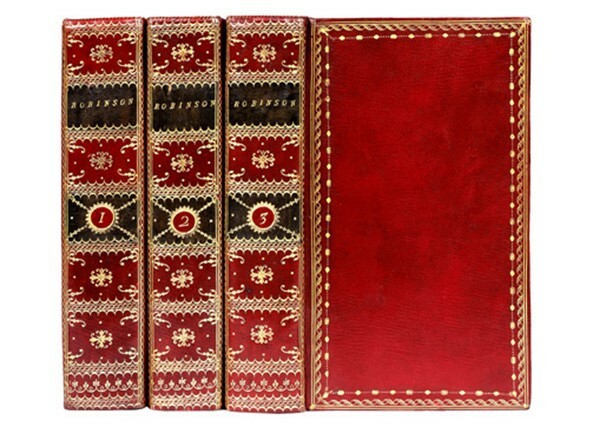
YTB-107Amsterdam, 1770. Ensemble 3 volumes in-12 de : I/ (1) f. bl., xiv, 629 pp., (1) f. bl., 1 carte dépliante et 7 figures ; II/ (1) f., viii, 562 pp., (2) ff. bl, 7 figures ; III/ 13 ff. paginés de v à xxx, (1) f., 7 figures. Plein maroquin rouge, jeu de double roulette au sein de double filet doré, dos lisses ornés de roulettes dorées formant faux-nerfs et de fleurons dorés, pièces de titre et de tomaison en maroquin vert, roulette dorée sur les coupes, roulette intérieure dorée, tranches dorées, quelques traces sur les plats du troisième volume. Reliure de l’époque. 178 x 110 mm. PREMIERE TRADUCTION FRANÇAISE des Aventures de robinson Crusoé par Juste van Effen et Themiseul de Saint-Hyacinthe. Elle avait paru originellement en 1720-1721 dans une autre version. Cohen, 405; Sander, 711; Sabin, 72218; Catalogue Rothschild, II, n°1759; PMM, 180. L’UN DES PLUS INTERESSANTS LIVRES ILLUSTRES PAR BERNARD PICART, « orné d’une carte pliée et de 21 figures par l’artiste, dont une seule signée. » (Cohen). « The special form of adventure that he chose and even the name of his hero have been adopted by countless imitators. At least equally relevant for the purpose is the figure of the lonely human being subduing the pitiless forces of nature; going back to nature and portraying the “noble savage” in a way that made the book required reading for Rousseau’s Emile. » (PMM) LES EXEMPLAIRES RELIES EN BEAU MAROQUIN ANCIEN SONT RARES ET TRES RECHERCHES. MAGNIFIQUE EXEMPLAIRE CONSERVE DANS SON ELEGANTE RELIURE EN MAROQUIN ROUGE DE L’EPOQUE, AU DOS PARTICULIEREMENT DECORATIF.
12+12+16 lines on 1¾ pp. 8vo. A fair copy manuscript, written in brown ink, formerly owned by the poet's son Friedrich and presented by him as a memento possibly to the publisher Friedrich Cohn in 1904 "Und es klagen ihre Tränen: | Weit der Himmel, tief die See, | Doch noch weiter geht mein Sehnen, | Und noch tiefer ist mein Weh […]" (from "Das Fischermädchen"). - This exquisitely written leaf was presented by Fontane's youngest son Friedrich (1864-1941) in 1904 apparently to Theodor Friedrich Cohn (1864-1936), a fellow partner in the Berlin publishing house of F. Fontane & Co. Although the date of the present manuscript is uncertain, all three of the present poems were originally written in the 1840s ("Guter Rat": 1849; "Das Fischermädchen": by 1844; "Der erste Schnee": 1841) and published in 1851. The present text of "Das Fischermädchen" and "Der erste Schnee" differs in places from the complete edition: see Theodor Fontane: Sämtliche Werke XX, pp. 7, 15-16).
2 SS. 8vo. Recto ein ganzseitiger Illustrationsentwurf zu "Damon. Phillis" (Zürich, 1756, SS. 44-47) mit einem Textzitat ("Doch setze mir zuerst den Kranz zurecht | Du hast mein Haar zerzaust") sowie einem weiteren Zitat aus "Die Erfindung des Saitenspiels und des Gesanges" (ebd., 91-99: "[Man pflanzte da zween Bäume auf einem hohen Hügel, dem Mädchen und] dem Jüngling, u. die späten Enkel erzählten [den K]indern in ihrem Schatten d. Erfindung des Saitenspiels u. des Gesangs"). Verso mit zwei Zitaten aus "Der Frühling" (ebd., 107-112) und "Die übel belohnte Liebe" (Salomon Gessners Schriften. Zürich: bey Orell, Gessner, Füssli u. Comp., 1770. Bd. 2, SS. 113-121; S. 120f.). - Gering fleckig.
1 S. 8vo. (227:137 mm). Mit typographischer Randleiste (Pfeilornament). Den Einblattdruck "Die Feier des siebenten Novembers 1825 dankbar zu erwiedern" hat Goethe in kleinster Auflage für den engsten Kreis seiner Freunde anfertigen lassen, um ihnen anlässlich der Glückwünsche zum 50. Jahrestag seiner Ankunft in Weimar (1775) zu danken. Offenbar reichte dazu die erste Auflage nicht aus, weshalb eine weitere nachgedruckt worden ist, beide bei Frommann in Jena, im Juni 1826 und November 1827. Laut Hagen (412) kann man die beiden Varianten des Blattes nur anhand der Gestaltung der einfassenden Bordüre unterscheiden: Hier ist es diejenige mit kleinen Pfeilen, die nach außen zeigen. Welche die frühere der beiden Varianten ist, ließe sich allenfalls anhand von Exemplaren feststellen, die Goethe datiert hat, doch tragen die wenigen nachweisbaren gewöhnlich (wie hier vorliegend) nur seine Unterschrift und die Ortsangabe. Unser Blatt dürfte wohl zur späteren Variante gehören, denn es ist noch ein anderes Exemplar davon bekannt geworden, das Goethe erst im Januar 1831 signiert und datiert hat. Mit der ursprünglichen Danksagung kann das nicht mehr viel zu tun gehabt haben: Goethe hat Restbestände des Drucks wohl in späterer Zeit für beliebige Grußadressen verwendet, zumal das Gedicht selbst ohnehin älteren Datums war. Unter dem Titel "Die Feier des achtundzwanzigsten Augusts dankbar zu erwidern" (incipit: "Sah gemalt, in Gold und Rahmen") war es bereits 1819 erschienen, damals anlässlich seines 70. Geburtstags. - Mit schmalen Rändern (die Vergleichsexemplare sind meist wesentlich enger beschnitten); leichte Falze mit geringen Randeinrissen; am oberen Rand verso geringe Montagespuren; leicht gebräunt. Kippenberg I, 104. Hagen 412. Goedeke IV, 3, 501, 114.
8vo. 1 page. With two enclosures (see below). To an unidentified correspondent ("Hochgeehrter Herr College"), reproaching him for ignoring his reminder of a few weeks ago, stressing the trouble this matter has caused him, and stating that he knows no reason why he should not have paid him the six thalers which were due three months ago: "Ich verdiene nicht, dass Sie meinen vor einigen Wochen geschriebenen Mahnbrief unberücksichtigt lassen. Diese Angelegenheit gibt mir so viel Mühe […]". - Together with a copy of a printed speech given by Grimm on the centenary of Schiller's birth ("Rede auf Schiller", Berlin, Verlag der kgl. Akademie der Wissenschaften, 1859), inscribed by Grimm on the upper wrapper to his friend, the jurist and rector of the Humboldt University of Berlin, Adolf August Friedrich Rudorff. Also enclosed is a manuscript note in an unidentified hand itemising some remarks by W. Grimm for the printer ("Bemerkungen von W. Grimm für den Stecher", oblong 8vo, 1 page). - Letter with some small defects to edges. Formerly in the collection of the Berlin pianist and composer Ernst Rudorff, the son of Adolf August Friedrich Rudorff.
Large 4to. Altogether 3¼ pp. on 4 pp. With one autogr. envelope. To George Brown, the owner of a gymnasium in Manhattan, Hemingway's personal trainer, boxing coach, and friend. - I: Hemingway's affection for his sporting pal is evident in this revealing and highly personal letter, written shortly before Ernest and Mary left for an African safari: "How are you kid? Mary sends her best. We are fine and in very good shape and think of you often. Were out on a trip together on the boat for two weeks and we go to bed every night after it gets dark and have plenty of time to talk and to sleep good [...]". Hemingway then gives news of his sons, and mentions his youngest son ("Gig"), who, in his early twenties, was turning violently hostile to his father: "I am sorry I spoke against Gig since he is a friend of yours and used to be of mine as well as my favorite son. But he changed very strange very fast. As bad as though the devil was managing him. I couldn't ever see him again; not even to go and see him hanged. But if he seems good to you, O.K. I haven't heard from him since last November when he came of age [...]" (Finca Vigia, San Francisco de Paula, Cuba, May 12, 1953). - II: Written on the eve of the latter's visit to Cuba and while preparations are being made for the film of The Old Man And The Sea: "George you can't have any confidence in any of those characters. They are all tighter than a hogs ass in fly time. That Goldwyn kid was nice as could be when it was a question of seeing us and thus becoming an old pal of old Ernie […]" (ibid., August 18, 1955). - III: Written from his sickbed. Preparations were still being made for the film mentioned above, and Hemingway had spent September trying to get actions shots of leaping marlins for the producer Leland Hayward. Apparently, too, Hemingway was making an effort to get Brown involved in getting Spencer Tracy in shape, for he writes: "I am very sorry about [Peter] Viertel [wrote the screenplay] behaving so carelessly. He is a very selfish boy but I think he has a little bit of an excuse in that he was with Zinneman on the script and was expecting you out there. While Zinneman was down here we discussed the whole thing about your getting Spencer in shape and agreed it was absolutely necessary and we spoke about it again on the long distance phone […]" (ibid., November 25, 1955; with several autogr. lines in pencil). - On personal stationery of Finca Vigia. - Partly light-soiled, otherwise in fine condition.
4to and (oblong) 8vo. A total of 19½ pp. on 20 ff. Amicable correspondence with the Konstanz dentist and composer Alfred Schlenker (1876-1950) and his wife Martha, reporting on his travels, his wish to see them, his health, his family, and his artistic work. - "Der Sommer holt noch etwas vom Versäumten nach, das ist gut. Aber in Lugano stehen die Fremden einander auf den Zehen, alles ist unleidlich überfüllt. Die Autocars aus aller Welt stehen Schlange [...]" [postmarked Zug, 1953]. - "Mit dem in Osnabrück abgebrochenen Stück Zahn konnte ich nicht, wie ich damals wollte, gleich zu Ihnen kommen, da ich inzwischen auf dieser merkwürdigen Reise auch noch um meinen Blinddarm gekommen bin [...]" [postmarked Frankfurt, 29 Nov. 1909]. - "Das was das Radio neulich gesendet hat, war eine von mir 'besprochene' Platte. Falls Sie einen Apparat für Langspielplatten besitzen und es wünschen, bekommen Sie diese Platte von mir geschenkt [...]" (postmarked Zug, 9 July 1959). - "[Das Kölner Hessearchiv] wurde vor einigen Jahren ohne mein Wissen und sehr gegen meinen Geschmack von einem ehrgeizigen Mann [...] gegründet, und ich habe Zeitlang gegen ihn Nachsicht geübt [...] Aber bald wurde dieser Mann so lästig und aufdringlich, und hat namentlich alle meine Freunde, deren Adressen er erschnüffelte, so frech und rücksichtslos ausgenützt, ihnen Briefe von mir abgeschwatzt [...] dass ich ihn durch meinen deutschen Rechtsanwalt warnen lassen musste [...]" (annotated by a collector: "postmarked Montagnola 27 April 50"). - The 12-line poem "Nachtgefühl" includes an autograph watercolour. Corners trimmed. - Includes two prints with a few autograph lines to Alfred and Martha Schlenker on the last page; also, a signed portrait woodcut of Hesse by Max Bucherer and a fragment of a portrait of Hesse drawn by an unidentified hand (13 x:29 cm, trimmed at top and bottom). - A few insignificant edge flaws, but generally in perfect condition. Pflicht und Passion. Die Freundschaft zwischen Hermann Hesse und Alfred Schlenker, Gaienhofen 2010, p. 21 (reproducing a postcard from this collection).
Oblong 4to. Contemporary red morocco, spine, covers leading edges and inner dentelle elaborately gilt, front cover showing crowned monogram "F.C.". Green moirée silk endpapers. All edges gilt. Comprises eight inscriptions (some mounted) by members of Hugo's circle, including Marie Nodier ("Le printemps est fini [...]", ½ p.), Félix Lecler ("Confiance", 1883, 1 p.), Louis Boulanger ("[Ode à Victor Hugo]", 1 p.), Auguste Souillard Saint-Valry ("Ode à Mr le Cte de Peyronnée", 1 p.), and, finally, Victor Hugo himself, represented by the last stanza of his poem "Ô mes lettres d'amour, de vertu, de jeunesse": "Oublions! oublions! Quand la jeunesse est morte, | Laissons-nous emporter par le vent qui l'emporte | A l'horizon obscur, | Rien ne reste de nous; notre oeuvre est un problème. | L'homme, fantôme errant, passe sans laisser même | Son ombre sur le mur!" - Several of the contributors counted among Hugo's circle of friends: Marie Nodier travelled to Switzerland with him; Louis Boulanger was the official painter of the Hugo family; Auguste Souillard Saint-Valry was a childhood friend of Hugo's and later trustee of his literary estate.
Large 8vo. 2 pages on bifolium. With autogr. address. To the engraver and illustrator Daniel Chodowiecki (1726-1801), about producing a series of engravings. - Lichtenberg's landlord, publisher, bookseller, wine merchant, and friend Johann Christian Dieterich (1722-1800) was also publisher of the "Musenalmanach", continued after the death of its editor Erxleben by Lichtenberg (as "Göttinger Taschen Calender"). The periodical targeted a wide audience of limited education. Shrewdly, Dieterich had made it a point from the beginning to include engravings, and the engagement of Chodowiecki, one of the most-sought illustrators of his time, was an additional factor that appealed to the picture-hungry audience. The issue discussed here by Lichtenberg was published in 1781, containing 2 fashion engravings and 12 monthly engravings by Chodowiecki on the subject of "Twelve Ways to Propose". - Slight defect to f. 2 due to broken seal. Such early letters by Lichtenberg are uncommon: auction records list no similarly early letters, nor any part of Lichtenberg's correspondence with Chodowiecki.
Small 8vo. 3 pp. To French composer and critic Paul Dukas, thanking for an article on William Beckford: "Je vous remercie tard, j'ai voyagé, de la belle page par vous écrite au sujet de Beckford [William], comme elle m'eût servi, précieusement, avant de préfacer son livre ! Cela reste un honneur, pour ma réédition, d'avoir motivé cette étude perspicace et haute, je la conserve comme un des titres du Vathek à la faveur française. Permettez aussi que je me montre flatté des paroles bienveillantes qui s'adressent particulièrement au bibliophile [...]".
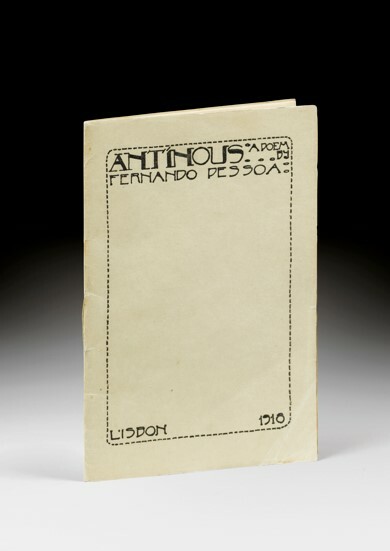
YTB-92Lisbonne, Monteiro & Co., 1918. In-8 de 16 pp., broché et non coupé, sous couverture crème, premier plat imprimé d'un joli décor Art Nouveau composé du titre et d'un encadrement de tirets. 205 x 136 mm. Rare édition originale. J. Blanco, Fernando Pessoa. Esboço de uma bibliografia, Maia, Centro des Estudos Pessoanos, 1983, p. 209, n° PO 13; P. Quillier, notice, in: F. Pessoa, Oeuvres poétiques, Paris, Bibliothèque de la Pléiade, 2001, pp. 2020-2022. Composé en 1915, ce poème orthonyme et homoérotique évoque les amours de l'empereur Hadrien et de son favori Antinoüs. Le texte présente d'importantes variantes par rapport à celui que Pessoa insérera, après l'avoir retravaillé, dans le premier fascicule d'English poems publié en 1921 Selon certains spécialistes, la poésie de Pessoa présente « l’analyse la plus subtile, dolente et tragique de l’homme du XXe siècle, mais aussi la plus lucide, la plus impitoyable ». Comme le signale Tabucchi, on peut dire que Pessoa (dès 1914) a résumé « par avance » les problématiques du XXe siècle : le moi, la conscience, la solitude. Sa manière de les affronter fait de lui une figure étonnante et incontournable de la poésie contemporaine. Fernando Pessoa has always been considered one of the best Portuguese poets, but we should not forget that he started his poetic career as an English poet and this astonishing bilingualism throws a new light on one of the greatest poets of our century. Not only did Pessoa write both in English and Portuguese throughout his life, but he always kept in his heart the secret wish to publish his poems written on English and to be considered an English author. That Portuguese “gentleman” who went on reading English books more than anyone else in Portugal, published his first poems in English, in 1918 ” (Anne Terlinden). Fernando Pessoa (1888-1935) apprit l’anglais dans son enfance, à Durban (Afrique du Sud), où il passa une partie de son adolescence. RARE ET PRECIEUX EXEMPLAIRE CONSERVE BROCHE, TEL QUE PARU, CONDITION RARE ET RECHERCHEE. A very rare and attractive wide-margined untrimmed copy kept in its original wrappers, as issued.
8vo. 2 pp. on bifolium. With autograph envelope. To the composer Casimir von Pászthory (1886-1966) in Vienna, who in 1914 set to music his 1906 poem "Die Weise von Liebe und Tod des Cornets Christoph Rilke", a copy of which composition he received some time ago, apologizing for not having thanked him earlier, mentioning that his desk is piled high with unanswered correspondence; also, acknowledging the receipt of 100 Marks and asking von Pászthory to send the balance to the "Insel" publishing house, who administer all his business affairs: "Schon als mir, vor einiger Zeit, Ihr Verleger ein Exemplar Ihrer Musik zur 'Weise von Liebe und Tod' zu übersenden die Aufmerksamkeit hatte, wäre ein Wort des Dankes an Sie am Platze gewesen, verzeihen Sie, dass ich mich, im Gedräng einer arg rückständigen Correspondenz, die meinen Schreibtisch buchstäblich überhäuft, erst heute dazu aufraffe, und nehmen Sie dieses kurze Wort wenigstens als ein herzliches. Inzwischen habe ich Ihnen auch noch hundert Mark zu bestätigen, die mir, auf Ihre Postanweisung hin, gestern ausgezahlt worden sind. Was den Rest des Betrages angeht, den Sie mit meinem Verlage seinerzeit vereinbart haben, so bäte ich Sie, ihn nach Leipzig an den Insel-Verlag senden zu wollen, der alles Geschäftliche für mich verwaltet [...]". - With 2 small marginal tears.
4 SS. auf Doppelblatt. 8vo. An den Ophthalmologen, Okkultisten und Schriftsteller Rudolf Tischner (1879-1961), dessen zwei letzte Nachrichten ihm "vom Miether meiner Münchner Wohnung (es werden nächstens zwei Jahre, daß ich in der Schweiz bin)" nachgesandt worden seien, so dass er sie erst jetzt beantworten könne: "Ich weiß es sehr zu schätzen, daß Sie sich meiner erinnert haben, bitte, bleiben Sie dabei, mich nicht aufzugeben [...]". Weiters über seine parapsychologische Beschäftigung mit den Arbeiten von William Jackson Crawford, Albert von Schrenck-Notzing, Theodore Flournoy und Waldemar von Wasielewski: "Außerordentlich wichtig sind die Entdeckungen Crawford's, gegen die ich - ich kann es nicht leugnen - zunächst den gleichen Widerwillen empfand, wie seinerzeit gegen Schrenck-Notzing's Materialisations-Phänomene, - aber nun ist diese Sache längst keine Geschmackssache mehr und man wird sich - tant bien que mal - dem Ergebnis dieser übereinstimmenden Forschungen unterwerfen müssen [...] Ich habe mir gestern Flournoy's Bücher bestellt und freue mich, nächstens die Schriften des Herrn von Wasielewski zu lesen; Sie sehen also, es fehlt uns nicht an contact (wenn es nicht unbescheiden ist, soviel zu sagen [...]".
8vo. 3½ pp. on bifolium. Amicable letter to his estate administrator Gaspard-François-Xavier Gaufridy about his spending six weeks in bed with a high fever before having his "emissaire", his mistress Marie-Constance Quesnet, deliver a memoir to the minister and his "chef des bureaux" concerning the military draft of Gaufridy's son François. The minister indicated the possibility of a leave of absence, provided that Gaufridy deliver several documents, which de Sade encourages him to do as soon as possible: "Gardant ma chambre depuis 6 semaines pour une terrible ébulition de sang et un accès de goute, il m'a été impossible d'agir par moi-meme, mais l'eusse je pu je ne l'aurais pas fait connaisant la manière infiniment plus adroite et plus chaude dont les emissaires feminins, et surtout le mien se conduisent en pareil cas. J'ai donc fait le memoire ci joint, et mon amie l'a porté [...] chez le ministre [...] il a dit à mon amie de se transporter chez [...] le chef des bureaux [...] mais il a dit comme le ministre que la loi était contre le jeune homme [...] il vous exhorte à vous presser, et dès que vous m'auvez envoiyé les pièces et que je les lui aurai remises le congé sera expédié sur le champ [...] Hatez-vous donc mon cher Gauffridi, je brute de finir cette affaire [...]". - De Sade confirms the receipt of three parcels containing jam, candles, and oil, and gives a sketch of a curious phenomenon he observed within one oil barrel, in which the oil appears to have solidified and compressed itself into two thirds of the container's space. Further, he complains about the various kinds of jam, wishing to have kiwi, less sour flavours and fewer red jams, which his doctor forbids him to consume: "Je viens de recevoir trois ballots contenant [...] huit pots de confitures de differentes sortes [...] neuf livres de bougies, deux boites de confitures seches et deux barils d'huile [...] il est arrivé quelque chose d'assez singulier au baril d'huile à manger, la figure ci joint[e] va vous le demonstrer [...] Toute l'huile parfaitement figée s'est comprimée dans la partie b et toute cette partie b est absolument pleine [...] quant à la partie a elle est entièrement vuide [!] et c'est coupé à pan droit comme si on l'eut fait avec un couteau [...] Les confitures sont excellentes mais pourquoi point de chinois que j'aime a la folie, et pourquoi tant d'acide et de confitures rouges qui me sont positivement defendues par mon medecin [...]". - In conclusion he mentions financial affairs, including the selling of the Château de Mazan, the costs of the estate having incurred him debts of one million, and the Château de La Coste, looted during the Revolution, as well as his need of 6,000 livres to pay a loan: "Le troisième objet est la vente du château de Mazan. Vous ne voulez pas absolument entendre qu'imaginant que vous alliez vendre cet objet sur le champ j'ai toujours acheté et que me voilà maintenant chargé d'une dette d'un million [...] tirez moi donc de le mauvais par tout de suite [...]". - Small traces of red wax.
4to. Some lines of red pencil. Large ink discharge on reverse due to wetting. A beautiful and witty manuscript illustrated with superb drawings of dreamlike and fantastic inspiration curiously evoking the universe of Salvador Dali. One can decipher in particular: "Girl, Aestus, exposed to the Gods, whom the ocean constellates [...]" (transl. from the French original). The poem, in the draft form, largely crossed out, carries in left and right margins the word "summer" which seems to be the title, but it differs totally from the work published under the same title published in the "Album des vers anciens" ("Album of ancient verses"), dedicated to Francis Vielé-Griffin.
Lutetiae (i.e. Paris), (? Guillaume Morel for) Henri Estienne (II), 1554. 4to. Contemporary limp vellum with remains of ties to boards. Remains of contemporary paper labels to spine and traces of autor in ink in contemporary hand, also to spine.A few smaller worm tracts to boards and a bit of spotting, but overall very nice. A large spot to title-page, presumably erased ink, from the removal of an old owner's name. The spot is in the blank margin, close to the printer's device, but not touching it. Apert from that internally very nice with only light occasional damp staining or browning. Old ink note in Greek characters to front free end-paper and a small note (referring also to ""Lyra"") on A(1)r. A very nice copy with large margins. Woodcut printer's device to title-page, woodcut headpiece and opening initial. Magnificently printed in all three sizes of the famous ""grecs du roi""-type. (8), 110 pp.
4to. ¾ p. on bifolium. With integral address-leaf. The present letter, written in Italian and in the hand of Count Pietro Gamba (the brother of his beloved Teresa Guiccioli), was written while Byron was making his final preparations for his voyage to Greece, where he was to die nine months later "that Greece may still be free". Its addressee is the Greek patriot Giorgio Vitali (1776-1854) at Leghorn, from an ancient Venetian family and the commander of the Ionic vessel "Hercules" that Byron wanted to take. Byron is delaying his departure until July 14, and tells Vitali that by passing through Leghorn they should not drop anchor in order to avoid pointless expense and waste of time. - Byron was to bid farewell to Teresa and board the "Hercules" on 13 July, the day after writing this letter. However, his departure was to be delayed by calms, and then a storm. By some accounts, his mood at this time was despondent, almost fatalistic. During the delay he went on shore again to visit the house outside Genoa that he had shared with Teresa; as her brother recalled: "His conversation was somewhat melancholy on our way to Albaro, he spoke much of his past life, and of uncertainty of the future, 'where', said he, 'shall we be in a year?'" (quoted by Leslie A. Marchand, Byron: A Biography [1957] III, 1089). They eventually set sail from Genoa on the 16th. During the couple of days spent at Leghorn, Byron received a verse-tribute from Goethe and dashed off his famous reply: "I sailed from Genoa some days ago - was driven back by a Gale of Wind - and have since sailed again - and arrived here (Leghorn) this morning to receive on board some Greek passengers for their struggling country" (22 July 1823). They set sail once again on 24 July, and finally reached Cephalonia on 2 August. - Not published in Marchand's edition of Byron's Letters and Journals (1973-1994); small clipping from opening the letter (slightly touching text); overall in fine condition.
Zusammen (2+4 =) SS. auf 3 Bll. Mit einem eh. adr. Kuvert und einigen Beilagen (s. u.). An den niederländischen Komponisten Jaap Geraedts, der sich 1957 an Celan gewandt hatte mit dem Vorschlag, dieser möge den Text zu einem geplanten Oratorium verfassen. Geraedts, der selbst weder Jude noch Opfer des nationalsozialistischen Terrorregimes war, hatte ausdrücklich nach einem jüdischen Dichter gesucht und sich schließlich gegen die ihm vom jüdisch-niederländischen Schriftsteller und Historiker Jacques Presser empfohlenen Dichter Maurits Mok und Abel Jacob Herzberg und stattdessen für Celan entschieden, der als Verfolgter und Augenzeuge aus der eigenen Tradition heraus den Text beisteuern sollte. "Für die Abfassung des Konzeptplans in deutscher Sprache braucht Geraedts einige Tage, aber bereits am 25. Mai wendet er sich mit einem Brief an Paul Celan, in dem er sich vorstellt, sein Vorhaben skizziert und die Anlage erläutert. Es werden noch vier Briefe folgen sowie ein Schreiben von Geraedts' Mutter [...], die Celan während ihres Aufenthalts in Paris ein Gespräch vorschlägt und ihn ebenfalls eindringlich bittet, ihrem Sohn zu antworten" (Sars, S. 9). - Am 5. Juli antwortet Celan aus dem schweizerischen Verbier: "Ihr erster Brief, den ich, wenn ich nicht irre, einen Tag vor meiner Abreise aus Paris erhielt, hat mich auch hierher begleitet. Daß ich ihn so lange unbeantwortet ließ, hat seinen Grund einzig darin, daß er mir zu wichtig erschien, als daß ich ihn mit meiner auf Reisen recht geduldlosen Feder hätte beantworten dürfen. Auch heute noch muß ich mir sagen, daß ein Anliegen wie das Ihre, soll es, wie es dies verdient, mit allem Lebensernst aufgenommen werden, an meine Konzentrationsfähigkeit Ansprüche stellt, denen ich, im Augenblick zumindest, nicht ganz gewachsen bin [...] Wenn ich meine Einstellung kurz charakterisieren darf: für mich bleiben diese Dinge, auch heute noch, in ein Dunkel getaucht, tiefer als man es gemeinhin wahrhaben will, ich sehe, wenn ich ehrlich sein soll, keinerlei 'Silberstreifen' am Horizont, Besinnung und Umkehr bleiben, wo sie überhaupt noch angesprochen werden, papierene Wirklichkeit, Vokabel, und dies selbst im Lager derjenigen, die gewillt scheinen, das vor kurzen historischen Augenblicken Geschehene im Gedächtnis zu bewahren [...] Ich will versuchen, es auch anders zu formulieren: ein Oratorium, wie das von Ihnen geplante müßte, für mein Gefühl, zeitlich umfassender (mithin unbegrenzter) gestaltet sein, als man es, auf den ersten Blick, konzipieren mag. Das Jüdische: es hat - erlauben Sie mir, dem Juden (und Nicht-nur-Juden), es so zu formulieren - eine Ewigkeitsdimension. (Und wäre es nur die schier ununterbrochene Untergangsnähe: sie allein würde ausreichen, dies zu bestätigen.)". - An dieser Stelle endet der Brief, den Celan zusammen mit dem zweiten Brief, den er am 25. Juli aus Paris schreibt, an Geraedts schickt: "Sie müssen mich, mit vollem Recht, für einen ganz unmöglichen Menschen halten! Verzeihen Sie dennoch! Ich habe - der beiliegende, nicht zu Ende geschriebene Brief soll es Ihnen zu beweisen versuchen - immer wieder an Ihren Brief gedacht, meine Säumigkeit schreibt sich, so seltsam das auch klingen mag, einzig von der Sorge her, mit meinen Gedanken weit hinter dem zurückzubleiben, was Ihnen am Herzen liegt [...]". Celan sichert Geraedts zu, versuchen zu wollen, "den Text zu schreiben, den Sie von mir erwarten". Anschließend unterbreitet er den Vorschlag eines Treffens und legt Geraedts "das Werk einer bedeutenden jüdischen Dichterin" ans Herz, "die in Stockholm lebt. Es ist das Werk von Nelly Sachs [...]". - Im März des darauffolgenden Jahres kommt es auch zu einer persönlichen Begegnung von Celan und Geraedts in Paris, doch aus der angedachten Zusammenarbeit sollte schlussends nichts werden. - Beide Briefe im linken Rand gelocht (keine Textberührung), ein Brief mit einer kleinen Rostspur durch eine Büroklammer. Beiliegend eine ms. Postkarte und ein ms. Brief von Celans Verlag, der Deutschen Verlags-Anstalt, an Geraedts sowie 3 (2 ms. und 1 eh.) Briefe (samt 2 Kuverts) von diesem an Paul Sars, dem Herausgeber des kleinen Briefwechsels von Celan und Geraedts. Paul Celan, Jaap Geraedts. Keinerlei "Silberstreifen" am Horizont. Der Briefwechsel des Dichters mit dem Komponisten. Herausgegeben und kommentiert von Paul Sars (Wien u. a. O, 2013).