DAUDET, AlphonseLivre Rare Book
858 463 résultats
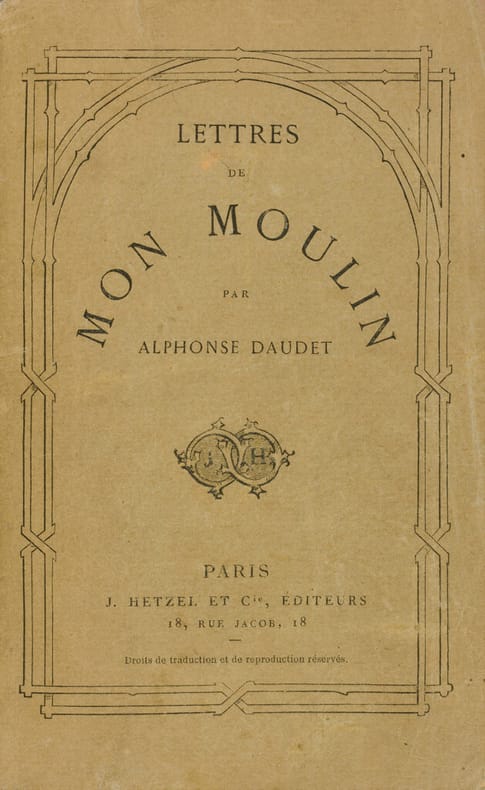
LCS-18028Précieux exemplaire avec envoi autographe de Daudet « au vieux maître Montigny ». Paris, J. Hetzel, s.d. [1869]. In-12 de (2) ff., 302 pp. Relié en plein maroquin rouge, double encadrement de filets à froid avec fleurons d’angle sur les plats, dos à nerfs orné de même, filet or sur les coupes, roulette dorée intérieure, tranches dorées sur témoins, couvertures et dos conservés. Etui. Devauchelle. 180 x 112 mm.
153841803On les vend à Paris, par Arnoul et Charles Les Angeliers frères, 1538. In-8 gothique (165 x 98 mm) de (8)-403-(1) ff. (marque de l'imprimeur), 49 bois dont plusieurs répétés, maroquin rouge, dos orné à nerfs, triple filet doré sur les plats, composition florale au centre, dentelle intérieure, tranches dorées (Capé).
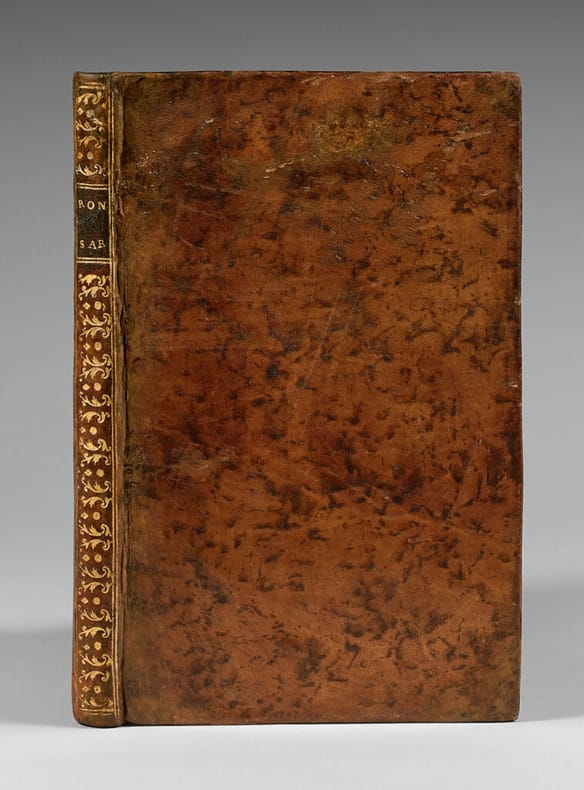
LCS-18532D’après Jean-Paul Barbier, Ma bibliothèque poétique, cet exemplaire réunissant cinq œuvres rarissimes de Pierre de Ronsard en reliure du XVIIIe siècle serait le seul connu. A Paris, chez Gabriel Buon, au clos Bruneau, à l’enseigne S. Claude, 1563. In-4 de 10 ff., signés A à B par 4 et C par 2. Soit: «A ma connaissance, cet exemplaire est le seul connu (voir Barbier, 4, n°45) d’un premier état de la seconde famille des éditions de 1563, qui se caractérise par: Le privilège au verso du feuillet 10 (et non au verso du titre). Un plus grand nombre de vers par page, de telle sorte que le texte se termine au recto du feuillet 10 et non au verso. Le décalage du début des strophes à droite» (Jean-Paul Barbier). Plein veau marbré, dos lisse richement orné, tranches rouges, coiffe supérieure restaurée. Reliure vers 1740. 214 x 133 mm.
4to. ¾ p. With autogr. address. A hitherto unpublished letter to his sister Pauline Périer-Lagrange. On the point of leaving Milan, he invites his sister to wait for him on the way to make the trip with him to Paris. "Mes affaires me rappellent à Paris, ma chère amie. Il est possible que je parte le 12 novembre, mais c'est le 15 au plus tard que je me mettrai en route. Je suppose que tu attendras un moment plus brillant pour faire le voyage de Paris. Cependant, si tu as la possibilité de le faire, je suis d'avis de partir, vu que l'occasion est chauve, comme dit don Japhet d'Arménie. Si tu n'as rien de mieux à faire, rends-toi à Cularo le 15 nov. Tu ne m'y attendras pas: 3 jours au plus. Sinon viens à Bourgoin le 16 ou le 17. J'embrasse tendrement ton mari. Je ne resterai que 20 à 24 h. au plus à Cularo; depuis la mort de notre pauvre grand-père, je n'ai plus de coeur dans cette ville. | Chapuis". - As soon as Stendhal arrived in Paris at the end of November 1813, he was to be charged with the defense of his native city Grenoble, a mission which proved impossible considering the superiority of the coalition forces. Like many high-ranking Napoleonic officials, Stendhal found no place in the strictly diminished government of the Bourbon Restoration under King Louis XVIII, and became a Napoleon's nostalgic and liberal, an oppositionist. He once more went to Milan and became the literary man and writer he is known as.
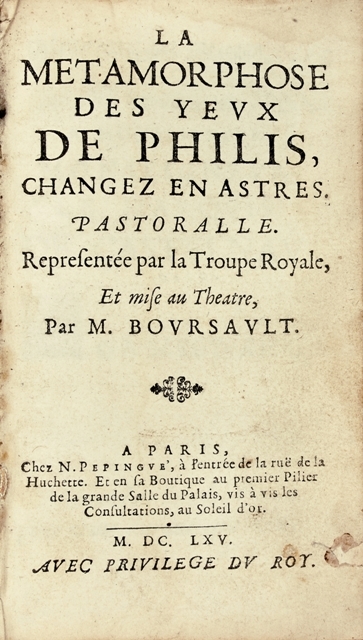
LCS-16007Edition originale de la pièce la plus rare de Boursault. Exemplaire de dédicace relié en maroquin bordeaux de l’époque armorié. Paris, N. Pepingué, 1665.In-12 de (2) ff., (10) ff., 46 pp., (2) ff.bl. Annotations manuscrites sur la garde blanche. Relié en plein maroquin bordeaux, plats richement ornés d’un double encadrement de filets et d’une roulette dorés, grandes initiales « C » entrelacées et couronnées aux angles au sein d’un motif de palmes dorées, grandes armes frappées or au centre, dos à nerfs richement orné, coupes décorées. Reliure de l’époque. 146 x 82 mm.
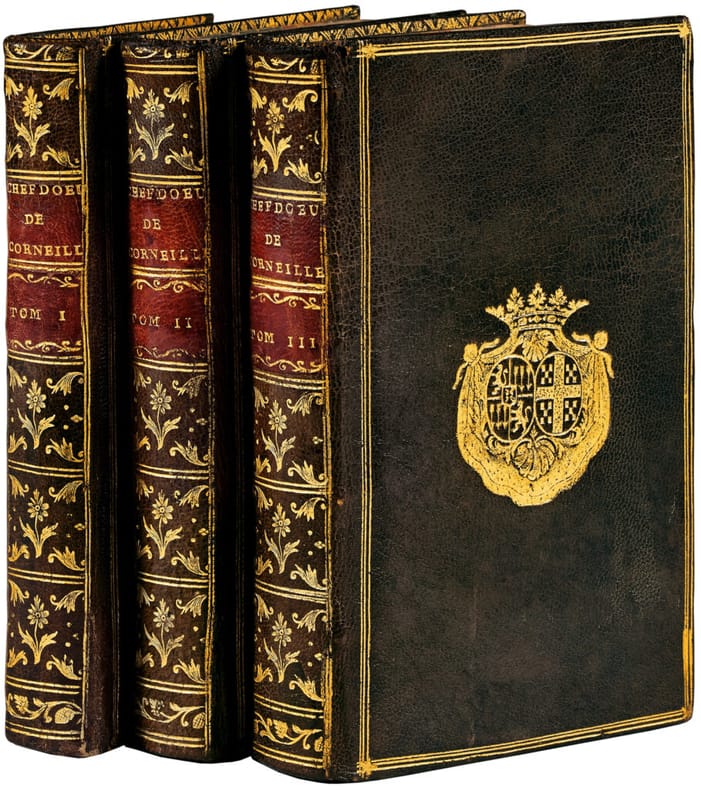
LCS-16077Les Chefs-d’œuvre de Pierre et Thomas Corneille reliés en maroquin olive de l’époque aux armes de Béatrix de Choiseul-Stainville, duchesse de Gramont, sœur du duc de Choiseul, ministre des affaires étrangères de Louis XV. Oxford, s.n., 1760.3 volumes in-12 de: I/ (4) ff. et 384 pp.; II/ (2) ff. et 382 pp., (1) f.; III/ (2) ff. et 557 pp. Pte. restauration et pte. mouillure dans l’angle inférieur du faux-titre du tome 1 sans atteinte au texte. Reliés en maroquin olive, triple filet doré encadrant les plats, armes frappées or au centre, dos lisses richement ornés, pièces de titre et de tomaison de maroquin rouge, filet or sur les coupes, roulette intérieure dorée, tranches dorées sur marbrures. Reliure de l’époque. 160 x 96 mm.
Small oblong 4to. 1 p. “Im Lebenstheater ist die Freude das große | Ballett, die Liebe die dramatische Idylle, | leider nur in Einem Act; die Ehe wird für | die harmoniereiche Oper gehalten, geht | aber sehr oft in ein ordinäres Spectakel- | Stück über; das Wircken des Menschen | soll sich zum Effect-Drama gestalten, | doch meistens wird nur eine lokale Pos- | se daraus; das große weltbekannte Traum- | spiel ist der Tod”. - Fine, only minimally browned leaf with tiny tear in bottom left margin. - Includes: I: Collector's folder with ms. notes about the writer and stamp of the Werner Eberhard Müller collection, Leipzig. II: Photograph of the artist in the role costume of Blasius Rohr in "Glück, Mißbrauch und Rückkehr oder Das Geheimniß des grauen Hauses" (96:64 mm; photographed by Hermann Klee and published by Neumann, Vienna).
- Gallimard, Paris 1954, 14,5x21,5cm, relié sous étui. - Edition originale, un des 41 exemplaires numérotés sur Hollande, tirage de tête. Reliure en demi chagrin maroquiné noir à bandes, dos lisse, date dorée en queue, encadrement de filets dorés sur les plats de papier gris souris, gardes et contreplats de papier noir, couvertures et dos conservés, tête dorée sur témoins, étui en plein chagrin maroquiné noir, intérieur de papier noir, reliure signée Montécot. Bel exemplaire. [ENGLISH DESCRIPTION ON DEMAND]
- Editions des hommes nouveaux, Paris 13 juin1913, 17x22,5cm, broché. - Édition originale du second livre de Cendrars, imprimée à 150 exemplaires sur papier de Hollande à la forme et proposée aux souscripteurs. Selon Sonia Delaunay, Séquences, Pâques à New York et le Transsibérien ont été publiés aux frais de l'auteur, grâce à un petit héritage. Le siège indiqué - Éditions Hommes nouveaux - 4, rue de Savoie, était en effet la petite chambre mansardée que Blaise Cendrars occupait à cette époque. Précieux exemplaire des poèmes de jeunesse de Blaise Cendrars, d'une exceptionnelle rareté et dans un état de conservation remarquable. [ENGLISH DESCRIPTION ON DEMAND]
- Mercure de France, Paris 1897, 12x19cm, relié sous chemise et étui. - Ubu Roi Mercure de France | Paris 1897 | 12 x 19 cm | bound in morocco Second edition, partly unpublished, printed with 300 copies using the autographic facsimile reproduction method: the handwritten text by Alfred Jarry is carefully written in calligraphy like the score written by Claude Terrasse, which is itself in first edition, one of 10 copies on Japan paper, the tirage de tête before 10 Holland paper. Binding in full garnet morocco, spine decorated with curved gilt fillets continuing on the boards, names of the author and the artist embossed in white, boards stamped with gilt and tricoloured (green, blue and white) fillets forming the title Ubu Roi in pataphysic calligraphy, endpapers in yellow watered and spangled fabric, frame of gilt stippling and a set of circles in the colours of the letters on the boards, following endpapers of glued paper enhanced with gold, all edges gilt, covers and mounted spine preserved, chemise in half morocco with strips and garnet flaps, glued paper boards enhanced with gold, beige felt interior, slipcase turn-ins split but remaining solid, glued paper slipcase enhanced with gold edged in garnet morocco, beige felt interior, beautiful Art Deco binding signed J. Anthoine-Legrain. Unavoidable and light discharges of ink in view of the quality of the Japan paper. The first iconoclastic masterpiece by the ubuesque precursor of Dadaism, surrealism and pataphysics. Provenance: the library of Albert Cornet-Épinat with his ex-libris glued to the first white endpaper. [FRENCH VERSION FOLLOWS] Deuxième édition en partie originale imprimée à 300 exemplaires selon le procédé de reproduction en fac-similé autographique?: le texte de la main d'Alfred Jarry est soigneusement calligraphié comme la partition de la main de Claude Terrasse qui est elle en édition originale, un des 10 exemplaires sur japon, tirage de tête avant 10 hollande. Reliure en plein maroquin grenat, dos lisse orné de filets ondulés dorés se poursuivant sur les plats, noms de l'auteur et de l'artiste poussés à l'oeser blanc, plats estampés de filets dorés et tricolores (vert, bleu et blanc) formant le titre Ubu roi en calligraphie pataphysique, gardes et contreplats de tissu jaune moiré et pailleté, encadrement de pointillés dorés et d'un jeu de cercles reprenant les couleurs des lettres des plats, gardes suivantes de papier à la colle rehaussé à l'or, toutes tranches dorées sur témoins, couvertures et dos remonté conservés, chemise en demi maroquin à bandes et à rabats grenat, plats de papier à la colle rehaussé à l'or, intérieur de feutre beige, chasses de l'étui fendues mais restant solides, étui de papier à la colle rehaussé à l'or bordé de maroquin grenat, intérieur de feutre beige, belle reliure Art Déco signée J. Anthoine-Legrain. Inévitables et légères décharges d'encre au regard de la qualité du papier japon. Le chef-d'uvre iconoclaste de l'ubuesque précurseur du dadaïsme, du surréalisme et de la pataphysique. Provenance?: bibliothèque Albert Cornet-Épinat avec son ex-libris encollé sur la première garde blanche.
188511520New York: Charles L. Webster and Company 1885. 1st Edition. Original cloth. Octavo. 366 pages. Very Good. Bound in original dark green cloth over boards with spine and upper board stamped in black and gilt. Some rubs and minor fading to cloth covers a few shallow bumps to board fore corners and spine ends. Hinges not cracked. Housed custom cloth and board folder in half morocco slipcase. A very nice first edition of one of the most important books in American literature. Hemingway believed that "American writing comes from that. There was nothing before. There has been nothing as good since." This copy has the important issue points at pages 13 57 and 143. A very handsome copy. Charles L. Webster and Company unknown
Large oblong 8vo. 43 ff. in carmine red velvet cassette with four gilt brass fittings and moirée satin endpapers. All edges gilt; red calf spine. The 33 entries, some written on the album leaf, others in letters or separate sheets of paper mounted within the album, are by the poets and playwrights Eduard von Bauernfeld, Ignaz Franz Castelli, Franz Grillparzer ("Was man den Kindern thut / Ist doppelt gut; / Weil im Erfolg, den Jeder sieht / Man ihre Ältern miterzieht"), Friedrich Halm (i. e. Baron Münch-Bellinghausen), Paul Maria Lacroma, Heinrich Laube, Betty Paoli, Otto Prechtler and Moritz Gottlieb Saphir; the scholars Helene von Druskowitz, Carl Helm, Ernst Pauer and Johann Emanuel Veith; the composer J. Hoven (i. e. Johann Vesque von Püttlingen: five-bar muscial quotation with the text: "und wäre nicht das Bißchen Liebe, so gäb' es nirgends einen Halt"); the singers Alois Ander and Emil Götze; the actors and actresses Marie Bayer-Bürck, Carl and Elisabeth Fichtner, Amalie Haizinger, Stella Hohenfels, Carl von La Roche, Carl Lucas, Louise Neumann, Carl and Julie Rettich, Mathilde Wildauer, Charlotte Wolter and Zerline Würzburg (wife of Ludwig Gabillon) and the dancer Fanny Elßler (fragment). A signature by Emperor Franz Joseph is mounted into the album. The pretty collection is topped off by a watercolour (signed Franz Steinfeld) and an oil landscape (signed "J. W.", corners broken). - Includes an ALS by Ignaz Franz Castelli (dated Vienna, 25 March 1864).
4to (196 x 244 mm). 40 ff. (some blank) containing ca. 90 entries by writers, musicians, and actors, as well as by family members, teachers, and classmates. Original navy leather with gilt cover borders. All edges gilt. A fine document of a young autograph collector's passion for the world of the stage, and of the Viennese "World of Yesterday" described by Stefan Zweig, remarkable for its surprising number of eminent contributors. - Alice Wagner, born in Zadar, Croatia (then under Austrian rule) eight days before the assassination of Archduke Franz Ferdinand in Sarajevo, was the daughter of the mechanical engineer Rudolf Wagner and his wife Anna; she spent her childhood in Vienna's middle-class 9th district. The earliest contributors to her album - apparently a gift for her 11th birthday - are her teachers, school friends, and relatives, and after gathering a dozen of such entries between 1925 and 1929, her interest in her collection appears to have waned. Yet after a hiatus of a year, now aged nearly seventeen, Alice finds a new use for the navy-blue volume: clearly a devotee of the theatre and opera, she turns to pursuing the signatures of the great performers and writers of the stage. In 1931 she obtains the signatures of singers Käthe Dorsch and Hans-Heinz Bollmann, as well as of playwrights Anton Wildgans and of Christa Winsloe, who recommends to her young admirer the movie version of her play, "Mädchen in Uniform" (ignoring the age restriction passed on the then-notorious film). - In the year 1932 alone Alice gathers no fewer than 37 dated contributions, which include internationally prominent writers such as Thomas Mann, Ernst Toller, Erich Kästner, and Jakob Wassermann, but also Viennese celebrities such as Stefan Zweig, Felix Braun, Felix Salten, Richard Beer-Hofmann, Max Mell, Franz Theodor Csokor, Ernst Lothar, Franz Lehár, Robert Stolz, Hans Moser, Otto Tressler, and even the physician Julius Wagner-Jauregg. The most peculiar entry is that by the satirist Alexander Roda Roda, who - long a happily married man, first by common-law and then legally - signs himself as the 18-year-old Alice's "fiancé" on August 4th, at 7:27 p.m. precisely. Underneath this tongue-in-cheek inscription the cabaret artist Fritz Grünbaum adds his own name on 28 April 1933, whimsically appointing himself "best man"; and underneath his entry, the actor Paul Morgan adds his own name on 10 October 1933. Further contributors of the years 1933/34 include Max Brod, Arnold Zweig, Attila Hörbiger, Tilla Durieux, Oskar Maria Graf, and Paula Wessely; undated entries include Ernst Deutsch and Max Pallenberg, Bruno Walter, Karl Schönherr, and Ferdinand Bruckner. - Contributions dry up after 1934, possibly reflecting as much the now 21-year-old Alice's changing interests as the increasing political constraints on Viennese culture, first under Austro-fascism and then following the National Socialist "Anschluss". On 9 March 1939 the Wagners, who were Jewish, were evicted from their home in the well-to-do Ayrenhoffgasse and were forced to move into a "Jew house" in the third district, where Jewish tenants were concentrated before deportation. At their address at Untere Weißgerberstrasse 5, apartment 7, the Austrian Holocaust victims' database records six known victims aged between 7 and 71 years, all deported to Minsk in November 1941 and to Auschwitz in November 1942. Alice Wagner escaped the fate of her housemates (which was also that of several of the contributors to her album, such as her "best men" Fritz Grünbaum and Paul Morgan): in July 1941 she married a 40-year-old Romanian, left Vienna, and in March 1942 gave birth to a daughter. It is not known how the family survived the remaining war years, but they returned to Vienna in early 1947 and moved into a house in Berggasse, not far from Sigmund Freud's old office. Her parents, too, survived the Holocaust. Her album gives poignant evidence of the last flaring up of the old Viennese and German cultural scene before its collapse. - A detailed list of contributors is available upon request.
8vo. 327 pp. Publisher's original printed wrappers. Inscribed by the author. First edition, inscribed to the managing director of the "Freier Verlag" (whose name has been effaced): "[Herrn Hans Huber] / In treuer Kameradschaft / Hugo Ball". Three years previously, the author had co-founded (with Hans Arp, Tristan Tzara, and Marcel Janco) the famous "Cabaret Voltaire" in Zurich, regarded as the cradle of Dadaism. In his present book he provides a historical analysis and critique of the "idea of the German state", which he held responsible for destroying "German thought". Prophetically, he writes: "It is my steadfast conviction that the destruction of the Prusso-German arbitrary power, as postulated by President Wilson in his famous address at Mount Vernon, will not be sufficient to protect the world from another German assassination [...]. It is of the utmost importance for the envisaged League of Nations to become fully aware of the historic strength of this foiled German plot, of the moral depletion of a people that has suffered for a thousand years under to most terrible theocracy [...]". The radical Ball, influenced by the great theorists of Anarchism, had spent most of the War years in exile in Switzerland, where he died in 1927, aged 41. Presentation copies of his books are rare.
4to and 8vo. Together 10½ pp. on 3 bifolia and 8 single sheets. The ALS in pen and pencil. With typescript envelope. Amicable letters to the French artist and writer Boris Vian (1920-59) about his literary career, from which he struggled to make a living, as well as family affairs and Vian's writing. - Several letters mention a piece on the Maginot Line which Vian was doing for the US magazine "Reporter", where Brossard worked as a journalist: "There is a lot of European stuff they are interested in and maybe you could do it. Namely, they are very interested in seeing a piece on the Maginot Line revisited [...] What is happening with the Line now, are people living in it, has it been dismantled, have the rats taken over, and so on. It would be a semi symbolic visit, as though you were visiting an idea about life you held as a child and found, in the adult world, that is was totally impracticable [...]". - Having left the "Reporter", he refocuses on his novels, expressing confidence that Vian's 1946 crime novel "I Spit on Your Graves" would be a huge success in the U.S.: "Forget the Maginot Line piece. I'm no longer working for the Reporter. Hope the whole thing did not upset you [...] My novel - published about 4 weeks ago - is slowly selling but will not make me any dough. Meanwhile I am trying to write a sexxy little novel under a different name - maybe Vernon Sullivan! - to make some money. My second novel ["The Bold Saboteurs", 1953] is all finished, on it I will stand or fall as a writer up to now [...] would you ask [Raymond] Queneau how he feels about the second novel [...] please send me another copy of I shall spit on your graves [...] I want to turn it over to my agent, who is the best in New York. I am positive it would sell like crazy here [...] My personal life stinks, as usual. But that is my destiny at the moment. My child, however, is very rewarding. A completely adorable beast [...]". - Hoping to score a secure job with the international broadcaster "Voice of America" funded by the U.S. Congress: "I am trying now to get a big job in the government, in the Voice of America. It would pay well, about $10,000 a year, and if they hire me they would want to send me to Europe for a couple of years. I go to Washington D.C. this week to see if my family can pull some wires in the government [and] use some influence on my behalf. It is too hard and too nerve wracking to try to make a full time living as a writer or an editor [...]". - About his financial situation and literary productivity: "I have a new novel coming out in the spring [...] It was just sold to the reprint people [...] for $7500. This is what we're living on. I have begun a third novel, called The Double Dealers [...]" (no such novel was published; Brossard's third novel was titled "All Passion Spent"; his fifth novel is titled "The Double View"). - About his family's difficult situation: "Very little new with me worth talking about, lots of minor bad luck - wife broke her ankle, then we found out she was pregnant, so had to have an abortion, which took all the money I had left. Still waiting on a job. Sent Queneau the rest of my second novel, but have not heard from him [...]". - Wondering about Sartre's intentions to publish two works: "The next time you see Queneau would you ask him if Jean Paul Sartre is going to publish those 2 stories [...]". - A few tiny marginal flaws; small portion of one letter torn, not affecting text.
4 pages in-8. À Victor Hugo. Charmante lettre où elle se plaint avec humour d'embarras gastriques. Elle supporterait son petit malaise avec plus de courage s'il était là pour la dorloter. "[...] Je m'en veux presque maintenant d'avoir sacrifié mon coeur à mon ventre une autre fois je ne ferai pas de ces stupides concessions-là et il s'en tirera comme il pourra et ces borborigmes aussi. Tiens qu'est-ce qu'ils me veulent donc ceux-là? Quand je vous dis qu'il n'y a plus de petits boyaux voici les miens qui veulent faire autant de bruit que les vôtres, les ambitieux. Voulez-vous bien vous taire tout de suite je n'aime pas les maux si tapageurs que ça [...]". Elle n'est cependant pas malade: "je t'aime trop voilà tout. Le reste c'est pure imitation et pour faire comme les grands boyaux. Je t'adore envers et contre tout [...]".
4 pp. in-8. À Victor Hugo. Belle lettre d'amour à son "cher Toto" dans laquelle elle évoque l'appel à la conscription du cadet de Victor Hugo. Dans ses multiples lettres d'amour, Juliette Drouet se comportait bien autrement qu'une simple maîtresse, mais en femme attentive à tout ce qui touchait son bien-aimé, montrant ainsi sa sensibilité et son intelligence. Ici elle attend son "petit homme" et lui demande ne pas lui "faire croquer le marmot trop longtemps". Elle demande des nouvelles de Madame de Montferrier, une amie de Victor Hugo qui avait été témoin du mariage de l'écrivain, et qu'elle a quittée hier. Elle s'inquiète aussi du sort de François-Victor, le fils cadet d'Hugo qui doit, conformément à la pratique de l'époque, tirer au sort un numéro décidant de son incorporation ou non au service militaire. Elle lui demande: "N'est-ce pas aujourd'hui que ton fils tire à la conscription? Si cela était il est probable que tu resteras chez toi jusqu'au moment où il rapportera son n° de la mairie. Pourvu qu'il ait le bon esprit de tirer le n° 1 il en est fort capable et je lui en fais d'avance mon compliment. Voime, voime, mais je suis sûre que tu aimerais mieux les trois portières chinoises? Tu es si difficile à contenter toi. Quant à moi ce que je préfère à tout les bric-à-bracs même au n° 1 de Toto c'est votre coeur ce qui est bien autrement fantastique que toutes les chinoiseries et les bonnes chances du monde [...]". L'allusion au "n° 1" que Juliette Drouet souhaite que tire François-Victor fait référence au complexe système de tirage au sort en vigueur pour la conscription militaire au XIXe siècle. De ce tirage au sort dépendait la durée du service militaire qui variait de six mois à un an, avec des possibilités d'exemption.
4 pages in-8. À Victor Hugo. Belle lettre d'une amoureuse délaissée. Elle est "confuse, triste, vexée, enragée", et elle se donne des coups de poings "à indiscrétion": "Je ne te vois plus, mon Toto, je ne t'occupe pas mais je ne te vois plus. Il est clair, cependant, que ce ne peut pas toujours être ton travail qui te retienne avec cette régularité ce sont bien plutôt les visites que tu fais et que tu reçois qui en sont la cause. Autrefois tu donnais moins de temps aux devoirs du monde et tu en donnais davantage à l'amour. Tu travaillais autant, si non plus, et j'étais plus heureuse. L'hiver je peux passer les nuits entières en veillant l'été je ne le peux pas; dès qu'arrive une heure du matin mes yeux se ferment malgré moi. Comment faire alors pour te voir puisque tu ne viens guère qu'à ce moment-là? Je ne me coucherai pas, je tiendrai mes croisées ouvertes et je prendrai du café pour m'empêcher de dormir. De cette façon, je pourrai au moins profiter des quelques minutes que tu peux me donner. Je commencerai ce régime ce soir [...]".
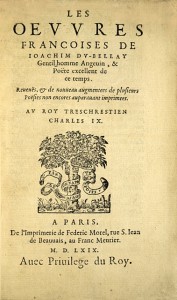
LCS-14708Première édition originale collective des Œuvres de Du Bellay, imprimée en 1569. A Paris, Federic Morel, 1569. 8 parties reliées en 1 volume in-8 de : I/ (12) ff., 40 ; II/ 80 ff. ; III/ 96 ff. ; IV/ 64 ff. ; V/ 60 ff. ; VI/ 88 ff. ; VII/ 80 ff. ; VIII/ 72 ff. Lettre manuscrite jointe. Plein maroquin rouge, triple filet doré encadrant les plats, dos à nerfs richement orné, double filet doré sur les coupes, roulette intérieure dorée, tranches dorées sur marbrure. Reliure signée Hardy. 164 x 103 mm.
Oblong 4to. ½ p. Draft for a letter to the Prussian State Councillor Carl Ferdinand Friedrich von Nagler (1770-1846). Goethe is delighted to have received a document from the Kingdom of Prussia honouring his work: "Was auch von der würdigen Schönheit des mir verliehenen Documentes verkündet wird, jedermann der es erblickt, findet es doch über alle Erwartung bewundernswerth, so daß mir bey jedesmaligem Vorzeigen der theure Gegenstand wieder neu erscheint und meine Verpflichtung deshalb immerfort frisch und neu lebendig empfunden wird [...]". - Some notes in pencil on verso.
1 S. Folio. Gerahmt (282 x 381 mm). Über eine ausständige Zahlung an die Separatkasse der Großherzoglichen Oberaufsicht für das Jahr 1829: "Nachdem die von dem Großherzogl. Controleur, Carl Friedrich Hoffmann, hier, geführte und anher abgelegte Rechnung über Einnahme und Ausgabe bey der Separa[t]kasse Großherzogl. Oberaufsicht, in der Zeit vom 1. April bis letzten Decbr. 1829 revidiert und darauf kalkulirt und abgeschlossen worden ist, wobey es sich ergeben, daß die Einnahme mit Verordnung Großherzoglicher Oberaufsicht, die Ausgabe aber durch eben dergleichen, und gehörig autorisirte Belege Bescheinigung gefunden hat und die schuldige Gewährschaft v. Fünfund Vierzig Thalern Dreiundzwanzig Groschen 3 dn. besteht; so wird gedachter Rechnungsführer, unter dem Vorbehalte, daß er die eben erwäh[n]ten 45 Rthlr. 23 g. 3dn. in seiner nächsten Rechnung wiederum zu vereinnahmen, bis dahin aber dafür zu haften habe, über diese abgelegte Rechnung für sich und die Seinigen hiermit in bester Rechtsform quittirt [...]". - Mit Siegelrest.
4to. 1 page. With autogr. envelope. In Russian. To the Russian artist Viktor Vasnetsov, asking to be allowed to make a copy of Vasentsov's "Virgin and Child" and mentioning a visit with Chekhov: "A friend of mine who has recently buried his wife would like to place in a chapel above her grave a copy of your 'Madonna and Child'. Be so kind as to tell me - is it possible to copy it? Could you possibly recommend one of your students, a person who is more able than the others to convey the beauty and soul of the original? How much, approximately, would such a copy cost - a copy the size of a human height or a bit smaller? Also, can a painting in oil retain its original integrity in a cold chapel? For answer to all of the questions - two of which are foolish, I presume - I will come to you around the 26th or 27th, and most definitely with Anton Pavlovich [Chekhov] [...]" (transl.). - Viktor Vasnetsov was a celebrated artist, particularly for mythological and historical subjects. In his later career he was responsible for a number of fresco cycles in churches, including in St Vladimir's Cathedral in Kiev and the Alexander Nevsky Cathedral in Warsaw. Only two letters from Gorky to Vasenetsov are known. - In perfect condition.
Zusammen 5¼ SS. auf 3 Bll. 4to. Mit 3 eh. adr. Kuverts und einigen Beilagen (s. u.). Aufschlussreiche, sehr persönlich gefärbte Korrespondenz aus fast zwei Jahrzehnten. Der Schriftsteller und seine erste Ehefrau Anna, die 1954 geheiratet hatten, waren seit den 1950er Jahren mit dem Botschafter Hans Lacher und dessen Ehefrau befreundet; diese Freudschaft begann in einer Zeit, als Grass noch völlig unbekannt war und seine ersten Werke als bildender Künstler wie als Schriftsteller publik zu machen begann. - Der erste der hier vorliegenden Briefe vom 19. XII. 1956 ist ein Bericht aus Annas Feder über die gemeinsame erste Wohnung in Paris in der Avenue d'Italie. Hier schreibt Anna auch kurz über die Arbeit von Günter: "Mein Mann ist sehr fleissig. Sein erstes Theaterstück wird am 20. Januar an einer Frankfurter Studentenbühne uraufgeführt. Da wird er natürlich hinfahren und hofft, von der ersten Aufführung einiges zu lernen". Es handelte sich hierbei um den Zweiakter "Hochwasser", dem allerdings das Stück "Die bösen Köche" vorausgegangen war. - Von Grass selbst stammt ein Brief vom 27. VI. 1960 (aus Berlin-Grunewald nach Berlin-Tiergarten), Teil einer launigen Konversation über die Widmung seines Gedichtes "Klappstühle" an Lacher, für die dieser zuvor in einem Telegramm (s. u.) um die Abkürzung seines Namens auf die Initialen H. L. gebeten hatte, was Grass "mit einem lachenden und einem skeptischen Auge" gelesen habe und das Ansinnen ironisch zurückwies. Der Scherz mit den Klappstühlen zog sich indessen jahrelang durch den Austausch, selbst der letzte dieser Briefe von der Hand Annas aus dem Jahr 1974 spielt noch darauf an. - Im Juli 1961 schrieb Grass dann einen Brief an Lacher nach Manila, wo dieser inzwischen als Botschafter der Schweiz auf den Philippinen lebte. Das Schreiben ist biographisch recht inhaltsreich; Grass berichtet über die Geburt der Tochter Laura Maria und gemeinsame Unternehmungen mit berühmten Kollegen: "In Zürich war ich - und nicht in Basel - bewegte mich dort im vollbesetzten Schauspielhaus mit den Dichtern Krolow, Enzensberger und unserer Sappho Ingeborg Bachmann auf den Brettern, die die Welt bedeuten, las hochdeutsch und westpreussisch aus eigenen Werken und durfte den Beifall eines kundigen Publikums schlürfen. Dürrenmatt hat uns prächtig vorgestellt; das heisst, er stellte den Dichtern das Publikum vor und fand so Gelegenheit, das eigene Nest - wie man in Deutschland sagen würde - zu beschmutzen". Außerdem kündigt er die Vollendung der Novelle "Katz und Maus" an - "zum Herbst soll sie die literarische Welt beglücken". - Im seinem dritten Brief berichtet Grass von der Entstehung seines neuen Romans "Hundejahre" und resümiert nach einer kurzen Skizze von dessen Inhalt: "Ich hoffe: ein buntes Buch, eines zum Lachen und zum Weinen. Vogelscheuchen treten in ihm gleichfalls auf, desgleichen eine Ballerina und ein Tischlermeister, kurzum: Zeitgenossen. Schade nur, daß es sich auf die Dauer nicht leichter schreibt, freier weg, wie zu Blechtrommelzeiten; denn den Altersstil möchte ich gerne noch in der Schreibmaschine schlummern lassen". Auch die geplante Verfilmung von "Katz und Maus" erwähnt er. Danach aber wünsche er sich "das Leben eines Lyrikers zurück", der dann "von tönen[d]sten Kritikern nicht mehr als wichtiger Repräsentant der 'deutschen Nachkriegsdichtung' durchs Feuilleton geschleppt wird, der vielmehr mit seinen Söhnen in den Zoo geht, Kochrezepte ausprobiert, und mit Frau, Söhnen und Tochter von jenen Geldern lebt, die ein Romancier gleichen Namens pausenlos für ihn verdient". - Die seinerzeit offenbar überschaubaren Einkünfte besserte seine Frau Anna damals durch Ballettunterricht etwas auf. Anna schrieb am 10. IX. 1974 noch an das Ehepaar Lacher und entschuldigte sich, eine Einladung absagen zu müssen. Inzwischen lebten Grass und seine Frau bereits getrennt; die Scheidung erfolgte 1978. - Beilagen: 1) Anna Grass (geb. Schwarz, 1932): 2 eh. Br. mit U. Paris, 19. XII. [1956] und Berlin, 10. IX. 1974. Zusammen 5 SS. auf 3 Bll. 4to. 2) 7 Bll. eh. Brieffragmente von Hans und Daisy Lacher aus dem Jahr 1961 und 1 ms. Telegramm Hans Lachers an an Grass (undatiert).
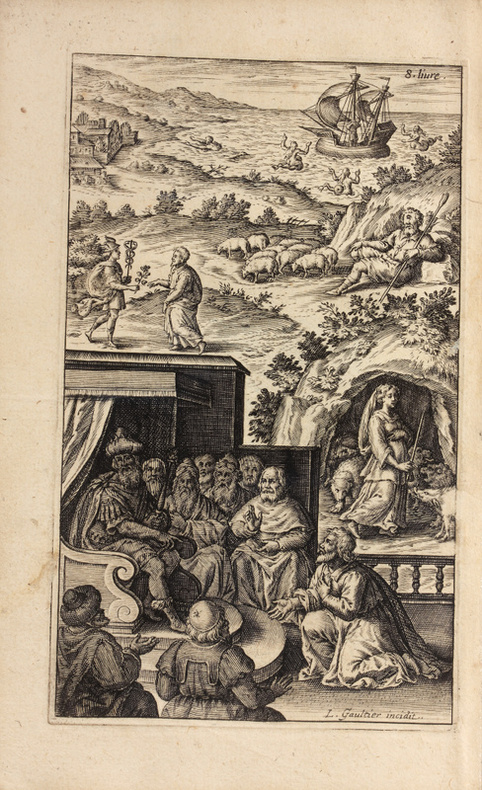
LCS-18031Rarissime édition originale de la traduction de l’Odyssée par Claude Boitel, la première version du texte intégral en prose française. Paris, chez la Veuve Matthieu Guillemot, au Palais en la gallerie des prisonniers, 1617. 3 parties reliées en 1 volume in-8 de : I/ (4) ff. y compris le titre frontispice, 409 pp., 5 planches à pleine page, (2) ff.bl. ; II/ 150 pp., 1 planche à pleine page, (1) f.bl. ; III/ 154 pp., (4) pp. pour le privilège et la marque de l’imprimeur, 1 planche à pleine page, (2) ff.bl. Relié en vélin souple de l’époque, traces de lanières, dos lisse avec le titre manuscrit. Quelques légères taches sans gravité. Reliure de l’époque. 173 x 110 mm.
8vo. 198 pp., final blank. Contemporary half calf with marbled covers, giltstamped blue spine label and appealingly gilt spine. All edges dyed green. First edition. - Prettily bound and well preserved: a crisp and wide-margined copy, only slightly browned with very occasional foxing. Inscribed on the flyleaf: "Meinem Freunde Eduard Ludolff für -- / W. Haering / Berl. d. 8ten Novbr. 1821", probably by the writer Wilhelm Haering, known under his pen name Willibald Alexis, for his school-friend, the lawyer Eduard Ludolff (1797-1857), who squandered his fortune on the arts and artists and later drowned himself; with another ownership, dated 1908 (Achim von Steman?). Acquired from the estate of the Frankfurt lawyer Wilhelm A. Schaaf (1929-2015), a specialist in economic, commercial and insolvency law. WG² 7. Goedeke VI, 102, 6. Sembdner 21, 8.