858 463 résultats
3 SS. auf Doppelbll. 4to. Schöner Brief an die Schriftstellerin Fanny Tarnow, die von 1816 bis 1818 in St. Petersburg gelebt hatte und während ihres dortigen Aufenthaltes auch häufig mit Klinger zusammengetroffen war, mit dem sie lebenslang eng befreundet blieb. Klinger dankt für ihr Schreiben und zerstreut Fannys Bedenken wegen weiterer Briefe, die er ihr gesandt hatte: "Die Möglichkeit, daß durch Sie meine Briefe in andre Hände kommen könnten, ist mir nie denkbar gewesen - habe ich dieses nicht bewiesen, da ich sie geschrieben habe? Ich bin überzeugt, daß Sie darüber mit mir gleich denken u. an nichts zweifeln. Ihre Briefe über P. hat mir allerdings mein Freund Semler kommen lassen, u. ich bin ihm dankbar dafür. Sie haben das, was Sie von den Sitten, Gebräuchen der Nation gesehen haben, sehr gut gesehen, u. sehr richtig dargestellt, wahr u. klar. Ich bedaure, daß Sie an diesem wirklich sehr merkwürdigen Volke nicht mehr beobachten konnten, besonders, daß Sie es nicht etwas im Innern haben sehen können. Sie werden wohl einem glauben, der nun 40 Jahre in diesem Reiche lebt, u. das Volk auch im Innern gesehen hat [...]". - Der preußische Finanzrat Semler hatte ein Jahr lang wegen Verhandlungen über einen Handelsvertrag mit Russland in Petersburg gelebt; der am Ende des Briefes erwähnte "wahrhaft edle, treue Teutsche", General von Dörnberg - "den ich liebe u. hochachte, u. von dem ich, wie ich sagen kann, geliebt u. geachtet werde" - war Wilhelm Caspar Ferdinand Frh. v. Dörnberg, der sich seinerzeit als Kämpfer zur Befreiung Deutschlands von der napoleonischen Herrschaft hervorgetan und als schwer verwundeter Reiterführer die Schlacht bei Waterloo überstanden hatte und der seit 1825 als außerordentlicher Gesandter in Petersburg lebte.
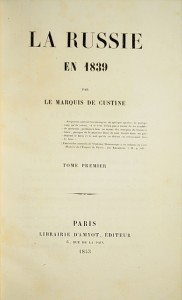
LCS-828Edition originale de La Russie en 1839 de Custine. Paris, Amyot, 1843.4 volumes in-8 de: I/ (2) ff., xxxi pp., 354 pp. ; II/ (2) ff., 416 pp., III/ (2) ff., 470 pp. ; IV/ (2) ff., 544 pp., 1 tableau dépliant. Reliés en demi-veau bleu de l’époque, dos lisses ornés de fleurons et filets dorés, tranches mouchetées.207 x 129 mm.
1p. 46.5:34cm (15 lignes). Exceptionelle rare lettre de Ninon de Lanclos, dont voici le texte: "Songes au capitaine que vous aves obligé tant de fois Monsieur je sais que pour faire du bien il ne faut point d'autre raison que celle de vos nobles inclination mais je ne pretans pas leur devoir tout quil y ait quelque chose pour lestime et lamitie que je conserve pour vous et pour celle que vous m'aves fait l'honneur de me prometre. Lanclos". - Cette lettre est à rapprocher de la lettre à Monsieur de Bonrepos dont le texte est quasiment identique (1p½ In-4, vendu aux enchères en 2002) mais présentée sur un papier de taille plus réduite et probablement aussi en caractères plus petits. Il est intéressant de noter que Monsieur de Bonrepos était un personnage assez important de la cour, qui fut même ambassadeur du Roi en Hollande. Notre lettre est forcément adressée à une personne plus importante encore, mais n'ayant aucune inscription de plus que le texte, il est impossible de savoir qui. Autographe de grande rareté.
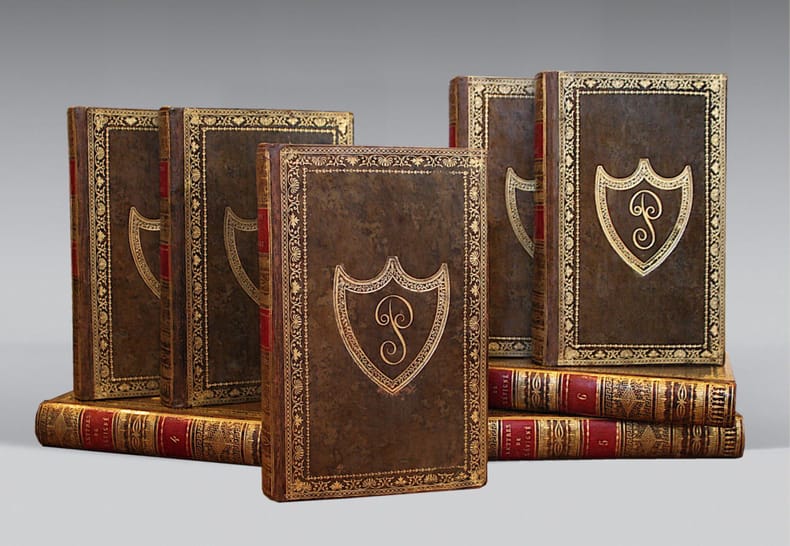
LCS-17786Précieux et bel exemplaire imprimé sur papier d’Angoulême revêtu d’une élégante reliure au chiffre de Pauline Bonaparte et orné de 2 portraits en frontispice, 4 portraits hors texte et l’écriture de l’auteur. Paris, Bossange, Masson et Besson, 1806. 8 volumes in-8 de : I/ (2) ff. 6 portraits, xxxv pp., (1) f., clxiv pp., 334 pp., II/ (2) ff., 479 pp., III/ (2) ff., 478 pp., IV/ (2) ff., 494 pp., V/ (2) ff., 480 pp., VI/ (2) ff., 447 pp., VII/ (2) ff., 527 pp., VIII/ (2) ff., 536 pp., (1) f. d’errata general. Plein veau brun raciné, roulette aux pampres de vigne encadrant les plats avec le chiffre P frappé or au centre, dos lisses très richement ornés, pièces de titre et de tomaison en maroquin rouge, coupes décorées, roulette intérieure, tranches dorées. Reliure armoriée de l’époque portant l’étiquette de Baudet Relieur. 199 x 120 mm.
8vo and 12mo. Altogether 9 pp. on 5 ff. The most important letter in this collection, to his close friend Armand Renaud, was written on 5 Dec. 1869 towards the end of a creative blockage that had begun earlier that same year. Suffering from an old illness and studying for a humanities degree, Mallarmé wished to take a year's leave from his post as a teacher in Avignon. He informs Renaud about his request to the Ministry of Education and his financial worries: "I find myself with hardly enough to get by". Therefore, he asks Armand to inform M. Lebourgeois of his request, who should in turn use his influence at the Ministry to obtain a higher allowance for Mallarmé. He also hints at the abandonment of his first literary project since 1866, the philosophical poem "Igitur", because of his studies: "I worked on what I told you but a serious occupation, which must be that of my forced leisure (the humanities degree in view of the doctorate), will give my thoughts a different direction. To tell the truth, a year of Latin and Greek suddenly appearing is a fortunate and interesting perspective". The Ministry granted Mallarmés leave, and during the year 1870 he worked on a linguistic thesis and a Latin thesis on divinity, neither of which he completed. - Mallarmé did not return to Avignon but stayed in Paris where he tried to launch the magazine "Art décoratif" in 1872. In the undated second letter, addressed to a M. Prunère, he announces that the painter Claudius Popelin (1825-92) would contribute a frontispiece to the project, admitting that he did not dare ask for other illustrations: "I saw M. Popelin who was charming and eager to do me the favour. I thus have the promise for a frontispiece [...] Very happy and very proud of my success, I did not dare mention the little ornament that I would like to see at the head of the first page, a kind of title serving as a transition for the reader who browses between the beautiful frontispiece of the cover and the text columns of the first page where it would be placed at the head [...] Do I dare ask you to procure that, just chatting?". The project ultimately fell through, and the recipient of the letter has not been identified. In 1874 Mallarmé launched the avant-garde fashion magazine "La Dernière Mode" and published a few issues as its sole editor. - The last letter in the collection is written to the sculptor and painter Albert Bartholomé (1848-1928) on behalf of the painter Jacques-Émile Blanche (1861-1942), a former student of Mallarmé. Blanche was hoping that the École des Beaux-Arts would buy one of his paintings following the 1892 exhibition of the Société nationale des beaux-arts at the Palais du Champ de Mars. The painting can be identified with his famous portrait of Marcel Proust, today in the collection of the Musée d'Orsay: "I gathered some information and I communicate it to you so as not to exasperate the terrible man we love. It is necessary that M. Blanche immediately addresses the director of the Beaux-Arts with a request to 'include the no. of his painting in the acquisitions made at the Champ-de-Mars'. This formality is indispensable and it will be followed by a recommendation, which, I believe, will have its effect [...]" (10 May, postmarked 1892). - The letter to Armand Renaud on mourning stationery; the letter to Prunère with deep tears in the folds and some browning but no text loss.
4to. 2 pp. In German, to Mr. Motschan, on imprinted stationery of the Library of Congress, Consultant in Germanic Literature: "It has been a long time since I received your kind letter of June in which you remembered my birthday with so much affection. But I did receive it and cannot understand why the earlier letter got lost It cannot be the old address which caused it, for I receive many letters that get delivered to Princeton first... It has been a long time since we have lived in Princeton. Actually, my time as a visiting professor there had already run out after one year but was extended for another year as an exception. But every year we are here on the West Coast, and we like it so much that after renting for quite a while we built our own home here in the country, in a beautiful area near Westwood and Santa Monica, and not far from either Hollywood or Los Angeles. It is the fourth house in my life - and I think it will be my final residence. For what it will be like in Europe after this mess - if I live long enough to see it - God knows. Which does not mean that I say Hitler will be able to win this war. I was very happy to hear so much good news from you and I congratulate you on your studies. I can understand that St[efan] Zweig s death affected you so deeply. I cannot approve of his decision - hiding, by the way, an incurable illness of his wife is supposed to have contributed to it - because of the discouraging effect it may have on his companions in misfortune. And yet at the same time he was so much better off than most of them. He was much too soft a person, absolutely peace loving and his attitude was completely in favor of intellectual free trade and he is said to have made a gloomy impression since quite some time ago. R.I.P But he should not have permitted the Nazis this triumph. If he had hated and despised them more, he would not have done it Received my best wishes and let us hope that Switzerland will get through this turmoil safe and sound again!" - Thomas Mann had supported the first World War, which led to a break with his pacifist brother, novelist Heinrich Mann. Thomas had lived mostly in Munich until 1933, when he moved to neutral Switzerland. In 1936, he emphatically disassociated himself from Nazism with an open letter. Then in 1938, Mann came to Princeton as a visiting Professor, and settled in California in 1941. At the time of this letter, Mann was finishing his tetrology, Joseph and His Brothers, and began work on Doctor Faustus. Stefan Zweig, a man of Jewish descent, had developed pacifist views with the advent of World War I, when he moved to Switzerland from his native Vienna so that he could express those views. Between the wars he lived in Salzburg, then emigrated to Brazil in 1938. The horrors of World War II were too much for him to bear, causing him to commit suicide in 1942.
2 SS. 4to. An den namentlich nicht genannten Franz Blei, der 1932 nach Cala Rajada (Mallorca) emigriert war, über eine mögliche Mitarbeiterschaft an der von Ernst Schönwiese herausgegebenen Literaturzeitschrift "das silberboot": "Wenn ich mich frage, warum ich Ihnen so lange nicht geschrieben habe, obzwar es nicht am Wunsch fehlte, so finde ich, dass ich mir selbst ein Gegenstand der Unlust bin. Ich kann von mir nur erzählen, dass ich materielle Sorgen habe und dass der Roman von Zeit zu Zeit einen Ausblick auf das Ende gewährt, der dann wieder zuwächst. Natürlich gibt es auch in meinem Leben anderes, aber es spielt sich wie auf einem Schiff ab, das jeden Tag vom gleichen Horizont eingeschlossen wird: mit einem Wort, ich verbreite jene heroische Langweile um mich und befinde mich selbst in ihr, die man auf dem Meer empfinden mag; glücklicherweise mit Martha, die dafür Verständnis hat. Ausnahmsweise ist heute etwas zu berichten, das nicht zum 'Schiff' gehört; es wird nämlich hier eine kleine Monatsschrift erscheinen, und ich fürchte nicht lange am Leben sein, die reine Literatur bringen will. Der zukünftige Herausgeber war vorgestern bei mir, und es zeigte sich, dass er Sie verehrt und einladen will, was ich überdies auch übernommen habe. Das Honorar ist so gering, dass ich es bereits wieder vergessen habe; aber unter den herrlichen Wirtschaftsverhältnissen Ihrer Insel könnte es irgendeine Kaufkraft haben [...]".
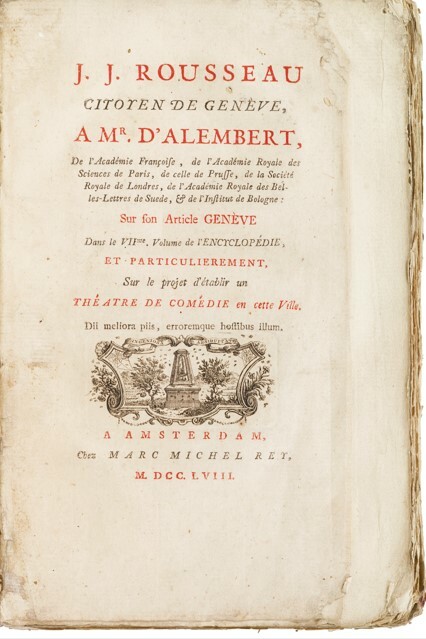
YTB-95ÉDITION ORIGINALE de la « très importante » et polémique Lettre sur les spectacles de Rousseau. Dufour, 71-73 ; Tchemerzine, V, 535 ; Rahir, Bibliothèque de l’amateur, 623. Le texte est aussi significatif de l’attachement de Rousseau pour sa patrie genevoise que de ses goûts et connaissances en matière de théâtre. La lettre de Rousseau est une réponse à l’article « Genève » publié dans le tome VII de l’Encyclopédie en octobre 1757 dans lequel D’Alembert, inspiré par Voltaire, demandait l’établissement d’un théâtre à Genève où, depuis Calvin, les représentations étaient interdites. L’œuvre rencontra un vif succès et Rey dut imprimer une seconde édition dès le début de 1759, mais son contenu souleva de nombreuses polémiques. D’Alembert répond lui-même en mai 1759 par une « Lettre de M. D’Alembert à M. J.J. Rousseau » dans laquelle il soutient que le théâtre peut être plaisant et utile à la fois. PRECIEUX ET BEL EXEMPLAIRE CONSERVE DANS SA BROCHURE D’ATTENTE DE L’EDITEUR, TEL QUE PARU, CONDITION RARE ET RECHERCHEE.
Large 4to. ½ p. With original mailing envelope. A charming note from Salinger to Maria DeSalvo in which he writes "I'm an unsatisfactory and, at best, a one-shot letter answerer, but I would like you to know that I liked that very nice letter you sent me. Thank you. Very good wishes to you. Sincerely, J.D. Salinger". - In black ink. Rare.
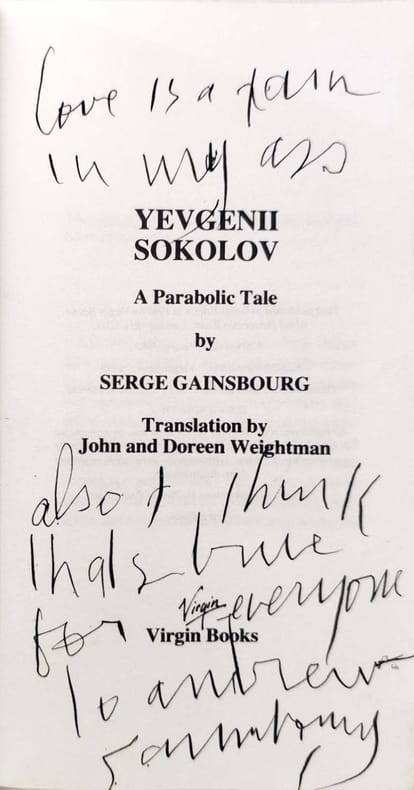
19801058741980 Londres, Virgin Books, 1980, broché, 110x195 mm. Avec 2 pages recto-verso d’illustrations couleur ainsi que la couverture qui rappellent les œuvres de Jacques de la Villeglé.
8vo. 3 pp. on bifolium. With autograph address on verso. To his sister Pauline Périer-Lagrange (1786-1857) in La Tour-du-Pin about the Bourbon Restoration shattering his dreams of a successful career under Napoleon, as well as his departure for Italy, mentioning a letter to their father requesting the title to estates with an income of 2,400 francs: "Tu verras, ma chère Pauline, dans le journal d'aujourd'huy, the total fall of my hope. Ainsi, il faut finir. Je passerai à Lyon dans un mois, de là à Gênes et Rome. J'ai écrit officiellement au Bastard [i. e. his father, the lawyer Chérubin Beyle] pour lui demander des terres rapp[ortan]t 2400F". He would like to grant general authority to the prosecutor Ennemond Hélie, discusses plans to sell his furniture as well as his cabriolet to raise enough money for his travels and a couple of months beyond the point when he will receive monies from M. Gagnon (likely a relative: his grandfather, Henri Gagnon, died in 1813), and admits having to struggle to reason with his creditors over a sum of 37,000 francs, hoping Pauline might persuade their father to help him out: "Je vends mon Mobilier et mon Cabriolet. Le produit de cette vente me donne le voyage et quelques mois. Ensuite l'argent que payera Mr. Gagnon. Le difficile est de faire entendre raison aux 37000F créanciers d'ici. Si tu peux pousse le bastard à être honnête homme une fois en sa vie [...]". Planning to meet her in Lyon in June, he asks her not to keep his fate a secret, sure to provoke some feelings of pity and shame among their family, especially their father, and happy never to see Grenoble again: "Nous nous donnerons rendez-vous à Lyon vers la fin de Juin. Mais où es-tu toujours au Plantier? [...] Ne fais pas mistère de ma misère. La pitié fera tomber la haine fondée sur l'envie, et peut-être donnera un peu de Vergogne au Bastard, qu'au reste j'espère bien ne plus revoir, ni Cularo [i. e. Grenoble] non plus [...]". - Signed with the pseudonym "F. Brenier". A small paper flaw due to opening the letter. Champion, Correspondance générale II, 987.
8vo. 1 page. To Kathleen Delvev, apologising for not writing sooner, as he has been away, thanking her but declining her invitation to speak at the Taunton Book Club: "Thank you for your invitation to come to the Taunton Book Club, but I'm afraid I won't be able to accept it as I shall be going to the States, fairly soon, I think, and don't know when I shall return: all my plans are in such a muddle at the moment [...]". - Thomas undertook four tours of America between 1950 and 1953. Here he writes in July 1953, fresh from his third visit, where he performed a "work in progress" version of Under Milk Wood, initially as a solo piece at Harvard and then at the Poetry Centre in New York with a full cast, when he gave his rewritten lines to the actors just minutes before the play began. During this tour he also began his affair with Elizabeth Reitell, the assistant of poet John Brinnin. - The following months back home, when this letter was written, were characterised by heightening tensions with his wife Caitlin and his increasingly unpredictable behaviour, fuelled by a desperate need to escape his situation ("all my plans are in such a muddle"). Encouraged by promises of more performances at the Poetry Centre and a month collaborating with Stravinsky in California, he returned to New York in October - "to Reitell, and exhaustion. Drinking heavily, he became ill and intermittently deranged about the time of his thirty-ninth birthday at the end of the month. On 4 November a doctor unwisely sedated him by injecting half a grain of morphine, which was to prove fatal" (Paul Ferris, ODNB). - Kathleen Delves was the secretary of the Taunton Book Club in the 1950s and, on hearing Dylan Thomas was available for public engagements, she invited him to speak. His reply has been retained in the family until now. It is unpublished, not appearing in the Collected Letters (ed. Paul Ferris, 2000). - Some spotting.
- K éditeur, Paris 1947, 13,5x17,5cm, broché. - Édition originale sur papier courant. Minuscules et très discrètes restaurations au verso du premier feuillet blanc. Important et bel envoi autographe signé d'Antonin Artaud : «?à M. Fernand Pouey qui a voulu comprendre mon aride effort. Antonin Artaud. 13 décembre 1947.?» Ce reconnaissant hommage est adressé au journaliste libertaire et engagé Fernand Pouey, alors directeur des émissions dramatiques et littéraires à la Radiodiffusion française et à l'instigation duquel Artaud écrivit Pour en finir avec le jugement de Dieu, enregistrée pour l'émission La Voix des poètes. Les deux hommes entretinrent une longue correspondance au sujet de ce projet qui fut entièrement réalisé mais censuré la veille de sa diffusion, le 1er février 1948. Fernand Pouey qui, quelques mois auparavant, avait déjà subi la même censure pour L'Enfant criminel qu'il avait commandé à Jean Genet, eut le courage de démissionner immédiatement. Cependant, la reconnaissance d'Artaud pour la compréhension de son «?aride effort?» est plus précoce et se réfère à la première journée d'enregistrement pour laquelle le poète s'inquiéta que «?le réalisateur [...] et [...] tous ceux à qui [il a] eu a faire [sic] comprennent quelles furent [ses] intentions et volontés?» (lettre à Fernand Pouey, 11 décembre 1947). La correspondance avec Pouey, comme cette dédicace éloquente, témoigne de la complicité intellectuelle entre les deux hommes. Ensemble, ils vécurent intensément cette ultime aventure radiophonique, sabordée par le directeur de la Radiodiffusion Française - pourtant lui-même fils de poète -Wladimir Porché. Les envois autographes d'Antonin Artaud sont très rares sur ce texte. [ENGLISH DESCRIPTION ON DEMAND]
- Robert Marin, Paris 1948, 11x17cm, broché sous chemise et étui. - BRETON André. La Lampe dans l'horloge [The Lamp in the Clock] Robert Marin, Paris 1948, 11 x 17 cm, original wrappers with custom slipcase First edition, one of the numbered copies on alfa mousse paper, this one not justified. Wrappers in chemise and case. With an exceptional and important presentation inscription from André Breton to Jean-Paul Sartre. Case with almond-colored paper boards and chemise, red morocco title-piece and label with "exemplaire de J. P. Sartre [J.P. Sartre's copy]". This inscription from the Pope of Surrealism to the master of Existentialism - of whose rare meetings, most notably in New York, there remain barely any traces in their biographies - is all the more surprising since Sartre had just published a vitriolic article on Breton in Qu'est-ce que la littérature? [What is literature?]: "The theoretical accord between Surrealism and the Communist Party against the bourgeoisie does not in fact go beyond the formal; it is the formal idea of negativity that unites them...Negativity subsists, no matter what anyone says, outside of history: it is, at the same time, of the instant and everlasting - it is the ultimate end of both literature and art. Somewhere, Breton approves of the... 'sacred mission' of the proletariat. But in the end, this class - imagined as a legion of exterminating angels - is in reality nothing more for authors than a religious myth that plays a role (for the salving of their consciences) analogous to that played by the myth of 'the People' in 1848 for well-intentioned writers." André Breton did not reply to Sartre's criticisms, nor even the ones formulated a year later by Simone de Beauvoir in The Second Sex. This little work, as much political as it is poetical, is nonetheless a part of the common cause of these two intellectuals within the extremely ephemeral Rassemblement Démocratique Révolutionnaire. Founded in 1947 by Sartre, it very quickly floundered despite the active engagement of Breton. 1948 was therefore the only intellectual meeting of these two great "Masters of Thought" of the second half of the 20th century, whose personalities - intransigent and exclusionary - did not allow for a lasting philosophical union. [FRENCH VERSION FOLLOWS] Édition originale, un des exemplaires numérotés sur alfa mousse, le nôtre non justifié. Précieux et exceptionnel envoi autographe signé d'André Breton à Jean-Paul Sartre. Notre exemplaire est présenté sous chemise et étui en plein cartonnage amande, pièce de titre et mention « exemplaire de J. P. Sartre » de maroquin rouge. Cette dédicace du pape du surréalisme au maître de l'existentialisme dont les rares rencontres, notamment à New York, n'ont laissé presque aucune trace dans les biographies, est d'autant plus surprenante que Jean-Paul Sartre vient juste de publier dans Qu'est-ce que la littérature un article au vitriol contre Breton : « L'accord de principe du surréalisme et du PC contre la bourgeoisie ne dépasse pas le formalisme ; c'est l'idée formelle de négativité qui les unit ; [...] la négativité se maintient quoi qu'on en dise, en dehors de l'histoire : à la fois dans l'instant et dans l'éternel ; elle est la fin absolue de la littérature et de l'art. Quelque part, Breton affirme [...] la « mission sacrée » du prolétariat. Mais précisément, cette classe conçue comme une légion d'anges exterminateurs n'est véritablement pour les auteurs qu'un mythe religieux et qui joue, pour la tranquillisation de leur conscience, un rôle analogue à celui que jouait le mythe du Peuple, en 1848, pour les écrivains de bonne volonté. » André Breton ne répondra pas plus aux critiques de Sartre qu'à celles que formulera, l'année suivante, Simone de Beauvoir dans Le Deuxième Sexe. Ce petit ouvrage politique autant que poétique s'inscrit cependant dans le combat commun des deux intellectuels au sein du très éphémère Rassemblement Démocratique Révolutionnaire fondé en 1947 par
- Gallimard, Paris 1945, 12x19cm, broché. - First Edition, one of 25 numbered copies on "pur-fil" paper draw head. The book Camus dedicated to his friend René Leynaud. Rare and nice copy. [FRENCH VERSION FOLLOWS] Edition originale, un des 25 exemplaires numérotés sur pur fil, tirage de tête. L'ouvrage que Camus dédia à son ami René Leynaud. Rare et agréable exemplaire.
- Gallimard, Paris 1954, 14x21cm, relié sous chemise et étui. - First edition, one of 45 numbered copies on Hollande paper, the tirage de tête Autograph inscription from Louis-Ferdinand Céline to his friend Pierre Duverger, the only photographer to have taken color photographs of Céline Quality blueish paper covers, sunned (as is often the case) Ex libris pasted onto foot of half-title This copy has a half black morocco chemise, spine in six compartments, date to foot, and a slipcase edged in black morocco, both by Goy & Vilaine. [FRENCH VERSION FOLLOWS] Edition originale, un des 45 exemplaires numérotés sur Hollande, tirage de tête. Envoi autographe signé de Louis-Ferdinand Céline à son ami Pierre Duverger, seul photographe a avoir réalisé des clichés en couleurs de Louis-Ferdinand Céline. Couverture bleutée des grands papiers, dos passé comme souvent. Ex-libris encollé en pied de la page de faux-titre. Notre exemplaire est présenté sous chemise en demi maroquin noir, dos à cinq nerfs, date en queue et étui bordé de maroquin noir, ensemble établi par Goy & Vilaine.
- Nouvelles Editions Françaises, Paris 1941, 11,5x19cm, relié. - First edition, one of 60 numbered copies on vergé d'Arches paper, deluxe copies ("tirage de tête"). Bound in brown half morocco, covers and spine preserved, top edge gilt, binding signed by Thomas Boichot. Nice copy. [FRENCH VERSION FOLLOWS] Edition originale, un des 60 exemplaires numérotés sur vergé d'Arches, tirage de tête. Reliure en demi maroquin marron, dos à cinq nerfs, date dorée en queue, plats de papier à motifs abstraits, gardes et conteplats de papier rouge, couvertures et dos conservés, tête dorée, reliure signée Thomas Boichot. Bel exemplaire agréablement établi.
- Mercure de France, Paris 1912, 15x19cm, relié. - First edition, one of 7 numbered copies on Hollande paper, the only large paper copies, this one no. 1, specially printed for Jean Cocteau's mother. Contemporary vellum Bradel binding by Dupré, gilt date to foot of spine, brown shagreen title label, marbled endpapers and pastedowns, covers and spine preserved. Light worming, principally affecting the margins of some leaves. A moving and exceptional autograph inscription signed and dated by Jean Cocteau to his mother, in Latin, quoting a verse of Virgils Bucolics: "Incipe, parve puer : cui non risere parentes, nec deus hunc mensa, dea nec dignita cubili est. / Virgile. / Jean", which in English is: "Realise this, child: the boy at whom his parents never smiled is fit neither to approach the table of the Gods, nor the couch of a Goddess." A unique copy. With the publication of this third collection of poetry Cocteau, a young prodigy then aged 23, was feted by artistic and literary circles. An intimate of Proust's, a friend of Jacques-Emile Blanche, a follower of Nijinski and Diaghilev and a disciple of Anna de Noailles, his ambition was to unite in his own person all the talents that surrounded him. The Danse de Sophocle [Dance of Sophocles], a reference to the nude dance that "the young and divine Sophocles" did in Athens after the naval victory at Salamis, reflects the ambition and the exaltation of the young Cocteau: novelist, painter, dancer, poet, he felt truly "fit to approach the table of the Gods." "As with all the best artists, he was a link between God and Earth." In his biography, Claude Arnaud dedicates a chapter ("The Living God") to the psychology of the poet in this period: "He was a piece torn from God, one of the terrestrial organs through which this Being, constantly evolving, thought about and finally acted to improve his creation." Thus, Cocteau broke free of his illustrious models and assumed his full artistic divinity, which unfolded in this ecstatic collection, witnessed by the eponymous poem: Thanks to you, dear pride, I wore the halo Given by the charming god of words... Thanks to you, I knew the frenetic struggles in which pen and paper, the dreary pot of ink Are the ties of verses you want to shout You want to scream, sing, sigh, laugh... And which we must - since they are in us and we feel them - Let flow like beautiful blood. The inscription to his mother, on the first of seven rare large paper copies, is a witness to Cocteau's only real great influence: Eugénie Cocteau. A mother idolized by her son, she was a profound influence on both the poet's life and his work, marked by the omnipresence of the Oedipal figure. Claude Arnaud describes at length this "filial outpouring coupled with an almost amorous attention...: 'only my love for you is rooted in something real, the rest seems to be a bad dream'." One can hardly miss in this quotation from Virgil the incestuous ambiguity that bound Cocteau to his mother. One of the most desirable provenances for this extremely rare copy. [FRENCH VERSION FOLLOWS] Édition originale, un des 7 exemplaires numérotés sur Hollande, seuls grands papiers, le nôtre portant le n°1 et spécialement imprimé pour la mère de Jean Cocteau. Reliure à la bradel en plein vélin, dos lisse, date dorée en queue, pièce de titre de chagrin brun, gardes et contreplats de papier à la cuve, couvertures et dos conservés, tête rouge, reliure de l'époque signée de Dupré. Légères piqûres affectant principalement les marges de certains feuillets. Émouvant et exceptionnel envoi autographe daté et signé de Jean Cocteau à sa mère, en latin, qui reprend l'un des vers des Bucoliques de Virgile?: «?Incipe, parve puer?: cui non risere parentes, nec deus hunc mensa, dea nec dignita cubili est. / Virgile. / Jean?» dont voici la traduction française?: «?Enfant, reconnais-la?: le fils à qui ses parents n'ont point souri n'est digne ni d'approcher de la table d'un dieu, ni d'être admis au l
- Dentu, Paris 1872, 11,5x18,5cm, relié sous chemise et étui. - Edition originale très rare et très recherchée selon Clouzot et pour laquelle il n'a pas été tiré de grands papiers. Reliure en plein maroquin rouge, dos à cinq nerfs, roulettes dorées sur les coiffes, encadrement d'une dentelle dorée sur les contreplats de maroquin blanc cassé enrichi d'un listel de maroquin mosaïqué rouge et d'un jeu de quintuples filets dorés, le listel et les quintuples filets dorés s'entrelaçant en écoinçons, encadrement d'un filet doré sur les contreplats, gardes de soie moirée ivoire, couvertures gris fer et dos conservés (Clouzot signalant deux états des couvertures : celles gris fer - les plus rares - et celles gris bleuté), toutes tranches dorées, doubles filets dorés sur les coupes, chemise en demi maroquin rouge à bandes, dos à cinq nerfs, plats de papier caillouté, étui bordé de maroquin rouge, intérieur de cuir beige, plats de papier caillouté, magnifique reliure signée Huser. Provenances : des bibliothèques Raoul Simonson et José Peraya avec leurs ex-libris encollés sur un contreplat. Superbe exemplaire, complet de ses rares couvertures gris fer et du catalogue de l'éditeur qui manque très souvent, établi dans une splendide reliure en plein maroquin doublé et mosaïqué de Huser. [ENGLISH DESCRIPTION ON DEMAND]
- Nouvelle librairie de France, Paris 1949, 22x28,5cm, broché sous chemise et étui. - Edition illustrated with 20 original lithographs in 8 and 10 colours by Kees Van Dongen and printed with 110 copies, ours is one of the 10 hors-commerce without the series of lettered and named lithographs on Rives vellum. We attach the presentation prospectus to the work. Rubbings and tears in the margins of the slipcase and on the joints of the chemise. A beautiful and rare copy. [FRENCH VERSION FOLLOWS] Edition illustrée de 20 lithographies originales en 8 et 10 couleurs de Kees Van Dongen et imprimée à 110 exemplaires, le nôtre un des 10 hors commerce sans la suite des lithographies lettrés et nominatifs sur vélin de Rives. Nous joignons le prospectus de présentation de l'ouvrage. Frottements et accrocs en marges de l'étui et sur les mors de la chemise. Bel et rare exemplaire.
- Plon, Paris 1961, 14x20,5cm, broché. - Folie et Déraison. Histoire de la folie à l'âge classique Plon | Paris 1961 | 14 x 20,5 cm | original wrappers First edition, of which there were no grand papier (deluxe) copies, an advance (service de presse) copy. Spine slightly bowed, with a few tears and lacks to plastic film cover. Slight foxing in the margins of a few pages. Handsome autograph inscription signed by Michel Foucault, at the time a young teacher, to Jean-Charles Varennes. A very rare advance copy, which could be said to have taken the place of the grand papier (deluxe) copies. [FRENCH VERSION FOLLOWS] Édition originale pour laquelle il n'a pas été tiré de grands papiers, un des exemplaires du service de presse. Une deuxième édition révisée paraîtra en 1972. Exemplaire complet de sa jaquette illustrée qui comporte quelques déchirures et manques de film pelliculé qui la recouvre, quelques rousseurs affectant les marges de certains feuillets. Exceptionnel envoi autographe signé de Michel Foucault, alors jeune enseignant, à Jean-Charles Varennes. Très rare exemplaire service de presse qui peut faire office de grand papier du premier ouvrage d'importance de Michel Foucault, tiré de son doctorat d'État.
- S.n., Berlin s.d. (1911), 12x19cm, relié. - First edition Contemporary half saffron sheep Bradel binding, gilt roulette at head and foot of spine, gilt fillet to covers, marbled endpapers and pastedowns, top edge gilt Very rare and precious autograph inscription from Maxim Gorki in Cyrillic to Gregory Alexinsky, member of the Duma and man of letters: "to G.A Alexinsky, comrade, with all best wishes and respect, the author". [FRENCH VERSION FOLLOWS] Edition originale. Reliure à la bradel en demi basane safran, dos lisse orné d'une roulette dorée en tête et en pied, filet doré sur les plats, contreplats et garde de papier à la cuve, tête dorée, reliure de l'époque. Très rare et précieux envoi autographe signé de Maxime Gorki en cyrillique à Grégoire Alexeï Alexinsky, député à la DOUMA et homme de Lettres : "à G.A. Alexinsky, au camarade, avec toute la sympathie et le respect, l'auteur".
- Calmann-Lévy, Paris 1878, 15x23,5cm, relié. - First edition, one of 15 copies on Whathman paper Contemporary Bradel binding by Paul Vié in red cloth, gilt fleuron to spine, midnight blue morocco titlepiece, double fillet and date at foot of spine Handsome autograph inscription from Victor Hugo to Leconte de Lisle, poet and head of the Parnassianist movement, who would go on to take over Hugo's chair at the Académie Française. [FRENCH VERSION FOLLOWS] Edition originale, un des 15 exemplaires sur Whatman. Reliure à la bradel en pleine percaline rouge, dos lisse orné d'un fleuron doré, pièce de titre de maroquin bleu nuit, double filet et date en queue, reliure de l'époque signée Paul Vié. Précieux envoi autographe signé de Victor Hugo à Leconte de Lisle, poète et chef de file du mouvement parnassien, qui reprendra le fauteuil de Victor Hugo à l'Académie française.
- Chez tous les libraires, Paris & Bruxelles 1874, 12,5x19cm, relié. - Édition originale rare, avec la couverture et le titre à la date de 1874. Reliure en demi maroquin noir à coins, dos à cinq nerfs, date en queue, filet doré sur les plats, contreplats et gardes de papier peigné, plats de couverture conservées, tête dorée, reliure signée Alix. Imprimée en 1869 par Lacroix, cette édition ne fut pas mise dans le commerce par crainte de la censure. Seuls une dizaine d'exemplaires furent brochés et remis à l'auteur (cinq ont été recensés à ce jour). En 1874, Jean-Baptiste Rozez, autre libraire-éditeur belge, récupère le stock et publie l'ouvrage avec une couverture et une page de titre de relais à la date 1874, et sans mention d'éditeur. C'est dans sa librairie que les poètes de la Jeune Belgique découvriront les premiers ce texte. Littérature du vertige à la limite du soutenable, de l'outrance adolescente, d'une noirceur totale, Les Chants de Maldoror, ou l'épopée d'une figure du mal errant dans le monde, devint célèbre grâce aux surréalistes qui en firent un véritable manifeste esthétique. Bel exemplaire élégamment établi. [ENGLISH DESCRIPTION ON DEMAND]
- Gonin & Cie, Lausanne 1930, 19,5x25,5cm, relié. - Le Livre des rois. L'Avènement de Salomon Gonin & Cie | Lausanne 1930 | 19.5 x 25.5 cm | Bradel binding Edition translated from Semitic texts by Joseph-Charles Mardrus and printed with 195 numbered copies on Arches, ours is one of the 20 hors commerce copies comprising a double set of illustrations in black and in colour. Bradel binding in half olive green morocco, spine decorated with a set of gilt squares of different sizes, one of them with a piece of pink mosaic morocco in the centre, gilt fillet frame on the snake skin paper boards, olive green endpapers, covers and spine preserved, top edge gilt, elegant binding signed Thomas Boichot. Illustrated with 31 original wood engravings in colour by François-Louis Schmied, including the frontispiece, 6 full-page, 15 compositions in the text and 9 ornamental initial letters. Handwritten signature of François-Louis Schmied below the justification of the print. [FRENCH VERSION FOLLOWS] Edition traduite des textes sémitiques par Joseph-Charles Mardrus et imprimée à 195 exemplaires numérotés sur Arches, le nôtre un des 20 hors commerce comportant une double suite en noir et en couleurs des illustrations. Reliure à la bradel en demi maroquin vert olive, dos lisse orné d'un jeu de carrés dorés de différents formats avec, pour l'un d'entre eux, une pièce de maroquin mosaïqué rosé en son centre, encadrement d'un filet doré sur les plats de papier façon peau de serpe, gardes et contreplats de papier vert olive, couvertures et dos conservés, tête dorée, élégante reliure signée Thomas Boichot. Ouvrage illustré de 31 gravures originales sur bois en couleurs par François-Louis Schmied, dont le frontispice, 6 à pleine page, 15 compositions dans le texte et 9 lettrines. Signature manuscrite de François-Louis Schmied en dessous de la justification du tirage.