858 328 résultats
1½ S. 4to. Inhaltsreicher Brief an den bekannten Regisseur und Theaterkritiker Gustav Hartung zum eventuell ersten Besuch Thomas Manns nach dem Kriege in Deutschland: "Die Kollegen, glauben Sie mir, waren anno 33 allesamt froh, mich los zu sein, und ich kann ihren Schmerz darüber, dass ich nun nicht wiederkommen will, keineswegs ernst nehmen. Aber das ist ja auch das allerwenigste. Der Zustand des Landes selbst macht einem Sorge. Die Hungersnot mag nicht so dramatische Formen haben, wie man erwartete, aber die allgemeine Unterernährtheit, Magerkeit, Schwäche, Apathie, Arbeitsunlust, Hoffnungslosigkeit, sind erschreckend nach allem, was ich höre. Arme Menschen! Und doch, und doch. Beschränkt sich der ärgste Jammer auf ein Jahr, zwei, drei Jahre - muss man nicht sagen, dass es immer noch eine maßvolle Sühne wäre für die ausschweifende Verschuldung? [...] Jeder, der mir wohl will, warnt mich, eine solche Reise doch ja nicht zu übereilen. Europa sei ein Graus, und in Deutschland würde ich zwischen sämtlichen Stühlen sitzen und zur Strapaze den Aerger haben [...]". - Auf Briefpapier mit gedr. Briefkopf der "Library of Congress | The Consultant in Germanic Literature". Verso gering fleckig, sonst tadellos erhalten. Die Briefe Thomas Manns. Regesten und Register. Hrsg. v. Hans Bürgin und Hans-Otto Mayer. Bearb. und hrsg. unter Mitarbeit von Yvonne Schmidlin (Frankfurt a. M., S. Fischer, 1976ff.), 46/83.
Large 4to. 2 pp. In German, to Hedwig Fischer, widow of Samuel Fischer who was Mann's publisher, on his name-imprinted stationery. He writes in part: "I just want to send you a greeting, nothing more. Hardly a day has gone by since we got the death notification in Basel, after the return trip from Lugano, without our speaking of you and your husband, and the shock that we felt at the time continues to reverberate and will for a long time. One had to be braced for this farewell, indeed, ultimately one almost had to be for it; and yet I cannot say how it moved me when it became reality. Nearly four decades of cooperation! I was very attached to the deceased. There was a placid cordiality between us, the way I have rarely experienced it in relationships with people, and hardly ever was there a superficial clouding or disgruntlement. Our characters were compatible, and I always felt that I was the born author for him and he my born publisher. I hinted at some of this in the memorial article, which probably came to your attention in the Sunday supplement of the Basler Nachrichten. It is indeed strange the way I rein in my feelings on such occasions, involuntarily suppressing them and growing cold for the sake of psychology and characterization. I'm just not a poet, but must resort to objectivity and distancing. I wouldn't be surprised if this were painful to you in this case. I am myself more satisfied with the two short pages I sent even now for the [Deutsche] Rundschau's memorial issue for [Peter] Suhrkarnp. May this issue turn out to be a very beautiful monument! From Reisiger, who will be coming to visit us in a few days, we heard that the end was gentle and without consciousness. That's fine and well. And you? How has your heart taken the separation? When one has been living side by side for so long and has shared everything! As soon as one starts thinking about life, the tears start to come. Your publishing house has brought out many beautiful and interesting things recently. Extremely interesting the book on Charlemagne. Döblin is planning an essay on it for the Sammlung, I hear, although emigrants otherwise don't like to mention German books, i.e., published in Germany. But what I read from start to finish and with quite unusual interest, was [Martin] Gumpert's Hahnemann, a life I knew hardly anything about and which in this presentation moved me deeply. Farewell, and be comforted! Give my regards to your children and grandchildren, and regards to you".
8vo. 4 pp. on bifolium. To the German writer Louise von François (1817-93) with news about the progress of his work and from his family. As he "started much and finished little", Meyer dedicates most of the letter to family affairs, recent visitors like the author Hermann Lingg and the publisher Julius Rodenberg and his reading of Flaubert and Keller: "I recently looked at the French Flaubert who can only be interpreted in light of his newly published correspondence with George Sand [...]". - He also announces that he will visit the famous Polish writer Józef Ignacy Kraszewski in his exile in Geneva. Despite strong reservations due to Kraszewski's conviction as a French spy in Germany Meyer feels obliged to meet his old acquaintance. - Well preserved.
LCS-18381«Un des beaux livres de la période romantique, illustré par Johannot; c’est la seule édition intéressante de ce chef-d’œuvre parue au début du XIXe siècle.» (Carteret). Paris, Ernest Bourdin et Cie, [1839]. Grand in-8 de (3) ff., 2 frontispices, xii pp., vii pp., (1) f. de faux-titre, 344 pp., 18 planches hors texte à pleine page. Demi-maroquin à grain long bleu canard à coins, dos orné de caissons décorés d'un fleuron doré et mosaïqué de rouge, non rogné. Reliure de Canape. 246 x 153 mm.
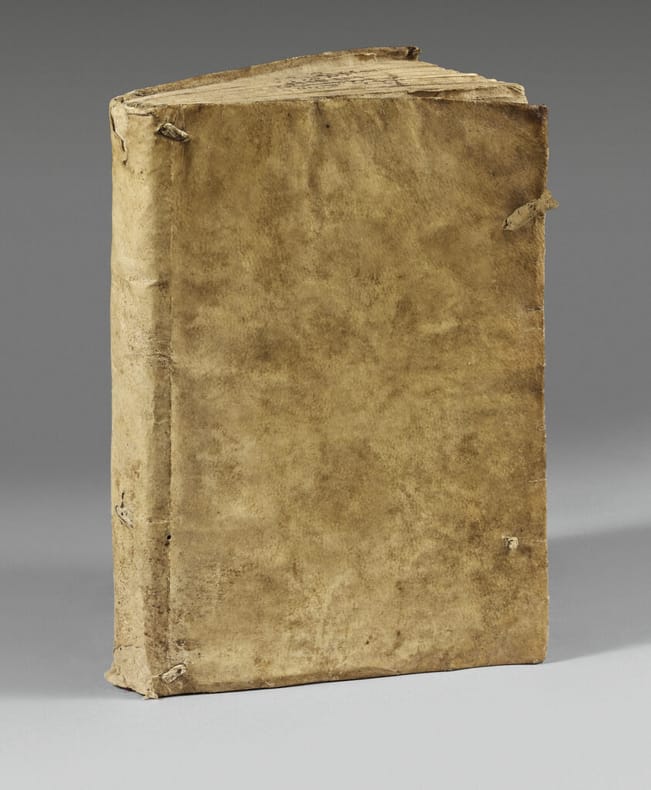
LCS-17579Précieux et remarquable exemplaire, l’un des deux répertoriés conservés dans sa première reliure en vélin de l’époque en tout premier tirage avant la mention ajoutée sur le titre général dans le second tirage « qu autres des plus signalez Poetes de ce temps ». Paris, pour Gilles Robinot, au Palais en la Gallerie des prisonniers, 1614. Avec privilège du Roy. In-8 de (4) ff., 123 ff., (1) f. de privilège. F. de titre légèrement effrangé, infime galerie de vers dans la marge blanche inf. des ff. 83 à 88, pte. mouillure dans le coin inf. des ff. 104 à 112. Au f. 93 commencent les « Autres Satyres et Folastreries, tant du Sieur de Sigonne & Bertelot, qu’autres des plus signalez Poëtes de ce temps ». Plein vélin souple, restes d’attaches, dos lisse, nom de l’auteur calligraphié à l’encre à l’époque sur la tranche supérieure. Reliure de l’époque. 162 x 104 mm.
8vo. 2 pp. on bifolium. With autograph address on verso. To Jean-Baptiste Quinquin in Avignon, who had caused him worries about obtaining a loan of 2,620 livres from his estate administrator Gaspard-François-Xavier Gaufridy, letting him know he just received the funds, certain that the emigration of his landlord Riper, as well as the seizing of the property, will not prevent him from retrieving what is rightfully his, and mentioning a bank account in Lyon: "Je ne vous ecris qu'un mot pour vous dire que vous venez de me mettre dans une mortelle inquiétude relativement à ce que vous me marqués de Gauffridi [...] je venois de recevoir une de lui, dans laquelle il avait placé les 2620 livres que je lui demandois ainsi qu'à vous [...] Il me semble que l'émigration de Ripert et la saisie de ses biens n'empeche pas que je ne doive retirer du mien ce qui m'appartient très certainement. Il m'est du de cette partie, et vous m'obligerés sensiblement d'en raisoner un peu avec Gauffridi qui compte beaucoup sur cet objet pour me compter mon quartier prochain. Engagés le de même à finir les comptes de Lions qui, me mande-t-on, a de l'argent à moi [...]". - About his plans to sell his property in Mazan in order to buy a house in Paris, mentioning a ridiculously low offer for the Mazan house, and concluding with a request to ask his aunt Henriette-Victoire de Sade, marquise de Villeneuve, for a loan of 40,000 francs: "L'offre qu'on fait de la maison de Mazan, la plus belle de la ville sans doute, est complètement ridicule [...] Ce qu'il y a de bien sur, c'est que je ne le laisserai surement pas à ce prix là. Si je trouvais un bon prix de toute la terre de Mazan, assurément, je le vendrois volontiers, pour acheter ici, où je puis faire une excellente acquisition [...] Je vous recommande vivement aussi mes intérêts près de ma tante, assurément il ne tient qu'a elle de me prêter la somme de quarante mille francs dont j'ai besoin [...]". - A brief autograph note by Quinquin on verso, summarizing the letter.
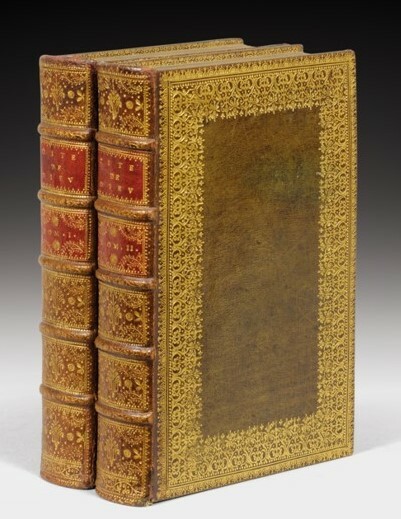
YTB-65Paris. Nicolas Pépié, 1701. 2 volumes in-8, maroquin olive, large dentelle dorée sur les plats, dos à nerfs richement orné avec le fer au soleil rayonnant, filet sur les coupes, roulette intérieure, doublures et gardes de papier à décors floraux dorés, tranches dorées sur marbrures. Reliure de l'époque de Padeloup, selon Brunet qui cite l'exemplaire. 190 x 123 mm. La plus belle édition de La Cité de Dieu imprimée sous le règne de Louis XIV avec celle de 1675, traduite par Lambert, en deux volumes également. “In “The City of God” theology is shown in relation to the history of mankind and God’s action in the world is explained. The book remained authoritative until the seventeenth and eighteenth centuries, when Bossuet was the last “Augustinian” historian. The idea of international law was partly derived from the book; Grotius cites St Augustine. Both Luther and Calvin took Augustine as the foundation of Protestantism next to the Bible itself” (PMM, 3 (for the 1467 edition)). « La Cité de Dieu » est l'apologie du christianisme. C'est à la fois une philosophie de la société humaine dans son devenir historique, une métaphysique de la société et une interprétation de la vie individuelle et sociale, à la lumière des principes fondamentaux du christianisme. Ce fut le premier livre imprimé en Italie (1467, à Subiaco) et nous savons combien ensuite l'humanisme en sentit le charme profond, comme le sentirent aussi les Réformateurs, Pascal, Kierkegaard ». PRECIEUX EXEMPLAIRE CITE PAR BRUNET (supplément I, col. 76) RELIE PAR PADELOUP, RELIEUR DU ROI POUR MONSIEUR, FRERE DE LOUIS XIVV DUC D’ORLEANS. L'exemplaire passa à sa mort à son fils, le futur Régent, Philippe d'Orléans, et fut offert par celui-ci au Couvent de la Visitation Sainte Marie de Chaillot avec l'ex-libris manuscrit suivant « Ce livre est du monastère de la Visitation Sainte Marie de Chaillot, Donné par M. le Duc d'Orléans, de la Bibliothèque de feue son Altesse Royalle ». Ce don royal fut dispersé lors de la fermeture du couvent pendant la Révolution. Dans la première moitié du XIXe siècle, « La Cité de Dieu » entra dans la bibliothèque du célèbre bibliophile et bibliographe Jacques-Charles Brunet et atteignit l'enchère impressionnante de 380 F OR lors de la dispersion de sa collection en 1868. Il passa ensuite dans les bibliothèques La Roche-Lacarelle (ex-libris, vente 1888, n° 35, ainsi décrit « Très bel exemplaire provenant des bibliothèques du duc d'Orléans, fils du Régent et de J. Ch. Brunet » ; Robert et Jeanne Percheron (ex-libris) ; baron Alain de Rothschild ; P. Sourget ; Hervé de Kerhor. Exemplaire réglé, cité et décrit dans le supplément au manuel du libraire de Brunet (I, col. 76).
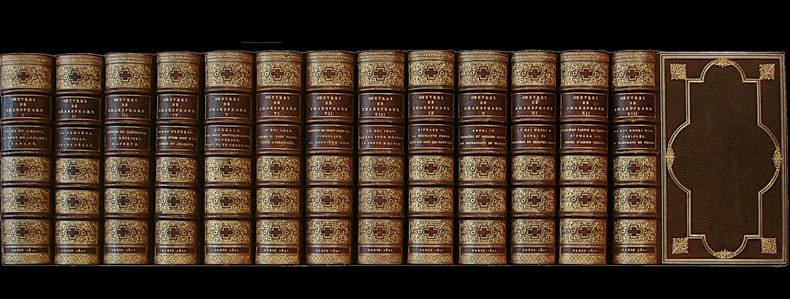
LCS-17791Paris, Ladvocat, 1821. 13 volumes grand in-8, plein maroquin lavallière, double encadrement d’un triple filet doré sur les plats, fleurons dorés en écoinçon, dos à nerfs richement ornés de filets et petits fers en arabesque, double filet doré sur les coupes, dentelle intérieure, tranches dorées. Exceptionnelle reliure signée Cuzin. 229 x 143 mm.
4to. French manuscript on paper. (3) pp. on 6 ff. Typescript: (18) pp. on 18 ff. Several drafts for Valéry's introduction to Martin Hürlimann's photo book "La France, architecture et paysages" (Zurich/Paris 1927), which was later published as part of Valéry's essay-collection "Regards sur le monde actuel" (Paris 1931). One of the typed pages re-uses a letter from 17 January 1927. - This beautiful ensemble of a manuscript and typescript with annotations and numerous corrections offers a rare insight into Paul Valéry's writing process. The text is an attempt at a profound characterization of France as a nation and its people. Both the manuscript and the typescript comprise several versions of only a few paragraphs of the long introduction. The recurring first phrase of the manuscript is: "La France est le pays du monde où les considérations de la forme, le souci singulier de la forme en soi ait persisté, et même se soit imposé dans les temps modernes" ("France is the one country in the world where questions of form, the singular concern for form in itself, have persisted and even imposed themselves in modern times"). The unsystematically numbered typescript represents passages that are more descriptive of France as a country, trying to establish links between the people and their historical and natural environment. The different versions of the poetic first phrases depict France as harmonious in its geographical diversity: "La terre de France est remarquable par la netteté de sa figure, par les différences de ses parties, par l’équilibre général de cette diversité de régions qui se conviennent et se complètent. Une sorte de proportion assez heureuse existe dans ce pays entre la plaine et la hauteur, entre la montagne et la mer, entre l'étendue intérieure et le développement des côtes, et sur les côtes mêmes, entre les plages, les roches, les falaises [...]." - A beautiful condensation of Valéry's patriotic sentiments is a sentence added by hand to one of the typed pages: "La France tombe, se reléve, se restreint, reprend sa grandeur, redéchire soi-même se reconcentre" ("France falls, rises again, restrains herself, regains her greatness, tears herself apart again, refocuses"). Valéry revised and extended this phrase for the final version. - Stronger browning of the typescript and occasional tears. The first page of the manuscript is dust-stained, showing several minor tears. With editing marks in crayon. Regards sur le monde actuel (Paris: Stock, Delamain et Boutelleau, 1931), pp. 103-144.
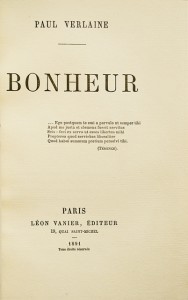
LCS-13890L’édition originale de Bonheur de Verlaine, l’un des 55 exemplaires sur papier de Hollande, unique tirage sur grand papier. Paris, Léon Vanier, 1891.In-8 de (2) ff., 120 pp. Relié en plein maroquin brun à grain long, triple filet doré encadrant les plats, dos lisse légèrement insolé orné d’un encadrement de triple filet doré, filet doré sur les coupes, doublures de maroquin havane à grain long ornées d’un encadrement de triple filet doré, gardes de tissu à motifs géométriques, couvertures et dos conservés, tranches dorées sur témoins. Reliure signée de Semet et Plumelle. 184 x 124 mm.
8vo. ½ p. Note of debt for the Duke of Wuerttemberg: "Je promets fournir à mr jean moire cent mille livres a son ordre soit en argent comptant soit en lettres de change [...] lesquelles avec cent mille livres que je luy aydeja données pour le compte de S. A. S. Mg le duc de virtemberg composeront la somme de deux cent mille livres dont S. A. S. doit me constituer les rentes viageres dont nous sommes convenus [...]" ("I confirm that I will provide M. Jean Moire with 100,000 livres either in silver or in security papers [...]. Combined with another 100,000 livres which I have already given him for the account of His Serene Highness, the Duke of Wuerttemberg, this payment constitutes the sum of 200,000 livres of which His Serene Highness will pay me the life annuities upon which we have agreed [...]", transl.). - Charles-Eugène, Duke of Wuerttemberg and count of Montbéliard, notoriously in debt, had borrowed a considerable sum from Voltaire. When the Duke was unable to repay him, he had to offer him his castle of Montbéliard instead. When Voltaire died in 1778, Charles-Eugène had still not settled his debts. - Slightly stained and with cracks at the edges and folds.
4to (210:133 mm). 2 pp. In French, to an unidentified friend: "[...] It seems that my wife missed you when she passed through Aix. We should have written you; but this voyage wasn t decided on until right at the last moment; and my wife thought she would always find you. What does she write me? That you complain about me because I am not answering your letters? If that were so I would have to be excused, because I am truly a poor man, burdened down with work and whose head is getting impassive. But truly, I am an innocent criminal, for I don't recall having received a single letter from you that I didn't answer. Let's pass the...sponge, shall we? My wife, who is impassioned of Rome, had a crazy desire to return there. [As for] me, I stayed [here] at my work. My Rome is tough going for me; and besides that, nothing exists which can totally absorb me. It will start appearing in The Journal toward December 20th; but you won't have the volume [the work in book form] until the first days of May. I have my pardon, don't I? And I send you the most affectionate of presses of the hand". - Won over to social humanitarianism toward the latter part of his life, Zola wrote the cycle, "Les Trois Villes", which no longer reflected a naturalistic perspective. When Zola wrote this letter, he had already published "Lourdes", the first novel in the trilogy and was still working on its sequel, "Rome", which would later be followed by "Paris". He had, the year before, visited the Italian capital to research for the novel, and had returned to Paris with voluminous notes about what he saw and heard. Madame Zola, who had accompanied him on this excursion to Italy, took more pleasure in the trip than he did. She found it easier here than in France to bask in his reflected glory, and she could imagine that Roman society was ignorant of the double life he was leading, whereas she was sure that all her friends in Paris knew. After this first visit she returned regularly on her own for several years running; it was an arrangement that allowed the estranged couple a semi-separation acceptable according to the conventions of the time.
Folio (ca. 267 x 407 mm). 1 p. (17 lines). Framed and glazed (457 x 599 mm). Spectacular manuscript written on paper with a gilt-stamped border and illustrated with a photograph pasted and captioned by Paul Éluard. The poem "Le temps d'un éclair" was published in Éluard's anthology "La Vie immédiate" (1932): "Elle n'est pas là. / La femme au tablier guette la pluie aux vitres / En spectacle tous les nuages jouent au plus fin / Une fillette de peu de poids / Passée au bleu / Joue sur un canapé crevé / Le silence a des remords [...]". - The small photograph (60 x 42 mm), pasted to the left of the first verse, shows the head and torso of a nude young woman. Éluard quotes his poem in the caption: "Une fillette de peu de poids / Passée au bleu" ("A young girl of little weight / Vanished into the blue"). The slight fading of the photograph even underscores its appropriateness as a congenial illustration of Éluard's poem: the allegory of a young girl's disappearance. - Traces of folds. With minor stains due to abrasions. Formerly in the collection of André Breton. P. Éluard, La Vie immédiate (Paris, Éditions des Cahiers libres, 1932).
200822827Portland and Various 2008-2018 and counting. The collection is in generally fine condition. Complete with all inserts booklets ephemera etc. Lacking only perishables which were eaten by your cataloguer and occasional assorted Powell's swag mugs totes and like which were also appropriated by your cataloguer. More than 125 columes in total a complete inventory is available. <br/><br/>For more than ten years and over seventy installments Powell's Books Portland has been issuing their semi-monthly INDIESPENSIBLE series a subscription-only selection of specially-produced typically limited edition volumes from many of the most prominent names in literature Claire Messud George Saunders Michael Chabon Annie Proulx Donna Tartt J.M. Coetzee Jeffrey Eugenides Jonathan Franzen Siri Hustvedt and publishing MsSweeney's Graywolf Algonquin. Installments commonly include a signed and slipcased recent release as well as one of more promotional titles usually ARCs or like but sometimes advance excerpts. We've been subscribers since volume one and over the ensuing decade this collection has come to represent one of the most diverse and vibrant portraits of contemporary letters and modern bookselling around — a tribute to both independent publishing and independent bookselling. With limitations for the initial installments were in the low hundreds not an easy collection to recreate esp. with all included ephemera and inserts — most of which include interviews with the featured writers not published elsewhere. A biographically and bibliographically significant collection. Price is as of current volume #76. Subscription will be maintained until sold. Price therefore subject to change. unknown books
- Amyot, Paris 1860, 34x27cm, relié. - Amyot, Paris 1860, 11.5 x 18.5 cm, bound First edition published the same year the Aosta Valley became part of Italy. The work is illustrated with 97 wood engravings in the text, 33 steel insert engravings, 6 chromotypographies and a map. Bound in half red shagreen, spine decorated with blind tooling, "Palais de Compiègne" gold stamped at the head of the spine, Napoleon III's monogram gold stamped on the spine, marbled paper boards, marbled endpapers, contemporary binding. Some minor foxing. "Bibliothèque de la Couronne - Compiègne" stamp on the title page. Our copy, unlike those placed in the national collection when the Palais de Compiègne library disbanded, does not have the "dépôt de l'État 1891" stamp. The Palais de Compiègne library, entirely refurnished by Napoleon III, was a truly sociable venue for the emperor's guests who borrowed novels, magazines and newspapers. An entertaining hand-written loan register has been digitized by the National Library of France. After the fall of the Second Empire, the third Republic allowed the library, which was then open to the Compiègne public, to remain for sometime, according to the memories of Jules Troubat, the former Sainte-Beuve secretary and the last librarian at the Palais. The decree of 16 January 1888 ordered the library to be permanently closed and emptied of its contents. One part of the collection - around 10,000 works - are given to the Compiègne municipal library in 1891. In March 1918, the town of Compiègne was bombed and evacuated; the books were then left open to the elements. It was not until the end of May 1918 that a librarian acting with the army evacuated the works that remained intact, but was unable to deal with the books that had suffered damage. This part of the collection will later be sorted and sold by weight. We have only been able to find one work from the Palais de Compiègne library on public sale, a Description of Egypt auctioned in 2014. Beautiful and rare copy, of renowned provenance, with Napoleon III's monogram and one of the rare works to have not made it to the national collection when the Palais de Compiègne library was dismantled in 1891. [FRENCH VERSION FOLLOWS] Édition originale publiée l'année même de l'intégration de la vallée d'Aoste à l'Italie. L'ouvrage est illustré de 97 gravures sur bois dans le texte, de 33 gravures sur acier hors-texte, de 6 chromotypographies et d'une carte. Reliure en demi chagrin rouge, dos lisse orné de filets dorés, «?Palais de Compiègne?» estampé à l'or en tête du dos, chiffre de Napoléon III frappé à l'or sur le dos, plats de papier marbré, gardes et contreplats de papier à la cuve, reliure de l'époque. Quelques rousseurs sans gravité. Tampon «?Bibliothèque de la Couronne - Compiègne?» sur la page de titre. Notre exemplaire, au contraire de ceux ayant rejoint les fonds nationaux lors de la dispersion de la bibliothèque du Palais de Compiègne, ne porte pas de tampon «?dépôt de l'État 1891?». La bibliothèque du Palais de Compiègne, entièrement remeublée par Napoléon III, fut un véritable lieu de sociabilité des invités de l'empereur qui empruntaient romans, revues et journaux. Un amusant registre manuscrit de prêt a d'ailleurs été numérisé par la Bibliothèque nationale de France. Après la chute du Second Empire, la IIIè République laisse subsister quelques temps la bibliothèque, qui est alors ouverte au public compiégnois, comme le rappellent les souvenirs de Jules Troubat, ancien secrétaire de Sainte-Beuve et dernier bibliothécaire du Palais. La bibliothèque sera définitivement fermée et vidée de son contenu par arrêté du 16 janvier 1888. Une partie des fonds - environ 10.000 ouvrages - sont attribués à la Bibliothèque municipale de Compiègne en 1891. En mars 1918, la ville de Compiègne connaît un bombardement et est évacuée ; les livres sont alors laissés aux intempéries. Ce n'est que fin mai 1918 qu'un bibliothécaire mobilisé par l'armée évacue les ouvrages intacts
- B. Mancel, Caen 1845, 11,5x15cm, relié. - First edition, one of the extremely rare copies on Hollande fort paper, the only large paper copies, of which a few are on colored paper. Contemporary half black shagreen with black paper boards, spine in five compartments with black fillets, corners a little rubbed. With an autograph inscription from Trebutien to Georges Lesnard. A little light foxing to endpapers. In his Annales de Normandie, Jean-Luc Piré gives an analysis of the importance of the collaboration between Barbey and Trebutien, devoting an entire paragraph to Dandysme to underline the importance of Trebutien's contribution to this little work, among the rarest and most sought-after by Barbey. "We are familiar with the monumental correspondence Barbey maintained "monkishly" with his friend over the course of twenty-six years...The presence of Trebutien is almost constant in the Aurevillian universe. The "Sagittarius" was not far off when he wrote to his correspondent: "Your name, interwoven with mine, is as well known as my own...Whoever says d'Aurevilly, says Trebutien." Even in the very midst of Dandysme, Barbey pays homage to his publisher and friend: "I ask the thirty or forty people who will read this their leave to introduce M. Trebutien as a friend whose merit is greater than my own, and whose imagination and knowledge - often separate, but united in him - need no personal friendship to impress those who appreciate such things." The story of Dandysme, more than any other of Barbey's books, is tied to his publisher, friend, and active collaborator. Initially conceived simply as an article on Brummel, who had died three years previously, Du Dandysme was to take on book form thanks to a number of documents provided by Trebutien, who served to provide Barbey with documentary material: "as for Brummell, I've literally followed all your advice. I've read everything you recommended." Having received two rejections for the article from the Revue des Deux Mondes and the Journal des Débats, d'Aubervilly gave Trebutien the green light for publication. Barbey was to take this book to heart: the exchange of proofs and corrections was incessant. In October, he decided to add notes. The collaboration with Trebutien took on particular meaning: "You have taught me to love Brummell once more. Without you, I would have thrown him on the dust-heap to repay the disappointments he caused...But you have given me back the taste for him and so, urged on by you, here I am immersed in the cult of detail, of little dots and shaded lines, of all those corrections that make up a finished work for which I haven't the strength, being a man of immediate passions, a brutal and rapid artist, animalistically reduced by his passions!" When, in 1850, Trebutien suggested publishing Prophètes du Passé, Barbey agreed in the following terms: "We'll correct the proofs like those for Brummell, won't we, my friend? I like that way of working, it is so inspiring. If a thought, a note, a little change should come to me, I can send it on to you." Whereas the first edition strengthened the friendship between the poet and his publisher, J-L. Piré notes that the reprinting of the work was, on the contrary, a source of friction: Barbey suggested to his friend (on the 2nd July 1858) that they let Poulet-Malassis reprint the work on Brummell...: "if you authorize me to deal with the sour Poulet [lit.: chicken]. We'll divide equally what he gives us for the Brummell and its reprint." But Trebutien despised Poulet-Malassis: "a socialist of the worst kind...he was the editor of one of the basest newspapers of the time...He established in Paris a bookshop where he reprints all the impure and impious works of the 18th century." (Piré Jean-Luc, in: Hors-série des Annales de Normandie. G.S. Trebutien [Préface par J.-Cl. Polet ] 1985, pp. 3-198.) An exceptional copy printed on large Holland paper in a sober contemporary binding. [FRENCH VERSION FOLLOWS] Édition origin
- Grasset, Paris 1948, 12x18,5cm, relié sous chemise et étui. - Grasset | Paris 1948 | 12 x 18.5 cm | bound in a chemise and slipcase First edition, one of 23 numbered copies on pure wire, the "tirage de tête". Bound in olive green morocco, gilt date at the foot of the spine, plates embellished with tan morocco panel stamps with geometric outlines, the inside of which have been laid with strips of brown morocco appearing like both snakeskin and the outline of a closed fist, all edges gilt, preserved wrappers and spine, chemise in half olive green morocco in strips, white paper boards, slipcase lined in olive green morocco, white paper boards, elegant and spectacular binding signed D. H. Mercher. A very rare and beautiful, perfectly set copy. [FRENCH VERSION FOLLOWS] Édition originale, un des 23 exemplaires numérotés sur pur fil, tirage de tête. Reliure en plein maroquin vert olive, dos lisse, date dorée en queue, plats agrémentés de plaques de maroquin fauve aux contours géométriques à l'intérieur desquelles ont été appliquées des lamelles de maroquin marron évoquant simultanément la peau de serpent et les phalanges d'un poing fermé, toutes tranches dorées, couvertures et dos conservés, chemise en demi maroquin vert olive à bandes, plats de papier blanc, étui bordé de maroquin vert olive, plats de papier blanc, élégante et spectaculaire reliure signée D. H. Mercher. Très rare et bel exemplaire parfaitement établi.
- Nouvelles Editions Françaises, Paris 1941, 11,5x19cm, relié. - Édition originale, un des 60 exemplaires numérotés sur vergé d'Arches, le nôtre un des 10 hors commerce numérotés en chiffres romains, tirage de tête. Reliure à la bradel en demi maroquin rouge, dos lisse, date dorée en queue, plats de papier caillouté, couvertures et dos conservés. Provenance?: bibliothèque de Maître Mikkelsen, avocat de Louis-Ferdinand Céline pendant son exil et son incarcération au Danemark. Nous présentons, joint à notre exemplaire, un certificat signé de monsieur l'expert Bernard Portheault, attestant de la prestigieuse provenance de ce volume. [ENGLISH DESCRIPTION ON DEMAND]
- appresso Gabriel Giolito de Ferrari , In Vinegia (Venise) 1547, in-8 (10,5x16cm), 227 ff. (29f.) - Sig.A-Z 8 Aa-Ff8 *-***8, relié. - (Venice), bound. A handsome illustrated edition and one of the first printed by Gabriele Giolito de Ferrari, dedicated to the Dauphin of France. It has a superb engraved title with Giolito's printer's device (a phoenix being reborn from its ashes on a globe marked with the printer's initials), 56 attractive woodcuts and numerous large ornate capitals, as well as a portrait of Ariosto after Titian in a medallion at the end of the poem, and two states of the printer's device. The end of the work is made up of a vocabulary of obscure words and an explanation of the difficult passages in the work compiled by Lodovico Dolce, with a separate title and not included in the pagination. Giolito published more than twenty books in thirteen years of printing - this is the third edition of this work, the first appearing in 1542 and the second in 1543. Printed in round Roman type, double column. Late 17th or early 18th century red morocco, spine richly gilt in six compartments, one compartment marked with "lettres rondes [round Roman type]". Covers with a frame of triple gilt fillets, gilt roulette frame to insides of covers, all edges gilt. Binding a little rubbed, faint dampstaining to end of volume. A handsome copy in a lovely red morocco binding. [FRENCH VERSION FOLLOWS] Belle édition illustrée et l'une des premières que donna Gabriele Giolito de Ferrari, dédiée au dauphin de France. Elle est ornée d'un superbe titre frontispice avec la marque typographique de Giolito (un phoenix renaissant de ses cendres sur un globe aux initiales de l'imprimeur), de 46 jolies figures gravées sur bois et d'autant de grandes lettrines ornées, du portrait de l'Arioste d'après le Titien placé en médaillon à la fin du poème, et de la marque de l'imprimeur en deux variantes. La fin de l'ouvrage se constitue d'un vocabulaire des mots obscurs et de l'explication des passages difficiles de l'ouvrage, non compris dans la pagination, avec titre particulier, compilé par Lodovico Dolce. Giolito donna plus de vingt éditions en treize années d'activité, celle-ci est la troisième édition; la première a paru en 1542, la seconde en 1543. Impression en lettres rondes sur deux colonnes. Reliure postérieure de la fin du XVIIème ou du début XVIIIème en plein maroquin rouge. Dos à cinq nerfs richement orné, l'un des caissons contient la mention "lettres rondes". Triple filet doré en encadrement des plats. Roulette dorée en encadrement des contreplats. Toutes tranches dorées. Quelques frottements sur la reliure et mouillures pâles en fin de volume. Précieux exemplaire parfaitement habillé en maroquin rouge.
- Librairie universelle, Paris 1904, 14,5x20cm, relié. - Librairie universelle | Paris 1904 | 14.5 x 20 cm | bound First edition, one of 25 numbered copies on laid paper numbered and justified by the publisher, only large papers. Bradel binding in half chocolate brown morocco, gilt date at the foot of the spine, marbled paper boards, marbled endpapers, preserved wrappers, illustrated by Manuel Orazi, and spine. Work illustrated with 136 in-text and insert drawings in black and in colour by Georges Bottini. Glued ex-libris. Our copy is enriched with an original, full page drawing signed by Georges Bottini and enhanced with black ink depicting Jacques Beaudarmon wearing a melon on his head talking with the "môme" "girl". This drawing is found in the form of a woodcut block as an illustration on page 133. The drawing is dedicated by Georges Bottini to M. Casanove: "en grande sympathie..." "in great sympathy..." An exceedingly rare large paper copy of the masterpiece by Jean Lorrain. [FRENCH VERSION FOLLOWS] Édition originale, un des 25 exemplaires numérotés sur vergé à la forme numérotés et justifiés par l'éditeur, seuls grands papiers. Reliure à la bradel en demi maroquin marron chocolat à coins, dos lisse, date dorée en queue, plats de papier marbré, gardes et contreplats de papier à la cuve, couvertures illustrées par Manuel Orazi et dos conservés. Ouvrage illustré de 136 dessins in et hors-texte en noir et en couleurs de Georges Bottini. Ex-libris encollé. Notre exemplaire est enrichi d'un dessin original, à pleine page, signé de Georges Bottini et rehaussé à l'encre noire représentant Jacques Beaudarmon coiffé d'un melon devisant avec la «?môme?». Ce dessin se retrouve sous forme de bois gravé en illustration de la page 133. Le dessin est dédicacé par Georges Bottini à M. Casanove «?en grande sympathie?». Très rare exemplaire en grand papier du chef-d'uvre de Jean Lorrain.
- Nrf, Paris 1914, 25,5x33cm, broché. - Nrf | Paris 1914 | 25,5 x 33 cm | in original wrappers First edition, one of 90 numbered copies on laid Arches paper, the only deluxe copies (grand papier) after 10 Montval. Beautiful copy. [FRENCH VERSION FOLLOWS] Édition originale, un des 90 exemplaires numérotés sur vergé d'Arches, seuls grands papiers après 10 Montval. Bel exemplaire.
- Dondey-Dupré, Paris 1833, 13,5x22cm, relié sous étui. - Édition originale très rare et recherchée, selon Clouzot, et imprimée à seulement 300 exemplaires. Reliure en plein maroquin rouge, dos à cinq nerfs sertis de filets noirs, date dorée en queue, roulettes dorées sur les coiffes, gardes et contreplats de papier peigné, encadrement d'une dentelle dorée sur les contreplats, doubles filets dorés sur les coupes, tête dorée, couvertures conservées, étui en plein papier marbré, intérieur de papier peigné, parfaite reliure signée Thivet, relieur ayant exercé pendant le dernier quart du XIXème siècle. Ex-libris encollé sur un contreplat, précisions bibliophiliques au crayon de papier, sur une garde, par un précédent possesseur de l'ouvrage. Bel exemplaire de l'un des plus rares «?Romantiques?», bien complet du frontispice sur Chine, dessiné et gravé par Célestin Nanteuil. [ENGLISH DESCRIPTION ON DEMAND]
- Mercure de France, Paris 1906, 12x19cm, broché sous chemise et étui. - Sésame et les Lys [Sesame and Lilies] Mercure de France | Paris 1906 | 12 x 19 cm | original wrappers with custom chemise and slipcase First edition of the French translation by Marcel Proust. Notes and preface also by Proust. A first impression copy numbered in the press. Presentation copy inscribed by Marcel Proust to the writer, musical critic and journalist Edouard Trogan, (also known under pseudonym of Louis Joubert). A small tear, not serious, to foot of upper wrapper. A pastiche chemise and slipcase in half light brown cloth by Goy & Vilaine. [FRENCH VERSION FOLLOWS] Edition originale de la traduction française, des notes et de la préface établies par Marcel Proust, un des exemplaires de première émission numérotés à la presse. Précieux envoi autographe signé de Marcel Proust à l'écrivain, critique musical et journaliste Edouard Trogan, également connus sous son nom de plume, Louis Joubert. Une petite éraflure sans gravité en pied du premier plat. Notre exemplaire est présenté sous une chemise et un étui en demi percaline caramel pastiche signés de Goy & Vilaine.
- Léon Genonceaux, Paris 1891, 11,5x18cm, relié. - Léon Genonceaux | Paris 1891 | 11,5 x 18 cm | bound in shagreen The first edition for large parts of the text, printed in 550 copies with the correct date of 1891 on the title. Contemporary paper boards with blindstamped floral motifs, spine very slightly browned, brown shagreen title-piece, gilt date to foot of spine, covers preserved. Biographical press clippings bound in at end, bookseller's description laid down on head of one endpaper, leaving a mark on the opposite page. This copy is complete with the original preface by Rodolphe Darzens, removed from most copies of this printing. A good copy in a contemporary binding, which is rare, according to Clouzot. [FRENCH VERSION FOLLOWS] Édition en grande partie originale, imprimée à 550 exemplaires et à la bonne date de 1891 sur la page de titre. Reliure en plein cartonnage ornementé de motifs floraux estampés à froid, dos lisse très légèrement bruni sans gravité, pièce de titre de chagrin marron, date dorée en queue, couvertures conservées, reliure de l'époque. Une étiquette de description de libraire encollée en tête d'une garde et qui a laissé une ombre en son regard. Sur trois feuillets ajoutés et reliés en fin de volume a été contrecollée une émouvante coupure de presse, contemporaine de l'édition et intitulée "La vérité sur Rimbaud". Elle reproduit la lettre d'Isabelle Rimbaud qui restitue la "vériable" biographie de son frêre en réponse à l'article "absolument faux" paru dans Entretiens politiques et littéraires. L'un des précieux exemplaires de première émission comportant la préface originale de Rodolphe Darzens dont la suite du tirage a été amputée. Agréable exemplaire établi dans une reliure de l'époque, ce qui est rare selon Clouzot.
- Nrf, Paris 1939, 11,5x18,5cm, relié. - First edition, one of 130 numbered copies on vélin pur fil paper, after only 1 Whatman, 9 Chine and 23 Hollande paper. Half morocco, one joint skillfully repaired to head, covers, endpapers and pastedowns marbled, top edge gilt, covers and spine preserved, binding signed by Malcorps. Autograph inscription signed by Antoine de Saint-Exupéry to Monsieur and Madame Maurice Crick. Provenance : from the library of Maurice Crick with his ex-libris pasted on endpaper. A nice copy elegantly bound. [FRENCH VERSION FOLLOWS] Edition originale, un des 130 exemplaires numérotés sur vélin pur fil, après seulement 1 Whatman, 9 Chine et 23 Hollande. Reliure en demi maroquin noisette à coins, dos à cinq nerfs, date dorée en queue, un mors habilement restauré en tête, plats, gardes et contreplats de papier à la cuve, tête dorée, couvertures et dos conservés, reliure signée de Malcorps. Envoi autographe signé d'Antoine de Saint-Exupéry à monsieur et madame Maurice Crick. Provenance : de la bibliothèque de Maurice Crick avec son ex-libris encollé sur une garde. Bel exemplaire agréablement établi.