858 328 résultats
¾ S. 4to. An den namentlich nicht genannten Franz Blei: "Der wahrhaftige Grund, warum ich Ihre beiden Briefe erst heute beantworte, ist der, daß man mir nicht die Zeit dazu läßt. Obwohl ich im Juni angekündigt hatte, daß ich nicht fertig werden könne, und die Versicherung bekam, daß man auf Grundlage der Zwischenveröffentlichung der einstweilen fertigen 600-700 Seiten, das Weitere ordnen werde, fand ich mich bei meiner Rückkehr in einer Situation des völligen Nichts. Ohne persönlichen bösen Willen, im Gegenteil bei persönlicher Anteilnahme, angesichts jener unpersönlichen kaufmännischen Theodizee, die sich einbildet, alles Üble rechtfertigen zu können. Um die moralische Wirkung beiseite zu lassen: ich habe vierzehn Tage lang überhaupt ohne Geld gelebt und lebe bis zum heutigen Tag noch ohne Sicherheit des nächsten Monats. Geld vom Verlag war nur unter der Bedingung zu bekommen, daß ich in drei Monaten mit dem Rest des Buches fertig wäre, was ich zurückweisen mußte [...] Ich stehe also unter einem Druck, der kaum und auf die Dauer sogar sicher nicht auszuhalten ist. | Denken Sie nicht an Deutschland, solange es möglich ist! [...]". - Musil und seine Frau Martha erlebten die Anfänge des nationalsozialistischen Regimes in der Berliner "Pension Stern" und zogen im Mai 1933 weiter nach Karlsbad, später wieder nach Wien, ehe sie - vor allem Marthas jüdischer Abstammung wegen - im August 1938 ins Schweizer Exil gingen. - Winzige Einrisse an den Rändern im Mittelfalz.
3 SS. auf gefalt. Doppelblatt. 8vo. In Zusammenhang mit der Redaktion der Ersch/Gruber'schen Enzyklopädie, vielleicht an Johann Gottfried Gruber: "Verehrter Freund, Ich wüßte in der That nicht, was Hassel u. ich Ihrer u. der ersten Redaktoren Mittheilung nach hinzufügen sollten, als ein: So ist's, u. wir werden das Unsrige thun. Daher schicke ich Ihnen Ihr Manuskript zum Druck mit einigen, den Styl betreffenden Bemerkungen zurück u. erwarte baldigst die Druckexemplare. Ferner lege ich bei den Artikel: 'Cavaceppi' für die jetzt in Druck begriffenen Bogen. Ersch hat mir den Artikel in den Schuh geschoben u. zwar so eilig, daß er mir auftragen mußte, ihn direkt an Sie zu befördern. An Hassel kann ich erst nächsten Mittwoch schreiben, um ihm dann das Direktorium mit meinen Ergänzungen zurückzuschicken. Eine solche Revisionsarbeit läßt sich nicht übereilen; man muß Fach auf Fach durchgehen. Daß es jetzt an Fuhren zwischen Leipzig u. Dessau fehlt, weiß ich selbst aus Erfahrung, von Ihrem Pech her. Hartmann, Ackermanns Commissionär, weiß wohl am besten Gelegenheiten nachzuweisen. Noch erinnere ich Sie an den mir versprochenen Band H der Frankfurter Encyclop. Auch haben Sie, wenn ich nicht irre, für Ersch die Biogr. des Contemp. und die Supplem. der Encycl. Brit. angeschafft. Hab' ich Sie in dieser Hinsicht recht verstanden, so ersuche ich Sie, mir bei Ersch die H-Bände dieser Werke zur Mittheilung anzuweisen. Ich selbst habe für die H. Bibl. viele encycl. Werke angeschafft, Reallexika über einzelne Wissenschaften u. Künste [...] Aber Alles läßt sich von uns mit eigenen Mitteln nicht zwingen, wenigstens nicht sogleich. Haben Sie nicht vorläufig mit Rochlitz wegen Haendel u. Haydn gesprochen? [...]". Schon 1821-25 hatte Müller für die für die 1. Sektion der Ersch/Gruber'schen "Allgemeinen Enzyklopädie der Wissenschaften und Künste" 56 Artikel beigesteuert (überwiegend zu italienischen Themen sowie englischen und deutschen Schriftstellern). Im Dezember 1825 übernahm er mit Georg Hassel die Redaktion der 2. Sektion ("H-N"). Müller, bekannt als Verfasser der "Schönen Müllerin" und der "Winterreise" und wegen seines Enthusiasmus für den griechischen Freiheitskampf auch "Griechen-Müller" genannt, starb im Oktober 1827, noch nicht 33-jährig, an einem Herzinfarkt. Sein Nachlass wird von der Anhaltischen Landesbücherei Dessau verwahrt.
8vo. 1 p. To the American entomologist George Franclemont concerning the comparison and identification of butterfly specimens: "Dear Dr Franclemont, your "Shawville, Pa[pillio]" lab[eled] 'Keutzingaria' is quite similar to specimens we have, also placed (incorrectly, I think) under that name, from Illinois, Maine and Nova Scotia, your 'Pittsburg, Pa.' lab. 'purpuraria' is extremely close (perhaps a trifle paler limbally) to our 'Packard type' specimen of Keutzingaria, from Maryland, your 'Pittsburg, Pa.' lab. 'nigrescaria' can be easily matched by specimens from Ill. and Maine in our series under that name. I am not returning the specimens until I hear from you - perhaps there are some other comparisons you might want me to make". - During his years as lecturer of comparative literature and Russian at Wellesley College, Massachusetts, from 1941 to 1948, Nabokov also pursued his scientific passion for butterflies, working as the de facto curator of lepidoptery at Harvard's Museum of Comparative Zoology. As a lepidopterist, Nabokov specialized in the Polyommatini tribe of the Lycaenidae family, on which he became an internationally recognized expert. The letter bears beautiful testimony to Nabokov's scientific work at the Harvard Museum. - John George Franclemont (1912-94) served in the Pacific theatre of WWII as an expert in the eradication of mosquitoes. He used his military deployment for entomological research and pursued a scientific career after the war. From 1947 to 1952, Franclemont worked in the Bureau of Entomology and Plant Quarantine in Washington, moving on to become a professor of entomology at Cornell (1953-77), where Vladimir Nabokov was his colleague. Franclemont donated his entomological collection of more than 35,000 specimens to Cornell University. - On stationery with printed letterhead of the Museum of Comparative Zoology. Traces of folds. With a minor rust stain and two holes from a staple.
YTB-39Paris, Jean Baptiste Coignard, 1695. In-12 de 1 titre, (4) ff., 69 pp., 36 pp. [Peau d’âne], 12 pp. [les Souhaits ridicules]. Peau d’Âne est précédé d’un titre particulier compris dans la pagination et les Souhaits ridicules d’un simple faux-titre. Veau blond, triple filet doré encadrant les plats, dos à nerfs finement orné, pièces de titre en maroquin citron et vert, filet or sur les coupes, roulette intérieure dorée, tranches dorées. Reliure signée « Petit successeur de Simier », vers 1860. 161 x 96 mm. SECONDE EDITION COMPLETE, RARISSIME, DONT TCHEMERZINE NE CITE QU’UN SEUL EXEMPLAIRE « Daulnoy, veau ancien, 4 100 FF ». Les éditions originales de Peau d’Ane » et des Souhaits ridicules paraissent l’année précédente, en 1694, chez le même imprimeur. Ce recueil renferme l'un des plus célèbres contes de Perrault, Peau d'âne, initialement publié en 1694 à la suite de la seconde édition de Griselidis. On y trouve également l'intéressante préface (8 pages) de Perrault qui défend les contes comme un divertissement et un sujet d'instruction (cf. Tchemerzine, t. V, pp. 174-175) : ces bagatelles n'estoient pas de pures bagatelles, qu'elles renfermoient une morale utile, & que le récit enjoué dont elles estoient enveloppées, n'avoit esté choisi que pour les faire entrer plus agréablement dans l'esprit & d'une manière qui instruisist & divertist tout ensemble. Selon la nouvelle classification des contes de Ruth B. Bottigheimer1, Peau d’Asne serait le premier conte de fées français écrit. PRECIEUX EXEMPLAIRE PROVENANT DE LA BIBLIOTHEQUE Guy Pellion AVEC EX-LIBRIS ARMORIE.
8vo. Together 7 pp. In French. From the correspondence with the publisher Jacques Rivière, concerning the publication of extracts of the "Recherche" in Rivière's Nouvelle Revue Française (NRF). The earliest letter, dated 17 January 1921, was dictated to his then secretary Henri Rochat, the later letters (September and October 1922) to his assistant Céleste Albaret. - The first letter concerns the forthcoming publication of the extract "Le Baiser" from "Le côté des Guermantes" on 1 February 1921. Proust relates that he "worked all night" on the proofs, lamenting that Rivière is a "quite demanding master". He also mentions that he suggested to Gaston Gallimard working simultaneously with several printers on "Guermantes" and the fourth volume "Sodome et Gomorrhe I et II", as he "could correct many proofs", but has not yet received an answer: "nous gagnerions beaucoup de temps si j'envoyais ma fin corrigée de Guermantes II à un second imprimeur et le manuscrit de Sodome I à un troisième imprimeur ; mais tout cela est pour un même ouvrage peut'être es [!] impossible d'atteler plusieurs imprimeurs à un même ouvrage". Although Proust himself doubts how feasible this suggestion may be, he stresses that it is important not to lose a single day. In closing, he points to a misprint: "le brouillon parle d'un 'entreteneur', alors que l'épreuve parle d'un 'entrepreneur', ce qui "ne veut rien dire du tout". - The second letter can be dated to 22 September 1922. Written in third person, it first relates how Proust suffered from "asthmatic crises such as he never had before", which made it "impossible to occupy himself with the book". Concerning the ongoing publications, Proust laments that "the extract le sommeil d'Albertine is a bit short and should be seasoned with adjacent pieces". While Proust had previously been "indifferent" to the placement of his extracts in the NRF, he now wishes to be "put first", although he understands if this is not possible. - The final letter can be dated to 12 or 13 October, a month before Proust's death. Incapable of correcting proofs of extracts from "La Prisonnière" himself, due to a high fever, Proust asks Rivière to eliminate any repetitions. He also condemns the ending of the final phrase "on the artist and the man of reason" as stupid, wondering how such a mistake could have happened: "Comme ma fièvre a sensiblement augmenté, je n'ai plus ajouté de corrections à celle que j'ai déjà faites. Si vous avez la gentillesse de jeter un œil bienveillant sur le tout, qui n’est pas long, vous pourrez peut-être enlever quelques redites, qui affaiblisse. En tous cas je ne puis comprendre par quel erreur de manuscrit la phrase finale fini si bêtement, sur l'artiste et l'homme de bon sens". In the final sentence of the letter, Proust bids farewell to Rivière, expecting that he will not be able to dictate further letters. - Gallimard had originally refused to publish the "Recherche" based on the judgment of André Gide, and Proust published "Du côté de chez Swann" at his own expense with Grassot in 1914. Gide later apologized to Proust, and Jacques Rivière managed to secure the publication rights for Gallimard, starting with "À l'ombre des jeunes filles en fleurs" in 1918. Apart from being his editor at Gallimard and the NRF, Jacques Rivière was one of Proust's earliest admirers and defenders. Their correspondence stretches from 1914 to 1922. - Traces of folds. Letter from September 1922 with an old restoration. Published in: Corr., XX, no. 18 ; XXI, nos. 328 and 344; Marcel Proust et Jacques Rivière, Correspondance, 1914-1922, Paris: Gallimard, 1976, nos. 101, 185 and 192.
1 S. auf Doppelblatt. 8vo. Mit eh. adr. Kuvert. An den Ophthalmologen, Okkultisten und Schriftsteller Rudolf Tischner (1879-1961): "Es ist überaus gütig, daß Sie mich auch an den neuen Versuchen wieder wollen theilnehmen lassen. Eine (allerdings geringe) Möglichkeit besteht, daß ich morgen aufs Land fahren sollte, dann müßte ich den Abend leider versäumen. Bin ich aber, wie ich nun hoffe, in der Stadt, so werde ich mich pünktlich um acht (diese Stunde ist doch wieder gemeint?) bei Ihnen einstellen […]". - Etwas fleckig.
4to (300 x 220 mm). 2 vols. (4), 331 pp. (4), 334 pp. With 1 frontispiece and 40 plates by Cochin, engraved by Dambrun, de Launay, Delignon, Duclos, Lingée, Patas, Ponce, Prévost, Saint Aubin, Simonet, Tillard, Trière and Varin. Red half morocco, smooth spine divided into six panels by a metope and pentaglyph and bead rule, lettered on green overlays in the second, volume number within an oval in the fourth, the others tooled with corner pieces and monogram AS within a sunburst. The wonderful illustrations are among Cochin's late works and at the same time the quintessence of the Louis XVI style in book illustration. Cochin's designs, commissioned by the Comte de Provence (later Louis XVIII), were rewarded with the enormous sum of 40,000 livres. Like the first edition, this second one was reportedly printed in only 200 copies on heavy vellum paper. - The elegant binding, although unsigned, is undoubtedly to be attributed to Georg Friedrich Krauss (active 1791-1824). He was the most prominent Viennese bookbinder of his time, and the Duke of Saxe-Teschen his most important client (cf. Breslauer, cat. 110, no. 167; Otto Schäfer catalogue of bookbindings, p. 161f.). - Corners slightly scuffed. Scattered foxing, quire 42 of the 1st volume, and quires 37, 39 and 40 of the 2nd volume browned, else fine. Provenance: Albert Casimir August of Saxony, Duke of Teschen (1738-1822), with his monogram on the spine of the binding and his distinctive shelf ticket on front pastedown. Sander 1891. Fürstenberg 88f. and passim. Cohen 977.
8vo. Altogether (2+1=) 3 pp. on 3 ff. To the English journalist and author John Arlott (1914-1991), the first on two poems for a possible broadcast on the BBC, expressing concern about reading both ("[...] they're very much alike in feeling and would give a monotonous effect - even if a reader read one of them and I the other [...] I suggest that only Poem In October is selected [...]", undated), the second inviting Arlott to lunch and admitting he had already told the host, his patron Margaret Taylor, that Arlott would attend, also mentioning that "I hope you get this note before you go Test-wards" (July 22, 1946). - Edges slightly frayed.
8vo. ¾ p. "Dear Leslie Collier, Apologies. I was in America when you came to Carmarthen, that couldn't be helped. But I've been back a month now, and I haven't written to say how sorry I was to have missed you and how I hope, whenever you're next in this part, you'll come along and have drinks. No letters were forwarded when I was away, so unfortunately, I couldn't let you know; but I could have written much sooner than this. My only excuse is that I have been busy about the country ever since I returned; and that's a poor excuse, I know. My wife also wants to apologise for not having seen you when you were down. Anyway, I shall look forward. Sincerely yours, Dylan Thomas". - A few light stains, and some mounting remnants on the verso, otherwise very fine. From the collection of Diana Herzog.
Zusammen 6 SS. auf 13 Bll. Gr.-8vo. Freundschaftliche Korrespondenz mit Rebecka Dirichlet (1811-58), der Enkelin Moses Mendelssohns, Tochter von Abraham und Lea Mendelssohn (Bartholdy) und jüngeren Schwester von Felix Mendelssohn Bartholdy und Fanny Hensel. I: "Ich nehme Sie beim Worte, gnädige Frau! Wollen Sie es gütigst versuchen, ob die beifolgenden Blätter der Jahrbücher an Mstrs Sarah Austin billig zu befördern sind? [...] Sie sehen vielleicht einen Augenblick die beiden Bände der Mstrs Sarah an, die ich noch zu Hause habe. Im Thl. 2 S. 320 ist die schöne mündliche Mittheilung von Felix beigebracht. Für Frau Professorin Hensel lege ich andre gedruckte Bogen bei, worin meine Anzeige von Preuß Lebensgeschichte Friedrichs des Großen steht. Im Ganzen hoffe ich auf Beistimmung [...]" (9. IX. 1833). Die englische Schriftstellerin Sarah Austin (1793-1867) hat Pücklers "Briefe eines Verstorbenen" übersetzt (ersch. London 1832) und stand seit 1833 mit Varnhagen in Briefkontakt. Von ihrer dreibändigen Anthologie "Characteristics of Goethe" hatte Varnhagen vermutlich den ersten Band ausgeliehen. Seine Besprechung von Joh. D. E. Preuß' "Lebensgeschichte Friedrich des Großen" erschien in den "Jahrbüchern für wissenschaftliche Kritik" und als Wiederabdruck in seinem 1833 erschienenen Werk "Zur Geschichtsschreibung und Literatur". - II: "Ich freue mich, gnädige Frau, daß Ihr Absagebrief doch zugleich wieder ein Zusagebrief ist! Der Freitag ist mir sehr recht. Ich werde mich einfinden, und Ihrer Befehle gewärtig sein [...] Die Tutti frutti [von Pückler-Muskau] sind unvergessen: ich schäme mich der Verspätung, die ich doch nicht Macht habe ohne dringende Gewalt zu lösen! [...]" (11. III. 1834). - III: "Empfangen Sie den innigsten Dank für das willkommene Geschenk [wohl ein Autograph], für Ihr gütiges Gedächtniß! - Wenn es darauf ankommt, den Karakter aus der Handschrift zu erkennen, so giebt es nicht leicht eine die mehr Stoff anbietet, als die der unglücklichen Herzogin! [d. i. die von ihrem Ehemann ermordete Fanny de Choiseul-Praslin, 1780-1847] Ich bin zwar kein allzu sichrer Leser, allein eine gewisse vornehme Lässigkeit und Verwirrung glaub' ich doch herauszudeuten [...] Bei der Juli-Revolution [von 1830] waren wir täglich bei Ihnen, und tauschten Neuigkeiten und Betrachtungen. Ich fühlte das stärkste Verlangen, diese schöne Erinnerung jetzt, bei der Februar-Revolution [in Frankreich], zu erneuern! Es will mir nicht gelingen, seit vier Wochen leid' ich an Rheuma [...]" (11. III. 1848). - IV: Bezieht sich auf die gewaltsame Befreiung Gottfried Kinkels aus dem Spandauer Gefängnis am 6. November 1850 und dessen Flucht nach England, an der Rebecka Dirichlet und Varnhagen ideell beteiligt waren: "Hier überreiche ich Ihnen, Hochverehrteste, den verabredeten Brief - - wie thut es mir wohl, wieder mit deutschen Lettern zu schreiben! - - der hoffentlich seinen Zweck nicht verfehlen wird [...] Sie thäten doch vielleicht gut, der Frau Professorin [Johanna] Kinkel vertraulich zu sagen, daß Mrs. Grote [d. i. Harriet Grote, die Gattin des Historikers George Grote] eine Frau besonderer Art und nicht immer leicht zu behandeln ist. An Hrn. Chorley sollten Sie doch wohl einige Zeilen wenden, ich denke mir ihn wie unsre [Ludwig] Rellstab, [Theodor] Rötscher, [Friedrich Wilhelm] Gubitz, und daher für ein freundliches Wort sehr empfänglich. Die Adresse von Hrn. Richard Monckton Milnes, Dichter und Parlamentsmitglied, ist 26 Pall Mall, London, es wird nicht schwer sein, jemanden zu finden, der dort einführen kann [...]" (22. II. 1851). Das Haus von Milnes war ein Treffpunkt deutscher Schriftsteller und Emigranten in London. - V: "Hiebei erfolgt das gewünschte Blatt für Ihren Herrn Neffen, das er zur guten Stunde dem Dichter [d. i. Ludwig Uhland] abgeben möge, der unter äußerer Kälte die frischeste Wärme hegt, wie seine Poesien es herrlichst darthun. - Weniger als Dichter, aber desto mehr als wunderlicher Kauz wäre vielleicht auch Justinus Kerner in Weinsberg Ihrem Neffen merkwürdig; auch er ist mein Jugendfreund, aber ich schreib' ihm nicht mehr, seitdem er in den letzten Jahren sich der rohen Unterdrückung schmeichelnd zu Füßen gelegt hat. Wenn aber Herr Hensel ihn sehen möchte, kann er nur geradezu in eignem Namen zu ihm gehen, er wird auf's beste von ihm aufgenommen werden. Trifft er den Sohn, Dr. Theobald Kerner, in Weinsberg, so möge er diesen herzlich von mir grüßen [...]" (4. X. 1851). Sebstian Hensel (1839-1898) war das einzige Kind von Fanny und Wilhelm Hensel. 1851 bezog er die Landwirtschaftsschule in Hohenheim bei Stuttgart. - VI: "[...] Meine Nichte [d. i. Ludmilla Assing] bedauert mit mir ungemein, daß wir gestern Ihrer gütigen erfreuenden Einladung nicht folgen konnten, wir hoffen uns baldigst schadlos halten zu dürfen, und unser größter Gewinn ist mit Ihnen zu sein, der durch Nebengewinne nicht erhöht wird! [...]" (4. II. 1853). - VII: "Auf Ihre liebenswürdigen Zeilen [...] würde ich gleich gestern geantwortet haben, hätte ich nicht vorher mit Frln. Solmar Rücksprache nehmen müssen. Dies ist erst am Abend möglich gewesen. Wir kommen also morgen (Montag) [...]" (26. II. 1854). Mit Henriette (Jettchen) Solmar (1794 bis etwa 1890) verband das Ehepaar Varnhagen sowie seine Nichte eine lange Freundschaft. - Tls. mit kleinen Randläsuren, insgesamt jedoch sehr gut erhalten. Varnhagens Briefe wurden 1869 in Marburg versteigert und zehn Jahre später erstmals von Konrad Feilchenfeldt im dritten Band der "Mendelssohn Studien" veröffentlicht sowie erschöpfend kommentiert (SS. 51-79).
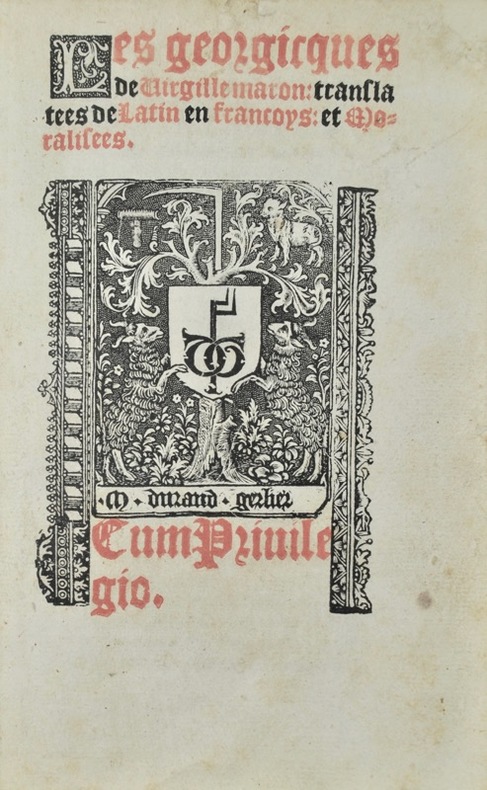
15199666Paris, Durand Gerlier, 1519. In-8 gothique de (148) ff. (a8, A-R8, S4), maroquin vert, filet à froid, encadrement central d’un triple filet à froid avec fleurons d’angle de style italien, dos orné de filets à froid et fers dorés, filets intérieurs et fleurs de lis aux angles, tranches dorées (reliure du XIXe siècle).
- Devambez, Paris 1925, Grd. in-4 (23x32,5cm), 158pp., relié. - Edition illustrée en premier tirage de douze eaux-fortes originales gravées par Edouard Chimot. Edition tirée à 576 exemplaires. Celui-ci, un des 100 sur papier vélin de Hollande Van Gelder contenant les états couleurs et noir et blanc de chaque figure. L'illustration de Chimot célèbre les amours saphiques de Bilitis. Exemplaire unique, enrichi d'un dessin original signé d'Edouard Chimot et d'une quadruple suite sur papier Japon de 8 eaux-fortes différentes de l'illustration de l'édition : 1. Au trait, cuivre non réduit ; 2. Au trait, cuivre non réduit avec remarques ; 3. En noir cuivre réduit ; 4. Etat définitif en couleurs. Cette quadruple suite est peut-être celle qui est annoncée à la justification pour les 40 exemplaires hors-commerce. De dimensions plus importantes que le livre, elle donne à l'exemplaire son grand format. Afin de combler le vide en pied, des languettes de papier ont été montées sur onglet. Dimension du livre original, 20x25, du dessin 21,5x31,5cm, la suite sur japon de même format que le dessin. Reliure doublée en plein maroquin caramel avec un important décor art-déco doré et mosaïqué continu sur les plats et le dos, signée en bas du contreplat Marie-Madeleine Lorthiois. Contreplats de maroquin bleu canard avec décor doré et mosaïqué, gardes de soie noire et or, doubles gardes de papier à la cuve argenté, filet doré sur les coupes, coiffes guillochées dorées, tranches dorées sur témoins, couvertures et dos conservés. Chemise en demi-maroquin caramel à rabats portant titre doré au dos, et un étui bordé de même.Traces de frottement sur l'étui, une trace de frottement en tête de la chemise. Exemplaire personnel de la relieuse et bibliophile Marie-Madeleine Lorthiois, avec son étiquette ex-libris. Magnifique reliure, " L'une des plus belles de Marie-Madeleine Lorthiois " (Christian Galantaris). [ENGLISH DESCRIPTION ON DEMAND]
1920140553Munich: Dreilander Verlag 1920. Collection of 38 issues of the landmark Weimar-era periodical highlighting fantasy horror and early science fiction stories. Text in German. <br /> <br /> One of the world's first fantasy periodicals alongside the Swedish "Hugin" "Der Orchideengarten" featured a mix of new German stories alongside translations of foreign literature largely French including works by Victor Hugo Guy de Maupassant Voltaire Charles Dickens Edgar Allan Poe Joseph Capek H.G. Wells and many others. The magazine also made forays into the proto-science fiction genre as seen in Vol. 2 No. 4 entitled "Phantastik der Technik." <br /> <br /> A true product of the Weimar era's cultural blossoming the magazine also features stunning illustrations both with its two- and three-color cover art and its woodcut reproductions throughout: sinister yet elegant visions of anthropomorphic flowers religious idols Grim Reapers and gory deaths. "Der Orchideengarten" featured the work of Gustave Dore Otto Linnekogel Karl Ritter Alfred Kubim Carl Rabus Otto Nuckel and many more. <br /> <br /> This archive contains the following largely sequential issues: Vol.1 Nos.1-18 16 and 17 published as a combined issue; Vol.2 Nos.1-6 8 10-16 18-24. <br /> <br /> 9 x 12 inches saddle stapled. Very Good to Near Fine condition. In a custom quarter leather clamshell box. Dreilander Verlag unknown
42598Paris, Editions Argillet, 1968. In-folio, non paginé, en feuilles, sous couverture gaufrée, chemise de et emboîtage illustré.
1124Paris : Éditions René Kieffer, 1920. UNE ILLUSTRATION ART DÉCO DES FLEURS DU MAL, EXEMPLAIRE DE LA BIBLIOTHÈQUE PERSONNELLE DE RENÉ KIEFFER
(4), 84, (8) pp. Marbled paperback with integrated original cover. 8vo. In German: "Gottfried Benn / gives himself this present for Christmas 1906". - From the library of the pianist, composer and music teacher Gottfried Galston (1879-1950).
In -folio, due voll. legati assieme; pp. (68), 504, (4); (40), 334, (2). Legatura in piena pelle alle armi di Felipe Ramirez Nuñez de Guzmán de Medina, nervi e titolo al dorso. Questa di Basilea del ’32 è considerata l’ultima e migliore edizione nel Cinquecento in latino delle Genealogie [...] che si deve all’umanista strasburghese Jakob Moltzer. Notevoli le illustrazioni genealogiche a piena pagina in quest’opera che, in vita, diede fama a Boccaccio, i cui lavori in volgare erano considerati una produzione minore. Rilegato con i Saturnalia e il commentario al Somnium Scipionis, le due maggiori opere di Macrobio nell’edizione di Camerario. Numerose illustrazioni nel testo fra cui l’incisione del planisfero macrobiano, diviso in zone climatiche, che costituì per circa un millennio il modello geografico terrestre: nella prima riproduzione a stampa di questa mappa, del 1483, le linee climatiche erano dritte, qui per la prima volta sono curve e rimandano a un modello di terra sferica e non piatta. This Basilea 1532’s edition is considered the last and the best latin edition in XVI century of “Genealogie”: it’s due to austrian scholar Jakob Moltzer. The full page genealogic illustrations are remarkable; this work gave a reputation to Boccaccio while he was still alive, and whose works in volgare were then considered a less important production. Bound with the “Saturnalia” and commentary to “Somnium Scipionis”, the most important Macrobio’s works in Camerario edition. Many illustrations in text: between them the macrobian world map, divided in climatical areas, that was for about 1000 years the geografic Earth pattern: in the first printed reproduction of this map, from 1483, the climatical lines were straight, while here they are bent and they suggest a spheric Earth model.
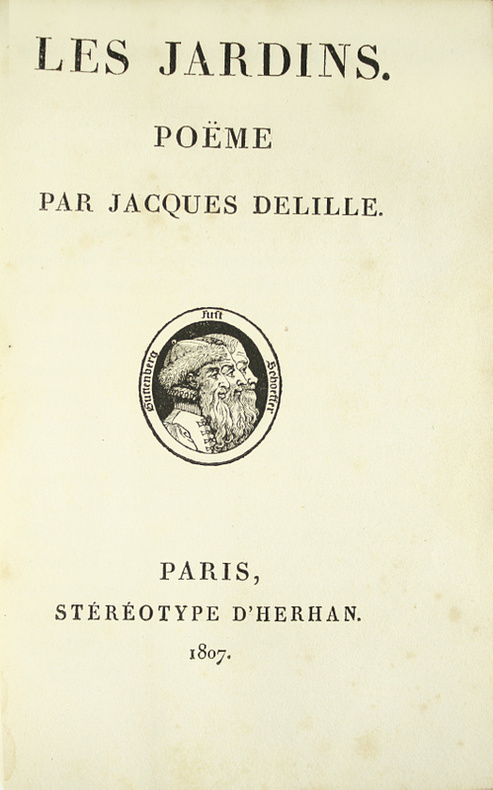
LCS-17774Ce type de reliure, extrêmement fragile, est de ce fait devenu très rare et recherché. Paris, Stéréotype d’Hernan, 1807.In-12 de (2) ff., 211 pp., 4 figures. Qq. rousseurs. Reliure couverte d’un vernis vert pâle sur les plats et vert foncé sur le dos, encadrement de filets dorés et d’une guirlande de fleurs peinte en couleurs autour des plats, bouquet de fleurs peint en couleurs au centre, dos lisse entièrement doré avec en réserve le titre, et des fleurs qui apparaissent en bleu foncé, tranches dorées. Reliure de l’époque.142 x 93 mm.Dimensions de la reliure : 150 x 97 mm.
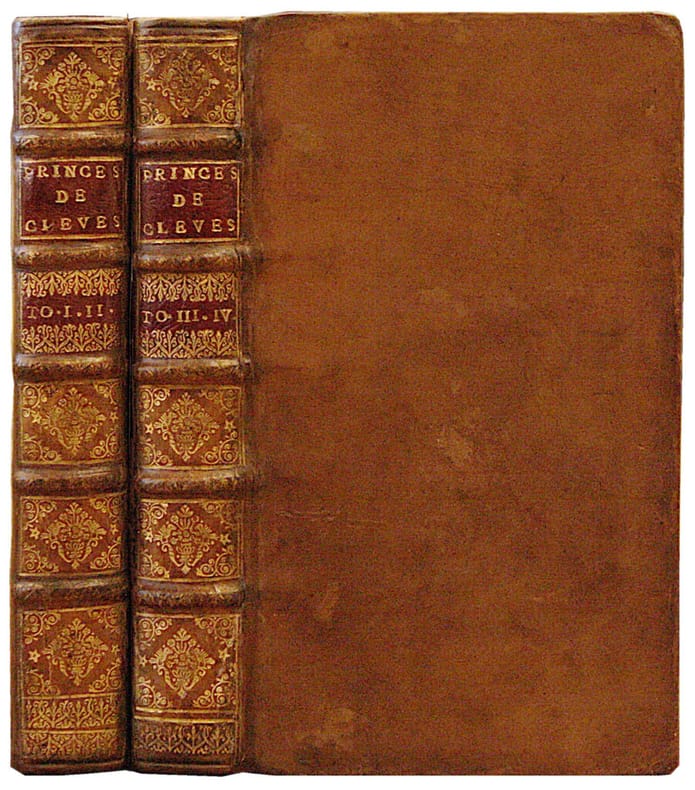
LCS-17848Véritable seconde édition de l’une des principales œuvres littéraires françaises du XVIIe siècle. Paris, Claude Barbin, 1689. 4 tomes en 2 volumes in-12 de : I/ (2) ff., 211 pp. ; (1) f., 214 pp., (1) f. bl. ; II/ (1) f., 216 pp. ; 211 pp. numérotées 213, (5) pp. de privilège. Veau glacé, dos à nerfs ornés, pièces de titre et de tomaison de maroquin rouge, roulette dorée sur les coupes, tranches rouges. Reliure de l’époque. 154 x 85 mm.
- Michel Lévy frères , Paris 1868, 12x18cm, relié. - Troisième édition - et dernière revue par l'auteur - en partie originale, car paraissent ici pour la première fois 25 poèmes inédits, l'édition totalisant à présent 151 poèmes (contre 100 pour l'édition de 1857). Un des rares exemplaires de première émission avec le titre à la bonne date de 1868 et sans mention d'édition. Ouvrage illustré, en frontispice, d'un portrait sur acier de Charles Baudelaire par Nargeot. Reliure en demi chagrin rouge, dos à quatre nerfs de filets et doubles caissons estampés à froid, plats de papiers à la cuve, un coin légèrement émoussé, toutes tranches peignées, reliure de l'époque. Exemplaire quasiment sans rousseur. La page de faux-titre portent l'intitulé : "Oeuvres complètes". L'ouvrage se vendait séparément ou comme le premier tome des oeuvres complètes dont l'édition s'étalera sur plusieurs années. Clouzot précise : "Très rare en reliure d'époque sans tomaison au dos". Il est nécessaire de savoir que la couverture de cette troisième édition se trouve toujours à la date de 1869, et que certains exemplaires, les plus rares, portent une page de titre à la date de 1868. Notice par Théophile Gautier. [ENGLISH DESCRIPTION ON DEMAND]
- Falaize, Paris 1952, 11,5x17,5cm, broché. - La Ballade de la geôle de Reading. - L'Artiste en prison [The Ballad of Reading Gaol] Falaize | Paris 1952 | 11.5 x 17.5 cm | original wrappers New edition of the French translation by Jacques Bour and the first edition of Albert Camus' famous preface. One of 50 numbered copies on Madagascar paper, tirage de tête. A fine autograph inscription from Albert Camus: "à Michel Simon grand artiste avec les voeux chaleureux d'un de ses vieux admirateurs [For Michel Simon, a great artist, with warmest wishes from an old fan]," and an autograph inscription from the translator Jacques Bour: "à Michel Simon qui ferait crouler tous les murs! [For Michel Simon, who raised all the roofs!]" A rare and very good copy. [FRENCH VERSION FOLLOWS] Nouvelle édition de la traduction française établie par Jacques Bour et édition originale de la célèbre préface d'Albert Camus, un des 50 exemplaires numérotés sur vélin Madagascar, tirage de tête. Précieux envoi autographe signé d'Albert Camus : "A Michel Simon grand artiste avec les voeux chaleureux d'un de ses vieux admirateurs" enrichi d'un envoi autographe signé du traducteur Jacques Bour : "A Michel Simon qui ferait crouler tous les murs!" Rare et bel exemplaire.
- Editions surréalistes, Paris 1934, 14,5x19cm, broché sous chemise et étui. - Le Marteau sans maître [The Hammer without a Master] Éditions surréalistes | Paris 1934 | 14.5 x 19 cm | original wrappers with custom chemise and slipcase First edition, one of 500 copies on ordinary paper. This copy has a chemise and slipcase. A little light spotting, not serious, nice copy. Retaining its advertising band and slip. Handsome autograph inscription signed by René Char: "à Man Ray au voyant carnassier de tout cur R. Char." ("To Man Ray to the carnivorous fortune teller, with all my heart, R. Char.") [FRENCH VERSION FOLLOWS] Edition originale, un des 500 exemplaires du tirage ordinaire. Notre exemplaire est présenté sous chemise et étui en plein cartonnage blanc. Quelques petites rousseurs sans gravité, agréable exemplaire. Exemplaire complet de sa bande annonce et de son prière d'insérer. Précieux envoi autographe signé de René Char : "A Man Ray au voyant carnassier de tout coeur R. Char."
- R.A. Everett & Co, London 1904, 12,5x19cm, reliure de l'éditeur. - Georges DARIEN Gottlieb Krumm, Made in England R.A. Everett & Co | London 1904| 12.5 x 19 cm | publisher's binding First edition of an extraordinary rarity published in London and written in English. The French edition, translated by Walter Redfern, only appeared in 1984. Publisher's binding in glazed brown calico, spine ends lightly rubbed, without significant damage, illustrated first board. Small and light dirt marks on the second board, small sections of paper missing due to the fragility of this featherweight laid paper. Exiled with the majority of the French anarchists following the enactment of the "Lois scélérates" in 1893 and 1894, Darien travelled to Belgium and Germany before settling in London where, like Jules Vallès twenty years earlier, he stayed for many years. His life during this stay in the British capital remains a mystery but it is here that he wrote his masterpiece Le Voleur and his famous pamphlets La Belle France and L'Ennemi du Peuple. It is in this context that the polyglot writer composed this entire novel written in English. Like Le Voleur, Gottlieb Krumm, in the cosmopolitan London of the Entente Cordiale, depicts intelligent and unscrupulous German immigrants who get rich thanks to intense and very varied criminal activity. However, unlike the characters of his contemporary Maurice Barrès, Darien's foreigners are not a horde of naturally inclined barbarians to the destruction of an idealised national identity. On the contrary, these are men without a real prior identity and who, when confronted with the bourgeois society, will embrace all weaknesses and exploit all resources. Fraud, scams, blackmail, fires, prostitution, Gottlieb Krumm does it all to make a fortune and get to the top of London's finance and business. The height of Satire, Georges Darien does not allow any critical recoil towards the actions of his characters since it is the anti-hero himself who ironically tells his story in English blended with foreign idioms and obscure metaphors. Confidentially published for a London audience who did not know him, this irreverent novel was probably not successful at the time and the copies of this first and only edition published seem to have very quickly disappeared. We have only identified four copies in international institutions (British Library, National Library of Scotland, University of Oxford, Australian National University) and no copies for sale. [FRENCH VERSION FOLLOWS] Édition originale d'une insigne rareté parue à Londres et rédigée directement en anglais. L'édition française, traduite par Walter Redfern ne paraîtra qu'en 1984. Reliure de l'éditeur en plein percaline marron, dos lisse, coiffes légèrement frottées sans gravité, premier plat illustré. Petites et claires taches de salissures sur le second plat, petits manques de papier en raison de la fragilité de ce papier vergé bouffant. Exilé, avec la plupart des anarchistes français, à la suite à la promulgation des «?Lois Scélérates?» de 1893 et 1894, Darien voyage en Belgique et en Allemagne avant de s'installer à Londres où, comme Jules Vallès vingt ans plus tôt, il restera plusieurs années. Sa vie durant ce séjour dans la capitale britannique reste parfaitement mystérieuse mais c'est ici qu'il écrit son chef d'uvre Le Voleur et ses célèbres pamphlets La Belle France et L'Ennemi du Peuple. C'est dans ce contexte que l'écrivain polyglotte compose ce roman entièrement rédigé en anglais. Comme Le Voleur, Gottlieb Krumm met en scène, dans le Londres cosmopolite de l'Entente cordiale, des immigrés allemands intelligents et sans scrupules qui vont s'enrichir grâce une activité criminelle intense et très variée. Cependant, contrairement aux personnages de son contemporain Maurice Barrès, les étrangers de Darien ne sont pas une horde de barbares naturellement enclins à la destruction d'une identité nationale idéalisée. Au contraire, ce sont des hommes sans véritabl
- E. Dentu, Paris 1879, 12x18cm, relié. - Edition originale sur papier courant, il n'a été tiré que quelques Hollande en grands papiers. Reliure à la bradel en demi percaline verte, dos lisse orné d'un motif floral doré, double filet doré en queue, pièce de titre de chagrin bordeaux moderne, plats de papier marbré, deux coins légèrement émoussés, reliure de l'époque. Précieux envoi autographe signé d'Alphonse Daudet : " au romancier J.B. d'Aurevilly son admirateur et ami Alphonse Daudet." Quelques petites rousseurs. Les deux écrivains se sont rencontrés à la suite de la critique bienveillante de Barbey sur Les Lettres de mon moulin dans Le Constitutionnel. Entre le virulent cotentinais et le doux provencal, nait alors une amitié à laquelle ils resteront fidèles leur vie durant, en dépit des cercles littéraires incompatibles auxquels appartiennent passionément les deux écrivains. En 1876, à la parution de Jack dédié à Flaubert, Barbey rédige une critique où l'admiration se mêle au ressentiment contre l'allégeance de Daudet à Flaubert: "Je voudrais que le 'moi' de Daudet, son 'moi' sensible et réfléchi, tînt plus de place dans son oeuvre actuelle. Lui qui (je m'en souviens) s'est moqué autrefois si joliment des Impassibles, ne peut pas sans inconséquence et perversion de sa nature, en devenir un. Il ne peut pas l'être comme cette forte mécanique de Flaubert, qui, en un roman, fait ce que Taine fait en histoire, c'est à dire montre l'objet et s'en va. (...) Alphonse Daudet est du très petit nombre d'écrivains qui ont à eux une manière qui ne ressemble à celle de personne, et c'est même la raison pour laquelle il échappe souvent à l'esprit de système et à des admirations dangereuses. C'est pour cela que ce talent charmant tremble si joliment dans le manche grossier du réalisme. C'est un conteur d'une grace émue et légère, qu'aucun romancier contemporain n'a au même degré que lui (...). Il a cet avantage des esprits infiniment poétiques, que la poésie suit, comme une lueur où qu'ils aillent et qui font tomber des ciels d'or sur la teigne des pouilleux, comme le faisait Murillo..." [ENGLISH DESCRIPTION ON DEMAND]
- s.d. (ca 1914), trois reliques. - Important and moving set of three relics belonging to three prominent 20th-century avant-garde figures: Paul Eluard, Max Ernst, and Gala. Found by Cecile Eluard in the apartment of her mother Gala after her death. - Iron cross of Max Ernst - "Gri-gri" [trinket] of Paul Eluard in 1914: a blue hand-sewn pouch with a small photographic portrait of him in a helmet and one of his mother - Gala's Orthodox medal with Saint Barbara, Saints Anthony and Theodosius on the back, mounted on a chain Cologne, November 1921, almost three years after the armistice. Eluard and Gala, travel to Germany to meet Max Ernst in his studio, after having missed his great debut in France. "A single week was enough for Paul Eluard to consider Max Ernst as his brother." (D. Bona, Gala la muse redoutable). Gala is seen wearing Max Ernst's iron cross on two pictures immortalizing this crucial visit. The German painter and the French poet had both lived hell on the front: "In February 1917, the surrealist painter Max Ernst and I were at the front, barely a kilometer apart. The German artilleryman Max Ernst was bombing the trenches where, as a French infantryman, I was standing guard. Three years later, we were best friends in the world and we have been fighting together ever since for the same cause: the total emancipation of man."(Paul Eluard, Donner à voir) This common trauma certainly brought the two artists together, creating between them a true brotherhood and artistic bond, beyond the abominations and absurdity of war. Our set also contains a touching war relic, a tiny apotropaic scapular containing two miniature portraits: one of Paul Eluard, wearing a helmet, the other with a profile of his mother, Jeanne-Marie Grindel. This common kind of trinket was designed to ward off evil for the soldiers who wore them close to their hearts. Photographs of loved ones, gold coins or religious medals were a precious link between the battlefield and civil life. The religious medal in our collection belongs to Gala, who arrived in Switzerland in 1913. She entered the Clavadel sanatorium as Helena Diakonova and met the young Eugène Grindel, whom she married in 1917. She never separated from her talisman, an orthodox medallion with Saint Barbara on one side and Saints Anthony and Theodosius on the other. "Max is [...] the best of friends. More natural, funnier, more seductive than most of his friends in Paris, handsome and delightful to be around, he is for Paul as well as for Gala, in that first week when they meet, charm itself. And what's more, Paul never stops telling Gala that Ernst is great. A very, very great artist, how can you not love him?" (D. Bona, op. cit.) When Eluard returned to Paris, he was still in very high spirits. He worked with Ernst by mail on two poem collections: Répétitions and Les Malheurs des immortels. To celebrate this shared artistic success, Eluard and Ernst spent the summer together in Tarrenz, Tyrol with their wives and friends - including Tristan Tzara, Hans Arp and Sophie Taeuber. Ernst soon left the apartment he had rented with his wife to join Paul and Gala in their house by the lake: "The Tzaras, the Arps, and Matthew Josephson witness an open romance: it is clear to everyone that Max and Gala are perfectly in love. They hold hands and take each other by the shoulders, they kiss, and prefer their solitude to group walks along secret mountain paths. [...] Gala for her part does not let Paul ignore anything either, and the poet cannot fail to see the impulse that carries his wife and his friend towards each other. Nonetheless he does nothing to oppose their affair. He is discreet and so complacent that he gives the impression of approving it. All the guests in Tarrenz notice it: Paul Eluard never tried to hold Gala back from an affair that he was the first to observe, even if he had to suffer for it. "You don't know what it's like to be married to a Russian woman!" he tells them, confiding [..