672 143 résultats
Small 4to. 25, 20, 14, 19, (5) ff. Loosely inserted within a cover of contemporary marbled boards with giltstamped calf label to spine. In marbled slipcase. Appealing collection of drafts for Carco's popular "Heures d'Égypte" (Avignon, 1940), dedicated to his impressions of Egypt and his travel memoirs. They comprise three chapters of the "Heures", beginning with "L'Égypte est une présence", including a brief description of the multi-storey palace of the French Egyptologist Auguste Mariette-Pacha, omitted from the published version, praising its bridges, boats, and sails, which are said to be of a blinding whiteness in sharp contrast with the ocean's blue: "Son chateau de plusieurs étages, ses ponts, ses embarcations, ses prélarts d'une blancheur éblouissante contrastaient avec l'azur fonci des flots bleus [...]". - Accompanying these are two drafts entitled "Sortilèges", renamed "Une histoire de Momie" in the print edition, as well as one of the chapter "Promenade au Mouski", the latter discussing the French writer Gérard de Nerval and his stay in Egypt: "Nerval must have wandered under these signs [...] until 1906, control registers were not required by the Egyptian police and the only information about Gérard's travels is contained in Gautier's [i. e. the French poet and Nerval's travel companion Théophile Gautier] lovely book - full of love, money and light - which the poet left behind during his sojourn in the country. Nerval had been planning to leave for years since the dark winter night of 1841 when, responding to a friend he thought strange, he exclaimed that he was not going home, but was heading East" (transl.). - With numerous erasures and corrections in ink as well as in blue and red crayon. Extremities lightly bumped. A very well preserved set.
4to and oblong 8vo. Altogether 23 pp. on 13 ff. Many addenda (see below). To her brother William, Prince of Wied (1845-1907) and his wife Marie, née von Nassau, Princess of the Netherlands (1841-1910). Comprehensive letters that provide an insight into the feelings and thoughts of the Queen consort of Romania and also provide a wealth of information from the European aristocracy and the political events of that time. - Accompanied by 8 original portrait photographs (calling card format) of Queen Elizabeth and her little daughter, who died at the age of 4 years, and 33 mostly autograph letters, postcards, etc. (altogether 102¾ pp. on 64 ff.) from the estate of Elizabeth's sister in law, Marie, Princess of Wied, born Princess of the Netherlands (1841-1910), including letters of her husband William and other relatives of Marie, more noble and diplomatic correspondence files, a "compilation of expenditure for her Royal Highness, Princess of Wied, Princess of the Netherlands, for the fourth quarter of 1892 ", a letter-fragment with a view of Pelesch Castle, and an engraved portrait of the royal couple (inscribed by Elizabeth on the reverse). - Overall, a wealth of valuable material on the history of Romania, Queen Elizabeth and her family from the houses Wied and Nassau.
4to. German manuscript in brown ink on paper. 7 lines. An early version of Celan's poem "Auf hoher See" that was first published in the 1952 poetry collection "Mohn und Gedächtnis": "Paris, das Schifflein, liegt im Glas vor Anker: | So halt ich mit dir Tafel, trink dir zu. | Ich trink solang, bis dir mein Herz erdunkelt, | Solange, bis Paris auf seiner Träne schwimmt, | Solange, bis es Kurs nimmt auf den Schleier Klarheit, | Der uns die Welt verhüllt, wo jedes Du ein Ast ist, | An dem ich hänge als ein Blatt, nie als ein Mensch". - Apart from the new title, Celan changed the fifth and seventh lines of the poem ahead of its publication. Instead of "Solange, bis es Kurs nimmt auf den Schleier Klarheit", the published version reads "So lange, bis es Kurs nimmt auf den fernen Schleier", and instead of "An dem ich hänge als ein Blatt, nie als ein Mensch", it reads "An dem ich hänge als ein Blatt, das schweigt und schwebt". - Celan presented this manuscript as a gift to Diet Kloos-Barendregt on 7 October 1949. Kloos-Barendregt (1924-2015) was a Dutch singer and resistance fighter whose husband had been executed by the Nazis in 1945. During a brief stay in Paris she met Paul Celan by chance at the Café Dupont in August 1949. They immediately formed a connection over their traumatic experiences and losses and started a romantic relationship. - Traces of folds. Minimally creased and minor browning. With punch holes. Provenance: from the estate of Diet Kloos-Barendregt, Bubb Kuyper auctions, November 2021. P. Celan, Mohn und Gedächtnis (Stuttgart, DVA, 1952). Cf. Paul Celan, Du mußt versuchen, auch den Schweigenden zu hören. Briefe an Diet Kloos-Barendregt. Handschrift - Edition - Kommentar (ed. by P. Sars, Frankfurt a. M., 2002).
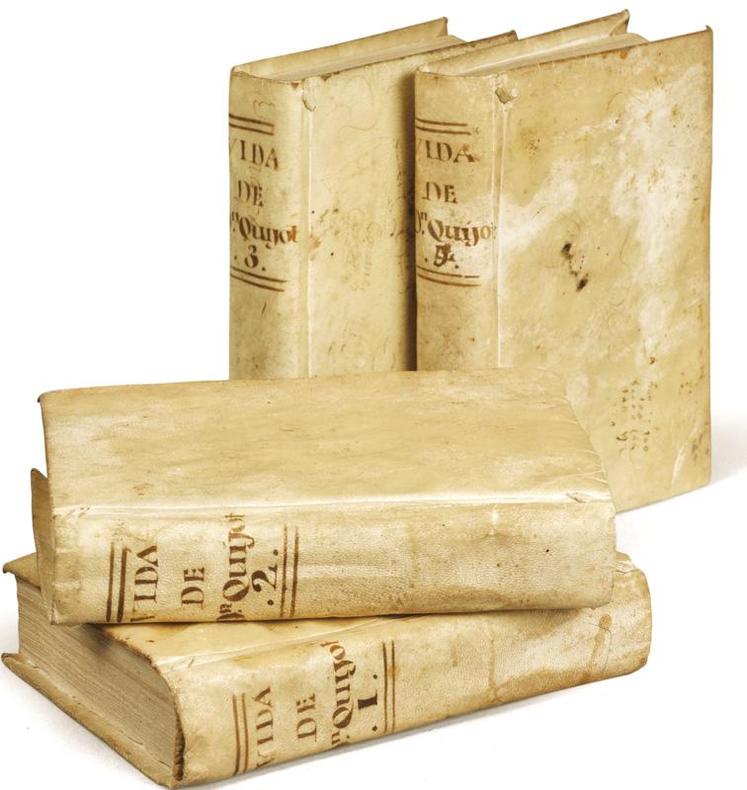
1777YTB-4CERVANTES Saavedra, Miguel de. [DON QUICHOTTE]. VIDA Y HECHOS DEL INGENIOSO CAVALLERO DON QUIXOTE DE LA MANCHA. Compuesta por Miguel de Cervantes Saavedra. Nueva edicion : Repartida en quatro Tomos en octavo para la mayor comodidad : corregida e ilustrada con quarenta y quatro estampas : anadida la vida de su Autor, escrita por Don Gregorio Mayas y Siscar Bibliotecario del Rey N. S. Madrid, D. Manuel Martin, 1777-78. 4 tomes en 4 volumes in-8 de : I/ (1) f. bl., (16) ff., (1) f., 166 pp., 268 pp, 270 pp. (mal chif. 278), (3) ff., (1) f. bl. ; II/ (1) f. bl., (3) ff., 517 pp., (4) pp., (1) f. bl. ; III/ (10) ff., 450 pp. (mal chif. 408), (5) ff., (1) f. bl. ; IV/ (1) f. bl., (2) ff., 387 pp., (9) pp., (1) f. bl. Vélin souple de l’époque, traces d’attache, dos lisse, titre calligraphié au dos, inscriptions manuscrites et qq. taches sur les plats. Reliure de l’époque. 150 X 100 mm. Viuda de Rico, 612-613 ; Rio y Rico, 74 ; Plaza Escudero, I, 48 ; Benages/Fonbuena, 54 ; Palau, 52023. PRECIEUSE EDITION DU DON QUICHOTTE DONNEE PAR MANUEL MARTIN AU SIECLE DES LUMIERES. Ornée de 44 figures gravées sur bois dans le texte, elle repose sur les éditions Costa 1605 et Martin, 1765. « No es texto muy común y Henrich no reprodujo su portada. Los Suñé la citan en la ficha 59, pero no habló de ella Givanel Mas, ni la cita del Río y Rico. La portada y la composición general son diferentes a las de otras ediciones.» (E. Rodriguez-Cepeda, Los Quijotes del siglo XVIII). « Hay que considerar, sin embargo, que estas impresiones son las que han universalizado la idea cervantina. Con la filosofía racionalista del siglo XVIII, la ilustración y el racionalismo fueron el mejor cobijo de la imaginería cervantina, permitiendo que un texto tan original y caprichoso proliferara en la mentalidad de los lectores con suma facilidad. Don Gregorio Mayans y Siscar hace el primer estudio sobre la vida del autor, incluido en esta obra. Mayans y Siscar no sólo es el primero, sino el que hace del Quijote un libro moderno para entender a Cervantes y el género novelístico en esa época. » (A. Sequera Victoriano, Ediciones de Don Quijote de la Mancha, impresa en el siglo XVIII). « A special type of Quixote, illustrated with woodcuts was sold in the street; it was published by M. Martín between 1765 and 1782. This was how this most intellectual of Spanish literary text penetrated the popular culture of the period. Por todo esto se extendió con los ilustrados el alcance de la obra cervantina y la fuerza del texto abarcaba a todas las clases sociales y a todos niveles culturales; en el XVIII empezó a ser el verdadero libro para todos. Los Quijotes con tacos de madera, hoy son muy escasos, los conjuntos de cuatro volúmenes andan casi siempre descabalados (inclusive en los catálogos y bibliotecas oficiales). Estas impressiones han sido las que más han universalizado la idea cervantina.» (E. Rodriguez-Cepeda). « Les philosophes, les encyclopédistes se font de Don Quichotte une arme contre la religion et ses ministres» (P. Mérimée, M. Bardon, Don Quichotte en France au XVIIe et XVIIIe siècles). TRES SEDUISANT EXEMPLAIRE, DE TOUTE PURETE, CONSERVE DANS SON VELIN SOUPLE DE L’EPOQUE. Provenance : Bibliothèque Fernand Bertrand, avec ex-libris sur la page de garde ; présence de divers ex-libris manuscrits de l’époque « Beauvany », « Château Gonti » sur les feuillets blancs et les plats.
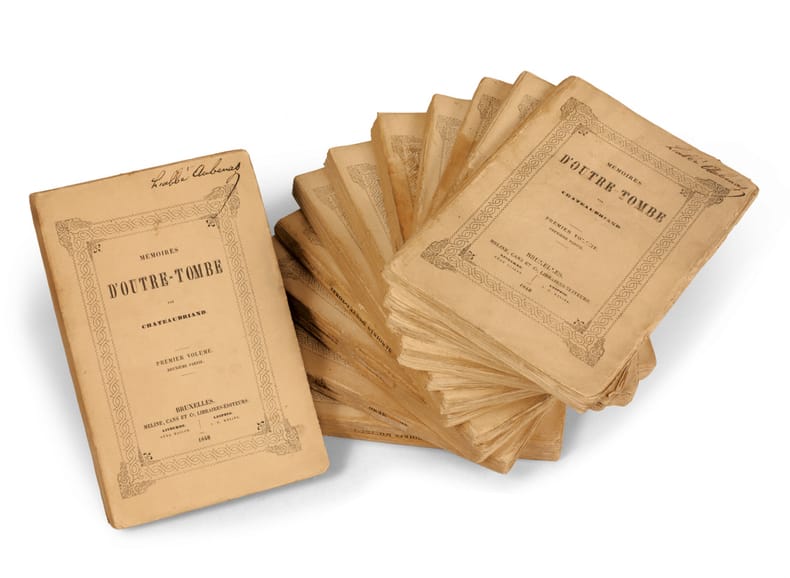
LCS-18254L’exemplaire de l’abbé Aubenas, intéressante provenance pour le chef-d’œuvre de l’auteur du « Génie du christianisme ». Bruxelles, Meline, Cans et Compagnie, 1848-1850. 6 tomes en 12 volumes in-12 de : I/ (2) ff., 140 pp. ; II/ pp. 141-356 ; III/ (2) ff., 180 pp. ; IV/ pp.181-374 ; V/ (2) ff., 232 pp. ; VI/ pp.233-471 ; VII/ (2) ff., 228 pp. ; VIII/ pp. 229-490 ; IX/ (2) ff., 180 pp. ; X/ pp.181-483 ; XI/ (2) ff., 212 pp. ; XII/ pp.213-516. Brochures d’origine, chemises et étuis. Brochures de l’époque. 191 x 120 mm.
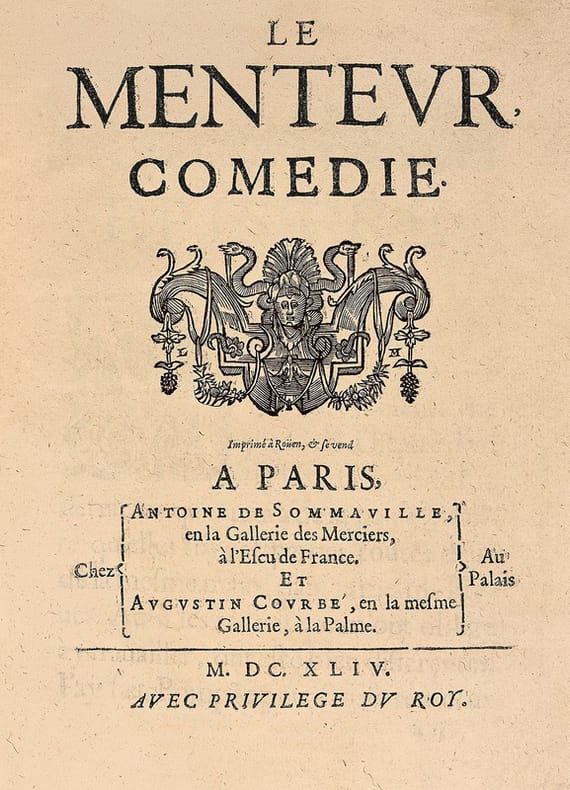
LCS-18282Tchemerzine, II, pp. 550 et 552 ; Le Petit, pp. 161-164 ; Picot, Bibliographie cornélienne, 35 et 40 Imprimé à Rouen, et se vend à Paris, chez Antoine de Sommaville et Augustin Courbé, 1644. In-4 de (4) ff. pour le titre, l’Epistre et la liste des acteurs, 130 pp. et (1) f. de privilège. Maroquin rouge, encadrement de triple filet doré sur les plats, dos à nerfs richement orné, double filet doré sur les coupes, large roulette intérieure dorée, tranches dorées. Trautz-Bauzonnet. 217 x 160 mm.
LCS-18375Précieux exemplaire enrichi d’une émouvante lettre autographe de Daudet adressée à son fils Léon à propos d’un diner chez le peintre Giuseppe De Nittis. Paris, E. Dentu, 1872. In-12 de (1) f. bl., (3) ff., 265 pp., (1) f. bl. Relié en maroquin brun, triple filets à froids encadrant les plats, dos à nerfs, pièce de titre de maroquin rouge, tranches dorées. Reliure de l’époque. 173 x 109 mm.
8vo. 2½ pp. on bifolium. To Mr. Breach, the proprietor of the Folkestone Inn, where Dickens stayed for three days while travelling to Boulogne-sur-Mer on Sunday, June 12th. Dickens mis-dated this letter as, according to another letter in the VanderPoel Dickens collection (A85) written from Folkestone dated Saturday the 11th, this letter, written on Thursday, would have been the 9th of June. In his letter Dickens asks the proprietor to have a "quiet and cheerful" room prepared for him and his family who plan on coming for the summer. Dickens was particularly fond of Boulogne as, the previous summer, he had completed two chapters of "Bleak House" while vacationing there. - Minor overall toning; brown spot to upper middle crease. - Provenance: from a Chicago-area private collection. Edgar Johnson, 756-759; The VanderPoel Dickens Collection, A85.
8vo. 2¾ pp. on bifolium. To Dr. Frederick Salmon complaining of some aches and pains. Dickens and his wife went to stay at the White Hart Hotel in Windsor on November 6th, the day after Dickens completed his novel "Barnaby Rudge". The trip was meant to provide some rest and relaxation for Dickens who had completed "The Old Curiosity Shop" and "Barnaby Rudge" back to back, and had recently undergone major surgery. Dr. Frederick Salmon had performed surgery on Dickens in October of 1841 for a fistula of the rectum, a procedure for which Salmon was renowned. In this letter, Dickens' describes his pain and references the operation with his typical wit, noting "all manner of queer pains were floating about my illustrious person [...] now (but not often) shooting through that region which you have made as tender as my heart [...]". Dickens tells his doctor that he is feeling "immeasurably better" and asks whether Salmon would like to make his follow up visit tomorrow rather than Tuesday. - Light soiling to creases; evidence of removal of wax seal. Property from a Private Chicago-area Collection. Provenance: The Comte Alain de Suzannet Dickens Collection Sold: Sotheby's, London, November 22-23, 1971.
8vo. 1½ pp. on bifolium. To the English journalist and writer Mark Lemon (1809-70) with congratulations on his play, praising particularly the performance of the English actor James William Wallack (ca. 1794-1864), who dines at his place the following Sunday, a dinner he invites Lemon to join: "Many thanks for the Box, and best congratulations on the Play. It went admirably - rose as it went on - mounted immensely in the third act - and closed in triumph. Howe was not good, but the rest were. Wallack beyond all praise. I have never seen such a fine, picturesque, splendid piece of melodrama. He really bore the whole play on his shoulders, and did gallant service. I believe he dines here next Sunday at ½ past 5. If so, will you come? No party. I begin to think you live in Australia [...]". - Mounted on backing paper.
1 S. Gr.-4to. Die andere Seite mit einem ganzseitigen eh. Schreiben von Döblins Gattin Erna. An Elvira und Arthur Rosin in New York mit der Bitte um die genaue Adresse von Elviras Schwester, Fr. Dr. Rosenthal, die gleichfalls in Paris lebt: "[...] Hier herrscht die alte politische Spannung und Unsicherheit, man weiß nicht, was wirklich gespielt wird; nicht einmal der anglo-russe pacte ist unter Dach. Eben erhalte ich den Kirkegaard Band von Herrn Rosin, schönsten Dank! Ich las drüben auf Ihrer Chaiselounge mittendrin ein paar wunderbare Passagen über Plato. Apropos Plato: Herr Olschki senior ist nun schon en route, - ihn kennen gelernt zu haben, gehört ja zu den Gewinnen meiner Amerikareise. Es ist doch eine schöne Stadt, ein gutes reiches kräftiges Land, in dem Sie jetzt sind, Frau Rosin, - schrecklich wie man hier zerkrampft wird und die Lügen einen umringen, man kann nur die Türe zumachen [...]".
Folio. ¾ pp. on bifolium. In pencil. Notes about the location of memorabilia from the age of Grumbach and Münzer. Written on a bifolium of slightly yellowed draft paper. Fontane's diaries and letters provide no other hint that Fontane took an interest in Wilhelm von Grumbach and his arguments with the Bishop of Würzburg, Emperor Ferdinand I, and the Elector of Saxony. Grumbach's legal battles, a history-based subject in the vein of Michael Kohlhaas, was likely to atttract a writer such as Fontane.
Large 8vo. 2 pp. on bifolium. To an unidentified recipient, about the correct pronunciation of "Archibald Douglas", the main character of his like-named ballad (he "most decidedly" favours 'Ar-khi-bald Doo-glass'), and of his own name (as in French, rather than the germanised forms "Fóntan, Fontáne, Fontané"). - Not recorded in the edition of Fontane's letters. - Foldings with small tears.
Large 8vo. 1¼ pages. "Da kommt es wiederum heran | Das Heer von Schiffern und von Mohren | Das in der Nordsee Uferbann | Mein einsam brütend Hirn geboren. | Doch sind es kaum die alten mehr | In Ruderwams- und Reiterkleide; | Wie Herren schreiten sie einher | Im Gurt von Gold, im Rock von Seide [...]". - Slightly browned and with small tear in lower margin.
4to. 1¾ pp. Contract between Maxim Gorki and André Germain, who hereby agrees to represent and commercialize Gorki's copyright in France.
4to. ¾ page. In Russian. To Solomon Gitmanovich Kaplun: "I am sending a letter to V. F. Khodasevich which was requested to be published in Beseda. I am asking you to advance me money against the fee for my 'Book about Blok' and all five children's books. M. I. [i.e. Moura Budberg] said that I received not a single letter from you over the entire summer. You replied that letters had been sent to me and that you had copies of them. Since I am still awaiting the reply to questions I asked you, perhaps you will send me the copies of your letters. I will not discuss how surprised I am at your attitude towards me". - S. G. Kaplun (1891-1940) was a journalist and publisher, the owner of the Berlin publishing house "Epoch" and from 1922 to 1925 the publisher of Gorky's literary and scientific journal "Beseda". - Left margin with punched holes (not touching text). Provenance: Hermitage auction, Monaco, 25 April 2019, lot 306.
4to. ¾ page. In German. Addressed to the editor of a newspaper, Gorky's statement repudiates remarks that have been attributed to him in various newspapers: "From Maxim Gorki, who is staying in Berlin at present for a short time, we have received the following note: / Allow me, dear editor, the polite communication that the interviews with me which have appeared in various journals are to be considered as apocryphal, and that I can in no way assume responsibility for their content. My current state of health does not allow me to undertake conversations with gentlemen of the press; I will however not fail to accede to your wishes as soon as I have the strength to do so" (transl.). - Disenchanted with Lenin's regime and suffering from tuberculosis, Gorky had left Russia in September 1921, initially staying in Berlin; ultimately he was to settle in Sorrento, with an extended household which now included Moura Budberg, his secretary and lover. - Provenance: Sotheby's, 25 May 1983; Heritage, 6 April 2016, lot 49152.
LCS-15520La première édition complète des Œuvres de Pierre Goudelin, émule de Theophile de Viau et de Mathurin Régnier, conservée dans sa première reliure en vélin souple de l’époque. Toulouse, Pierre Bosc, 1648. In-4 de (16) pp., 213, (1) p.bl., (70) pour le Dictionnaire de la langue toulousaine, 104 pp. Plein vélin souple de l’époque, dos lisse orné du titre manuscrit en tête et de la date en queue. Reliure de l’époque. 230 x 165 mm.
1 S. auf Doppelblatt. 8vo. An einen Herrn, der ihm wohl ein Manuskript des Königsberger Literarhistorikers Alexander Jung übersandt hatte, welches Grimm ihm unbesehen zurücksendet, da er "so bedrängt mit arbeiten und geschäften" sei, "dass ich nicht die geringste zeit übrig habe es einzusehen; übrigens ist schon seit einigen tagen herr Jung in Königsberg von allem durch mich in kenntnis gesetzt worden, was ich für ihn thun kann. ich bedaure seine widrige lage aufrichtig und habe ihm den rath ertheilt, sich hier an die allgemeine deutsche verlagsanstalt zu wenden [...]". - Stellenweise unbedeutend fleckig.
92 SS. auf 23 losen Doppelbll. Kl.-4to. Vollständiges Manuskript der Novelle "Tantalus", 1901 bei Carl Krabbe in Stuttgart erschienen. Auf dem Titelblatt der Vermerk des Verlegers in roter Tinte: "Mspt an den Autor zurückgegeben". - Tinte auf festem Papier, zahlreiche Korrekturen und Streichungen im Text und auf den breiten linken Rändern; unbeschnitten; das Doppelblatt mit den Seiten 41 bis 44 durchtrennt.
8vo. 1 p. Bifolium with integral address panel. To "Monsieur Tarride libraire" on the publication of his "Napoléon le Petit", which Hugo had written after leaving France and going into exile in Brussels. Afterwards moving to London, Hugo wrote the present letter to his publisher, who was up to release the book illegally on August 7: "[...] je m'empresse de vous informer que vous pouvez en toute sûreté mettre sur la couverture le nom de M. Jeffs comme éditeur".
8vo. 1 page. Probably to the writer Alexandre Dumas, with the recommendation of an actress seeking an engagement at a theatre, and mentioning his recent prosperity due to the success of "The Three Musketeers": "Voici, Monsieur, une personne qui me paraît digne de votre intérêt, c'est Mme Vendrezanne, artiste, elle est dans une situation qui lui fait vivement desirer un engagemen[t] ou un emploi quelquonque dans un théâtre ce qui la rend facile sur les conditions. Je sais que la prospérité est revenue chez vous avec le grand succès des Mousquetaires. S'il vous était possible d'utiliser [?] Mme Vendrezanne, vous ferez une bonne oeuvre et peut-être, je le crois, une bonne affaire [...]". - Apart from Alexandre Dumas, who owned the "Théâtre Historique", also the director of the "Théâtre de l'Ambigu-Comique", where the "Musketeers" premiered in 1845, could be considered as a possible recipient. - Slight marginal flaws, one touching the first letter of the signature.
Large 8vo. 2 pp. on bifolium. With autogr. address. To Louis Labarre, Brussels, praising him as a poet-prophet: "J'ai lu, mon cher frère, votre [illegible] et j'y ai retrouvé votre ami. Vous avez mis là toutes les hautes aspirations et votre espoir. […] Vos quatre beaux vers d'envoi m'ont vivement touché. Je Vous accorde [?] mon applaudissement ému, et ma cordialité profonde". - Louis Labarre (1810-92) was a Belgian author, journalist, editor of "La Nation", publishing French political dissenters. - Paper professionally repaired, a few words blurred by ink bleed.
1 S. Kl.-8vo. Widmungsgedicht in Pentametern für den aus Bunzlau gebürtigen Dichter und Orientalisten Andreas Tscherning (1611-59): "Cl. et eruditissimo viro Andreae Tscherningio poetae caes. laur. s. p. // Tscherningius ille, qui diu Parnassio / In monte vixit, musici mystes sacri / Frequens, amator pervigil mentis bonae [...]". Möglicherweise das Manuskript zu Huswedels Beitrag in der 1644 zu Tschernings Rostocker Promotion erschienenen Lobschrift "Acclamationes In Lauream Magistralem Viri Clarissimi Andreae Tscherningii" (VD 17, 125:018978A). Der hier verherrlichte Opitzianer Tscherning, der 1641 die erste deutsche Übersetzung einer arabischen Dichtung publiziert hatte, wurde anschließend in Rostock Professor der Dichtkunst. - Der aus Hamburg gebürtige und am Johanneum erzogene Huswedel wurde in Rostock Magister und studierte anschließend in Wittenberg und Leiden (wo er Joseph Justus Scaliger kennenlernte). Er wirkte in seiner Heimatstadt und in Rostock als Professor des Griechischen; wegen Konflikten mit den Hamburger Theologen blieb er ab 1628 vollends in Rostock. - Papierbedingt etwas gebräunt; kleine Bugfalteneinrisse. Selten.
3 SS. auf Doppelblatt. Kl.-8vo. An seinen Freund, den Philologen und Übersetzer J. H. Voss, der nach einem geplanten Besuch bei seinem Bruder Abraham, damals als Gymnasiallehrer in Rudolstadt tätig, eine gemeinsame Reise zu Jean Paul nach Bayreuth geplant hatte: "Dein Fruchtblatt, guter Heinrich, bekam ich gerade an meinem Geburtmorgen. Nur zog eine große finstere Wolke über den ganzen Tag, in welche Jacobis Leiche eingewickelt war, weil mir die Meinigen aus falscher Schonung dessen Tod durch Unterschlagen einiger Zeitungen zu verhehlen gewußt. Nur deinem Wunsche gemäß schreib' ich dir; denn sonst bei dieser Nähe mündlicher Worte wären schriftliche ein Telegraph in der Stube. Leider muß ich es mir meiner Verhältnisse wegen gefallen lassen, daß du nicht bei mir wohnst, da du deinen lieben Abraham mitbringst, was mich wieder auf die andere Art entschädigt. Steige ja in der Sonne ab, dem besten Gasthause, worin ich immer in meiner jüngern Zeit so wie Siebenkaes logierte. Den Tag deiner Ankunft schreibe mir so bestimmt wie möglich. Außer Gegend u. außer den Meinigen hab' ich Euch wenig anzubieten. Über Heidelberg u. meine Lebensbeschreibung hast Du mich misverstanden; nur aufgeschoben hab' ich das Genießen beider, nicht aufgegeben. Und nun reise so glücklich als du in Rudolstadt sein wirst! / Jean Paul". - Friedrich Heinrich Jacobi, der Philosoph und Freund Goethes, war am 10. März gestorben. Mit "Siebenkäs" ist die Hauptfigur seines 1796/97 erschienenen Romans über das Eheleben des Armenadvokaten Siebenkäs gemeint. Abraham Voss gab 1833 den Briefwechsel zwischen seinem Bruder und Jean Paul heraus. - Mit kleinem Falzrest auf Bl. 2 verso.