GAUTIER, ThéophileLivre Rare Book
672 143 résultats
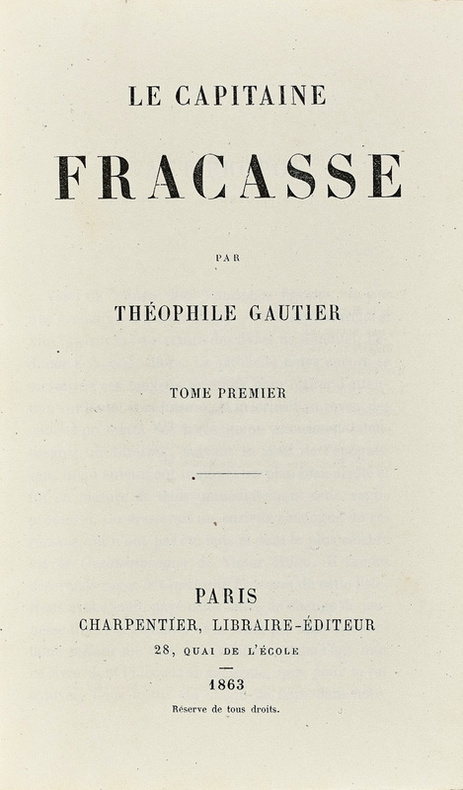
LCS-18029Rare dans cette condition. Paris, Charpentier, 1863. 2 tomes en 2 volumes in-12 de : I/ (2) ff., iv pp., 373, (3) ; II/ (2) ff., 382 pp., (2). Reliés en demi-veau blond, dos à nerfs ornés de filets dorés droits et pointillés, pièces de titre et de tomaison de maroquin havane et vert, tranches mouchetées. Reliure de l’époque. 176 x 112 mm.
- Eugène Didier, Paris 1852, 8,5x14cm, relié. - First edition. Marbled sheep Bradel binding by Loisellier-Le Douarin, spine with gilt cartouche and three mosaiced lozenges of red and beige morocco, date at foot of spine, covers with a frame of triple gilt fillets, marbled pastedowns and endpapers, all edges gilt, an elegant binding. Rare autograph inscription from the author to (Adolphe) Nibelle, very slightly shaved. This copy is additionally enhanced with three manuscript corrections by the author towards the end of the volume. Further, a manuscript note signed by Nibelle has been mounted on guards at the beginning of the work, detailing the desirable collectible features of the book. Scattered foxing. [FRENCH VERSION FOLLOWS] Edition originale. Reliure à la bradel en pleine basane marbrée, dos lisse orné d'un cartouche doré agrémenté de trois pastilles de maroquin rouge et sable mosaïqué, date dorée en queue, encadrement de triples filets dorés sur les plats, gardes et contreplats de papier à la cuve, toutes tranches dorées, élégante reliure signée Loisellier-Le Douarin. Rare autographe signé de l'auteur à (Adolphe) Nibelle très légèrement rogné. En outre, notre exemplaire est enrichi de trois corrections manuscrites de l'auteur en fin de recueil. Enfin, une note manuscrite signée du dédicataire précisant les particularités bibliophiliques de notre exemplaire a été montée sur onglet en début de volume. Rousseurs éparses.
- Poulet-Malassis & De Broise, Paris 1859, 12x19cm, relié. - Première édition française en partie originale et postérieure d'un an à l'originale, un des 10 exemplaires sur hollande, seuls grands papiers avec 2 chine. Reliure à la bradel en demi percaline cerise, dos lisse orné d'un motif floral doré, date et double filet dorés en queue, pièce de titre de maroquin noir frottée, plats de papier marbré, couvertures conservées, tête dorée, reliure signée à froid Pierson. Précieux et rare envoi autographe signé de Théophile Gautier à Jules Pelletier, secrétaire général du ministère d'Etat auquel Gautier prêta sa plume. Il l'en remercia en intercédant auprès de l'Empereur qui le fit nommer Officier de la Légion d'Honneur le 7 août 1858. Notre exemplaire est bien complet, en frontispice, du portrait de H. de Balzac tiré sur chine et gravé à l'eau forte par E. Hédouin ainsi que de ses 3 fac-similés autographes (qui manquent souvent selon Clouzot). [ENGLISH DESCRIPTION ON DEMAND]
- S.n., s.l. (Paris) 1850 (1890), 11x18cm, broché sous chemise et étui. - Lettre à la Présidente [Letter to the President] n. n. | [Paris] 1850 [printed in 1890] | 11 x 18 cm | original wrappers First edition printed anonymously with a very small number of copies on Japan paper. Work illustrated with an erotic frontispiece by Félicien Rops on China. Some discrete restorations on the spine and cover boards. "The President", the honorary nickname given to Apollonie Sabatier (alias Aglaëe Savatier, her real name), was one of the most captivating Salon mistresses of the 19th century. She inspired an ethereal love in Baudelaire who composed his most mystical poems in Fleurs du mal for her. The other artists who frequented the apartment on Rue Frochot, during its famous Sunday dinners, had more licentious feelings for this women of surprising wit and beauty. The sculptor Clésinger thus represented her through his lascivious "woman stung by a snake"; Flaubert wrote sensual letters to her which end with "the very sincere affection of one who, alas, only kisses your hand"; while she was long accepted as having been the model for Gustave Courbet's Origine du monde. Gautier sent her this letter in 1850, copies of which she herself distributed to her guests but which was never published, "In October 1850, Gautier sent her [this] very long letter, farcical and obscene, from Rome, commenting with a Rabelaisian exaggeration what his friend Cormenin and he had learned regarding sexuality during their completed travels. Gautier knew that his freedom of expression would not offend Madame Sabatier. He had long since accustomed her to it and he prided himself on his "smut" to brighten up the friendly social gatherings of the Rue Frochot." (Dictionnaire des uvres érotiques) Indeed, honoured by this priapic attention, the President distributed copies to all her guests and the reading of Gautier's "indecent prose" became a popular event at Parisian soirées. However, the letter was published, luxuriously but confidentially, only after the recipient's death in 1890. After this first edition of 50 copies on Japan paper, a second edition on laid paper, with a larger print run, and without the Rops frontispiece, followed a few months later. A rare and beautiful, very sought after, copy. [FRENCH VERSION FOLLOWS] Édition originale imprimée anonymement à 50 exemplaires sur japon. Ouvrage illustré d'un frontispice érotique de Félicien Rops sur chine. Quelques discrètes restaurations au dos et plats de couverture. Notre exemplaire est présenté sous chemise en demi-maroquin rose framboise et plats de papier à motifs or et rose, étui bordé de maroquin, dos lisse, titre en long, ensemble signé T. Boichot. La Présidente, surnom honorifique attribué à Apollonie Sabatier, (pseudonyme d'Aglaé Savatier), fut l'une des maîtresses de Salon les plus envoûtantes du XIXè siècle. Elle inspira un amour éthéré à Baudelaire qui composa pour elle ses plus mystiques poèmes des Fleurs du mal. Les autres artistes qui fréquentaient l'appartement de la rue Frochot, lors de ses célèbres dîners dominicaux, éprouvaient pour cette femme étonnante d'esprit et de beauté, des sentiments plus licencieux. Le sculpteur Clésinger la représenta ainsi à travers sa lascive «?femme piquée par un serpent?»?; Flaubert lui écrivit des lettres sensuelles qui se concluent par «?l'affection bien sincère de celui qui ne vous baise, hélas, que les mains?», tandis qu'elle passa longtemps pour avoir été le modèle de l'Origine du monde de Gustave Courbet. «?En octobre 1850, Gautier lui adressa de Rome [cette] très longue lettre, bouffonne et obscène, commentant avec une truculence rabelaisienne ce que son ami Cormenin et lui-même avaient appris, en matière de sexualité au cours du voyage qu'ils accomplissaient alors. Gautier savait que sa liberté d'expression n'offusquerait pas Madame Sabatier. il l'y avait habituée depuis longtemps et se flattait d'égayer par ses «?saloperies?» les raouts a
- Fernand Mourlot, Paris 1967, 25,5x33cm, en feuilles sous chemise et étui. - Bouquet de rêves pour Neila [Bouquet of Dreams for Neila] Fernand Mourlot | Paris 1967 | 25.5 x 33 cm | in leaves in a chemise and slipcase Illustrated edition with 18 original insert lithographs in colour by Joan Miró, one of 150 numbered copies on Rives vellum, only print after 25 vellum and 25 non-trade. Very beautiful copy. Handwritten signature of Joan Miró on the print details page. Our copy is enriched with a handwritten inscription dated and signed by Joan Miró to Armand Blanc accompanied with an original drawing in pencil. [FRENCH VERSION FOLLOWS] Edition illustrée de 18 lithographies originales hors-texte et en couleurs de Joan Miro, un des 150 exemplaires numérotés sur vélin de Rives, seul tirage après 25 vélin et 25 hors commerce. Très bel exemplaire. Signature manuscrite de Joan Miro à la justification du tirage. Notre exemplaire est enrichi d'un envoi autographe daté et signé de Joan Miro à Armand Blanc accompagné d'un dessin original réalisé au crayon de papier.
- Mercure de France, Paris 1897, 11,5x18,5cm, relié. - First edition in part. Bradel binding, covers preserved, modern pastiche binding. Handsome autograph inscription signed by Alfred Jarry to René Emery, fonder of the periodical "Fin de siècle" and author of "Amour à toutes les sauces". [FRENCH VERSION FOLLOWS] Édition en partie originale. Reliure à la bradel en plein papier à motifs floraux, dos lisse, pièce de titre de maroquin marron, date dorée en queue, couvertures conservées, reliure pastiche moderne. Précieux envoi autographe signé d'Alfred Jarry à René Emery, fondateur de la revue "Fin de siècle" et auteur du sulfureux "Amour à toutes les sauces".
- S. n. (Jacques Guérin), s.l. 1955, 22x27,5cm, en feuilles sous chemise à lacet. - Edition originale entièrement hors commerce et imprimée à 28 exemplaires numérotés. Reliure de l'éditeur en plein cartonnage recouvert de papier à motifs floraux, dos lisse muet comportant de discrètes traces de restauration en tête et en pied, étiquette de titre avec nom de l'auteur encollée sur le premier plat, exemplaire complet de son lacet de soie noire. Envoi autographe signé de Violette Leduc : "... en souvenir de l'Italie, de l'Espagne aussi. Avec mon amitié. 24 Janvier 1956. Violette Leduc", le nom du dédicataire a été proprement gratté. Notre exemplaire est enrichi d'un portrait gravé d'une femme agrémenté d'une précision manuscrite. Très rare ouvrage consistant en le fac-similé du manuscrit autographe et présenté sous chemise en papier peint à motif floral et à lacets, étiquette de titre encollée sur le premier plat. Rare et agréable exemplaire. [ENGLISH DESCRIPTION ON DEMAND]
- Dondey-Dupré, Paris 1833, 13,5x22cm, relié. - Édition originale très rare et recherchée, selon Clouzot, et imprimée à seulement 300 exemplaires. Reliure en demi maroquin rouge à coins, dos lisse orné d'arabesques romantiques dorées, date dorée en queue, encadrement de filets dorés sur les plats de papier marbré, gardes et contreplats de papier caillouté, couvertures doublées conservées, élégante reliure pastiche romantique signée Devauchelle. Bel exemplaire de l'un des plus rares «?Romantiques?», bien complet du frontispice sur Chine, dessiné et gravé par Célestin Nanteuil. [ENGLISH DESCRIPTION ON DEMAND]
LCS-849Rare édition originale, bien complète des trois numéros, de la remarquable Revue du monde nouveau créée par Charles Cros en 1874. Paris, n°1 (15 Février) - n°2 (1er Avril) - n°3 (1er Mai) 1874.3 fascicules grand in-8 paginés en continu de 1 à 224. Conservés dans les brochures d’origine vertes imprimées. Quelques piqures. Préservés dans une chemise et un étui de papier marbré vert.254 x 163 mm.
- Nrf, Paris 1929, 12x19cm, broché. - Edition originale, un des 697 exemplaires numérotés sur pur fil. Précieux envoi autographe signé de l'auteur à Geneviève Stewens, épouse de Christian Sarton du Jonchay. Fils de Charles Sarton du Jonchay, alors en garnison en Algérie, Christian Sarton du Jonchay s'engage à quatorze ans dans le Régiment de Spahis Auxiliaires algériens que dirige son père. Après de nombreuses péripéties, il obtient la croix de guerre et devient, à quinze ans seulement, le plus jeune maréchal des logis de France. Après avoir servi dans différents régiments de cavalerie et bataillons de chasseurs, il est blessé en juillet 1918 et termine la guerre avec sept citations, comme lieutenant et chevalier de la Légion d'Honneur. A la fin de la Première guerre mondiale, il choisit de poursuivre sa carrière dans l'armée et se porte volontaire, en 1921, pour servir lors de la Campagne de Syrie, obtenant là encore plusieurs distinctions. Une grave blessure à l'épaule le rendant partiellement invalide le contraint à se tourner vers l'aviation, d'abord comme observateur, puis en obtenant son brevet de pilote le 17 août 1927. Après une affectation au 2e Régiment d'aviation à Strasbourg, il rejoint le Groupe des Avions nouveaux, précurseur du centre d'essais du matériel aérien CEMA, comme commandant de la Section des avions légers. Cependant, après son échec à l'École de Guerre, il prend sa retraite en 1933. Du Jonchay rejoint alors Caudron-Renault, filiale aviation de la grande société automobile. Il devient, avec sa femme américaine Gene - dédicataire de cet exemplaire - une figure du milieu mondain gravitant autour de l'aviation. Bel exemplaire. [ENGLISH DESCRIPTION ON DEMAND]
- De l'Imprimerie de P. Didot l'Aîné, Paris 1814, 12,5x20,5cm, relié. - De l'Imprimerie de P. Didot l'Aîné | Paris 1814 | 12,5 x 20,5 cm | bound in calf First edition of Stendhal's very first book, published under the pseudonym of Louis-Alexandre-César Bombet. Contemporary binding in half brown calf, spine decorated with gilt fillets and tooling as well as a red morocco title piece. "Very rare" according to Clouzot [FRENCH VERSION FOLLOWS] Edition originale du tout premier livre de Stendhal, publiée sous le pseudonyme de Louis-Alexandre-César Bombet. Reliure de l'époque en demi veau brun à coins, dos lisse orné de filets et fers dorés ainsi que d'une pièce de titre de maroquin rouge. "Très rare" selon Clouzot.
1575648K20Medina : Francisco del Canto 1575. First edition. Leather. Good. 12" by 8.5". None. An extremely scarce first edition volume of this early and extremely influential work of world history penned by the highly controversial Jesuit Friar and pseudo-historian Fray Hieronymo Roman. Very scarce. The work is only held within four institutional libraries. The first edition of the work in the original Spanish. Volume one only. A second volume was published simultaneously with a third volume first published in 1595. The work has been rebound and is lacking the first two blank leaves otherwise complete. Pagination is irregular as called for. The work offers a wide ranging comparative history of the world's civilisations and their institutions. The work has a particular focus upon political legal and moral issues and includes reference to the Indies Far East and pre-Columbian America. The author Fray Hieronymo Roman was a clergyman librarian and Spanish historian known to be a close friend of Alonso de la Vera Cruz; considered to be the most important figure in philosophy in the sixteenth century. The work is the author's Magnum Opus and offers a very early example of anti-colonial writing. The comprehensive work was not without its controversy; indeed it faced censorship owing to its implications regarding the first conquistadors including casting doubt on the legitimacy of the Spanish rule in the New World. In 1583 the work was included upon the Spanish Inquisition's list of prohibited books after being denounced by the Council of the Indies. The following year the work was also included upon their index of books to be destroyed. The author managed to avoid further censorship by correcting the most controversial passages in the later 1595 edition. As such first edition copies such as this one are extremely scarce to come across and are considered of greater historical significance in part due to their inclusion of the more controversial anti colonial standpoint particularly in reference to Spanish colonisation in America. A very scarce example of this early anti-colonial writing written by a noted Spanish friar and historian. Rebound in half crushed morocco with marbled boards and gilt detail to the spine. Externally very smart with slight rubbing heavier to the joints and head and tail of the spine resulting in some minor loss to the leather. Hinges strained with cords visible. Bookseller's stamp to rear pastedown. Lacking first two blank leaves. Internally firmly bound. The occasional sympathetic repair particularly to the title page. Decorative contemporary banner has been adhered under title where previously would have read "diuididas en XXVII libros". The occasional tidemark throughout heavier to the first twenty leaves. The occasional contemporary ink annotation including to title page and fore edge. Scattered spotting. Good Francisco del Canto hardcover
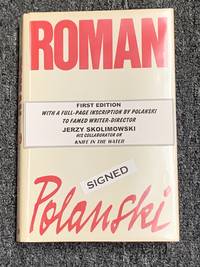
198412801<b>Signed & Inscribed First Edition First State copy a presentation copy by the internationally famed director to noted Polish writer/director Jerzy Skolimowski writer of Polanski's breakthrough film KNIFE IN THE WATER. Much better than very good copy slightly foxed to topedge leaves in like dust jacket showing light wear and a modicum of stain to spine & back panel not affecting the author portrait. This copy is a rarity indeed: it bears a full-page inscription by Polanski in Polish to Skolimowski translation provided by him on a laid-in sheet. In blue ink: "Romek. So you see what is happening / I am signing my biography to you / And it is in English / You could not have foreseen this / during those hot evenings / on Narutowicra Street / when you were served / fruit juices by Kuba / Love/ R." Signature a rarity today highly sought after; an inscription by him particularly one with this degree of meaning & history in such an association on a presentation copy is an extraordinary uniquity.</b> Morrow hardcover books
Berlin, S. Fischer Verlag, 1912. Royal 8vo. Volumes 1 and 2 (i.e. the entire year) of ""Die neue Rundschau, 1912"" present, in the original half vellum bindings with gilt title to spines. A few pencil annotations on flyleaf. An exceedingly nice and clean set.
London, Cassell & Company, 1883. Bound (with the original cloth binding also) in an exquisite full dark green morocco binding with single gilt line-borders to boards and gilt spine. Single gilt line to edges of boards and to inner dentelles. All edges gilt. Binding signed Sangorski & Sutcliffe. Bound in at the end is the original green cloth binding, which has been carefully mounted, baords on arch their leaf, and the spine on its own. The spine is also very well kapt and has all the original gilding. First and last leaves with a bit of light brownspotting, otherwise just and some minor, light scattered brownspotting. All in all a very nice and fresh copy. Frontispiece map of Treasure Island printed in three colours.
- Plon, Paris 1961, 14x20,5cm, broché. - [Madness and Civilization: A History of Insanity in the Age of Reason] Plon, Paris 1961, 5 1/2 x 8 1/16 ", original wrappers. First edition, of which there were no grand papier (deluxe)copies, an advance (service de presse) copy. A second, revised, edition appeared in 1972. Spine slightly bowed, retaining dj, dj with a few tears and lacks to plastic film cover. Handsome autograph inscription signed by Michel Foucault, at the time a young teacher, on his first important work, taken from his doctorate. A very rare advance copy, which could be said to have taken the place of the grand papier (deluxe) copies. [FRENCH VERSION FOLLOWS] Édition originale pour laquelle il n'a pas été tiré de grands papiers, un des exemplaires du service de presse. Une deuxième édition révisée paraîtra en 1972. Dos légèrement gauchi, exemplaire complet de sa jaquette illustrée qui comporte quelques déchirures et manques de film pelliculé qui la recouvre. Précieuse signature autographe de Michel Foucault, alors jeune enseignant, sur son premier ouvrage d'importance, tiré de son doctorat d'État. Très rare service de presse qui peut faire office de grand papier.
- Charles Carrington, Paris 1906, 14,5x23cm, relié sous chemise et étui. - First edition of the French translation by Hugues Rebell, one of 30 numbered copies on Japon, the tirage de tête. Full morocco, cover and spine preserved, all edges gilt, chemise in half morocco, slipcase lined with morocco, elegant contemporary binding signed Huser. Illustrated, as frontispiece, with a photographic portrait of Oscar Wilde. Provenance : from the library of Henri Thuile with his ex-libris pasted to head of a pastedown. A very nice copy elegantly bound by Huser in lined morocco. [FRENCH VERSION FOLLOWS] Edition originale de la traduction française établie par Hugues Rebell, un des 30 exemplaires numérotés sur Japon, tirage de tête. Reliure en plein maroquin bordeaux, dos à cinq nerfs sertis de filets noirs, date dorée en queue, roulettes dorées sur les coiffes, encadrement d'un filet doré sur les contreplats de maroquin noir, gardes de soie moirée rouge, couverture et dos conservés, toutes tranches dorées, doubles filets dorés sur les coupes, chemise en demi maroquin rouge à bandes, plats de papier marbré, étui bordé de maroquin rouge, plats de papier marbré, élégante reliure de l'époque signée Huser. Ouvrage illustré, en frontispice, d'un portrait photographique d'Oscar Wilde. Provenance : de la bibliothèque d'Henri Thuile avec son ex-libris encollé en tête d'un contreplat. Très bel exemplaire parfaitement établi par Huser en maroquin doublé.
8vo. XVI, 8, XVII-XXII, 9-192 pp. With numerous illustrations and photographs by David Hockney, R. B. Kitaj, Kenneth Patchen, Mal Dean, John Furnival and many more. Original illustrated wrappers. One of only 25 signed copies. The famous double number of the avant-garde literary magazine: a milestone of the Beat Generation and one of the most important anthologies of underground literature of the 1960s and '70s. Featuring 56 original signatures by leading figures of the Beat Generation, including William S. Burroughs, Jack Kerouac, John Cage, Samuel Beckett, David Hockney (monogram), Ronald D. Laing, Allen Ginsberg, Gregory Corso, Robert Creeley, Thom Gunn, and Jack Hirschman. - The lion's share of signatures are on the last page; 16 signatures are mounted beneath the corresponding texts. The present copy is number 14. - "New Departures" was founded in 1959 by the editor, poet, translator, and performance artist Michael Horovitz (1935-2021), a pioneer of London underground culture during the Swinging Sixties. - From a Viennese private collection. In fine condition. OCLC 314592223.
Folio. 4 ¾ pp. on 8 ff. In red ink. Article in French entitled "Le 7 Novembre est bien la fête des Sans-Dieu" ("November 7 is effectively the Feast of the Godless") for the atheist magazine "La Lutte antireligieuse et sociale", organ of Proletarian Free Thought (better known as "Organisation des travailleurs sans dieu"). Louis Aragon spent a year in Moscow from early 1932 after breaking with the Surrealist movement, particularly André Breton. During this time he witnessed the enormous parade on Red Square for Revolution Day on October 15. In the article Aragon describes the event with a focus on anti-religious messages, contrasting the "byzantine" Saint Basil's Cathedral with modern architecture, engineering, and technological progress such as the planned Moscow Canal, achieved by communism. The military parade was followed by a parade of workers with their tools, products and anti-religious posters, for "this crowd has no God anymore, this immense crowd has no God anymore". And yet there are new idols, standing out against the old ones: "What an extraordinary figure made above this crowd, where you find the best shock workers of socialist construction, the best pioneers from the kolkhozes and sovkhozes, the baroque cathedral, like a phantom of the past!" In closing, Aragon enthusiastically describes the accompanying air show, likening the aircrafts to symbols of socialist progress, in comparison with the symbols of tsarism and orthodoxy: "And in passing with their straight wings they seem to deride the contorted golden eagles of the Tsars, the crosses with two crossbeams of the old church, where today only the voices of Marx and Lenin are heard, of the old church that is chained to the triumphal chariot of the Proletariat". - Louis Aragon was loyal to Moscow and Stalinism well into the 1960s, even defending the Moscow Trials in articles. When the scope of Stalinist terror was finally revealed, he distanced himself from Soviet communism and condemned its past and continuing crimes. - Several minor tears, somewhat dusty and smudged. Collector's note in pencil to the first page.
Large 4to. 2¼ pp. on bifolium. To an American friend, expressing her willingness to encourage and support the Hungarian revolutionaries, who had left Hungary after the Revolution of 1848 frequently injured and destitute. She praises their courage and moral values, and affirms the importance of the liberal attitude and America's support for Europe in this period: "Les soupirs qui proviennent d'une respiration libérée servent le bien-être de ceux qui en sont les auteurs [...] J'apprends par votre lettre que vous n'avez point reçu la correspondance que je croyais vous avoir prié d'accepter [...] L'édition qui doit être vendue au profit des Hongrois prisoniés, date de l'an 1850 muni d'une préfaçe qui marque son but. [...] J'apprécie [...] votre prévenante bonté pour ces grandes ames si joyeusement engagés dans cette lutte à mort. [...] les jeunes garçons s'arrachant à l'enfance soudain devenus grands guerriers hardi et determiné en servant leur patrie mais liberal envers l'enemi quand ils l'avaient sous la main. […] Du temps de leur victoire, on leur avait voué une flamme enthousiaste en Allemagne mais depuis qu'on a oser courber sous les pieds du bourreau des héros, il n'y a plus une étincelle à réveiller. [...] A Berlin, […] on a chassé et repoussé les malades hongrois qui devaient s'arreter pour faire panser leurs plaies [...] Vainquers dans leur patrie, magnanime enver l'ennemi ; un moment après fuyards chassés de pays en pays autour de la terre, sans qu'une âme hospitalière leur tende la main. Ce n'est donc qu'en Amérique que l'on apprécie prondement et sincèrement les grands caractères qui se maintiennent sublimes dans les plus effroyables destinées. [...] je vous estime [...] par ce que [...] vous avez confirmé la dignité de toute votre nation si libérale si inspirée pour les grands sentiments ce qui est pour le momment de la plus grande importance [sic]".
36 pp. on 36 ff. 4to. Complete typescript of the piece "Les Cenci", with some corrections. Artaud has signed twice, at the top of the first page and on the last page; some small corrections written in black ink do not seem to be from his hand. "A beautiful black masterpiece is the only legacy that is still important to leave [...] For I, the old count Cenci [...], it happens more than once in my dreams to identify myself with destiny" (transl.). Artaud finished Cenci's text, a "tragedy in four acts and ten paintings on a theme of Stendhal and Shelley", at the beginning of February 1935. The dress rehearsal took place on 6 May 1935 at the Théâtre des Folies-Wagram. The play left the stage after 17 performances. Artaud played the main role, that of Count Cenci, and directed the production according to the principles set out in Le Théâtre et son double. Balthus designed the sets and costumes. The critics were divided; the play was notably praised by Pierre-Jean Jouve: "The will of Antonin Artaud joining that of Balthus is everywhere: the extreme points appear in the emphatic and dark play of Artaud himself, in the incandescent beauty and the childish, wild action of Iya Abdy". An invitation card is attached to a gala performance of Cenci at the Théâtre des Folies-Wagram on 7 May 1935. - Small damage to edges on some sheets; on browned paper.
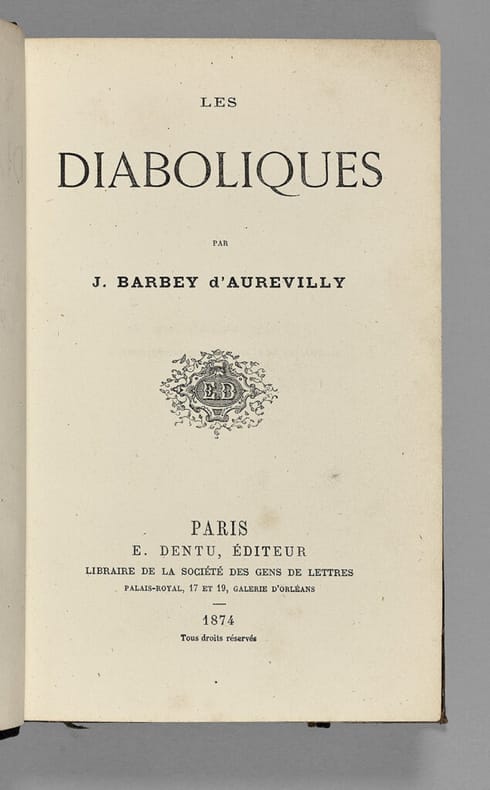
LCS-17504L’une des plus précieuses éditions originales littéraires du XIXe siècle. Paris, E. Dentu, 1874.In-12 de (1) f., viii pp., pp. 7 à 354, (1) f. de table. Demi-maroquin tabac, dos à nerfs orné de filets dorés, tranches mouchetées. Reliure de l’époque. 175 x 110 mm.
2 pages in-4. "Mon cher André Malraux, j'ai été d'autant plus touché de votre mot que je me suis senti étroitement proche de vous en lisant Les Voix du Silence. Albert Skira, particulièrement heureux de votre appréciation, aimerait, si vous l'autorisez, utiliser une phrase pour la publicité. Je m'excuse de vous le demander, mais je ne pourrais guère me prétendre étranger aux préoccupations dont témoigne sa question... Il y a bien longtemps que nous ne nous sommes vus et si par hasard vous aviez un moment un jour de la semaine prochaine (du 22 au 29), que je passe à Paris, puis-je vous proposer de vous rencontrer ?" - Réponse de Malraux à l'encre rouge: "Cher G.B. je repars pour la Suisse ce soir. Mais que Skira emploie la phrase en question, s'il le croit utile: je me réjouis de tout ce qui peut servir votre livre. Soy. ass., cher G.B. de mon bien symp. souvenir".
8vo. 2 pp. on bifolium. With autograph address. To the journalist and editor Paul Mantz (1821-95), apologizing for a further delay in the completion of his famous article on Théophile Gautier for "L'Artiste". Baudelaire cites obligations for "La Revue Contemporaine" as the cause but promises to finish immediately afterwards. He hopes that the article will be "good enough" for Mantz and Gautier, himself an editor at "L'Artiste", to excuse "such tardiness". In closing, Baudelaire announces that he is keen to write a review of Charles Asselineau’s "La double vie" as soon as the Gautier article is done: "Il faut que vous m'excusiez une fois, une seule fois encore. Je suis repris par la Revue Contemporaine pour 5 jours et l'article Gautier n'est qu'à moitié chemin. Je ne pourrai donc m'y remettre que mardi, et la journée de mardi suffira pour le finir. Il y a encore du caricaturisme à l'imprimerie, et c’est même la partie la plus ennuyante; croyez que je suis très honteux, mais j’espère que l’article sera assez bien fait pour que Théophile et vous me pardonniez tant d’inexactitude. Je tiens vivement à me charger du livre d'Asselineau (la Double vie). L’article sera fait le lendemain du Gautier [...]". - Baudelaire’s article on Théophile Gautier ultimately appeared on 13 March 1859, whereas the review of "La double vie" appeared as early as 9 January 1859, both in "L'Artiste". Later in 1859, the Gautier article would appear as a monograph with a congratulatory letter by Victor Hugo to Baudelaire serving as its preface. Charles Asselineau (1820-74) was one Baudelaire's closest friends and had supported the first publication of "Les Fleurs du Mal" in 1857. He also wrote the first biography of Baudelaire, published in 1869. - Traces of folds. A tear from breaking the seal; insignificant tears and some browning.
Folio (223 x 282 mm). ½ p. An album leaf with printed borders, printed footer "Beitrag zum Selbstschriftenalbum 'Deutschlands Zukunft'", and printed form for biographical information, mounted on a sheet of parchment paper (ca. 330 x 344 mm). A Marxist sentiment in German: "Deutschland braucht für seine zukunft nichts anderes als andere länder: die möglichst geschickte anwendung marxistischer gesichtspunkte auf gesellschaft und wirtschaft. Dann hätte es natürlich ebenso wie andre Länder die chance, aus seinem kulturellen sumpf herauszukommen [...]" ("For her future, Germany needs nothing but what other countries need: a thoroughly skilful application of Marxist perspectives to society and economy. That, of course, would provide Germany, like other countries, with a chance to escape from her cultural quagmire"). - Written as a contribution for an anthology published by Friedrich Koslowsky, "Deutschlands Köpfe der Gegenwart über Deutschlands Zukunft" (Berlin, Eigenbrödler-Verlag, 1928). - Brecht, already a confirmed communist by 1928, was just about to enjoy one of the greatest stage successes of the Weimar Republic with his "Threepenny Opera" (adapted from Gay's "Beggar's Opera"), with music by Kurt Weill. That same year Brecht had met Schoenberg's student Hanns Eisler, an artistic association that would last the rest of Brecht's life. Koslowsky 295.