672 143 résultats
12mo. Together 2¼ pp. on bifolia. Both to Jules Verne's younger sister Anna. The earlier letter from 30 December 1901 contains New Year's wishes, news about Jules Verne's health, and an invitation to visit him and his wife Honorine in Amiens: "Nous te renvoyons nos vœux, pour cette nouvelle année 1902 dans laquelle je vais achever ma soixante-quatorzième ! Mes yeux sont toujours dans le même état et je ne me déciderai à subir l'opération que le jour où ce sera absolument nécessaire. Je sais que tous les enfants vont bien, et je te renouvelle ce que je te disais dans ma dernière lettre : si tu reviens dans le nord, tache de t'arrêter, soit pour quelques heures, ou bien quelques jours à Amiens, cela nous fera grand plaisir". - The second letter from August 1902 again concerns Jules Verne's eye cataract and his decision to delay surgery as long as possible: "Honorine et moi, nous t'envoyons nos meilleurs compléments, en te priant de les transmettre à ton fils ! Cependant, cette double bénédiction ne laisse pas d'être lourde, comme tu le dis. Mais il faut bien l'accepter. Honorine n'a pas trop à se plaindre de sa santé. Et toi ?... Pour moi, j'y vais mal. Je n'ai point encore été opéré de mon cataracte, et je me n'y déciderai que lorsqu'il ne sera plus possible de faire autrement. Tant que je pourrai lire et écrire, même difficilement, j'attendrai [...]". - The earlier letter without signature due to clipping. Well preserved.
1 p. (42 lines). 8vo. Mounted on cardboard. A working manuscript, comprising three 14-line stanzas, written in dark brown ink, with autograph title ("Die Bürger, die Künstler und der Narr"), containing a number of deletions, corrections and revisions. "Unter einem Künstler verstehen sie einen, / der sich nicht abgibt mit solchen Schweinen / und nichts zu tun hat mit allen den Dingen, / die ihnen im Handumdrehn gelingen, / um sich dafür mit Schaffen und Schreiben / und hauptsächlich ihnen die Zeit zu vertreiben; / und da er doch von Beruf ein Träumer / und deshalb auch Schuldterminversäumer, / der das tut, wozu er nicht ist verpflichtet, / und das andere lieber läßt unverrichtet, / so kann er zwar leichter als sie sich entflammen, / sonst aber geht es ihm gar nicht zusammen. / Und teilten die Bürger nicht besser sichs ein, / ja dann könnten sie auch solche Künstler sein! [...]". - First published in 1922 in "Worte in Versen" vol. VI. - Slightly spotty.
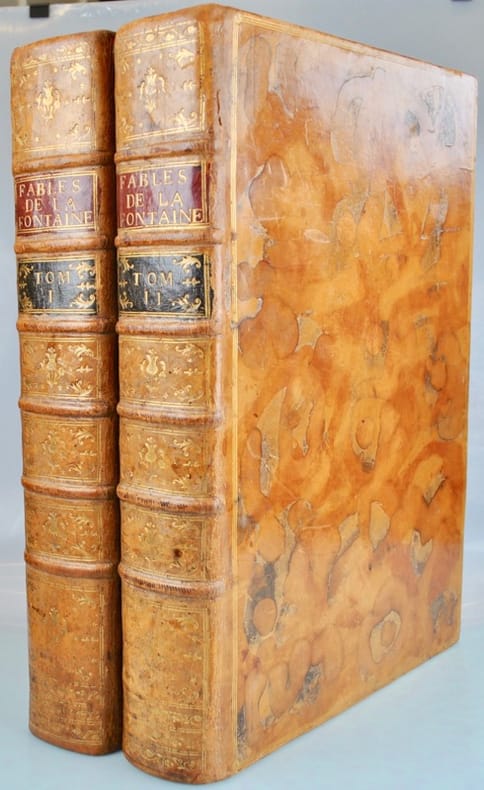
175541866Paris, Desaint et Saillant, 1755-1759. 4 tomes en 2 volumes in-folio de : tome I (1755) titre. Livre I, II et III des Fables. Frontispice, Portrait de Oudry et 69 fig. ; II (1755) : Livres IV, V et VI des Fables 68 fig. ; III (1756) : Livres VII, VIII et IX des Fables 68 fig. ; IV (1759) : Livres X, XI et XII des Fables 69 fig. plus l'explication du frontispice et de quelques vignettes et culs-de-lampe contenus dans l'ouvrage, veau porphyre glacé, triple filet doré sur les plats, dos orné à nerfs, pièces de titre en maroquin rouge et de tomaison en maroquin noir, tranches dorées (reliure de l'époque).
Mostly small 4to. Altogether 34½ pp. on 22 ff. With 8 envelopes. Together with a portrait postcard with 2 autograph but unsigned lines. Mostly dictated. To the prominent Swedish baritone and opera administrator John Forsell, mentioning her novel "Gösta Berling's Saga", which was set to music by Riccardo Zandonai (under the title "I cavalieri di Ekebù") and was staged at the Stockholm Opera in 1928 in connection with her 70th birthday. Moreover, on some economic problems with a Mr. Falke, who wrote a dramatization of "Gösta Berling", and "who has never paid me a Pfening, but has repeatedly sought to capitalize his being in contact with me" (transl. from the Swedish original). - From the estate of John Forsell (1868-1941).
4to. 2 pages. With envelope. To the French writer Pierre Jean Jouve: "I do not break without emotion this silence of 20 years that I allowed to grow in me like an evil [...]" (transl. from the French original).
8vo. 1 p. "Amare volo, potiri nolo. | Laudatâ Virtute & politiori literaturâ Fulgentissimo Domino Possessori, sic adfectum benivolum innuere & honorificum sui recordationem procurare voluit". - With a colored coat-of-arms in gouache; Logau appends to his signature his Ovidian motto: "Non est mortale quod opto" ("What I desire is not mortal"). - In 1625 Logau continued his study of law at Altdorf. - Extremely rare; the only autograph of the great Silesian poet and member of the Fruitbearing Society in the auction records of the last decades. Slight spotting; mounted at left edge; altogether well-preserved.
1 S. 4to. Ein Dialog aus dem ersten Akt von Manns einzigem Theaterstück "Fiorenza": "Fiore: Du bist kein Held; du bist nur stark. | Und du langweilst mich. | Piero: Nur stark? Nur stark? Ist denn, wer | stark ist, kein Held?! | Fiore: Nein. Sondern wer schwach ist, aber so | glühenden Geistes, | daß er sich dennoch den | Kranz gewinnt, - der ist ein Held".
2½ SS. auf 2 Bll. Gr.-4to. An den Vorstand der "League of American Wrighters", dem US-amerikanischen Schriftstellerverband, zu dessen Ehrenpräsidenten Thomas Mann im Juni des Jahres ernannt worden war. - Im November erschien im Bulletin der League der Artikel "France today" von Elliot Paul, den Thomas Mann verwundert "als Letzter und nur zufällig zu sehen" bekam. - "Aber der Aufsatz selbst stellt eine nur zu überzeugende Rechtfertigung dieser Notmaßnahmen dar, denn er beweist die völlige Abhängigkeit des internationalen Kommunismus von der russischen Macht- und Bündnispolitik, er dient nicht etwa sachlicher Information, sondern ist ein Akt stalinistischer Kriegssabotage, eine politische Kampfhandlung gegen die Demokratien zugunsten Hitlers und Stalins". - Besonders diesen Absatz hat Mann in dem Entwurf stark überarbeitet, eine erste Fassung wurde nach zahlreichen Änderungen vollkommen gestrichen und auf dem zweiten Blatt neu begonnen. Auch diese Fassung weicht von der gedruckten Fassung in einigen Passagen und Formulierungen ab. - "Zwischen dieser Gesinnung [seiner eigenen, "anti-totalitären und demokratischen Überzeugung"] und der einer Vereinigung, aus der Manifeste wie der Artikel ›France today‹ hervorgehen, besteht eine solche Übereinstimmung aber offenbar nicht, und so kann ich die mir freundlichst übertragene Ehrenstellung nicht länger als gerechtfertigt ansehen". - Da ihm "laute Demonstrationen widerstehen", bittet er, seinen Namen von dem ihm eingeräumten Ehrenplatz zu streichen [...]". Auch hier finden sich im Entwurf zahlreiche Streichungen und Änderungen. - Der Entwurf entstand wohl noch am 17. November, denn bereits am 18. November diktierte er seiner Frau Katja die endgültige Fassung, am 24. November wurde das Schreiben übersetzt und dürfte kurz danach abgeschickt worden sein. - Für Thomas Manns politische Stellung in seiner Exilzeit und seine Sicht auf das Verhältnis der westlichen Welt zum stalinistischen Russland von ganz enormer Bedeutung. Durch die zahlreichen Bearbeitungen hat der Briefentwurf Manuskriptcharakter. - Gelocht und mit Abdruck einer Büroklammer. Vom Vorbesitzer ehemals im Rahmen präsentiert, daher im Passepartoutausschnitt leicht gebräunt. - Mit Bleistiftanmerkung zum Empfänger und dem Hinweis "Geschenk von Frau Mann 1970". - Thomas Mann, Briefe 1937-1947, SS. 134/135.
Large 8vo. 203, (1) pp. Publisher's original cloth with giltstamped title to spine and upper cover. All edges red. First edition of May's only play: a richly symbolistic example of the author's mature work that focused on pacifism, the raising of humans from evil to good, and the universal "question of mankind". Set in Muslim Mesopotamia, his verse drama shows the transformation of Abu Kital, Sheikh of the An'allah, who is aided by the sheikhs of eight Arabic tribes as well as the colourfully named "Sheikh of the Caravan of Death", from a disciple of cruelty to a man of noble mind. - Inscribed by the author to a German journalist on the front flyleaf: "Herrn Redacteur Carl Ullmann mit bestem Gruß vom Verfasser", dated at his home "Radebeul-Dresden, Villa 'Shatterhand', d. 15ten Septbr. 1906". - May was a phenomenonally popular author of travel fiction, often set in the Middle East and the American West, and remains one of the best-selling German writers of all time, with some 200 million copies published. In spite of the high hopes he nourished for it, the play was poorly received by May's readers and turned out to be his greatest disappointment. - Binding slightly stained and dustsoiled. Some foxing and brownstains to interior (more pronounced on flyleaves and pp. 37-41); a very few minor edge flaws (some with early repairs). Plaul 404 (cover illustration: no. 134).
4 SS. 8vo. Überschwenglicher Jugendbrief an seinen "geliebten Herzensfreund", den späteren Schauspieler Friedrich Kayssler (1874-1945). - Der Brief endet: "[...] Nulla vestigia retrorsum! Das soll die Christian Morgenstern'sche Devise sein, u. sie soll das Kaysslersche ›Durch!‹ nicht hinter sich lassen! Dein treuer Freund u. Gefangner [...]". - Veröffentlicht in: Christian Morgenstern. Werke und Briefe. Bd. 7. Briefwechsel 1878-1903. Hrsg. von Katharina Breitner. Stuttgart 2005.
LCS-A34Précieux exemplaire d’une grande fraîcheur de ce texte très recherché. Paris, Michel Lévy frères, 1851. In-12 de (2) ff., xiii pp., 406 pp. Demi-maroquin vert à coins, dos à nerfs orné de filet à froid autour des caissons et de fers dorés, tête dorée, couvertures grises imprimées conservées. Devauchelle. 181 x 115 mm.
Oblong 8vo. 1 p. Reverse with autograph musical quotation signed by Arthur Rubinstein. The second verse of his famous poem "Un Canto para Bolivar", read by Neruda at the University of Mexico on July 24, 1941, for the 101st anniversary of the death of Simon Bolivar, and published in an edition of 500 copies (Imprenta Universitaria, 1941). Neruda noted this stanza in an autograph album in New York in 1943. "Tu pequeño cadáver de capitán valiente | ha extendido en lo inmenso su metálica forma, | de pronto salen dedos tuyos entre la nieve | y el australien pescador saca a la luz de pronto | tu sonrisa, tu voz palpitando en las redes". - Two years earlier, Rubinstein penned four bars of the Polish national anthem "Himno Polaco" in the autograph album from which this sheet originates.
110 x 150 mm. Encapsulated in a PSA/DNA authentication holder. An unusual handwritten letter from Pound, who writes on one side, "Every man has the right to have his ideas examined one at a time. The present tax system is unadulterated shit soaked in stupidity." The reverse bears a few notations in another hand, making reference to the English translator and poet Edward Powys Mathers and his pseudonym "Torquemada”. - Written on Ezra Pound's rare personal portrait stationery. A light central vertical fold to the Card, some tape remnants to the reverse. Very good.
4to 1 1/3 pp. Apparently to actor and composer Johann Nepomuk Nowakowski (1796-1865), on a planned staging of his famous play "Das Mädchen aus der Feenwelt, oder der Bauer als Millionär" in Poland. - Besides his stage career, actor and composer J. N. Nowakowski wrote musical scores for plays and made the Polish arrangement for Offenbach's "Le mariage aux lanternes". - Some tiny holes through ink corrosion.
8vo. 2 pp. on bifolium. To a journalist, whose letter, which was delivered to him at the very moment of his leaving Paris, he just rediscovered, regretting his having missed out so honourable an opportunity as to contribute to the October issue of the journal "Deutsche Arbeit", and announcing to enclose a poem that might appear in another issue: "Durch den Umstand, dass Ihr Brief mir im Augenblick meiner Abreise von Paris übergeben wurde, konnte es geschehen, dass er bei mir ganz in Vergessenheit gerieth, so sehr, das ich ihn eben erst wiederfinde. Ich muss Sie deshalb sehr um Entschuldigung bitten und Sie versichern, dass ich ganz und gar nicht mit dieser Handlungsweise identisch bin: im Gegentheil, es entspricht meinem Gefühl, jede derartige Aufforderung der Deutschen Arbeit als Ehrung und freundliche Beziehung zu empfinden, und Sie wissen, dass Sie mich jederzeit bereit fanden, mich an Ihrer Zeitschrift zu betheiligen. Diesmal ist es nun allerdings zu spät geworden, aber ich sende Ihnen gleichwohl noch ein Gedicht, das, wenn auch im Oktober-Heft nicht mehr unterzubringen, Ihnen doch vielleicht für später nicht unwillkommen ist [...]". - "Deutsche Arbeit" was edited between 1901 and 1918 by the Society for the Advancement of German Science, Art and Literature in Bohemia, later by the "Verein für das Deutschtum im Ausland". - On mourning paper.
1¾ SS. auf Doppelblatt. 8vo. An Richard Coudenhove-Kalergi: "Mit recht lebhafter Erinnerung habe ich Ihre Anzeige gelesen und beeile mich, Ihnen und Ihrer Gemahlin die aufmerksamsten Wünsche hinauszusenden. Aus der Adresse geht hervor, wie sehr Sie beide nun in Thätigkeit stehen; möchten die neuen Umstände Ihre Energie, so wie Sie es sich gewünscht haben, in Anspruch nehmen und beschäftigen […]". - Weiters mit der Zusicherung, "jene alte kleine Erzählung aus dem 'Simplicissimus'" für Coudenhove-Kalergis Vetter suchen zu wollen.
1 S. 8vo. An den namentlich nicht genannten Germanisten August Sauer in Prag zur Übersendung einer Novelle: "Obwohl Sie in Ihrer freundlichen Aufforderung zur Theilnahme an der neuen heimatlichen Publikation nur von Gedichten gesprochen haben, sende ich Ihnen eine Novelle "Reflexe", die mir besonders passend erscheint, und die ich umso lieber Ihrer Zeitschrift geben würde, als sie mir persönlich besonders lieb ist unter allen neueren Arbeiten [...]". - August Sauer lehrte seit 1892 an der Karl-Ferdinands-Universität in Prag und war u. a. Mitglied der Gesellschaft zur Förderung deutscher Wissenschaft, Kunst und Literatur in Böhmen. Zugleich fungierte er als Redakteur der von der Gesellschaft herausgegebenen Zeitschrift "Deutsche Arbeit" (1901-18). Der frischgebackene Ehemann Rilke, der im April des Jahres die Bildhauerin und Malerin Clara Westhoff geheiratet hatte, reiste im Sommer 1902 - nach bloß 16-monatigem Zusammenleben - nach Paris, um dort an seiner Monographie über Auguste Rodin zu arbeiten; Clara löste den Haushalt in Worpswede auf und folgte Rilke mal mehr und mal weniger während dessen Wanderjahren. Die 1912 von ihr eingereichte Scheidung kam auf Grund von zu hohen Kosten und bürokratischen Schwierigkeiten nicht zustande. - Mit kleinen (am rechten oberen Rand stärkeren) Randläsuren und einem eh. Antwortvermerk des Empfängers.
8vo. 3 pp. on bifolium. To a young woman, concerning the translation of Paul Valéry's dialogue "Eupalinos ou l’Architecte" (1923). The correspondent had asked Rilke on behalf of the artist Hans-Henning von Vogt (known as "Alastair") whether such a translation were forthcoming: "On me tend mon courrier à la descente du train; j'y trouve votre lettre et j'y réponds sur le champ avant même de monter chez moi à Muzot où, après une très longue absence, de nombreuses occupations m’attendent. (Je dis cela surtout pour rendre excusable ce vilain papier que le hasard me prête ...) Comment, Mademoiselle, aurais-je oublié l'aimable rencontre chez Monsieur André Germain et notre petit trajet en voiture? Mais cet agréable souvenir me devient plus présent encore et plus précieux, depuis que je le sais si gracieusement doublé du vôtre. - Quant à la question que vous me transmettez de la part de M. Alastair, j'éprouve tous les regrets possibles en vous disant que la traduction d''Eupalinos' n'est plus libre: ce serait peu de chose si je me proposais de traduire cet admirable dialogue; mais la version allemande existe, entre mes papiers, depuis l'automne 1924 et n'attend pour être publiée, que le texte de l'autre dialogue [L’Âme et la Danse, 1925], en partie encore à traduire, (et, peut-être, la parution de ce troisième que Paul Valéry nous avais laissé espérer). - Cela m'attriste, Mademoiselle, d'être chargé par les faits d'une réponse si parfaitement négative; veuillez ne pas oublier, en la faisant parvenir à Monsieur Alastair, de lui dire qu'elle vous était arrivée portée par mes regrets les plus sincères et inséparable d'eux [...]". - The translation of Valéry's dialogues was a very personal project for Rilke and certainly more important to him than he would let it appear in this characteristically polite and elegant letter. Rilke had first discovered Valéry in 1921 and immediately felt a strong connection to the poet and his work. He initiated a correspondence and translated 23 poems from the famous "Charmes" that would be published as "Gedichte" in 1925. On 5 April 1924 Valéry visited him in Muzot, an event of great importance to Rilke. The sympathy was mutual, for in a letter from 16 April 1926 Valéry expressed his satisfaction at having a German translator whom he could trust. At this point the translation of "L'Âme et la Danse" was already under way, and Rilke must have completed it very soon after the letter at hand was written. He did not live to see the German publication of Valéry's dialogues in 1927, passing away on 29 December 1926 at the Swiss sanitarium of Valmont.
8vo. 3 pp. In French, to an unnamed critic: "I owe my thanks, Sir, for the kind and generous appreciation of my works you wrote in la Phalange; you gave my talent much more praise than it deserves; but the honesty and the elevation of your heart led you to such excess of kindness to me, because you recognized someone well-intentioned in me. Pax Hominibus bonae voluntatis [Peace on earth and goodwill to all men]. That is my motto, and it is also the only Latin I know. But this being certain, from the bottom of my soul, that I have always meant well, has helped me find consolation for other people s injustices as well as for my own failings […]". Sand continues her lengthy letter asking if her correspondent might read a small book she has sent along, noting: "I am sure that you will want to encourage such a sturdy , such a wildly strong talent, and that it will strike you as it does me […]". - Repair to central horizontal fold. On stationery with her embossed initials.
8vo. 3 pp. In French, to an unidentified lady. Sand writes to her correspondent about her play, Le Mariage de Victorine, a love story which concluded with the happy marriage of a poor adopted daughter to the son of the house. Contrary to her custom, Sand went to Paris for the opening of the play. A few days after the opening, Louis Napoléon staged his coup d'état, Sand quickly returned to Nohant and the play closed. In the present letter Sand laments the situation: "Be sure that I feel sorry about the great misfortune Victorine went through more for you and Mr. Montigny than for myself. Be sure too that I want to do all I can to make up for this disaster, by writing another play in better days to the best of my ability, for which I promise right now that I won't ask him any bonus if, as it is to be feared, Victorine, after being stricken down in its prime, does not rise again from the barrier which it has fallen [...]. In 1876, the play was revived a new generation of theater-goers who had not seen the original production twenty-five years earlier was charmed and a long run was assured."
4½ SS. auf 3 Bll. (ein Doppel-, ein Einzelblatt). 8vo. Langer, inhaltsreicher Brief an Goethes "Urfreund" Karl Ludwig von Knebel (1744-1834), geschrieben eben eine Woche nach dem "Lauchstädter Verlöbnis" mit Friedrich Schiller. Im dem damals kursächsischen Luxus- und Modebad Lauchstädt bei Halle (Saale) kurten im Sommer 1789 Charlotte und Caroline von Lengefeld. Beide Schwestern hatten sich in Schiller verliebt, als er 1787 völlig mittellos nach Rudolstadt gekommen war, sich für keine der beiden entscheiden konnte und über eine Dreierbeziehung nachdachte. Nach einem kurzen Besuch Schillers in Lauchstädt erreichte Charlotte hier sein in Leipzig geschriebener "Verlobungsbrief" vom 3. August. - Im vorliegenden Schreiben schwärmt Charlotte einerseits von den Werken Denis Diderots, andererseits ist sie erzürnt über sein Frauenbild: "Da H. von Stein eine Woche früher geht als wir, so schicke ich Ihnen hier den Diderot wieder, mit dem schönsten Dank, er hat mich von neuem wieder sehr angezogen, zumahl da mir sein Geist lieber geworden ist, als da ich ihm zu erst las, in seinen oeuvres morales, sur l'amitié et les Passions, die ich vorigen Winter gelesen habe ist erstaunend viel wahres u. schönes. Nur in einem Stück bin ich unzufrieden mit ihm. Daß er keine guten Begriffe von die Frauens hat, er sagt wir wären unfähig wahre Freundschaft zu fühlen u. noch manches andere. Es kann aber sein daß er nur von denen spricht die er kennt, u. die französischen Frauen haben vielleicht diese Eigenschaften die er Ihnen zur Last legt [...]". Anschließend berichtet sie ausführlich von ihrem Aufenthalt in Lauchstädt und dem Kur-Alltag: "Ich hätte Ihnen schon früher geschrieben, das Baad erlaubt es aber nicht, u. nimmt den Kopf so ein [...]. Aus Halle haben wir einige interessante Menschen gesehen, als den Professor Meckel ein sehr geschickter Arzt, er ist recht wie er sein muß um den Leidenden Linderung zu schaffen[,] er hat so einen warmen Eifer für seine Kunst; wir gehen Donnerstag nach Halle u. ich freue mich seine anatomischen Praeparate zu sehen, die die merkwürdigsten in Deutschland sein sollen. Auch den Weltumseegler Forster, den Vater habe ich kennen lernen u. sehe ihm auch Donnerstag wieder, er hat viele Merkwürdigkeiten aus Tahiti [...]". In Vorfreude auf den mit Schiller verabredeten gemeinsamen Winter in Weimar schreibt sie: "Ich freue mich auch auf den Winter u. es ist der erste dem ich mit Vergnügen entgegen sehe, weil wir ihn in so guter Gesellschaft verleben werden [...] Empfehlen Sie uns den Geh[eimrat] Goethe wenn Sie ihm sehen". - Einige alte Sammlernotate am Briefkopf; tadellos erhalten. Normalisiert gedruckt in: Briefe von Schiller's Gattin an einen vertrauten Freund, hg. von H. Düntzer (Leipzig 1856), S. 54 ff., Nr. 8.
YTB-67Paris, Bossange, Delaunay, Mongie, 1823.
8vo. 4 pp. on bifolium. With autograph envelope. Interesting and beautiful letter to Stéphane Mallarmé concerning a dinner in Mallarmé's honour that was scheduled for the following day. Valéry had organized the dinner in celebration of the publication of Mallarmé's essay-collection "Divagations" together with the so-called Mardistes, the artistic circle surrounding Mallarmé that would meet every Tuesday in the house of the poet. Despite his involvement in the organization, Valéry wrote to inform Mallarmé that the dinner would not be as intimate as planned, blaming the co-organizers: "j'ai appris hier avec un double regret que cette fête intime serait assez différente de la projetée ; et que, dans la réalité, il serait tenu peu de compte de ce qui avait été convenu entre l'initiative et moi, d’une part ; entre vous et moi, de l'autre". Therefore, he would even prefer not to attend this "random meeting", fearing that his feelings for Mallarmé might be offended by others: "Je vous avoue, mon cher maître, que je pense ne pas assister à un rendez-vous que je me trouve avoir indiqué trop vaguement. Du reste, mes sentiments pour vous, pourraient eux-mêmes se trouver froissés à droite ou à gauche par je ne sais qui". - Valéry had imagined a "dialogue between a certain group" and Mallarmé that had a "long association through reading and the Tuesdays" and could do without the "eternal restarts of the negotiations". Thus, he draws a "bitter philosophical conclusion, as is customary", wondering whether this "incoherence between advice and execution" shows how little "the ideas of unity and continuous efforts" that produce "the rare new forms of thinking and of writing" have penetrated society, "even in an elite", and alludes to Edgar Allen Poe's "Murders in the Rue Morgue", although misrepresenting Poe's allegorization of the Roman goddess Laverna. - Valéry's motives for backing out were more personal than he would admit in the letter: the Mardist André-Ferdinand Hérold had invited Léon Dierx and Catulle Mendès against Valery's wishes. Mendès, on the other hand, was offended because the invitation reached him only on the day before the dinner. Asking Mallarmé directly if he wished him to come, the response must not have been very encouraging, as Mendès ultimately declined. Valéry was not aware of Mendès' decision when he wrote the letter at hand. Mallarmé responded encourageingly, asking Valéry to come for his sake and underlining that he did indeed remember what has been agreed upon. The dinner took place at the famous Cabaret du Père Lathuille in Batignolles. While Mallarmé was very pleased with the event, Claude Debussy was afraid that people might have noticed how bored he was, judging from the expression of his face. - Traces of folds. Well preserved. M. Jarrety, Valéry-Mallarmé : des instananés sans légende, in: Romantisme 122 (2003), pp. 119-128.
12mo. ¾ p. To a journalist, thanking him for his favourable reviews in the Gazette de France, especially for an article on his famous novel "Around the World in Eighty Days": "Je n'ai jamais négligé de lire vos articles de critique dans la Gazette de France, et, croyez-le bien, j'en ai apprécié toute la valeur. Je viens donc vous remercier pour celui relatif au Tour du Monde, que vous avez la bonté de m'envoyer, et je vous en remercie bien cordialement. Veuillez croire aux bons sentiments de votre dévoué compatriote". - Some browning. With traces of former mounting.
8vo. 1 page. To General Henri-Joseph Brugère, in French: "In memory of the few reports we had when you commanded the 2nd Corps in Amiens" he intervenes on behalf of his son-in-law M. de Francy, 1st class subintendent in residence in Besançon: "The climate of this city is detestable for his wife and daughter who cannot live there in winter". He would like a change of residence, and currently a place is vacant in Orléans: "May I ask you for a recommendation from your friends at the War Ministry" (transl.). - Small contemporary notes in coloured pencil; overall in fine condition.