Henderikse, JanAntiquariat.de

48 779 résultats
201462554AB's-Hertogenbosch., Luiscius Books., 2014. 62 x 45 x 10,5 cm. OLeinen Kassette / OLeinen-Mappe., 62554AB Objektkasten im Leinen teils etwas angestaubt, leinenmappe minimal aufgebogen. Sehr gutes, funktionierendes Exemplar.
303-Eo.J. Aquarell und Deckfarben, auf Velin, verso signiert und datiert ?T. Faber del 1823?. 27,7:22,4 cm. Verso von älterer Hand mit Bleistift beschriftet: ?Der Fels ist jetzt von der Straße ...abgesprengt u i die Straße unmittelbar an dieselbe verlegt, ...?.
132-Eo.J. Aquarell über Bleistift, mit Bleistiftlinie umrandet, auf Velin. 25:37,5 cm. Kat. 84, Nr. 71. Provenienz: Nachlaß Ludwig Thiersch, München; Sammlung Prof. Richard Jung, Freiburg, (nicht bei Lugt). Verso bezeichnet: ?im L. Thiersch Nachlass Leop. Rottmann um 1860?. Dieser Vermerk bezieht sich auf den in München tätigen Landschaftsmaler L. Thiersch (1825 - 1909). Beide Künstler, Rottmann und Thiersch, waren in derselben Stadt tätig und werden sich wohl gekannt und Arbeiten ausgetauscht haben. Durch diese Provenienz darf die Zuordnung an Leopold Rottmann als sicher gelten. Farbfrisches Aquarell, das in der Landschaftsauffassung dem älteren Bruder, Carl Rottmann (1797 - 1850), verpflichtet ist.
264-Eo.J. Aquarell über Bleistift, auf Velin, rechts unten bezeichnet und datiert ?Nauplia im Juni 1834.?. 17,7:29 cm.
304-Wo.J. Lithographie, 1911, auf cremefarbenem China, mit Bleistift signiert ?I. Teichmann?, im breiten Rand unten bezeichnet, betitelt und datiert ?6. Lithographie = die Hingerissenen 3. 5. 11?. Darstellungsgröße 25,5:46,2 cm, Blattgröße 42,5:59,8 cm. Deutlich wird hier Teichmanns Nähe zur Mitte des 19. Jahrhunderts einsetzenden Lebensre-form-Bewegung und der in diesem Zusammenhang propagierten Freikörperkultur.
396-Eo.J. Feder in Grau, grau laviert und in zarten Farben aquarelliert, mit schwarzer Tuschlinie umrandet, auf cremefarbenem Velin. 21,8:27,4 cm.
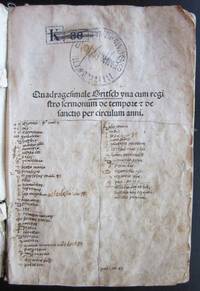
1495SAV133Venice: Lazarus de Suardis 1495. Paperback. Very Good . Venice: Lazarus de Suardis 21 March 1495. 8vo 173 x 116 mm. 284 leaves. Collation: 1-84 a-H in 34 gatherings of 4. Woodblock monogram printers device on colophon leaf. 48 lines double column Gothic type with printed guide letters. Stamp of the St. Charles Borromeo Seminary Library deaccessioned and two library shelfmarks pasted in Q83 and K30. Contemporary limp vellum; lightly soiled with some dampstains backstrip partly perished with partial ms. title and light edgewear; lower outer corner of l5 and D2 torn affecting a few words but in remarkable shape given its extensive use; cloth folding case. Title extensively inscribed in Latin with two columns of a subject index for sermons. The annotator was interested in indexing themes like heaven paradisus and hell infernus or Virgin Mary and Evangelists and easily being able to locate sermons for certain medieval virtues and vices or sins like luxury patience love anger and justice. Early biographical inscriptions on rear blank date to probably to the mid-sixteenth century and venetis gives this book a probable Venice home at one point. There are further scattered annotations notes and references to the index which reflect on sermons of interest. This book likely once belonged to preaching Franciscan monk from northern Italy. This monastic association is further evident with an ownership inscription in the lower margin of a1 Iste Liber est fratus dominici. Preaching was most closely associated with the Franciscans who also traveled extensively to reach audiences. The compact octavo format and lightweight wrappers of this volume would have made transportability much easier. Incunable edition of Johannes Gritschs register of medieval sermons called the Quadragesimale with an interesting period index of subjects probably added by a Franciscan scribe. Johannes Gritsch of Basel himself a Franciscan monk delivered his sermons in German and translated them in simple Latin ready for translation and adaptation to the vernacular. He used scriptural passages supporting texts from classics and fables and exemplary stories to prove moral grounds. Two main themes have been recognized to dominate the medieval sermon: the awareness of death and the need for contrition. Preachers would have relentlessly implored their audience to come to repentance. Brother Dominic the early modern friar who heavily used this book was no exception. He leaves evidence of his moral preaching interests throughout the book. The preliminary subject index is an invaluable glimpse into a composing preachers mindset at the dawn of the sixteenth century. This is the twenty-first edition of Gritschs Quadrigesimale which included fifty numbered sermons and additional sermons for specific church feasts; the first appeared in 1468 and a succession of printings appeared well into the sixteenth century. In fact a Lyons edition of the "Quadragesimale" was produced just one month later after this one in 1495 by Joannes Treschel. Printed sermon compilations were especially popular in monastic communities where volumes of model sermons would have enjoyed wide circulation. ISTC ig00506000. <br/><br/>Incunable edition of Johannes Gritschs register of medieval sermons called the Quadragesimale with an interesting period index of subjects probably added by a Franciscan scribe. Johannes Gritsch of Basel himself a Franciscan monk delivered his sermons in German and translated them in simple Latin ready for translation and adaptation to the vernacular. He used scriptural passages supporting texts from classics and fables and exemplary stories to prove moral grounds. Two main themes have been recognized to dominate the medieval sermon: the awareness of death and the need for contrition. Preachers would have relentlessly implored their audience to come to repentance. Brother Dominic the early modern friar who heavily used this book was no exception. He leaves evidence of his moral preaching interests throughout the book. The preliminary subject index is an invaluable glimpse into a composing preachers mindset at the dawn of the sixteenth century. This is the twenty-first edition of Gritschs Quadrigesimale which included fifty numbered sermons and additional sermons for specific church feasts; the first appeared in 1468 and a succession of printings appeared well into the sixteenth century. In fact a Lyons edition of the "Quadragesimale" was produced just one month later after this one in 1495 by Joannes Treschel. Printed sermon compilations were especially popular in monastic communities where volumes of model sermons would have enjoyed wide circulation. ISTC ig00506000. Lazarus de Suardis paperback
EN-043o.J. Farbholzschnitt, 1920, auf sehr dünnem Japan-Bütten, mit Bleistift signiert und vom Künstler selbst als ?Hand. Selbstdruck? bezeichnet. Darstellungsgröße 17,7:13,2 cm, Blattgröße 26,5:20,2 cm. Blatt 13 der 21-Blatt-Folge: Van Zantens glückliche Zeit. Hrsg. Dresden, Galerie Ernst Arnold, 1919/1920. Literatur: Boettger 49; Ausst. Katalog: Mit Leidenschaft ins Holz gerissen. Der Dresdner Expressionist Otto Lange (1879-1944). Reutlingen/Jena, 2011, Farbabb. S. 64. Hier heißt es dazu: ?Als einzige inhaltlich zusammenhängende Folge nimmt die Holzschnittserie Van Zantens glückliche Zeit eine singuläre Stellung im gesamten Oeuvre Otto Langes ein. Beeindruckend ist Langes äußerst phantasievolle und doch zugleich textgetreue Wiedergabe der exotischen Erzählung Bruuns. Sowohl durch die einfallsreichen und zugleich präzisen Darstellungen als auch durch seine individuelle Technik hebt sich Otto Langes Folge von den zumeist verallgemeinernden und künstlerisch eher konservativen Arbeiten Georg Schrimpfs (1889-1938) und Artur Bärs (1884-1972) ab. Fraglos verkörpert seine Schöpfung die kongeniale Umsetzung der literarischen Vorlagen des Bestsellerautors Laurids Bruun (1864-1935). Wie ein zeitgenössisches Resümee in der Kunstzeitschrift Der Cicerone aus dem Jahre 1920 bezeugt, urteilen Langes Zeitgenossen ebenso: ?Otto Langes Holzschnitte sind in strengem Rhythmus gebunden; die handgedruckten farbigen Blätter strömen eine starke Kraft aus (...). Hier spürt man wirklich etwas von dem Nachempfinden eines empfindsamen Meisters und starken Könners seiner Kunst.?? (op. cit. S. 55/56).
064-Ho.J. Bleistift auf grautonigem Papier, eine Zeichnung rechts unten monogrammiert "ML" (ligiert). Je 9,8 : 16,7 cm. Auf den Rückseiten der Zeichnungen befinden sich jeweils weitere, jedoch sehr flüchtige Skizzen. Zu drei Seiten hin - rechts, links und unten - ist das Papier vergilbt. Mit dem oberen Rand waren die Blätter in das Skizzenbuch geheftet.
EN-045o.J. Kaltnadelradierung, um 1920, auf Kupferdruckpapier, mit Bleistift signiert, bezeichnet und betitelt. Darstellungsgröße 32,3:24,2 cm, Blattgröße 45,1:32,2 cm.In den breiten Rändern leicht knickfaltig, verso an den Rändern etwas berieben. Probedruck, prachtvoller Abzug mit leichtem Plattenton!
19711015FBBerlin., Edition Rene Block., 1971. 1 Blatt., 1015F Tadelloses Exemplar.
198867515ABDüsseldorf., Takako Saito., 1988. 67515AB 1 Schachstäbchen mit ausgebesserter Bruchstelle. Sonst sehr gutes Exemplar.
EN-064o.J. Holzschnitt, 1919, auf braunem dünnem Japan, mit Bleistift signiert. Darstellungsgröße 13 cm Durchmesser, Blattgröße 16,7:15,5 cm. - Mit leicht unregelmäßig geschnittenen Rändern links und unten.- Literatur: Söhn HDO 40909. Erschienen als Titelseite in: Die Aktion. Hrsg. von Franz Pfemfert. Heft Nr. 18 (10. Mai 1919).
17969581Britain: Unpublished 1796. Fine late 18th century English manuscript atlas beautifully drawn almost certainly by a child and offering 68 full-page maps 32 in outline and a further 36 with keyed explanatory apparatus. The manuscript's creator probably in or around London details a colonial-era map of North America California as peninsular entitled 'Ten Northern American Colonies' going no further south than Virginia as well as providing maps of the 'East Indies and China' and a further 'Epitome of the new World' - north and south America as well as maps of England and Europe. We have not identified which printed map of the American colonies 'M.L.S.' was working from. This manuscript atlas is a particularly good example of its kind. The only English county to have its own full map is Middlesex - hence the suggestion of a London origin to the manuscript. The presence of maps of legal circuits in England may suggest a lawyerly family background. Map drawing for children in the 18th century was part of a polite education - the kind undertaken by the Bertram children in Jane Austen's Mansfield Park - and in Britain functioned as a way of understanding imperial expansion and contraction if it were to be acknowledged in the years after 1776. These maps could demonstrate and develop as here the child's skilled draughtsmanship in the copying process which would have drawn upon printed examples available to the child or their tutor. And when completed the atlas could be retained to demonstrate the child's educational achievement - certainly the family involved in the production of this atlas approved of the outcome as they commissioned its attractive tree-calf binding after the manuscript was completed. DESCRIPTION: Attractively bound quarto size manuscript 19x24cm in tree calf spine relaid gilt sun emblems to the backstrip and 'Maps' on a black label. Marbled endpapers; paper with 'GR' watermark and horizontal chainlnes. Written on the the second flyleaf the initials 'MLS'. Manuscript title: 'A System of Geography Consisting of Thirty-Five Maps 1796' no printed analogue to this located. A 'Contents' page follows the title offering a diagram of 'Circles' followed by the 35 maps that cover Europe the Americas North America and South America Ireland Scotland 6 maps of the legal circuits in England the 'War on the Rhine' concluding with 'East Indies and China' West Indies and 'Epitome of the Old World' 'of the New World' 'of England'. Maps drawn in ink on the rectos and explanatory details opposite. Maps 1-32 are each presented twice. The first version presents the topographical outline only; the second also has the apparatus and key. The three epitome maps 33-35 are presented once only with full apparatus. An additional map on watermarked paper from 1800 and also initialled 'M.L.S.' is also laid in. The manuscript runs to pp 144 plus a single leaf laid in & terminal blanks. Please contact Christian White Rare Books Ltd for more information or images of this item 1796 Unpublished unknown
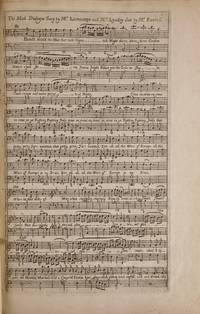
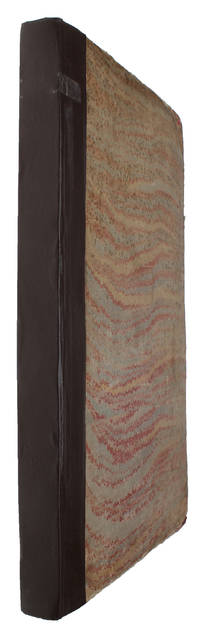
41185Folio. Contemporary dark brown leather-backed blue/gray boards. Titled "A collection of Songs by several eminent Masters" in contemporary manuscript on recto of first page of music. Engraved throughout.<br /> <br /> Provenance<br /> With "Lucy Gregory July the 6th 1756" and "Prince Gregory" in contemporary manuscript to front pastedown. Manuscript titling and annotation "Ex dono Revd. Dr. Dawson For use of Musical Society Windsor Castle to be returned to Dr. Dawson When ye club ceases viz when it is reduced to three persons" to blank recto of first song along with title and index to blank verso of final song.<br /> <br /> Contains 33 songs including works by Barrett Blow Eccles Galliard Handel 8 Leveridge Orlandini Pepusch Daniel Purcell Henry Purcell 2 Weldon and others. Scored mainly for voice most for one voice and few for two and figured basso continuo with single-line flute arrangements for some songs.<br /> <br /> 1. Handel. "A Favorite song in the Opera of Theseus" "See see your faithfull lover pineing". London ca. 1720. i blank 2 i blank pp. BUC p. 1001.<br /> <br /> 2. Purcell H. "Sing all ye muses. A song set by Mr. Henr. Purcell The Words by Mr Durfey." London ca. 1700. From Part I of The Comical History of Don Quixote. 4 pp. BUC p. 861 another edition. Scored for two voices and figured basso continuo.<br /> <br /> 3. Handel. "Mi brilla in English and Italian" "Be Kind and Love" / "Mi brilla nel seno". London ca. 1720. i blank 2 i blank pp. HWV 10 Silla.BUC p. 93. <br /> <br /> 4. Purcell H. "The Mad Dialogue Sung by Mr. Leveridge and Mrs. Lynsey" "Behold the man with gigantick might". From The Richmond Heiress. London ca. 1700. 3 i blank pp. BUC p. 862.<br /> <br /> 5. Handel. "Vieni torna in English & Italian" "Turn o turn thee dearest Creature / Vieni torna Idolo mio". London ca. 1715. i blank 2 i blank pp. HWV 9 Teseo. BUC p. 1041.<br /> <br /> 6. Handel. "A Favourite Song by an Eminent Master Within the Compass of the Flute" Recitativo: "Lo here my Love" / Aria: "Love in her eyes sits playing". London ca. 1725. i blank 2 i blank pp. BUC p. 624.<br /> <br /> 7. Handel. "A Song with a Symphony for an Octave Flute & Violins" Recitativo: "Ye verdant Plains" / Aria: "Hush ye pretty warbling Quire". London ca. 1722. i 3 paginated 4-6 i blank pp. HWV 49 Acis and Galatea. BUC p. 432 date incorrect; JISC two copies at Oxford and the British Library. In score for piccolo violin voice and unfigured basso continuo. <br /> <br /> 8. Handel. "A song by an Eminent Master" "Would you gain the tender Creature". London ca. 1750. HWV 49 Acis and Galatea. BUC pp. 432 1091.<br /> <br /> 9. Eccles. "Air in the Opera Semele. The words by Mr Congreve" "Come Zephrys". London ca. 1730. i blank 2 i blank pp. BUC p. 309. <br /> <br /> 10. Orlandini. "A favourite Song in the Opera of Arsaces Sung by Sigr. Senesino" "Se sol la mia morte" / "Cœlestial Corinna". London ca. 1721. i blank 2 i blank pp. BUC p. 56. "Lucy Gregory" in contemporary manuscript to upper outer corner of final blank page. <br /> <br /> 11. Anon. "The Ladys Repulse or Favourite Minuet in Hercules" a pasticcio. London ca. 1715. 2 pp. BUC p. 478. <br /> <br /> 12. Barrett. "A Song sett by Mr. Iohn Barrett Sung by Mrs. Lindsey" "Mistake not Nymph". London ca. 1705. 1f. recto music verso blank pp. BUC p. 86.<br /> <br /> 13. Barrett. "Liberia A Song Set to Musick" "Liberia's all my Thought". London ca. 1715. 1f. recto music verso blank pp. BUC p. 86.<br /> <br /> 14. Purcell D. "Lovely Charmer. A song in the Island Princess." London ca. 1700. 1f. recto music verso blank pp. BUC p. 856.<br /> <br /> 15. Leveridge. "A Favorite Song in the new Opera The words by Mr. Leveridge." London ca. 1720. 1f. recto music verso blank pp. BUC p. 339.<br /> <br /> 16. Anon. "Tom a Bedlam" "Forth from my dark and Dismall cell". London ca. 1720. 1f. recto music verso blank pp. BUC p. 345. <br /> <br /> 17. Leveridge. "A Scotch Song Sung by Mr. Leveridge the words by Mr Durfey" "Farewell my Bonny". London ca. 1710. 1f. recto music paginated "10" verso blank pp. BUC p. 325.<br /> <br /> 18. Blow. "Go Perjur'd Man. A Song for two Voices." London ca. 1710. 1f. recto music verso blank pp. BUC p. 115.<br /> <br /> 19. Anon. "A song by a Gentleman" "How charming". London ca. 1730. 1f. recto music verso blank pp. BUC p. 370.<br /> <br /> 20. Weldon. "Orpheus Song to the Waves Sett by Mr. Iohn Weldon Sung by Mrs. Linsey." "Stop O ye Waves". London ca. 1710. 1f. recto song verso version for flute pp. BUC p. 1065.<br /> <br /> 21. Anon. "A Song by a Great Master" "Beauteous Idol charming Creature". London ca. 1720. 1f. recto music verso blank pp. BUC p. 93. <br /> <br /> 22. Turner. "A Song On Mira's Singing and Beauty" "Singing charms The Bless'd above". London ca. 1710. 1f. recto music verso blank pp. BUC p. 1024.<br /> <br /> 23. M. F. "A song in the Italian style by F M" "Ah Crudel prenesto". London ca. 1720. 1f. recto music verso blank pp. BUC p. 638. A humorous song satirizing Italian opera with text in nonsense-Italian.<br /> <br /> 24. Galliard. "Sung by Mr. Pack in The Opera of Circe" "Fairest if thou can'st be King". London ca. 1720. 1f. recto music verso blank pp. BUC p. 358.<br /> <br /> 25. Vanbrughe. "Apollo to Daphne by Mr. Vanbrughe" "My Dearest Daphne". London ca. 1735. Not in BUC but may be from Vanbrughe's collection Mirth & Harmony; see BUC p. 1034.<br /> <br /> 26. Anon. "The Address with The Lady's Answer" "Ah lovely Nymph". London ca. 1725. 1f. recto music paginated "7" verso blank pp. BUC p. 11. <br /> <br /> 27. Handel. "A Song the words by Mr. Kirkland set to a Trumpet Minuet of Mr. Hendell's" "Phillis the Lovely". London ca. 1725. 1f. recto music verso blank pp. HWV 349 Watermusic. BUC p. 781. <br /> <br /> 28. Young and Leveridge. "The Reproach" "Send back my long stray'd Eyes" and "Mr. Leveridge's Tune." London ca. 1720. 1f. recto music verso blank. BUC p. 1098. The instrumental tune appears to be unrelated to the song; here may however be some association as the song incorporates imagery related to the eyes and the tune's name not given here is "Black-eyed Susan." <br /> <br /> 29. Anon. "A Song after the Italian Manner by an Eminent Master" "Lovely cruel charming fair". London ca. 1715. 1f. recto music verso blank pp. BUC p. 632 another edition. <br /> <br /> 30. Handel. "Di godere in English & Italian by Mr. Hendell" "Di godere" / "Oh my dearest". London ca. 1720. 1f. recto music verso blank. HWV 228. Not in BUC; possibly related to an edition in Foundling Museum. JISC "This song appeared in two editions in 1719: the first was in The Yearly Subscriptions a volume of twenty songs advertised on 5 December the second in the Monthly Mask of Vocal Music issued on 24 December".<br /> <br /> 31. Pepusch. "A Song in the Mask of Martillo" "Tender Hearts to ev'ry Passion". London ca. 1716. 1f. recto music verso blank pp. BUC p. 722. <br /> <br /> 32. Carey. "The Midsummer Wish Taken from the Journal" "Waft me some soft and cooling Breeze". London ca. 1725. 1f. recto music verso blank pp. BUC p. 165. <br /> <br /> 33. Leveridge. "A Song in the Beau Demolish'd Sung by Mr. Leveridge" "Whilst I'm carrouzing". London ca. 1730. 1f. recto music verso index in contemporary manuscript pp. BUC p. 615. <br /> <br /> Binding worn rubbed and bumped; spine partially lacking; lower board nearly detached. Minor dampstaining and worming; occasional small stains. John Barrett ca. 1674-ca. 1745 was an English composer and organist pupil of John Blow. "Like many of his contemporaries such as Jeremiah Clarke John Eccles and Daniel Purcell Barrett composed mainly for the theatre and his many songs mostly of the double-barrelled art song variety are both tuneful and attractive." Christopher Powell revised by H. Diack Johnstone in Grove Music Online<br /> <br /> John Blow 1649-1708 was an English composer organist and teacher. "By his mid-20s he had become the foremost musician in England and in later years he was the elder statesman of the Restoration school whose chief luminary was Henry Purcell." Bruce Wood in Grove Music Online <br /> <br /> John Eccles ca. 1668-1735 was an English composer. "Eccles's greatest talent is revealed in his many songs. Remarkable for their beautifully contoured melodies and impeccable prosody they quickly capture the mood and subtleties of the poetry and are eminently singable. His large works are notable for their dramatic pacing and their carefully planned tonal architecture. In the latter respect he surpassed even Purcell and was far in advance of his day. Eccles brought the Restoration tradition to its close. After Purcell's death in 1695 he was undoubtedly the greatest of the Restoration theatre composers." Stoddard Lincoln in Grove Music Online<br /> <br /> John Ernest Galliard ca. 1687-1749 German composer and oboist "certainly played a significant role in London's musical life in the first half of the 18th century." Roger Fiske revised by Richard G. King in Grove Music Online<br /> <br /> George Frideric Handel 1685-1759 English composer of German birth was "one of the greatest composers of his age." Anthony Hicks in Grove Music Online<br /> <br /> Richard Leveridge 1670-1758 English bass and composer was "a leading singer on the London stage and a popular composer of songs." Olive Baldwin revised by Thelma Wilson in Grove Music Online. <br /> <br /> Giuseppe Maria Orlandini 1676-1760 was an Italian composer. "The large number and wide spread of performances of his operas confirm the opinions of Burney La Borde Martini and Quadrio that Orlandini was highly celebrated as a composer of dramatic music. He was best known for his comic intermezzos in which genre his importance almost certainly outweighs that of Pergolesi. Indeed Orlandini's Bacocco e Serpilla under various titles and with added music by various composers appears to have been the most frequently performed piece of musical drama in the entire 18th century." John Walter Hill and Francesco Giuntini in Grove Music Online<br /> <br /> Johann Christoph Pepusch 1667-1752 a German-born composer and theorist active in England is best known for his arrangement of music for The Beggar's Opera to John Gay's libretto; he composed works in all genres including vocal music.<br /> <br /> Daniel Purcell ca. 1664-1717 brother or cousin of Henry Purcell was an English composer and organist. "Although he was a victim of invidious comparison with Henry Daniel was a talented composer whose style while perhaps too ornate is never dull or incompetent." Mark Humphreys revised by Robert Thompson in Grove Music Online<br /> <br /> Henry Purcell 1659-1695 composer and organist "was one of the most important 17th century composers and one of the greatest of all English composers." Peter Holman and Robert Thompson in Grove Music Online<br /> <br /> John Weldon 1676-1736 an English organist and composer "of considerable talent" was a pupil of Henry Purcell. Margaret Laurie revised by Stephen Bullamore in Grove Music Online. unknown
013-Io.J. Aquarell, über Bleistift, auf Velin, links unten signiert und bezeichnet ?Blaschnik fe Roma.?. 29,5:22 cm. Vermutlich Vorzeichnung für eine Lithogaphie. Bei unserer Darstellung der Innenseite des berühmten Vesta-Tempels von Tivoli handelt es sich sicher um eine sehr seltene Wiedergabe des Motivs ? für gewöhnlich wurde die Außenseite des Tempels, entweder von der gegenüberliegenden Bergseite oder von unten vom Tal her, zusammen mit der Schlucht und den Wasserfällen, von den Malern der Zeit wiedergegeben. Blaschnik jedoch zeigt den Tempel vom Garten des Gasthauses aus, das sich auch heute noch dort befindet.
1830151-W1830. Bleistift, auf chamoisfarbenem Velin, rechts unten bezeichnet und datiert ?Sorrento am 25. Juli 1830? und von einer anderen Hand ?im Hause der Gr(äfin) v(on) E(gloffstein). 18,3:24,1 cm. - Verso: Porträt der Karoline Lauska. Bleistift, rechts unten bezeichnet ?Frau Lauska?. Minimal fleckig. Im Juli 1830 reiste Julie von Egloffstein in Begleitung des Malers Fr. Preller d.Ä. (1804-1878) von Rom über Neapel nach Sorrent, wo sie einige Gemälde und Zeichnungen schuf. Unsere Ansicht ist von dem Haus aus gemalt, in dem die Künstlerin sich während ihres Sorrenter Aufenhaltes aufhielt. Das rückwärtige Bild zeigt ein Porträt der 1794 in Berlin geborenen Malerin Karoline Ermeler, die den Musiker F.I. Lauska (/1764-1825) geheiratet hatte. Sie war eine Schülerin von J.C.H. Kretschmar (1769-1847) und von W. von Schadow (1788-1862). Lauska bereiste Italien drei Mal, sicher 1829-1830. Möglich ist, daß sich Lauska ebenfalls 1830 in Sorrent aufhielt, wo dann Egloffstein das Porträt gemalt haben könnte. Ungewöhnlich ist bei diesem Porträt nicht nur die Wahl der Porträtansicht, sondern auch, daß es sich um eines jener seltenen Porträts einer Künstlerin handelt, das von einer Künstlerin gemalt wurde.
FH-351o.J. Farbholzschnitt von mehreren Stöcken, 1904, auf Bütten, mit Bleistift signiert und datiert. Darstellungsgröße 9,7:14,5 cm, Blattgröße 13,1:18 cm. Werknummer 1. - Von größter Seltenheit! Um wen es sich bei der Dargestellten handelt, konnte nicht geklärt werden. Die frühen Farbholzschnitte der Künstlerin sind gekennzeichnet durch eine hohe Experimentierfreudigkeit mit Farben und Druckmedium.
FH-104o.J. Holzschnitt in Rotbraun, auf Bütten, mit Bleistift monogrammiert ?L.v.H? und als ?Probedruck? bezeichnet. Darstellungsgröße 27,8:37,8 cm, Blattgröße Sehr selten!- Provenienz: Sammlung P. Hüssy, Zürich.
128-Ho.J. Feder in Schwarz und Aquarell, auf Velin, rechts unten signiert ?MKaus?. 29,6:41,9 cm.
191967463ABParis., Editions de la Rirene., 1919. 31,7 x 25,1 cm. 60 unpaginierte S. Illustrierter OKarton., 67463AB Vorsätze minimal stockig. Kleiner roter Exlibrisstempel auf dem letzten Blatt, sonst ungewöhnlich schönes und frisches Exemplar.
07-Go.J. Öl auf Holz, rechts unten signiert und datiert ?F. Reynaud 51?. 22,5:17 cm. Provenienz: Frankfurter Privatbesitz; Auktion 84, Arno Winterberg, Heidelberg, Nr. 339 mit Farbabb. Verglleichsliteratur: E. Bénézit, Dictionnaire critique et documentaire des Peintres, Sculpteurs, Dessinateur et Garveurs. Nouv. Édition. Librairie Gründ 1966, Bd. VII, S. 200 mit Abbildung der Signatur.
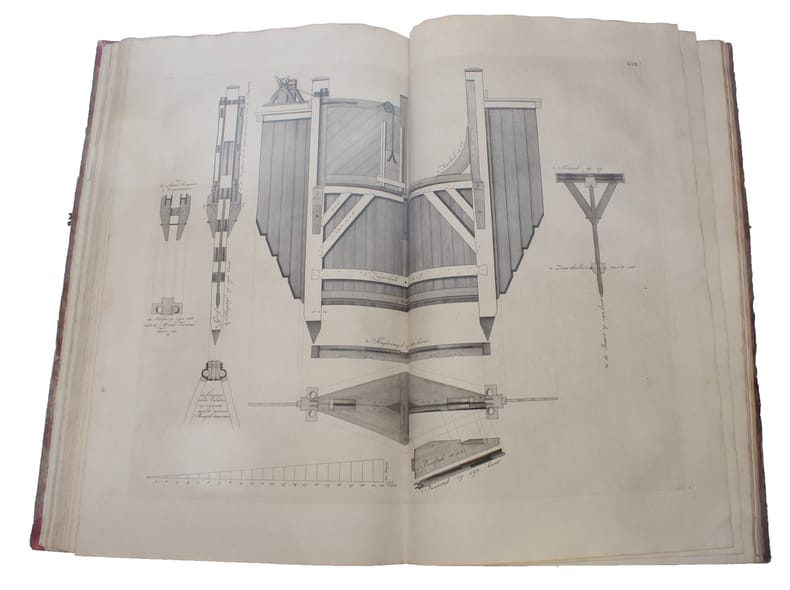
175751848Amsterdam Petrus Schenk 1757-74. Large folio. 55 x 345 cm. A large uncut copy in contemp. marbled boards spine gone and later backed with buckram original corners in leather a bit bumped. Stamps on foot of first title-page. Halftitel title-pages in red/black with engraved vignettes. 22 engraved leafs with dedications 14;28 pp. and 25 24 large double-page or triple-page folded engraved plates 6 additional plates only sometimes present. With a total of 55 plates. On thick heavy paper wide-margined and internally fine and clean. <br/><br/><em>Second edition. "Tileman van der Horst and Jan Schenk produced the Theatrum Machinarium Univesale one of the most celebrated works on the construction of all those elements so necessary to keeping life dry in Amsterdam the place of the book’s publication. It was perhaps the most important work then produced on dikes sluices dams weirs canals and swing-bridges the very elements of existence in Holland. Jan Schenck was the engraver of this work which may also be the most accurate and the most sumptuously illustrated book of its type in Holland in the 18th century - the technical aspects of the rendering was just superb." - Brunet V1082 - Graesse VII 258. </em> hardcover
175751848Amsterdam, Petrus Schenk, 1757-74. Large folio. (55 x 34,5 cm.). A large uncut copy in contemp. marbled boards, spine gone and later backed with buckram, original corners in leather a bit bumped. Stamps on foot of first title-page. Halftitel, title-pages in red/black with engraved vignettes. (2),2 engraved leafs with dedications, 14"(2),8 pp. and 25 + 24 large double-page or triple-page folded engraved plates + 6 additional plates (only sometimes present). With a total of 55 plates. On thick, heavy paper, wide-margined and internally fine and clean.
EN-069o.J. Lithographie, 1920, auf chamoisfarbenem Bütten mit Wasserzeichen: Roemerturm, mit Bleistift signiert und als ?Probedruck? bezeichnet. Darstellungsgröße 18,6:16,2 cm, Blattgröße 33:24,3 cm. - Im oberen Rand etwas wellig vom Druck. Provenienz: Nachlass Günther Franke, München: verso mit Zollstempels. Literatur: Hofmaier 170 A (von C, dieses Exemplar!); Glaser 147; Gallwitz 141. Blatt 6 der 6-Blatt-Folge: Stadtnacht.