15th century Netherlandish ScribeBiblio.com
48 779 résultats
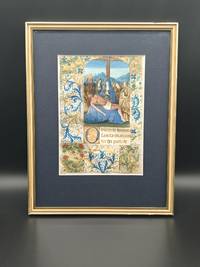
1359Very Good. Leaf from Book of Hours near Ghent-Bruges Belgium late 15th century. 180 x 130 mm Single leaf on parchment. Three lines of text of the Obsecro te Marian prayer in Latin executed in Gothic textualis. Single three-line initial in blue on red-gold field with shell gold ornamentation overlaid. Border separated into six sections: top section in strewn border style with blue flowers and pink roses on gold background; middle two sections with blue and gold acanthus leaves and blue flowers; bottom left section with red roses or strawberry flowers on gold background; bottom centre section with blue and gold acanthus leaves; bottom right section with blue and white iris. Blue flowers indicating production location close to Brugges. Central scene shows the Pieta with Mary clothed in royal blue and highlighted in shell gold holding Christ after the crucifixion surrounded by four other women with nimbs one of whom holds a book and one man in a 16th century hat. Artist has used forgrounding effect with city on a hill in the background. Leaf is framed in late 20th century frame misattributed on back as "Book of Hours English -1390". Mounting unknown but unlikely to be fully mounted. Verso not visible. hardcover
192121397El Paso Texas: Not Published 1921. The collection includes over 150 dated and signed letters written to and a few items from Dr. Lucinda DeLeftwich Templin 1888-1969 author historian & collector ".one of El Paso's best-loved and most distinguished educators - in 1916 she took her undergraduate and Master's at U. of Missouri and became Dean of Lindenwood College in St. Charles MO. did doctoral work at Harvard and Columbia and took over as principal at the Radford School in 1927 at the time called El Paso School for Girls; Dr. Templin interested Mr. and Mrs. G. A. Radford of Webster Grove Mo. in the school and the Radfords paid off the mortgage provided an endowment fund that insured the institution's stability and the name of the school was changed in honor of these benefactors. During Dr. Templin's administration Radford School grew to a nationally accredited school for girls in the Southwest and when she retired in 1967 the 22-acre campus had more than $1000000 in physical improvements and was debt-free. Dr. Templin had also completed plans for construction of a $400000 library and museum on property owned by the school; she was a member of the nation's leading educational organizations and honorary societies named consistently to Who's Who in America and Who's Who in American Education; author of numerous publications most of which were concerned with the field of education. The above material from her obituary; This wide-ranging diverse collection has three intertwining themes - letters concerning Dr. Templin's ongoing interest in education and educational materials for her school letters which relate to the business and academic part of Radford and letters of reference for applicants and correspondence which relates to the creation of her War Museum where she collected military autographs uniforms photographs paraphernalia weapons from around the world. A sampling of what is found here chronological order: 1921 Dr. James G. Kiernan writing about some autographs he was sending to Templin - he was famous for the earliest-known use of the word heterosexual in the United States; 1921 Ellen Shaw Barlow writing in relation to the national Committee on Prisons and Prison Labor requesting Templin's presence for a meeting of the Committee on the Care and Training of Delinquent Women and Girls; 1926 Roy Franklin Nichols 1896-1973 American historian and a Pulitzer Prize winner writing regarding one of Templins' publications; 1928 Breckinridge Long 1881 - 1958 diplomat and politician served in the administrations of Woodrow Wilson and Franklin Delano Roosevelt on Democratic National Committee letterhead - regarding a portrait of Rev. John Breckinridge his great-grandfather Templin was sending in appreciation of his " defense of Religious Freedom "; Federico de Onis Sánchez 1885 - 1966 Spanish writer and literary critic taught Spanish literature at Columbia University in New York concerning a recommendation of one of his students for a position at Radford ; educator John L. Bergstresser; Jessie H. Humphries Associate Dean Texas Womens University; Butler Ames 1871-1954 American politician engineer soldier and businessman; Richard Fenner Burges 1873-1945 Texas legislator and conservationist; Alice Mildred Burgess; William Blair Roberts 1881-1964 Episcopal Suffragan Bishop South Dakota; Katharine Denworth president of Bradford Academy regarding an article on sororities in colleges; N. Floyd Templin of the Ohio House of Representatives writing on Templin family genealogical matters; John G. Barry consulting mining geologist and engineer of El Paso regarding an educational alliance between the Radford School and the Texas College of Mines; Arthur L Burroughs publisher writing about the subject of grammar in education; Harriet M. Chase of the National Education Assoc.; Jack Braveheart regarding a talk on the American Indian; Ivan Lee Holt Methodist bishop of St. Louis; Cornelia McKinne Stanwood of the Sarah Dix Hamlin School San Francisco; Joseph Dorfman economic historian at Columbia Univ. asking Templin about her studies with Thorstein Veblen; an interesting 2-page letter from Dr. J. Travis Bennett of El Paso regarding the setting-out of a chart for the physical examination and reportage on condition of applicants to Radford with suggestions; Bertha Baur 1858-1940 directed the Cincinnati Conservatory of Music; A.F. Kuhlman Assoc. Dir. University of Chicago regarding research work on childrens' reading habits information; Dr. William S. Gray 1885-1960 American educator and literacy advocate also of U. of Chicago on the same subject; Sallie Caldwell Teachers College Columbia University regarding early learning & English curriculum materials; Mrs. Florence F. Osgood of the Neshobe camp for girls in Vermont requesting an alliance with Radford School; U.S. Army major later colonel Livingston Watrous; Colonel D.C. Pearson New Mexico Military Institute; Ruth Elliott of Wellesley College; Chris P. Fox sheriff El Paso regarding falling down on the job for police protection near the school; Brent N. Rickard American Smelting & Refining Works; Louise Traxell Greeley Dean of Women at U. of Wisconsin Madison; Lieutenant Colonel Joseph P. Aleshire Fort Bliss Texas; Mrs. L.J. Calvocoressi Chairman of the Women's Auxiliary of the Greek War Relief Assoc.; Lt. Col. later major-general Ray. T. Maddocks; Robert E. McKee Sr. 1889-1964 major U.S. contractor engineer builder; Columbia Broadcasting System program press information director George Crandall; Colonel later Brig. General Charles G. Sage; Elmer Davis 1890 1958 news reporter author the Director of the United States Office of War Information during World War II and a Peabody Award recipient; William McChesney Martin Jr. 1906-1998 ninth and longest-serving Chairman of the United States Federal Reserve serving from April 2 1951 to January 31 1970 under five Presidents; Bernard Hoffman 1913 - 1979 American LIFE magazine photographer and documentary photographer first American photographer on the ground at Hiroshima and Nagasaki after the atomic bomb was dropped in 1945; Alfred E. Stearns Chairman Overseas Schools Committee; Colonel Hugh J. Deeney Chief of the Adjutant General Division; Col Harold R. Turner first commander of White Sands Missile Proving Ground; Guy Sylvestre Jean-Guy Sylvestre OC FRSC 1918 -2010 Canadian literary critic librarian and civil servant; Rear Admiral Barry Kennedy Atkins 1911 -2005 officer of the United States Navy best known for his achievements as a destroyer captain in World War II; R. Burdell Bixby prominent Republican of NY State; Robert W. Hamilton justice of the Texas Supreme Court regarding a Radford school girl reference; Colombian world federalist Santiago Gutiérrez; M.S. Sundaram Head of Education Indian embassy; Raymond L. Telles Jr. b. 1915 was the first Mexican-American Mayor of a major American city El Paso Texas 3 letters; Ángela Acuña de Chacón Chilean who served as commissioner 1960-1972 on the Inter-American Commission on Human Rights; William G. Stark Consul General of Canada; Rene Mascarenas Miranda Municipal President mayor of Juarez; Gordon Llewellyn Allott 1907-1989 Republican politician; Mrs. William Barclay Parsons president of the National Council of Women of the United States; John Koehler Gerhart 1907 - 1981 United States Air Force four star general; J. T. Rutherford 1921 - 2006 United States Representative from Texas; R. G. Follis Chairman of Board. Standard Oil Company of California; Robert John Morris 1914-1996 President of the University of Dallas American anti-Communist activist 2 notes; Karl Robin Bendetsen 1907 -1989 remembered primarily for his role as architect of the internment of Japanese Americans during World War II; Elmer Ellis 1901 - 1989 American educator and fourteenth president of the University of Missouri; historian C.L. Sonnichsen; Marshall S. Carter Deputy Director of Central Intelligence CIA; Millicent C. McIntosh 1898-2001 fourth dean of Barnard College 1947-1952 and the College's first president - this is the last letter dated 1962 and in it Dr. Templin is asking for McIntosh to help with providing a successor to the headship at Radford - Templin was soon to retire and died relatively soon afterwards. Some of the letters and notes are very short with limited content; others more voluminous.Additional materials include: letters to another Templin family member from Scott Wike Lucas 1892 - 1968 two-term Democratic United States Senator 1939-1951 from Illinois and Joel Bennett Clark 1890 -1954 better known as Bennett Champ Clark Democratic United States Senator from Missouri from 1933 until 1945 later a United States federal judge; and a few other letters; an undated letter to Templin from pianist Ola Gulledge; a two -page undated letter on The American School Foundation Mexico letterhead; a few letters from Frank S. Ross Major Gen. U.S. Army regarding the Templin War Museum project; a clipped signature of Alvan Tufts Fuller 1878 -1958 and one of John Kieran; and a unidentified sepia-tone matte-finish photograph circa 1920s that may be Dr. Templin or perhaps a friend; a few of the items with the original mailing envelopes; many letters with old adhesive residue from being mounted at some time some with old tape marks in the corners some of the items trimmed as if to accommodate in a smaller frame or album not here; old fold lines ageing; some with corner-attrition due to being removed; in overall good to very good condition and an interesting group of material encompassing the rich educational business and personal life of this well-known Texas woman educator whose contacts spanned the United States and the world. . Unique. Not Bound. Very Good. Not Published Paperback books
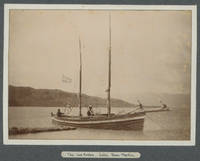
1890List01108Mostly Patagonia 1890. Printing-out paper prints the images measuring 3 1/4x4 1/2 to 4 1/4x6 inches and the reverse each with a caption written on a label affixed to the mount below the prints. 4to blue pictorial cloth. 1890s. In this bound photo album forty-six photographs document a group traveling from pastoral locations in northern Argentina to breathtaking views at the southern tip of the continent. The photographs were taken by an accomplished photographer and handwritten captions in English provide brief descriptions of the locations and people documented. Apparently a member of an exploration commission the photographer and his team travel first from Bahia Brazil to Buenos Aires and La Pláta then on to the southern tip of the continent and back up the continent through remote lakes and mountains on both sides of the Chilean/Argentinian border.<br /> <br /> While the photographer’s name and nationality are not clear from the album there are two photographs with a Sr. Moreno who is likely the Argentinian explorer Francisco ‘Perito’ Moreno. The photographs of “Sr. Moreno†bear a clear resemblance to photographs of Francisco Moreno and they are taken in La Plata which is where Moreno was the first director of the natural history museum Museo de La Plata. On the album page following the one with photographs of Sr. Moreno there are photographs of the Museo de La Plata building and grounds. Museo de La Plata was established in 1884 and Moreno’s personal collection of 15000 pieces formed the core of the original collections Farro. In order to fill the exhibit rooms he sought more materials and carried out collecting campaigns in Patagonia. At times he hired naturalists to travel into remote parts of Patagonia to gather samples of flora fauna geology and artifacts of indigenous people’s culture Farro. Museo de la Plata was exhibiting anthropological remains and indigenous material culture at the same time that Argentina was expanding into indigenous territory Farro. In this way Museo de la Plata was not just a natural history museum it was also a force of colonialism. <br /> <br /> Not only was Argentina in the process of colonizing Patagonia but also it sought to claim and maintain territory in relation to Chile. A sixty year boundary controversy between Argentina and Chile resulted in the Treaty of 1881 in which the two countries agreed for the first time on the boundaries in Patagonia Perry. Even after 1881 vague language in the treaty that the boundary be “the most lofty peaks that divide the waters†extended the dispute until 1902 Perry. Because Patagonia had not been colonized extensively scientific exploration of the region was tied with nation-building and establishing these borders. In 1896 the Argentinean government appointed Moreno as the Expert Representative in the border dispute with Chile. He led commissions of naturalists and surveying engineers through the disputed border regions along the Andes Mountains Museo de La Plata n.d. Moreno’s work had parallels in Chile’s attempts to establish borders too: “Through the work of these explorers the state was able to.draw up laws and decrees regarding environmental destruction and more effectively defend its position in the limits conflict with Argentina†Etchegaray 2018. <br /> <br /> We do not know whether the exploration commission in this photo album was affiliated with Moreno the collections of Museo de la Plata or the boundary controversy. However given the route to the tip of the continent and the back up along the newly established border it seems possible that this commission could have played some role – whether directly or indirectly – in the process of exploration and nation building occurring at that time. <br /> <br /> References<br /> <br /> Etchegaray J. L. 2018. Cataloging the nation: Explorations and the incorporation of North Patagonia into the Chilean National Ordering 1856-1902 Thesis San Francisco State University. In AS36 2018 HIST .E83. http://dspace.calstate.edu/handle/10211.3/213510<br /> <br /> Farro Máximo E. n.d. The Business of Museums: Towards a History of Collections in La Plata’s Museum 1888-1906 – World Archaeological Congress. Retrieved June 15 2021 from https://worldarch.org/world-archaeological-bulletin/the-business-of-museums-towards-a-history-of-collections-in-la-platas-museum-1888-1906/<br /> <br /> Ryan C. 2011. Indigenous possessions: Anthropology museums and nation-making in Argentina 1862–1943 Ph.D. The University of Wisconsin - Madison. Retrieved June 15 2021 from http://www.proquest.com/pqdtglobal/docview/885379045/abstract/E55A419FE8D54C0DPQ/1<br /> <br /> Museo de La Plata. n.d. Retrieved July 2 2021 from https://www.museo.fcnym.unlp.edu.ar/museo. unknown
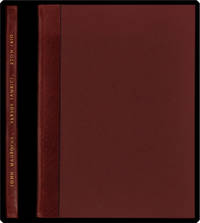
161037309Etonae: In Collegio Regali excudebat M. Bradwood for Ioannes Norton in Graecis &c. regius typographus 1610. 4to 22.8 cm; 9". 4 ff. 73 1 pp. 4 ff. <br><br>One of the first two books printed at Eton both in Greek and both printed in 1610. The Byzantine poetry here is from the pen of John Mauropus an 11th-century teacher hymnographer orator Byzantine Greek poet and correspondent of scholars.<br>Â Â Â Â This the editio princeps was edited by and has the notes of Matthew Bust 1543 or 15441613 Fellow of Eton College and father of his namesake who was Master of Eton 161130. The prefatory matter and notes are printed in Latin in italics and the main text is in a large greek face; the actual printer's name is from STC.<br>Â Â Â Â Searches of STC WorldCat and ESTC locate many copies in Britain and even Europe but only five in U.S. libraries.<br>Â Â Â Â Provenance: 18th-century ownership inscription at top of title-page: "Petri Bonifantii." Most recently in the library of American collector Albert A. Howard small booklabel "AHA" at rear.<br>Â Â Â Â => An amazing early English schoolbook! <br>Â Â Â Â <br>Â Â Â Â STC rev. 14622; ESTC S103427. 20th-century quarter red morocco with red cloth sides. Light age-toning and some stray ink spots. In fact very good. In Collegio Regali, excudebat [M. Bradwood for] Ioannes Norton, in Gr[a]ecis, &c. regius typographus hardcover books
1744D4448France 1744. Hardcover. Very Good. Manuscript book on paper in French. c.1744. 8vo 166 x 106mm. 8 355pp. written in brown ink in a clear humanist script with some calligraphic aspects between framed pages in a single column of approximately 28 lines headings in Roman majuscules. With 89 full-page diagrams and technical illustrations of sundial construction and usage and other supporting images three are on plates and two of which are folding at rear. Contemporary mottled calf spine gilt in compartments labeled Gnomonique on gilt red morocco lettering piece marbled endpapers & edges; edges uniformly toned occasional stains; expertly rebacked preserving the original spine somewhat worn. Full contents listed on first 6 pages for this expertly executed and comprehensive compendium on the sundial. The objective of this manual is to enable the 18th century audience to understand the operating principle of sundials by describing the construction and manipulation of different forms of sundials including the planet-sundial moon-clock celestial houses-clock polar-clock ancient Babylonian and Jewish clocks as well as the construction of quadrants and astronomical tables. The suns position in the sky has always been an obvious means to keep track of time. The use of shadows of sticks cast by the sun were a natural means of indicating the time of day by the direction of the shadow and the time of year by its length. Although town squares began constructing clocks beginning somewhere in the 14th century sundials remained in the picture well into the 18th century. Mechanical clocks were expensive and could be found only in the most noble of homes. They were also more of a curiosity at first; most people still used their sundials or just estimated the time of day by the height of the sun in the sky. In 1777 when the French General Lafayette wanted to express his admiration for his ally and friend General George Washington during the American Revolution he chose a silver Explorer sundial as his gift. But by the close of the 18th century clocks and watches began to supersede sundials. They had one huge advantage- they worked all day long and were not dependent on weather. However they were also notoriously unreliable- telling time only approximately within an hour and needing to be reset frequently of course with the help of a sundial. Although the work of this study is anonymous an ownership entry at the foot of the title helps to date the work: Hic est Thorridon Rectoris Laurentii Moussault 1744. This wide-ranging study of the sundial appears at a time when the mechanical clock was on its way into popular fashion. A unique scholarly work that may well be one of the last close studies of such an ancient and important time-telling tool. <br/><br/> hardcover books
355-Eo.J. Feder in Dunkelbraun und Bleistift, auf Bütten. 13:18,5 cm. Skizzenbuchblatt, mit zwei Braunflecken mittig im Vordergrund. Provenienz: Verso Siegel des historischen Vereins von Ober-Bayern; Antiquariat Robert Wölfle, München; Münchner Privatsammlung. Die frei komponierte ideale Landschaft orientiert sich stilistisch an Cl. Lorrain (1600-1682) und N. Poussin (1594-1665).
EN-114o.J. Lithographie, 1920/21, auf cremefarbenem Velin, mit Bleistift nummeriert, bezeichnet, signiert und datiert ?54/80 Titus Felixmüller geboren am 29.12.1920 Felixmüller 20?. Darstellungsgröße 26,8:32,3 cm, Blattgröße 29,4:42,8 cm. ? Verso an den oberen Ecken Reste alter Verklebung Literatur: Söhn HDO 243. Nr. 54 von 80 Exx., rechts unten mit Blindstempel ?Graphikum?. Provenienz: Heinrich Gustav Karl Mock (1904 Altenburg -München 1984) Kunsthistoriker, Graphiksammler, -verleger und -händler. Mock war seit seiner Jugend Graphiksammler, seit September 1933 ehrenamtlicher Direktor des Lindenau-Museums, stiftete 1984 seine Graphiksammlung als ?Stiftung Heinrich Mock? dem Kunstforum Ostdeutsche Galerie in Regensburg. Den ?Verlag Graphikum? betrieb er erst seit 1961 in München. Dieser Umstand lässt darauf schließen, dass Mock das hier beschriebene Blatt zu diesem Zeitpunkt noch besaß.
1800146-W1800. Gouache, auf Bütten, verso signiert und datiert ?Carolina Friederica Friedrich à l'an 1800?. 29:20,3 cm.
197781584Frankfurt a. M. Heinrich-Hoffmann-Museum, 1977. Titelei, 2 Textbl.; 1 Holzschnitt und 5 Radierungen auf Bütten. (= Edition Nr. 1). Elefantenfolio. 63 cm. Lose in OHLn.-Kassette mit Ln.-Rücken.
362-Eo.J. Pinsel in Braun und Grau, braun und grau laviert, über Bleistift, über ganz schwach angelegter Bleistiftquadrierung, mit schwarzer Tuschlinie umrandet, links unten signiert ?W. Huber après JC Hub.?. 28,6:37,8 cm, auf Sammlungsuntersatz mit mehreren Tuschlinien und grauem Aquarellrand aufgezogen. Mit zwei Wurmlöchern links oben. Provenienz: Aus dem Besitz der Nachfahren des Künstlers.
475-Eo.J. Bleistift, mit einigen Deckweißlichtern, auf cremefarbenem Whatman-Papier, rechts unten signiert und datiert ?Fried. Kaulbach 1847?. 29,8:27,6 cm. Sensible und sehr fein durchgeführte Porträtstudien des noch jungen Malers, die zwischen den Reisen nach Italien im Jahr 1844 und nach Paris 1850 entstand.
EN-115o.J. Radierung, 1911, auf chamoisfarbenem festem Büt-ten. 23,5:17,8 cm. ? Der breite Rand unten mit Abriss der linken unteren Ecke, zwei kleineren Löchern und ungleichmäßigen Rändern links und unten. Literatur: Petermann 12, II (von III) vor der Schließung der Scheitellinie.. ? Guter Abdruck mit Wischton.
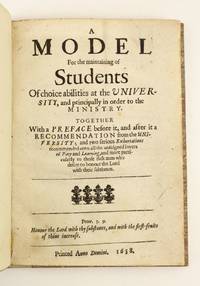
1658ST16442s.l.: s.n. Printed Anno Domini 1658. FIRST EDITION. 190 x 135 mm. 7 1/2 x 5 3/8". 3 p.l. 14 pp. complete. <br/> 20th century vellum-backed marbled boards flat spine with vertical titling. Front pastedown with bookplate of the Fox Pointe Collection. Wing P-2842B; ESTC R207754. ◆Text lightly washed and pressed but still crisp faint foxing to lower edge of title page otherwise a fine fresh copy in an unworn binding.<br/> <br/> Written by an opinionated English cleric this is an extraordinarily rare pamphlet proposing an unusual fund to support young 17th century scholars. According to DNB the scheme outlined in the present work was meant "to support the university studies of young men of promise seeking entry into the ministry." The plan "was approved by John Worthington and Anthony Tuckney and had the support also of John Arrowsmith DD Ralph Cudworth William Dillingham DD and Benjamin Whichcote. The fund raised about £900 and it appears that William Sherlock afterwards dean of St Paul's received assistance from this fund during his studies at Peterhouse Cambridge until 1660 when he graduated BA. Those entrusted with administering the fund sent Poole regular reports on students interviewed and the ratings they had received in philosophy logic and languages. The scheme was abandoned at the Restoration." Poole 1624 - 79 was the author of a number of controversialist pamphlets on subjects ranging from Unitarianism to preaching by lay persons before undertaking his major work: a synthesis of critical biblical commentaries "Synopsis criticorum aliorumque sacrae scripturae interpretum." This is one of his scarcest writings: ESTC lists seven copies two in North America while ABPC and RBH record just two copies at auction. s.n. Printed Anno Domini unknown
198562646ABRotterdam., Publishing House Bebert., 1985. 35,5 x 28,0 x 12,8 cm. Pink gefärbte Holz-Box., 62646AB Es fehlt die Holztafel von Joseph Beuys!!! Sonst aber tadelloes Exemplar.
EN-108o.J. Lithographie, um 1921, auf hellbraunem Bütten, mit Bleistift nummeriert und signiert ?20/100?, ?Archipenko?. 29,2:21,3 cm. Nr. 20 von 100 Exx. Literatur: Karshan 24; Söhn HDO 50406-1. Selten! Als Beilage erschienen zur Vorzugsausgabe in 100 nummerierten Exemplaren zu: DER ARARAT: Glossen / Skizzen und Notizen zur neuen Kunst. München, Goltzverlag, 2. Jg., 6. Heft, Juni 1921. Ss. 183-200, 3 Bll. Anzeigen. Rot und schwarz gedruckter Umschlag mit Fadenheftung nach einem Entwurf von Toni Wendling. Mit Texten von Maurice Raynal, Friedrich Markus Huebner, H. H. Stuckenschmidt, Helmut Kolle, Rudolf Utzinger, Guido Kaschnitz und Grete Brandt. Mit Abbildungen nach A. Archipenko, Alb. Servaes, F. Boucher und Josef Eberz. ? Umschlag mit leichten Gebrauchsspuren. Von dieser wichtigen expressionistischen Zeitschrift erschienen insgesamt 24 Hefte und drei Flugblätter. [3 Warenabbildungen]
766-Eo.J. Feder in Schwarz, mit schwarzer Feder umrandet, auf Bütten mit Wasserzeichen: J Whatman 1883, rechts unterhalb der Darstellung mit schwarzer Feder signiert ?Jules Aviat?. Darstellungsgröße 25:39 cm, Blattgröße 40,2:53,5 cm. ? Einige Stockflecken und im Rand leicht angeschmutzt. Vorzeichnung für das in den Musées de Chambéry befindliche, 1884 entstandene Gemälde ?Le Chantier du lycée Lakanal à Sceaux ((Inv. Nr. M1369; A 318 (ehemalige Nummer); Board 743)).
172988673Venedig, Bartolomeo Javarina, 1729. 2 Bll., LVI, 176, 344, [15] S.; 2 Bll., S. 345-709 [recte: 693], [4] Bll., 80 S. Mit 2 Titelkupfern, 6 gestoch. Faltkarten, 36 Kupferstichen a. 35 meist gefalt. Taf. (darunter 19 Bll. als S. 381-454 in der Paginierung enthalten) sowie 17 Textkupfern (dav. 9 ganzseitig). Folio. Blindgeprägtes Schweinsleder d. Zt. auf 5 Bünden mit Rückenschild (Bd. 2 über Holzdeckeln, mit Schließenresten).
155-Wo.J. Bleistift, auf gelblichem strukturiertem Papier, rechts unten signiert ?T. Blau?. 27,3:26,5 cm. Insgesamt etwas stockfleckig. Virtuos-atmosphärischer Ausschnitt einer Parklandschaft, der, wie von der Künstlerin bekannt, von einem mächtigen Laubbaum hinterfangen wird.
0849-Co.J. Radierung, 1922, auf Bütten, signiert und nummeriert. 11:14,6 cm. Literatur: Kornfeld 20; Cramer books 2, Blatt 20 aus der Folge ?Mein Leben?. Nr. 30 von 110 Exx. ? Sehr guter Abdruck, vollrandig, Papier leicht vergilbt.
307-Eo.J. Aquarell, etwas weiß gehöht, auf Velin, links unten signiert ?J. F. Dielmann?. 15,2:22 cm. In den Rändern etwas ungleich beschnitten. Literatur: Jakob Fürchtegott Dielmann: Gründer der Kronberger Malerkolonie, hrsg. von der Museumsgesellschaft Kronberg im Taunus, anläßlich der Jakob-Fürchtegott-Dielmann-Ausstellung der Kronberger Museumsgesellschaft vom 16. März bis 8. April 1985 in der Kronberger Receptur, Frankfurt am Main 1985, mit Farbabb. S. 69.
EN-014o.J. Holzschnitt, 1920, auf chamoisfarbenem Bütten mit Wasserzeichen: Gelder Zonen, mit Bleistift signiert, datiert und nummeriert. Darstellungsgröße 50:34 cm, Blattgröße 62,8:48,2 cm. - Insgesamt leicht knittrig, entlang des Oberrandes zwei Knickfalten. Literatur: Ausst. Katalog: Die Graphik des Darmstädter Expressionismus 1915-1925. Darmstadt, Galerie Netuschil 1995, Abb. 41.
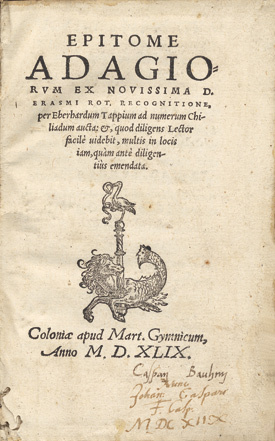
15499472Cologne, Mart. Gymnicus, 1549 ; in-8 ; plein vélin estampé sur ais de bois, dos à trois gros nerfs, fermoirs de cuivre (reliure de l'époque) ; (16) y compris le titre, 632, [634], (76) pp. index, (1) f. blanc (*, AZ, Aa-Xx - 8, Yy - 4).
351-Eo.J. Pinsel in Braun und Grau, über Bleistift, auf Bütten mit Wasserzeichen: C & I Honig, links unten bezeichnet ?Vöslau?, rechts unten signiert und datiert ?Fischbach. 1821.?. 23:30 cm. Einriß im unteren Bildteil und winziges Löchlein hinterlegt. Provenienz: Sammlung Ferdinand Rudolf Hintze, Stettin, nicht bei Lugt. Bildmäßig durchgeführte Zeichnung aus der frühesten Schaffensphase des Künstlers.
167-Do.J. Schwarze und rote Kreide, auf braun getöntem Bütten mit Wasserzeichen: Kleine Lilie mit undeutlichem Namenszug. 39,3:33 cm. Provenienz: Sammlung Boguslav Jolles, Dresden u.Wien, Lugt 381 sowie Lugt Suppl. 381a. Horizontale Mittelfalte geglättet, Oberfläche leicht berieben.
FH-356o.J. Farbholzschnitt von mehreren Stöcken, 1904, auf blauem Bütten, mit Bleistift signiert und als ?Orig. Farbholzschnitt Handdruck? bezeichnet. Darstellungsgröße 19,8:30 cm, auf die Umfassungslinie geschnitten, unten und rechts mit Rand. Werknummer 6. - Sehr selten! Literatur: Ausst. Katalog: Goethes Weimar in Farbholzschnitten von Margarethe Geibel. Fürstenfeldbruck, Nr. 84, Abb. S. 59. Angela Meinz schreibt hier zu diesem Blatt: ?Der Farbholzschnitt wurde ihre bevorzugte Arbeitstechnik. Ein Beispiel ist der frühe, noch ganz vom Eindruck asiatischer Kunst geprägte Farbholzschnitt ?Kiefern? (1904). Die Kompositionsweise mit den das Bild durchziehenden Schrägen erinnert an chinesische Pflanzenstudien.?