Thiemann, Carl - 1881 Karlsbad ? Dachau 1966Antiquariat.de

48 779 résultats
FH-491o.J. Farbholzschnitt, 1909, auf chamoisfarbenem Japan, mit Bleistift signiert, bezeichnet und betitelt ?Original-Farbenholzschnitt Handdruck ?Dachau Münchner Straße?. Darstellungsgröße 39,5:49,5 cm, Blattgröße 42,5:54 cm. - Im alten Passepartoutausschnitt leicht gedunkelt.- Literatur: Thiemann-Stoedtner FH 50; Klaus Merx, Carl Thiemann, Meister des Farbholzschnitts. Darmstadt, Ed. Roether, 1976, Farbabb.; K. A. Reiser, Graphik des deutschen Jugendstils. Düsseldorf 1972, Ss. 42/43, Nr. 160; Ausst. Katalog: Daniel Studer, Faszination Farbholzschnitt. St. Gallen/Reutlingen, 2016/2017, Farbabb. S. 215. Prachtvoller Abdruck in satten Farben und mit schmalem Rand rundum!
1801080-D1801. Feder in Braun, grau laviert, auf grautonigem Bütten mit angeschnittenem Wasserzeichen, rechts unten signiert und datiert ?G: Urlaub. Fecit / d 3t octobr.. 1801 ». 16,9 :21,4 cm. - Verso mehrere Bleistiftstudien von Füßen. Vergleichsliteratur: Ausst. Katalog: Goethe und die Kunst. Hrsg. von S. Schulze. Frankfurt am Main, Schirn Kunsthalle, 1994, Nr. 169 mit Farbabb. ?Bei Urlaub erhält die bürgerliche Genredarstellung eine etwas frivole Note, die dem französischen Rokoko Rechnung trägt und einen pikanten Gegensatz zu der eher biederen Auffassung der Frankfurter Maler bildet.? (Op. cit. S. 241).
756-Eo.J. Feder und Pinsel in Grau und etwas Grün, grau laviert und mit reicher Deckweißhöhung, auf cremefarbenem festem Zeichenpapier, links unten signiert, bezeichnet und datiert ?C. Wuttke. Corfu 1889.?. 33,2:47,2 cm. Für eine Neuauflage des Buches von Ferd. Gregorovius über Korfu schuf Wuttke 1889 Vorzeichnungen für Illustrationen. Vermutlich ist dieses Blatt in diesem Zusammenhang entstanden.
1606SE262<p>4o 220x159 mm. Collation: 4 A-H4. 8 64 pp. On the title-page woodcut coat of arms of the dedicatee Francesco Borghese as Captain General of the Saint Roman Church surmounted by a coronet. Woodcut decorated initials and tailpieces. Contemporary gilt-tooled vellum. Covers within a double fillet with Borghese's coat arms at the centre. Small heraldic dragons at each inner corner. Holes for ties at the foredges. Smooth spine decorated with alternating heraldic dragons and eagles. Minor losses small marginal stain to the lower cover. A very good copy in its original binding. Some light scattered foxing and staining.<br />Provenance: Francesco Borghese 1556-1620 brother of Pope Paul V and Captain General of the Saint Roman Church armorial binding.<br /><br />First edition of this important work likely Palazzolo's presentation copy to the dedicatee of the work itself Francesco Borghese whose coat of arms is stamped on its fine binding.<br />Francesco Borghese Duke of Rignano was the younger brother of Camillo who had been elected Pope as Paul V on 16 May 1605. Since his ascent to St Peter's throne the pope had vigorously fought for the development and reinforcement of the Papal Army and named his brother Generale di Santa Romana Chiesa i.e. Captain General of the Saint Roman Church. In this context the Milanese nobleman Cesare Palazzolo – Generale collaterale i.e. the general inspector for the papal armed forces – was commissioned with the redaction of the present work which contains not only the outlines of the reform but above all its theoretical justification. The work traces the spiritual basis of the disciplined soldier and re-defines military duties in terms of Christian piety. The soldiers of the Pope should be not only well organized and courageous but also disciplined and devoted. The pattern of conduct proposed by Palazzolo is thus dual natured both military and religious. <br />As noted Palazzolo dedicates his book to Francesco Borghese whose coat of arms as Captain General of the Saint Roman Church stands out on the title-page. <br />The handsome gilt-tooled vellum binding was executed – as the gold-tooling clearly attests – in the most renowned and sought-after workshop then active in Rome that run by the Soresini binders who worked for the papal court as well as other high-profile clients from the 1590s to ca. 1630. Credit for this particular binding may belong to Baldassare Soresini who was so active for the Borghese family that he was known as the 'Borghese Binder'. The choice of such a refined atelier could therefore reveal Palazzolo's intention of offering this copy to an outstanding recipient as indeed Francesco Borghese was.</p><p>STC 17th century Italian 642; G. Vianini Tolomei "I ferri e le botteghe dei legatori" Legatura romana barocca. 1565-1700 pp. 31-2 and pls. i-ii; G. Brunelli Soldati del papa. Politica militare e nobiltà nello Stato della Chiesa 1560-1644 Rome 2003 ad indicem; Idem "Cultura politica e mentalità burocratica nei carteggi dell'organizzazione militare pontificia 1560-1800" A. Jamme – O. Poncet eds. Offices écrits et papauté xiiie- xviie siècles Rome 2007 pp. 301-310.</p> Luigi Zannetti
12 vols., 8vo., First Edition; cloth, gilt backs, all near fine copies. COMPLETE SETS ARE VERY SCARCE.
1981658FBKassel., Orangerie., 1981. 658F Sehr gutes Exemplar.
EN-070o.J. Lithographie, 1911, auf chamoisfarbenem Japan-Büttten, mit Bleistift signiert. Darstellungsgröße 15,4:15 cm, Blattgröße 41,4:29 cm. Provenienz: Nachlass Günther Franke, München. Literatur: Hofmaier 32 b (von c); Glaser 25; Gallwitz 19.
EN-067o.J. Lithographie, 1920, auf feinem Japan-Bütten, mit Bleistift signiert. Darstellungsgröße 19,5:15 cm, Blattgröße 30,5:24,3 cm. Provenienz: Nachlass Günther Franke, München: mit Stempel ?Graphisches Kabinett, München? sowie mit Fragment eines Zollstempels. Literatur: Hofmaier 168 B (von C); Glaser 145; Gallwitz 139. Blatt 4 der 6-Blatt-Folge: Stadtnacht.
442-Eo.J. Feder in Braun, braun laviert, auf chamoisfarbenem Velin. 31,2:20,8 cm. Verso Leimreste von einer alten Verklebung, insgesamt etwas braunfleckig.
354-Eo.J. Feder in Dunkelbraun und Bleistift, mit einzelner Federlinie umrandet, auf Bütten. 16,7:20,7 cm. Provenienz: Sammlung ACCN, Inv. 788, nicht bei Lugt. Die frei komponierte ideale Landschaft orientiert sich stilistisch an Cl. Lorrain (1600-1682) und N. Poussin (1594-1665).
650-Eo.J. Aquarellierte Federzeichnung, um 1850, auf Velin. 21 : 28,7 cm. Literatur: Vgl. Nagler Monogrammisten I, 1220. - Papier etwas vergilbt und etwas fleckig. Komisch-satirische Arabeske, in der des Künstlers Signet, der Korkenzieher, selbstironisch zum "Schlangenblick" umgestaltet wird.
0832-Co.J. Radierung in Braun, 1919, auf Velin, links unten signiert. 20,8:14,3 cm. ? Verso mit Resten alter Montierung. Literatur: Rosenbach 87, außerhalb der Auflage von 100 Exx. Sehr guter Abdruck mit vollem Rand.
394-Eo.J. Schwarze Kreide, Pinsel in Braun und Goldbronze auf braunem Karton, verso wohl von fremder Hand bezeichnet ?Ph Veit del? sowie Sammlungsnummer ?No 295?. 27,3:21,4 cm. Provenienz: Sammlung Franz Brentano, Philosoph (1838-1917), Neffe des Dichters Clemens Brentano; Margarete Brentano; Alexander Brentano von Weyhe, Buenos Aires.
391-Eo.J. Aquarell und Pinsel in Grau, über Bleistift, auf Bütten mit Fragment eines Wasserzeichens. 17:20,8 cm. Provenienz: Aus dem Nachlaß der Familie Fellner, Frankfurt am Main. Giacomo Meyerbeers (1791-1864) Oper ?Robert le Diable (Robert der Teufel)?, die in Paris 1831 mit großem Erfolg uraufgeführt worden war, behandelt die märchenhafte Legende, die sich um das Leben Robert I. rankte, der 1027-1035 Herzog der Normandie war. Jener soll bereits von seiner Geburt an dem Teufel, seinem Vater, geweiht gewesen sein, konnte jedoch diesem trotz zahlreicher Schicksalsschläge entkommen.
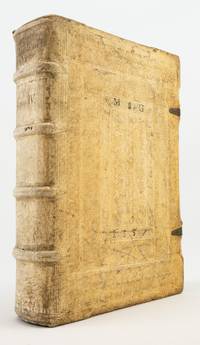
1556ST20472Basel: Hieronymus Froben 1556. First Edition of this Latin Translation. 343 x 235 mm. 13 1/2 x 9 1/4". 4 p.l. 730 142 2 blank pp. 12 leaves. Translated from the Greek by Petrus Nannius and Wolfgang Musculus. <br/> Contemporary blind-stamped pigskin over bevelled wooden boards by Balthasar Wernher of Lauingen covers framed by palmette rolls and a roll signed with the initials B. W. that features half-figures of Christ as Salvator Mundi St. Paul St. John the Baptist and King David central panel of upper cover with vertical palmette rolls the blank frame around it with the letters "M G" above the panel separated by turnip tool the date 1557 below the panel central panel on the lower cover with the same tooling but surrounded by a frame with a roll of medallions of the Reformers raised bands ink lettering to a couple of panels two original brass catches and catchplates one catchplate defective. Printer's woodcut device to title page and final page numerous decorative woodcut initials. Title page with three early ink owner inscriptions; occasional early ink marginalia and underlining. VD16 A 3980; Adams A-2083; Hoffmann I 415. For the binding: Haebler I 475 3; EBDB roll r003786 and workshop w004477. Binding somewhat soiled and chafed pigskin at one corner rubbed away one-inch circular hole on back board a contemporary issue with tooling impressed on the wood beneath isolated minor marginal stains or mild foxing other trivial imperfections but an extremely pleasing copy very fresh internally with excellent margins in a completely satisfying unrestored contemporary binding.<br/> <br/> This collected edition of the writings of the Church Father and leading advocate of the doctrine of the Trinity comes in a lovely binding by a known German workshop. The Einbanddatenbank "Bookbinding Database" or EBDB of the German Research Foundation attributes the Salvator Mundi/St. Paul/King David/John the Baptist roll to Lauingen binder Balthazar Wernher ca. 1525-74/75 whose initials appear in the panel featuring Christ. His workshop was active ca. 1555-75; the date on our binding indicates it was produced near the beginning of his career. One of the four great Eastern Doctors of the Church and the Patriarch of Alexandria St. Athanasius ca. 297 - 373 led the fight against the Arian doctrine which held that Christ was a creation of God the Father rather than consubstantial with Him. Athansius’ writings on the Incarnation and the Trinity which make up most of the text here were enormously influential. According to Catholic historian Cornelius Clifford "Athanasius was the greatest champion of Catholic belief on the subject of the Incarnation that the Church has ever known and in his lifetime earned the characteristic title of 'Father of Orthodoxy' by which he has been distinguished ever since." The English theologian and Cardinal John Henry Newman declared Athanasius a "principal instrument after the Apostles by which the sacred truths of Christianity have been conveyed and secured to the world." This translation of his writings was one of the final works by the Dutch humanist Petrus Nannius Pieter Nannick 1496-1557 a contemporary of Erasmus. The printer here was Hieronymus Froben who took over the family business from his father Johann Froben 1460-1527 a central figure in the printing history of the 15th and early 16th centuries who played a key role both in the intellectual ferment of the northern Renaissance and the theological turmoil of the Reformation. Our substantial large folio binding with its thick boards and four sets of muscular double bands provides an appropriate reflection of the weightiness of the works it contains. [Hieronymus] Froben unknown
2689Oxford: Printed by Thomas Baskett Printer to the University 1753. Hardcover. Good. Octavo. No pagination. Final leaf: Bb3. Contemporary red morocco repaired. With 47 engraved plates most likely by Frederick Hendrick van Hove. ESTC T182569. ESTC records a copy in Scotland three at Oxford some in private collections one in Australia but none in the US. Tear in title-page not affecting text. Bound with: The Whole Book of Psalms Collected into English Metre. London: Printed by C. and J. Ackers for the Company of Stationers 1753. <br/> <br/> Oxford: Printed by Thomas Baskett, Printer to the University, 1753. hardcover
325-Eo.J. Aquarell und Feder in Schwarz, mit einzelnen Deckweißhöhungen, über Bleistift, auf festem Bütten, links unten signiert ?Albr Adam fec.?. 10,5:19,5 cm. Farbfrisches Aquarell des bedeutenden Pferdemalers!
143-Eo.J. Aquarell, Tuschfeder in Schwarz, stellenweise mit Weiß und Goldbronze gehöht, über Bleistift, oben und unten mit schwarzer Tuschlinie umrandet, auf chamoisfarbenem festem Zeichenpapier, rechts unten signiert und datiert ?Peter Becker 1901 ?. 28,5:19,3 cm. In Originalpassepartout fest montiert und dort vom Künstler bezeichnet ?[Peter Becker 1901]? sowie betitelt.
FH-040o.J. Farblinolschnitt, 1925, auf chamoisfarbenem Japan, mit Bleistift signiert und als ?Handdruck? bezeichnet. Darstellungsgröße 18:18 cm, Blattgröße 19:18,7 cm. Die besonders reizvolle Katzen-Darstellung in einem noch guten Abdruck, Papier etwas vergilbt, auf Karton aufgezogen. Literatur: Ausst.-Katalog: Holzschnitt. Wien ab 1900. Wien, Galerie bei der Albertina, 2016/2017, Nr. 49 mit Farbabb.
1310-Co.J. Kaltnadelradierung, 1918, auf chamoisfarbenem Japan, mit blauem Stift signiert und bezeichnet ?Nr 4?. Darstellungsgröße 22,5:31,3 cm, Blattgröße 32,4:52 cm. ? Im linken breiten Rand leicht knitterfaltig. Literatur: Schwarz 348, II (von II). ? Vorzüglicher, vollrandiger Abdruck, tadellos. [2 Warenabbildungen]
EN-019o.J. Farblithographie, 1932, auf cremefarbenem Velin, mit Bleistift signiert, datiert und bezeichnet ?Orig. Lith. 1932, IX?. Darstellungsgröße 38,3:27,8 cm, Blattgröße 38,4:27,9 cm. Literatur: Nicht im Ausst. Katalog: Steindrucke von Adolf Erbslöh München. München, Karl und Faber, 1982. - Tadelloses Exemplar!
714-Eo.J. Feder in Schwarzbraun, braun und grau laviert, mit Deckweiß gehöht, auf festem cremefarbenem Bütten, rechts unten monogrammiert ?FG.?. 29,4:43,4 cm. - Kleinere Papierschäden verso hinterlegt. Literatur: P. Pfisterer, Monogrammlexikon 2. Berlin/New York 1995, FG 478-480.
FH-355o.J. Farbholzschnitt von mehreren Stöcken, 1904, auf braungrünem Papier. 19,9:30 cm, auf die Umfassungslinie geschnitten. Werknummer 5. ? Sehr selten!
727-Eo.J. Feder und Pinsel in Grau und etwas Braun, über Bleistift, auf Velin mit Fragment des Wasserzeichens: C & I Honig; rechts unten mit Bleistift signiert und nummeriert ?C. Kuntz No 6?. 49,7:59,2 cm. ? Mit Vergilbungen im Bereich des Himmels, kleine Einrisse in den Rändern sorgfältig restauriert. Vergleichsliteratur: J. Lauts / W. Zimmermann, Katalog Neuere Meister 19. und 20. Jahrhundert. Karlsruhe 1971, 2 Bde. Bd. I, Nr. 651-654, Bd. II, Abb. 243, 245 und 256; R. Theilmann / E. Ammann, Die deutschen Zeichnungen des 19. Jahrhunderts. Staatliche Kunsthalle Karlsruhe. Kupferstichkabinett. 2 Bde. Karlsruhe 1978, Bd. I, Nr. 2150 und 2151, Bd. II, Abb. S. 60.
0835-Co.J. Kaltnadelradierung, 1912, auf chamoisfarbenem Kupferdruckpapier, signiert. 13,1:11,3 cm. Literatur: Stix 2; Pabst R 4. ? Sehr guter Abdruck, vollrandig. ? Das Porträt steht in Zusammenhang mit dem Gemälde ?Arthur Schnitzler?, Wien 1910, das den Dargestellten Spiegelverkehrt in gleicher Position zeigt. Das Gemälde ist abgebildet in: ?Max Oppenheimer, Menschen finden ihren Maler. Zürich, Oprecht 1938, S. 31.