Maetzel, Emil - 1877 Cuxhaven ? Hamburg 1955Antiquariat.de

48 779 résultats
EN-099o.J. Rote Kreide, auf gelblichem Papier mit Wasserzeichen: Monopol, links unten monogrammiert und datiert ?EM. 20.? 50,5:34,5 cm. Kleine Fehlstellen in beiden Seitenrändern, zwei Löchlein im Bereich des Monogramms sind sauber hinterlegt.
627-Eo.J. Aquarell über Bleistift, um 1835, auf cremefarbenem Velin. 24,5:40,4 cm. - Im Ganzen nicht ganz frisch. Studie eines nah gesehenen Berghangs in herbstlicher Farbigkeit, wie sie für Christian Morgenstern typisch ist. Vergleichsliteratur: J. Lauts/W. Zimmermann, Katalog neuere Meister 19. und 20. Jahrhundert. 2 Bde. Karlsruhe, Staatl. Kunsthalle 1971, Bd. I, S. 173 (Inv. Nr. 2278), Bd. II, Abb. S. 297 unten; Ausst.-Katalog: ?Münchner Landschaftsmalerei 1800-1850. München, Städt. Galerie im Lenbachhaus, 1979, Nr. 401, Farbabb. S. 353: ?An der Amper bei Oberhausen?. ?Im allgemeinen wurden in München bis in die dreißiger Jahre Studien für die Gesamtkomposition der Bilder in Aquarell ausgeführt, während es nur ausnahmsweise Detailstudien gab. Friedrich Pecht spricht in seiner ?Geschichte der Münchener Kunst im neunzehnten Jahrhundert? vom aquarellartig bunten, harten und nüchternen Charakter der gesamten frühen Münchner Malerei. Der eine, schon genannte Weg, auf dem die Freilichtskizze nach München kam, führte über Rom. Beispiele sind die drei Ansichten von der Villa Malta in Rom von Georg von Dillis aus dem Jahre 1818 in der Schack-Galerie in München, die von lichter, flockiger und fernsichtiger Struktur sind. Ihnen haben in München erst in den dreißiger Jahren die aus dem Norden gekommenen Künstler etwas Vergleichbares an die Seite zu stellen. Sie wanderten gemeinsam in die Berge, vor allem nach Berchtesgaden und an die bayerischen Seen, um hier solche Studien vor der Natur zu verfertigen?.?. (Barbara Eschenburg über ?Nordländer in München? in: Ausst.-Katalog: ?Münchner Landschaftsmalerei 1800-1850. München, Städt. Galerie im Lenbachhaus, 1979, S. 111.
0840-Co.J. Kaltnadelradierung, 1929, auf cremefarbenem Bütten, signiert und bezeichnet ?Hans und Suse Paret ziehen nach Dahlem, Vogelsang 12 und haben Telephon Breitenbach 3913.? 10,7:18 cm. ? Mit leichtem Lichtrand rundum. Literatur: Stix 58, erwähnt 100 Exemplare auf Kupferdruckkarton, Größe unbekannt, erschienen im Atlantis-Verlag, Berlin; Pabst R62. Exemplare auf Bütten sind offenbar bisher nicht bekannt.- Hans Paret (1896-1973) war Kunsthistoriker und mit der Tochter Paul Cassirers Suzanne verheiratet. Es gab offenbar eine freundschaftliche Verbindung zwischen beiden und Max Oppenheimer.
FH-186o.J. Holzschnitt in Grau, Rot und Grün, auf aufgewalztem China, rechts unten im Stock monogrammiert ?AP? (ligiert). Darstellungsgröße 28,5:25,2 cm, Blattgröße 54,9:42,8 cm. Schöner Abruck, insgesamt leicht fleckig. [2 Warenabbildungen]
275-Eo.J. Bleistift auf Velin. 23,4:33,7 cm. Provenienz: Vente Salathé, Stempel nicht bei Lugt. Im ganzen etwas fleckig, kleine Fehlstelle an der linken unteren Ecke. Vgl. zu dem Gebäude: S. Wechssler, Ernst Fries (1801-1833), Heidelberg 2000, S. 208 f., Kat. Nr. 271, ?Rom, Tiberufer, 1826?.
740-Eo.J. Feder in Braun, auf Bütten mit Wasserzeichen: Adler über Initialen FAG. 42:31,5 cm. Provenienz: Sammlung F.W. Fink (1796-1861; Lithograph, Radierer und Kalligraph), Lugt 928. Vom Sammler verso bezeichnet ?vom Maler Schaller, (Bruder des Bildhauers, dem jüngeren, gest. zu Wien 184... nach Prof. Redl. Bey Weber gekauft FWFink?).
FH-326o.J. Folge von 6 Holzschnitten, auf hauchdünnem Japan, auf Untersätze montiert, im Stock monogrammiert ?ES? sowie sämtlich mit Bleistift signiert ?Schlangenhausen?. Darstellungsgröße je ca. 31,5:10,5 cm, sämtlich mit Rändchen rundum. Mit von der Künstlerin eigenhändig gestaltetem Umschlag, vorne mit Aquarell eines Krokus sowie Atelierstempel (Haus mit zwei Schlangen). Die Holzschnitte zeigen: Krokusse, Buschwindröschen, Schlüsselblumen (2) und Schneeglöckchen. Von großer Seltenheit!
615-Eo.J. Bleistift und Feder in Dunkelgrau, mit Bleistiftlinie umrandet, auf chamoisfarbenem Velin, rechts unten signiert ?Schwind?. 20,7:17,9 cm. Möglicherweise schildert die Zeichnung ein Motiv aus der deutschen Dichtung der Romantik. Zu denken wäre da besonders an ?Phantasus? von Ludwig Tieck, eine Sammlung von Märchen, Erzählungen, Schauspielen und Novellen.
EN-119o.J. Lithographie, 1929, auf cremefarbenem Velin, im Stein monogrammiert, mit Bleistift nummeriert ?34/130? und signiert ?Niklaus Stoecklin?. Darstellungsgröße 30,5:38,4 cm, Blattgröße 46,2:56,7 cm. Mit Restaurierungen in den Rändern. - Das Pariser Motiv schildert der Künstler als Nachstück. Die mehrarmige Laterne ist von vier entlaubten Bäumen umgeben und zeigt den kleinen Platz in intimer Atmosphäre.
FH-288o.J. Farbholzschnitt, 1909, auf Japan, am Oberrand mit Bleistift signiert. 28,8:39,8 cm. - Kleine Fehlstelle an der linken unteren Ecke. Literatur: Thiemann-Stoedtner FH 59; Klaus Merx, Carl Thiemann, Meister des Farbholzschnitts. Darmstadt, Ed. Roether, 1976, 136 F, Farbabb. 37, S. 62.
FH-289o.J. Farbholzschnitt, 1912, auf Bütten, mit Bleistift signiert. 35:28,4 cm. Literatur: Thiemann-Stoedtner FH 126; Klaus Merx, Carl Thiemann, Meister des Farbholzschnitts. Darmstadt, Ed. Roether, 1976, 221 F, Farbabb. 2, S. 12. - Tadellos frisches Exemplar!
0931-Co.J. Kaltnadelradierung, 1922, auf Japan-Bütten, mit Bleistift siogniert. Darstellungsgröße 12,9:18 cm, Blattgröße 39,7:29,7 cm. ? Mit vereinzelten Stockflecken und besonders im Unterrand leicht knickspurig. Literatur: Rosenbach 42. Erschienen als Blatt 26 zum Mappenwerk: Arno Holz zum 60. Geburtstag. Hrsg. von Fritz Gurlitt, Berlin. ? Sehr guter Abdruck, vollrandig.
FH-292o.J. Holzstich in mehreren Farben, 1947, auf chamoisfarbenem Bütten, mit blauer Tinte in tschechischer Sprache beitelt, signiert und datiert. Darstellungsgröße 42,2:25 cm, Blattgröße 48,3:31,4 cm. Kleiner Randeinriß unten, in den Rändern etwas knitterfaltig.
043-Io.J. Bleistift, 1824, auf Bütten mit Wasserzeichen: Vogel auf Dreiberg im Kreis, rechts unten bezeichnet ?Ciclopenmauer in Palestrina?. 19,5:27,3 cm. Mit Knickfalte. Für beide Zeichnungen von Richter und Wagner gilt, daß sie am 20. September 1824 während der Studienwanderung der Künstler in den Sabiner Bergen entstanden sind. Sie hatten diese Ortschaft nach einer Nachtwanderung erreicht, worüber Richter in seinen Lebenserinnerungen berichtet. Die Zeichnungen sind vor der Natur entstanden, wobei Wagner etwas rechts von Richter gesessen haben muß. Sie benutzten sogar Papier mit demselben Wasserzeichen. Literatur: Katalog 76: Carl Wagner. Frankfurt a.M., Joseph Fach, 1999, Nr. 19 mit Abb.
425-Eo.J. Bleistift mit leichter Lavierung in Blau, auf Velin. 27,9 x 20,8 cm. Detailgetreue und seitengleiche Vorzeichnung zur beigefügten Radierung vom 21. Januar 1842; 27,5 x 20 cm. Nicht bei Mallinger und Nagler
224-Eo.J. Bleistift, auf cremefarbenem Velin, im Unterrand signiert und datiert ?C.G. Hammer dl a N. Dresd. 1852?, verso bezeichnet ?In Prietz b/ Kamenz Dommühle?. 20,9:27,1 cm. Typische mit tupfendem Pinsel detailreich und bildmäßig durchgeführte Zeichnung.
347-Eo.J. Bleistift, leicht aquarelliert, auf bräunlichem Velin, rechts unten bezeichnet und datiert ?Aussicht auf das Tal von Ephesus vom Berge Pagos bei Smyrna. 9.7.6.?, sowie weitere Bezeichnungen im Unterrand. 16,1 x 27,7 cm. Auf Untersatz montiert.- Sammlung Bernhard Funck, München, nicht bei Lugt.- Obwohl die Datierung auf der Zeichnung durch Beschneidung nicht vollständig ist, kann man mit Sicherheit sagen, dass sie zwischen 1867 und 1869 entstanden sein muß, da Klose zu dieser Zeit Kleinasien bereiste.
196866543ABNew York., Siegelaub / Wendler., 1968. 28 x 22 cm. 185 Blatt. OKarton mit transparentem OKunststoffumschlag in einer handgefertigten Leinen-Kassette mit Rückenprägung "Xerox Book"., 61660AB First edition 1000 copies. Rücken etwas gebräunt,der transparente Umschlag an drei Stellen eingerissen, an zwei Stelen mit kleineren Fehlstellen. Sonst sehr gutes Exemplar.
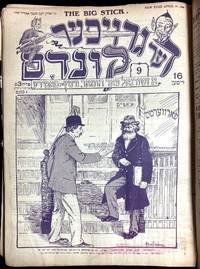
190942930New York: Ferlag "Kibets 1909. 1st Edition. Original publisher’s binding Folio newspaper. Complete first volume Starting with Vol I Nr 1 of “Der Kibitser†Dec. 15 1908 renamed and renumbered first as Vol I Nr 1 Jan 22 1909 of “Der Groyser Kibetser The big kibetzer†with the following issue of Feb 5 numbered as "3" to correctly follow from the first issue and then with Vol I Nr 6 March 19 1909 onward as “Der Groyser Kundes The Big Stick†or “The Big Prankster.†Incidentally the other set of this volume we examined also did not have a Nr 2 so we are confident this is complete as issued. <br> One centerfold cartoon by Zuni Maud see image features "Der Kaptialistisher Tayfel"--the Capitalist Devil–holding back a "mother" by the hair to stop her from interfering as "baby's milk-bottle" is drained off by the "milk-trust" cat. <br> The caption reads "The Capitalist Devil: - to the mother: Never mind madam all in English in Hebrew letters you go to the factory the milk-trust will take good care of your baby."<br> This cartoon-laden periodical was a New York City Yiddish language satirical bi- weekly which ran from 1908 until 1927.<br> The humor paper was issued biweekly this volume for its first 20 months and then weekly after that. OCLC also references another Vol I Nr 1 from April 15 1908 a special S´imhes` Toyreh Simchas Torah issue but this may have been a one-off. <br> Founded by the humorist Yosef Tunkel or Der Tunkeler his pen name meaning 'The Dark One' the paper was taken on by Jacob Marinoff when Tunkel left to work for an established paper in Warsaw. The paper consciously set itself up in opposition to the serious Yiddish-language press of the time such as the socialist Forverts.Naturally more traditional religious Judaism did not escape its satire: The later 1915 "Christmas" edition included a parodic conversation between Jesus and the prophet Elijah. <br> Despite its irreverent attitude to everything it also published poetry by Di Yunge "The Young Ones" poets such as Moyshe-Leyb Halpern and Zuni Maud. At its height it had a circulation of 35000 but folded in 1927 due to flagging sales. Der Groyer Kunds is highlighted in this recent talk by Yiddish comics scholar Eddie Portnoy on the reactions in the Yiddish press to restrictions on Jewish immigration to the US: https://www.yiddishbookcenter.org/collections/archival-recordings/recorded- programs/ybcr-nybc-ybcr-1048/door-slams-shut-reactions-yiddish-press-immigr ation .<br> SUBJECTS: Yiddish wit and humor -- Periodicals. OCLC: 28297536. Most holdings appear to be fragmentary and do not include these issues. Issue 18 with torn cover. In final issue the bottom margin suffers some loss to the final leaves none to the dramatic front cover though. Damaged boards are loose and most issues are coming loose though the quality paper used has remaind strong and bright much better than standard newsprint would have. Important graphic Yiddish humor from the great migration period. Dramatic and displayable! BK5 YID-43-9A-LEX. [New York]: Ferlag "Kibets unknown
1801055966Istanbul: Darü't-Tibaatü'l-Âmîre Mühendishâne Istanbul AH 1216 1801 CE. 1801. 1st Edition . Leather. Very Good. 8vo - over 7¾ - 9¾" tall. Contemporary brown half calf both boards marbled. Demy 8vo. 21 x 14 cm. In Ottoman script Old Turkish with Arabic letters. 33 1 blank p. Many marginal notes underlined words by red ink stains between pp. 15-18 stained margins two ownership period seals some notes and calculations on the front pastedown and the boards. Hand-coloured and decorated headpiece. Otherwise a good copy. Exceedingly rare first edition of this foundational textbook traditionally attributed to Mahmud el-Rûmî hence known as the 'Mahmudiye' which served for centuries as the primary resource for teaching Arabic to children in Ottoman madrasahs and was reprinted in numerous subsequent editions. Between 1801 and 1900 the book was published 30 times after this first edition. First composed in the 16th century and widely used in Ottoman madrasahs it was the principal introductory text for children beginning their study of Arabic. Its pedagogical structure and clarity made it a standard in elementary religious and linguistic education for centuries. The book offers a concise and accessible introduction to Arabic grammar and morphology especially tailored for young learners. It includes basic Arabic vocabulary introduction to Arabic letters and pronunciation noun and verb conjugations with emphasis on common forms simple sentence structures essential grammatical rules and inflection patterns i'râb. Written in rhymed prose or verse the text was designed to be easily memorized. It laid the groundwork for more advanced studies in the Arabic language Quranic recitation and Islamic sciences in the Ottoman madrasahs. Professor Müderris Abdurrahman Efendi was the first director of the "Engineering School Printing House" Mühendishâne Matbaasi established in 1797 in Üsküdar Istanbul. A professor of algebra and geometry Abdurrahman Efendi had studied fortification techniques for ten years under French experts before the founding of the Mühendishâne-i Berrî-i Hümâyûn also known as Mühendishâne-i Cedide in 1793 during the Nizam-i Cedid reform period. While managing the printing house he also taught engineering courses at the newly founded school. Commonly known among the public as the "Üsküdar Printing House" the Mühendishâne Matbaasi under his direction published several important works including the famous Cedîd Atlas. Despite this the press was regarded as a public-interest institution and lacked sufficient capital which hindered its development. Due to the lack of progress Abdurrahman Efendi stepped down on December 2 1807 and was succeeded by Seyyid Hüseyin Beyefendi former deputy chief clerk of the registry Defteremini. The Mühendishâne Printing House 1797 was founded under the chairmanship of Mühendishane teacher Abdurrahman Efendi with the printing sets inherited from Ibrahim Müteferrika who published the first Turkish book in the Ottoman Empire. Until 1824 66 works were printed including the important publications of the period such as Bashoca Hüseyin Rifki Tamani's Usûl-i Hendese 1797-98 Atlas-i Kebîr Tercümesi 1803 author: William Faden translated into Turkish by Resmî Mustafa Aga and Mahmut Raif Efendi's Cedveli-Tableau des nouveaux reglemens de I'Empire Ottoman 1798 printed in French in the Ottoman Empire. The printing house which was inactive for almost 45 years between 1826 and 1870 started operating again especially in 1878 and 38 works were printed here until 1906. Source: ITÜ online. Beydilli 15. Özege 18418. Türkmen 29.; Yazmadan Basmaya: Mühendishâne 11.; As of May 2025 we can't trace any copies in OCLC. <br/> <br/> Darü't-Tibaatü'l-Âmîre [Mühendishâne], Istanbul, AH 1216 [1801 CE]. hardcover
18306526London 1830. Aquatints coloured by hand. A fine complete series of four anonymous prints of hunting scenes possibly after the Alkens.<br/> <br/> The style and naming of these prints suggests an Alken origin for the series. Siltzer records a number of series by the Alken family in which the first plate is titled "Unkennelling." This title appears to be unique to them and supports the supposition that the present series are after the Alkens. Henry Thomas Alken was born into what became an artistic dynasty. He studied under the miniature painter J. T. Barber and exhibited his first picture a miniature portrait at the Royal Academy when he was sixteen. From about 1816 onwards he "produced an unending stream of paintings drawings and engravings of every type of field and other sporting activity. He is best remembered for his hunting prints many of which he engraved himself until the late 1830s.To many sporting art is "Alken" and to describe his work or ability is quite unnecessary." Charles Lane British Racing Prints pp. 75-76<br/> <br/> Cf. Siltzer pp.57-76. unknown
18306526London 1830. Aquatints coloured by hand. A fine complete series of four anonymous prints of hunting scenes possibly after the Alkens.<br/> <br/>The style and naming of these prints suggests an Alken origin for the series. Siltzer records a number of series by the Alken family in which the first plate is titled "Unkennelling." This title appears to be unique to them and supports the supposition that the present series are after the Alkens. Henry Thomas Alken was born into what became an artistic dynasty. He studied under the miniature painter J. T. Barber and exhibited his first picture a miniature portrait at the Royal Academy when he was sixteen. From about 1816 onwards he "produced an unending stream of paintings drawings and engravings of every type of field and other sporting activity. He is best remembered for his hunting prints many of which he engraved himself until the late 1830s.To many sporting art is "Alken" and to describe his work or ability is quite unnecessary." Charles Lane British Racing Prints pp. 75-76<br/> <br/>Cf. Siltzer pp.57-76. unknown books
1913055436Dersaadet-Konstantiniyye: Kader Matbaasi. AH 1331 1913. 1st Edition . Soft cover. Very Good. 8vo - over 7¾ - 9¾" tall. Original wrappers. Light stains on the front cover. Otherwise a good copy. Cr. 8vo. 20 x 11 cm. In Ottoman script Old Turkish with Arabic letters. 48 p. First printed edition of this earliest travel account of China in the Islamic world and description of the early 16th century China and the Ming Dynasty by Nakkâs the leader of the delegation sent by Mirza Shahruh son of Tamerlane. This book is known also "Hitaynama" i.e. The book of China which was translated by Çelebizâde and published by Ali Emirî. Hitay or Hitai is the name given to northern China by the Uyghurs Mongols and some peoples in Medieval Europe. This area contains northern China Beijing and certain regions of Manchuria between the Great Wall of China and the Yellow River Huang He. Ming dynasty and Tamerlane relations were always tense. After Tamerlane's death at last his Chinese campaign his son Mirza Shahruh sent a delegation to the Chinese emperor which included Nakkâs. His book written in Persian was completed in 1422. In his book he described their three year-voyage which started from Herat to Pekin. There is valuable information in this travel book on many topics such as the size of the Chinese court of the Ming dynasty in Han-Balik-Pekin the multitude of the emperor's servants the emperor's wooden seating ceremonies banquets for the ambassadors the characteristics of the rooms they stayed in the emperor's religion and the way of worship etc. At the beginning of the 15th century the book was presented to Sultan Suleiman the Magnificent and Sultan Selim. Source: Osmanlida seyahatname yazarligi ve Ümit Burnu seyahatnamesi: Kantas Mehmet Ziya. Özege 31. <br/> <br/> Kader Matbaasi., [AH 1331] paperback
185528465Susquehanna Depot 1855. Pencil pen and ink. Signed in ink: "Theodore Krausch. Susquehana sic Depot. N.Y. and Erie Railroad. October 13 1855." A very handsome drawing of a locomotive by a prominent inventor and engineer.<br/> <br/>Theodore Krausch dates unknown was employed by what was then known as the New York and Erie Railroad at Susquehanna Depot where railway cars and locomotives were designed built and repaired. The town in northeastern Pennsylvania just below the New York border and Binghamton came into existence with the coming of the railroad. Krausch who obtained several patents during his life one for innovations in railway chair design also received a Silver Medal from the American Institute of the City of New York for a drawing of a locomotive no doubt similar to this one. During the 1850s when railway lines and companies were spreading out across the country each railroad customized its engines and cars to its specific needs. There was a large degree of standardization and this Krausch drawing is a perfect rendition of the 4-4-0 wheel arrangement and overall design that was used almost universally in 19th century America. unknown books
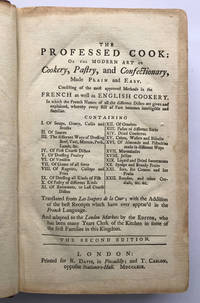
17693726<p>First published as Soupers de la cour in 1755 Menon's work first appeared in English in 1767 in a translation by Bernard Clermont under the title The Art of Modern Cookery Displayed Consisting of the most approved methods of cookery &c. London printed for the translator 1767. This is its first appearance under the new title which was to be retained for the third edition of 1776 in which the translator's name appears on the title-page. With a six-page 'Translator's Apology' in addition to the 'Author's Advertisement'. In his fascinating apology Clermont reveals many of the concerns of the eighteenth century chef while pointing to some of the key differences between English and French cuisine. He also writes about the challenges of translation: 'This Book was published in four small Volumes. I thought it too full of Words and of Repetitions and that the Sense of the Author could be explained without all the volubility of the French Language which I have as much as I was capable supplied with the Expressiveness of the English' p. vi.<br /><br />'Menon's book covers menus hors d'oeuvres entrées and some deserts. An entire chapter is devoted to sherbets or ices and ice cream. Like Marin that other great contemporary of Menon's both placed emphasis on their sauces. Menon's recipes were surprisingly varied coming not only from France but Italy Germany Ceylon and Flanders and used in everything from hors d'oeuvres to deserts' Harrison Une Affaire du Gout 1983.<em><br /></em><br /><em><br /></em><em>8vo 210 x 125 mm pp. xvi xxiv 286; 2 blank ii 289-588 some light browning in text in contemporary calf single filet gilt to covers plain spine with raised bands ruled in gilt spine worn with vertical cracking restoration to spine and corners rather a workaday bit of repair work tending to solidity rather than beauty with the early ownership inscription of M. Findlater on the front endpaper.</em><br /><br />See Harrison <em>Une Affaire du Gout A Selection of Cookbooks</em> 1475-1873 91.<br /><br />ESTC t90913 at BL and Harvard only.</p> R. Davis and T. Caslon