184 817 résultats
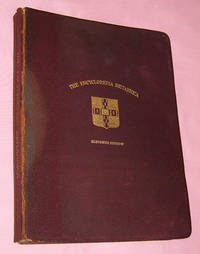
19100001045Cambridge: Cambridge University Press eleventh edition 1910. Full Flexible Leather with Vertical Case. Very Good . Large 4to complete with 29 volumes 8.75 x 11.75 about 1000 pages each. The ultimate encyclopedic reference for the historian or any other scholar who wishes to discover the "state of knowledge" in his or her specialty before 1910. When we found that precious edition at a yard sale in Minnesota more than 40 years ago when we were a lowly graduate student we almost wet our pants. Of course we bought it even though it cost us nearly two months' rent and we've been hauling it around with us ever since. Now it is time to pass it on to someone who will love as much as we the Royal we did! A Collectors' item. The interiors of all volumes are about as good as it gets. Original burgundy flexible leather covers are very good. They were very good when I bought them more than forty years ago and they have received several applications of preservative oils since then. Though a bit fragile they will last many more decades with care and careful handling. The 29 volumes sit horizontally in a vertical case of mahogany we think which has but minor easily remedied scuffing. The case is included obviously. Also included a "reader's guide" which is bound in tan buckram. This is obviously a very heavy product that is very expensive to ship and so shipping is negotiable depending on buyer's location and desire for care security etc. The product is undoubtedly too large to entrust to the US Postal Service. Cambridge University Press hardcover
"Whatever place its author may ultimately occupy in future histories of England, one thing is certain, that in the history of the Jewish people the name of Balfour will enjoy unchallenged immortality, evoking comparison with that of Cyrus, for the issue of the Balfour Declaration marked the opening of a new epoch in the annals of Jewry which will be recognised as such even in the remotest centuries to come. In this little book have been gathered together all the utterances of Lord Balfour on the interpretation and implications of his Declaration, on its political aspects and its practical realisation, made during the last ten years." - Preface. [4], 5-128 pp. 7" x 4.75". Original spine label present and intact. Front free endpaper professionaly replaced. Tanning to central portion of half-title. Prior owner's ink stamp upon title page. Duplicate spine label bound at p.128. Average external wear. Binding intact with moderate forward lean. No dust jacket, presumably as issued. Quarter inch notch from top of backstrip. A sound copy of this jewel of Zionist history. EMANUEL p.48. [ASIN B000852UV4] Book
1925000514Damascus: al- Matba'a al- Haditha 1925 Book. As New. Hardcover. 4to - over 9¾ - 12" tall. A comprehensive work by a well-known scholar and politician from Damasscus about the city including the political social and the other aspects during the Ottoman synasty in the last period. Six volumes 4to. in Arabic printed between 1343 and 1347 AH. 1925 and 1927 AD. in Damascus. 309 317 271 310 308 425 p. in later fine bindings. al- Matba'a al- Haditha hardcover
1963V91162Paterson, New Jersey, Rowman and Littlefield 1963 Complete series of 167 volumes, together over 100.000 pages, 29cm., uniform editor's hardcover bindings in green cloth, gilt lettering at spine, upper edges of some volumes are somewhat spotted (though not the pages themselves), this is a reprint of the original 194O's-edition, good condition, text and pages in very good condition, total weight: ca. 330kg., V91162
18930002122CROTON-ON-HUDSON WESTCHESTER COUNTY NEW YORK. Good. 1893. On offer is a super original manuscript relic of late 19th Century secret societies and fraternal organizations being an 1893 - 1895 IMPROVED ORDER OF RED MEN TRIBES Minutes Book. The book proper published specifically for the Club has printed forms for the IMPROVED ORDER OF RED MEN TRIBES. Pages on the left side of the open ledger have a Printed Heading with space for filling in information by hand. The page heading reads: "HUNTING GROUNDS OF" "WIGWAM OF" "TRIBE NO" "IMP. O.R.M." "SLEEP" and "MOON G.S.D.4" then below the heading information is printed information for the TRIBE to record Minutes Activities Events the INITIATION OF NEW MEMBERS etc. Includes such titles as: "Keeper of Wampum" "Application of Paleface" "Record of Previous Council Fire read" "Twig box was opened by" "New Business" "Council Fire was then Quenched" etc. Almost all pages are filled in with various handwritten minutes and notes about the REDMEN meetings including dates 1893-1895 place Croton-on-Hudson New York events New Member Induction Bill needing Payment Committee Reports Problem members General Problems Plans Political Stands etc. Pinned-on to one of the pages is a 2 page handwritten letter on "Improved Order of Red Men Wigwam of Kitchawau Tribe No. 237" letterhead. We cannot help but note that this book and the Society it represents predates the Washington Redskins baseball team controversy declaring the team name racist yet this fraternal organization clearly honors Native Americans and stands as an homage to their tribal attributes. Please read the Wiki article after the description. The ledger is also a treasure trove of genealogical and social history of the Westchester County area with many many names of members and their activities. The book has a leather spine and corners leather edged with gilt paper title label on front cover 8.5" x 13.5" pages printed on watermarked paper "Kenilworth" approximately 200-300 unnumbered pages. The front cover is split at its spine fold and is almost disbound. Internally a couple signatures including the first are shaky; one page is loose and is pinned-on to another page otherwise the pages are quite nice - tight bright and clean with writing that is clear and fully legible. HISTORICAL NOTES: Wiki: The Improved Order of Red Men traces its origin to certain secret patriotic societies founded before the American Revolution. They were established to promote Liberty and to defy the tyranny of the English Crown. Among the early groups were: The Sons of Liberty the Sons of St. Tammany and later the Society of Red Men. Their rituals and regalia are modeled after those used by Native Americans. The organization claimed a membership of about half a million in 1935 but has declined to less than 38000. Notable members: Theodore Roosevelt Warren G. Harding and Franklin D. Roosevelt. ; Manuscript; Folio - over 12" - 15" tall; KEYWORDS: HISTORY OF RED MEN FRATERNITY IMPROVED ORDER OF THE RED MEN KITCHAWAU TRIBE CROTON-ON-HUDSON WESTCHESTER COUNTY NEW YORK WASHINGTON REDSKINS SECRET PATRIOTIC SOCIETIES AMERICAN REVOLUTION THE SONS OF LIBERTY THE SONS OF ST. TAMMANY THE SOCIETY OF RED MEN DEGREE OF POCAHONTAS KNIGHTS OF PYTHIAS FRATERNAL ORGANIZATIONS SOCIETIES BROTHERHOODS SECRET SOCIETIES MOUND CITY LODGE PYTHIAN CASTLES PYTHIAN SISTERS DRAMATIC ORDER KNIGHTS OF KHORASSAN THE NOMADS OF AVRUDAKA PYTHIAN SUNSHINE GIRLS AND THE JUNIOR ORDER ORDER OF THE EASTERN STAR HALF CENTURY MATRONS CLUB PRINCE HALL AFFILIATION SISTERHOODS RELIGION AOKMC THE ANCIENT ORDER OF KNIGHTS OF THE MYSTIC CHAIN MASONS MASONIC FREEMASONS CHIVALRY ARCANE OCCULT AMERICANA HANDWRITTEN MANUSCRIPT AUTOGRAPHED AUTHORS DOCUMENT LETTER AUTOGRAPH KEEPSAKE WRITER HAND WRITTEN DOCUMENTS SIGNED LETTERS MANUSCRIPTS HISTORICAL HOLOGRAPH WRITERS AUTOGRAPHS PERSONAL MEMOIR MEMORIAL PERSONAL HISTORY ARCHIVE DIARY DIARIES JOURNAL LOG PRIMARY SOURCE FIRST HAND ACCOUNT SOCIAL HISTORY PERSONAL STORIES LIVING HISTORY ANTIQUITÉ CONTRAT VÉLIN DOCUMENT MANUSCRIT PAPIER ANTIKE BRIEF PERGAMENT DOKUMENT MANUSKRIPT PAPIER OGGETTO D'ANTIQUARIATO ATTO VELINA DOCUMENTO MANOSCRITTO CARTA ANTIGÜEDAD HECHO VITELA DOCUMENTO MANUSCRITO PAPEL . hardcover
32353-V1-1Government Printing Office Washington 1870. Full cloth Rare first edition orig. signed by the later preseident of the USA James A. Garfield. 487 pp. Index -good.-The cover is somewhat smudged and discoloured ex-libris Ernesti de Halle This is Ernst von Halle 1868-1909 / Hamburg Berlin-Grunewald economist on the inside of the front board small bits torn out of the two front fly-laves name in ink on the front fly-leaf stamp form the Amerika-Institut in Berlin on 2 pages some foxing. Spine damaged at top and bottom small parts of cloth missing. Still in a good condition. Government Printing Office, Washington, 1870 hardcover
1948104585BBBeverly Hills, Copley Galleries, 1948. 4°. 12 S., [2] Bl. mit 5 Abb., 2 Illustrationen u. 1 signierten und num. Heliogravure ("autographed photograph by the artist", Bildgröße 23,2 x 13,6 cm.). Hellblauer OKart. mit gelbem umgelegten OKart.
1825c2401040028xbvkNot localized or dated (3 sheets with watermark 'J. Whatman / Turkey Mill** / 1823 [resp. 1824*** and 1825]'), ca. 1823-1825. 18 sheets of paper of the period, sizes from ca. 24 x 19 cm to ca. 31 x 22 cm; the drawings within pencil-frames of ca. 18 x 13/14 cm, slightly varying; 16 of them signed 'P. J. Redouté' in the lower left corner of the frame****. - Loose in olive-grey folded carboard of the period with ink-title at frontpanel (as quoted above) and another similar title in pencil at inner rear-panel (perhaps by Redouté himself): ''Dessin / des Roses / 168 Dessin au Trait / Collection des Dessins originaux / de L'ouvrage des Roses pour l'Edition en-4°- / 168 Dessins au Trait''; Folio (ca. 32,5 x 24,5 cm).
Together 5 vols., 8vo., with frontispieces and illustrations in the text, the first two works with front and rear endpaper maps, the third work with large folding map at end; hand-woven indian silk sides, moroccan wassa goatskin backs lettered in gilt, gilt tops, silk ribbons, all volumes housed in three separate custom-made Moroccan wassa goatskin slip-cases with scalloped edges and elaborately decorated and lettered in gilt, the whole extended set (books and slip-cases) in fine state. EDITION LIMITED TO 1750 NUMBERED EXTENDED SETS (THIS SET No. 861). The extended set comprises 'The Hobbit' (seventh printing thus, 2002); 'The Fellowship of the Ring' (seventh printing thus, 2002); 'The Two Towers' (sixth printing thus, 2001); 'The Return of the King' (seventh printing thus, 2002); 'The Silmarillion' (fourth printing thus, 2003). ' The Silmarillion' is edited by Christopher Tolkien. 'The Lord of the Rings' trilogy is illustrated by Ingahild Grathmer drawn by Eric Fraser, 'The Hobbit' by Eric Fraser and 'The Silmarillion' by Francis Mosley. Calligraphy for all volumes is by John Andrew and the bindings are by Smith Settle of Otley. ORIGINAL SUBSCRIBER'S EXTENDED SETS (ALL FIVE VOLUMES WITH MATCHING ISSUE NUMBERS) ARE MOST UNCOMMON.
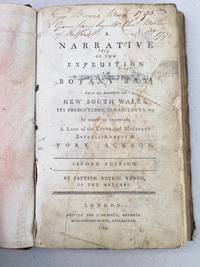
229659J. Debrett London 1789. 146 pp plus 2pp of Debretts advertisements at end - no half-title as often contemporary quarter-calf binding spine replaced- annotations on front paste-down and title- see below - overall a firm and comfortable copy of this foundation stone of Australian settlement - with contemporary patina and association. Title page inscription: Geo. Brown's Book 1795 Given him by Mr Chas. Booth of Retford Nott 1792 Front paste-down inscription: "Mr Chas. Booth inlisted for a Soldier on being refus'd his Fortune to purchase a Commission went over to Ireland and died as soon as he arrived He was a handsome youth about Twenty years Old - was the son of Mr Alister John Booth - Retford - The youngest of his numerous family. " A sad and poignant minor marker in the sequence of this tome's history. Second edition . J. Debrett, London, 1789 unknown
Very Good Turkish, Ottoman (1500-1928) Original dark brown handsome full leather bdg. with a traditional flap. Folio. (32 x 22 cm). In Ottoman script (Old Turkish with Arabic letters). [2], [6], 238 leaves. The size of the text block in red borders: 25.5 x 14.5 cm. 33 lines on each page. Printed on paper with European watermarks. The size of the text block in red borders: 25 x 14.5 cm. 33 lines on each page. Printed on paper with European watermarks. Handwritten title on the bottom edge. A fine copy. The 19th incunable of the Islamic world, printed by Ibrahim Müteferrika's legendary Basmahane. The publication of Ottoman chronicles which began in 1734 with the edition of Naimâ's history, continued after a long break in 1783. This volume, containing the works of three court chroniclers who followed each other in rapid succession, is a chronological continuation of Mehmed Râsid's history, published by Müteferrika. Arpaemînizâde Mustafa Sâmî (deceased 1734) was the court's historian from 1730 to 1733, Sâkir Hüseyin (died 1742) in 1733, and Subhî Mehmed (ca. 1711-1769) from 1739 to 1745. The work of the three chroniclers is known as one coherent historiography, which presents the events of Ottoman history from 1730 to 1744. This work is a particularly valuable source on the Habsburg-Ottoman war between 1736 and 1739, in which Subhî participated in person. The prestige of the work, which offers detailed data on the administrative events (appointments, dismissals, and other biographical communications) is further increased by the fact that Subhî in many cases used original documents. This chronicle includes the events between the years 1730-1743. Contents: Ahd-i Humâyûn [i.e. Imperial constitutional declaration]., Zikr-i tecdîd-i san'at-i tab' [i.e. Preface on the Muteferrika Press of Vasif Efendi]., Fihrist-i târîh-i Sami ve Sakir ve Subhi [i.e. Contents of the work]., Text., History of Subhi. The workshop of Müteferrika began its historical mission in 1728. They published 17 works in 22 volumes. The printing house served as a means to the long-term goal of Müteferrika, his efforts to broaden the horizon and modernize the knowledge of Ottoman society and Islamic civilization. This is evidenced by the subjects of the books selected for publishing, the motivations put forth in the publisher's introductions, as well as by the documents illuminating the background of the publication of each book, also published in print. In 1742, with the publication of the Persian dictionary of Hasan Suûrî, a chapter of Ottoman book printing came to an end. With the death of Müteferrika, the printing of Turkish books was temporarily interrupted. The first generation of Ottoman-Turkish prints was soon followed by a new series when in 1756 Ahmed and Ibrâhîm Efendi (the latter perhaps the founder's son, according to speculative sources) made an attempt to resurrect the legacy of Müteferrika through the possession of a decree obtained from the Sultan. However, this experiment did not prove to be lasting, as it did not last longer than the new edition of the first Turkish printed book, the Lugat-i Vankûlî. After this, for several decades there was no continuation to the Turkish book printing established by Müteferrika, until in 1783 the workshop was put in operation again for the publication of six more works. The subjects of these late 18th century works were dominated by history and military technology, thus Müteferrika's strategy of book distribution made its way hand in hand with the efforts of modernization of the Ottoman state. The second edition of Lugat-i Vankûlî followed the principles of the first edition, and its introduction was composed on the model of the introductory pages of the two last books published under Müteferrika's supervision. The works published after 1783 display a noticeable development in typography not only as to its somewhat refined visual impression but also in its structure. For example, the d+h and r+h ligatures, (For more info please visit our website)
Very Good Turkish, Ottoman (1500-1928) Original dark brown handsome full leather bdg. with a traditional flap. Folio. (32 x 22 cm). In Ottoman script (Old Turkish with Arabic letters). [9], 288 leaves. The size of the text block in red borders: 25 x 14.5 cm. 33 lines on each page. Printed on paper with European watermarks. Handwritten title on bottom edge. Marginal cutting on the first page. Overall a very good copy. The 20th incunable of the Islamic world, printed by Ibrahim Müteferrika's legendary Basmahane. Süleymân Izzî succeeded Mehmed Subhî Efendi (ca. 1711 - 1769) in 1745 as an official court historian (vaka'nüvis) and held this office until 1753, and is known as one of the three chroniclers for coherent historiography, representing the events in the Ottoman history from 1730 to 1744 and is a particularly valuable source on the Habsburg-Ottoman War between 1736 and 1739, as proven by his chronicle titled "Tevârîh-i Sâmî ve Sâkir ve Subhî", published in 1784. During this time, he recorded the contemporary events taking place between 1744 and 1753 in the Ottoman Empire. This work was the last item in a series of chronicles published by the printing house founded by Müteferrika. Franz Babinger writes that some parts of the book have been translated into German. Hammer translated one of the parts in question into German. All published, Izzi has planned the third part of his work, but this third part was never published. Contents: "Ahd-i Hümâyûn".; "Zikr-i iâde-i fenn-i tiba'at" [i.e. On the book pressing and publishing with a preface by Ahmed Vâsif Efendi].; "Fihrist-i Târîh-i Izzî" [i.e. Content of Izzi's history].; Izzî tarihinin birinci bölümü [i.e. The first chapter].; Izzî tarihinin ikinci bölümü [The second chapter]. The workshop of Müteferrika began its historical mission in 1728. They published 17 works in 22 volumes. The printing house served as a means to the long-term goal of Müteferrika, his efforts to broaden the horizon and modernize the knowledge of Ottoman society and Islamic civilization. This is evidenced by the subjects of the books selected for publishing, the motivations put forth in the publisher's introductions, as well as by the documents illuminating the background of the publication of each book, also published in print. In 1742, with the publication of the Persian dictionary of Hasan Suûrî, a chapter of Ottoman book printing came to an end. With the death of Müteferrika, the printing of Turkish books was temporarily interrupted. The first generation of Ottoman-Turkish prints was soon followed by a new series, when in 1756 Ahmed and Ibrâhîm Efendi (the latter perhaps the founder's son, according to speculative sources) made an attempt to resurrect the legacy of Müteferrika through the possession of a decree obtained from the Sultan. However, this experiment did not prove to be lasting, as it did not last longer than the new edition of the first Turkish printed book, the Lugat-i Vankûlî. After this for several decades there was no continuation to the Turkish book printing established by Müteferrika, until in 1783 the workshop was put in operation again for the publication of six more works. The subjects of these late 18th century works were dominated by history and military technology, thus Müteferrika's strategy of book distribution made its way hand in hand with the efforts of modernization of the Ottoman state. The second edition of Lugat-i Vankûlî followed the principles of the first edition, and its introduction was composed on the model of the introductory pages of the two last books published under Müteferrika's supervision. The works published after 1783 display a noticeable development in typography not only as to its somewhat refined visual impression, but also in its structure. For example, the d+h and r+h ligatures, characteristic of the first generation of Müteferrika's printed books, are replaced by separate letters. This extremely rare presented book is from the seven publications of this late period of the
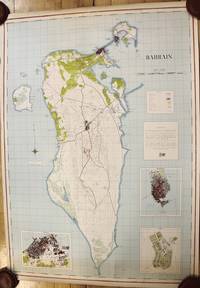
1951M9730London c.1951-1953. Very Good mounted on contemporary linen. Notes: A very scarce wall map of Bahrain published jointly by the Royal Geographical Society and the Bahrain Petroleum Company. The map depicts roads tracks buildings cultivated areas marshland and the Bahrain Refinery. Major cities as Awali Manama Town and Muharraq Town are shown in detail. The map has three large insets of Muharraq Awali and Manama.<br><br>Bahrain small Arab state situated in a bay on the southwestern coast of the Persian Gulf. It is an archipelago consisting of Bahrain Island and some 30 smaller islands. Its name is from the Arabic term al-baḥrayn meaning “two seas.†The economy has long relied on processing crude oil from neighbouring countries and more recently the financial commercial services and communications sectors have grown markedly as has tourism.<br>Britain’s decision to withdraw all of its forces from the gulf in 1968 led Bahrain’s independence in August 1971. A treaty of friendship was signed with the United Kingdom terminating Bahrain’s status as a British protectorate.<br> Size : 925x655 mm 36.42x25.79 Inches Coloring: Hand Colored Category: Maps Asia Middle East Persian Gulf; unknown
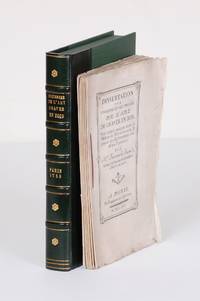
175876869Paris: J. Barbou 1758. unbound cord tied housed in a green half-morocco goat over cloth boards clamshell case spine tooled in gold leaf with title author and date. large 12mo. unbound cord tied housed in a green half-morocco goat over cloth boards clamshell case spine tooled in gold leaf with title author and date. 92 3 pages. Pour éclaircir quelques traits de l"histoire de l'Imprimerie & prouver que Guttemberg n'en est pas l'Inventeur. Very rare first edition Bigmore and Wyman p.227. Unbound textblock lightly soiled with minor creasing at corners. Faint moisture staining throughout with some affecting the text. In this text Fournier sets out to prove that Gutenberg was not the inventor of the printing press by examining the history of printing. He believed that the technology Gutenberg made popular existed long before the German printer's work. Fournier also followed up this text with two additional works which are not present: De l'origine et des productions de l'imprimerie primitive en taille de bois 1759 and Observations sur un ouvrage intitulé Vindiciae Typographicae 1760. These two works provided further discussion of the origins of woodcut prints including a passage refuting popular belief about the origin wood engraving and some ideas for further study. <BR> <br /> <BR> <br /> Fournier 1712--1768 was born in Paris and trained as a wood engraver and type founder being a member of the 18th century dynasty of the well-known Fournier family. He later turned to steel engraving. He published a table of the proportions of the different printing characters whose purpose was to propose for all typefaces a fixed measurement in "typographic points" and a systematic gradation. He worked closely with the collaborators of the Encyclopédie providing the printer Le Breton with all the documentation relating to the typographic foundry and plans for his own instruments as well as providing Diderot with his collection of ancient alphabets. Finally after multiple disputes with his Parisian colleagues he became infamous for the printing of his famous Manuel Typographique 1764 1766 just prior to his death. J. Barbou unknown
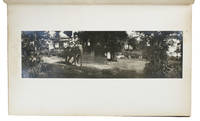
1903LCCDKE4XUWG9Batavia: G. Kolff & Co. 1903. Contemporary brown cloth title in gold decorated endpapers. Folio. With 1 engraved double-page plate 4 lithographed colour-plates and 22 albumen photographs with guard leaves containing text. 2 works in 1 volume. Rare first and only edition of a report on the investigation of tea cultivation and production in Assam India and Ceylon. The Dutch cultural association Cultuur Maatschappij in Palakan-Salak asked H.J.Th. Netscher and Alexander Albert Holle to investigate the Assam and Ceylon tea cultivation and production with regard to the economic position of Java tea in the world market. Netscher and Holle had their investigations on tea cultivation and culture in British India and Ceylon printed but never put them on the market merely giving some copies to parties concerned with the tea industry. They gave the present copy to Norbert Pieter van den Berg head agent of the Dutch East Indian commercial bank at Batavia and president of the Javanese bank. The report discusses various aspects of tea and its cultivation including the geographic dissemination different kinds of tea seeds the conservation of tea seeds the process of drying tea leaves and the arrangement of tea factories. But the book also describes some remarkable things that caught Netscher and Holles attention of during their journey. They write for example about sugar and elephants. Nevertheless the main purpose of their report was to gather information on British-Indian tea cultivation especially regarding competion on the world market.The 22 albumen photographs in the present copy inserted through the whole book show mainly the tea gardens of Assam and Ceylon but also elephants and landscapes Netscher and Holle saw on their journey. A sign for that at least some of these photographs are contemporary is that they refer to their own train on one of the pictures. These pictures give this extensive and important report on tea cultivation enriching insights into the tea cultivation in British-India and Ceylon ca. 1900.Presentation copy from the Cultuur Maatschappij Parakan-Salak to Norbert Pieter van den Berg with some bolts at the end of the book unopened. Head and foot of spine slightly rubbed corners bumped some stains on the boards. Slightly browned not affecting the text otherwise in very good condition.l WorldCat 9 copies not noting the albumen prints; for Netscher & Holle: All about tea p. 128; Performing otherness: Java and Bali on international stages 1905-1952 p. 15; for Norbert Pieter van den Berg: Biographisch woordenboek der Noord- en Zuidnederlandsche letterkunde pp. 55-56. G. Kolff & Co., hardcover
19682091502135413708Not Available 1968. Soft Cover. Fine. Volume: 49 Not Available paperback
19732091502135703607National Palace Museum Gakushu Kenkyusha 1973. Soft Cover. Fine. The book is in fine condition. National Palace Museum Gakushu Kenkyusha paperback
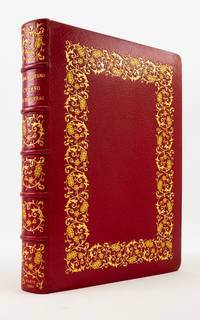
1899ST20804Paris: Armand Magnier 1899. No. 42 OF 500 COPIES this ONE OF 20 ON JAPON WITH ENGRAVINGS IN THREE STATES. 300 x 207 mm. 12 x 8". 4 p.l. <br/> ELEGANT SCARLET CRUSHED MOROCCO GILT AND INLAID BY THE CLUB BINDERY and LEON MAILLARD Finisher both names stamp-signed in gilt on front turn-ins covers framed by curling gilt vines bearing citron morocco blossoms a total of 104 inlays on each cover raised bands spine panels with gilt vine circlets blooming with a total of 20 inlaid citron morocco flowers gilt lettering turns-ins elaborately gilt marbled endpapers top edge gilt other edges untrimmed. Original paper wrappers bound in the pictorial front cover present in three additional states black & white B&W before letters and color. In slightly worn matching morocco-backed jacket. With 54 wood engravings by Romagnol after François Thévenot cover and portrait Adrien Moreau Act I Charles Léandre Act II Albert Laurens Act III François Flameng Act IV and Albert Besnard Act V including five full-page plates all in three states one before letters the full-page plates also in a color state separately furnished to subscribers by the publisher per a notice bound in at the end of the text. Front pastedown with morocco bookplate of Robert Hoe. Lower corners a bit bumped tail edge of lower board with shallow one-inch dent occasional paper flaws or discoloration to edges of leaves but an excellent copy the interior clean and fresh and the binding lustrous.<br/> <br/> This is a luxurious illustrated edition of Rostand's classic work offered in a sumptuous binding done by the Club Bindery for its co-founder and manager Robert Hoe. Rostand's influential and enduringly popular 1897 verse play in five acts--sometimes referred to colloquially as the "Romance of the Nose"--is loosely based upon the real-life story of the French author and duelist Cyrano de Bergerac 1619-55 who was famous for having a prodigious proboscis. A theatrical triumph from its opening night the play focuses on the eloquent Cyrano's unrequited love for the comely Roxanne whom he must court as secret proxy for a friend of handsome visage but wooden tongue. Rostand 1868-1918 wrote a number of successful plays often like "Cyrano" based on figures from French history. The present beautiful large-format copy was originally owned by Robert Hoe a founder of the Grolier Club and one of the world's great book collectors. After Grolier was established in 1884 it soon became apparent that the country's few established hand binders were overtaxed in providing repairs and rebinding for the club members' rapidly accumulating acquisitions. As a consequence in 1895 Grolier members along with Edwin Holden and other wealthy collectors established the Club Bindery in order to attract European craftsmen to provide close to home fine quality binding work rivalling what was available abroad. The Club Bindery was in operation until 1909 with Hoe being its manager and most important client. It provided bindings that tended to be traditional in style--though frequently with elaborate decoration--and that lived up to its patrons' expectations in terms of excellence. The first members of the staff of the Club Bindery were the Englishmen R. W. Smith and Frank Mansell. They were subsequently joined by a number of French binders chief among them being Leon Maillard who had worked previously for Cuzin Gruel and Marius-Michel and whose precise and intricate finishing is impressively demonstrated on our binding here. It is said by Beverly Chew that Hoe 1839-1911 had a collection that was "the finest America has ever contained." He acquired illuminated manuscripts early printing he owned a Gutenberg Bible on paper and one on vellum fine bindings French and English literature and Americana and when his library was sold in 1911-12 it fetched nearly $2 million a record that held until the Streeter sale more than 50 years later. The present volume represents the fine level of aesthetic achievement typical of the bindery and it is especially impressive because of its significant dimensions. Armand Magnier unknown
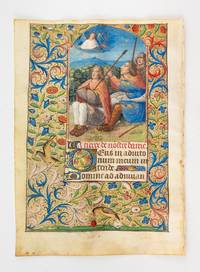
1500ST20810PParis ca. 1500. 165 x 117 mm. 6 1/2 x 4 5/8". Single column 18 lines in a gothic book hand. <br/> Rubrics in red line fillers in blue and pink with gold bezant five one-line initials in burnished gold on pink and blue ground one two-line initial in blue on gold ground with a flower in the center one three-line initial in blue filled with ivy on gold ground recto with panel border of colorful flowers vase and acanthus verso with A LARGE ARCH-TOPPED MINIATURE OF THE ANNUNCIATION TO THE SHEPHERDS surrounded by A FULL BORDER of acanthus flowers and two birds all on a painted gold ground. Slight soiling to vellum but a very well-preserved leaf in fine condition.<br/> <br/> From what was surely a costly Book of Hours this leaf features a charming and skillfully painted miniature of the Annunciation to the Shepherds attributable to the workshop of Jean Pichore fl. ca. 1502-20 a major figure among illuminators of the period and one of the most sought-after artists in France at the turn of the 16th century. Depicting the traditional subject associated with the hour of Terce our miniature portrays as usual an angel appearing to shepherds tending their flock bringing news of the birth of Christ. Although the biblical narrative suggests that the shepherds were startled by the angel's appearance the three figures in this miniature appear remarkably unmoved--in fact only one of them seems to take any notice at all. The first shepherd sits on the ground looking straight ahead; the second holds his hands in prayer but looks little more than well prayerful at the angel in the sky; and a third figure maintains a slightly aloof expression taking no particular interest in the unfolding miraculous event. What may seem to be indifference can be explained easily enough by the artist's successful portrayal of nighttime cold! All three shepherds are thickly dressed one with his arms pressed tightly against his chest another with a hood partly covering his face and the sheep are tightly huddled together into one woolly white cluster. Another manifestation of the artist's success here is seen in the particularly well done molding of the faces with subtle shading attractively rendered features and clear individuation. Moreover although the shepherds seem essentially unmoved their garments are dusted with a glistening gold radiance from above a further subtle touch revealing a high level of achievement on the part of the painter. Finally the borders are one last source of delight with a small bird shown in mid-flight and a second one investigating a single strawberry that seems to have been placed there just for him. All of these indications of sophistication suggest that the original manuscript must have been commissioned by a patron able to pay a premium for the work of a highly skilled atelier. unknown
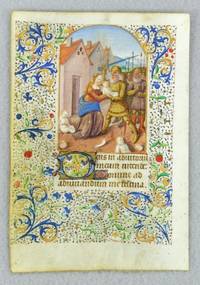
1450ST11774-85Paris ca. 1450. 159 x 108 mm. 6 1/4 x 4 1/4". Single column four lines of text on the verso 15 on the recto in a very pleasing gothic book hand. <br/> Attractively matted. Recto with a line filler in colors and gold verso with a one-line initial in burnished gold on a maroon and blue background with white tracery and a three-line "D" in blue and white enclosing a spray of violets in the same colors the capital on a burnished gold ground the same side WITH A FULL SWIRLING BORDER of acanthus leaves flowers and berries and many burnished gold ivy leaves ENCLOSING A BLOODY ILLUMINATED MINIATURE OF THE MASSACRE OF THE INNOCENTS measuring approximately 78 x 54 mm. Fore and lower margins on the side with the miniature a bit rubbed and with a faint patina reflecting frequent use also minor fading and loss of paint and gold in the same place otherwise in fine condition THE MINIATURE itself REMARKABLY WELL PRESERVED WITHOUT ANY EROSION OF PIGMENT.<br/> <br/> This leaf comes from a Book of Hours decorated by extremely skilled members of what must have been a first-class workshop. The Massacre of the Innocents cannot help but be a moving subject and the composition here as well as the painter's considerable ability add to the emotional impact in the present miniature. The center of the scene is dominated by the gold-armored gray-bearded soldier whose sword is raised over the head of a woman clinging to her son. The blood-spattered foreground is littered with the dismembered bodies of infants looking like so many broken dolls. On the left we see a row of modest cottages providing considerable depth as they recede toward distant hills. On the right stands a crowd of grim-faced soldiers all as elderly as their commander and seemingly following orders that are unwelcomed; it is perhaps the acute sadness in their faces that makes this scene especially memorable. The clear sky green fields and serene blue mountains in the distance contrast markedly with the horrific events unfolding. unknown
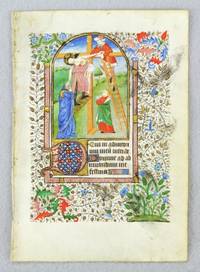
1420ST12005fFrance probably Paris ca. 1420. 210 x 146 mm. 8 1/4 x 5 3/4". Single column recto with five lines of text verso with 16 lines all in a very pleasing very regular gothic book hand. <br/> Attractively matted. Rubrics in red verso with a one-line and two two-line initials as well as a line filler in colors and burnished gold recto with a one-line initial and a line filler in the same style and with a quite large five-line "D" in pink and white with enclosed floral diapering all on a burnished gold ground the same side WITH A LOVELY FULL BORDER of swirling hairline stems bearing numerous leaves and berries of burnished gold and with sprays of acanthus leaves and flowers in multiple colors spilling from the corners this ENCLOSING A POIGNANT ARCH-TOPPED MINIATURE OF THE REMOVAL OF CHRIST FROM THE CROSS measuring approximately 85 x 60 mm. the miniature within a thin gold frame and enclosed in turn on three sides by bars in colors and gold the scene showing two men on ladders unfastening Christ's lifeless body from the cross while Joseph of Arimathea waits below clutching cloth to be used for a burial shroud as the Madonna at the lower left of the picture reaches up to clasp her son's bloody arm. With a small cross stitched in white thread in each upper corner. ◆A little soiling right along hinge edge a few smudges in the border a couple of tiny flakes of paint missing from the cross and the sky otherwise fine the vellum clean and fresh the colors rich and the gold lustrous.<br/> <br/> This is an especially sorrowful scene depicted with power grace and sensitivity by an artist demonstrating very considerable skill in composition and execution. The scene is well designed with the cross providing a device for focus at the center of the miniature. Nicodemus identified by his expensive attire is atop a ladder behind the cross lowering Christ's limp body onto the shoulder of another man probably a servant whose ladder is set against the front. Despite the fact that the corpse is more bones than flesh the artist has made it seem a heavy burden draped over the shoulder of the man as he walks backward down his ladder. Fully stretched out Christ's left arm is held for balance by Nicodemus at the top right while the other arm hangs down toward the Virgin. While we can only see her back her image evokes great pathos as she reaches up with both hands to grasp the mangled arm of her son his blood running from his hand onto hers. Joseph of Arimathea whose position anchors the right side of the picture looks on with concern tightly holding linen to shroud the body. St. John and Mary Magdalen conventional participants in the Deposition are not present in this miniature. While it is possible and even likely that the same artist produced this scene and the miniature of Christ Carrying the Cross this one is better as the faces are more deftly painted and the folds in the various garments are more clearly defined. unknown
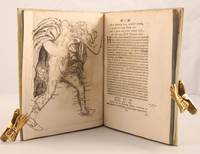
108053Uppsala 1701. 4 79 1 blank 16 pp. Parallel Latin and Swedish text. Additional engraved title-page. 1 engraved map of the Baltic Sea in the shape of a man. 2 woodcut plates 1 folding. Woodcut initials. 16 pp. misbound at end. Bound with : Illustri celeberrimoque viro dn. Johanni Wallisio proffessori incluta Oxoniensi academia primario & seniori Olavus Rudbeckius filius S.P.D. Uppsala 1703. 12 pp. Contemporary vellum. A fine copy. . hardcover
Druck der Ashendene Press in 150 Exemplaren. Gedruckt in der Subiaco Type in Rot und Schwarz, mit großen rubrizierten Initialen in Blau von Graily Hewitt. Gedruckt von St. John und Cicely Hornby. Nach Colin Franklin ist dieses Buch eines der chamantesten Werke der Presse. Sehr schönes und sauberes Exemplar.
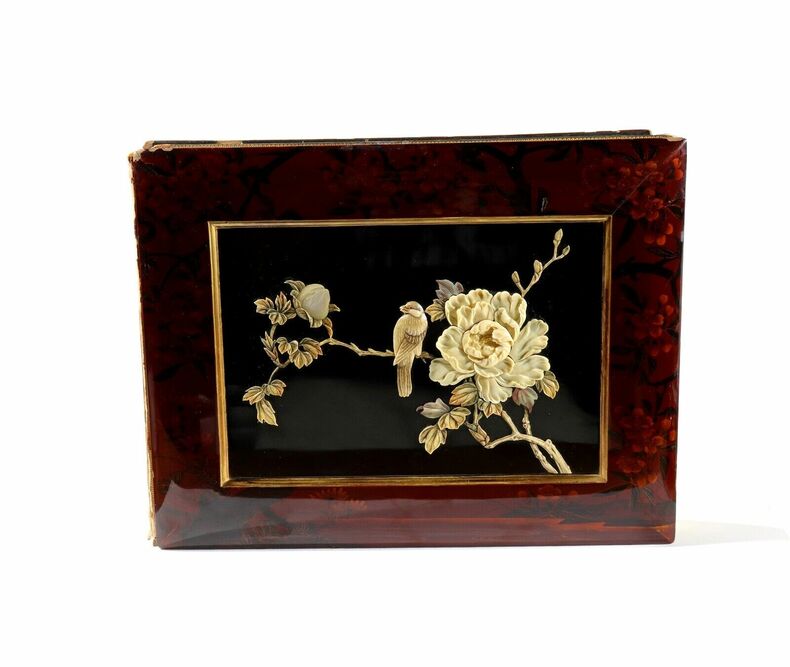
1890AMO-4520[Japon, Yokohama ?, vers 1890] Très beau spécimen en grand format (36 x 27 cm environ pour l'album et 26,5 x 20,5 cm pour les tirages). Complet. Très bel album très bien conservé malgré quelques chocs sur quelques bords et le dos de l'album manquant (bande de cuir), parfaitement solide et très décoratif. Très belle esthétique d'ensemble, superbe décor sur le premier plat (rare aussi beau et fin). Intérieur d'une grande fraîcheur. Beau coloris au pinceau à la main.
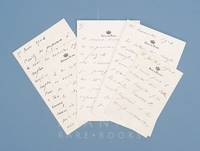
1901100107AG1901. Laeken / Brussels Château de Laeken Palace of Laeken 1901 - 1906. 16 pages of MLS Manuscript Letters signed on 10 leaves of Leopold's official stationery "Château de Laeken" and "Palais de Bruxelles". The leaves with different sizes 135 cm x 9 cm and 18 cm x 115 cm. Excellent condition. Unsigned. Tremendously rare to find original letters by Leopold II on the open market in which the Colonial Free State and the protection against inquisitive visitors is discussed in such clear and instructive fashion. Leopold's correspondence with Adolphe de Cuvelier shows how he is very much trying to still protect and influence the narrative of his Colonial Slavery Outpost even in the final years of his life. Adolphe de Cuvelier 1860-1931 Secretary General of the Ministry of Foreign Affairs of the Congo Free State President of the Syndicate for Studies and Enterprises in Congo. He was given the title of knight in 1893 and baron in 1908 each transferable at first birth. Wikipedia _______________________________ Leopold II French: Léopold Louis Philippe Marie Victor; 9 April 1835 17 December 1909 was the second King of the Belgians from 1865 to 1909 and through his own efforts the owner and absolute ruler of the Congo Free State from 1885 to 1908. Born in Brussels as the second but eldest surviving son of Leopold I and Louise of Orléans he succeeded his father to the Belgian throne in 1865 and reigned for exactly 44 years until his deaththe longest reign of any Belgian monarch. He died without surviving legitimate sons. The current Belgian king descends from his nephew and successor Albert I. Leopold was the founder and sole owner of the Congo Free State a private project undertaken on his own behalf as a personal union with Belgium. He used Henry Morton Stanley to help him lay claim to the Congo the present-day Democratic Republic of the Congo. At the Berlin Conference of 18841885 the colonial nations of Europe authorized his claim and committed the Congo Free State to him. Leopold ran the Congo using the mercenary Force Publique for his personal gain. He extracted a fortune from the territory initially by the collection of ivory and after a rise in the price of natural rubber in the 1890s by forced labour from the native population to harvest and process rubber. Leopold's administration of the Congo Free State was characterised by atrocities and systematic brutality including torture murder and the amputation of the hands of men women and children when the quota of rubber was not met. In 1890 George Washington Williams used the term "crimes against humanity" to describe the practices of Leopold II of Belgium's administration of the Congo Free State. Colonial accounts typically emphasized Leopold's modernizing changes in the Congo and not the mass death he facilitated. These and other facts were established at the time by eyewitness testimony on-site inspection by an international commission of inquiry and the 1904 Casement Report. Modern estimates range from 1 million to 15 million Congolese deaths with a consensus growing around 10 million. Some historians argue against these figures citing the lack of reliable censuses the enormous mortality caused by smallpox and African trypanosomiasis and the fact that there were only 175 administrative agents in charge of rubber exploitation. In 1908 the reports of deaths and abuse and pressure from the Congo Reform Association and other international groups induced the Belgian government to take over the administration of the Congo from Leopold as a new territory Belgian Congo. Wikipedia unknown