184 822 résultats
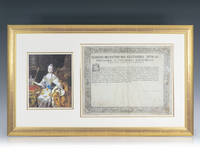
98658<span class="match">Document </span>in Cyrillic boldly signed by Catherine the Great "Ekaterina." Renewal of an appointment for Lieutenant General Otto von Derfelden dated 1784. Double-matted with an image of <span class="match">Catherine</span> Catherine II Russian: Yekaterina Alekseyevna also known as Catherine the Great born Princess Sophie of Anhalt-Zerbst was Empress of Russia from 1762 until 1796 the country's longest-ruling female leader. She came to power following a coup d'etat which she organized--resulting in her husband Peter III being overthrown. Under her reign Russia was revitalized; it grew larger and stronger and was recognized as one of the great powers of Europe. That said however she was a usurper of the Russian throne because her son Paul I should have naturally been the Tsar following Peter III's death. In her accession to power and her rule of the empire Catherine often relied on her noble favourites most notably Grigory Orlov and Grigory Potemkin. Assisted by highly successful generals such as Alexander Suvorov and Pyotr Rumyantsev and admirals such as Fyodor Ushakov she governed at a time when the Russian Empire was expanding rapidly by conquest and diplomacy. In the south the Crimean Khanate was crushed following victories over the Ottoman Empire in the Russo-Turkish wars and Russia colonised the territories of Novorossiya along the coasts of the Black and Azov Seas. In the west the Polish-Lithuanian Commonwealth ruled by Catherine's former lover king Stanislaw August Poniatowski was eventually partitioned with the Russian Empire gaining the largest share. In the east Russia started to colonize Alaska establishing Russian America. Catherine reformed the administration of Russian guberniyas and many new cities and towns were founded on her orders. An admirer of Peter the Great Catherine continued to modernise Russia along Western European lines. However military conscription and the economy continued to depend on serfdom and the increasing demands of the state and private landowners led to increased levels of reliance on serfs. This was one of the chief reasons behind several rebellions including the large-scale Pugachev's Rebellion of cossacks and peasants. Catherine decided to have herself inoculated against smallpox by a Scottish doctor Thomas Dimsdale. While this was considered a controversial method at the time she succeeded. Her son Pavel was later inoculated as well. Catherine then sought to have inoculations throughout her empire stating: "My objective was through my example to save from death the multitude of my subjects who not knowing the value of this technique and frightened of it were left in danger." By 1800 approximately 2 million inoculations were administered in the Russian Empire. The period of Catherine the Great's rule the Catherinian Era is considered the Golden Age of Russia. unknown books
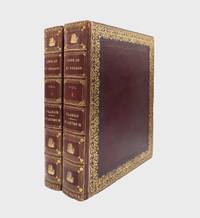
1809375553London: Printed by T. Bentley Bolt Court Fleet Street for T. Cadell and W. Davies in the Strand and W. Miller Albemarle Street 1809. First Edition. Frontispiece and 3 other plates to volume I 7 plates to volume II 4 of them accompanied by plans headpieces vignettes and facsimiles to the text double page pedigree to volume. 375; 511 pp. 2 vols. Imperial Quarto. Contemporary full maroon straight-grained morocco flat bands title gilt direct to the spines compartments with nested concentric gilt panels centred on a rope-twist panel with a ship under sail centre tool in the first fifth and sixth compartments wide arabesque rolled panels to the boards enclosing ruled and foliate panels in blind dog-tooth edge-roll all edges gilt dog-tooth roll to turn-ins dun endpapers. First Edition. Frontispiece and 3 other plates to volume I 7 plates to volume II 4 of them accompanied by plans headpieces vignettes and facsimiles to the text double page pedigree to volume. 375; 511 pp. 2 vols. Imperial Quarto. "One of the main foundation stones of the Nelson legend" Wilson 'Nelson Apotheosised' in Cannadine ed. Admiral Lord Nelson "the 'official' biography" NMM. M'Arthur a former naval purser had served with Nelson in the Mediterranean and had already begun collecting material for a biography when he saw "an advertisement in the papers announcing that the Nelson family had selected a gentleman 'of high respectability and rank' to write the life and asking all who had letters . in their possession not to make their material available to anyone else." McArthur came forward claiming groundlessly that Nelson himself had asked him to write his life and that he had already incurred considerable expense in preparing the book including the commissioning of a set of paintings to be engraved as illustrations. An unseemly squabble ensued the outcome of which was fairly inevitable in that Earl Nelson was under pressure from the Prince Regent to commission his librarian and chaplain James Stanier Clarke to write the book. It was agreed that the authors would pool their efforts but not before they had further fallen out over whose name should come first on the title page. That we do not refer to McArthur & Clarke is a lasting memorial to the usefulness of a powerful patron. The finished work is wonderfully illustrated with anecdotal head-pieces and plates by Westall and battle-scenes by Nicholas Pocock. The subscribers list is a remarkable directory of the great and the good of Regency Britain with an inevitable emphasis on naval notables. William Beckford took a copy on vellum - one of two "one of which was burnt" - Sir Home Popham and Admiral Keats proof copies as also Admirals Cornwallis and Anson Earl St. Vincent and Lady Hamilton. Thomas Masterman Hardy had an ordinary copy as did the Sandwich Book Society and Leeds Circulating Library. Highly desirable thus. Cowie 137; NMM II 921 Printed by T. Bentley, Bolt Court, Fleet Street for T. Cadell and W. Davies, in the Strand and W. Miller, Albemarle Street unknown
1916055955Istanbul: Istanbul Darülfünunu Tip Fakültesi Yayinevi Matbaa-i Âmire. AH 1332 1916 CE - 1928. 1916. Hardcover. Very Good. 8vo - over 7¾ - 9¾" tall. Contemporary black clothes and separate fascicles. Roy. 16x24 cm. In Ottoman script Old Turkish with Arabic letters. Richly illustrated. A good collection. Vol. 1: March 1332 / 1916 - August 1334 / 1918 = Complete set of issues 1-7 no 4 is not inserted into the volume; it is present separately as a fascicle. Vol. 2: August 1335 / 1919 - June 1336 / 1920 = Complete set of nos 1-6. Vol. 3: Between August 1336 / 1920 and April 1337 / 1921 five issues were published; of this volume the first number August 1336 / 1920 and the no 5 April 1337 / 1921 are missing. Nos. 2 3 and 4 are present in fascicle form. Vol. 4: August 1337 / 1921 - December 1338 / 1922 = Complete set of nos 1-9. Vol. 5: January-February 1339 / 1923 - December 1339 / 1923 = Complete set of nos 1-12. Vol. 6: January 1340 / 1924 - December 1340 / 1924. Vol. 7: January-February 1341 / 1925 - May-December 1341 / 1925. Vol. 8: Of this volume only the first number dated January 1926 is present; the remaining 11 issues are missing. Vol. 9: January 1927 - December 1927 = Complete set of nos 1-12. Vol. 10: Between January and February 1928 and November 1928 12 issues were published; nos 1-7 and 11-12 are present while issues 8-10 are missing. Extremely rare collection including 83 issues of 99 of this journal of the Istanbul University Faculty of Medicine. This is one of the seven important periodicals published starting in 1916 by the Istanbul Darülfünun which was the first Turkish academic institution in the modern sense. Due to World War 1 this journal was published at irregular intervals and after the Alphabet Reform 1928 it switched to the new script starting from the January-June 1929 issue. Therefore this collection consists entirely of early issues printed in Ottoman Turkish using the Arabic script. The journal published by the professors of the Faculty of Medicine included many prominent figures in its editorial board: Ziya Nuri Dean of the Faculty of Medicine and Professor of Laryngeal and Otic Diseases Ismail Dervis General Secretary of the Faculty of Medicine and Professor of Obstetrics and Midwifery Tevfik Recep Professor of Histology and Embryology and Sevki Professor of Philosophy. In the same issue Sadettin Vedat Assistant Professor of Surgery is also recorded as the Secretary. Over time these names underwent some changes. For example in Year XV No. 1-2 1933 under the heading of Editorial Board Nasir Heyeti the names Akif Sakir Akil Muhtar Hamdi Suat Ihsan Hilmi Kenan Tevfik M. Hayrullah Necmettin Rifat Neset Ömer Server Kamil Süreyya Ali Tevfik Recep Ziya Nuri Fazil Serafettin and Tevfik Remzi appear. In this issue Behçet Sabit and Muzaffer Esat Bey are also listed under the title of Editors-in-Chief Tahrir Müdürleri. Again on the inner title page of this issue there is a list of the Editorial Board Tahrir Heyeti composed of 36 members. Some examples of articles in the collection that can be considered scientific contributions to the literature: The first article published in the first issue How Digitalis Takes Effect by Akil Muhtar 1877-1949 immediately draws attention. In this important study known as the "Usskof Experiment" and recorded in Turkish medical literature Akil Muhtar Özden proved for the first time in the world that digitalis when taken orally begins to take effect after one and a half hours and reaches its maximum effect after three and a half hours. A summary translation by Mustafa Hakki of Celal Muhtar Özden's 1865-1947 famous article titled On the Trichophytosis of the Hands and Soles Rahatü'l-yed ve ahmasü'l-kadem trikofisisi originally published in Annales de Dermatologie et de Syphiligraphie No. 8 August 1892 was printed in AH 1340 Issue 78. In this renowned article Celal Muhtar identified the Trichophyton fungus as the cause of a skin lesion observed on the hands and feet and presented the cases of trichophytosis he had followed. Ad <br/> <br/> Istanbul Darülfünunu Tip Fakültesi Yayinevi, Matbaa-i Âmire., AH 1332 [1916 CE] - 1928. hardcover
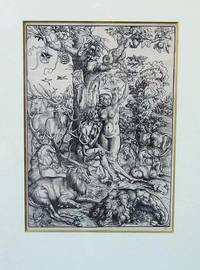
15092751509. Woodcut. <b>Hollstein VI.10.1; Bartsch XI.319.1; Dodgson II.294.57. </b>Later impression. Provenance: King Friedrich August II of Saxony Lugt 971. 13 5/8 x 9 3/4. Trimmed just outside the platemark. With some minor repairs. books
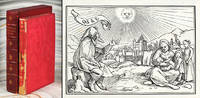
18301071768vo. London: William Pickering 1830. 8vo 188 leaves 1-5 6-14 360 =376 pp. With 90 wood engravings after Holbein by John and Mary Byfield. Original red/pink silk somewhat worn section within foxed or stained withal a decent copy of a great rarity. Enclosed in a red morocco pull-off box. § Large-paper copy of the first edition with an introduction by Dibdin. Limited to 12 copies of which three are known today including this one. Jackson states 12 large-paper copies on india paper; published at one guinea. The Rylands copy is in calf-backed red silk. The Old Testament text accompanying each engraving is in five languages. The advertisement in vol.II of the Pickering Aldine Poets 1830 includes the note ‘Dr. Dibdin has given five specimens of the wood cuts in his Bibliographical Decameron vol. i. 174-180 where will be found a copious account of this work.’ Windle and Pippin A54a. Jackson 73. The Robert Pirie copy with his bookplate and a note at the front that this and a copy on vellum were both lost after he purchased them -- the vellum copy has never been found. William Pickering hardcover books
1935226762London Jonathan Cape 1935. 1935. First trade edition. 4to. Illustrated with 54 plates and 4 folding maps. In a designer binding of full tan niger morocco gilt stamped the covers with elaborate interlocking linear design based on the traced route of a journey by Lawrence in the desert spine lettered in gilt marbled doublures and endpapers. Enclosed in a mahogany edged slipcase with marbled boards and a matching marbled chemise. Fine fresh as new. Binding by J.J.D. Yardley 1971. Includes correspondence between binder and Colonel Bradfer Lawrence giving a detailed story of the binding design and materials used to bind the book and to make the unusual slipcase. H.J. Desmond Yardley 1905-1972 was a binder who enrolled at the Central School of Arts and Crafts where he was taught by William Matthews. In 1956 he was elected to the Guild of Contemporary Bookbinders later becoming an exhibiting Fellow of the Designer Bookbinders. Exhibited: "The Art of the book William Morris and after 1892-1977 Fitzwilliam Museum Cambridge England 1978.". Hardcover. Fine. London, Jonathan Cape, 1935. hardcover books
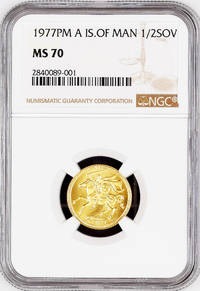
0000007007Pen and Sword Books Ltd. No Binding. As New. New flawless: Isle of Man - Stone Age to Swinging Sixties - and oh yeah: also one 1977 PM Pobjoy Mint Isle of Man 1/2 Gold Sovereign MS 70 Grade. A pristine 2024 example of the best book there is on the Mystical Isle; the finest Mint State half soveriegn from the same inexplicable locale this one as rare as the place itself. Please review all images. 3.99 grams of which 3.6612 are pure gold - IE fineness is 916.7. A Nordic in fact Viking Warrior graces the obverse Brits might call it the reverse and Queen Elizabeth II is on the reverse. This is a genuine rarity even if it weren't in MS-70 "perfect" per grader's terms condition but it is. The two most respected grading / authentication / slabbing companies and most notably so for coins such as this are NGC Numismatic Guaranty Corp. and PCGS Professional Coin Grading Service. As of this listing NGC shows only 6 examples of this coin exist this being one of those that they have graded. PCGS appears to show none at all. No other such graded MS-70 appear anywhere internet or elsewhere - again as of this listing. But it's been that way for a long time. I've seen over the years some MS-68s and MS-69s listed in the range of $900 to $1200. But if you're even here looking - I don't have to tell you the magnitude of the value difference between a 69 and a 70 in the case of rare coins. But there is no true current market information on an MS-70. For now I have to leave this price as it is for now and either increase or decrease it if and when credible new information presents itself. The mystery in this one Just the mystery of the magical Isle of Man itself - which is a "British Crown Dependency" whatever that may be - small unique and full of folklore having arisen so they say from the antics of Buggane Fenodyree the Glashtyn the Moddey Dhoo - and no doubt more once lurked behind those. I personally feel the Tuatha Dé Danann must have started the whole thing. Can't guarantee that though. LSPC-0000007007 <br/> <br/> Pen and Sword Books Ltd unknown
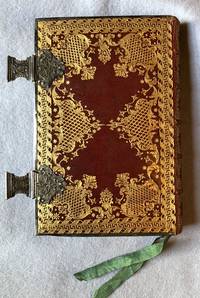
17562896Rome: Gioacchino & Giovanni Giuseppe Salvioni 1756. <p>8vo 208 x 133 mm. 24 407 1 pp. 2 parts the Office of the Dead separately titled. Printed in red and black. Engraved frontispiece and 12 full-page engravings by Arnold Van Weserhout and Jacob Frey after Joseph Passarus Giuseppe Passaro two engraved title vignettes 12 engraved tailpiece vignettes a few unsigned others by Frey after Passaro or by M. Schedi engraver 3 engraved capital initials numerous red-printed woodcut initials. Foxing occasionally severe short marginal tear to fol. Z7.<br /> Slightly later eighteenth-century Roman gold-tooled red goatskin covers with large dentelle border composed of a triple neo-classical roll-tooled outer frame enclosing six large ornaments each with a basketweave design of diagonally crossing gilt fillets framed in volutes and leafy sprigs a few tiny petal or star tools board edges protected with a probably later frame of silver or silver-plated metal discreetly nailed to the binding two elaborately chased silver fore-edge clasps and catches spine in six uniformly gold-tooled compartments gilt edges with gauffred border design pair of green ribbon page markers marbled endpapers; 20th-century black morocco felt-lined case. Provenance: with Gumuchian Catalogue XII/1930/225; Maurice Burrus bookplate purchased from Gumuchian in 1934 purchase notes at end. <br /> <br /> A striking rococo binding in fine condition on a luxuriously printed and illustrated Office of the Virgin from the official Vatican press.<br /> <br /> From the mid- to late eighteenth century the Salvioni press used one or more bookbinding workshops that produced finely gold-tooled bindings for their Vatican publications. Although often referred to as the “Salvioni bindery†this appellation is circumstantial: â€the Salvioni firm was responsible for promoting the bindings but it is not known which workshop produced them†British Library Database of Bookbindings. Some of these “Vatican†bindings incorporated variously colored or mottled leather. This example with its basketweave cartouches relies purely on tooling for its effect. An example evidently from the same workshop on a book printed at Rome in 1791 by Salomini using analogous cartouches as corner-pieces as well as a similar “spiraling†border design and some of the same leafy spray and star tools is reproduced in Legature papali no. 264.<br /> <br /> “Whereas the . more flamboyant bindings produced by the Salvioni Bindery rely frequently on polychrome enamel heightening these Vatican bindings strike a somewhat more sober note with their very fine dark-red morocco and rich gold-tooling of high quality†Martin Breslauer Catalogue 107/428.<br /> <br /> Gumuchian Catalogue de Reliures du XVe au XIXe siecle no. 225 plate 68. Cf. British Library Database of Bookbindings Shelfmark c27e18; For other “Salvioniâ€Â bindings see Miner / Walters Art Gallery The History of Bookbinding no. 523; Biblioteca Apostolica Vaticana Legature papali da Eugenio IV a Paolo VI no. 264 plate CXCIII. </p> Gioacchino & Giovanni Giuseppe Salvioni unknown
8050Hand-drawn double-page map of the Bonin Islands. 61 folding leaves. Large 8vo 268 x 200 mm. orig. wrappers stitched spine backed at an early date with matching paper. Japan: ca. 1860.<br/> <br/> An intriguing manuscript containing early Japanese translations of American reports drafted during Perry’s mission to the Bonin Islands Ogasawara-shima in June 1853 one month before he sailed into Edo Bay for the first time. It is a fascinating record of America’s colonial and commercial ambitions in the mid-19th century and Japan’s response. The volume’s upper wrapper bears the official seal onikki kata belonging to the Keeper of the Diary the functionary responsible for recording important events on behalf of the bakufu.<br/> <br/> We are uncertain how the Japanese obtained these secret American documents and when this manuscript was compiled. Perhaps it was composed after Japan’s 1860 Embassy to the United States when representatives were sent to Washington to negotiate a treaty between the two nations. Upon the return of Japan’s diplomatic mission the chief negotiator Yoshitake Kimura assigned a linguist Kudo Iwaji the task of translating the documents and books they had brought back. He also translated Perry’s Narrative of the Expedition of an American Squadron to the China Seas and Japan 1856; it remained in manuscript until 1912. Iwaji is mentioned twice herein as the compiler of our manuscript volume.<br/> <br/> Before Perry’s fateful incursion to Edo Bay in July he explored the Bonin Islands as a potential coal depot and resupply station for future travel and commerce between the United States and Asia. This manuscript is based on accounts of this expedition written by Anton L.C. Portman Perry’s Dutch translator and the American translator Samuel W. Williams 1812-84 an expert in Chinese and Japanese who are referred to several times in the text. Our high-level Japanese-government-produced report is divided into two sections based on these firsthand reports by Williams and Portman. <br/> <br/> At the beginning of the volume is a two-page manuscript map of the archipelago’s two main islands Chichi-jima and Haha-jima. The text offers a lengthy history of the islands and the various attempts by Britain and Russia to claim it. It is also filled with very detailed notes on the climate ecology natural resources etc. Portman’s portion has rather scholarly observations on some botanical specimens that were collected.<br/> <br/> All of this information on the archipelago would have been extremely useful to the Japanese when they made an official claim to it in 1862. Control of the islands was ceded to the United States after World War II and in 1968 returned to Japan.<br/> <br/> In excellent condition. Preserved in a chitsu.<br/> <br/> ⧠Peter Booth Wiley Yankees in the Land of the Gods: Commodore Perry and the Opening of Japan 1990 pp. 204-14.<br/> <br/> The National Archives of Japan spring 2004 digital exhibition “Gekido Bakumatsu – Kaikoku no shogeki –†“The end of the turbulent Edo period – Impact of the Opening of the country†accessed 11 February 2022 was of great help as we wrote this description. unknown
11430Seven vols. 8vo 260 x 148 mm. orig. semi-stiff wrappers with pasted-on title-slips orig. stitching. Shanghai: Xinzhongguo yixueyuan ca. 1941-42.<br /> <BR> <BR> A collection of textbooks issued by the New Chinese Medical College of Shanghai Xin zhongguo yixueyuan æ–°ä¸åœ‹é†«å¸é™¢ established in 1935 as the city's third modern medical school. The teaching faculty including many leading figures in the modernization of Chinese medicine sought to integrate traditional Chinese and modern Western medicine within a coherent pedagogical system. Giving equal weight to the medical theories terminology and treatments derived from longstanding Chinese practices as well as modern scientific research these textbooks pioneered the Sino-Western hybrid approach of medical instruction zhongxiyi jiehe ä¸è¥¿é†«çµåˆ that was unusual at the time but has since become widely accepted. Copies of these textbooks printed by mimeograph for the students are difficult to find today: we do not locate any in WorldCat although a copy of the 1936 school code is held at Berkeley accession no. 46645586.<br /> <BR> <BR> The individual titles of the seven volumes are as follows.<br /> <BR> <BR> • Tonglun ke jiangyi 通論科講義 Lectures on General Theory. By Liu Zhongqi 劉仲çª. 22 28 34 23 5 folding leaves.<br /> <BR> <BR> • Yaowuxue jiangyi diyice 藥物å¸è¬›ç¾©ç¬¬ä¸€å†Š Lectures on Pharmacology Vol. 1. By Zhu Zhicheng 朱志æˆ. 1 171 folding leaves. Final leaves wormed on upper corner. <br /> <BR> <BR> • Yaowuxue jiangyi dierce 藥物å¸è¬›ç¾©ç¬¬äºŒå†Š Lectures on Pharmacology Vol. 2. By Qian Jinyang 錢今陽. 1 94 1 43 unnumbered insert between ff. 20 & 21 1 34 folding leaves. Includes materials for the second year of the course.<br /> <BR> <BR> • Houke jiangyi 喉科講義 Lectures on Otorhinolaryngology. By Xu Banlong 許åŠé¾ author and Shen Zongwu æ²ˆå®—å³ instructor. 48 folding leaves. Followed by Zhenduanxue jiangyi 診斷å¸è¬›ç¾© Lectures on Diagnosis. Anonymous. 28 folding leaves. Followed by Zabing jiangyi 雜病講義 Lectures on Miscellaneous Diseases. By Qian Gongxuan 錢公玄. 30 10 folding leaves. Followed by Yaowuxue changshi 藥物å¸å¸¸è˜ Common Sense Pharmacology. 37 folding leaves. Final leaves wormed.<br /> <BR> <BR> • Erke jiangyi 兒科講義 Lectures on Pediatric Medicine. By You Xuezhou å°¤å¸å‘¨. 92 folding leaves. <br /> <BR> <BR> • Fukexue jiangyi 婦科å¸è¬›ç¾© Lectures on Gynecology. By Jin Shaoling 金少陵. 1 152 folding leaves. Preface dated Minguo 31 1942.<br /> <BR> <BR> • Neijingxue jiangyi 內經å¸è¬›ç¾© Lectures on the Inner Canon. By Jin Shaoling 今少陵. 69 20 2 folding leaves. Postscript dated Minguo 30 1941. Divided into two years of instruction.<br /> <BR> <BR> Very good copies. Light worming foxing and staining appear throughout but rarely affect reading. Lightly annotated throughout in red and black. Blue collector's seals åœ‹è¯ and 國è¯è—書 appear at the beginning of volumes. <br /> <BR> <BR> ⧠裘沛然 et al. eds. æ苑鶴鳴:上海新ä¸åœ‹é†«å¸é™¢æ ¡å² 上海ä¸é†«è—¥å¤§å¸å‡ºç‰ˆç¤¾ 2000 esp. pp. 58-67. unknown
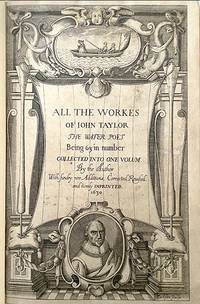
163029102London: Printed by J. B. for James Boler 1630 1630. First edition. ESTC S117734; STC 23725; Pforzheimer 1006. A lightly washed copy with the following repairs: engraved title-page and one leaf Mmm5 pages 139-40 skillfully remargined with slight loss of a few letters on the final two lines on page 140; fore-edges occasionally trimmed close without loss; binding a little rubbed at the hinges and edges; remains of a bookseller's description on the front free endpaper; overall a fine copy. Folio late 19th century full olive morocco by Riviere gilt rules decorations spine lettering and gilt ornamental wreath on the boards a.e.g. Engraved title-page by Thomas Cockson and numerous woodcuts in the text. The collected works of a colorful member of the London literary scene in the late 16th and early 17th centuries - not a major figure but an extraordinary one. John Taylor 1578-1653 moved in the circles of Ben Jonson John Fletcher Thomas Coryate George Wither Thomas Dekker and Samuel Daniel among others. His background was modest and by trade he was a waterman on the Thames ferrying passengers across the river from the city to the Bankside but he was also a poet satirist pamphleteer self-promoter adventurer and traveller. He published over 150 titles usually in the ephemeral format of a broadside or pamphlet in prose and verse and on an array of subjects: comic narratives about London characters rhyming squibs on the travails of everyday life mock eulogies panegyrics upon himself anagrams sonnets narratives of real and imaginary travels invectives at rival poets and writers politics and low-life etc. In 1630 Taylor proudly arranged to have his works collected in the handsome folio format that previously had been used only for three other English authors - Daniel Jonson and Shakespeare - thus placing himself in select company. Whether or not All the Workes collected all of Taylor's works to 1630 is in question and he continued to publish almost until his death in 1653 little of which has been collected in any format. All the Workes itself was not reprinted until almost 250 years after this first edition. Robert Southey in his Lives of Uneducated Poets London 1836 wrote that the first poet to overcome the unfavorable obstacles of a poor education and humble beginnings "was John Taylor the Water-Poet a man who has long been more known by name than by his writings." ¶ Copies of Taylor's All the Workes are difficult to find in the marketplace in an unsophisticated state and this copy bears some evidence of repairs. See below. But it is also has very good provenance. On the front paste-down is the bookplate of collector Kenneth Rapoport with his catalogue slip laid in which states "Purchased from Seven Gables 9/22/77 @ $1040." A note on the verso updates it value as of 2004 to "$3-4000.". London: Printed by J. B. for James Boler, 1630 unknown
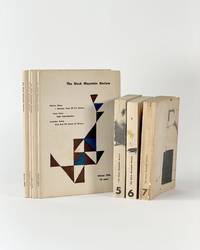
1957410610Black Mountain NC: Black Mountain College 1957. Spine of issue 7 partly split wrappers slightly smudged; issues 3 and 4 with small stains on wrappers. Otherwise a fine clean set of this rare complete periodical. Complete set of 7 issues 4to and 8vo. Illustrated by FRANZ KLINE and RENÉ LAUBIÉS the first four with cover illustrations by K. KITASONO other illustrations by AARON SISKIND J.ALTOON D. RICE and E. CIRBETT. "It is difficult… to appreciate the excitement in certain very limited circles of course produced by the appearance of the Review." Martin Duberman 'Black Mountain: An Exploration in Community' 1972. With contributions by Robert Creeley publisher of Divers Press in Palma de Mallorca Charles Olson the College Rector Kenneth Rexroth Paul Blackburn Robert Duncan Denise Levertov William Bronk and Larry Eigner. The final issue was devoted to Beat authors and contains work by Jack Kerouac Allen Ginsberg Gary Snyder Philip Whalen and published a pre-publication excerpt from "Willam Lee's" Naked Lunch William S. Burroughs. Clay and Phillips p. 106ff: "The Black Mountain Review printed in Palma de Mallorca where Creeley was producing his Divers Press books developed from the friendship in daily correspondence between Creeley and Black Mountain rector Charles Olson who thought a quality literary journal might help increase enrollment. Black Mountain College unknown
193331883Elizabeth New Jersey: Charles D. Hornig 1933-1935. Darkening to cheap paper but pages quite supple the full set is attractively bound a full leather binding with front and spine stamped in gold. Complete sets are rare. 31883. Octavo 18 issues printed or self wrappers. The first important weird fiction fanzine and one of the most desirable of the fanzines of the thirties. For two years it published news and fiction related to the genre.<br /> Stories first published in THE FANTASY FAN include H. P. Lovecraft's "The Other Gods" and "From Beyond" Clark Ashton Smith's "The Epiphany of Death" "The Ghoul" "The Kingdom of the Worm" and "The Primal City" as well as tales by Robert Bloch August Derleth Robert E. Howard David H. Keller and others. THE FANTASY FAN was "an interesting mix of news articles stories poems and miscellany. Hornig however made an error in initiating a column of controversy entitled 'The Boiling Point' which quickly led to acrimonious letter exchanges between Lovecraft Forrest J. Ackerman Clark Ashton Smith and numerous others; the column was terminated with the February 1934 issue. Perhaps Hornig's greatest accomplishment was the serialization of the revised version of Lovecraft's 'Supernatural Horror in Literature' October 1933-February 1935. However the serialization proceeded at such a slow pace that it had reached only the middle of Chapter VIII before the magazine folded. THE FANTASY FAN also saw the first publication of Lovecraft's stories. 'The Other Gods' November 1933 and 'From Beyond' June 1934 as well as reprints from amateur papers of 'Polaris' February 1934 and 'Beyond the Wall of Sleep' October 1934; it also published 'The Book' October 1934 'Pursuit' October 1934 'The Key' January 1935 and 'Homecoming' January 1935 from 'Fungi from Yuggoth.' Brief excerpts of Lovecraft's letters to Hornig appeared regularly in the magazine's letter column. The October 1934 issue was dedicated to Lovecraft. After the demise of THE FANTASY FAN numerous attempts were made to revive or succeed it but no magazine truly filled its place as a news organ a forum for the expression of fan's views and a venue for work by distinguished writers in the field" Joshi and Schultz An H. P. Lovecraft Encyclopedia pp. 90-91. "As a real help to the lover of weird and fantasy fiction Hornig's magazine reigned supreme in the field at that time . Almost every weirdist of importance in fandom was at one time or another represented in its pages. And as a love-feast for such fans it has never again been equaled" Moskowitz The Immortal Storm pp. 18-20. ". one of the legendary magazines of the 1930s . an extremely consistent and reliable magazine ." Tymn and Ashley eds. Science Fiction Fantasy and Weird Fiction Magazines pp. 822-23. According to Hornig writing in 1988 "THE FANTASY FAN was printed by Conrad Ruppett of Jamaica New York hand set. Julius Schwartz and I helped him collate and staple each copy every month for eighteen months. Except for the second issue 500 copies there were only 250 printed and the paid circulation never reached over 50. What happened to the residue Well I found someone to buy up most of the unsold copies and that was B. K. Gores of Austin Texas. I never heard from him before or since never knew him in fandom and don't know whatever happened to him. Somewhere there should be stacks of TFF unless they're destroyed."<br /> Reference: Joshi I-B-ii-232. Pavlat and Evans Fanzine Index 1965 p. 37. Charles D. Hornig unknown
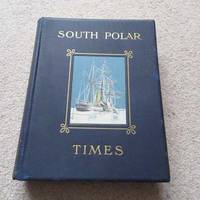
191439Smith Elder London 1914. First Edition. Hardcover Original Cloth. Very Good Condition/No Dust Jacket. 1st Limited Edition: This is copy 43 of a limited edition of 250. Original covers no dust jacket all page edges gilt. Copiously illustrated drawings in the text and full-page plates from sketches and paintings by E. Wilson and others. Gutta-percha binding very delicate with leaves just loosening. Gutta Percha was used as the binding glue in many early books it is not a difficult job to remove and reback using modern glues Ex Library with various library stamps on some pages. The South Polar Times was a magazine written and printed by the members of Antarctic Expeditions during the various voyages they undertook. The South Polar Times form what is perhaps the most personal of the printed documents to have come out of that most remarkable of periods of Antarctic adventures revealing so many often contradictory aspects of these men's various personalities. 'During the Antarctic winter of 1902 and 1903 the officers of the National Antarctic Expedition on board the Discovery among other diversions wherewith to lighten the long and dreary darkness brought out at monthly intervals a periodical to which they gave the name of "The South Polar Times" the contents of which range over a wide field grave and gay scientific and humorous prose and poetry. It contains a diary of the events of each month a record of the proceedings of the local Debating Society a monthly acrostic humorous notes besides articles of a more solid nature as well as stories sketches of various kinds and poems of a standard considerably above average.' One of the corner stones of an Antarctic collection. Volume 1 & 2 were Scott's 1st "Discovery Expedition" Special Limited Edition first issue in this format. Quantity Available: 1. Shipped Weight: Under 5 kilogram. Category: Arctic & Antarctic; Exploration. Pictures of this item not already displayed here available upon request. Inventory No: 39. . This book is extra heavy and may involve extra shipping charges to some countries. Smith Elder hardcover
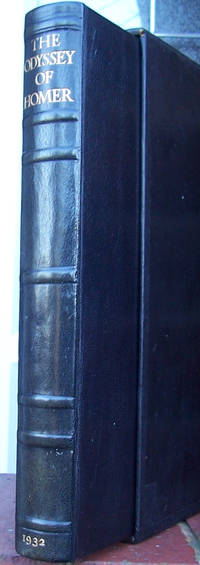
1932062461London: Bruce Rogers Wilfred Merton & Emery Walker 1932. Book. Fine. Hardcover. First Edition. Folio - over 12" - 15" tall. A fine copy of this splendid edition of T.E. Lawrence's translation of Homer's Odyssey. Bound in full black leather by W. H. Smith & Son Bindery who bound for the Ashendene Press. The binding is in fine condition and the volume is housed in a more recent black cloth slipcase by Chris Shaw. Printed in Rogers' Centaur type on light grey Barcham Green paper watermarked with a Greek galley and printed with aromatic ink that still holds the spicy aroma. The title page and each chapter heading has a gold leaf roundel depicting a Greek vase design the printing of these took seven separate impressions and along with the typography is a wonderful feature of the book. In Joseph Blumenthal's "Bruce Rogers. A Life in Letters" Blumenthal describes this volume: "I believe the Bruce Rogers Odyssey is indisputably amongst the most beautiful books ever produced. It is difficult to describe a work of genius. In the Odyssey without tricks or accessory decoration with a classic austerity akin to the timeless proportions of the Parthenon with only type and paper and ink with consummate skill Rogers created a masterpiece". Here indeed is a fine copy of this master work without doubt one of the most handsome volumes in the Lawrence canon. As an added bonus the Lawrence translation is still most readable so the volume offered combines printing excellence with a practical and readable text. Limited to 530 copies. An exceptional copy of this fine landmark volume.See for further details: O'Brien A141; Wilson Translating the Bruce Rogers 'Odyssey' Castle Hill Press; Blumenthal Bruce Rogers. A Life in Letters; Rogers Paragraphs on Printing. Bruce Rogers, Wilfred Merton & Emery Walker Hardcover
16702080502106917709Not Available 1670. Soft Cover. Fine. The book is in fine condition. Not Available paperback
20172081502111907915Kaikyo Literary Publishing Company 2017. Soft Cover. Fine. The book is in fine condition. Kaikyo Literary Publishing Company paperback
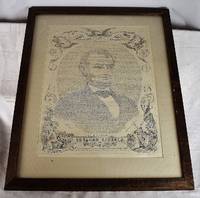
18652307060077Philadelphia: Swander Bishop & Co; Art Publishing Association 1865. First Edition. Art Prints & Posters . Very Good. 22 x 16 1/2 in. visible framed. Original Lithograph under glass. The words of Lincoln's two emancipation proclamations Sept. 22 1862 and Jan. 1 1863 written to form a portrait of the President. On the bottom border are two scenes. The left depicting 1860 has a tied kneeling slave being whipped by an overseer. The right has an emancipation scene of 1865 showing a victorious black Union soldier in uniform his sword held high freeing a slave. Eberstadt 48. Note: A copy of this lithograph sold in Swann Galleries' Printed & Manuscript African Americana sale Mar 29 2018 - Sale 2471. Also see Brown University's Swander R. Morris "Emancipation Proclamation" 1865. Philadelphia: Swander, Bishop & Co; Art Publishing Association unknown
COMPLETE SIX VOLUME SET BOUND IN THREE. RARE elaborate and vast series of detailed lithograph prints of Egypt and the Near East by the eminent Scottish painter David Roberts (1796-1864), which he produced from sketches he had made during long tours of the region (1838-1840). These and his large oil paintings of similar subjects made him a prominent Orientalist painter, and he was elected as a Royal Academician in 1841. [ALL VOLUMES]: 300x220mm. Unpaginated. Half-leather gilt Hardcover with gilt ribbed spine. Text block edges gilt. Marbled endpaper. Cover and spine rubbed and slightly scratched. Cover slightly stained. Cover corners bumped and worn. Cover edges slightly bumped. Spine edges and hinges rubbed. Whitepages and few other pages age-stained. Some pages and plates slightly age-stained (otherwise the plates are in very good condition). Pages slightly yellowing. [VOLS.I-II]: Cover corner and spine upper edge peeling. [VOLS.III-IV]: Two bump-marks on spine rear hinge. [VOLS.III-IV & V-VI]: Front cover somewhat lumpy. [SUMMARY]: This extremely rare precious set of classic 19th-century Orientalist lithographs by the foremost artist in this genre is good condition. PLEASE NOTE: This item is overweight. We may ask for extra shipping costs.
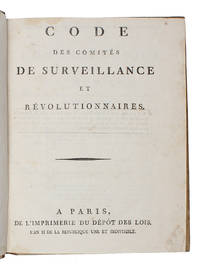
179360748Paris Impremerie du depot des lois An II 1793. 4to. In contemporary half calf with gilt lettering and ornamentation to spine. Wear to extremities. Upper part of back hinge split with minor loss of letters. Small dampstain to upper inner margin otherwise a nice copy. 2 VII 2-116 100 8 pp. <br/><br/><em>Exceedingly rare first edition of this highly interesting document being the Code of the Committees of Surveillance containing 106 regulations and guidelines for the functioning of these committees during the French Revolution. The Committees of Surveillance were established during the Reign of Terror September 5 1793 - July 27 1794 as part of the revolutionary government's efforts to identify and suppress counter-revolutionary activities. These committees were tasked with monitoring individuals' behavior enforcing revolutionary laws and ensuring loyalty to the revolutionary government. The document outlines the powers duties and procedures of these committees as well as the penalties for those found to be opposing the revolution providing a unique and fascinating insight into the legal and administrative framework of revolutionary France – arguable one of the most profound and radical moments in modern European history. The Committee of Surveillance in France during 1793 was established as a part of the radical phase of the French Revolution. Its function was to oversee and monitor the activities of suspected counter-revolutionaries and enemies of the Revolution as well as to enforce laws related to internal security and revolutionary principles. The committee was tasked with identifying individuals or groups deemed to be a threat to the revolutionary government often leading to arrests interrogations and in some cases executions by the Revolutionary Tribunal. It played a significant role in the Reign of Terror a period marked by extreme political violence and repression in France. The present work is of the utmost scarcity. We have not been able to trace a single copy at auction and OCLC only lists one copy in Paris. Nadaillac Catalogue d’une Collection Importante Sur la Revolution Francaise 724 </em> unknown
179360748Paris, Impremerie du depot des lois, An II (1793). 4to. In contemporary half calf with gilt lettering and ornamentation to spine. Wear to extremities. Upper part of back hinge split, with minor loss of letters. Small dampstain to upper inner margin, otherwise a nice copy. (2), VII, (2)-116, 100, 8 pp.
19932081502111907122Hanayama bungei 1993. Soft Cover. Fine. Size: A4 hardcover book Hanayama bungei paperback
1809000867cSCOTLAND IRELAND ENGLAND DUBLIN EDINBURGH UK. Good. 1809. On offer is a remarkable original 1809 - 1833 handwritten manuscript book once used by the British Army's 94th Regiment of Foot. This book contains all manner of writings relevant to the running and goings-on of the Regiment by the Officers. The book is rather eclectic containing standing orders regimental orders different charts and forms for payroll and other reportage for example on the conditions of the Dublin Garrison orders of the day direct communications between officers public requests for leave advancement of funds settling of accounts etc. public apologies for poor behavior copies of letters sent to superiors up to and including the Duke of York Commander of all His Majesty's Forces and many other of Britain's peerage and there are even personal reminiscences notes of reference for departing soldiers plus much much more. Most of the entries of personal notes and those for Day Book purposes are signed by all manner of officers and peerage; Colonels Captains Lords and many reference specific orders by the Supreme Commander of the Army or even the King. Most fascinating are the 'Memorialist' messages of certain officers writing in the 3rd person touting themselves while seeking favor. 164 pp of history and methodology of this noted British Army regiment contained in this entirely handwritten book. Most of the entries are circa 1809 - 1827 but the oldest entry in the book is dated Edinburgh Castle 1833 and is addressed to what appears to be 'My Dear Beaver' while the correspondent signs in initials F.M. late of St. Lucia. He makes reference to Mr. Beaver as the clergyman that baptized his 3 children. Also of note: on the very last page written upside down are a quote a note and an invitation dated Fort Charlotte 1825 to His Excellency Major General Blackwell by Mr. and Mrs. Murray. Many clues for the astute researcher will assuredly unveil many of the writers in this fascinating piece of British militaria. Save for the front cover being nearly detached and some loosened endpapers this book would be G. Truly one of the most exceptional pieces of manuscript militaria we have ever encountered.; English; 4to - over 9¾" - 12" tall; KEYWORDS: HISTORY OF MILITARY MILITARIA BRITISH ARMY 94TH REGIMENT SCOTLAND IRELAND DUBLIN GARRISON MAP MANUSCRIPT DOCUMENT LETTER AUTOGRAPH DIARY JOURNAL LOG KEEPSAKE WRITER HAND WRITTEN DOCUMENTS SIGNED LETTERS MANUSCRIPTS HISTORICAL HOLOGRAPH WRITERS DIARIES JOURNALS LOGS AUTOGRAPHS PERSONAL MEMOIR MEMORIAL PERSONAL HISTORY antiquité contrat vélin document manuscrit papier Antike Brief Pergament Dokument Manuskript Papier oggetto d'antiquariato atto velina documento manoscritto carta antigüedad hecho vitela documento manuscrito Papel . unknown
19732091202133213203Gakushu Kenkyusha 1973. Soft Cover. Fine. Number of books: 4 books in total Gakushu Kenkyusha paperback
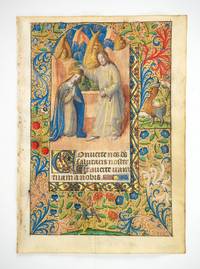
1500ST20810RParis ca. 1500. 163 x 115 mm. 6 1/2 x 4 1/2". Single column 18 lines in a gothic book hand. <br/> Rubrics in red line fillers in blue and pink with gold bezant six one-line initials in burnished gold on pink and blue ground two two-line initials in blue on gold ground with a flower in the center one three-line initial in blue filled with ivy on gold ground verso with panel border of colorful flowers and acanthus recto with A LARGE ARCH-TOPPED MINIATURE OF THE CORONATION OF THE VIRGIN with an "L" shaped frame of burnished gold and painted flowers and A FULL BORDER of acanthus flowers a man playing a bagpipe and a hybrid creature wearing a hat all on a painted gold ground. Very minor wrinkling to vellum but the leaf IN LOVELY CONDITION with the gold everywhere gleaming brightly.<br/> <br/> From a luxuriously appointed Book of Hours this leaf features a handsome miniature of the Coronation of the Virgin attributed to the workshop of Jean Pichore fl. ca. 1502-20 a major figure among illuminators of the period and one of the most sought-after artists in France at the turn of the 16th century. Executed with imagination and delicacy the miniature features the traditional subject associated with the hour of Compline showing the Virgin being crowned Queen of Heaven following her Death and Assumption. The composition here is quite intimate with the Virgin kneeling before her son as she accepts with humility the crown he lays upon her head. Christ is depicted barefoot and slightly bowed toward his mother in a gentle display of respect. The artist creates a wonderful backdrop for this scene composed entirely of seraphim painted gold blue light pink and green closely packed together. Two of the seraphim hold up light pink draperies behind the central figures as if to shield this tender moment from prying eyes. The borders here are a source of delight featuring a figure wearing a jester-like cap and playing the bagpipe as well as a creature with the body of a bird and the face of a human donning a rather fashionable bycocket cap. The illumination here is of high quality features a liberal use of gold and contains unique marginal details suggesting that the original manuscript must have been a costly commission for a wealthy patron. unknown