184 824 résultats
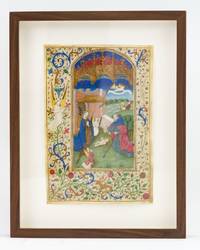
1470ST17765Delft ca. 1470. Leaf: 172 x 115 mm. 6 3/4 x 4 1/2". Frame: 242 x 190 mm. 9 1/2 x 7 1/2". <br/> In an attractive wooden frame. A FINELY PAINTED MINIATURE OF THE NATIVITY within an arch-topped compartment the parents of the Christ Child kneeling before him as he lies on the ground outside the stable Joseph uncharacteristically supporting himself with a cane in his left hand and holding a long burning candle in his right two diminutive angels in attendance the head of an ass sticking out of the stable window in the background to the left AND IN THE RIGHT BACKGROUND A CHARMING DEPICTION OF THE ANNUNCIATION TO THE SHEPHERDS ALL OF THIS BENEATH A VERY DETAILED ARCHITECTURAL CANOPY suspended in the sky AND THE WHOLE WITHIN A FULL BORDER of acanthus leaves and other foliage and flowers in reds blues greens yellows and brushed gold along with very many small burnished gold ivy leaves and buds on hairline stems a small stag in the bottom border and a large delicately shaded angel who mirrors the Virgin's pose in the left border verso blank. ◆A hint of soiling to edges of vellum but IN VERY FINE CONDITION without any paint erosion with the colors rich and true and with the burnished gold still shimmering.<br/> <br/> Notable for its attractive color scheme fine craftsmanship and unusual composition this vibrant leaf was produced by a talented artist belonging to the stylistic group known as the Masters of the Delft Half-Length Figures. The lack of text and blank back of this leaf clearly suggest that it was produced as a singleton intended for insertion in a Book of Hours and its subject matter indicates that it would have faced the opening for the third hour of the day Prime. The present depiction of the Nativity is out of the ordinary in that it is combined with another scene the Annunciation to the Shepherds a subject that usually begins Terce in the Hours of the Virgin. It is a testament to the artist's ingenuity and compositional skills that he has managed to incorporate these two scenes so seamlessly; in fact rather than pulling focus from the main subject celebrating the birth of Christ this secondary scene adds additional interest to the picture and amplifies the storyline. Though the Annunciation to the Shepherds takes place at a distance from the Nativity we immediately grasp their connection and can see how arrival of humanity's savior was felt far beyond the manger. It is also interesting to note how much the artist has emphasized the figure of Joseph. Not only does he take up as much space as the Virgin but the candle and cane he holds frame the Christ child and communicate a strong suggestion of a protective parent the Virgin is doing her part by praying hard but she is more passive. In addition to its engaging subject matter there is a high level of artistic achievement here including delicately molded figures impressively detailed architectural elements and a lovely color palette. The elegant hand seen in this miniature manifests a quiet sophistication that distinguishes this artist as a particularly talented member of his circle. Active from about 1450-80 the Masters of the Delft Half-Length Figures were named by James Marrow after the angels and other figures whose upper bodies are typically found emerging from a cloud within the borders. Although the present leaf uncharacteristically contains a full-length angel in the border it shares other stylistic similarities such as the elaborate architectural canopy hovering over the main composition; and it particularly resembles the work of the artist of Keble College MS 77 an illuminator described in "The Golden Age of Dutch Manuscript Illumination" as "one of the more articulate of the group" whose "figures are more fully modelled and his palette . . . deeper and brighter" than that of his contemporaries. Because of the complexity of the subject matter and the high level of artistic accomplishment seen here this leaf was probably part of an elaborate Book of Hours produced in response to an important commission. unknown
16011169London: Adam Islip 1601. First Edition. Good. Folio. 2 vols. in 1. 60 614 42 12 632 86. First edition in English of Pliny’s important encyclopedic work which was for centuries considered the highest authority on subjects relating to the natural and physical world including botany zoology geography pharmacology and more. Lowndes referred to this translation as a "work of immense labour and what few men of his time could have executed in a superior manner to Dr. Holland." Near contemporary half brown calf over marbled boards black gilt morocco lettering labels spine lettered and ruled in gilt wear to binding and joints ink notations throughout especially to front blank and title-page ownership signatures on title page 9 of vol. I and page 4 of vol. II as well as some ink markings to the woodcut devices on the first few leaves of vol. I and the final leaf in vol. II. This is a huge book for 1601 and copies with missing or duplicated or misbound leaves are seen with more frequency than slimmer books or later ones. This one has the complete text and prelims and it has the often missing errata after the Preface in vol. I and at the end of vol. II though it is not without its faults. B iii and B iv in vol. II are chipped at the margins just touching the marginal citations these two leaves may be supplied imissing Ppp index vol/ 2 there is creasing to the first few and last few leaves and minor insect damage near the end of volume II but withal it is a good textually complete copy. Pliny's encyclopedic work functioned for centuries as the highest authority on subjects relating to the natural and physical world including botany zoology geography pharmacology and numerous other disciplines. Completed around 77-79 CE the “Natural Historyâ€Â synthesized Greek and Roman knowledge within a single comprehensive framework drawing from nearly 500 sources to create what became arguably the most influential scientific text of the pre-modern period.<br /> <br /> Philemon Holland's 1601 translation brought Pliny's comprehensive compilation to English readers for the first time. Lowndes characterized this as a "work of immense labour and what few men of his time could have executed in a superior manner." Holland's scholarly approach preserved the technical vocabulary while rendering complex concepts accessible to readers lacking classical training.<br /> <br /> Pliny himself embodied the Roman aristocratic ideal of combining administrative service with intellectual pursuit. Gaius Plinius Secundus served as Vespasian's admiral while compiling his vast encyclopedia demonstrating the integration of practical governance and scholarly endeavor characteristic of the Roman elite. His death during the Vesuvius eruption of 79 CE killed by ash inhalation while investigating the catastrophe exemplifies the empirical curiosity that drove his encyclopedic project. Adam Islip unknown
19922110502151005583Hara shobo 1992. Soft Cover. Fine. Number of books: 142 Hara shobo paperback
16154007Ávila and La Horcajada 1615. Manuscript on parchment 380 x 270 mm. 18. Complete. Contents: ff. 1r-4v: Regla in Spanish in 30 numbered sections inconsistent numbering on ff. 3v-4v in a rounded script in brown ink the first page slightly larger up to 27 lines. F. 1r: incipit first four lines in large lettering with very large calligraphic initial: En el nombre de dios todo poderoso padre y hijo y espiritu sancto tres personas y una esencia. Section 30 f. 4v added in a slightly later hand. The word Cruz symbolized by a red Maltese cross. Text on ff. 2r-2v underlined in red. Calligraphic initials some with marginal extensions in brown purple or red. Marginal drawings of prickly foliage some in the shapes of fantastic animals. Later marginal notes opposite many sections. Ff. 5r-5v: Heading: Este es traslado de un testimonio followed by two notarial subscriptions on f. 5v one partially in cursive signed and dated Ávila 11 May 1527 the other in italic partly faded including the date 1615. F. 6r: A cerca de la procession de la Resurrection. After an introductory portion in a small round early 16th-century hand in brown ink the text continues from f. 4v with sections 32-37 of the Regla of which sections 33-37 are in a later sixteenth-century hand; these sections ruled through with light diagonal lines. Signatures or notes in lower margin. F. 6v: blank except for five lines heavily cancelled in red. Ff. 7r-7v: five paragraphs in a fine upright italic hand the first and third with headings in red La orden que han de tener en la procession de la Resurxection sic en la faded and illegible.; La orden que sea de tener en la procession de la Resurretion sic en el domingo de pascua es la siguente. Followed on f. 7v by a note in a different hand dated from La Horcajada 21 May 1550. Ff. 7v-8v and back inner cover: later additions some quite faded. A few later marginal annotations throughout.Rubrication and decoration: headings and line fillers in red a few ornamented line fillers or borders some passages underlined in red or light purple else ruled in dry point numerous calligraphic initials in red or brown ink opening initial with purple filigree extension filling left margin numerous foliate vegetable and zoomorphic ornamental designs in the margins in red purple and brown ink.Binding: stitched into the original parchment cover with title "Regla de la Pasion" in large letters the R with decorative extensions above a large cross in green ink entwined with the snake and in the margins apparently the instruments of the Passion.Condition: rubbing and staining vertical crease from folding causing occasional erasure of text outer edge of first page somewhat rubbed affecting legibility of text some words at line ends helpfully written over in a later hand the inks used in the last two leaves quite faded; wrapper worn and darkened with tears at top and 3 small holes in lower cover.Provenance: Confraternity of the Holy Cross of Horcajada; purchased in France with export license. An early Spanish confraternity manuscript containing the rules and statutes that governed the Confraternity of the Holy Cross referred to as the Cofradía or Hermandad de la Cruz the word Cruz being supplied by a Maltese cross in red of La Horcajada a town located in Castile y León in the province of Ávila. As in other Roman Catholic countries confraternities or lay brotherhoods played a vital role in community life in Spain functioning as mutual aid societies and venues for laypeople to express their piety and perform charitable acts. Vernacular manuscript confraternity statutes from the Iberian peninsula surface much more rarely than for example their Italian counterparts although it appears that Spain had a larger number of confraternities proportional to the population especially in Castile y Leon than the other Catholic lands. Virtually every community including small villages had at least one confraternity. While exact numbers of confraternities in sixteenth-century Spain are unknown "studies carried out for a number of cities suggest that the number of confraternities and brotherhoods in the Hispanic kingdoms was larger than elsewhere in Catholic Europe. The reasons behind the extraordinary popularity of confraternities and brotherhoods in the Hispanic kingdoms cannot yet be established however in view of the current state of research on the topic. There has been a tendency for scholars to emphasize the confraternity as a primarily urban phenomenon a reflection perhaps of their early development in Italy where they formed an essential part of civic and urban life. In the Hispanic kingdoms however these institutions were equally important in the religious and social life of the small village. Pastoral visitations carried out by the bishops of Cuenca during the sixteenth century found that `nearly every community had at least one brotherhood' even small villages of 500 inhabitants. A similar pattern prevailed in villages around Toledo during the late sixteenth century" Callahan pp. 18-19.In his article on Spanish confraternities William Callahan further points out their popular nature which "arose from the initiative of the laity rather than the clergy prime examples of the lay piety that began to flourish in late medieval Europe. This piety developed largely on its own uncontrolled by either local bishops or the pope both of whom regarded its manifestations with some suspicion. The resiliency of traditional confraternities and brotherhoods developed from their connection to local religious cultures. It also reflected a fact noted by scholars who have studied specific cities and regions the strongly popular character of membership. There were of course some associations that limited membership to the nobility or clergy but in most cases members were recruited from the popular classes. This was obviously true in the case of peasant villages where only one or two confraternities existed." pp. 22-23. In spite of the centrality of confraternities to early modern religious life in Spain there is comparatively little modern scholarly literature especially on the rural confraternities. Note the absence for example of any articles on Spain or Portugal in Brill's recently published Companion to Medieval and Early Modern Confraternities edited by Konrad Eisenbichler.This working manuscript bears witness to this central but understudied aspect of Spanish popular religious culture before the restrictions placed on confraternities by the Council of Trent and succeeding Popes. Consulted frequently and contributed to by members of the confraternity the manuscript includes abundant interlinear and marginal additions and corrections and half- or full-page later additions. The town of La Horcajada is identified in the opening page. Ff. 1r to 5v contain the introduction the first 30 statutes and a notarized testimony with heading "Este es traslado de un testimonio" which relates to the apparently recent establishment of the confraternity. The statutes cover admission of new members general rules of comportment requirements of prayer and confession for feast days and for the canonical hours charity for poorer members of the confraternity chants etc. Several paragraphs relate to processions including required habits and admission of non-members into the processions. On f. 6r a paragraph on the procession de la Resurrection is followed by six entries numbered 32 to 37 of which paragraphs 33 to 37 are in a later 16th-century hand. Several light diagonal lines through these five paragraphs may indicate that they were cancelled. The verso f.6v contains only five lines heavily cancelled in red ink and f. 7r continues discussion of the procession of the Resurrection on a feast day the name of the saint is smudged and on Easter Sunday in a different 16th-century upright cursive. This second section of which portions are difficult to read because of fading ends on f. 7v and is followed by a note in a larger hand dated from La Horcajada 21 May 1550. The final leaf and inner back cover contain later additions some quite faded. One late addition in the lower margin of f. 5v is dated 1615.The manuscript is decorated in a popular style. Some of the leafy plant designs have a thorny look that may reflect local vegetation. Animals and grotesques include a scorpion-like creature birds and possibly imaginary mammals. A witness to the central role played by religious confraternities in early modern Spain bearing the marks of its use and in original condition it is a rare survival and would repay further study.Cf. William Callahan "Confraternities and Brotherhoods in Spain 1500-1800" Confraternitas: The Newsletter of the Society for Confraternity Studies 12:1 2001 17-25. See also William A. Christian Local Religion in Sixteenth Century Spain Princeton 1981; Maureen Flynn Sacred Charity: Confraternities and Social Welfare in Spain 1400-1800 Basingstoke 1989. unknown books
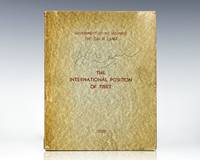
195968003Government of the Dalai Lama 1959. First edition of this important document which details the historical relationship between Tibet and China from the 7th century to the 1950s and presents arguments supporting Tibet's claim for sovereignty. Octavo original printed flexible board wrappers with the title and date printed in red letters. Boldly signed by His Holiness the Dalai Lama on the front panel. Table of contents and 63 pages of text. In 1959 the Dalai Lama sought support from the U.S. and other nations to recognize their government in exile and to bring their case for Tibetan sovereignty and against Chinese aggression before the United Nations. It is necessary to distinguish between two 1959 publications under the same title. The more common today appears to be an octavo volume of 49 pages which several sources attribute to the Central Electric Press in Delhi India. The British Library and Harvard University each has a copy in that smaller format; WorldCat details 10 locations of the 49 p. 8vo edition under two OCLC numbers. Our publication a mimeographic duplication from a document produced on a typewriter printed on rectos only of quarto sized sheets has 63 leaves and an un-numbered first leaf "Table of Contents". Technical limitations mean that our publication in quarto mimeographed format is both more fragile by nature and less likely to have been issued in a large number of copies. Considering that the 14th Dalai Lama spent all but the first 90 days of 1959 residing in exile in Dharamshala in the state of Himachal Pradesh in northern India it is likely that our publication was produced there. Historical Context: In 1959 within days of the rapidly devolving March uprising in Lhasa the Dalai Lama and his retinue fled Tibet with the help of the CIA's Special Activities Division. They crossed the border into India on 30 March 1959 and soon afterward the Dalai Lama set up the Government of Tibet in Exile in Dharamshala receiving support from the CIA including a personal annual stipend of $180000 and other material support from at least 1959 until about 1974. CIA support for the Government of the Dalai Lama in Exile and other potential Tibetan assets reportedly totalled about $1.7 million per annum. In April 1959 the Dalai Lama sent a message to the U.S. Government requesting that the U.S. formally recognize the Free Tibetan Government and that he encourage other nations to do so. Under Secretary of State C. Douglas Dillon advised President Eisenhower that the U.S. should "avoid taking any position which might encourage the Dalai Lama to seek international recognition." Despite considerable U.S. covert support of the Tibetans' efforts to oust the Chinese the official U.S. position held that Tibet was an autonomous country under Chinese suzerainty. The State Department believed this position better served America's broader foreign policy interest viz. China and India. In fact the Eisenhower administration both the State Department and the CIA restrained the Tibetans from presenting their case against Chinese aggression instead skirting the political issues and treading the softer line of human rights violations and cultural oppression. The Tibetans finally enlisted Ireland and Malaya to request "The Question of Tibet" to be added to the U.N. agenda for its 14th session. Consequently the United Nations' Resolution 1353 XIV on Tibet was passed in October 1959. This first U.N. resolution on Tibet did not address the sovereignty issue but voiced their "grave concern at the continued violation of the fundamental rights and freedoms of Tibetans" and calling for "respect of the fundamental human rights of the Tibetan people and for their distinctive cultural and religious life." For an interesting exposition of this era of Tibetan diplomacy see "Tibet Issue at the UN: a case study in informal diplomacy 1950-65" by Kalzang Diki Bhutia. Either directly or indirectly this publication was made possible by support from the CIA; it is a fascination sidelight of history that the official US government position was not in alignment with this text and also that no copy of our rare publication seems to have survived in any institutional library in the United States. Housed in a custom half morocco clamshell box. Government of the Dalai Lama unknown books
Signed and inscribed by author to George Stimpson upon title page. Signed by Mr. Stimpson inside front cover. Subsequent printings of this work were dedicated to "Two of the finest scholars of the twentieth century, George Stimpson and Ezra Pound, who generously gave of their vast knowledge to a young writer to guide him in a field which he could not have managed alone... The research (for this work) at the Library of Congress was directed and reviewed daily by George Stimpson, founder of the National Press Club in Washington, whom the New York Times on September 28, 1952 called 'A highly regarded reference source in the capital... Government officials, Congressman, and reporters went to him for information on any subject'... This work was the first nationally circulated revelation of the secret meetings of the international bankers at Jekyll Island, Georgia, 1907-1910, at which place the draft of the Federal Reserve Act of 1913 was written." - from Foreword to 1991 reprint. Average wear and soiling. Binding intact. An important piece of Americana. [SINGERMAN 0865] Book
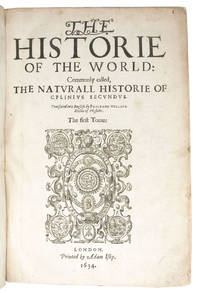
1634I44FL3PUPRNNLondon: Adam Islip 1634. Contemporary calf spine in six compartments tooled and lettered in gilt. Folio 23.5 x 32 cm. Elaborate woodcut device on title-page; woodcut initials head- and tailpieces. 2 parts in one volume. Pliny's renowned Natural History in its second publication in English repeating with corrections the 1601 first publication translated by Philemon Holland the greatest translator of the Elizabethan age. The "Naturalis Historia" is one of the largest single works to have survived from the Roman empire to the modern day and purports to cover the entire field of ancient knowledge based on the best authorities available to the author. Pliny claims to be the only Roman ever to have undertaken such a work. It comprised 37 books in 10 volumes and covered over 20000 facts on topics including the fields of botany zoology astronomy geology and mineralogy as well as the exploitation of those resources. It remains a standard work for the Roman period and the advances in technology and understanding of natural phenomena at the time. Some technical advances he discusses are the only sources for those inventions such as hushing in mining technology or the use of water mills for crushing or grinding corn. Much of what he wrote about has been confirmed by archaeology. ''We know from Pliny that there were important pearl fisheries in the Gulf . Pliny identifies Tylos Bahrain as a place famous for its pearls . He attests that pearls were the most highly rated valuable in Roman society and that those from the Gulf were specially praised . The pearl related finds at the site of El-Dur indicate the site was integrated into the maritime trade routes linking the Roman Empire the Persian Empire India and South Arabia'' Carter. Book 6 holds a chapter that gives the first detailed account of the regions around the Gulf including what are now Qatar the Emirates and Oman. Binding rubbed; front hinge splitting. Includes the final printed leaf in vol. 2 containing the publisher's advertisement to the reader that all errors have been corrected in the present edition and the errata leaf included in the same position in 1601 has become unnecessary rather than having been mistakenly omitted. Some slight browning and brownstaining but an excellent copy removed in 1973 from the Royal Meteorological Society Symons Bequest 1900 with their bookplate on the front pastedown.l STC 20030. Cf. Pforzheimer 496 1601 ed. Adam Islip, unknown
A modern Jew, perhaps for the first time, analyzes western civilization as an expression of the Gentile way of life and shows where this clashes with the nature and spiritual impulses of the Jew. - paraphrased from front flap of replica dust jacket included with this copy. "We Jews, we, the destroyers, will remain the destroyers for ever. Nothing that you will do will meet our needs and demands - The wretched fate which scattered us through your midst has thrust this unwelcome role upon us." - p. 155. "I console myself with the thought that if this book offends by its assertiveness, God knows that the infinite tactfulness of thousands of other Jews seems to have offended no less. Whatever we do we are damned - and I would rather be damned standing up than lying down." - p. 221. "Born in Romania, Maurice Samuel [1895-1972] moved to the United States in 1914. A Jewish intellectual and writer, he is best known for You Gentiles." - Wikipedia. [6], 7-221pp. 7.75" x 5.5". Narrow opening in binding at title page. Unmarked with average wear and soiling. Book
1910000180Each 16.5 x 14 11 x 8 cm. Contains 2 of which published in the book listed in our inventory; health reform and organizations in Hejaz during the Hajj season 1330 AH. By Dr. Kasim Izzeddin. The other 3 photos are not published in this book.
1909000140<p><strong>80 × 75 cm. Produced by KolaÄŸası Osman Nuri secretary of the Military School of Geography in 1323 AH 1907 AD.</strong></p><p>The map rarely includes a small inset map of the city of DirÊ¿iyyah in the Najd region together with additional inset maps of Medina ṬÄʾif Mecca and the harbor of Jeddah.</p> The Ottoman geographical military school, war press
19892111902160200913Araragi Production Office 1989. Soft Cover. Fine. Volume: 118 768 Araragi Production Office paperback
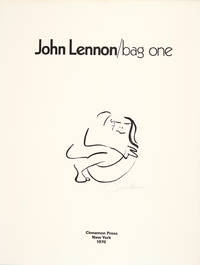
1970123601New York: Cinnamon Press 1970. Rare Bag One lithograph signed by Beatles icon John Lennon. One page the title page from Lennon's Bag One Portfolio. Signed by him beneath the image. One of 300 numbered copies this is number 172. In near fine condition. Matted and framed. Rare and desirable. In 1969 as a wedding gift for Yoko John drew the 'Bag One Portfolio'—a chronicle of their wedding ceremony honeymoon and their plea for world peace in the Bed-In. The following year the artwork was produced in a series of three hundred portfolios of fifteen signed prints each. The majority depict John and Yoko's most intimate private moments—upon their first exhibition in London more than half were deemed 'indecent' and confiscated by Scotland Yard. The rare title page features perhaps the most famous and recognizable print of the suite. Cinnamon Press unknown
11382A complete collection of 90 intricate architectural models of tea house designs with dimensions and components printed lithographically each design housed in a large folding envelope manuscript titles on outside of each envelope. The two sets of 45 models are each stored in the two original publisher's boxes with a printed list pasted to the inside of the lid of both boxes as issued. A total of 90 envelopes folded: 255 x 172 mm. Japan: ca. 1920s-30s.<br /> <BR> <BR> A remarkable creation a complete set of 90 elaborate architectural pop-ups of tea ceremony houses and related structures as well as interior features like benches shelves boxes shutters ceilings etc. In Japan paper pop-up models have been used since at least the 16th century as a primary means of communication between carpenters and their patrons particularly in the construction of tea houses. Precise notes for carpenters and builders have been lithographed on to the numerous flaps. A symbol of sophistication and wealth tea houses were in great demand in early 20th-century Japan. It is possible that these pop-ups functioned as a trade catalogue from which clients could pick their preferred size and specifications. Printed labels affixed to the inside of the wooden box lids list all 90 models.<br /> <BR> <BR> The pop-up flaps are attached to floor plans of different sizes and designs. There are notes regarding tea houses designed or favored by famous figures and schools in tea ceremony history. The primary folding flaps consist of exterior and interior walls ceilings alcoves and passageways. The flaps contain detailed drawings on both sides depicting the interior decor windows and their decorations passageways bathrooms etc. Attached to the wall flaps are more flaps which show smaller interior objects including boxes shelves display alcoves tokonoma benches etc.<br /> <BR> <BR> The purpose of these pop-up plans was to allow an experienced builder to visualize and construct an entire building from the plans themselves. "The okoshi-ezu has no real counterpart in Western drawing.Okoshi-ezu are extraordinary in that they are both easy to understand and extremely comprehensive - a combination that is usually mutually exclusive in architectural drawing where legibility tends to decline as the density of information increases. This quality makes okoshi-ezu drawings extremely helpful in studying the buildings they represent. Indeed okoshi-ezu provided such a complete description of the design that they were often used as the basis for the common practice of copying teahouses; the dimensional and specification information they included meant they could be used as construction drawings. These drawings could communicate so much with so little because their representational qualities were so similar to the actual architecture they represented - thin walls wrapped around cubic spaces to create highly refined and specific compositions of material space and light."-Andrew Barrie "Okoshi-ezu: Speculations on Thinness" in Interstices 11 online resource.<br /> <BR> <BR> The name of Sakata SakujirÅ å‚田作治郎 appears on both printed labels on the lids; he was a tea ceremony utensil merchant in Osaka. <br /> <BR> <BR> Our set is in fine condition. A small number of the envelopes have minor foxing; the models are intact and pristine.<br /> <BR> <BR> ⧠See Japanese Architecture and Art Net Users System JAANUS for a helpful explanation of the uses of okoshi-ezu and tate-ezu 建絵図. unknown
16154007Ãvila and La Horcajada 1615. <p>Manuscript on parchment 380 x 270 mm. 18. Complete. Contents: ff. 1r-4v: Regla in Spanish in 30 numbered sections inconsistent numbering on ff. 3v-4v in a rounded script in brown ink the first page slightly larger up to 27 lines. F. 1r: incipit first four lines in large lettering with very large calligraphic initial: En el nombre de dios todo poderoso padre y hijo y espiritu sancto tres personas y una esencia. Section 30 f. 4v added in a slightly later hand. The word Cruz symbolized by a red Maltese cross. Text on ff. 2r-2v underlined in red. Calligraphic initials some with marginal extensions in brown purple or red. Marginal drawings of prickly foliage some in the shapes of fantastic animals. Later marginal notes opposite many sections. Ff. 5r-5v: Heading: Este es traslado de un testimonio followed by two notarial subscriptions on f. 5v one partially in cursive signed and dated Ãvila 11 May 1527 the other in italic partly faded including the date 1615. F. 6r: A cerca de la procession de la Resurrection. After an introductory portion in a small round early 16th-century hand in brown ink the text continues from f. 4v with sections 32-37 of the Regla of which sections 33-37 are in a later sixteenth-century hand; these sections ruled through with light diagonal lines. Signatures or notes in lower margin. F. 6v: blank except for five lines heavily cancelled in red. Ff. 7r-7v: five paragraphs in a fine upright italic hand the first and third with headings in red La orden que han de tener en la procession de la Resurxection sic en la faded and illegible…; La orden que sea de tener en la procession de la Resurretion sic en el domingo de pascua es la siguente. Followed on f. 7v by a note in a different hand dated from La Horcajada 21 May 1550. Ff. 7v-8v and back inner cover: later additions some quite faded. A few later marginal annotations throughout.<br /> Rubrication and decoration: headings and line fillers in red a few ornamented line fillers or borders some passages underlined in red or light purple else ruled in dry point numerous calligraphic initials in red or brown ink opening initial with purple filigree extension filling left margin numerous foliate vegetable and zoomorphic ornamental designs in the margins in red purple and brown ink.<br /> Binding: stitched into the original parchment cover with title “Regla de la Pasion†in large letters the R with decorative extensions above a large cross in green ink entwined with the snake and in the margins apparently the instruments of the Passion.<br /> Condition: rubbing and staining vertical crease from folding causing occasional erasure of text outer edge of first page somewhat rubbed affecting legibility of text some words at line ends helpfully written over in a later hand the inks used in the last two leaves quite faded; wrapper worn and darkened with tears at top and 3 small holes in lower cover.<br /> Provenance: Confraternity of the Holy Cross of Horcajada; purchased in France with export license.  <br /> <br /> An early Spanish confraternity manuscript containing the rules and statutes that governed the Confraternity of the Holy Cross referred to as the CofradÃa or Hermandad de la Cruz the word Cruz being supplied by a Maltese cross in red of La Horcajada a town located in Castile y León in the province of Ãvila. As in other Roman Catholic countries confraternities or lay brotherhoods played a vital role in community life in Spain functioning as mutual aid societies and venues for laypeople to express their piety and perform charitable acts. Vernacular manuscript confraternity statutes from the Iberian peninsula surface much more rarely than for example their Italian counterparts although it appears that Spain had a larger number of confraternities proportional to the population especially in Castile y Leon than the other Catholic lands. Virtually every community including small villages had at least one confraternity. While exact numbers of confraternities in sixteenth-century Spain are unknown “studies carried out for a number of cities suggest that the number of confraternities and brotherhoods in the Hispanic kingdoms was larger than elsewhere in Catholic Europe. The reasons behind the extraordinary popularity of confraternities and brotherhoods in the Hispanic kingdoms cannot yet be established however in view of the current state of research on the topic. There has been a tendency for scholars to emphasize the confraternity as a primarily urban phenomenon a reflection perhaps of their early development in Italy where they formed an essential part of civic and urban life. In the Hispanic kingdoms however these institutions were equally important in the religious and social life of the small village. Pastoral visitations carried out by the bishops of Cuenca during the sixteenth century found that `nearly every community had at least one brotherhood’ even small villages of 500 inhabitants. A similar pattern prevailed in villages around Toledo during the late sixteenth century†Callahan pp. 18-19.<br /> <br /> In his article on Spanish confraternities William Callahan further points out their popular nature which “arose from the initiative of the laity rather than the clergy prime examples of the lay piety that began to flourish in late medieval Europe. This piety developed largely on its own uncontrolled by either local bishops or the pope both of whom regarded its manifestations with some suspicion. The resiliency of traditional confraternities and brotherhoods developed from their connection to local religious cultures. It also reflected a fact noted by scholars who have studied specific cities and regions the strongly popular character of membership. There were of course some associations that limited membership to the nobility or clergy but in most cases members were recruited from the popular classes. This was obviously true in the case of peasant villages where only one or two confraternities existed.†pp. 22-23. In spite of the centrality of confraternities to early modern religious life in Spain there is comparatively little modern scholarly literature especially on the rural confraternities. Note the absence for example of any articles on Spain or Portugal in Brill’s recently published Companion to Medieval and Early Modern Confraternities edited by Konrad Eisenbichler.<br /> <br /> This working manuscript bears witness to this central but understudied aspect of Spanish popular religious culture before the restrictions placed on confraternities by the Council of Trent and succeeding Popes. Consulted frequently and contributed to by members of the confraternity the manuscript includes abundant interlinear and marginal additions and corrections and half- or full-page later additions. The town of La Horcajada is identified in the opening page. Ff. 1r to 5v contain the introduction the first 30 statutes and a notarized testimony with heading “Este es traslado de un testimonio†which relates to the apparently recent establishment of the confraternity. The statutes cover admission of new members general rules of comportment requirements of prayer and confession for feast days and for the canonical hours charity for poorer members of the confraternity chants etc. Several paragraphs relate to processions including required habits and admission of non-members into the processions. On f. 6r a paragraph on the procession de la Resurrection is followed by six entries numbered 32 to 37 of which paragraphs 33 to 37 are in a later 16th-century hand. Several light diagonal lines through these five paragraphs may indicate that they were cancelled. The verso f.6v contains only five lines heavily cancelled in red ink and f. 7r continues discussion of the procession of the Resurrection on a feast day the name of the saint is smudged and on Easter Sunday in a different 16th-century upright cursive. This second section of which portions are difficult to read because of fading ends on f. 7v and is followed by a note in a larger hand dated from La Horcajada 21 May 1550. The final leaf and inner back cover contain later additions some quite faded. One late addition in the lower margin of f. 5v is dated 1615.<br /> <br /> The manuscript is decorated in a popular style. Some of the leafy plant designs have a thorny look that may reflect local vegetation. Animals and grotesques include a scorpion-like creature birds and possibly imaginary mammals. A witness to the central role played by religious confraternities in early modern Spain bearing the marks of its use and in original condition it is a rare survival and would repay further study.<br /> <br /> Cf. William Callahan “Confraternities and Brotherhoods in Spain 1500-1800†Confraternitas: The Newsletter of the Society for Confraternity Studies 12:1 2001 17-25. See also William A. Christian Local Religion in Sixteenth Century Spain Princeton 1981; Maureen Flynn Sacred Charity: Confraternities and Social Welfare in Spain 1400-1800 Basingstoke 1989.</p> unknown
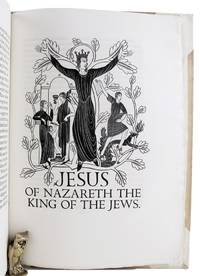
1931162756London: The Golden Cockerel Press 1931. With decorations by Eric Gill. Pp. ii270last blank2colophon verso blank 645 wood-engraved illustrations and decorative initials 4 full page large cockerel device on title page; f'cap. folio; half white pigskin spine lettered and ruled in gilt with five raised bands maize buckram boards lightly foxed as often bottom fore-corner of upper board faintly bruised very slight signs of professional cleaning to spine; t.e.g. others uncut; within the original card slipcase which is lightly soiled and worn the edges splitting with signs of early repairs; binder's stamp at foot of upper pastedown and bookseller's sticker on lower pastedown a couple of tiny spots to endpapers; The Golden Cockerel Press London 1945. One of 488 numbered copies thus bound printed on Batchelor hand-made paper total edition 500. Chanticleer 78; Gill 285. The first book printed from the 18-point size of the Golden Cockerel type designed by Eric Gill; regarded as one of the greatest 20th century English private press books and the masterpiece of the Golden Cockerel Press. 'The book among all books in which Roman type has been best mated with any kind of illustration' Chanticleer page 36. Chanticleer states 65 woodcuts but Evan Gill page 119 notes the decorative initial N on page 8 although from 2 separate blocks forms one illustration. The Golden Cockerel Press unknown
In-folio, two volumes. Later vellum over pasteboards with handwritten title on spine, slightly stained. Leaves [70], pp.583; pp. 772, ll.[6]. Roman, italic and Greek character. With a full-page woodcut portrait of Mattioli, 3 printer's devices and over 900 three-quarter-page figures (cm. 22x16) engraved in wood in the text, depicting plants, herbs, animals, insects and distillation procedures, of which two are colored by contemporary hand. Edit16 CNCE 35759 - Nissen BBI 1395 - Pritzel 5985 - Adams D 675 - Hunt 145.
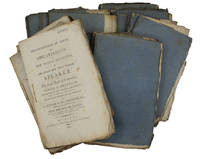
1789AQVBF8<p>8vo. 51 volumes. Preserved in the original states; the vast majority stitched as issued many uncut and in the original plain paper wrappers.</p><p>A remarkably fresh collection of pamphlets relating to Ireland and - largely - the proposed and later completed political union between Ireland and Great Britain dating from the final decade of the eighteenth- and first decade of the nineteenth- centuries. Included are historical and literary works references to the 1798 Irish Rebellion and numerous speeches made by Irish and British politicians during the long debates in both Houses of Parliament.</p><p>Highlights include:</p><p>- AN INDEPENDENT OBSERVER REDFOORD Archibald. Union necessary to security. Addressed to the loyal inhabitants of ireland. Dublin. Printed for J. Archer 1800.</p><p>8vo. 2 106pp. Uncut and partially unopened in original publisher's powder blue wrappers. Occasional inked corrections to text some dampstaining to margins.</p><p>Presentation copy inked inscription to head of title: 'For William Smith Esq. / from his sincere friend / The Author'.</p><p>ESTC T194733.</p><p>- AN OFFICER. TAYLOR Sir Herbert. Impartial relation of the military operations which took place in Ireland in consequence of the landing of a body of French troops under general Humbert in august 1798. Dublin. Printed for J. Milliken 1799.</p><p>8vo. 2 69pp 1. With two engraved folding plates and a folding table. Uncut and partially unopened in original publisher's marbled wrappers. ESTC T114958.</p><p>- A REAL FRIEND. A letter to the people of Ireland which they all can understand and ought to read. Dublin. Printed for J. Milliken 1799.</p><p>8vo. 3 6-33pp 1. In this edition the text ends on p.34 with 'I am your real friend. Finis'. Uncut and unopened in original publisher's powder blue wrappers. Foxed.</p><p>ESTC records a single copy of this edition in North America Missouri and none elsewhere.</p><p>From the collection - recently dispersed - of the Marquesses of Lothian who also held the Earldom of Ancram at Newbattle Abbey; many were presumably acquired by William Kerr 5th Marquess of Lothian 1737-1815 British soldier and peer.</p><p>A full list of the contents of this collection is available on request.</p> [vs.].
AQ17706Dublin Edinburgh and London: vs. 1789-1801 51 volumes. Preserved in the original states; the vast majority stitched as issued many uncut and in the original plain paper wrappers. A remarkably fresh collection of pamphlets relating to Ireland and - largely - the proposed and later completed political union between Ireland and Great Britain dating from the final decade of the eighteenth- and first decade of the nineteenth- centuries. Included are historical and literary works references to the 1798 Irish Rebellion and numerous speeches made by Irish and British politicians during the long debates in both Houses of Parliament. Highlights include: - AN INDEPENDENT OBSERVER REDFOORD Archibald. Union necessary to security. Addressed to the loyal inhabitants of ireland. Dublin. Printed for J. Archer 1800. 8vo. 2 106pp. Uncut and partially unopened in original publisher's powder blue wrappers. Occasional inked corrections to text some dampstaining to margins. Presentation copy inked inscription to head of title: 'For William Smith Esq. / from his sincere friend / The Author'. ESTC T194733. - AN OFFICER. TAYLOR Sir Herbert. Impartial relation of the military operations which took place in Ireland in consequence of the landing of a body of French troops under general Humbert in august 1798. Dublin. Printed for J. Milliken 1799. 8vo. 2 69pp 1. With two engraved folding plates and a folding table. Uncut and partially unopened in original publisher's marbled wrappers. ESTC T114958. - A REAL FRIEND. A letter to the people of Ireland which they all can understand and ought to read. Dublin. Printed for J. Milliken 1799. 8vo. 3 6-33pp 1. In this edition the text ends on p.34 with 'I am your real friend. Finis'. Uncut and unopened in original publisher's powder blue wrappers. Foxed. ESTC records a single copy of this edition in North America Missouri and none elsewhere. From the collection - recently dispersed - of the Marquesses of Lothian who also held the Earldom of Ancram at Newbattle Abbey; many were presumably acquired by William Kerr 5th Marquess of Lothian 1737-1815 British soldier and peer. A full list of the contents of this collection is available on request. . [vs., 1789-1801] unknown
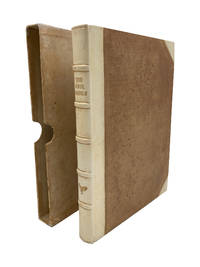
1931001546London: The Golden Cockerel Press 1931. 270pp 2. Original half pigskin and buckram over boards raised bands spine in six panels title in gilt to second panel cockerel device to fifth t.e.g. remainder untrimmed. Spine slightly rubbed usual light foxing to cloth covers internally bright and clean. Bookplate of Victor Alberts to front pastedown. Number three hundred and thirty-three of five hundred copies on paper with another twelve on vellum. Binding is by Sangorski and Sutcliffe. In the original slipcase which has Japanese paper repairs to edges and corners. The Four Gospels is widely regarded as one of the best private press books. Cave and Manson 78; Chanticleer 78 "a flower among the best products of English romantic genius"; A Century for the Century 26; Gill 285. First Thus. Half Pigskin and Buckram. Very Good. Illus. by Gill Eric. Folio. Private Press. The Golden Cockerel Press Hardcover
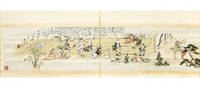
6222Many finely drawn illustrations in brush ink & colors. Scroll 285 x 9310 mm. 23 joined sheets some inoffensive worming carefully repaired. Japan: copied before 1857.<br/> <br/> A finely illustrated scroll created in the witty and refined realistic style of Yamato-e and Ukiyo-e brush work depicting the route taken — a distance of about 4 km. — by pleasure-seekers from Ryogoku Bridge to Shin Yoshiwara the center of prostitution in the city of Edo. By the 18th century it was the home to some 1750 women. This was an extremely busy section with a strong commercial tradition in what is today’s central Tokyo. <br/> <br/> Our scroll is an early copy of the original scroll; we do not know if that earlier scroll still exists. It was created by Bunyo Tozaka 1783-1852 a prominent Nanga-style artist who studied with Buncho Tani and specialized in kachoga pictures of flowers and butterflies. The author of the notes was Hirokata Yashiro 1758-1841 the influential historian of Japan and great book collector he had more than 50000 Chinese and Japanese books housed in a series of three buildings in Ueno known at the Shinobazu Bunko.<br /> The beginning of our copied scroll depicts several boats holding men including samurai and women making their way along the Sumida River from Ryogoku Bridge to Shin Yoshiwara. They disembark at Kumagatado adjacent to Asakusa Bridge. From there the men — clearly samurai — mount rented horses Daiden Horse Co. with very inadequate saddles and continue their journey. There are images of high-ranking men with their faces hidden by large hats in order to conceal themselves. Their family crests on their kimono are also hidden. They pass through Raijin Gate today’s Kaminarimon which belongs to Tokyo’s oldest temple Senso-ji. There is a merchant depicted along the side of the road selling dumplings the famous Yone manju. Finally the samurai dismount and board small boats at an embankment to cross some wetlands at the Nihon zutsumi. They arrive at a commercial area called Doromachi “Mud Town†where the travellers wash their feet and tidy themselves before entering Shin Yoshiwara and all its pleasures.<br/> <br/> Then we see several samurai “interviewing†prostitutes. Heading north there is a gate through which the samurai enter Shin Yoshiwara. Women are standing waiting to meet their customers. Some women are serving tea there is a man carrying a portable lending library on his back and we see men with hidden faces entering buildings with women waiting inside. There is another building with women sitting being “showcased†to passing potential clients. Next we have a scene of women entertaining with musical instruments; men are standing outside making their selections. The following scene shows men upstairs being entertained by dancers and musicians with food and drinks being served. A garden is shown. Women are seen on the street aggressively soliciting men. There are always suggestions of rooms behind rooms ready for the clients and their women.<br/> <br/> The next scene is the kitchen with men preparing octopus lobsters and shrimp. Another man is cutting up fish. Women carry the prepared food to another room where men are being served and entertained. At the end we see a man taking a nap. At the end there are notes — collector’s thoughts — regarding the manuscript: he tells who the original artist and author were and that this is a detailed description of a past time painted in a style similar to Morunobu Hishikawa and Iccho Hanabusa. The collector considered our scroll to be “finely done†and he has signed his name “Choton Kishi†with his seal which might be painted not stamped.<br/> <br/> Throughout the artist’s sense of perspective and design is extremely fluid and imaginative. Many of the figures and landscapes have been heightened with lacquer gold silver and mica. As we move through the scroll there is also a sense of the day passing to evening.<br/> <br/> With the seal of the founder of the Kishi Library Choton Kishi d. 1857 the distinguished book collector and natural historian. This fine scroll was offered for sale by the great bookseller Shigeo Sorimachi in 1977 in his 50th anniversary catalogue. The scroll has been carefully backed in the past century. Preserved in a box with Mr. Sorimachi’s handwriting on the upper cover. unknown
6222Many finely drawn illustrations in brush ink & colors. Scroll 285 x 9310 mm. 23 joined sheets some inoffensive worming carefully repaired. Japan: copied before 1857. A finely illustrated scroll created in the witty and refined realistic style of Yamato-e and Ukiyo-e brush work depicting the route taken - a distance of about 4 km. - by pleasure-seekers from Ryogoku Bridge to Shin Yoshiwara the center of prostitution in the city of Edo. By the 18th century it was the home to some 1750 women. This was an extremely busy section with a strong commercial tradition in what is today's central Tokyo. Our scroll is an early copy of the original scroll; we do not know if that earlier scroll still exists. It was created by Bunyo Tozaka 1783-1852 a prominent Nanga-style artist who studied with Buncho Tani and specialized in kachoga pictures of flowers and butterflies. The author of the notes was Hirokata Yashiro 1758-1841 the influential historian of Japan and great book collector he had more than 50000 Chinese and Japanese books housed in a series of three buildings in Ueno known at the Shinobazu Bunko. The beginning of our copied scroll depicts several boats holding men including samurai and women making their way along the Sumida River from Ryogoku Bridge to Shin Yoshiwara. They disembark at Kumagatado adjacent to Asakusa Bridge. From there the men - clearly samurai - mount rented horses Daiden Horse Co. with very inadequate saddles and continue their journey. There are images of high-ranking men with their faces hidden by large hats in order to conceal themselves. Their family crests on their kimono are also hidden. They pass through Raijin Gate today's Kaminarimon which belongs to Tokyo's oldest temple Senso-ji. There is a merchant depicted along the side of the road selling dumplings the famous Yone manju. Finally the samurai dismount and board small boats at an embankment to cross some wetlands at the Nihon zutsumi. They arrive at a commercial area called Doromachi "Mud Town" where the travellers wash their feet and tidy themselves before entering Shin Yoshiwara and all its pleasures. Then we see several samurai "interviewing" prostitutes. Heading north there is a gate through which the samurai enter Shin Yoshiwara. Women are standing waiting to meet their customers. Some women are serving tea there is a man carrying a portable lending library on his back and we see men with hidden faces entering buildings with women waiting inside. There is another building with women sitting being "showcased" to passing potential clients. Next we have a scene of women entertaining with musical instruments; men are standing outside making their selections. The following scene shows men upstairs being entertained by dancers and musicians with food and drinks being served. A garden is shown. Women are seen on the street aggressively soliciting men. There are always suggestions of rooms behind rooms ready for the clients and their women. The next scene is the kitchen with men preparing octopus lobsters and shrimp. Another man is cutting up fish. Women carry the prepared food to another room where men are being served and entertained. At the end we see a man taking a nap. At the end there are notes - collector's thoughts - regarding the manuscript: he tells who the original artist and author were and that this is a detailed description of a past time painted in a style similar to Morunobu Hishikawa and Iccho Hanabusa. The collector considered our scroll to be "finely done" and he has signed his name "Choton Kishi" with his seal which might be painted not stamped. Throughout the artist's sense of perspective and design is extremely fluid and imaginative. Many of the figures and landscapes have been heightened with lacquer gold silver and mica. As we move through the scroll there is also a sense of the day passing to evening. With the seal of the founder of the Kishi Library Choton Kishi d. 1857 the distinguished book collector and natural historian. This fine scroll was offered for sale by the great bookseller Shigeo Sorimachi in 1977 in his 50th anniversary catalogue. The scroll has been carefully backed in the past century. Preserved in a box with Mr. Sorimachi's handwriting on the upper cover. unknown books
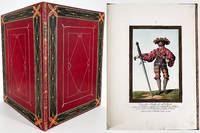
17901485Basel: C. de Mechel 1790. First Edition. Fine. Chrétien de Mechel after Hans Holbein. Folio 14 1/8 x 10 1/2 inches 360 x 263 mm; hand-colored aquatint title and 12 etchings & aquatint plates with hand-colroing in watercolor by Chrétien de Méchel after Hans Holbein the Younger. Handsome contemporary mosaic binding in red morocco inlaid dark green border with red and yellow dots and yellow corner piece designs gilt board edges and turn-ins gilt designs on spine and green label with gilt title spine a little rubbed marbled endpapers a.e.g.; preserved in a slipcase with marbled paper and red morocco profiles a little rubbed and faded. <br /> <br /> Cohen / deRicci 493; Colas 1462; Rahir Bibliothèque de l'Amateur p. 661; Brunet III 251-252; Cicognara 2044; Bobins 490; Vinet 2177. Housed in a stunning mosaic binding this rare folio contains a complete suite of 12 magnificently-colored plates the third part of a series of 4 comprising Holbein's oeuvre published in Basel by Chrétien de Méchel from 1780 to 1792 and usually found in uncolored state. The Swiss civil and military costumes originally drawn by Hans Holbein the Younger 1497 - 1543 and housed in the Basel Public Library. Chrétien de Méchel renders these drawings in a robust and precise manner for this edition featuring 6 women and 6 men some in military costume. More commonly encountered lacking the hand-coloring en bistre each of these scarce engravings appears fresh and in superb condition with excellent saturation and extensive bright coloration. An excellent exemplar of this rare hand-colored volume.<br /> A copy can be found in the Robert Wylie Lloyd collection at the British Museum inv. 1958.0712.3056.1-12. C. de Mechel unknown
1970144022New York: Cinnamon Press 1970. Rare Bag One lithograph signed by Beatles icon John Lennon. One page the title page from Lennon's Bag One Portfolio. Signed by him beneath the image. From the collection of Jonathan Cott author and editor of numerous books predominately focusing on music and who has written articles for varied publications such as Rolling Stone The New York Times The New Yorker The Los Angeles Times The Village Voice Vogue Esquire and The Wall Street Journal. This was presented by John Lennon to Jonathan Cott who interviewed Lennon and Yoko Ono several times and whose December 5 1980 interview with Lennon was the final solo interview conducted before his death on December 8th of that year. Lennon had created the "Bag One" drawings depicting his wedding and honeymoon with Yoko Ono and presented them to her in 1969. Framed. Rare and desirable and with noted provenance. In 1969 as a wedding gift for Yoko John drew the 'Bag One Portfolio'—a chronicle of their wedding ceremony honeymoon and their plea for world peace in the Bed-In. The following year the artwork was produced in a series of three hundred portfolios of fifteen signed prints each. The majority depict John and Yoko's most intimate private moments—upon their first exhibition in London more than half were deemed 'indecent' and confiscated by Scotland Yard. The rare title page features perhaps the most famous and recognizable print of the suite. Cinnamon Press unknown
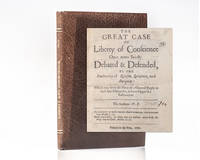
1670149562London 1670 i.e. 1671. Rare second edition of one of the most persuasive defences of liberty and “the free and uninterrupted exercise of our consciences"William Penn. Quarto bound in full modern morocco gilt titles and ruling to the spine inner dentelles elaborately stamped in blind. A powerful argument for toleration and against the intrusion of civil authority into religious matters this second edition was revised and enlarged from the first edition during Penn's imprisonment at Newgate in 1670 a defining episode in his lifelong defense of religious liberty. This is evidently a 2nd edition being much enlarged from the 1st which may be seen on comparison; and "J." for Junior is here omitted in the Title page and also the Dedication to the King which the first contains -- and an address "to the Supream Authority of England" dated "Newgate the 7th of the 12th monteth called February 1670." -- and a Preface added; also new matter in the work" Smith Friends' Books II p.286-7. In very good condition. Bookplate of William Tarun Fehsenfeld to the pastedown. The Great Case of Liberty of Conscience Once More Briefly Debated & Defended by the Authority of Reason Scripture and Antiquity constitutes one of William Penn’s earliest and most systematic expositions of the principle of religious toleration. This second edition revised and enlarged during his imprisonment in Newgate Prison in 1670 following his arrest for preaching at an unlawful Quaker meeting develops and refines arguments first articulated in the initial printing. Drawing on reason Scripture and early Christian authority Penn maintains that civil government possesses no jurisdiction over matters of faith and that coercion in religion violates both divine and natural law. Produced during a formative period of persecution the text articulates a mature defense of liberty of conscience that would later inform Penn’s political philosophy and the legal and religious framework of his American colony. unknown