Walbert, M.W.MareMagnum

184 825 résultats
483 pages. "In this volume the author endeavors to give an accurate history of the present National Bank System of currency, including an account of the first United States Bank, - both of which were borrowed from Great Britain by those statesmen who, like the father of Sir Robert Peel, believed that a national debt was the source of prosperity. It is believed that the facts adduced in the following pages will be productive of some good, in pointing out the immense evils lurking in that system of banking, - a system which has produced panics at will, and which is the active abettor of the stock gamblers, railroad wreckers, and those industrial tyrants of modern times, the enormously overcapitalized and oppressive trusts. It is sought to point out the great dangers of delegating purely government powers to these greedy monopolists, by which they are enabled to organize a money trust, far more tyrranical than all the other combinations now in existence; and by which they absolutely defy the authority that endowed them with corporate life." - from Introduction. Binding sound. Unmarked. Moderately worn and soiled externally. Only defects are insect damage along exterior of each hinge. Detailed photos available upon request. An ultra-rare first edition copy of this classic and vitally important work. Book
419 pages. Index. Footnotes. Frontis portrait of Adam Weishaupt. "I have felt impelled to devote one more book to the Revolution as a whole by going this time further back into the past and attempting to trace its origins from the first century of the Christian era. For it is only by taking a general survey of the movement that it is possible to understand the causes of any particular phase of its existence. The French Revolution did not arise merely out of conditions or ideas peculiar to the eighteenth century, nor the Bolshevist Revolution out of political and social conditions in Russia on the teaching of Karl Marx. Both these explosions were produced by forces which, making use of popular suffering and discontent, had long been gathering strength for an onslaught not only on Christianity, but on all social and moral order." - Preface. Bookplate upon front free endpaper. Last two leaves of index loose but present. Back free endpaper missing. Front board loosely attached. Tiny bit of writing atop last blank page. Gilt lettering upon backstrip worn but legible. SINGERMAN 161, WEEMS p.71. Book
190210786ABVienna and Leipzig, Wolfrum, n.d.(ca. 1902). 45 : 33 cm. Title-pages and index 94 (of 96) coloured plates. Loose as issued in original half-cloth portfolio. Series I and II (all published?).
Very Good Arabic Original brown half leather bindings in Egyptian style, raised six bands to spine, title gilt on the second, volume nos on fourth, and alphabetical with the historical content of the volumes on sixth compartments and "Mahmoud Al-Tawawî" name. Minor foxing on some pages. Overall a very good set. Roy. 8vo. (24 x 17 cm). In Arabic. 14 books are complete set in 7 volumes. Extremely rare first printed edition of the most comprehensive and complete corpus on Baghdad city, which includes Al-Baghdadi's first-hand account of the collection of hadiths, biographies, and his travels in the 11th century Baghdad in traditional "al-râwî" style. Al-Baghdadi is known as a Muslim traveler in the pursuit of knowledge who compiled hadiths and traveled to many Islamic cities. He was born on the 24th ?jumada II, 392 (1002) at Darzidjan, a large village on the west bank of the Tigris below Baghdad. The son of a khatib [i.e. preacher], he began his studies very early and spent his youth traveling in search of ?adith. In this way, he visited Basra, Nishapur, I?fahân, Hamadân, and Damascus. Finally settling in Baghdâd, he held the office of a kha?îb and this was the origin of the name al-Khatîb al-Bag_dadi. After completing his education, he spent more than twenty years of his time writing "Tarikh Baghdad". He finished his corpus in 444 AH [1052-53]. He was a fellow student of Rîsürrüesâ Ibn al-Muslima who was the vizier of the Abbasid caliph Kâim-Biemrillâh. The vizier took Khatib, whom he appreciated in the science of hadith, under his patronage. The Abbasid caliph, therefore, ordered Khatib to be given permission to take hadith lessons from him. Khatib started to narrate hadiths from "Tarikh Baghdad" to his students here in his house near the Nizâmiya Madrasa, on the other hand, he started to read the books for which he had permission to narrate from many teachers, also write the books he planned. Several years after, the Turkish commander Besasiri (?-1060), who was a supporter of the Fatimid Caliph Mustansir-Billâh, entered Baghdad with the encouragement of the Fatimid caliph, deposed the caliph, and killed Ibn al-Muslima. Some members of the Hanbali sect, who had a grudge against Khatib because of what they wrote against some Hanbalis in Tarikh Baghdad, started to disturb him by taking the opportunity to kill the vizier. Therefore, he had to flee to Damascus. In his masterpiece, Khatibi, in addition to his account and descriptions of the city during his time in Baghdad, 7831 figures of people in total who lived or came in Baghdad before 450 (1058), statesmen such as caliphs, viziers, commanders, poets, judges, and other professions. This is an alphabetical work giving information about biographies of these figures, but it starts with the name "Muhammad" referring to the Muslim prophet. The first volume is about the establishment of Baghdad in the pre-Islamic period, its conquest by the Muslims, and its history. This masterpiece of him, published in fourteen volumes, is the most comprehensive corpus written on Baghdad in the Islamic world including the city's topography, history, et alli. Brockelmann, GAL, I, 401; Suppl., I, 563.; H. Gibb, "Islamic Biographical Literature".; F. Rosenthal, A History of Muslim Historiography, Leiden 1968, p. 14, 43. Only one set in OCLC in BnF (Bibliothèque nationale de France): 1198963531.
Very Good Turkish, Ottoman (1500-1928) Contemporary quarter leather bdg. Handsomely bound. Six raised bands to spine, the second compartment has the title, the fifth has "issue 1-104", and the sixth has ex-owner's name of the volume, "Semseddin" lettered gilt. Original end-papers of the period. Slightly age-toned on the lower pages, fading on extremities of boards, overall a very good volume. Folio. (41 x 29 cm). In Ottoman script (Old Turkish with Arabic letters) and Turkish with Latin letters. This folio volume consists of 104 issues of the periodical, each issue has 4 pages, which has mostly color illustrated covers as well as several b/w ones. A rare togetherness of the first 104 issues of this Turkish satirical magazine, richly illustrated with thousands of attractive illustrations and caricatures, was published in Istanbul twice a week every Wednesday and Saturday with at least four, at most eight pages, during the Letter Revolution 1928, when the transition from the Arabic alphabet to new Latin letters was ensured. The collection provides an invaluable resource, reflecting the changes in society during and after the Letter Revolution in New Turkey, 1928, placing the new Latin alphabet instead of old Arabic letters and contributing to the development of reading and writing skills of the new Turkish society, as well as "creating the basis for the rapid social evolution in the young Turkish Republic Revolution" soon after the proclamation of the Republic in 1923. The newspaper had a printing house with the same name headquartered in Bab-i Ali (The Sublime Porte of Constantinople), the place where the heart of the Ottoman press was. Burhan Cahid Morkaya left Karagöz Newspaper and founded Köroglu Newspaper in 1928 and wanted the people living in Istanbul and Anatolia to be able to read and write new letters. Indeed, during the period of its publication, Köroglu Newspaper reached the most remote corners of the New Turkish Republic with its attractive cartoons covering local and mostly international subjects. In addition to this news and cartoons, Morkaya also published Turkish reading passages with Arabic letters that were transcripted into Latin letters. Therefore, he created a great positive effect that facilitated the transition to new letters during the Turkish Alphabet Revolution. Duman 1155.
Very Good Turkish, Ottoman (1500-1928) Contemporary 1/3 leather bdg. with cloth spine. Leather boards. Restored. Demy 8vo. (22 x 15 cm). In Arabic. [138] p. Slightly chipped extremities of papers. Occasionally stained on pages, wear on binding. Text is fine. Including 'kataba'. The routine, predictable, yet exhaustive nature of the journey Ottoman pilgrims endured may have discouraged them from recording their journeys. The route was relatively well-defined, and the caravan orderly and well-protected. Moreover, Ottoman pilgrims, unlike Christian travelers, were traveling across the lands of the same state, thus seeing people of the same Muslim culture, without needing to speak different languages, use different currencies, or negotiate borders between states. The uniqueness and peculiarity of a journey would motivate the traveler to record it and the result would be of interest to an audience. As for the Ottomans, if the texts which were composed to help future pilgrims with practical information are excluded, the majority of known narratives, are written by those authors such as Ahmed Fakih, Fevri, Evliya Çelebi, Nabi, and Shaikh Sinan er-Rûmî who undertook at least some parts of their journeys independently of the official caravan. Texts which seem to have been intended simply to provide practical information either on the stations or on the rites of the hajj or on both are defined as guidebooks. These texts appear not to be based on a particular pilgrimage journey, regardless of the fact that their authors might have performed the hajj. This manuscript starts with 'Bayân al-Menâzil Beyt Al-Sam wa al-Qabah' [i.e. Descriptions and stations from Damascus to Mecca] including a very detailed routes' list with their times hour by hour. 40 routes and hours probably by mounts and/or walking between Damascus and Mecca, Qaba. Other chapters of the text include rites and routes like "Farziyyat of Hajj, Ihram, Mukhrima, entry to Mecca-i Muqarrama, tawaf, Sa'y between Safa and Marwa, Arafat in Mecca, Muzdalifa from Arafat, Ef'al in Mina, Umra, Taawaf al-Vedâ, Qabr-i Sharif in Medina al-Munawwara, etc. Sheikh Sinan Al-Roumi's manasik al-hajj is one of the most important and famous ones in the hajj literature of the Islamic world. It was a mostly used reference book among Muslim pilgrims, especially in the Ottoman world. Calligrapher and copied by Ahmed b. Muhammed b. Suleyman. Text in black ink and important headings in red ink on paper with 'ahar'. A fine paper suitable for calligraphy. A very good example from the first half of the 18th century.
1862ST16794Boston: Printed for the Author for private distribution 1862. 235 x 175 mm. 9 3/8 x 6 7/8". 35 1 pp. <br/> HANDSOME BROWN CRUSHED MOROCCO BY THE ROSE BINDERY OF BOSTON stamp-signed in gilt on front turn-in covers with wide frame of multiple gilt fillets curling leaf tools and daisy tools raised bands spine gilt in triple-ruled compartments with two leaf tools at center turn-ins framed by gilt rules and daisy tools light brown moiré silk doublures and endleaves top edge gilt. Original wrappers bound in. EXTRA-ILLUSTRATED WITH 25 PLATES including steel engravings copperplates etchings a mezzotint and a woodcut all depicting people and events from the text. Front flyleaf with morocco bookplate of Frank Deering; original front wrapper with ink presentation inscription: "Mr. Wm. B. Trask / with the regards of / the Author." Text leaves with light even toning occasional faint offsetting from plates or tissue guards one plate with mild foxing otherwise a lovely copy the text and plates clean and fresh and THE HANDSOME BINDING LUSTROUS AND UNWORN.<br/> <br/> This short overview of the life of the Elizabethan courtier and explorer is most attractively bound and extra-illustrated with portraits of Raleigh Queen Elizabeth Francis Drake and other members of the court as well as friends and rivals of the book's subject along with a view of the Tower of London where he was imprisoned the battle with the Spanish Armada and the famous scene in which Raleigh gallantly placed his cloak over a puddle for the queen to cross. The text is an anomaly in the writings of antiquarian and genealogist Samuel Drake 1798-1875 who wrote primarily about early New England including several accounts of Indian captivities. Drake presented this copy in its original wrapper to his fellow editor at the "New-England Historical & Genealogical Register and Antiquarian Journal" William Trask. The book was later extra-illustrated and elegantly bound for distinguished Maine collector Frank Deering 1866-1939 by the Rose Bindery in Boston a firm that catered to bibliophiles. <br /> <br /> Around the turn of the 20th century Boston was home to a number of hand binderies formed as part of the American embrace of the Arts & Crafts Movement. Hoping to stand out from the competition the Rose Bindery did not advertise but published a small booklet outlining the services they offered for "the owners of libraries but more especially of rare volumes first editions unique books that require new bindings or where the present binding should be repaired so as to preserve or restore its original character and beauty." The booklet also explained the bindery's creative approach: "It has been truly said that a great deal more thought should be put into what is left out of the design than to what is put into it; dignity and character should always be uppermost in the mind of the designer." Our binding embodies this philosophy with restrained and elegant tooling with an unusual curling leaf tool thoughtfully deployed. <br /> <br /> Deering was head of a lumber company and also served in his state's legislature. History was his main area of interest and his library contained an impressive collection of early Americana. According to his obituary in the journal of the American Antiquarian Society "One of the prominent features of his library was the almost complete collection which he gathered of Indian narratives and captivities in which field his collection was un-rivalled in the country." It seems likely he knew of Samuel Drake due to their shared interest in this topic. The special treatment he commissioned for this book adds greatly to its allure as does the pristine condition of the binding. Printed for the Author for private distribution unknown
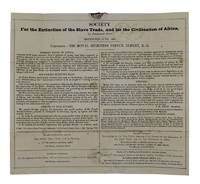
AQ30000Single leaf mulready letter- sheet folded addressed to 'Mrs Clive Sanderstead Croydon Surrey' postmarked Frome with the 306 duplex cancellation to folded front and further post-marks of Croydon and Frome dated September 1844 to folded verso. Some tears to folds margins without loss of text remains of opened wax seal and old paper repairs to recto. The earliest of several known variants of this rare plea for donations for the Society for the Extinction of the Slave Trade and for the Civilization of Africa printed on the reverse of a 'Mulready' penny postal stationary sheet. First issued on 1 May 1840 in parallel with the world's first stamp - the Penny Black - these pre-paid self-folding letter sheets featured an engraved design by John Thompson after William Mulready 1786-1863 and were valid for use from 6th May. Much to postal reformer Rowland Hill's surprise unlike their adhesive philatelic counterpart the Mulready covers quickly proved unpopular both with customers and stationers - who relied upon the sale of writing paper for letters - alike. They were superseded by the introduction of simpler postal stationary with impressions akin to stamps in the top left hand corner in 1841; Mulready sheets were subsequently withdrawn from sale during the early 1840s. Despite their unpopularity soon after issue the promotional opportunities provided by advertising on the verso of the Mulready letter-sheets were seized upon by commercial and voluntary associations alike. Insurance companies banks newspapers publishers and religious institutions are all known to have advertised in such a manner; many made this stationary available in quantity at a discounted rate to ensure wide circulation to the writing desks of the literate across Britain. Advertisements for The Society for the Extinction of the African Slave Trade are known to have featured on nine slightly different advertisements to the verso of the Mulready one- and two-penny letter-sheets; this is the earliest known advertising that 'Shortly will be Published' an Abridgement of Buxton's The African Slave Trade London 1840 implying that these were issued in the very first year of the stationary's use. The fact that no fewer than four works published by John Murray are also advertised could indicate that the cost of producing these pre-paid advertising letter sheets was borne by the publisher. 'A subscription of One Guinea and upwards per annum constitutes an Annual Member. A donation of Ten Guineas and upwards constitutes a Life Member Subscriptions and donations of a smaller amount will be thankfully received.' Founded by English politician Fowell Buxton 1786-1845 in June 1839 with the aim not only of finally extinguishing the Slave Trade in Africa some decades after the original abolition of the Trade in Britain her colonies and the United States but also to 'watch over and befriend the interests of Africa' and form a commercial 'Company which shall cultivate portions of her soil'. As noted in this advertisement which sought 'subscriptions and donations' this included persuading the British Government's sending an expedition see item number 36 led by the Royal Navy to explore the Niger river which despite the death of a full third of the those involved largely to fever did secure the signing of several treaties against the slave trade with tribes in modern day Nigeria. As this advertisement - signed by secretary Irish clergyman and missionary John Trew 1792-1869 notes further expeditions 'into the interior of Africa' were envisaged at 'considerable expense' to the society; however the Society was acrimoniously dissolved in 1843 - the year before this letter-sheet was used - before any such expeditions could be repeated. Stanley Gibbons Queen Victoria Vol. 1 Pt. 1 SG MA480a. Dimensions unfolded: 220 x 200 mm; folded: 133 x 88 mm. unknown
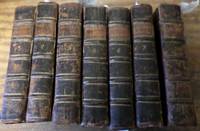
17396829G. Smith In Stanhope-street near Clare-market et al 1739. 1st Edition . Book Hardcover. Good/No Jacket. G. Smith In Stanhope-street near Clare-market et al 1739. 1st Edition . Good/No Jacket. Seven of the ten volumes of this set published in 1739 and 1740 these volumes. Volume 1 contains the alegorical frontispiece indicating that no branch of natural philosophy is foreign to the society. In addition each volume has thirteen numbered engraved plates mostly folding of which plate 5 in volume 4 and plate 9 in volume 5 are missing apparently never having been bound in. Contemporary full calf with simple gilt panelling on the covers and rules across the spine simple blind-embossed borders within the panels raised bands and volume numbers in gilt arabic numerals on spine "BADDAM'S MEMOIRS" on red Morocco labels gilt bordered. All page edges red-sprinkled. The condition of the bindings is worn with some splitting of joints and parting of paper at hinges but still strong with no incipient detaching of boards. Occasional loose free endpaper. Text pages and plates with little if any foxing. Pagination: vi5168; 5164; 1-512489 mis-numbered page 5137;5066;5145blank; 515blank 4; 5164.Usual double free endpapers of this period. The provenance going back through time is indicated by the bookplates of a recent FRS of John Hallifax displaying his arms as granted in 1788 and finally the pioneer inventor and mill-owner Jedediah Strutt who partnered Richard Arkwright in the world's first water-powered cotton mill in CromfordDerbyshire which still largely survives as a shell and later set up giant mills of his own in Belper and Milford sadly almost completely lost in the carpet demolition of the 60's. His small ornate-lettered "Jedh. Strutt" bookplate is attached to the top corner of each front pastedown. G. Smith, In Stanhope-street near Clare-market, et al hardcover
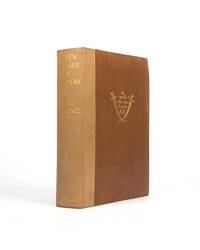
122650London Jonathan Cape 1935. . First trade edition limited issue number 519 of 750 copies; 4to 25.5 x 20 cm; folding maps printed in red and black 54 plates including portrait frontispiece slight age-toning to text leaves as usual otherwise near-fine; publisher's pigskin-backed brown buckram boards gilt gilt crossed swords device to upper cover slight bumping to corners and minor mottling to fore-edges of boards otherwise very good-plus.<br /> A handsome copy of T.E. Lawrence's classic memoir Seven Pillars of Wisdom from the collection of Lt. Cdr. Geoffrey Ingleton 1908-1998 one of Australia's foremost maritime historians and his son the noted Tokyo publisher and book dealer Nick.<br /><br />Following his extraordinary military and diplomatic career in Arabia and having already become a legendary figure in the public imagination T.E. Lawrence purchased his Dorset cottage retreat Clouds Hill in 1924 to write his book about the war. The first draft of Seven Pillars was completed by November 1919 but was soon lost according to the author at Reading Station. A second draft was finished during 1922 and finally appeared as a private edition reflecting Lawrence's love of fine printing in 1926.<br /><br />'Subtitled "A triumph" its climax is the Arab liberation of Damascus a victory which successfully concludes a gruelling campaign and vindicates Lawrence's faith in the Arabs. In a way Seven Pillars is a sort of Pilgrim's Progress with Lawrence sustained by his faith in the Arabs successively overcoming physical and moral obstacles' ODNB.<br /> O'Brien A042. London, Jonathan Cape, 1935. hardcover
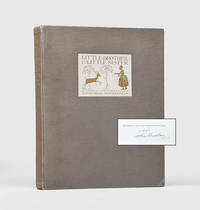
1917170261London: Constable & Co. 1917. With the additional signed plate Signed limited edition number 443 of 525 copies signed by the artist. The limited edition included an "extra plate" being a duplicate of "He hurried away with long strides" signed by Rackham and this is present here in the original printed envelope. A review in The Bookman noted that "Here is an ideal conjunction of author and artist - the fairy and folk tales of the Brothers Grimm could not have a more fitting illustrator than Arthur Rackham nor he more suitable authors to illustrate." Quarto. Colour frontispiece and 11 colour plates mounted on grey paper black and white illustrations in the text all by Rackham. With additional plate. Original grey cloth spine lettered in gilt front cover lettered and decorated in gilt on white background pictorial endpapers top edge gilt others untrimmed. Housed in a custom brown cloth slipcase with white morocco opening. Extremities a little bumped minor tear to top of front joint front hinge split but firm some foxing and browning minor creases to two plates light soiling and creases to envelope: a very good copy. Latimore and Haskell pp. 46-7; Riall p.129. The Bookman December 1917 p. 156. hardcover
1894124133Oxford: printed for the Association by the Printers to the University 6 issues with the imprint of Horace Hart; the last 5 with that of Frederick Hall 1894-1919. The state of women's education in Oxford at the height of the suffragette agitation An important set of reports published by the pioneering Association for Promoting the Higher Education of Women AEW containing a mass of information relating to the state of women's education in Oxford at the height of the suffragette agitation. The earliest report dates from 1894-95 and the latest from 1918-19 each running from October of one year to the same month of the next. The sequence is incomplete with two issues missing 1900-01 and 1910-11. The reports are scarce in any sequence. WorldCat and Library Hub record runs at the London School of Economics and the British Library. The society's papers and publications are held in the Bodleian deposited there in 1975. The question of women's suffrage and its relevance within the structures of the University of Oxford had been a topic of frequent discussion prior to the formal debate on the subject at the Oxford Union on 19 February 1880. Societies like the Oxford Women's Liberal Association OWLA and the Women's Emancipation Union plus the activism of Florence Davenport Hill who had been a founder member of the Bristol Women's Suffrage society in 1868 and had since moved to Headington paved the way for groups like the AEW and later the Oxford Women's Suffrage Society. The organization's work led to the founding of four women's colleges: Lady Margaret Hall and Somerville opened in 1879 followed by St Hugh's in 1886 and St Hilda's in 1893. St Anne's also originated as part of the AEW catering for female students who lived with private families in Oxford while attending courses run by the society. The AEW counted the activist Eleanor Smith 1823-1896 among its founding members and Annie Rogers 1856-1937 Oxford's first woman don as a secretary. Perhaps the most significant sections in these reports are those titled "General Statistics" which provide accounts of lectures attended by students tutorial arrangements results of examinations donations and subscriptions. The report of 1917-18 also provides a commentary on the "extension of the University Parliamentary Franchise to women who being British subjects and not subject to any legal incapacity have attained the age of thirty and have been admitted to and passed the final examination and kept under the conditions required of women by the University the period of residence necessary for a man to obtain a degree at Oxford. They are registered on specially favourable terms as the Act admitting them is so drafted that the fee of £1 for registration cannot be required of persons who are not graduates. The Register contains at present the names of 409 women." The AEW continued its activities until November 1920 when it dissolved itself as the university by admitting women to membership had taken responsibility for them. 23 issues octavo; comprising a total of 616 pages the issues c.20-30 pp. in length. Original printed paper wrappers sewn and wire-stitched as issued. Housed in a former library's dark purple cloth flat-back box with metal latch closure paper label to spine reading "Australian Council for Educational Research". Each issue complete with stamps shelf marks and labels of the Education Department Library latterly the Board of Education Library. Overall a scarce survival in very good condition. Shelfwear and creasing to wrappers those for the earliest issue detached; rear wrapper for the 1909-10 issue torn but no loss. hardcover
1965160722London: Jonathan Cape 1965. Scarce proof copy Proof copy of the first edition first impression. The text and illustrations are printed in brown and green throughout the green appearing much lighter in the proof one illustration slightly differs. The book was published in laminated boards without a dust jacket. Octavo. Illustrated throughout by Lennon. Original white wrappers. With dust jacket. Book fine dust jacket with minor rubbing to edges. hardcover
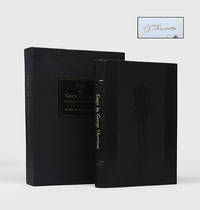
166828Guildford: Genesis Press 1987. First edition first printing no. 1438 of 2500 copies signed by the former Beatle and the illustrator. A fine production as expected from Genesis the pioneers of high quality art-rock publications. With foreword by Jeff Lynne middleword by Elton John and backword by George Harrison. CD contains the following tracks: Sat Singing Recorded March 1980. Lay His Head Recorded April 1980. For You Blue Recorded live in Washington DC December 1974. Flying Hour Recorded March 1978. Quarto. Illustrated throughout by Keith West together with photographs by Gered Mankowitz Brian Roylance Richard Young and John Carter. Original black half-morocco boards gilt edges lettering to spine gilt with limited edition CD 'Songs' the whole contained in custom-made clamshell box with card tray lettering to front cover and spine gilt. Minor rubbing to CD cover otherwise fine. hardcover
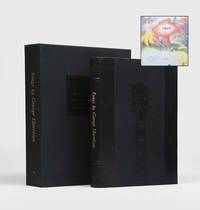
184417Guildford: Genesis Press 1992. I look at the world and I notice it's turning while my guitar gently weeps First edition number 1602 of 2500 copies signed by the former Beatle and the illustrator Keith West. This is a fine production from Genesis the pioneers of high quality art-rock publications with a foreword by Ringo Starr "middleword" by Elton John and "backword" by George Harrison. Loosely inserted is a hand-coloured drawing by the illustrator Keith West. The CD contains the following tracks: "Life Itself" "Hottest Gong in Town" "Tears of the World" and "Hari's on Tour Express" recorded live in Washington D.C. in December 1974. Quarto. With 3 photographic plates tipped in illustrated limitation page tipped in 2 folding plates at centrefold illustrations by Keith West throughout. Original black half morocco boards lettering to spine gilt edges gilt. In publisher's clamshell box with limited edition CD 'Songs' in card tray gilt lettering to spine and leather label lettered in gilt with card guitar bookmarker. In fine condition. hardcover
100964The Pastoral Review Ltd. Sydney Melbourne and London. 1929. The Pastoral Review Ltd. 1929. First edition. Large thick 4to. iv 540 pages. With b/w photographs to almost every page of houses interiors exteriors owners and their familes gardens landscapes livestock etc. 45 properties described in detail. Mostly these are based in New South Wales but there are a few from Victoria and Southern Australia. Bound in full black morocco gilt not unlike a family Bible. All page edges gilt. Marbled endpapers. The leather to upper joint has partially split but joint is sound and has been professionally strengthened along front hinge. Head and tail of spine very frayed and worn lower corners and outer edge of upper board rubbed. Pages lightly browned otherwise a clean and sound copy of a scarce item the first volume of the second series of Pastoral Homes. hardcover
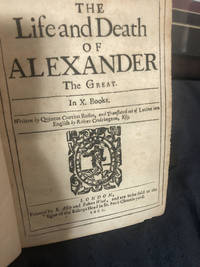
1661Bv1103<p>"NONE BUT ALEXANDER COULD PERFORM WHAT ALEXANDER HATH DONE": SCARCE 1661 EDITION IN ENGLISH OF QUINTUS CURTIUS RUFUS' LIFE AND DEATH OF ALEXANDER THE GREAT CODRINGTON Robert translator. The Life and Death of Alexander the Great. In X. Books. London: E. Alsop and Robert Wood 1661. Small quarto 6 x 7-1/2 modern full brown calf elaborately gilt-decorated spine raised bands black morocco spine label. Housed in a custom black linen slipcase. 1661 edition the scarce second edition of Robert Codrington's esteemed translation into English of this life of Alexander the Great a splendid volume attractively bound in full calf. Curtius Rufus flourished in the first century C.E.; particulars of his life are unknown. His Historiarum Alexandri Magni "introduces a number of picturesque details which are grouped effectively; and the career of the great Macedonian is regarded as a series of brilliant and romantic adventures. There are a number of carefully finished speeches worked into the narrative and much sententious reflection. The style is evidently formed on that of Livy" Peck 449. Preceded by John Brende's 1553 first translation into English which ran through a number of printings in the intervening century before Codrington undertook his new translation "exactly conferred with the Original and purged from many gross errors and absurdities with which it before abounded." Codrington's translation first appeared in 1652 under a slightly different title see Wing C7699. Title page with wood-cut engraved vignette engraved headpieces and ornamental initials. Occasional mispagination toward the end as issued without loss of text. A superlative example handsomely bound. Book Bv1103. $4000. We specialize in rare Ayn Rand as well as other legends and landmarks.</p> E. Alsop and Robert Wood hardcover
1852List2521London 1852. Five groups of documents measuring 13 x 8 inches various paginations see full description below. Fine condition. A scarce set of primary source documents relating to the protection of British territory in the Caribbean in particular along the Mosquito Coast during the period of varied interests in the area in the period following the Anglo-Spanish agreement on the slave trade. Consisting of a series of secretarial copies of reports delivered to Peter McQuhae Commodore of H.M.S. Imauam stationed in Jamaica these dispatches offer an overview of the issues confronting the British Navy in Jamaica during the period and in the Caribbean more broadly. Most of the documents refer to issues with Cuba the most interesting perhaps being a letter warning of an impending filibustering expedition against Cuba by a pro-slavery faction in the American South. <br /> <br /> The group consists of five groups of bound documents some bound out of order and likely bound later. Contents are as follows: <br /> <br /> 1. Addington A.M. Four Page Report Concerning Placing a Ship of War at Grey Town to Discourage Invasions on the Mosquito Coast March 13 1851. <br /> <br /> Henry Addington writes McQuhae to recommend stationing a warship at Grey Town:<br /> <br /> “.it would be sufficient that a Ship of War should from time to time look in grey Town without remaining there at any time long enough to endanger the health of the crew… to provide for the case which is possiblee tho’ not at all likely that during the interval between the visits of a Ship of War some expedition of Nicaraguan or some of the North Americans returning from California might take advantage of the comparatively unprotected state of the lace to take possession of it and that the cruiser on its return to Grey Town might find the place so occupied Lord Palmerston concieves taht in such an event it would seem to be inconsistent with the Honor of this Country that a British Ship of War should acquiesce in such an aggression and it would be right that the intruder should be expelled if the Commander of the Ship of War should find as he probably would that he had the means of doing so without much difficulty and that in case he should repel the intruders and re-establish the authorities of the Mosquito Government demanding the liberation of any British or Mosquito subjects who might have been made Prisoners and holding hostages for their relief if they should have been removed up into the interior of the Country.<br /> <br /> It It is to be hoped however that all questions of dispute in regard to Grey Town will beoon be settled because Her Majesty’s government has through Her Majesty’s Minister at Washington proposed to the Government of the United States that an arrangement should be made by which the Sovereignty of Grey Town… should be transferred to the State of Costa Rica… Lord Palmerston desires me to add that there are at present at Washington a plenipotentiaries both from Nicaragua and Costa Rica for the purpose of conducting this negotiation…â€<br /> <br /> 2. Addington G.M. Single Page Letter in Secretarial Hand Warning of Incoming Ships to Cuba Carrying Enslaved Individuals January 24 1852. <br /> <br /> Addington writes to McQuhae about two incoming vessels carrying enslaved Africans passing on information received at Rio De janeiro by another British vessel:<br /> <br /> “I am directed by Earl GraH.M. Minister at Rio reporting that he had recieved information that two Slavers had sailed from Havana to… the coast of Africa… with the intention of returning with Cargoes of slaves which are to be landed at the Entrade de Cuchillo in Cuba.â€<br /> <br /> 3. Seymour G.F. et al. Four Reports Bound Together on Varied Subjects including the Case of the Creole British Fishing Rights in Spanish Waters off of Cuba and Porto Rico and the Case of a Detained British Vessel in Cuba 1852. <br /> <br /> A series of four reports addressed to McQuhae on various subject as follows:<br /> <br /> A. Report dated May 17 1852 from Seymour discussing the case of the Creole detained in 1851:<br /> <br /> “.enclosing copies of a letter from the Under Secretary of State for Foreign Affairs approving of the course I had pursued with regard to the Creole and of a despatch from the Earl of Malmesbury to Her Majesty’s Minister at Madrid relative to the rights of British Subjects to fish on the coast of Cuba…â€<br /> <br /> B. Letter from Augustus Stafford Apriul 23 1852 discussing the Creole mostly discussing the enclosure of varied reports on the subjects but with little specific information. <br /> <br /> C. Addington A.M. April 21 1852 letter discussing the Creole case and the enclosure of documents. <br /> <br /> D. Earl of Malmesbury April 14 1852 letter discussing the Creole case in more detail:<br /> <br /> “ The Right thus claimed rests on this universally admitted precept of international Law “dominium finitur ubi finitur armorum vis†which in modern practice has been construed to mean “about one marine league from the mainland†and H.M.’s Govt are clearly justified in demanding that the Spanish authorities shall be ordered not to meddle or interfere with British fishermen outside that three mile boundary…â€<br /> <br /> 4. Earl of Malmesbury et al. Series of Three Secretarial Copies of Reports Concerning Impending Filibuster Raids on Cuba Giving Instructions for Assisting Spanish Forces. <br /> <br /> A very interesting series of reports detailing the planned response to pending “Piratical Attacks†showing the extent to which British forces were prepared for an American filibuster attack on the island and the degree to which they intended on assisting the Spanish forces. As follows:<br /> <br /> A. Seymour G.F. Secretarial Copy of Letter Written on May 5 1852 from Cumberland at Bermuda relaying the transmission of a full report of instructions to the British forces regarding an impending filibuster raid:<br /> <br /> “ I hereby enclose for your guidance… orders… relative to the assistance which is to be afforded by Her Majesty’s Ships on the application of the Captain General of Cuba in the Transport of Troops in the event of a Piratical attack being again made on that island by which you will govern your conduct…â€<br /> <br /> B. Earl of Malmesbury. Secretarial Copy of a Letter Dated April 10 1862 discussing piratical attacks:<br /> <br /> “.that in the event of a Piratical Attach being made upon that island… HM’s ships might assist in conveying troops to any poiunt of the Coast of Cuba at which the invading Party might effect a landing…â€<br /> <br /> C. Honley P. Secretarial Copy of an Undated Letter c. 1852 regarding piratical attacks:<br /> <br /> “Her Majesty’s ships might assist in coveying Troops to any point off the Coast of Cubat at which the invading Party might effect a landing… you should be instructed until further ORders that if the Captain General of Cuba should require your assistance for the transport of troops in the manner pointed out in your abovementioned dispatch you should comply with that demand…â€<br /> <br /> 5. Crampton Sir John. Copy of a Letter in Secretarial Hand Relaying the Impending Danger of a Pro-Slavery Filibuster Mission from Florida May 17 1852. <br /> <br /> A fascinating letter relaying information received from M. Calderon de la Barca concerning an impending filibuster mission against Cuba led by a Dr. Wren part of an organization called “The Lone Star Association:â€<br /> <br /> “.it would appear that the government of the United States has also received an intimation that something of the sort is on foot for the President informed M. Calderon that orders had already been sent to the U.S. Authorities at the different Ports of the Union to be prepared to take vigorous measures for the repression of any such attempts… an expedition is in fact meditated by certain parties in the South and that it is intended that it should leave some Port of Florida. The real object of this expedition however as as I am told not Cuba… but San Domingo for the purpose of acting as auxiliaries to the Dominicans against the Haytians… it is by no means impossible that its ultimate aim would be Cuba… the persons I am given to understand engaged in the expedition are a Dr. Wren who is president of a society called “The Lone Star State Association…â€<br /> <br /> The letter is worthy of further study - we find references to a Dr. Wren in newspaper articles from the period but were unable to pinpoint his identity or the history of his organization. An article from a Loudon Tennessee newspaper describes Dr. Wren as a “representative of New Orleans societies†and described a meeting in Loudon in 1852 trying to recruit for the overthrow of the Spanish colonial government of Cuba through an invasion. unknown
1873140948037Vienna: L. C. Zamarski & C. Dittmarsch 1873. The Babylonian Talmud complete in 24 books bound in 12 volumes. The title page to the first volume is undated but typically dated 1864 in institutional catalogs; the second volume is dated 1866 the last volume is dated 1872 but the last page of the Taharot Vol. XXIV is dated 1873. Tall quarto each volume measuring 14" x 10". Bound in half cloth and paper-covered boards leather spine labels with gilt lettering. Title pages printed in red black yellow and gilt. Very Good overall lots of edge wear with exposed boards chipping toning and wear to spines. Cloth of volume 7 appears to have been inexpertly repaired; binding tape repair to rear hinge. Other than that the bindings are sturdy; contents have a little foxing with age. Occasional marginal notes presumably from either Ernest or Walter Jacob; a few pages of notes in Hebrew laid in as well. <p>This set has a very distinguished provenance: it came from the estate of Walter Jacob a significant leader in Reform Judaism in America author of 43 books and the chief rabbi at Rodef Shalom in Pittsburgh. His father Ernest Israel Jacob 1899-1974 was district rabbi of Augsburg and was deported to Dachau concentration camp for several months after Kristallnacht in 1938; he eventually emigrated to the US. Walter's grandfather Benno Jacob was considered one of the great biblical commentators of liberal Judaism. Ernest Jacob has written a note on the front pastedown of the first volume: "The textual corrections and marginal annotations in this Vienna edition of the Babylonian Talmud are by the late orientalist Samuel Landauer a great Aramaic scholar formally librarian of the University library at Strasbourg Alsace from whose estate I bought this work. Ernest I. Jacob." <p>A lovely 19th century Hebrew edition of the central text of Rabbinic Judaism and the source of Jewish law and theology compiled in the 3rd to 6th centuries in Mesopotamia. <p>International buyers please note: shipping this set outside the United States will require extra charges due to its weight and size. L. C. Zamarski & C. Dittmarsch unknown
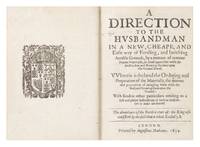
653611 leaves lacking the final blank but with the first leaf blank but for woodcut royal arms on verso. Small 4to early 19th-cent. half-calf & drab boards upper joint a little cracked spine lettered in gilt. London: A. Mathewes 1634. First edition of an extremely rare anonymous work on improved fertilizers. "The book deals mainly with steeping seed in mixtures of rape-seed oil and other things and with burnt lime. These mixtures are to be formed in different proportions and there are alternative constituents. The results promised are not to overstate it very advantageous."-Fussell I p. 32. Nice copy. Stamp of the Lawes Agricultural Trust on front paste-down. hardcover books
1940581774Atlanta Georgia: Atlanta University 1940. Softcover. Near Fine. Original set of two 12" 78 rpm red vinyl records. One record features Mattiwilda Dobbs singing soprano accompanied by Robert Williams singing tenor on one side "New Born" and the other record features Mae Belle Finch singing soprano. Both records credit Kemper Harreld as director. The Dobb's record has one faint scratch on the "New Born" side the Finch record has a few faint scratches to both sides overall near fine in good original unprinted paper sleeves with a small dampstain to one creasing and edgewear including chips and tears to both. The runout etches suggest that these records could have originally been issued as a set. According to Spelman College these recordings at least the Dobbs recordings were from a performance in January of either 1946 or '47 when the chorus was invited to play on the CBS radio program Wings Over Jordan.<br /> <br /> Mattiwilda Dobbs the daughter of Atlanta civic and political leader John Wesley Dobbs graduated from Spelman College in 1946 with a degree in Spanish and music. She went on to have a highly successful career in music and was a pioneer for Black performers becoming the first Black singer to perform at La Scala in Italy and the first Black woman to land a long-term contract and sing a lead role with the Metropolitan Opera as well as the first Black singer to play a lead role at the San Francisco Opera. Her New York Times obituary states that her voice was "praised by critics for its crystalline purity and supple agility and for her impeccable intonation sensitive musicianship and captivating stage presence." It goes on to say that Dobbs "made relatively few recordings."<br /> <br /> Also featured is Mae Belle Finch. Although she never went on to make the name for herself that Dobbs did she sings here with great passion and gives a haunting performance of "I Wonder as I Wander." The director of these performances Kemper Harreld was a successful African-American concert violinist who founded both the Morehouse College and Spelman College Glee Clubs.<br /> <br /> Unrecorded by both OCLC and Discogs and equally unknown in the trade. A rare set of records showcasing two very early performances by Mattiwilda Dobbs. Atlanta University unknown
194316542JUniversal City: Universal Pictures 1943. An original carbon typescript story treatment 7 pages for the film story for 1943 Universal horror film classic. The film stars Lon Chaney Jr. as the Wolf Man and Bela Lugosi as Frankenstein's monster. with Ilona Massey Patric Knowles Lionel Atwill Maria Ouspenskaya under the direction of Roy William Neill. “The film involves the Wolf Man - Larry Talbot who is brought back to life. Seeking a way to return to his death to escape his werewolf curse he meets with gypsy Maleva Maria Ouspenskaya who advises him that the only way to stay dead is to confer with Dr. Frankenstein. The doctor is long dead but his equipment is in working condition leading Talbot to seek the help of scientist Dr. Mannering Patric Knowles and Frankenstein descendant Baroness Elsa Frankenstein Ilona Massey. Talbot then attempts to have his life sucked from his body and transferred into Frankenstein's monster Bela Lugosiâ€. Very good. Each page is in an acid free clear plastic sleeve in a new binder. Enclosed in a handsome custom cloth clamshell box. Universal Pictures hardcover
15256388Basel: Johannes Froben 1525. Very Good/Erasmus's edition of Pliny's Natural History conserving the notes from Ermolao Barbaro's edition of 1492 printed by Johannes Froben at the height of his powers. Froben's title page is effectively a billboard: "We give you the work of the Divine Pliny called History of the World more emaculate than any edition ever produced before starting with the annotations of erudite men first among them Ermolao Barbaro and then exemplary contributions by learned people which are still worth correcting with faith in the oldest codices from which we have restored many faults do difficult to find that no one no matter how learned could find them or had found them. We have nothing to envy. We have defeated all of our elders. And if someone now takes this prize from us we will not envy them but we will be grateful for the improvement of public education. Go reader and be fruitful. And by the way we added an index that lacks for nothing. Folio 37 cm; 18 leaves 671 143 pages. Woodcut printer's device the double-headed caduceus designed by Holbein on title page on verso of p. 671 on the title page of the index and on the final page. Holbein's detailed chiaroscuro woodcut initials throughout. Bound in vellum over boards titled in manuscript on spine. Old jottings in manuscript on upper board apparently an Italian and Latin vocabulary list including the names of foodstuffs. Portion of vellum near head of spine replaced. Erasmus's name on running head of dedicatory letter aggressively inked over! Occasional scattered very light foxing in a generally bright and unblemished text. References; Adams P-1560; van der Haeghen Biblioteca Erasmiana p. 45. For the initials among Holbein's largest see Schneeli and Heitz table V #II and table LXXXIII #XL. Johannes Froben hardcover books
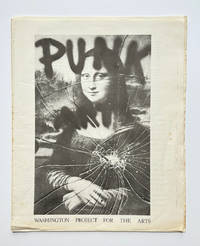
513a<p>First Edition. Multiple formats and dimensions see individual descriptions below Very good. items loose as issued. 513</p><p><em>The exhibition Punk Art organized in Washington DC in 1978 by the Washington Project for the Arts is generally considered the first exhibition of visual arts related to the punk movement. The present collection of materials represents the principal print materials produced for the show. Included are: 1 Punk Art exhibition catalog. 35.5 x 29 cm 27 pp. tabloid format folded but unbound offset on white newsprint-like commercial stock. With a preface by WPA director Alice Denney and an essay on "Punk Precedents" the remainder consisting of interviews with artists and illustrations of works. 2 Letter size mail flyer offset on white commercial stock. Recto with image and exhibition details verso with WPA letterhead and postage-paid notice. 3 Folded exhibition calendar/poster 60.5 x 45.5 cm unfolded 22.5 x 20.5 folded offset on brown commercial stock. With WPA and exhibition-related events for May and June 1978. 4 Exhibition opening invitation 12.5 x 10 cm folded offset on folded brown paper bag printed with illustration and event details. Folded bag contains small card 10 x 11 cm detailing perks for different donation amounts. 5 Poster for Punk Art exhibition at the School of Visual Arts in New York November 1978 executed in black silkscreen on heavy stock ca. 50 x 65 cm. Miller tells us that this poster was created by students in Al Brunele's printmaking workshop at SVA in vanishingly small numbers.</em></p> Washington Project for the Arts
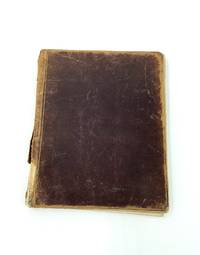
0012000United States Legislature. Fair with no dust jacket. Hardcover. On offer is an autograph album circa 1830-1861 coinciding with the 29th through 34th United States Congresses which ran from 1845 to 1857. The autographs contained within include 262 United States Senators and Congressmen. The majority of the autographs do not have accompanying dates however one signer dated their entry 1843 and another dated their entry 1850. This album provides a quintessential glimpse into Antebellum Period US politics. It is clear to see from the signatures and accompanying notation of the state from which each signer hails some also note their home towns that the American legislature is still fully functional at this point. The album is easy to navigate as the owner has had all the Senators sign at the beginning of the album and then left a few blank pages before having Congressmen sign in the later pages of the album. The owner was able to gather 46 signatures of Senators from Alabama Arkansas Connecticut Delaware Florida Georgia Illinois Indiana Iowa Ohio Kentucky Louisiana Maine Maryland Michigan Mississippi Missouri North Carolina New Hampshire New Jersey New York Pennsylvania Rhode Island South Carolina Tennessee Texas Vermont Virginia and Wisconsin. The owner then gathered 216 signatures from Congressmen from from Alabama Connecticut Delaware Florida Georgia Illinois Indiana Iowa Kentucky Louisiana Maine Maryland Massachusetts Michigan Mississippi Missouri North Carolina New Hampshire New Jersey New York Ohio Pennsylvania Rhode Island South Carolina Tennessee Texas Vermont Virginia and Wisconsin. Some highlights of the Senators category include: - John Bell U. S. Secretary of War as "Jno: Bell / of Tennessee" on page 6- Lewis Cass U. S. Secretary of State as "Lewis Cass" on page 2- Salmon P. Chase U. S. Secretary of Treasury and Supreme Court Chief Justice as "S. P. Chase / Ohio" on page 1- Thomas Corwin U. S. Secretary of Treasury as "Tho Corwin / Lebanon / Ohio" on page 1- Hannibal Hamlin U. S. Vice President U. S. Minister to Spain and Governor of Maine as "H. Hamlin / Maine" on page 3- Robert M. T. Hunter Confederate Secretary of State as "R M T Hunter / Virginia" on page 4- William R. King U. S. Vice President as "William R. King / of Alabama" on page 1Senators of other historical importance include: - Roger Sherman Baldwin Governor of Connecticut as "Roger Sherman Baldwin / of Connecticut" on page 8- Thomas Hart Benton U. S. Senator from Missouri from 1821-1851 as "Thomas H. Benton / U. S. Senate / Mri." on page 3- Andrew P. Butler co-author of the Kansas-Nebraska Act as "A. P. Butler / of South Carolina" on page 4- James Cooper Union General as "James Cooper / Penna." on page 5- William L. Dayton U. S. Minister to France as "Wm. L. Dayton / Trenton N. Jersey" on page 7- Augustus Dodge U. S. Ambassador to Spain as "A. C. Dodge / Iowa" on page 8- Henry Dodge Governor of Wisconsin Territory as "Henry Dodge / Wisconsin" on page 2- Stephen A. Douglas who defeated Abraham Lincoln for Senator as " S. A. Douglas / Chicago / Illinois" on page 6- Alpheus Felch Governor of Michigan as "Alpheus Felch / Michigan" on page 2- Henry S. Foote Governor of Mississippi as "HS Foote / Miss" on page 7- John P. Hale U. S. Minister to Spain as "John P. Hale / Dover N. H." on page 8- George W. Jones U. S. Minister to New Grenada as "Geo. W. Jones / S. U. S. / Dubuque / Iowa" on page 1- Thomas G. Pratt Governor of Maryland as "Thomas G. Pratt / Maryland" on page 1- Pierre Soulé U. S. Minister to Spain as "Pierre Soulé" on page 7- James Whitcomb Indiana Governor as "Jas. Whitcomb / Indiana" on page 2- David Levy Yulee the first elected U. S. Senator of Jewish ancestry as "D. L. Yulee / Florida" on page 3Some highlights of signatures among the Congressmen include: - Albert Gallatin Brown Governor of Mississippi Confederate Senator from Mississippi page 28- Howell Cobb U. S. Secretary of the Treasury Governor of Georgia President of Provisional Confederate States Congress page 9- Winfield S. Featherston Confederate Brigadier General page 32- Isham G. Harris Governor of Tennessee page 15- David S. Kaufman 1st U. S. Congressman from Texas from 1846-1851 page 24- Humphrey Marshall Confederate Brigadier General U. S. Minister to Qing Empire page 31- Lafayette McMullen Governor of Washington Territory page 49- Charles S. Morehead Governor of Kentucky page 30- James Lawrence Orr Governor of South Carolina Confederate Senator from South Carolina U. S. Ambassador to Russia page 24- Frederick P. Stanton Acting Governor of Kansas Territory page 33- Alexander H. Stephens Vice President of Confederacy from 1862-1865 Governor of Georgia page 35- Thaddeus Stevens the well-known Radical Republican page 40- Robert Toombs Confederate Secretary of State page 53. The album may have belonged to Hugo Jackson of Chicago. His signature is found separated from the politicians on a late page in the album. Our informal research was unable to discover any further biographical data on Jackson. This acquisition comes with a Certificate from John Reznikoff a premier authenticator who works with authentication services including PSA and JSA James Spence Authentications as well as numerous auction houses. The diary has a leather cover in good condition save for some small marks and scuffing. The binding shows signs of age and there is loss to the spine see photos. Many of the pages of the album are very loose or have come detached. There are some small ink stains throughout. Overall fair condition. Measurement: 6.375" x 7.875" x .75". ; Autograph; 16mo 6" - 7" tall; Signed by Author . hardcover