ABAA
48 402 résultats
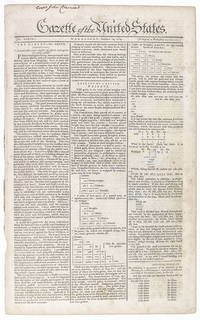
1789116518New York: John Fenno Wednesday August 19 1789. Rare original printing of the Gazette of the United States issued during the presidency of George Washington on August 19 1789. Folio one page folded this issue includes a the following articles many continued from previous issues: Extract of a Letter on Weights The Bow By Express From Paris and Sketches of the Proceedings of Congress in the House of the Representatives of the United States an Act for the Establishment of Lighthouses Beacons Buoys and Public Piers approved by George Washington as President of the United States and the obituary of George Washington Knox. In very good condition with a closed tear to the rear panel and ownership signature. First issued on April 15 1789 the Gazette of the United States was an early American partisan biweekly publication friendly to the administration of George Washington and to the policies and members of the emerging Federalist Party. The Gazette played a notable role in the development of political parties and early partisanship. It also played a leading role in inspiring the creation of its rival paper the National Gazette which was founded at the urging of anti-Federalist leaders Thomas Jefferson and James Madison as a vehicle for their party's own political self-promotion and polemics John Fenno unknown books
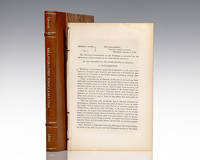
1863149486Washington: Government Printing Office January 2 1863. Rare first War Department and fifth overall printing of the Emancipation Proclamation. Twelvemo General Orders No. 1 extracted from the larger volume of orders for 1863 4 pages disbound. President Lincoln had intended to issue the order earlier in 1862 but deliberately delayed its release until after the Union's strategic victory at Antietam at which point he announced the Preliminary Emancipation Proclamation. General Order No. 139 September 22 1862 which declared that all slaves held in rebelling states would be forever free from the first day of January 1863. The text of the final Emancipation Proclamation present in this order is noted for its direct and decisive language: "By the President of the United States of America . That on the first day of January in the year of our Lord one thousand eight hundred and sixty-three all persons held as slaves within any State or designated part of a State the people whereof shall then be in rebellion against the United States shall be then thenceforward and forever free; and the Executive Government of the United States including the military and naval authority thereof will recognize and maintain the freedom of such persons and will do no act or acts to repress such persons or any of them in any efforts they may make for their actual freedom." The first printing for the War Department of General Orders No. 1 was distributed to various military outposts and bureaus throughout the United States. Based on the extensive research of Charles Eberstadt the copy for the War Department was the fifth time the final version of the Emancipation Proclamation appeared in print on January of 1863 following three hastily prepared issues for the State Department and another for Lincoln's hometown Illinois States Journal newspaper in Springfield Illinois. A copy of the War Department Printing was included in the Grolier Club's One Hundred Influential American Books Printed before 1900. Eberstadt 12; Grolier Club One Hundred Influential American Books 71; Streeter 1751. In near fine condition. Housed in a custom half morocco case. A scarce work. The Emancipation Proclamation issued by President Abraham Lincoln on January 1 1863 represented a pivotal moment in the trajectory of the American Civil War and the broader struggle over the institution of slavery. Although it did not immediately free all enslaved individuals the proclamation declared that all persons held as slaves in states or parts of states still in rebellion against the United States were to be henceforth free. This executive order grounded in Lincoln's war powers as commander-in-chief was intended primarily as a military measure to weaken the Confederacy by undermining its labor force and discouraging foreign powers from recognizing or supporting the secessionist cause. The proclamation also signaled a significant shift in Union war aims reframing the conflict from a struggle solely to preserve the Union to one explicitly linked to the abolition of slavery. While its immediate legal impact was limited to areas outside Union control the Emancipation Proclamation laid the groundwork for the eventual passage of the Thirteenth Amendment which formally abolished slavery throughout the United States. Government Printing Office unknown
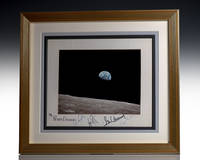
149888Photographic print of the iconic ‘Earthrise' image taken by Bill Anders during the Apollo 8 mission. Glossy finish color print of the earth rising over the moon with "To Gene Cernan" calligraphically inscribed on the mat beneath. Boldly signed on the mat beneath the photograph by Neil Armstrong Gene Cernan George H.W. Bush and Cy Laughter. The first and last men on the moon met future president George Bush at a 1987 ‘Bogie Busters’ golf tournament in Ohio—an annual event hosted by Laughter from 1967 to 1991. Dayton businessman Cy Laughter founded the annual golf tournament which ran for thirty years to raise money for charity and it drew many major national celebrities each year. Quadruple matted and framed. The print is in fine condition and the original mat in near fine condition condition. The entire piece measures 19 inches by 17 inches. Rare and desirable. Taken by American astronaut William Anders from lunar orbit on December 24th 1968 during the Apollo 8 mission 'Earthrise' has become synonymous with the American space program and essentially marked the beginning of the environmental program. In Life's 100 Photographs that Changed the World wilderness photographer Galen Rowell called Earthrise "the most influential environmental photograph ever taken". Fifty years to the day after taking the photo William Anders observed "We set out to explore the moon and instead discovered the Earth." unknown
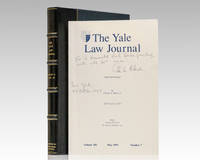
150833New Haven Connecticut: The Yale Law Journal Co. Inc. 1993. Original May 1993 offprint of The Yale Law Journal containing Charles L. Black Jr.'s "And Our Posterity."  Octavo original wrappers The Yale Law Journal Volume 102 May 1993 Number 7. Inscribed by the author on the front wrapper "For the Honorable Ruth Bader Ginsburg with all best wishes! Charles Black New York 29 October 1993." The recipient Ruth Bader Ginsburg American lawyer and jurist served as an associate justice of the Supreme Court of the United States from 1993 until her death in 2020 and was responsible for some of the most eventful legal decisions of the past half-century. Nominated by President Bill Clinton in 1993 to replace retiring justice Byron White Ginsburg became the first Jewish woman and the second woman to serve on the Court after Sandra Day O’Connor. Ginsburg spent much of her legal career as an advocate for gender equality and women’s rights winning many arguments before the Supreme Court. During her tenure as associate justice of the Supreme Court Ginsburg received attention for her fiery and passionate dissents that reflected liberal views of the law. She was popularly dubbed “the Notorious R.B.G.†a moniker she later embraced. She authored several important majority opinions related to gender discrimination voting rights and affirmative action in cases such as United States v. Virginia 1996 which struck down the Virginia Military Institute’s male-only admissions policy as violating the Equal Protection Clause of the Fourteenth Amendment Olmstead v. L.C. 1999 in which the Court ruled that mental illness is a form of disability covered under the Americans with Disabilities Act of 1990 and Friends of the Earth Inc. v. Laidlaw Environmental Services Inc. 2000 in which the Court held that residents have standing to seek fines for an industrial polluter that affected their interests and that is able to continue doing so. In fine condition. Housed in a custom half morocco clamshell box from the Harcourt Bindery. A unique piece of history. Charles L. Black Jr. 1915–2001 was a prominent American constitutional scholar whose work significantly shaped twentieth-century legal thought. A longtime professor at Yale Law School and later at Columbia Law School Black was widely respected for his influential writings on constitutional structure judicial review and the role of the Supreme Court. He is particularly noted for assisting Justice Thurgood Marshall in preparing the brief that contributed to the Supreme Court’s landmark decision in Brown v. Board of Education 1954 a case that fundamentally reshaped constitutional law and civil rights jurisprudence in the United States. The Yale Law Journal Co., Inc. unknown
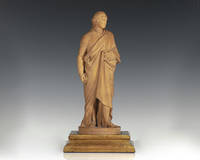
1850123164c. 1850. Fine terracotta statue of President George Washington after Sir Francis Chantrey's Washington as a Roman Senator 1826. Terracotta. In 1818 the Washington Monument Association commissioned Francis Chantrey to sculpt a pedestrian statue of George Washington in white marble. Unveiled in Doric Hall of the Massachusetts State House in November 1827 it was the first sculpture to be placed in the then new State House and the first full-sized marble statue in New England. In fine condition. The statue measures 14.75 inches in height. American statesman and soldier George Washington served as the first President of the United States from 1789 to 1797 and was one of the Founding Fathers of the United States. He served as Commander-in-Chief of the Continental Army during the American Revolutionary War and later presided over the 1787 convention that drafted the United States Constitution. He is popularly considered the driving force behind the nation's establishment and came to be known as the "father of the country" both during his lifetime and to this day. unknown books
1850123164c. 1850. Fine terracotta statue of President George Washington after Sir Francis Chantrey's Washington as a Roman Senator 1826. Terracotta. In 1818 the Washington Monument Association commissioned Francis Chantrey to sculpt a pedestrian statue of George Washington in white marble. Unveiled in Doric Hall of the Massachusetts State House in November 1827 it was the first sculpture to be placed in the then new State House and the first full-sized marble statue in New England. In fine condition. The statue measures 14.75 inches in height. American statesman and soldier George Washington served as the first President of the United States from 1789 to 1797 and was one of the Founding Fathers of the United States. He served as Commander-in-Chief of the Continental Army during the American Revolutionary War and later presided over the 1787 convention that drafted the United States Constitution. He is popularly considered the driving force behind the nation's establishment and came to be known as the "father of the country" both during his lifetime and to this day. unknown
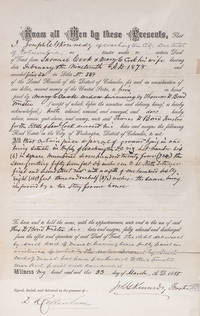
1885141500Washington D.C March 23 1885. Rare real estate document signed by famed abolitionist Frederick Douglass as Recorder of Deeds for Washington D.C. One page partially printed the property deed agreement is signed by Douglass “Fredk. Douglass†as Recorder of Deeds certifying a deed transferring a plot of land in Washington DC from Joseph C.G. Kennedy to Thomas D. Bond. Following the Civil War Douglass received numerous political appointments from Republican presidents including positions as United States Marshal of Washington D.C. 1877-81 and later ambassador to the Republic of Haiti 1889-91. He was nominated Recorder of Deeds for Washington D.C. by President James Garfield and confirmed by the Senate on May 7 1881. He held the position until 1886 when he resigned to resume public speaking full time. In very good condition. Douglass wrote of his position as Recorder of Deeds in his third memoir Life and Times of Frederick Douglass: "The duties of Recorder though specific exacting and imperative are easily performed. The office is one that imposes no social duties whatever and therefore neither fettered my pen nor silenced my voice in the cause of my people. I wrote much and spoke often and perhaps because of this activity gave to envious tongues a pretext against me. I think that I was not while in this office or in that of Marshal less outspoken against what I considered the errors of rulers than while outside of the office. My cause first midst last and always whether in office or out of office was and is that of the black man; not because he is black but because he is a man and a man subjected in this country to peculiar wrongs and hardships. As in the case of United States Marshal so in that of Recorder of Deeds I was the first colored man who held the office and like all innovations on established usage my appointment did not meet with the approval of the conservatives and old-time rulers of the country but on the contrary met with resistance from both these and the press as well as from the street corners. I held the office of Recorder of Deeds of the District of Columbia for nearly five years. Having so to speak broken the ice by giving to the country the example of a colored man at the head of that office it has become the one special office to which since that time colored men have aspired." unknown
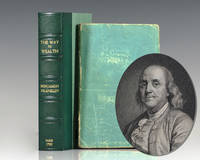
1795125491Paris: Printed for Ant. Aug. Renouard Antoine-Augustin Renouard 1795. Renouard's scarce bi-lingual edition of Franklin's popular collection of aphorisms. Octavo bound in contemporary wrappers frontispiece portrait of Franklin engraved by Alexandre Tardieu after Duplessis' painting. The Way to Wealth was first published as the preface to Poor Richard's Almanack of 1758 the last of the almanacs written by Franklin himself under the title "Father Abraham's Speech." Revered for the elegance of its printing this bi-lingual edition also includes Franklin's private letter to Madame Passy along with "Dialogue entre la goutte et Franklin" the poem "Le Sage et la goutte" and the essays "Quelques mots sur l'Amerique avis a ceux qui voudroient aller s'etablir dans cette contree" and the separately paginated "Observations sur les Sauvages du Nord de l'Amerique" which is noted by Ford to be present in only a few copies. Sabin 25596; Ford 107. In near fine condition. Exceptionally clean internally. Housed in a custom chemise slipcase within a half morocco clamshell box. A beautiful example rare in wrappers. This pithy collection of the most clever sayings garnered from the run of Poor Richard's Almanack was first printed as a separate edition by Franklin's nephew Benjamin Mecom of Boston in March of 1758. By the late 18th century the work had attained great popularity not only in American but in London and Pairs. Renouard's The Way to Wealth was revered not only as the first bi-lingual edition but for the elegance of its printing; emphasizing the tremendous esteem Franklin had earned during the years he dwelt among the French to whom his words of wisdom symbolized the freedom embodied in the newly-founded American republic of no small significance in the wake of their own revolution. Printed for Ant. Aug. Renouard [Antoine-Augustin Renouard] unknown books
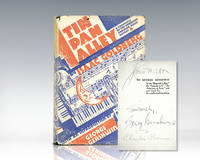
193084308New York: The John Day Company 1930. First edition of this work on American popular music. Octavo original cloth illustrated. Introduction by George Gershwin. Boldly signed "Sincerely George Gershwin" on the dedication page. Additionally signed by conductor Charles Previn and tenor James Melton. Near fine in a very good dust jacket. Previn was an American film composer who was highly active at Universal in Hollywood during the 1940s and 1950s. Before going to Hollywood Previn had arranged music for over 100 Broadway productions. Melton was a popular singer in the 1920s and 1930s and later began a career as an operatic singer when tenor voices went out of style in popular music around 1932-35. Contemporary bookplate near fine in a very good dust jacket. Rare and desirable signed. American composer and pianist George Gershwin's orchestral compositions spanned the genres of popular jazz and classical music and are now considered to be some of the most important musical works of the twentieth century. Gershwin began his career composing Broadway theatre works with his brother Ira Gershwin and soon became a major figure in musical theatre in New York City and later Hollywood. Gershwin's classic Song-Book is illustrated with full-page color lithographic plates after Constantin Alajalov and includes such Gershwin standards as "Swanee" "Fascinating Rhythm" "That Certain Feeling" "The Man I Love" "Strike Up the Band" and "I Got Rhythm" among others. "In one of his few prose writings George provided an introduction for the song book. What is most important. is that it contained the original published version of each song followed side by side by George's 'improvised' versions of the songs" Carnovale 14. The John Day Company hardcover books
193084308New York: The John Day Company 1930. First edition of this work on American popular music. Octavo original cloth illustrated. Introduction by George Gershwin. Boldly signed "Sincerely George Gershwin" on the dedication page. Additionally signed by conductor Charles Previn and tenor James Melton. Near fine in a very good dust jacket. Previn was an American film composer who was highly active at Universal in Hollywood during the 1940s and 1950s. Before going to Hollywood Previn had arranged music for over 100 Broadway productions. Melton was a popular singer in the 1920s and 1930s and later began a career as an operatic singer when tenor voices went out of style in popular music around 1932–35. Contemporary bookplate near fine in a very good dust jacket. Rare and desirable signed. American composer and pianist George Gershwin’s orchestral compositions spanned the genres of popular jazz and classical music and are now considered to be some of the most important musical works of the twentieth century. Gershwin began his career composing Broadway theatre works with his brother Ira Gershwin and soon became a major figure in musical theatre in New York City and later Hollywood. Gershwin's classic Song-Book is illustrated with full-page color lithographic plates after Constantin Alajalov and includes such Gershwin standards as “Swanee†“Fascinating Rhythm†“That Certain Feeling†“The Man I Love†“Strike Up the Band†and “I Got Rhythm†among others. “In one of his few prose writings George provided an introduction for the song book. What is most important… is that it contained the original published version of each song followed side by side by George’s ‘improvised’ versions of the songs†Carnovale 14. The John Day Company hardcover
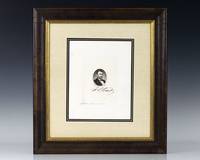
187144047Washington D.C 1871. Portrait engraving of President Ulysses S. Grant. Boldly signed U.S. Grant. The engraving measures 5.5 inches by 4 inches. This portrait engraving produced by the U.S. Bureau of Engraving and Printing. In near fine condition affixed to an 8 inch by 10 inch sheet bearing a small note. Matted and framed. The entire piece measures 16.5 inches 18 inches. Ulysses S. Grant was the 18th President of the United States 1869-77. As Commanding General of the United States Army 1864-69 Grant worked closely with President Abraham Lincoln to lead the Union Army to victory over the Confederacy in the Civil War. He implemented Congressional Reconstruction often at odds with Lincoln's successor Andrew Johnson. Twice elected president Grant led the Republicans in their effort to remove the vestiges of Confederate nationalism and slavery protect African-American citizenship and supported unbridled nationwide industrial expansionism during the Gilded Age. unknown books
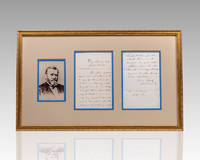
1870151783New Jersey 24 September 1870. Autograph letter signed by and entirely in the hand of Ulysses S. Grant as President. Two pages blue lined paper the letter is addressed to Governor M Jewell of Connecticut. The letter reads in full "Dear Governor: .Mrs. Grant and myself leave here for Boston on Monday next to put our son in College. We will return about Wednesday to Hartford and remain only long enough to take Nellie out to Farmington. We will be pleased to accept your proffered hospitality for the short time we do remain in your city. Please present Mrs. Grant's and my kindest regards to Mrs. Jewell and the children. Yours truly U.S. Grant." Double matted and framed with a portrait of Grant. In fine condition. The entire piece measures 22 inches by 13.5 inches. Prior to serving as the 18th President of the United States Ulysses S. Grant served as the Commanding General of the United States Army and led the Union to victory over the Confederacy under the supervision of President Abraham Lincoln. Elected president in 1868 Grant stabilized the post-war national economy created the Department of Justice and led the Republicans in their efforts to remove the vestiges of Confederate nationalism racism and slavery. The presidential administration including the cabinet of Ulysses S. Grant was fraught with scandal and corruption following the Black Friday gold panic in 1869 scandals were discovered in seven federal departments including the Treasury Interior and State. Known to run his cabinet in an unprecedented military style Grant often pardoned whose accused and convicted of government crimes nepotism became prevalent in his appointments with over 40 family members appointed by him to the United States government throughout his two terms. unknown
187144047Washington D.C 1871. Portrait engraving of President Ulysses S. Grant. Boldly signed U.S. Grant. The engraving measures 5.5 inches by 4 inches. This portrait engraving produced by the U.S. Bureau of Engraving and Printing. In near fine condition affixed to an 8 inch by 10 inch sheet bearing a small note. Matted and framed. The entire piece measures 16.5 inches 18 inches. Ulysses S. Grant was the 18th President of the United States 1869–77. As Commanding General of the United States Army 1864–69 Grant worked closely with President Abraham Lincoln to lead the Union Army to victory over the Confederacy in the Civil War. He implemented Congressional Reconstruction often at odds with Lincoln's successor Andrew Johnson. Twice elected president Grant led the Republicans in their effort to remove the vestiges of Confederate nationalism and slavery protect African-American citizenship and supported unbridled nationwide industrial expansionism during the Gilded Age. unknown
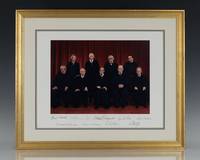
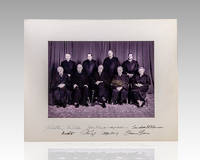
51010William Rehnquist Supreme Court oversized photograph signed by all nine justices dressed in robes. Group portrait taken on the occasion of the investiture of William Rehnquist being elevated to Chief Justice and Antonin Scalia's investiture. Signed by John Paul Stevens Sandra Day O'Connor Antonin Scalia William H. Rehnquist William J. Brennan Jr. Thurgood Marshall Byron R. White Lewis F. Powell Jr. and Harry A. Blackmun. Matted and framed to an overall size of 21 inches by 23 inches. The Rehnquist Court refers to the Supreme Court of the United States from 1986 to 2005 when William Rehnquist served as Chief Justice of the United States. Rehnquist succeeded Warren Burger as Chief Justice after the latter's retirement and Rehnquist served as Chief Justice until his death in 2005 at which point John Roberts was nominated and confirmed as Rehnquist's replacement. The Rehnquist Court is generally considered to be more conservative than the preceding Burger Court and Warren Court. According to Jeffrey Rosen Rehnquist combined an amiable nature with great organizational skill and he "led a Court that put the brakes on some of the excesses of the Earl Warren era while keeping pace with the sentiments of a majority of the country." Biographer John Jenkins argued that Rehnquist politicized the Supreme Court and moved the court and the country to the right. Through its rulings the Rehnquist Court often promoted a policy of New Federalism in which more power was given to the states at the expense of the federal government. The Rehnquist Court was also notable for its stability as the same nine justices served together from 1994 to 2005 the longest such stretch in Supreme Court history. unknown books
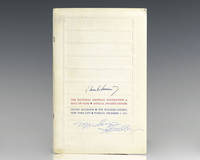
19611248041961. The National Football Foundation and Hall of Fame Annual Award Dinner held at The Waldorf-Astoria in New York City on December 5 1961 boldly signed by him and college Hall of Famer Marshall Goldberg below. President John F. Kennedy gave the address at the annual awards dinner for the National Football Foundation and Hall of Fame. During the banquet the President received the National Football Foundation's Gold Medal for his promotion of the role of athletics in the development of civic and political leadership. In his speech President Kennedy congratulated the University of Alabama's football team for their advancement to the Sugar Bowl and discussed the importance of improving the country's physical fitness and the recent establishment of the Council on Youth Fitness. Bob Hope served as Master of Ceremonies for the evening. In this speech President Kennedy called on Americans to participate in sports and other forms of physical activity. In near fine condition. Rare and desirable. All four Kennedy brothers played football at Harvard. Robert and Edward both were Harvard football lettermen. Joe Jr. played at the Choate School and was an active member of the Harvard Squad. JFK gamely pursued a playing role in Harvard's football program but did not progress beyond the junior varsity as illness and injury in his freshman year curtailed his involvement. unknown books
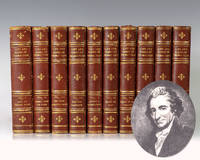
1925138611New Rochelle New York: Thomas Paine National Historical Association 1925. The Patriot's edition of the Life and Works of Thomas Paine. Octavo ten volumes bound in three quarter morocco with gilt titles and tooling to the spine in five compartments within raised gilt bands marbled endpapers top edge gilt. In good condition. One of the founding fathers of the United States Thomas Paine authored two of the most influential pamphlets at the start of the American Revolution which ultimately inspired the 1776 Declaration of Independence. Virtually every American rebel read Paine’s powerful pamphlet Common Sense which crystallized the American Revolution and demand for independence from Britain. John Adams asserted "without the pen of the author of Common Sense the sword of Washington would have been raised in vain." Thomas Paine National Historical Association unknown
151784William Rehnquist Supreme Court oversized black and white photograph signed by all nine justices dressed in robes. Signed below on the illustration board in black felt tip by John Paul Stevens Byron R. White William H. Rehnquist Harry A. Blackmun Sandra Day O'Connor David Souter Antonin Scalia Anthony Kennedy and Clarence Thomas. In near fine condition. The piece measures 14 inches by 10.25 inches. The Rehnquist Court refers to the Supreme Court of the United States from 1986 to 2005 when William Rehnquist served as Chief Justice of the United States. Rehnquist succeeded Warren Burger as Chief Justice after the latter's retirement and Rehnquist served as Chief Justice until his death in 2005 at which point John Roberts was nominated and confirmed as Rehnquist's replacement. The Rehnquist Court is generally considered to be more conservative than the preceding Burger Court and Warren Court. According to Jeffrey Rosen Rehnquist combined an amiable nature with great organizational skill and he "led a Court that put the brakes on some of the excesses of the Earl Warren era while keeping pace with the sentiments of a majority of the country." Biographer John Jenkins argued that Rehnquist politicized the Supreme Court and moved the court and the country to the right. Through its rulings the Rehnquist Court often promoted a policy of New Federalism in which more power was given to the states at the expense of the federal government. The Rehnquist Court was also notable for its stability as the same nine justices served together from 1994 to 2005 the longest such stretch in Supreme Court history. unknown
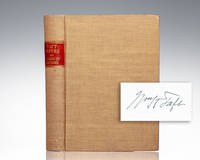
1920146671New York: The Macmillan Company 1920. First edition of this collection of speeches and articles by President William Howard Taft from May 1915 to the adoption of the revised Paris Covenant on April 28 1919. Octavo original publisher's tan cloth red leather spine label. Signed by Taft on the front free endpaper. In very good condition with light toning to the spine light bumping to the corners. Rare and desirable signed. William Howard Taft served as the 27th President of the United States 1909–1913 and as the 10th Chief Justice of the United States Supreme Court 1921–1930 the only person to have held both offices. The Macmillan Company hardcover
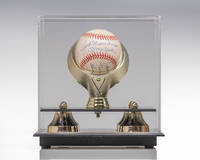
149305Rare Rawlings Official American League baseball signed by 12 members of the 500 Home Run Club. Signed by Ted Williams Mickey Mantle on the sweet spot Hank Aaron Willie Mays Eddie Murray Frank Robinson Reggie Jackson Willie McCovey Ernie Banks Eddie Mathews Mike Schmidt and Harmon Killebrew. In fine condition. Accompanied by a letter of authenticity from PSA/DNA Authentication Services. The 500 Home Run Club is an exclusive group of Major League Baseball players who have achieved one of the sport’s most celebrated milestones—hitting 500 or more home runs during their careers. Membership in the club signifies both exceptional power-hitting ability and sustained excellence over time linking its members to baseball’s most storied traditions of achievement. Some of the most prominent figures in this elite circle include Babe Ruth the first to reach the mark in 1929; Willie Mays and Hank Aaron whose accomplishments symbolized consistency and grace across eras; as well as Ted Williams Mickey Mantle and Eddie Murray each representing a blend of power discipline and professionalism that defined their respective eras. unknown
1998007208Amsterdam: Anthos. Signed first edition of rare English language Dutch edition of Irving's novel. The true first edition of Irving's novel preceding the release of the US and UK editions. Author's SIGNED presentation to motorcycle legend Cook Neilson who took the photo of Irving that was used for the dust jacket of the book: "For Stepp and Cook - with my appreciation and affection - John Irving April 1 1998." Together with AUTOGRAPH LETTER SIGNED by Irving on his stationery to Neilson laid in in which Irving says that Neilson's photos will also be used on the UK edition and jokes that another photo to be used for the American and Canadian editions is more flattering because it doesn't show Irving's face. Closes with mention of a nearby school in Vermont. Neilson was a preeminent motorcycle journalist and editor of Cycle Magazine. As a motrocyclist Neilson won the Daytona Superbike race in 1977 on a Ducati. He was inducted into the AMA Motorcycle Hall of Fame and the Ducati North America Hall of Fame in 2006. Published Amsterdam: Anthos 1998. 8vo. Some foxing spots along front edge of page block and verso of dust jacket else near fine in near fine dust jacket. One page typewritten letter on laid paper signed by Irving near fine. . Near Fine. Hard. 1st. 1998. Anthos unknown
18000009165Very Good. 1800. On offer is an exceptional relic of turn of the 19th Century scientific knowledge. The book in question is a large 260 page handwritten tome touching on a tremendous array of subjects and topics such as astronomy cosmology natural history advanced mathematics physics and more. The book dates from somewhere between 1790 and 1810. Its author is unknown. What is known is the author is a student of a Professor Sanderson who is mentioned quite often Sandersons Lectures upon Opticks; Sandersons Hydrostaticks; Sandersons Lectures on Sound. Despite extensive research who this Professor Sanderson is and where he taught could not be discovered. It is evident that he was an exceptionally learned professor as the range of topics covered by him in this book are truly incredible. As stated there is a truly exceptional amount of information in this book a compendium of scientific physical natural and astronomical science. Roughly the first half of the book deals with different aspects of physical science and mathematics. The second half deals with astronomy cosmology and the application of physics to these matters. This book comes at the very end of the Scientific Revolution. This age would eventually cede to the Age of Reflection and Romanticism but this book deals solidly with science in the age of Copernicus Newton Galileo Bacon and Descartes. Subject headings include: That the surfaces of all Fluids are not plain but spherical Of Projectiles The Medium of Sounds Sandersons Lessons upon Opticks Of the Reflection of Light Of the Plane Speculum The Texture of the Eye Of the Rainbow Lectures on Mechanicks Of the perpendicular motion of heavy Bodies Of Gravitation The Vibration of Pendulums Of the descent of heavy bodies on incline planes Of the Motion of projectiles Of the Laws of Nature The Laws of Nature applied to system of the world How the planets are retained in Orbits Of the Geographical Longitude and Latitude of places Of the Moon Explained the real motions of the sun explained the dimensions of the earthProfessor Sanderson's Lectures upon the tides lectures upon Astrology General advanced mathematics and physics and a tremendous amount more. There is also included one handdrawn chart of various important dates in the history of the world both in Ante Christum and later Post Christum and also in the Julian Period a calendar used by historians since its introduction in the 16h century to convert between different calendars. Year 1 of the Julian Period is 4713 BCE. The Creation of the World is listed as 3950 Ante Christum as well as 765 Julian Period. Other important dates include The Destruction of Troy The Building of Rome The Death of Alexander the Great and The Christian Era beginning at year 0 Post Christum. The writing in the book is often quite poetic and much more interesting than a regular science textbook. Whether copied from Professor Sanderson or by the author himself the content is both interesting for it historical scientific value as well as for the quality of writing that shows a very different style of writing. For example when discussing gravitation: As Philosophy has had different improvements in different ages so these have been various sentiments about this great and general affection of matter first Aristotle taught us all Earth bodies have a natural inclination to send towards the centre of the earth as to a proper place but it has been sufficiently proved that there is no such thing as positive absolute levity. Copernicus thought it to be an innate principle in the parts of matter when they are separated from their wholes to reduce themselves thither again the nearest way or in right lines. But this is only to tell us in other words of heavy bodies do descend but gives not the least idea of the cause of gravitation. The book contains 261 numbered pages all with writing in them. The reverse of each page is left blank however there are occasional notes put in the blank page. This means the book is a total of 522 pages long. It is bound in a quarter leather binding and the book measures 12.5 x 8.25 inches. The leather corner pieces have mostly worn away and the spines hinges are cracked at the head and tail. There are small pieces of binding exposed where the leather has worn away. The binding however is still very tight. Only one page is loose. The handwriting is easily legible throughout each and every page. The pages often do show some small signs of foxing and age-toning but nothing that affects the legibility of the content. OVERALL: VG; Manuscript; Folio - over 12" - 15" tall; KEYWORDS: HISTORY OF LATE 18TH CENTURY EARLY 19TH CENTURY PROFESSOR SANDERSON ASTRONOMY COSMOLOGY NATURAL HISTORY PHYSICS SCIENTIFIC TOME COMPENDIUM OF KNOWLEDGE MOTION OF PLANETARY BODIES ANTHOLOGY OF SCIENCE SCIENTIFIC REVOLUTION COPERNICUS NEWTON GALILEO DESCARTES GRAVITATIONAL THEORY HANDWRITTEN MANUSCRIPT DOCUMENT LETTER AUTOGRAPH WRITER HAND WRITTEN DOCUMENTS SIGNED LETTERS MANUSCRIPTS HISTORICAL HOLOGRAPH KEEPSAKE WRITERS AUTOGRAPHS PERSONAL MEMOIR MEMORIAL ARCHIVE DIARY DIARIES JOURNAL LOG ANTIQUITÉ CONTRAT VÉLIN DOCUMENT MANUSCRIT PAPIER ANTIKE BRIEF PERGAMENT DOKUMENT MANUSKRIPT PAPIER OGGETTO DANTIQUARIATO ATTO VELINA DOCUMENTO MANUSCRITTO CARTA ANTIGÜEDAD HECHO VITELA DOCUMENTO MANUSCRITO PAPEL . hardcover
19090007007ASEA ABOARD THE S.S. CHINA. Good. 1909. On offer is a sensational original manuscript travel diary providing a very detailed description of an eventful round-the-world cruise taken in 1909 hand written by a California man with a keen eye for observation and a gift for description. The 7 x 4 inch book has 200 pages or so and is a little more than half filled and commences June 14 to September 7th ending abruptly upon leaving Naples. The author H.A. Sommer and his wife Milly left their home in Los Angeles and travelled by train to San Francisco where they spend some time touring. He comments on the ruins of City Hall and the Courthouse and the destruction caused by the great earthquake of 1906. 'We also viewed the Ruins of the City Hall and Courthouse from the last great Earthquake a horrible sight. Form this we can obtain a slight Idea of what the terrible destruction must have been.' June 14 They then board the Steam Ship China for their journey to Asia. Their first major stop is Hawaii and his notes are very descriptive ranging from Japanese warships in the harbor to architecture and the local people. 'The whole city of Honolulu is a Dreamland it lacks word to describe its climate is perfect all year round never above 84o and seldom below 70o. As we rode back and forward on the street we noticed every Residence large or small was surrounded by a large variety of flowers and trees.' June 23 En route there are two deaths one described as a suicide by a crew member and another of a steerage passenger who died of illness. He describes the burial at sea. 'This morning we got up early to see the burial of the dead Japanese . no one appeared except Milly myself and another Gentleman the corpse was sewed in the Canvas and heavy leaden weights attached to it resting on a board at the stroke of 4 bells 6 o'clock the Captain appeared Bible in hand the first officer being already on deck. The Captain ordered the Engines to be stopped and he after every one present uncovered their heads proceeded to read out of the Bible. The two Quartermasters stepped forward took hold of the American flag which covered the dead body the pushed it forward then a couple of Sailors lifted the rear End and the body slowly gliding forward dropped in the Sea and all was over. June 29 He devotes a number of pages to their stop in Japan and his descriptions are rich in detail: A clear morning after breakfast we had our baggage taken ashore as our boat made fast we noticed some little Jap's- having red Caps on their heads looking much like dressed up monkeys they took hold of all baggage carried it to the customs house. June 6 everything is very tiny small houses People Streets and Street Cars narrow and crooked street what gives them an ancient appearance. Houses are built close together with tile roofs. People in general are quiet and modest. p. 26. Their voyage continues on via China Hong Kong Singapore Ceylon Egypt Arabia and The Holy Land including Jerusalem Jaffa. The same rich descriptions continue. The diary ends abruptly on Sept 7th as they are making passage from Naples to Genoa. There is no hint as to reason and the reader can only speculate. On the following pages p 106-107 there is an entry by one Mitchell Jon Cremin dated Feb 24th 1964. Context suggests this was a boy as he took it to his school. He said that he found the journal in an old house. Cremin says: He meaning Sommer rote about his wife wen she dide on the ship p. 107 However there is no way to verify this. For a historian this is an outstanding collection of observations and descriptions of life in many parts of the world from a time long past. Whether a historian a researcher into cultural differences or simply one who enjoys the rich tapestry of people and nations of that time that move across these pages this journal is a gem. The journal is in good condition and all pages are intact. ; Manuscript; 12mo - over 6¾" - 7¾" tall; KEYWORDS: HISTORY OF TRAVEL JOURNAL HA SOMMER SAN FRANCISCO EARTHQUAKE HAWAII SANDWICH ISLANDS CIRCUMNAVIGATION OF THE WORLD MITCHELL JON CREMIN STEAM SHIP CHINA JAPAN BURIAL AT SEA SUICIDE ABOARD SHIP STEAM SHIP CHINA SS CHINA AMERICANA HANDWRITTEN MANUSCRIPT DOCUMENT LETTER AUTOGRAPH WRITER HAND WRITTEN DOCUMENTS SIGNED LETTERS MANUSCRIPTS DIARY DIARIES JOURNALS PERSONAL HISTORY SOCIAL HISTORY HISTORICAL HOLOGRAPH WRITERS AUTOGRAPHS PERSONAL MEMOIR MEMORIAL ANTIQUITÉ CONTRAT VÉLIN DOCUMENT MANUSCRIT PAPIER ANTIKE BRIEF PERGAMENT DOKUMENT MANUSKRIPT PAPIER OGGETTO D'ANTIQUARIATO ATTO VELINA DOCUMENTO MANOSCRITTO CARTA ANTIGÜEDAD HECHO VITELA DOCUMENTO MANUSCRITO PAPEL . unknown
1951006892Paris: Aux Editions Eliane Norberg. First edition thus. Signed De Luxe limited edition. Sumptuous full leather Artesian binding by Jacques Blanchet. From an edition of 202 number 72 of 180 printed on Velin d' Arches. Published Paris: Editions Eliane Norberg 1951. Folio 10 1/2" x 13 1/4" x 2 7/8" thick 302pp. illustrated with full page engraved plates and fine textual engravings from copper - all with tissue guards and two leather engravings cover and verso in 6 colors by Robert Fonta. Full dark blue satin morocco over 1/4" thick boards with chamfered corners and leather inner hinges attached to thick duplex flyleaves and gray leather pastedowns. Gilt block paneled titles on spine top edges tinted blue with gilt embossed edge design stamped into the page block. Front cover and verso decorated with unique six-color leather inset engravings by Fonta Signed on the half title by the Bazin: "Hommage amical / de l'auteur / Herve Bazin." Presentation copy to his publisher with a four paragraph typewritten A.L.S. by his wife Jacqueline mounted on free endpaper in which she writes about the color leather engravings and their signification to the situation of Arthur the unstable protagonist of the novel."Cuir chagrin noir dont la couleur evoque le triste bilan d'une vie de desequilibre." A novel of youth rebellion and a man's fractured life caught up in the penal system. The novel is semi-autobiographical based on the author's own experience in mental hospitals from 1937-1940 and was made into the film "Head Against the Wall" in 1959. Binding signed in the leather in gilt by Jacques Blanchet. Encased in a custom matching leather and felted slipcase that echoes the curve of the book. A beautiful exquisite production. Minor rub to a few areas of the spine else fine - binding tight text and plates clean and bright in a very good slipcase with some wear at the corners and edges. . Fine. Full-Leather. 1st. 1951. Aux Editions Eliane Norberg hardcover
19180008181WESTERN FRANCE. Good. 1918. On offer is a simply outstanding first-hand account which differs with the official account of how a soldier won the second highest military decoration in the United States. This handwritten letter is 4 pages long and each of the two pages measures 9 inches by 6.75 inches. Although a bit frayed in some places along the edges the letter is completely intact. The handwriting is legible and easily read. Edward Rischmann was an American soldier who served with Company I 312th Infantry Regiment 78th Division A.E.F. near Grand Pre France. He was a private. The letter was written on Oct 22nd 1918. Rischmann was 23 at the time. On October 23rd he participated in the assault on the Citadel of the French town of Grandpre. This action was a small part of the overall Meuse-Argonne Offensive. It was the largest military operation in United States military history involving 1.2 million American soldiers. It was one of a series of Allied attacks known as the Hundred Days Offensive which brought the war to an end. The battle cost 28000 German lives 26277 American lives and an unknown number of French lives. It was the largest and bloodiest operation of World War I for the American Expeditionary Force AEF which was commanded by General John Pershing and it was the second-deadliest battle in American history. Rischmann's citation succinctly describes his actions. The citation however is incorrect: "CITATION: The President of the United States of America authorized by Act of Congress July 9 1918 takes pleasure in presenting the Distinguished Service Cross to Private Edward Rischmann ASN: 2412427 United States Army for extraordinary heroism in action while serving with Company I 312th Infantry Regiment 78th Division A.E.F. near Grand Pre France 23 October 1918. Private Rischmann was a member of an assaulting party which stormed and captured the Citadel at Grand-Pre. He scaled the wall and alone entered a dugout from which he captured 45 Germans guarding them until assistance arrived". His letter however breathes life into those dry words. Filled with courage humanity and at times despair his letter presents a haunting picture a man plunged into the hell of close combat: "In the middle of the roadway lay one of our dead soldier lads dead laying on his front part of his stomach. It was a pitiful sight to stare at. I can never get it out of my memory of this beloved young soldier lad who was shot down and killed while he was advancing toward the enemies. I will never forget as it is as though this boys position and his agonies he suffered dying there is imprinted into my mind". Although the Citation says he scaled the wall and alone entered a dugout from which he captured 45 Germans guarding them until assistance arrived. Rischmann's own words describe a grimmer reality. As he writes in his letter in the assault Rischmann was captured. He was led by his captors into that dugout. Because he was able to speak German he could communicate with his captors and began to help treat their wounded. "I was taken into a dugout that led into the earth. . What befell my youthful body and eyes I will never forget here were dying comrades of their army suffering in terrible pain. I quickly went to work and asked for bandages . I done everything human for these unfortunate men for I too felt sorry for them". A short while later he was questioned by a senior German officer and he offered to take their surrender and thus save their lives: ". I can save their lives and mine if they would surrender and give up to me. They held a brief talk together and suddenly the highest one who happened to have an iron cross pinned on his uniform said Alright Comrade We Give Up. So forty five Germans surrendered to me". Rischmann lived a full life after the war. He passed away in 1978 at the age of 83. This is an outstanding piece of primary documentation from World War 1.For a war historian it is precious. It provides the flavour and the context of an event that clearly warranted recognition. It conveys the immediacy of the action and hints at the horrors that he witnessed. It is a superb piece of battlefield history.; Manuscript; 8vo - over 7¾" - 9¾" tall; KEYWORDS: HISTORY OF; 20TH CENTURY; NEWARK; NEW JERSEY; 1910s; FIRST WORLD WAR; WW1; GREAT WAR; EDWARD RISCHMANN; WORLD WAR 1; AEF; AMERICAN EXPEDITIONARY FORCE; GENERAL JOHN PERSHING; 312TH REGIMENT; MEUSE-ARGONNE OFFENSIVE; GRANDPRE FRANCE; DISTINGUISHED SERVICE CROSS; DSC; WARTIME CORRESPONDENCE; WARTIME LETTERS; WAR HEROES; HUNDRED DAYS OFFENSIVE 78TH DIVISION OF AMERICAN EXPEDITIONARY FORCE; 312TH INFANTRY REGIMENT; MILITARY HISTORY; PERSONAL NARRATIVES OF WW1; AMERICAN HEROES OF WW1; AMERICANS AND GERMANS ENCOUNTERS IN THE GREAT WAR; NEWARK SOLDIERS IN WW1; GREAT WAR HEROES FROM NEW JERSEY ; FRANCE; WESTERN FRONT; INFANTRY DIVISIONS OF THE US ARMY; AMERICANA HANDWRITTEN MANUSCRIPT DOCUMENT LETTER AUTOGRAPH WRITER HAND WRITTEN DOCUMENTS SIGNED LETTERS MANUSCRIPTS DIARY DIARIES JOURNALS PERSONAL HISTORY SOCIAL HISTORY HISTORICAL HOLOGRAPH WRITERS AUTOGRAPHS PERSONAL MEMOIR MEMORIAL ANTIQUITÉ CONTRAT VÉLIN DOCUMENT MANUSCRIT PAPIER ANTIKE BRIEF PERGAMENT DOKUMENT MANUSKRIPT PAPIER OGGETTO D'ANTIQUARIATO ATTO VELINA DOCUMENTO MANOSCRITTO CARTA ANTIGÜEDAD HECHO VITELA DOCUMENTO MANUSCRITO PAPEL . unknown
17590007025LOWER CANADA QUEBEC NEW ENGLAND. Good. 1759. On offer is a superb original historic manuscript relic and American colonial document about one of the pivotal events in North American history. Measuring about 8 inches by 6 inches this 2 page document is made of hand laid paper and bears a mid 18th Century British watermark. The paper has some light stains but otherwise is in very good condition. The handwriting is clear and legible. Both sheets are completely filled. Written as a poem no later than 1809 the manuscript is entitled The Battle of Quebec 1759. It was found among the colonial papers of Eliphelet Coffin. Coffin was born in Dover NH in 1742 and farmed there all of his life. He died in 1808. He may or may not be the author of the poem. The Battle of Quebec 1759 is also known as the Battle of the Plains of Abraham. This was a pivotal battle in the Seven Years War between Britain and France the history of North America and the history of Canada. For seven years Britain and France fought essentially the first world war in history. The war was driven by the commercial and imperial rivalry between Britain and France Although British armies supported their European allies against France and her allies Britain deliberately targeted France's overseas colonies in a determined drive to destroy France as a commercial rival. In North America the British victory over France established British hegemony in North America. The removal of France as a North American power increased the confidence of British colonies such as New York Pennsylvania and Massachusetts the backlash of which likely seeded the desire and drive for greater independence from Great Britain from those ever increasingly disgruntled 'Americans'. The Battle of the Plains of Abraham therefore led indirectly to the American Revolution and the creation of the United States. For Canada the sounds of the guns on the Plains of Abraham echo down to this day. It marked a crucial turning point in Canadian history. The Seven Years war in North America laid the bi-cultural foundations of modern Canada. As it also led indirectly to the American Revolution it further influenced Canadian identity and boundaries including the influx of Loyalists and the creation of Upper Canada and New Brunswick. Here is a snippet: "King George and Luwis could not agree ref to Louis XV of France Where there Divided line should be Til they had fought by land and sea They seemed in all a flame from Stanza 1 Bold Sandler comes with fifty ships ref to Vice-Admiral Charles Saunders The sea looks red what doth the mail With a loud triumph and a pleasant gale Right up to Quebec we did go from Stanza 2.; Manuscript; 8vo - over 7¾" - 9¾" tall; KEYWORDS: HISTORY OF COLONIAL CANADA BATTLE OF THE PLAINS OF ABRAHAM; SEVEN YEARS WAR; FRENCH INDIAN WARS; ELIPHELET COFFIN; GENERAL JAMES WOLFE; VICE-ADMIRAL CHARLES SAUNDERS; LOUIS-JOSEPH DE MONTCALM UPPER CANADA LOWER CANADA PRE REVOLUTIONARY WARS FRANCE VERSUS ENGLAND NORTH AMERICA PRE CONFEDERATION CANADIANA QUEBEC AMERICANA HANDWRITTEN MANUSCRIPT DOCUMENT LETTER AUTOGRAPH WRITER HAND WRITTEN DOCUMENTS SIGNED LETTERS MANUSCRIPTS DIARY DIARIES JOURNALS PERSONAL HISTORY SOCIAL HISTORY HISTORICAL HOLOGRAPH WRITERS AUTOGRAPHS PERSONAL MEMOIR MEMORIAL ANTIQUITÉ CONTRAT VÉLIN DOCUMENT MANUSCRIT PAPIER ANTIKE BRIEF PERGAMENT DOKUMENT MANUSKRIPT PAPIER OGGETTO D'ANTIQUARIATO ATTO VELINA DOCUMENTO MANOSCRITTO CARTA ANTIGÜEDAD HECHO VITELA DOCUMENTO MANUSCRITO PAPEL . unknown