78 260 résultats
(2+2+2+1 =) 7 SS. auf 4 Bll. (Qu.-)12mo. Der Brief mit eh. Adresse verso. In französischer Sprache an Léonce Détroyat über ihre Genesung nach einer Fußverletzung, die es ihr hoffentlich bald erlauben werde, ans Meer zu reisen: "Hélas telle que je vous écris voici douze jours que je suis étendue ne pouvant faire usage de mon pied, mais j'ai été l'objet de soins si excellents que je suis en voie de quérisoner, et j'espère partir pour la mer sous peu [...]". - Mit zwei Einladungen zum Frühstück, sowie der Mitteilung, dass sie ihre Mittwochstreffen bis zu ihrer Abreise wieder aufnehmen wolle: "Ne vous ayant pas vu depuis quelque temps je n'avais pas l'occasion de vous dire que j'avais repris nos mercredis jusqu'à mon départ [...]". - 3 auf Briefpapier mit gepr. Wappen.
1 S. auf Doppelblatt. 8vo. Mit eh. Adresse (Faltbrief). An die Schauspielerin Léontine Fay über eine Probe, die Albert, in der Rolle des "Germain", mit ihr am kommenden Tag in der Oper abhalten wolle: "Ma belle demoiselle, Monsieur votre père a dû vous faire part qu'Albert qui n'a pas joué depuis longtemps le rôle de Germain désirait faire une répétition avec vous. Il vous attendra demain lundi à l'opéra à l'heure, serez-vous assez gentille pour vous y rendre? Je ne sais comment vous remercier de toute votre complaisance, mais je crois que vous devez être heureuse de faire le bien en faisant tant de plaisir. Tout à vous de cœur | Ad. Nourrit". - Selten. - Etwas fleckig und mit einigen ausgebesserten Fehlstellen.
4to. 1 p. Six measures boldly written in ink, entitled "Fant. Polon. / op 19" and marked "Allegro molto vivace". - On an album leaf with decorative border. Remains of former mounting at far left, slight bleeding from ink on verso (handwritten poem by an unidentified writer), otherwise fine. With printed portrait mounted on album leaf (on verso an autograph poem signed by Lillian Kaunam in January 1893).
8vo. 2 pp. on bifolium. To a lady, regarding a charity concert for the poor.
Large 4to. 3½ pp. on monogrammed bifolium. To the Austrian piano manufacturer Ludwig Bösendorfer, telling from a serious illness which had caught him down, and his successful recovery which allows him again to give concerts; also, he is offering 600 Gulden for a Piano from Bösendorfer.
4to. 1/3 p. Written under an offer for a gothic harp which was sent him by Kistner (Den Haag, 31 March 1842): "Cher Monsieur Kistner, Comme il a toujours été question pendant mon séjour à Leipsic d'acheter une harpe pour le theatre et les concerts Philharmoniques - Je desire vous informer qu'il y a ici un excellent instrument et à très bon marché et je sais que la Direction des Concerts ne doit pas manquer un occassion qui s'offre si rarement d'acquérir une Harpe à double mouvement à un prix si modique".
[8], 198, [2] p. ; in-4°. Illustrato e completo di copiose partiture musicali. Prima edizione rara
11023Châteauroux. L'Ire des Vents. 1986. Grand in-8° en feuilles. [28 pages]. Tirage à 70 exemplaires imprimés par Darantière sur vélin d'Arches (+ 20 ex. accompagnés en suite dun tirage en couleurs de la pointe sèche justifiée et signée) et signés au colophon par l'auteur, sous couverture rempliée en papier du Moulin Richard de Bas.
1 S. Folio. 4 Notenzeilen. - Der Schüler Simon Sechters war seit 1841 Hoforganist und von 1853 bis 1901 Domkapellmeister an St. Stephan in Wien. Sein kompositorisches Werk umfaßt geistliche und weltliche Werke. - Gefaltet.
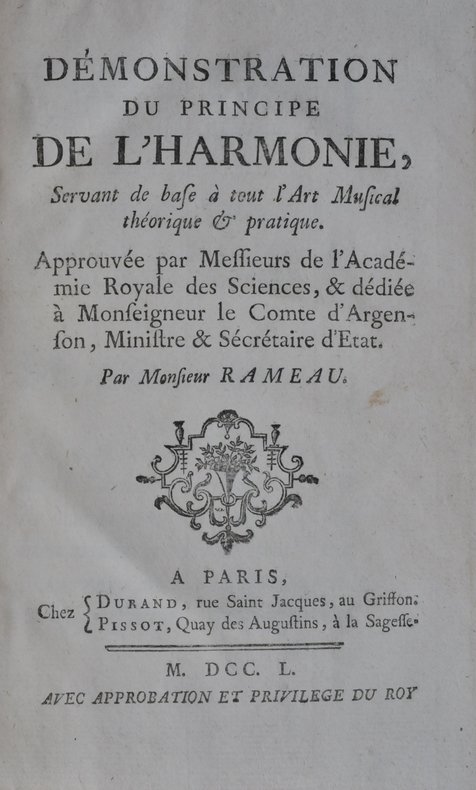
175046405346Paris, Durant, Pissot, 1750 ; in-8, veau fauve marbré, dos orné, tr. rouges. (Reliure de l’époque) XXIII pp., XLVII pp., 112 pp.Suivi de : Nouvelles Réflexions de M. Rameau sur sa démonstration du Principe de l’Harmonie, servant de base à tout l’Art Musical théorique et pratique. Id., ibid., 1752 ; 2 ff., 85 pp. (approbation signée Condillac), 5 planches dépliantes (appartenant au 1er ouvrage).ÉDITION ORIGINALE très rare, dédiée au comte d’Argenson. Ce traité, rédigé avec Diderot, est considéré comme le mieux écrit de tous les écrits théoriques de Rameau. À son sujet, et sur l’apport important de Diderot, voir Girdlestone. Rameau pp. 491-494. L’ouvrage fut adressé en 1749 aux membres de l’Académie des Sciences. Les 47 pages préliminaires donnent le rapport très flatteur des académiciens, signé Dortous de Mairon, Nicole et D’Alembert. Dans ce livre on retrouve, sous une forme très soignée, la matière des traités théoriques publiés précédemment par Rameau.Bel exemplaire avec la très rare suite des Nouvelles réflexions publiée en 1752, voir Girdlestone pp. 531-541.
17372674DBParis, Prault, 1737. 4°. (16), 201, (13) S. Mit 12 Kupfertafeln. + Wichtig: Für unsere Kunden in der EU erfolgt der Versand alle 14 Tage verzollt ab Deutschland / Postbank-Konto in Deutschland vorhanden +, 2674D
18092829BBLeipzig, Breitkopf & Härtel, (1809). Quer-4°. (2) Bl., 50 S., (1) Bl., 62 S., (1) Bl., 29 S. Mit 3 gest. Titelbl. Späterer Halblederband mit dem eingebundenen blauen Orig.-Umschlag. + Wichtig: Für unsere Kunden in der EU erfolgt der Versand alle 14 Tage verzollt ab Deutschland / Postbank-Konto in Deutschland vorhanden +, 2829B 3 (von 4) Teilen in 1 Band.
12mo and (oblong) 8vo. Together ca. 16½ pp. on 5 bifolia and 1 single leaf. Enclosure (see below). A collection of letters written during preparations for performances of Reyer's operas "Sigurd" and "Salammbô", mirroring the European stages' vogue for orientalism in the 1860s. - Three letters to the theatre director Eugène Ritt. Through a letter by the composer Louis-Albert Bourgault-Ducoudray, Ritt should have been informed by the librettist Blau that Reyer could no more do to postpone Mily Balakirev's "Tamara". Rehearsals for "Salammbô" should start as soon as possible, and Reyer sends greetings to the director Pedro Gailhard: "Vous avez dû comprendre en lisant le lettre de M. Bourgault-Ducoudray que j'ai prié Blau de vous communique, qu'il ne m'a plus guère possible de faire la moindre dèmarche officielle pour tâcher d'obtenir l'ajournement de Tamara [...]" (Friday). Reyer misses his star Rose-Lucille Meuniez, known as "Rose Caron". As regards a reprise of "Salammbô", he is satisfied with the conducting of the orchestra as well as with the musicians; he asks Ritt to let Gailhard know that a duo's solo performances are working out perfectly. Reyer announces his arrival in Paris for the next performance of "Sigurd": "Tout est bien qui finit bien [...] Mad. Carna m'a joliment manqué, à moi et à beaucoup d'autre [...] La reprise de Salammbô avait pourtant attiré beaucoup de monde [...] orchestre très-bien condit et artistes très delicieux de ne pas faire regretter leurs prédécesseurs [...]" (Bruxelles, Monday). Further about postponing "Tamara", which would permit staging "Salammbô" earlier (Saturday). - To Nérée Desarbres, Secretary of the administration of the Paris Opera, requesting two box tickets for "Guillaume Tell" for the Dutch senator M. Durand and his daughter, who wish to see the singer M.lle Thompson as Mathilde: "Mr Durand, Sénateur hollandais et sa fille tiennent beaucoup à voir Mlle Thompson dans Guillaume Tell [...]" (Tuesday, before 1863). - To minister Durand with a note that tickets are reserved for "Fidelio". - To a minister requesting an audience of five minutes ("24 rue Tour d'Auvergne", no date). - To his friend, the poet and librettist Joseph Méry, about the singer Caroline Lefebvre, who performs in "Maître Wolfram" (with a libretto by Méry), and who had made a critical statement about Reyer's expression in his letter to her, as he had mentioned her "pretty mouth". Reyer further invites Mèry to Baden, which is ravishing in spring, and mentions a Bavarian girl: "Elle me répondit de lui avoir écrit d'une manière pas convenable parce que je lui dis ceci dans une lettre que je lui ai adressée à propos de Maître Wolfram: ce j'aurais mieux aimé apprendre la visite par votre jolie bouche que par les plume de M. Méril. Voilà pourquoi je présume que votre visite lui fera infiniment plus agréable [...]" (Saturday, 21 May [before 1866]). - Enclosed is a note to receive the costumer E. Lacoste and communicate to him certain detailed instructions concerning the Act II of "Salammbô", especially regarding electric lighting, avoiding of any reflections on the costumes and jewellery so as to create a "milky" atmosphere; also with details for the costumes of the title character. - Partly with slight ink offsetting. One letter with blindstamped monogram.
1 S. Folio. "Quittung über Dreitausend Einhundert fünfzehn Gulden 75 Ö.W. welche der Gefertigte als halbe Brutto Einnahme für die Aufführung des Verdi Requiem's am 12. Juni [1]875 von der kk. Hofoperntheater-Cassa richtig erhalten hat [...]". - Ricordi war als Schriftsteller, Maler, Komponist (unter dem Pseudonym "Jules Burgmein") und Geschäftsmann begabt; unter seiner Leitung erreichte das Verlagshaus der Familie den Höhepunkt seiner Entwicklung. Er expandierte nach Neapel, Florenz, Rom, London sowie Palermo und Paris. Neben den späten Opern Verdis hatte er die Werke Vincenzo Bellinis und die Opern Giacomo Puccinis im Repertoire; zudem sicherte er dem Verlag die italienischen Rechte an den Werken Richard Wagners. - Gefaltet; Stempelmarke; Kassa- und Registraturvermerke in Buntstift.
Nel settembre del 1843 Rossini lasciò Parigi e si trasferì a Bologna, dove anni prima aveva acquistato una casa nella vicina Castenaso. La città gli offrì un seggio nel consiglio comunale e lui continuò ad occuparsi delle sorti del Liceo Musicale, dando consigli a giovani artisti e compositori. Talvolta si recava a teatro (a Bologna ascoltò il Nabucco di Verdi) e frequentava le serate musicali. La nostra missiva è inviata al mecenate e collezionista ravennate Rasponi per raccomandare un giovane compositore, membro di una delle più prestigiose Accademie italiane, della quale entrò a far parte anche il giovane Mozart. “[…] è tutt’ora vacante in Ravenna il Posto di Maestro Compositore e Istruttore di Musica, un Concorso è aperto. Si presenta, con mio onorevole Certificato, qual candidato il Maestro Magino Serafini Accademico Filarmonico Numerario di Bologna al Posto, capace quale lo è il mio protetto al disimpegno delle attribuzioni indicate nel invito ha bisogno della vostra protezione ed’io vengo a domandarvela sicuro avrete a lodarvi per quanto farete nella vostra onnipotenza a suo prò: Talento e buona condotta sono le doti del mio raccomandato […]”. Alcuni brani musicali autografi di Serafini, probabilmente originario di Fano, sono oggi conservati presso la Biblioteca dell’Accademia Filarmonica di Bologna.
1 S. 8vo. In französischer Sprache an Madame Mendl.
1 S. Gr.-4to. An Klaus Burmeister: "Schon im April kam Ihr Brief vom 25. 3. 1986. Doch zögerte ich mit der Antwort und kann Ihnen leider auch jetzt nichts genaues sagen. Der Grund ist der, daß Sie von einer Autograp[h]edition der Partitur schreiben - und eben die ist jetzt unmöglich. Als die Uraufführung geplant wurde, machte ich im 2. Satz sehr viel Änderungen und ließ das alles auf zusätzlichen Blättern von meinem damaligen Sekretär ausführen - und der, noch ein erfahrungsloser Mann, machte es fehlerhaft, so daß ich es gar nicht in die Partitur, sondern in eine Kopie eintragen ließ, in der Hoffnung, es später selbst in Reinschrift zu machen. Nun hatte ich im Juli 1985 einen schweren Schlaganfall, der mir dreimal fast das Leben kostete, und danach habe ich zwar Möglichkeit begrenzt zu arbeiten, aber keine Hoffnung die frühere Handschrift zurückzubekommen [...]". - Im linken Rand gelocht (keine Textberührung) und etwas knittrig; beiliegend ein ms. Gegenbrief des Adressaten im Durchschlag.
1 S. auf Doppelblatt. 8vo. Mit eh. Adresse (Faltbrief). An Carlo Severini (1793-1838), den Direktor des Théâtre-Italien: "Si vous voulez donner absolument Don Juan jeudi prochain, je vous promets de faire tout mon possible pour pouvoir chanter [...]" ("Wenn Sie unbedingt kommenden Donnerstag den 'Don Juan' geben wollen, so verspreche ich alles mir Mögliche zu unternehmen, um ihn singen zu können [...]"). - Johanna von Schoultz sang in Mozarts "Don Giovanni" sowohl die Rolle der Donna Elvira wie auch die der Donna Anna, welch letztere sie zwischen 1835 und 1837 in Paris gab. - Mit kleinen Randläsuren. - Sehr selten.
Oblong folio. 1 p. Four bars entitled "Etendue du Violon" ("Allegro"), and dedicated to the German painter and Court photographer Robert Weigelt (1815-79).
Oblong 4to. 2 pp. Probably the notation of two own compositions for piano, recto with underlined text "tout à coup resonne parmi les français" (39 bars), verso without (33 bars). - Upper margin somewhat spotty.
Edizione originale. L’esemplare del celebre collezionista Michel Bolloré (ex libris in raffinata etichetta in marocchino con facsimile di firma in oro al primo contropiatto), in bella legatura con segni d’uso perimetrali; fioriture ma bell’esemplare con grandi margini. Capolavoro di Stendhal, sospeso — come usuale nelle sue prime opere — tra saggio letterario-filosofico, biografia non autorizzata e grande affresco narrativo. Rossini diventa quindi lo spunto per discorrere ad ampio raggio di musica e di storia della musica, con l’intero capitolo quarto della prima parte dedicato a «Mozart e l’Italie». Escoffier, Le Mouvement Romantique, 511; Cordier, Bibliographie stendhalienne, n. 64; Carteret, Le Trésor, p. 347 2 voll.
Calling card format. 1 page. To Emma Pollak, his wife's cousin, presenting her with a small item: "Anbei folgt die besagte Kleinigkeit die ich bitte zu Ihren Füssen legen zu dürfen [...]".
Calling card format. 1¼ pp. To Emma Pollak, his wife's cousin, notifying her of the theatre box in which he and his wife Adele will be pleased to receive Emma that same evening at half past eight: "In freudiger Erwartung Sie und Ihren lieben Gemahl heute Abend zu sehen erlaube ich mir die Logennummer bekannt zu geben. No 9 heisst sie wo wir um ½9 Uhr Sie erwarten [...]".
Calling card format. 1¼ pp. With envelope ("Madame de Pollak"). To Emma Pollak, the cousin of Strauß's wife Adele, inviting her for dinner at a Vienna hotel: "Wir müssen heute zusammen soupiren! Ich erlaube mir Hotel Meissel (Mehlmarkt) als Rendezvousplatzel vorzuschlagen. Spatenbräu ist zu viel Wirtshaus [...]".