152 160 résultats
199630117967386223University of Chicago Press 1996. Book. Acceptable. Paperback. POETRY MAGAZINE! You will receive a single issue of the POETRY MAGAZINE dated: June 1996. Some shelf wear and scuff marks to the covers. Former owner address sticker to the cover. The binding is good. The pages flow clearly. VINTAGE MAGAZINE TO TREASURE!. University of Chicago Press Paperback
198630117967386220University of Chicago Press 1986. Book. Acceptable. Paperback. POETRY MAGAZINE! You will receive a single issue of the POETRY MAGAZINE dated: Some shelf wear and scuff marks to the covers. Former owner address sticker to the cover. The binding is good. The pages flow clearly. VINTAGE MAGAZINE TO TREASURE!. University of Chicago Press Paperback
- circa 1917-1918, 22,3x27,6, une feuille sous chemise et étui. - «L'An suave»: autograph youth poem dedicated to Marie Laurencin. «Have I neglected the miraculous Nymph, Icarus in the snowy shrubs...» [ca 1917-1918] | 22.3 x 27.6 cm | single sheet in custom chemise and slipcase A remarkable autograph poem of youth by André Breton dedicated to Marie Laurencin entitled «L'an suave». 15 verses in ink on vergé paper, composed in April 1914. This manuscript was copied between March 1917 and the beginning of 1918. This poem is offered for sale in a chemise and case with paper boards decorated with abstract motifs, the spine of the chemise in green morocco, pastedowns and endpapers of beige suede, a sheet of flexible plexiglass protecting the poem, case edged with green morocco, piece of green paper with caption «poème autographe» to bottom of upper cover of case, the whole by Thomas Boichot. Key poem of the author's pre-Dadaist period, it formed part of the set of 7 manuscript poems by Breton (known as coll. X. in the uvres complètes d'André Breton, volume I in La Bibliothèque de la Pléiade, Gallimard, 1988, p. 1071). These poems of his juvenilia are carefully copied out in black ink on watermarked vergé paper. The small collection was addressed to his circle of friends and writers, most notably including Valéry, Apollinaire, Théodore Fraenkel, and his brother in arms André Paris. They were later published in his first collection, Mont de piété, which appeared in June 1919, published by Au Sans Pareil, established not long before by his friend René Hilsum. The precise dating of this set of autograph poems is made possible by the composition of the final poem in the set («André Derain»), written on 24 March 1917, which provides a definitive terminus post quem. An earlier version of the poem «Age», dedicated to Léon-Paul Fargue, appears in our collection under its original name, «Poème». Dated by the author 19 February 1916, the day of his 20th birthday, and composed 10 days previously (according to his letters), it was not retitled and reworked until its publication in July 1918 in Les Trois Roses. Judging by the similarities to things published before this last poem, the seven autograph poems were probably written during 1917 or at the beginning of 1918, while Breton was doing his residency in Val-de-Grâce and where, significantly, he made the acquaintance of Louis Aragon. The poems that make up Mont de piété represent a rare and valuable insight into his youthful influences at the dawn of his joining the Dada movement and his discovery of automatic writing. Quite short and sometimes sibylline, one detects Symbolist highlights borrowed from Mallarmé, whom he rediscovered at poetry mornings in the théâtre Antoine and the Vieux-Colombier accompanied by his schoolfriend Théodore Fraenkel. During the first month of the War, Breton also dedicated himself to Rimbaud, plunging into Les Illuminations, the only work he carried with him in the confusion and haste that followed the outbreak of war. From his readings of Rimbaud were born the poems «Décembre», «Age», and «André Derain», while he borrowed Apollinaire's muse Marie Laurencin to whom he dedicated «L'an suave». The author's poetic inheritance was particularly marked by Paul Valéry, with whom he corresponded from 1914. Valéry played a considerable role in the writing of the poems of Mont de piété with the advice he gave the young poet. Admiring his disciple's audacity, who addressed each of these poems to him, he characterized the poem «Façon» (1916) thus: «The theme, language, scope, meter, everything is new, in the style, the manner of the future» (Letter of June 1916, uvres complètes d'André Breton, vol. I in La Bibliothèque de la Pléiade, Gallimard, 1988, p. 1072). These essential buds of Breton's youth were written between his seventeenth and twenty-third year. Taken by surprise in Lorient by the declaration of war, he became a military nurse, serving in several hospitals
- circa 1917-1918, 22,3x27,6, une feuille sous chemise et étui. - Remarquable poème de jeunesse autographe signé d'André Breton, titré "Poème" et dédié à Léon-Paul Fargue, 21 vers à l'encre noire sur papier vergé, daté par l'auteur du 19 février 1916 et probablement composé dix jours plus tôt. Notre manuscrit fut rédigé entre mars 1917 et le début de l'année 1918. Notre poème est présenté sous chemise et étui aux plats de papier à motifs abstraits, dos de la chemise de maroquin vert olive, gardes et contreplats de daim crème, feuille de plexiglas souple protégeant le poème, étui bordé de maroquin vert olive, étiquette de papier olive portant la mention "poème autographe" appliquée en pied du premier plat de l'étui, ensemble signé de Thomas Boichot. Poème essentiel de la période pré-dadaïste de l'auteur, il fait partie d'un ensemble cohérent de sept poèmes manuscrits de Breton (désigné sous le nom de coll.X. dans les uvres complètes d'André Breton, tome I de La Bibliothèque de la Pléiade, Gallimard, 1988, p. 1071). Ces poèmes, de sa graphie de jeunesse, sont soigneusement calligraphiés à l'encre noire sur papier vergé filigrané. Cet ensemble a été adressé à son cercle d'amis et d'écrivains, où figurent notamment Valéry, Apollinaire, Théodore Fraenkel, et son frère d'armes André Paris. Il fut par la suite publié dans son premier recueil, Mont de piété, qui parut en juin 1919 à la maison d'édition Au sans Pareil, nouvellement fondée par son ami René Hilsum. La datation précise de cet ensemble de poèmes autographes est déterminée par l'écriture du dernier poème de la collection (« André Derain »), composé le 24 mars 1917, qui offre un terminus post quem absolu. En outre, le présent manuscrit est une version plus ancienne du poème « Age », dédié à Léon-Paul Fargue. Daté par l'auteur du 19 février 1916 - le jour de ses vingt ans - et créé 10 jours plus tôt selon sa correspondance, il ne fut rebaptisé et remanié que pour sa publication en juillet 1918 dans Les Trois Roses. Selon toute vraisemblance antérieurs à la parution de ce dernier poème, les sept poèmes autographes, furent probablement rédigés courant 1917 ou au début de l'année 1918, alors que Breton poursuit son internat au Val-de-Grâce et fait la rencontre décisive de Louis Aragon. Les poèmes qui constitueront Mont de piété représentent un rare et précieux témoignage de ses influences de jeunesse, à l'aube de son adhésion au mouvement Dada et sa découverte de l'écriture automatique. Assez brefs et parfois sibyllins, on y sent poindre des accents symbolistes empruntés à Mallarmé, qu'il redécouvre lors de matinées poétiques au théâtre Antoine, au Vieux-Colombier, en compagnie de son camarade de lycée Théodore Fraenkel. Durant le premier mois de la guerre, Breton se consacre également à Rimbaud, et se plonge dans Les Illuminations, seul ouvrage emporté dans la confusion et la hâte qui suivit la déclaration de guerre. De ses lectures rimbaldiennes naquirent les poèmes « Décembre », « Age », et « André Derain », tandis qu'il emprunte à Apollinaire sa muse Marie Laurencin à qui il dédie « L'an suave ». Par ailleurs, l'héritage poétique de l'auteur sera particulièrement marqué par la figure de Paul Valéry, avec qui il entre en correspondance dès 1914. Valéry joue dans l'écriture des poèmes de Mont de Piété un rôle considérable par l'attention et les conseils qu'il prodigue au jeune poète. Admiratif de l'audace de son disciple, qui lui adressa chacun de ses poèmes, il apprécie le poème « Facon » (1916) en ces termes : « Thème, langage, visée, métrique, tout est neuf, mode future, façon » (Lettre de juin 1916, uvres complètes d'André Breton, tome I de La Bibliothèque de la Pléiade, Gallimard, 1988, p. 1072). Ces fleurons incontournables de la jeunesse de Breton furent composés entre sa dix-septième et vingt-troisième année. Surpris à Lorient par la déclaration de guerre, il devient infirmier militaire, puis officie dans plusieurs hôpitaux et sur le front pendant l'offensive de
Collezione consecutiva di 12 annate. Notevole insieme conservato in 4 volumi. Il settimanale politico letterario progettato come supplemento al quotidiano Il Fanfulla uscì dal 27 luglio 1879 al 31 ottobre del 1919. Molti i direttori negli anni a partire da Ferdinando Martini; Baldassare Avancini, Luigi Capuana, il critico musicale Eugenio Cecchi, Enrico Nencioni e come responsabile Bonaventura Severini. Di grande successo per la modernità delle proposte e informazioni culturali ebbe prestigiose firme, da Giosuè Carducci, Matilde Serao, Grazia Deledda, a Gabriele D’annunzio che iniziò a collaborare appena diciannovenne, Giovanni Verga vi pubblicò in anteprima le sue novelle, Collodi, Edmondo De Amicis, Federico De Roberto, Antonio Fogazzaro, Cesare Pascarella e molti altri. Fu la prima pubblicazione periodica a carattere nazionale. Disponiamo dei primi 12 anni (1879-1890) completi di indici, supplementi e frontespizi che accompagnavano la raccolta dei numeri. In straordinaria condizione. 4 voll.
191764267circa 1917-1918 | 22.30 x 27.60 cm | une feuille sous chemise et étui
Documento autografo originale. Esemplare molto ben conservato, con normali segni del tempo (difetti marginali alle copertine; pagine brunite). Esemplare dell’edizione originale de «Il Guanciale» nell’emissione con copertina arancione e indicazioni «Paris: Mérat & C.ie». Slegata e reimpaginata dall’autore, conservando i due piatti della brossura, per farne copia di lavoro. Bartolini la invia a Spagnoletti scrivendo al frontespizio: «(ne ho qui una copia!) / all’amico / Giacinto Spagnoletti / con gratitudine / per la sua lettera / del gennaio 1950 / Luigi Bartolini». Subito sotto, di pugno di Spagnoletti: «a Vanni Scheiwiller, / “girando” un caro omaggio / con affetto e stima, / Giacinto Spagnoletti / Milano, il 2 · 1 · 54». La copia conserva all’interno solo le pagine relative alle poesie «Parenti», «S. Antonio Abate», «Battesimo della primavera», «Primavera in paese», «Fonte maggiore» (solo la prima strofa più i primi 6 vv. della seconda), «Uccelli in gabbia», «La bella al balcone» (compresa la lettera prefatoria di Marinetti), «Gli angeli incisi». Fittamente postillate con correzioni e ripensamenti manoscritti dell’autore le poesie «Primavera in paese», «Fonte maggiore» e «La bella al balcone». Al recto muto di p. 37 (conclusione della poesia «Battesimo della primavera») applicato un foglio volante sottomisura recante di pugno di Bartolini l’incipit di «Fonte maggiore» (vv. 1-10), pieno di segni correttivi e varianti, e preceduto dalla nota «Per l’almanacco di Strapaese». Il nucleo di poesie selezionate dall’autore rappresenta un primo stadio del lavoro che condurrà alla sezione «Primi versi» di «Pianete» (Vallecchi 1953), la raccolta di poesie del dopoguerra con introduzione di Spagnoletti; in «Pianete» però saranno pubblicate solo: «Parenti», «S. Antonio Abate», «Battesimo della primavera», «Primavera in paese», «Fonte maggiore» – il nocciolo della sezione (che raccoglie in più altre tre poesie non considerate in questa copia di lavoro) – e con solo quattro delle numerose varianti riportate nella nostra copia.
Dieci acqueforti originali, numerate e firmate dall'Artista (cm da 14,5x19,5 a 30x19,5. Foglio cm 35,5x27). Ogni incisione reca a matita anche un proverbio di Gentilini. Edizione curata dalla Libreria La Margherita Le acqueforti sono state stampate coi torchi della Regia Calcografia, dal calcografo Salvatore Barrovecchio, su carta speciale fabbricata al tino con timbro a secco dell'Editore. Le lastre originali sono state biffate. Esemplare n. 28. 4to (cm 37x28,5). pp.. . Ottimo (Fine). . Prima edizione di 45 esemplari numerati. . Prima cartella di incisioni di Franco Gentilini.
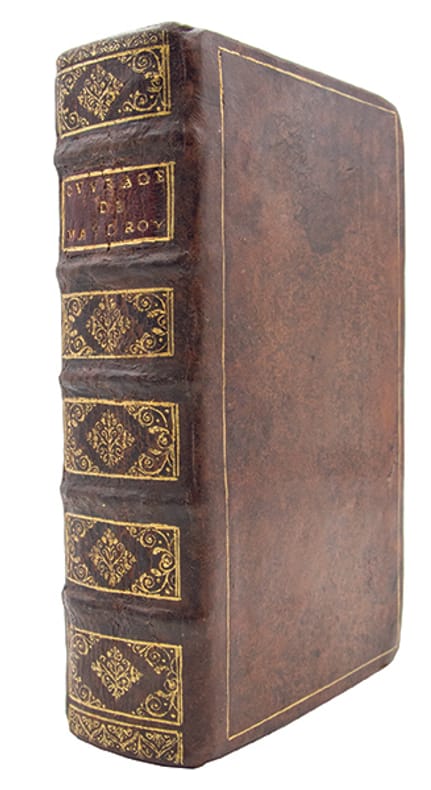
391362 tomes reliés en un volume in-12 (160 x 90 mm) veau brun moucheté, dos à nerfs orné de compartiments fleuronnés et cloisonnés, pièce de titre de maroquin rouge (reliure de l'époque), (12), 275 p., (1) p. de privilège et (16), 438 [i. e. 440] p., nombreux bandeaux et culs-de-lampe gravés sur bois. Paris, Claude Barbin, 1685.
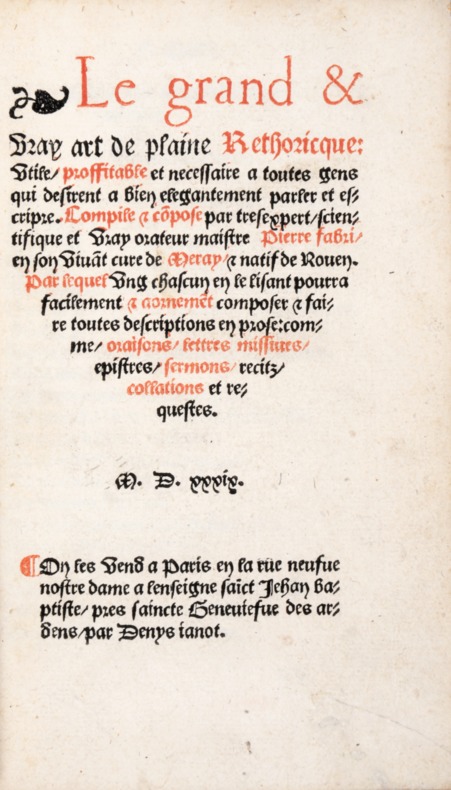
153916135Paris, Denis Janot, Estienne Caveiller, 1539. 2 parties en 1 vol. in-8 gothique (15,5 x 9,3 cm) de (2)-CLXIIII ff. (2)-LXIIII ff. (sign. a-x8, Aa8-Hh8), maroquin janséniste vert, dos à nerfs, tranches dorées sur marbrure, dentelle intérieure (Hardy-Mennil).
157942165Lyon, Jean de Tournes Imprimeur du Roy, 1579. 2 parties en 1 volume in-16 (120 x 75 mm) de (26)-597-(1) pp., 314 pp., (1) f. fleuron au verso, 22 figures dans le texte (42 x 55 mm), maroquin rouge, dos orné à nerfs maroquin rouge, dos orné à nerfs, filets et roulette dorée intérieurs, tranches dorées sur marbrure (Belz-Niédrée).
Con le prime 20 novelle di Giovanni Boccaccio, 68 fregi e 55 litografie originali a colori di Luciano Minguzzi, di cui 20 a piena pagina, firmate dall'Artista (cm 47x35 - 12x15). Testo trascritto a mano dall'Editore con penna a inchiostro litografico direttamente su lastre di zinco. Per la realizzazione del volume sono state stampate 332 lastre delle quali, le 20 riguardanti le litografie grandi, biffate e conservate. Edizione firmata dall'Artista e dall'Editore Stampato su carta intonsa di puro straccio della cartiera Ventura di Cernobbio, con marchio editoriale in filigrana. Litografie a cura di Giuseppe De Bellis. Custodia in piena pelle bicolore con impressioni in bianco confezionata da Nardari. Es. 77/100. Folio (cm 51x39). pp. 112. . Ottimo (Fine). Abrasioni alla custodia (Damage to the slip-case). Edizione di 100 + XXX es. numerati e firmati. .
Prima edizione così. CON DEDICA Esemplare X nella serie di sole tre copie contrassegnate X, Y, Z, completo (non è prevista in questi esemplari la gouache di Fautrier). Lunga dedica autografa di Jean Fautrier al poeta e critico Piero Bigongiari. Firme autografe di Ungaretti, Fautrier e Le Noci al colophon, impronta della mano del poeta con la firma autografa. In ottime condizioni (normali segni del tempo all’astuccio; pergamino leggermente scurito al dorso). Monumentale edizione molto rara, tirata in soli 43 esemplari variamente numerati, dei quali: 15 fuori commercio numerati in lettere, contenuti in astuccio verde in carta Canson (A-D riservati ad personam agli autori; E-N e X, Y, Z); 28 commerciali numerati in numeri arabi contenuti in custodia in pergamena (solo questi ultimi comprendono una tempera originale di Jean Fautrier). -- Il volume, stampato in occasione dei 75 anni del poeta. riproduce gli autografi di: «Monologhetto», «Auguri», «Taccuino del Vecchio» e «Apocalissi».
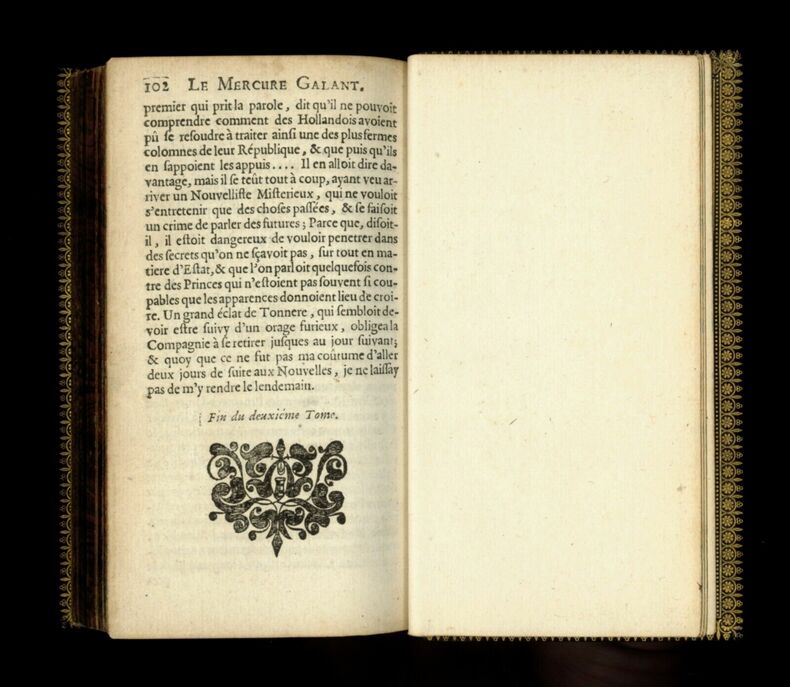
1673AMO-4528Suivant le Copie imprimée à Paris, chez Claude Barbin, 1673 (Tome I et II et III). [Hollande ou Bruxelles ? Elzéviers ou Vleugart ?] A Paris chez Claude Barbin, 1674 (en réalité même imprimeur que les trois tomes précédents). [Hollande ou Bruxelles ? Elzéviers ou Vleugart ?] 4 tomes reliés en 2 volumes in-12 (13,3 x 9 cm | Hauteur des marges : 130 mm) de (12)-108 ; (18)-102 ; 125-(5) ; 1 feuillet blanc ; (4)-114 pages. Collationné complet. Joli frontispice gravé Reliure plein maroquin bleu nuit, dos à nerfs, chiffre couronné répété (voir provenance) dans les caissons aux dos et dans les angles des plats, encadrement intérieur composé de roulettes et filets dorés, doublures et gardes de papier peigne, non rogné (ébarbé), relié sur brochure. Splendide exemplaire parfaitement établi par Capé au milieu du XIXe siècle. reliures fraîches malgré quelques légères décolorations du maroquin sur le pourtour des plats, sans gravité. Intérieur frais malgré quelques petits manques angulaires à quelques feuillets et une petite réparation ancienne dans l'angle inférieur d'un feuillet, sans manque).
Libro d'artista composto da testo e disegni dell'Autore Stampato su carta Moulin Richard de Bas dall'Atelier Vincent Auger, con caratteri Helvetica Neue Bold e Gillick Helvetica New. Rilegatura in pergamena di pelle di capra. Contenitore in plexiglas. Cm 41x29,5. pp. 48. . Perfetto (Mint). . Edizione originale di 30 es. numerati e firmati. . In his second publication with the team of Three Star Books, Liam Gillick offers a philosophical text entitled Pourquoi travailler? (Why Work?). His argument is presented materially as well as in carefully reasoned prose, to conclude that both different types of labor — and also less — might behoove those in the culture industry today. Gillick's text addresses the issue of production for the "knowledge worker," and sheds a searing light on the forms of labor that cultural production now entails. Professedly uninterested in art history, an atheist with a predilection for secular imagery (even when excavating medieval iconography), Gillick has produced what might even be considered a sacred text of his own. This is as much due to the form chosen as the content in which his thinking is framed. Gillick's essay on labor began as a symposium contribution, was then printed as a small give-away publication, and is freely available in English on the Internet. In its Three Star Books manifestation, it is presented as a rarity. The text, typeset in the special Gillick Helvetica New that the artist himself designed, is printed in letterpress on the finest of Richard de Bas handmade paper. These sheets are gathered together in a bound cover created from white goatskin parchment, each cover pleated by hand. The resultant volume, fitted with over a dozen black and white images executed after woodblock prints, is held together in a near-sculptural form, by a fluorescent orange Plexiglas case. Citing the earliest of printing traditions —woodcut— Gillick has selected images from the dawn of the mechanically produced book to go along with his both crafted and yet electronic book.
195064011Ripton VT & New York NY: Robert Frost 1950. 4to. sized 8 x 10.5 in. 13 leaves typescript typed on a “Mill†typewriter typically used by the military for communiques and for civilian telegrams and featured a 9 point font larger than the standard typewriter font stapled twice at upper left corner center crease fold faint thumbing at fore-edge of last couple leaves slight creasing to a couple leaves and very minor small stain to fore-edge last leaf inscribed by Robert Frost to his friend Reginald Cook English Professor at Middlebury College head of the Bread Loaf School nearly from its’ inception title change insertion of an apostrophe and annotation both in Frost’s bold ink MS at upper right corner. A very scarce original “Ribbon Copy Typescript†-- not a carbon copy of one of the author’s longest poems as well as one of his more important late poems offering a metaphor on free will and betrayal. Frost original typescript or manuscript poems are frequently only less than a page to 2 pages long while this is significantly more. This typescript was used originally by Frost on May 25 1951 for “the Blashfield Address of the American Academy of Arts and Letters†- as quoted from the first published edition issued afterwards as a signed limited edition by House of Books in 1951. Clearly as evidenced by the manuscript revisions here he chose to revise and rename the poem “Hard to Keep from Being King†and subsequently later further revised for the printed version. The poem also appeared with a few textual changes in Frost’s last collection “In the Clearing†under the title of “How hard it is to keep from being king when it’s in you and in the situation†-- a near quote of the last 3 lines of the first leaf of this typescript. A list of textual changes can be supplied upon request. See: Henry Hart The Life of Robert Frost p. 342. Robert Frost, unknown
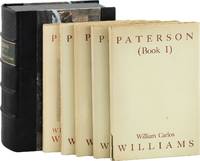
194688109New York: New Directions Books 1946-1958. First Editions. First Printings. Five octavo volumes 24cm; beige cloth blocked in various colors and titled in gilt on front covers; dustjackets; 48; 58; 56; 64; 48pp. All volumes show a hint of foxing to upper board edges some offsetting to pastedowns on Vol.1 else cloth bindings are uniformly clean and contents quite fresh; very Near Fine. Dustjackets are all unclipped Vols.1-3 showing a hint of sunning to spines and upper panels Vol.1 showing a 2" split to lower front joint and clear tape reinforcement at upper edge on verso with a single foxed spot to front panel; one tiny nick to lower front panel on Vol.3 with two clear tape mends on verso; faint foxing to verso of Vol.5; Near Fine. All housed in a custom felt-lined half-morocco clamshell case designed by Chicago bookbinder Scott Kellar with the covers reproducing a photo of the Passaic Falls.<br /> <br /> A uniformly attractive set of these five volumes which together constitute Williams's magnum opus a long poem completed over the course of more than a dozen years. "Paterson is both a man and a city as Joyce's Earwicker is both a man and a hill. The long poem has many moods and includes quotations from letters by Pound and Ginsberg large Seurat-like canvases of the Park on Sunday intimate Bonnard-like interiors uproarious comedy. The Passaic river becomes to him what the polluted Bièvre was to Huysmans. 'A poem is a complete little universe it exists separately. Any poem that has worth expresses the whole life of the poet'" Connolly The Modern Movement p.95. WALLACE A24a A25a A30a A34a A44a. 88109. New Directions Books unknown
194215579New York: Knopf 1942. First edition. Hardcover. Near Fine/good . Two signed items. Stated first edition of book which is inscribed by Hughes on the front free endpaper "To Edwin R. Embree with the sincere regards of Langston Hughes. Chicago February 24 1942." Drawings by E. McKnight Kauffer. Book has black and orange cloth boards. Slight fading of orange at top and bottom of spine. Dust jacket with price intact has a long 1/8-inch shallow chip across top front edgewear and small corner chips. ALSO laid in is a 5x8" one-page Hughes poem "The Negro Speaks of Rivers". Signed and dated 1941 by Hughes on the front. On the verso he has writen "Twenty Years Writing and Publishing -- June 1921-June 1941". This is the first separate publication of the poem and it is printed on orange card stock with illustration at top by Aaron Douglas. It is one of 250 copies Hughes had printed in 1941 and sent to friends and is now rare. Not available for international shipping. <br/><br/>Stated first edition. Knopf hardcover
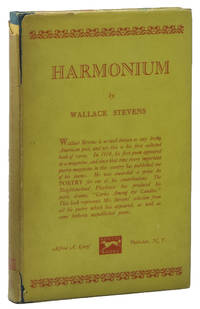
192302063New York: Alfred A. Knopf 1923. Octavo. Pastel-striped paper over blue cloth with paper spine label; 140 pp.; dust jacket. First edition second state binding limited to 215 copies. This was the smallest print run of the 1500 first edition copies spread across three binding states. With the exceedingly scarce unsophisticated dust jacket. A Near Fine copy with scant rubbing to board edges and one small stain to top of spine label; page edges a trifle browning along the top and small bookseller's ticket to rear endpaper else Fine internally. The unclipped $2.00 dust jacket is Very Good with some surface soiling and a small chunk missing to crown not affecting title; 1" hairline crack along joint fold. We find zero copies of either the first or state binding with the dust jacket currently in the trade June 2015. Alfred A. Knopf hardcover
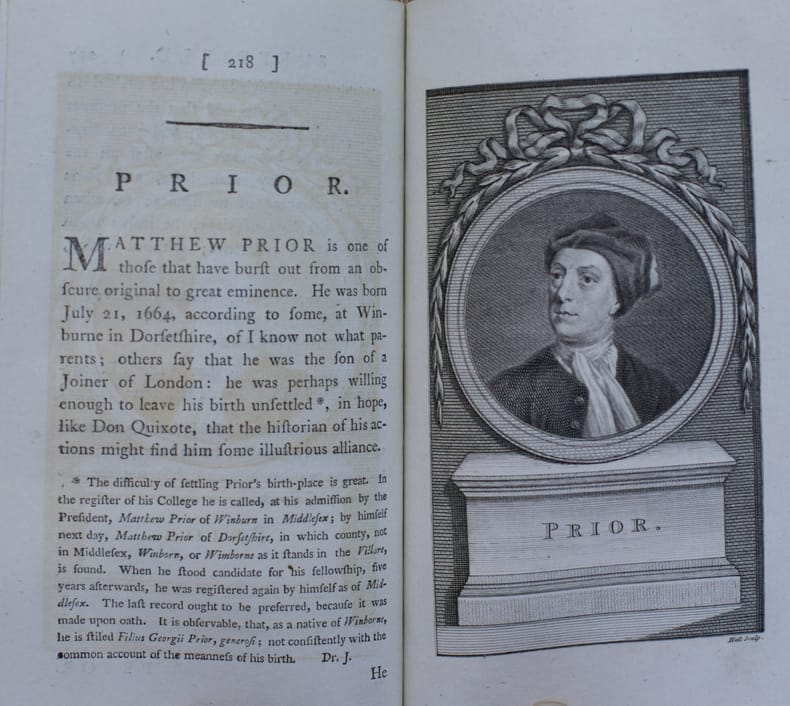
75 volumes In-8, environ 24000 pages au total. Illustré de I29 portraits hors texte gravés sur cuivre de Cowley, Milton, Butler, Otway, Waller, Philips, Dryden, Parnell, Rowe, Addison, Hughs, Buckingham, Prior, Congreve, Blackmore, Gay, Swift, Broome, Pope, Dr Watts, etc.... Un recueil de biographies par Samuel Johnson consacré aux poètes anglais les plus importants, contenant des sélections dÕÏuvres les plus populaires pour chacun. Cet ouvrage est une vaste collection de courtes biographies et dÕévaluations critiques. Les six premiers volumes se nomment 'Lives', les soixante-sept suivants contiennent les poèmes des auteurs cités dans 'Lives', dont Milton, Dryden, Gay, Butler, Swift, Pope... Les volumes 74 et 75 sont des volumes dÕindex. Collection complète en 75 volumes, en excellente condition. Illustrated with I29 copper-engraved out-of-text portraits of Cowley, Milton, Butler, Otway, Waller, Philips, Dryden, Parnell, Rowe, Addison, Hughs, Buckingham, Prior, Congreve, Blackmore, Gay, Swift, Broome, Pope, Dr Watts, etc.... A collection of biographies by Samuel Johnson devoted to the most important English poets, containing selections of the most popular works for each. This work is a large collection of short biographies and critical assessments. The first six volumes are called 'Lives', the next sixty-seven contain the poems of the authors mentioned in 'Lives', including Milton, Dryden, Gay, Butler, Swift, Pope... Volumes 74 and 75 are index volumes. Complete collection in 75 volumes, in excellent condition.
28.5 x 38.5 cm 174 pp legatura con dorso in tela canapa e quadranti in carta Ingres rosa leggermente sbiadita. Stampato in 150 esemplari numerati (il nostro è il numero 67) con 17 litografie originali di De Pisis. Proveniente da collezione privata, ex libris. Pagine in condizioni ottime, alcune fioriture al taglio.
in-8 (mm 160 x 100), pp. 177 (senza l'occhietto che si trova negli esempl. destinati a unirsi alle Operette, cfr. sotto) leg. posteriore in pelle verde scuro, titolo e filetti al dorso a nervetti. Seguono il frontespizio due pagine di Indice delle composizioni e una curiosa e utile nota bibliografica sulle edizioni genuine dal 1818 al 1831: le poche altre "essendo state senza concorso dell'autore, non hanno nulla di proprio...". Edizione in parte originale: sono 11 i canti aggiunti ai 23 pubblicati da Piatti: Il passero solitario, Il Consalvo, Il pensiero dominante, Amore e morte, A se stesso, Aspasia, Sopra un bassorilievo antico sepolcrale, Sopra il ritratto di una bella donna, Palinodia al Marchese Gino Capponi, Imitazione, Scherzo. Quindi per la prima volta sono compresi i 34 canti e inoltre in fine compaiono cinque frammenti di cui tre inediti. La pubblicazione fu seguita dallo stesso Leopardi durante l'estate del 1835, ed era pronta alla fine di settembre. Il volume è a volte affiancato da un secondo, con le prime Operette morali corrette e accresciute, che la censura era intervenuta a bloccare. "Giusto quanto si legge nella bibliografia leopardiana del Cappelletti, che cioè questa edizione è rarissima e si è dubitato se esistesse, bisognerebbe dire che questo volume dei Canti di Napoli fosse stato soppresso dalla Censura e sequestrato prima che se ne spacciassero pubblicamente esemplari". La censura in realtà si mosse unicamente per la stampa delle Operette che lo Starita intendeva pubblicare in due volumi, limitandosi peraltro a far uscire il primo tomo verso la fine di dicembre del 1835. Poi lo Starita - che ambiva a pubblicare le Opere in sei volumi - ritirò dal mercato anche questi primi due che risultano quindi rari anche singolarmente. Lievi e usuali fioriture dovute alla povertà della carta su oltre la metà dei fogli, qualche macchia marginale; ruga della carta al f. di titolo. L'ultimo foglio, contenente l'errata, è stato velato al verso e con 8 lettere restaurate. . Benedettucci 38. Mazzatinti 676-677..
39143London, Printed by John Nichols for J. Buckland, J. Rivington and sons..., 1790. 75 volumes in-8°, environ 24000 pages au total. Reliuresplein veau glacé d’époque, dos lisses ornés de 6 filets dorés, pièces de titre en maroquin vert, coupes ornées de roulettes dorées, tranches jaunes / Bound in full contemporary glazed calf, smooth spines decorated with 6 gilt fillets, green morocco title-pieces, spines decorated with gilt roulettes, yellow edges.
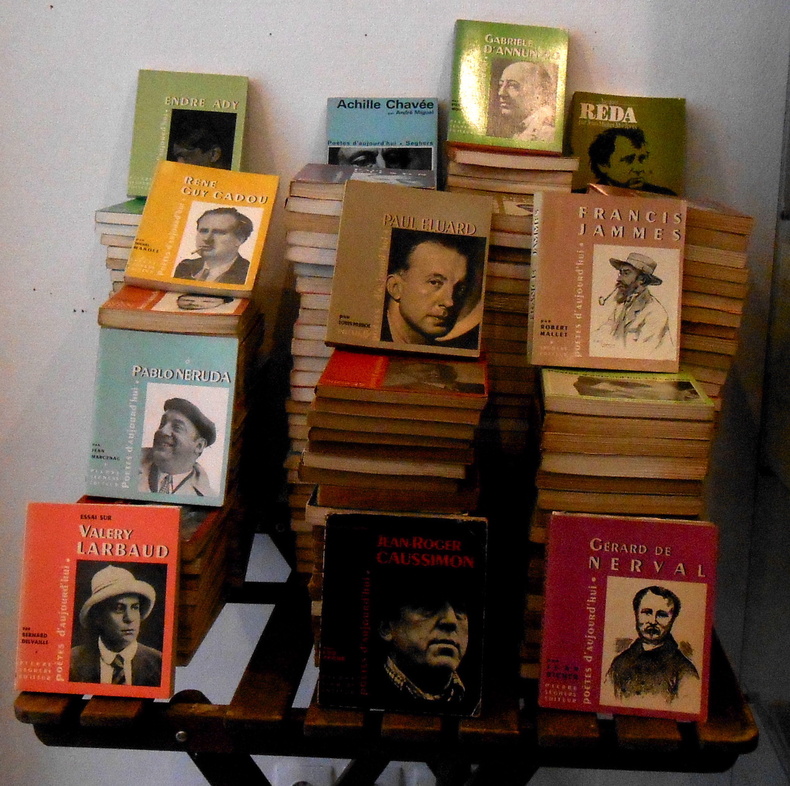
194523085Paris, Éditions Seghers, collection Poètes d’Aujourd’hui, du n°1, Paul Eluard par Louis Parrot, 2ème semestre 1945 au n°270, Jude Stefan par Michel Sicard, avril 1994 plus les deux volumes non numérotés: Maïakoski par Elsa Triolet, décembre 1945 et D.A.F. de Sade par Gilbert Lély, mars 1948. Brochés, 14 cm x 16 cm.Textes en première édition et en bon état en règle générale. 54 ouvrages dédicacés par les poètes et/ou les auteurs des essais et provenant des bibliothèques de Max-Pol Fouchet, Aragon et Elsa Triolet (Asturias), Jean Cassou, Jean Blot, Albert Loranquin, … 3 ont des cachets de bibliothèque, 2 le prix collé et 1 le dos consolidé. Mohamed Iqbal (n°107), est un exemplaire hors-commerce sur vergé de Hollande et non coupé.Il y a eu deux ouvrages différents sur Hölderlin, Eluard et Aragon et deux éditions différentes et augmentées pour Marcel Béalu et André Frénaud. On joint le 45 tours Paul Eluard dit par Gérard Philippe et Marguerite Yourcenar, n°38, Ecrivains d’Hier et d’Aujourd’hui, avec un bel envoi de l’auteur Jean Blot. Liste détaillée sur demande.
191764263circa 1917-1918 | 22.30 x 27.60 cm | une feuille sous chemise et étui