Sbarra, Francesco.MareMagnum

78 250 résultats
Folio. (16), 105, (3) pp. With folding engr. title page and 23 folding engr. plates by Matthäus Küsell after Ludovico Burnacini. Marbled half calf (c. 1900) with giltstamped title to gilt spine. This splendid work, published on the occasion of the formal opening of the Court Theatre in 1667, contains the libretto and stage designs of the eponymous opera, produced in honor of the marriage between Emperor Leopold I. and Infanta Margareta Teresia of Spain. The "Pomo d'oro" is considered one of the 17th century's most significant achievements of the musical stage; Burnacini's imaginative stage designs are known only through these illustrations, congenially engraved by Küsell. The two additional plates which Vinet mentions, depicting interior views of the auditorium, are not contained in any of the copies cnsulted for comparison; they were produced only after Küsell had completed the series and were added to a very small number of copies. As they are not mentioned by the printed table of plates (ff. B1r-B2v), the work may be considered complete thus. - Occasional browning and waterstaining; several plates with signs of old remargining and restoration; slight defect to one plate (some loss to image, retouched). Attractive, uncommonly well-preserved copy in comparison with the five copies sold at auction during the past three decades (four of which were incomplete, wanting the engr. title page or one of the 23 stage-designs). From the collection of the Viennese brewer Joseph Wuensch (1843-1916) with his bookplate and library label on the front pastedown. VD 17, 39:126553Z (two copies, collations agreeing with the present copy). Kat. der Ornamentstichslg. Berlin 4127 (as here). Vinet 669 (25 plates). Palau 230.777. Thieme/B. V, 264. AKL XV, 253.
Calling card format. 1 page. To the musical writer and musician August Schmidt (1808-91), in German, on the verso of his printed visiting card, introducing a musician named Puyn visiting from Amsterdam. - "64" written in unknown hand at upper right of printed side.
5 SS. Tinte auf Papier. Geheftet. Qu.-Folio. Psalm 26, komponiert für Singstimme und Klavierbegleitung: "Richte mich o Ewiger". - Stadler zählte zu den prominentesten Persönlichkeiten des Wiener Musiklebens an der Wende vom 18. zum 19. Jahrhundert; er war mit Mozart, Haydn, Beethoven und Schubert befreundet und verfasste zahlreiche Schriften über Mozart, dessen Nachlass er gemeinsam mit Georg Nikolaus Nissen ordnete. - Im Rand eigenh. Echtheitsbestätigung (um 1880) durch den Komponisten Josef Venantius von Wöss (1863-1943): "Comp. von Hrn. Abbé Max. Stadler. / Des unsterblichen Tondichters eigene Handschrift" sowie "Autograph". Sehr selten; seit 1950 kein einziges Autograph des Komponisten im Handel nachweisbar.
8vo. Altogether (4+1=) 5 pp. on double leaves. To the critic Alexander Berrsche. A long and comprehensive letter in which Strauss explains in detail what Berrsche had criticized in his review of an Academy Concert that Strauss had conducted: "You heard quite correctly that it was less 'vivacious', less 'dashing' than usual [...] the brass section remained 'unaffected' and 'subdued'. Beethoven's Scherzo was played (following Bulow's rule) in moderate tempo for the first time, and only the second repetition was played in full Vivace, the finale was played a third slower than is common among the world's most famous conductors and even Richard Wagner himself postulated (erroneously, in my opinion) [...]". - Includes a typed letter to Berrsche by the publisher, and a letter from Strauss to a Munich publishing house.
138:101 mm (portrait) on cardboard. Dedicated to Carl Brandt, a close collaborator of Wagner at Bayreuth: "Lieber Brandt | wenn wir erst zum | letzten Brand | gekommen sein werden, | wollen wir Lachnerin | einen Hahn | schlachten | Dieses gelobend bin ich | Ihr | dankbarer Richard Wagner". - From the studio of Fritz Luckhardt. - Mentioned in Wagner, Letters (A 673) and in an auction catalogue of Leo Liepmannsohn (cat. 63, no. 193). - Somewhat spotty; script somewhat faded. Hermann Kaiser: Der Bühnenmeister Carl Brandt und Richard Wagner. Kunst der Szene in Darmstadt und Bayreuth. Darmstadt, Eduard Roether Verlag, 1968.
2 SS. Qu.-8vo. Mit eh. Adresse. An Alban Berg in Ossiach am See mit Dank für dessen Ostergruß, privaten Mitteilungen und Nachrichten über Arnold Schönberg: "[...] Ich freute mich sehr, daß Du von Dingen sprichst, die mir, je älter ich werde, immer wichtiger werden. Darüber müssen wir wieder ein Mal ausführlich sprechen. In diesem Zusammenhang: Ich las jetzt 'Sylva sylvarum'. Wie schön diese Beziehungen. Letzten Endes Entsprechung zwischen alldem in der 'Natur' u. der 'Kunst'. Kein Gegensatz. Du warst wieder krank. Kannst Du nicht herausfinden, wie Du Dich zu verhalten hättest, um Dir diese Leiden zu ersparen? Wir ziehn morgen wieder nach Mödling, Neusiedlerstr. 58. Schönberg ist noch nicht zurück. Er dirigierte noch 2 Konzerte in A[msterdam]. Von ihm selbst habe ich keine Nachricht. Vermutlich kommt er dieser Tage zurück. Wie steht es mit Deinen Angelegenheiten? Schreib mir bald. Ich möchte noch sagen: laß Dir einmal das kirchliche Ostern dort am Land recht bewußt werden. In meiner Jugend war ich fast immer am Gut meines Vaters um diese Zeit. Und was ich dort erfuhr, ist mir unvergeßlich [...]". - Bei "Sylva Sylvarum" handelt es sich entweder um Francis Bacons 1627 unter dem Titel "Sylva sylvarum: or, A natural history, in ten centuries whereunto is newly added the history naturall and experimentall of life and death" posthum veröffentlichte Sammlung naturhistorischer Beobachtungen und Experimente oder um August Strindbergs 1895 erschienene Naturstudien. - Durch die Förderung Wilhelm Mengelbergs konnte Schönberg in Amsterdam mit dem Concertgebouw-Orchester zwischen März 1920 und März 1921 sieben Konzerte eigener Werke dirigieren, darunter am 19. und 20. März 1921 seine "Gurre-Lieder". Einen Monat nach seiner Karte reiste Webern zusammen mit Schönberg, Guido Adler, Hugo Botstiber, Emil Hertzka, Alma Mahler-Werfel, Felix Salten, Richard Specht, Paul Stefan, Egon Wellesz und zahlreichen anderen Freunden und Repräsentanten des Wiener Kulturlebens nach Amsterdam, wo Wilhelm Mengelberg das Gustav Mahler Festival Amsterdam 1920 veranstaltete (6. bis 21. Mai). - Mit einem kleinen Antwortvermerk aus Bergs Hand. Weberns Unterschrift durch eine Briefmarke etwas überdeckt.
Small 4to. 3 pages on bifolium. To the French musicologist Henry Prunières. Weill is happy to hear that his first quartet was performed at the concerts of the Revue Musicale: "Je suis heureux, Monsieur, de pouvoir vous exprimer la joie profonde que m'avait causé cet hommage rendu à mon œuvre. Mon éditeur, l'Universal- Edition, m'a fait part de votre intention de faire jouer mes sept mélodies Frauentanz. Je suis flatté de l'intérêt que vous portez à mon ouvrage [...]".
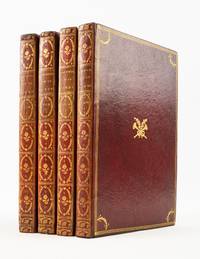
1773ST20891Paris: Chez de Lormel Imprimeur de l'Academie Royale de Musique 1773. FIRST EDITION First Issue with pencilled correction of "affreux Serpent" on p. 54 of Vol. II. 237 x 160 mm. 9 1/4 x 6 1/4". Engraved throughout. Four volumes. <br/> Tasteful contemporary crimson morocco gilt covers with triple fillet border floral garland at corners crossed trumpets with laurel branches at center smooth spines in gilt compartments with floral sprig within an oval catkin wreath two tan morocco labels gilt turn-ins marbled endpapers all edges gilt restorations to head of two spines. ENGRAVED THROUGHOUT: Engraved decorative title page and dedication page in volume I three engraved frontispieces by Le Bouteux and Le Barbier in volumes II-IV one of these a portrait of the dedicatee La Dauphine Marie Antoinette and 100 FULL-PAGE PLATES the 25 in volume I designed and engraved by Moreau le jeune all with tissue guards those in volumes II-IV engraved by Masquelier and Née after designs by Le Barbier Le Bouteux and Saint-Quentin about one-third of the plates with original tissue guards. Without the separately printed portrait of Laborde issued in 1774 and found in some copies. Cohen-de Ricci pp. 534-38; Ray 49 pp. 90-91 p. 76; Lewine pp. 266-68. Spines slightly and evenly sunned a hint of wear at corners but the bindings otherwise beautifully preserved with only the most trivial imperfections; internally with isolated inconsequential foxing or small stains. A VERY FINE CONTEMPORARY SET the lovely bindings scarcely worn the margins extremely ample the contents clean and fresh and THE ENGRAVINGS RICHLY IMPRESSED.<br/> <br/> Dedicated to the crown princess Marie Antoinette this opulent production--offered here in fine contemporary morocco--beautifully displays the music fashion and aristocratic antics of Louis XV's court perfectly encapsulating the French Rococo. According to Cohen-de Ricci "This book—one of the most beautiful of the 18th century—is perhaps along with 'Contes de La Fontaine' the most delightful by virtue of the grace of its subjects and the variety of the costumes depicted therein." It contains some of the most elegant and memorable engravings to be seen in any French work of the period and they transform a book of perhaps more than occasionally vapid songs into a profoundly pleasurable visual experience. The author Benjamin de Laborde or Jean-Benjamin de La Borde 1734-94 was the hunchbacked valet of King Louis XV. In consequence of the monarch's indulgence of his favorite de Laborde's songs were given a presentation described by Ray as being of "the utmost sumptuousness" the entire work having been produced by engraving. The first volume which Cohen-de Ricci Ray and Lemire unanimously proclaim a "masterpiece" is graced by plates that were both designed and cut by Jean-Michel Moreau called Moreau le jeune 1741-1814. Ray says that the work done by Moreau le jeune during the 1760s "showed him to be the equal of the established rococo masters Boucher Eisen and Gravelot" and that in his work during the 1770s "he carried all before him." So Moreau was in his prime then when he executed these charming scenes often of courtship set in pastures pleasure parks and elegant interiors; they represent the culmination of the Rococo style delicate and lush without being cloying. Because of a quarrel between the artist and the author the final three volumes were illustrated by Le Bouteux and by Jean-Jacques-François Le Barbier 1738-1826. Le Barbier was one of the first great French neoclassical illustrators and Ray declares the engravings here his "most sustained and accomplished series of illustrations apart from that for Gessner's 'Oeuvres'" and laments that the present work "has not received the attention it deserves." Le Barbier's compositions are characterized by charm grace and elaborate and convincing detail. This first printing presents the engravings at the height of their richness and power which has been undimmed by the intervening centuries. With any copy of this work the engravings will always take center stage but here the tasteful contemporary red morocco bindings deserve a prolonged bow: they are perfectly elegant and elegantly perfect. Chez de Lormel, Imprimeur de l'Academie Royale de Musique unknown
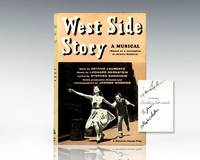
195871012New York: Random House 1958. First edition of this classic musical. Octavo original half cloth. Signed by Arthur Laurents Leonard Bernstein and inscribed by Stephen Sondheim on the half-title page. Fine in a very good dust jacket. Rare and desirable signed by these three contributors. This is the first example we have seen. Rare and desirable. In 1947 Jerome Robbins approached Leonard Bernstein and Arthur Laurents about collaborating on a contemporary musical adaptation of Romeo and Juliet. He proposed that the plot focus on the conflict between an Irish Catholic family and a Jewish family living on the Lower East Side of Manhattan during the Easter-Passover season. The girl has survived the Holocaust and emigrated from Israel; the conflict was to be centered around anti-Semitism of the Catholic "Jets" towards the Jewish "Emeralds" a name that made its way into the script as a reference. Eager to write his first musical Laurents immediately agreed. Bernstein wanted to present the material in operatic form but Robbins and Laurents resisted the suggestion. They described the project as "lyric theater" and Laurents wrote a first draft he called East Side Story. Only after he completed it did the group realize it was little more than a musicalization of themes that had already been covered in plays like Abie's Irish Rose. When he opted to drop out the three men went their separate ways and the piece was shelved for almost five years. In 1955 theatrical producer Martin Gabel was working on a stage adaptation of the James M. Cain novel Serenade about an opera singer who comes to the realization he is homosexual and he invited Laurents to write the book. Laurents accepted and suggested Bernstein and Robbins join the creative team. Robbins felt if the three were going to join forces they should return to East Side Story and Bernstein agreed. Laurents however was committed to Gabel who introduced him to the young composer/lyricist Stephen Sondheim. Sondheim auditioned by playing the score for Saturday Night his musical that was scheduled to open in the fall. Laurents liked the lyrics but was not impressed with the music. Sondheim did not care for Laurents' opinion. Serenade ultimately was shelved. Laurents was soon hired to write the screenplay for a remake of the 1934 Greta Garbo film The Painted Veil for Ava Gardner. While in Hollywood he contacted Bernstein who was in town conducting at the Hollywood Bowl. The two met at The Beverly Hills Hotel and the conversation turned to juvenile delinquent gangs a fairly recent social phenomenon that had received major coverage on the front pages of the morning newspapers due to a Chicano turf war. Bernstein suggested they rework East Side Story and set it in Los Angeles but Laurents felt he was more familiar with Puerto Rican immigrants and Harlem than he was with Mexican Americans and Olvera Street. The two contacted Robbins who was enthusiastic about a musical with a Latin beat. He arrived in Hollywood to choreograph the dance sequences for The King and I and he and Laurents began developing the musical while working on their respective projects keeping in touch with Bernstein who had returned to New York. When the producer of The Painted Veil replaced Gardner with Eleanor Parker and asked Laurents to revise his script with her in mind he backed out of the film freeing him to devote all his time to the stage musical. West Side Story is set in the Upper West Side neighborhood in New York City in the mid 1950s an ethnic blue-collar neighborhood in the early 1960s much of the neighborhood was cleared in an urban renewal project for the Lincoln Center which changed the neighborhood's character. The musical explores the rivalry between the Jets and the Sharks two teenage street gangs of different ethnic backgrounds. The members of the Sharks from Puerto Rico are taunted by the Jets a white gang. The young protagonist Tony a former member of the Jets and best friend of the gang's leader Riff falls in love with Maria the sister of Bernardo the leader of the Sharks. The dark theme sophisticated music extended dance scenes and focus on social problems marked a turning point in American musical theatre. Bernstein's score for the musical includes "Something's Coming" "Maria" "America" "Somewhere" "Tonight" "Jet Song" "I Feel Pretty" "A Boy Like That" "One Hand One Heart" "Gee Officer Krupke" and "Cool". The original 1957 Broadway production directed and choreographed by Jerome Robbins and produced by Robert E. Griffith and Harold Prince marked Sondheim's Broadway debut. It ran for 732 performances before going on tour. The production was nominated for six Tony Awards including Best Musical in 1957 but the award for Best Musical went to Meredith Willson's The Music Man. Robbins won the Tony Award for his choreography and Oliver Smith won for his scenic designs. The show had an even longer-running London production a number of revivals and international productions. A 1961 musical film of the same name directed by Robert Wise and Robbins starred Natalie Wood Richard Beymer Rita Moreno George Chakiris and Russ Tamblyn. The film was nominated for eleven Academy Awards and won ten including George Chakiris for Supporting Actor Rita Moreno for Supporting Actress and Best Picture. Random House hardcover books
1 S. Qu.-8vo. Mit eh. Adresse. An Hermine Spies, damals eine der führenden Altistinnen Europas, für die Brahms mehrere Lieder schrieb und die er bei Liederabenden begleitete: "Eigentlich wäre ich gar gern nach W[iesbaden] gekommen, nur ist es ein wenig unsicher, da ich vorher 99 andre Stationen absolviren muß. So freue ich mich denn sehr Ihrer Güte und Liebenswürdigkeit und hoffe auf einen schönen, sonnigen Tag in Rüdesheim [...]".
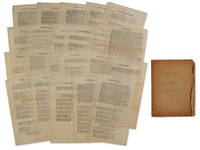
1940List2441New York 1940. Eighty-five pages including sixty loose pages and a partial draft of Guthrie’s Hard Hitting Songs for Hard Hit People totaling twenty-five pages. With one handwritten page. One page - a typewritten copy of “The Ballad of Harry Bridges†- with a handwritten note by Guthrie to Ambellan. With photocopies of several letters from Guthrie to Ambellan included. Also with a broadside of the Carol Tree Carol by Alan and Elizabeth Lomax 1940 and a notecard with the lyrics to “Hawl Away Joe†written Inscription states “Here you are Harold hope it aint late. Well if it is will be singing about old Harry for a many a day to come. Pour it on em Boy. Woody G.â€. A fascinating collection of material from the collection of Harold Ambellan Woodie Guthrie’s friend collaborator and landlord during an important creative period for Guthrie in the 1940s. The group contains a partial draft of Guthrie’s Hard Hitting Songs for Hard Hit People which was written while Guthrie was living in Ambellan’s loft as well as a collection of over sixty loose songsheets not included in the book. Of these over thirty are not listed in Tulsa’s Woody Guthrie Center finding aid. The sixty pages include variant titles and verses to recorded and published versions with some items attributed to Ledbelly and overall the group should shed light on scholar’s efforts to map out the landscape of the American folk song at the time of Guthrie’s work. The typescript draft generally matches the published version with the occasional typo. <br /> <br /> Nora Guthrie writes in her introduction to Hard Hitting Songs of the influence of Ambellan on Guthrie’s creative process. Ambellan was an artist and sculptor and part time musician and Guthrie lived in Ambellan’s loft on 21st Street. “The loft was mostly filled with Ambellan’s sculptures which were abstract and very large. However the couple managed to throw a cot up in the back of the loft for Woody to crash on… Evenings at the loft often included impromptu hootenannies where Woody and Pete’s Seeger musician friends would gather to raise some money to help pay the Ambellans’ rent… There was a lot of singing and a lot of songwriting and it was in the 21st Street loft that Hard Hitting Songs came into existence.†Guthrie wrote “Vigilante Man†and “Hard Travellin†while staying at the Ambellans’ loft. <br /> <br /> Nora Guthrie continues: “ Alan Lomax’s father John Lomax had collected a group of songs that dealt with migrant workers’ share crop farmers’ and industrial workers’ issues many of the lyrics protesting workers’ conditions and advocating for their rights. At the time the material was considered ‘too hot to handle’ by government employees so Alan handed it over to Pete Seeger and Woody to browse through. They loved the material and together with Alan they decided to create a new songbook they would embellish with their own writings and commentary as well as some additional original songs. Working fourteen hours a day they completed the songbook in about five months. … The manuscript which they had titled Hard Hitting Songs for Hard-Hit People was left behind in the loft literally saved by Elisabeth Higgens until its existence became known in the 1960s when it was first published in 1967.â€<br /> <br /> Overall a very scarce relic of an important period in Guthrie’s career with a fantastic association. Guthrie ephemera and archival pieces are notoriously scarce on the market with single letters occasionally surfacing. unknown
Zusammen (2½+1 =) 3½ SS. auf 3 Bll. (Qu.-)8vo. Der Brief mit eh. adr. Kuvert, die Karte mit eh. Adresse. Mit einigen Beilagen (s. u.). An den Dirigenten und Komponisten Ernst Hermann Seyffardt mit Dank für eine Widmung (1884) und betreffs einer Verabredung (1887): "Haben Sie herzlichen Dank für Ihre Widmung u. glauben Sie daß ich solches Geschenk zu würdigen weiß. Längst hätte ich es Ihnen gesagt, aber ich war immer in Versuchung weiter zu schreiben. Ich hätte Ihnen dadurch bewiesen wie sehr u. gern ich Ihr Werk betrachtet u. bedacht habe - aber das gehört nicht zu dem ernstlichen Dank der Ihnen zunächst gebührt! Jetzt schreibe ich im Moment der Abreise u. kann nur sagen wie sehr es mich erfreut hat, daß Sie einer Arbeit, die Sie so lange u. ganz erfüllt haben mag, meinen Namen vorgesetzt haben. Aber ich freue mich darauf, wenn wir gelegentlich, ganz abgesehen von meiner dankbaren Freude, wieder zusammen sitzen o. behaglich kritisieren o. plaudern über Gedichte u. Musik! […]" (Brief aus Wien vom [3. XII. 1884]). - "Ich denke Montag Ab[end] spät dort einzutreffen, im Zähringer Hof abzusteigen u. Dienstag früh 10 Uhr weiter zu fahren. Falls Sie nun zu den Frühaufstehern gehören, könnten Sie mich noch beim Frühstück treffen u. etwa ein wenig mit spazieren? Das wäre eine besondere Freude [...]" (Karte aus Thun mit Poststempel vom 11. IX. 1887). - Der Brief mit kleinen Einrissen im Mittelfalz und dort mit Klebefilm hinterlegt; das Kuvert mit Klebestreifen an den Rändern versehen; die Postkarte mit einer kleinen Knickfalte im Bereich der Unterschrift. Beiliegend 2 Kabinettphotographien und zwei Portraitpostkarten.
Zusammen 1794 SS. Notendrucke. Meist gr.-4to. - Beiliegend 5 Notendrucke von Werken Johann Nepomuk Hummels, Simon Sechters, Heinrich Marschners, Johann Rt. von Herbecks und Carl Perfettas. Zusammen 196 SS. Meist gr.-4to. Weiters beiliegend Spohrs "Selbstbiographie". 2 Bde. Mit 15 Tafeln. XV, (1), 350, (2) SS. (2), 412, (2) SS. Marmorierte Halbleinenbände der Zeit mit Rückentitel und -vergoldung. 8vo. "Paul Wittgenstein hat vor allem Bach und Beethoven geliebt. Beethoven war seine Nummer eins. Ich würde sagen, Beethoven war seine große Liebe, alles andere war schön und akzeptabel, aber geliebt hat er nur Beethoven und Bach", erzählt Erna Otten-Attermann in einem Interview aus dem Jahr 2004/2005 mit Irene Suchy über ihren Lehrer Paul Wittgenstein ("Der Musiker im wunderschönen Schloß". In: Empty Sleeve. Der Musiker und Mäzen Paul Wittgenstein. Innsbruck u. a., Studien Verlag, 2006, SS. 37-43, 41). Es ist auch bekannt, daß Wittgenstein - um im Bild zu bleiben - zeitlebens einige Geliebte unterhielt; daß auch Louis Spohr zu diesen hinzuzuzählen ist, ist jedoch - von einem kleinen Hinweis abgesehen - bislang nicht bekannt gewesen. E. Findell erwähnt in einem Aufsatz in der Music Review (32/1971), daß Richard Strauss mit Paul Wittgenstein gewöhnlich Duette gespielt hätte und daß sie beide dieselbe Leidenschaft für Spohrs Kammermusik entwickelt hätten, und auch an anderer, etwas entlegenerer Stelle gibt es vereinzelt Hinweise aus Wittgensteins Vorliebe für Spohr. In zwei bislang unpublizierten Briefen Wittgensteins an Erich Wolfgang Korngold aus den 1920er Jahren - feilgeboten vom Wiener Antiquariat Inlibris Gilhofer Nfg. - ist wiederholt von Spohr die Rede. In einem Brief vom 25. V. 1923 bedauert er, einer Einladung zu einem Hauskonzert nicht die genaue Adresse hinzugefügt zu haben: "Verzeihen Sie diese Gedankenlosigkeit und die daraus für Sie entstandenen Unannehmlichkeiten. Mir war es doppelt leid, da die beiden Spohr'schen Stücke recht brav gespielt worden sind. Wunderer [d. i. der Oboist Alexander Wunderer, 1877-1955] hat sie seinen Schülern ordentlich einstudiert; er hat, so wie ich, eine Vorliebe für diesen jetzt ganz vernachlässigten Meister. Und ein Meister ist er, das verrät jede Note [...]". Wenig später folgt eine zweite, diesmal mit allen notwendigen Daten versehene Einladung: "Donnerstag den 1. November, nachmittags 4 Uhr, führt Wunderer mit seinen Schülern zwei Doppelquartette von Spohr bei mir in der Alleegasse auf. Hätten Sie Lust es anzuhören? [...]" (Br. v. 22. X. 1923). Diese keineswegs beiläufige Beschäftigung mit Spohr wird besonders an Hand des vorliegenden Bestands deutlich, der 39 (davon mehr als 24 in Erster Ausgabe) von Spohrs rund 300 Werken umfaßt. Keine flüchtige Geliebte also, sondern eine ernsthafte Beschäftigung mit dem Komponisten und Geigenvirtuosen. - Detaillierte Verlistung auf Anfrage.
4to and 8vo. Together 23 pp. on 6 bifolia, one with autograph address on verso. Amicable correspondence with Renée Françoise Adélaïde Lemonnier (1767-1833), wife of the mathematician Joseph-Louis Lagrange (1736-1813), at the Palais National des Sciences et des Arts in Paris. - Missing her greatly, not even feeling it in her power to complain about Lemonnier's new friend: "Oh! je vous ensure mon amie [...] je m'ennui fort de votre absence. Je n'ai seulemen[t] pas les Ressource d'aller (comme à Paris) voir par ma fenestre, si je puis vous appercevoir à la Votre. Je n'ai pas même les Ressources de me mettre de mauvaise humeur contre cette figure à Callot, de Madame M. qui a pris ma place auprès de vous, pour! pour vous aimer moins que je ne vous aimes, assurément [...]" (12 Prairial [1 June]). - In great admiration for Napoleon, crediting him with having an impact on nature as well as politics: "Cet incroyable génie de Bonnaparté s'occupe du Mayence d'y Remédier. Cette Confusion semble s'étendre sur la Nature. Les saison paraissent aussi changées, aussy dérangées que la politique [...] que nous sommes heureux au milieux d'un tel caho, d'avoir un Bonnaparte [...] celuy la est mon dieu [...]" (4 Messidor [23 June]). - About her poor health, having to spend a month in bed, reminding her to be less trusting, alluding to her solitude, and asking for news about mutual friends: "Moy, je vie dans ma maison des champs je ne dirais pas sans chagrins! n'y souris car, J'ay trop d'objets de peines, de Regrêts pour que cela puisse Estre, mais! je crois que je suis un peu plus insousciante sur les vicissitudes de cette miserable vie. Dites moy le que vous faites de vos amis [...]" (5 Complémentaire [22 September]). - Wondering whether she attended a feast given by Napoleon: "Avez vous été témoin [...] de la belle fêtte des honneurs que le brave, le sensible, le spirituel Bouonaparté a fait rendre au temple de Mars en le Grand Turenne: l'on dit que cela estoit superbe [...]" (28 Vendémiaire [20 October]). - Very well preserved.
Folio. Four two-line systems with altogether 16 bars and three underlaid stanzas. 1 p. Autograph transcript of Hawaii's National Anthem which Berger composed in the year before and which is still valid up to now under the title "Hawai'i Pono'i". Its words were written by King David Kalakaua (1836-91), the last reigning king of the Kingdom of Hawaii, who dated and signed the present copy as "David M. Kahanonesi, Re Kai Hanola". - Berlin-born musician Henri Berger arrived in Hawaii in 1872, having been commissioned by the King to turn a handful of local musicians into a royal orchestra. Berger was closely affiliated to the Royal Family, served as Royal Bandmaster up to 1915, and acquired lasting merits for his efforts to transcribe literally hundreds of traditional Hawaiian melodies, saving them from oblivion. - Somewhat spotty, edges with some browning; small tear in the lower left margin.
Oblong 8vo. 1 page. With autograph address. To Gustav Ophüls, telling him where to find his folk songs, "namely in Nicolay's Almanack, as well as in Kretzschmer and Zuccalmaglio's collection". For some songs Brahms does not know the source: "Erlauben Sie in aller Kürze: meine Volkslieder finden sie zum größten Theil in Nicolay's feinem Almanach u. in Kret[z]schmer's und Zuccalmaglio's Volksliedersammlung (je 2 Theile) für einige (z. B. 'Erlaube mir', 'In stiller Nacht') weiß ich keine gedruckte Quelle [...]". - The pianist and music critic Gustav Ophüls (1866-1926) was director of the district court in Düsseldorf and published a collection of texts set to music by Brahms ("Brahms-Texte. Vollständige Sammlung der von Johannes Brahms componirten und musikalisch bearbeiteten Dichtungen", 1898). In 1921 he also published his memoirs of Brahms ("Erinnerungen an Johannes Brahms"). - In perfect condition.
1 S. Qu.-8vo. Mit eh. Adresse. An seinen Verleger Fritz Simrock in Berlin über eine kleine Korrektur in seinen "49 Deutschen Volksliedern" (WoO 33, 1893/94): "Ich lese eben, daß ich in No. 45 (7tes Heft No. 3) mich verschrieben u. Sie könnten das nach Leipzig melden ehe es der Stecher 6mal wiederholt! Vers 5 muß es heißen: 'Ich schlafe noch' statt nicht. Verzeihen Sie, aber warum sollen wir's nicht so bequemer haben? Hanslick ist heute früh 8 Uhr abgefahren, sagen Sie ihm, daß s[ein] Mädchen um 9 Uhr bei mir war u. ich den schönsten Reise-Proviant hergerichtet hatte! Klinger reiste von hier nach Griechenland u. dachte im Juli etwa zurückzukommen […]". - Von einer vertikalen Knickfalte und einer weiteren in einer Ecke abgesehen ausgezeichnet erhalten. Gedruckt in: Deutsche Brahms-Gesellschaft (Hrsg.), Brahms' Briefe an Peter Joseph Simrock und Fritz Simrock, Bd. IV. (GA Bd. XII), Berlin, 1919, S. 132, Nr. 835.
Oblong (small) 8vo. 16 pages on 8 ff. All with printed letterhead. Interesting, apparently unpublished correspondence detailing Britten's collaboration with the Revd. Kenneth Sherlock (1901-90), rector of St Bartholomew's Church, Orford, in Woodbridge, Suffolk, where all three "Parables for Church Performance" ("Curlew River", "The Burning Fiery Furnace", and "The Prodigal Son") were performed. Britten is very warm in tone to Sherlock and, in a number of letters, alludes to his declining health, which continued to deteriorate until his death in 1976. - 1) A somewhat philosophical letter about Russia, the Russian people and the human spirit generally and further mentioning a forthcoming tour of Germany and Austria. 2 pp. On headed paper ("The Red House, Aldeburgh, Suffolk"). - The remainder on personalised correspondence cards. - 2+3) About Curlew River: "It was wonderful being able to do Curlew River in your wonderful church […] I'm just off to Holland, after having whizzed up north with Rostropovich […]"; "It is lovely that Curlew River can be back where it belongs in 1965!". - 4) Mentioning "The Prodigal Son": "All goes well here now - only a lot of patience is needed! Don't worry - somehow there will be a Prodigal Son in Orford Church in time! [...]". - 5) Thanking Sherlock for his support: "It is always a real joy for us to come and work in Orford Church - not least because of your own unfailing kindness and deep understanding of what we are trying to do [...]". - 6) "Peter and I are just off to USSR via London for a month or so, so I am afraid a meeting about next year will have to wait till September. But Stephen R. can in the meantime give you all our proposals for next year's Festival at Orford [...]". - 7) "I am here for a week or so (before going off to Helsinki, + to USSR again) [...]". - 8) "What a wonderful lot of flowers - how cheering to be reminded that spring and health will not be far away! I was very touched by them [...]". - Letter 1 shows slight separation to the lower fold; 2 to 8 in excellent condition. Not in the Collected Letters, Volume 6 (1966-1976), ed. by Philip Reed & Mervyn Cooke.
4to. Altogether (2½+2 =) 4½ pages. Each on bifolium with integral address panel. Armorial seal. 1) Levens writes to Monsieur Le Comte de Rochefort, concerning his motets and the questionability of their success as music without symphony by means of subscription, as Levens already has some experience in working with cathedral chapters, that would usually subscribe. Nevertheless he agrees on trying: "Vous croyés Monsieur la voyer des souscription praticable pour la musique sans symphonie, je doute du succés connoissant comme je fais les chapitres de la plupart des cathedrales qui sont ceux qui par preference devroient souscrire: mais enfin on peut tenter". Levens mentions the offer of a Parisian engraver, his idea of using smaller paper and the addition of 14 staves for further possible voices, such as two bass parts and small choirs in the choirs: "J'avois trouvé à Paris un graveur qui m'avoit promis de graver ma musique en symphonie [...]. Je ne say à quel prix on pourroit le faire en petit papier [...]. J'y ay mis 14 portées parce qu'il se trouve quelque fois deux Basses differentes ou des petits choeurs dans les choeurs". Levens ends his letter by recommending his 26-year-old son for the position of a "maitre de Musique" in Avignon, mentions his son's skills in composing and playing the violoncello, and that the chapter of Toulouse hasn't accepted him due to his young age: "Sa musique est de fort bon goût [...] il a d'ailleurs fort bien étudié et joué du violoncello comme il faut, tant pour l'accompagnement que pour des pieces. [...] Les Messieurs du Chapitre de Toulouse le trouvent trop jeune [...]". He gives a list of pieces of music: 12 masses, 24 Magnificat, 6 Dixit, 6 Beatus, etc. (Letter from 23. V. 1746). - 2) Levens gives a list of pieces of music without symphony. It is a list of 32 titles of religious music, followed by their numbers. Levens hopes that the count's efforts regarding his music are not in vain and states his concerns in cooperating with the chapters. Levens ends with mentioning his son's employment as "maitre de musique" at Saint-Étienne in Tolouse since August: "Les tems sont très mauvais et les chapitres, avec qui, il faudroit pour ainsi dire, avoir affaire, sont très difficiles [...]" (Letter from 10. X. 1746). - Both letters with traces of old folding, verso with traces of old montage and a small tear on fol. 2 due to breaking seal.
8vo. 3¾ pages on bifolium. In French. According to an early collector's note, the present letter was written to his friend Ernst Weyden, a scholar and member of the Faculty at the University of Cologne. Liszt discusses his planned marriage to Carolyne Sayn-Wittgenstein, Richard Wagner, and a planned collaboration with Weyden: "Je suis très sensible à vos bons souhaits pour mon quarantième anniversaire, lesquels se résument pour moi tous dans un seul : c'est que la femme qui s'est absolument dévouée à moi qu'elle est devenue à la fois et la racine et la fleur de ma vie, me soit conservé. Grâces au Ciel j'ai tout lieu d'espérer que ce voeu suprême de mon coeur sera exaucé, - et d'après les nouvelles que j'ai trouvé ici il est très probable que dans peu de mois mon mariage aura lieu [...]" ("I am very sensitive to your good wishes for my 40th birthday, which can be summarized for me in one thing: that the woman who has been absolutely devoted to me and who has become both the root and the flower of my life, be kept for me. Thanks be to Heaven that I have every reason to hope that this supreme wish of my heart will be granted - and from the news I have found here it is very likely that in a few months my marriage will take place [...]" (transl.). - Liszt is grateful to Weyden for having reported on his brochure on Lohengrin and Tannhäuser in the Kölnische Zeitung. "It is to be presumed that my brochure will contribute to spreading the understanding of Wagner's works, which, in order to be greatly admired, only need to be understood from a higher point of view than one is accustomed to judge ordinary operas. You have thus done art a service, as well as me, by contributing your share to the propagation of these two eminent works of which Germany will be able one day to be proud [...]". Liszt treasures his memories of their architectural trip and hopes that they will one day resume their peregrinations: "In the meantime, please do not forget our collaboration project in honour of the Duomo; I hope that you will be able to send me the stanzas I have requested before the end of the year [...]. - On blue paper. Slightly wrinkled, otherwise in good condition.
8vo. 2½ pp. To an unknown recipient, asking for calligraphic help regarding a manuscript: "More than others I am able to repent the charm of silence on the things that we take to heart [...] Let me ask you again for your calligraphic collaboration. Here is the manuscipt in question that you have to complete [...]". - Provenance: Robert Bory, musicologist.
8vo. 2½ page on bifolium. Pretty letter to Baron James de Rothschild about wine. "Your magnificent spirits - especially the incomparable Segestano - cannot fail to comfort my foolish mind. Allow me to thank you for this gift with all the obliging and affectionate feelings you know me with and for which it will always be a pleasure to give you all the musical and personal proofs". Obliged to leave the next day, he regrets being unable to "come and pay my sincere respects and tributes to Madame la Baronne de Rothschild, in her Versailles in Boulogne. In spite of this setback, I will not keep less vivid memories of her gracious hospitality" (translated from the French original). - Counter-leaf slightly spotty.
4to. ½ p. With autogr. address. To his publisher Antonio Pacini in Paris; a side letter to a letter addressed to Pacini which was erroneously sent to himself: "Caro Pacini, Avendo ricevuto dalla posta una lettera con altra a voi diretta, ve le spicco tutte due curioso di sapere, se capite nulla nella mia, e se rilevate qualche cosa dalla vostra!" - Somewhat spotty, some damage to edges; left edge with traces from mounting.
8vo. ½ page. Two bars from an unidentified work.
Oblong folio. 18 pages on 9 ff. Exercises in harmony and singing, probably executed while Ravel was studying at the Conservatory in the class of André Gedalge. Written in black ink on 12-line Italian style sheets; some parts have not been completed or are sketched in pencil. Others bear indications like "Syncopes", "Mode majeur", "Mélange de la 2de et de la 3me espèce". - Slight damage to edges and minor traces of handling, otherwise in good condition.